

Here's something you might be interested in.
Ask a Hipster — Advice you didn't know you needed
Big Screen — Movie commentary
Blurt — Music's inside track
Booze News — San Diego spirits
Classical Music — Immortal beauty
Classifieds — Free and easy
Close to Home — What it’s like on the street where you live
Cover Stories — Front-page features
Drinks All Around — Bartenders' drink recipes
Excerpts — Literary and spiritual excerpts
Feast! — Food & drink reviews
Feature Stories — Local news & stories
Fishing Report — What’s getting hooked from ship and shore
From the Archives — Spotlight on the past
Golden Dreams — Talk of the town
The Gonzo Report — Making the musical scene, or at least reporting from it
Letters — Our inbox
Movies@Home — Local movie buffs share favorites
Movie Reviews — Our critics' picks and pans
Musician Interviews — Up close with local artists
Neighborhood News from Stringers — Hyperlocal news
News Ticker — News & politics
Obermeyer — San Diego politics illustrated
Outdoors — Weekly changes in flora and fauna
Overheard in San Diego — Eavesdropping illustrated
Poetry — The old and the new
Reader Travel — Travel section built by travelers
Reading — The hunt for intellectuals
Roam-O-Rama — SoCal's best hiking/biking trails
San Diego Beer — Inside San Diego suds
SD on the QT — Almost factual news
Sheep and Goats — Places of worship
Special Issues — The best of
Street Style — San Diego streets have style
Surf Diego — Real stories from those braving the waves
Theater — On stage in San Diego this week
Tin Fork — Silver spoon alternative
Under the Radar — Matt Potter's undercover work
Unforgettable — Long-ago San Diego
Unreal Estate — San Diego's priciest pads
Your Week — Daily event picks
Randy Cunningham describes 1972 shooting down MiG over Vietnam - and his future
Among the few Navy fighter pilots still around with actual combat experience
Cunningham: "That happened 12 years ago, and you can't glide for 12 years on history."
Randy Cunningham taxied the F-4 Phantom onto the catapult aboard the USS Constellation, and both he and Bill Driscoll, the radar intercept officer in the back seat, turned to look at the spinning fingers of the catapult officer. It was January 19, 1972, and the carrier was cruising into the wind off North Vietnam. Above them circled the RA-5 photo reconnaissance plane and the A-7 and A-6 attack bombers that were accompanying it on the recon mission over the North Vietnamese airfield at Quan Lang near the Laotian border. Cunningham and Driscoll were in one of the fighters that were to escort the group to and from the airfield.
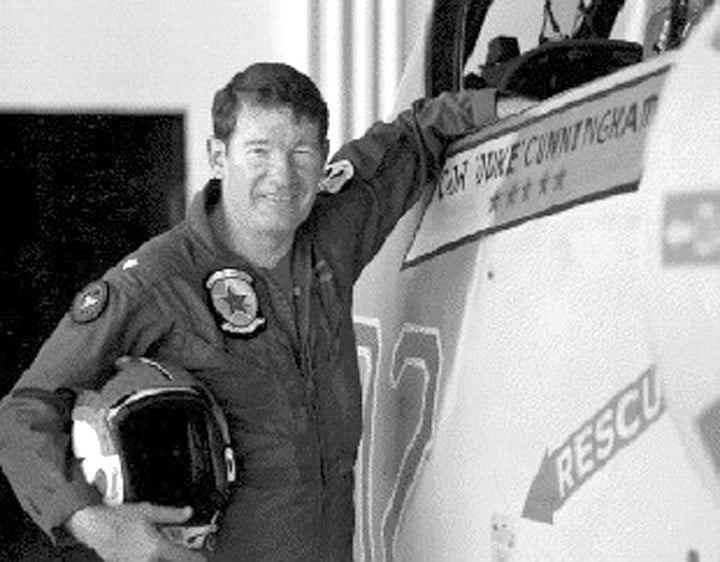
Cunningham. I asked him the same question that had stunned him that night on the Constellation. His face drained, and he sat back down, elbows on his knees. "The first kill I had was against the MiG-21, and I could see the guy in the airplane when I went over him, as he died."
Though President Nixon hadn't yet ordered the resumption of heavy bombing in the north, the B-52s that were hitting Laos had had increasing numbers of MiG interceptors to contend with, and the Navy was being sent in to assess the MiG strength at Quan Lang. But as everyone knew, they were really being sent in to destroy the airfield under the pretense of taking pictures of it. The rules of engagement at that time wouldn't allow bombs to be dropped or MiGs to be fired upon over North Vietnam unless the American planes were attacked first.
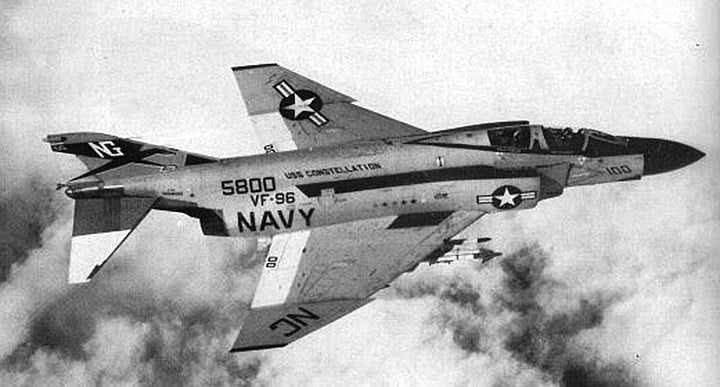
Navy F-4. By December of 1972, the last month of any significant action over North Vietnam by American pilots, the Navy had shot down 24 MiGs in air-to-air combat, while losing only 2 fighters to MiGs.
The catapult officer signaled for full afterburner, and Cunningham shoved his throttle forward, dumping fuel into his tailpipes and igniting it for extra thrust. In response to the catapult officer's salute, Cunningham flipped him the finger, in the irreverent tradition of fighter pilots. He and Driscoll and everybody else in the group knew that they'd be taking surface-to-air missiles (SAMs) and anti-aircraft artillery (AAA) fire and, in the cockeyed jargon of the war, they'd be retaliating with a "protective reaction strike." With orange flames roaring out of the Phantom's tailpipes, the hold-back cable was released, and in two seconds Cunningham and Driscoll were accelerating past 168 knots and climbing.
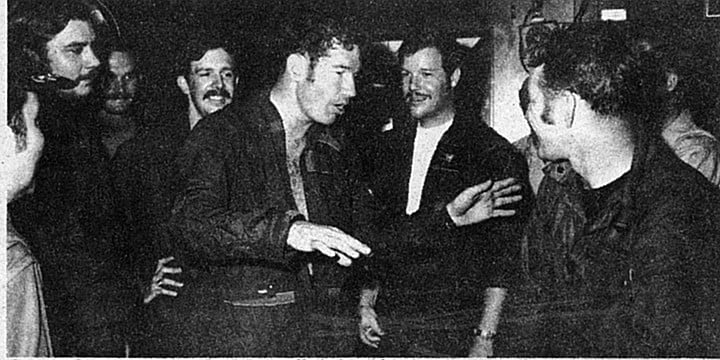
Cunningham (gesturing) and Driscoll (behind him) recounting the Col. Tomb battle, U.S.S. Constellation, May 10, 1972
After about 30 minutes the formation of 35 aircraft was vectoring in on the airfield. SAMs and the AAA started coming up when the formation was 15 miles from target. The planes regrouped into sections to attack from three separate directions, and Cunningham and his wingman in the other Phantom, Brian Grant, had what they considered a fighter's dream job; they screamed in low over the field to search for MiGs taking off. There were none. Then, as the thousand-pound bombs started falling from the A-7 Corsairs, the two F-4s took up a position north of the action, to try to intercept any MiGs coming down from other airfields.
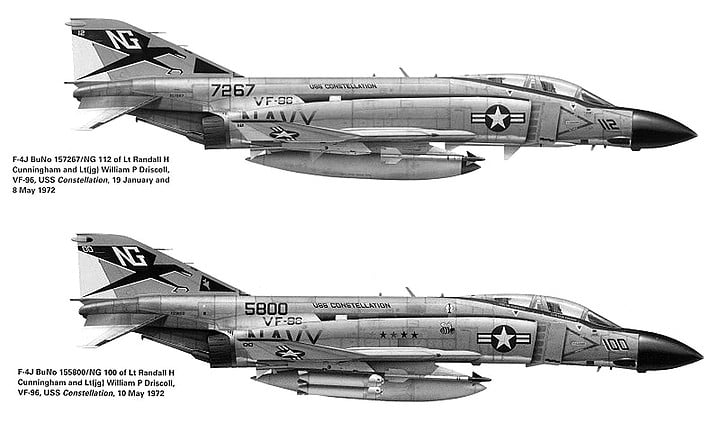
F-4s flown by Cunningham and Driscoll. On Jan. 19, 1972 Cunningham and Driscoll spotted the glint of two MiG-21s in afterburner, about four miles away.
But Cunningham and Grant got separated when they realized they'd been pincered between two SAM sites that eventually fired off 18 of the "flying telephone poles" at them. As Cunningham's electronic warning gear indicated a locked-on SAM, he called to his wingman, "Brian, you're on your own!" and then broke hard down to the right. The missile followed. He then pulled up into an eight-G climb, but the missile couldn't make the same turn, and it exploded far below him.
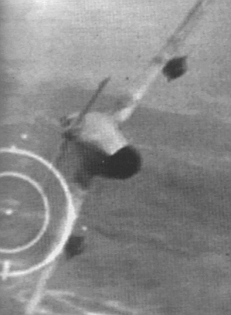
The MiG tactics were usually designed to effect a fast approach on a bomber group, preferably from below.
The climb had bled off precious speed, so as more SAMs started up, Cunningham nosed over at 15,000 feet, jammed the throttle full forward to go into afterburner, and headed straight down. To the north he and Driscoll spotted the glint of two MiG-21s in afterburner, about four miles away. It had been 22 months since a MiG had been shot down, and few had even been encountered during that time, so with relish Cunningham accelerated to 650 knots and pulled in behind them. The leader was about 500 feet above a canyon, and his wingman was back and to the right a little higher. Cunningham broadcast his squadron's call sign and the code for MiG-21s: "Showtime! Bandits, blue bandits, north of the field!"
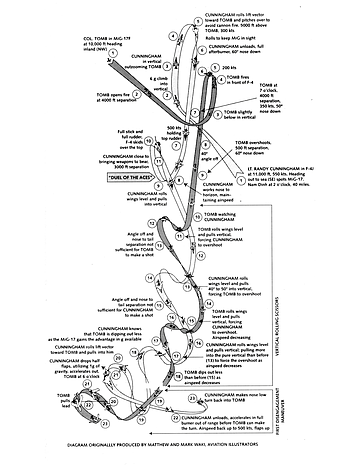
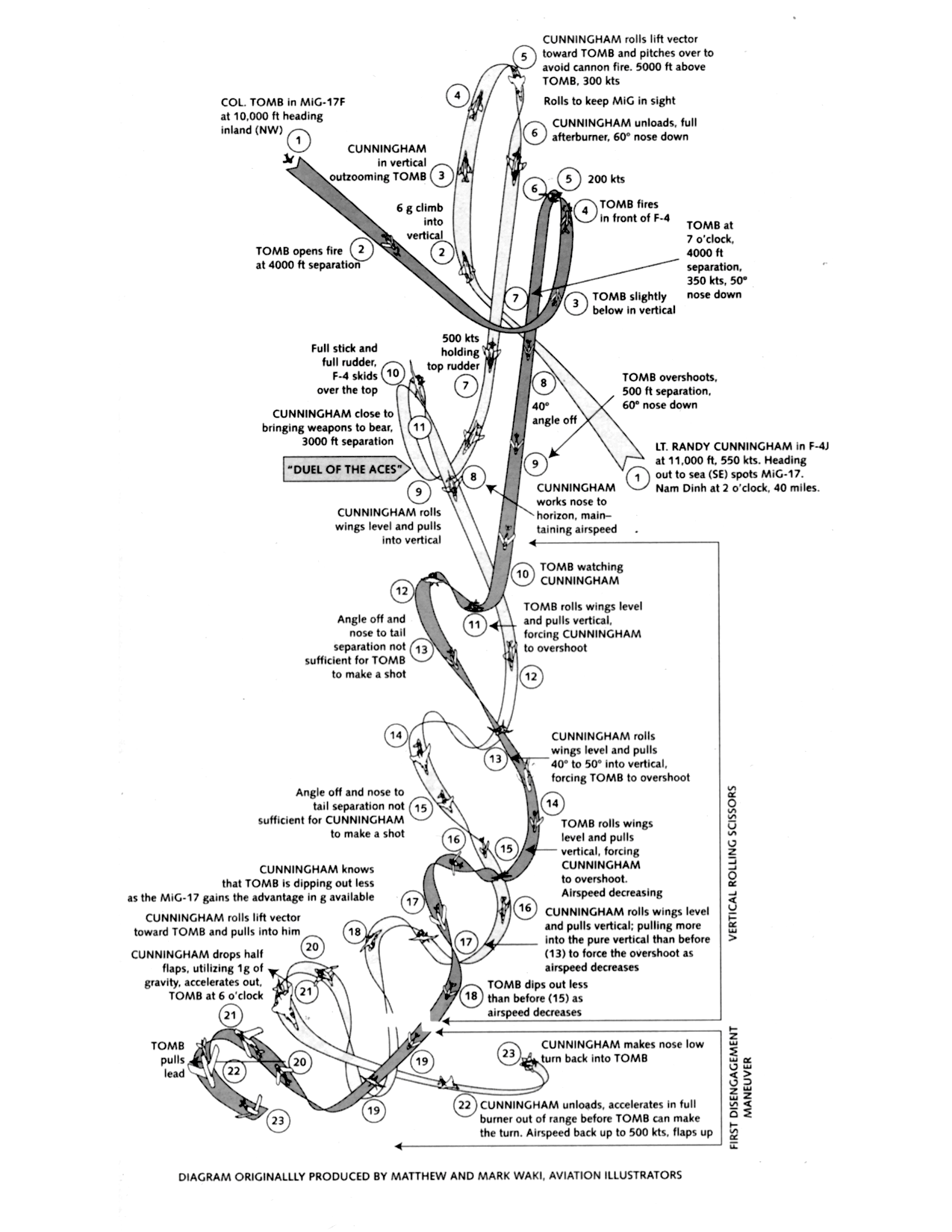
Cunningham-Col. Tomb dogfight. Click medium-sized version. Then click on resulting medium-size image to get full size.
Barely 200 feet off the ground and going 650 knots, Cunningham and Driscoll lined up on the leader and got a radar fix for their Sparrow missiles. Driscoll called, "He's locked up on radar, in range, shoot, shoot, shoot!" But at the last second Cunningham reached up to the instrument panel and pushed a toggle switch down from "radar" to "heat," opting for the heat-seeking Sidewinder rather than the radar-guided Sparrow. In training, Cunningham had had bad luck with the Sparrow; at low altitudes, radar noise often interfered with the missile's guidance system, and throughout the entire war the missile would attain a kill factor of only about 7 percent. So with the Sidewinder selected, and the MiG in afterburner, Cunningham got the strong aural tone in his earphones that indicated the heat-seeker was locked on to target. He squeezed the red trigger on the handle of his joystick and called, "Fox two," the code for firing a Sidewinder. But just then the MiG dodged hard to the right, curling into a high-G turn, one too tight for the missile to follow. Still at tree-top level, Cunningham did a barrel roll and followed the more maneuverable MiG, which was losing speed. He glanced away long enough to see the MiG's wingman abandoning his leader. The F-4 was upside-down at 600 knots, and as Cunningham executed a quick aileron roll and came right-side up, he was just 40 degrees off dead center of the MiG's tail and closing. He got a good aural tone just as the delta-wing MiG began to level off, and he squeezed the trigger while calling, "Fox two." The missile flew up the MiG's tailpipe just as the wings leveled. It exploded into pieces and, as the Phantom zoomed over the flaming debris, Cunningham caught a quick glimpse of the cockpit section. Through the MiG's canopy the pilot was clearly convulsed with horror before tumbling into the ground.
Driscoll let out the war whoop that inaugurated a year of feast for naval aviators. By December of 1972, the last month of any significant action over North Vietnam by American pilots, the Navy had shot down 24 MiGs in air-to-air combat, while losing only 2 fighters to MiGs. But the tumultuous reception given Cunningham and Driscoll when they landed on the Constellation that January afternoon was just a little sweeter than those that followed for each succeeding "MiG killer" on all five aircraft carriers in Task Force 77. Cunningham and Driscoll — and by extension, the 5000-man crew — had gotten the first MiG in the second part of what came to be known as two separate air wars over North Vietnam. The first of those two wars had run from the summer of 1965 to the fall of 1968, and both the Navy and the Air Force matched up poorly against the MiGs. (The Navy lost 7 fighters in aerial combat during that period and shot down just over 30 MiGs; many more Navy planes were lost to SAMs.) This second part of the air war, everyone now supposed, was going to be different.
That night aboard the Connie all the squadron commanders organized a party to celebrate Cunningham's and Driscoll's victory. Cunningham was having a fine time retelling the story, using his hands — right for the MiG, left for the Phantom — and recounting the fight. Then a pilot asked innocently, "What's it feel like to kill another human being?" The question struck to the bone. Cunningham didn't answer; immediately he returned to his room. As he relates in Fox Two, his recently published book about his Vietnam experiences, "As I interrogated myself, a sickening feeling dug at my stomach. Dropping bombs for a year had not bothered me. Everything was so far removed when the 500-pounders went off in the jungle below, almost like bombing practice in the desert. But this was different. I observed another human being die because of me. I watched his twisted machine disintegrate, taking him to a horrible death, but at the time I guess my defense mechanisms allowed me to put it out of my mind. Now, after the excitement had died down, I was confronted with it point-blank as I tried to make excuses for myself, saying it was in the line of duty...."
Cunningham visited the chaplain that night, confessing his feelings of doubt only after receiving assurances that the conversation would remain confidential. But the next day he was confronted by his squadron skipper, who'd received a full briefing from the chaplain. Cunningham found himself insisting that if the situation arose again, he could definitely pull the trigger without hesitation, and in the next four months he proved good to his word. He and Bill Driscoll went on to notch a total of five confirmed enemy kills and to earn the unofficial designation of "aces"; in fact, they became the only Navy aces of the Vietnam War.
On a soft couch in his home in Mira Mesa, not far from Naval Air Station Miramar where he's stationed, Commander Randy "Duke" Cunningham is being cuddled by his five-year-old daughter, April. One of two daughters from his second marriage, she presses against the wide cluster of decorations on his chest and, wrapping her arms around his ruddy, mobile, beaming face, flattens the ribbons that signify Cunningham's status as the most highly decorated Navy pilot of the Vietnam War. Beneath her rest the Navy Cross, 2 Silver Stars, 15 Air Medals, various commendation medals, a Purple Heart, and the South Vietnamese Medal of Honor and Cross of Gallantry. "Okay honey, why don't you let Daddy have some privacy." But as April untangles herself from him and happily starts away, he grabs her. "Don't think Daddy doesn't love you, honey. Nothing I ask of you would ever be because I didn't love you." He stares tenderly into her face for a moment, solicitous in that unique way of fathers who have killed in war. I'd seen such intense expressions of affection from another decorated aviator once, someone I hadn't thought about for years. He was the father of one of my elementary school friends, and he'd been a bomber pilot in World War II. Jimmy Johnson had been telling me his father's war stories for months; he'd even dug out some of the medals and ribbons stashed under a bench. Then one day his father was home and Jimmy asked him to tell us about the time he parachuted out of his damaged bomber. Mr. Johnson had grabbed his son the same way Cunningham now grabbed his daughter. "It's nothing to be proud of," he'd said softly, staring hard at my friend. "It's nothing to be proud of." Then he hugged his son in a way I didn't see again until that afternoon in Cunningham's house.
During our conversation, just after Cunningham had enthusiastically recounted a long dogfight he'd won against the infamous North Vietnamese ace known to the Americans as "Colonel Tomb," I asked him the same question that had stunned him that night on the Constellation. His face drained, and he sat back down, elbows on his knees. "The first kill I had was against the MiG-21, and I could see the guy in the airplane when I went over him, as he died. I could see him almost thrashing around in the cockpit. The explosion had severed his tail, and the rest of the plane tumbled end over end. He couldn't punch out. Now that -- if I close my eyes, mentally I can still see that. And I dream about it once in a while. Equate it to -- if you were a Marine on the ground, and you saw someone way up on a mountain, and you shot him and you just saw something drop. It probably wouldn't bother you as much as going up to that same individual and, looking him in the eye, you stick a knife in him.... Now if I hadn't ever seen this guy, this flash in the cockpit, it probably wouldn't have bothered me. I knew I could do it again, it just bothered me a little more than I thought it would, knowing I had taken another human life."
Cunningham had killed a lot of people with bombs, from afar. I asked him if the act of killing bothered him less each time. "No. But I think mentally you can do anything on this earth that you really set your mind to. And what I'd do, if I'd start to think about it, I'd try to change my mind, my thought processes. I wouldn't allow myself to dwell on it."
The MiG killers, as they refer to themselves, were the only Navy aviators who dealt death at close quarters, and Cunningham is one of the few still in the Navy. Historically, the fighter aces from any war (there were more than 300 Navy aces in WWII) almost never make it to the top of the military structure. Cunningham's boss, Commander Nick Criss, the commanding officer of fighter squadron VF-126, who talks as rapidly as Cunningham talks slowly, explains: "The personality type that does well in combat is probably a little less manageable than the kind of guy who goes along with all the wickets all the way. It takes the kind of guy to throw himself in there to get those kills. You can't be timid at all. But when peace breaks out, all these little bureaucrats who've been hiding under the rocks resurface...and start reestablishing all the rules that everybody was violating for years and years during the war. And the kind of personality that can kill MiGs runs right smack against that.... And I know almost all the MiG killers, to a man, ran into big trouble after the war was over."
Curt Dose, who along with his radar intercept officer Jim McDivitt shot down a MiG on May 10, 1972, the same day Cunningham and Driscoll got their last three MiGs and became aces, now runs a local retail computer store. "It's true," says Dose, in agreement with Nick Criss. "We were flying a hundred hours a month during the war, and when we came back [after the war], we were flying only eight or ten hours a month in F-14s, which is just about enough to scare you to death every time you go up."
Cunningham also had his share of postwar troubles with the resurfaced Navy bureaucracy, but back in the spring of 1972, as the air war intensified over North Vietnam, those future difficulties were inconceivable to the 30-year-old warrior.
Fighter pilots have a saying about aerial combat tactics in this supersonic age: The circles are bigger but the geometry is the same. Which means that once two planes are locked in close combat, the only dictum from World War I that doesn't still apply is the one about making sure that you take off your spurs before strapping into the cockpit. But on May 8, 1972, as the bombs rained down in sheets over North Vietnam, Cunningham and Driscoll learned that sometimes even the circles aren't all that much bigger than they used to be.
For several days now, MiGs had been coming up to hassle the bombers that were trying to blunt a massive North Vietnamese offensive. The MiG tactics were usually designed to effect a fast approach on a bomber group, preferably from below, then to shoot a missile or strafe the bombers with cannon fire before withdrawing. For nearly four months, since Cunningham and Driscoll had got their first MiG, no others had been shot down. Then, on May 6, four MiGs were shot down by four Navy Phantoms. The MiG pilots were starting to engage in aerial combat, and on May 8, just as Cunningham and his wingman Brian Grant had separated to form combat spread (about a mile abeam of each other), Cunningham saw a MiG-17 come screaming up through the cloud layer and begin firing its cannons at Grant's Phantom. Cunningham radioed for Grant to drop the extra fuel tank attached to the Phantom's belly in order to accelerate and outrun the MiG. The tank fell away and Grant gave full throttle.
"Brian, I'm high at your nine o'clock," called Cunningham. "Don't push negative Gs or you'll fly through his BBs." Until this point in the war, American pilots had been told that the MiG-17s only had two cannons under the belly and one under the nose. And the MiG-17, unlike the MiG-21, wasn't supposed to carry the Atoll heat-seeking missile. But as Cunningham tried to maneuver in behind the MiG that was now on the tail of his wingman, he saw the flash of an Atoll being fired.
"Brian, Atoll! Break port!"
The Phantom turned hard; the missile couldn't follow. But the MiG cut across the circle of Grant's turn and kept firing its cannon. Cunningham was still trying to get behind the MiG when he heard the voice of Driscoll, his radar intercept officer, come over his earphones. "Duke, look up!" Two more MiG-17s. Cunningham saw them pass just over his canopy going the opposite direction, but he figured that by the time they got turned around, the MiG on Grant's tail would be a goner. Though his aural tone didn't indicate a lock-on, Cunningham fired a Sidewinder anyway. It missed, but it was enough to make the MiG break off and run. But just as Cunningham started to follow it, Driscoll spotted the two MiGs already turned around and shooting their cannons. Suddenly, for Cunningham and Driscoll, the circle was deadly small. Driscoll had seen the two planes (which had been only about 4000 feet apart when they passed the Phantom) bank toward each other and complete their turns without their flight paths overlapping -- a maneuver the Phantoms could never have duplicated.
Cunningham locked in on the running MiG, and his Sidewinder shot was perfect. The MiG exploded. But in an instant his emotions changed from rage to stark fear. Two other MiGs were now on his tail and sending tracer bullets past his canopy. Cunningham pulled hard to port in an effort to draw the MiGs in front of his wingman Grant, and for a brief instant he got a good look at the North Vietnamese pilot. The American aviators called their adversaries "Gomers," after the hapless TV character Gomer Pyle. Cunningham says he saw the pilot "...with his beady little Gomer eyes, Gomer hat, Gomer goggles, and Gomer scarf." Every maneuver he tried was matched. The G-suit around his belly and thighs expanded and forced the blood to stay up in his chest and brain as he rolled over into a nose-low, 12-G turn, popping rivets and breaking flap hinges on the overstressed jet. But the MiGs stayed with him. Finally, as a last resort he dropped down into the clouds, lit the afterburner, and radioed Grant he'd come out heading into the sun. He angled back up into the clear and Grant was behind him and, as the MiGs popped up, the wingman fell in behind them. Immediately the MiGs dipped back down into the cloud cover. Grant lost them. They disappeared.
Duke Cunningham took his nickname from his idol, John Wayne. But he assumed "Duke" only after his second MiG kill; prior to that, Cunningham had been known as "Yank." Knowing that the North Vietnamese monitored American radio transmissions, Cunningham's superiors figured that "Yank" was recognized as having shot down two MiGs. It would be prudent for him to change his name. Duke was a natural alternative.
Cunningham was born in Los Angeles, but had been raised since the age of 12 in the tiny farming community of Shelbina, Missouri. He describes the area as "about as redneck as you could get." After graduating with a physical education degree from the University of Missouri in 1964, Cunningham got his master's in education and went on to become a successful high school and college swimming coach. Yet he'd always wanted to fly, and come 1967, the redneck in him knew just what to do. At the relatively ripe age of 25, he applied for the necessary waiver and was accepted into the Navy.
The pilots in year group '67 found themselves in crowded quarters. The Navy had been losing a lot of planes and people over North Vietnam, and it needed replacements. For this reason, in 1967 it trained 1800 pilots, nearly double what it had been training, and triple what it is now training. "It's a strange year group," says 38-year-old Nick Criss, who is the same rank as Cunningham but four years younger and his commanding officer. "Sixty-seven was the worst year for Navy attrition over Vietnam, but we were the most gung-ho class they'd had in years. We wanted to go to war.... The Navy had projected the loss rates out and figured that if we kept losing pilots like we had been, we needed to train twice as many. But then as soon as they got us in the pipeline, Johnson knocked off the air war up north and we didn't have any attrition; so all these guys lived, basically."
The competition for advancement within year group '67 was fierce for many years after the war because it was so crowded. But that crowding wasn't all a result of President Johnson's 1968 bombing halt. When the air war resumed in 1972, the Navy's attrition level was still far below what it had been. And much of the credit for this goes to a Navy captain named Frank Ault.
In the mid-'60s the Navy turned to Ault, an aviator, and assigned him the task of finding out why the Navy was losing so many aircraft over Vietnam. Ault knew he would never make admiral, so there was no need to be politic. He laid the truth bare: Navy pilots were being trained to see dog-fighting as passé.
F-4 fighter crews now thought of themselves as interceptors, trained to shoot down bombers while flying straight and level at .9 mach. The age of the dogfight, according to the military's theorists and contractors, ended in Korea. In the late '50s and early '60s, the Navy as well as the Air Force had begun placing emphasis on the use of tactical nuclear weapons, to the exclusion of conventional warfare. That was why, Ault explained, the Navy's F-4 Phantom was built to drop bombs and fire missiles and had no mounted guns of any type. That was also why the aircraft carrier Kitty Hawk, commissioned in April of 1961, found itself with too little storage space for conventional bombs and missiles when it went to Vietnam.
The Ault report precipitated a revitalized program of Naval fighter training. Out of it came improved missiles and the realization that dogfighting was, in fact, an important part of any air war. The establishment of Top Gun, the Naval Fighter Weapons School at Miramar, and the idea that aerial-combat maneuvering should be practiced against dissimilar aircraft whose flight characteristics closely resembled those of MiGs, completely transformed Naval-fighter-training philosophies. By the time Cunningham's squadron went on its combat cruise in 1969, the pilots and their radar intercept officers had practiced aerial combat against Air Force F-106 Delta Darts and Navy A-4 Skyhawks, and some of them had gone through Top Gun's intensive six-week course. Though the Navy Phantoms were at a disadvantage because they didn't have guns and were required to carry an extra 5000 pounds of fuel to cover the long distances between the carrier (which was 60 or 70 miles offshore) and the target, the fighter pilots were confident that year group '67 was going to stay overcrowded.
About the same time in May that Cunningham and Driscoll were shooting down their second MiG, a letter arrived aboard the Constellation from Cunningham's wife. She'd been seeing another man and decided the marriage was hopeless. A couple of days later, as he taxied the Phantom onto the catapult, his ebbing marriage was just one more thing for Cunningham to put out of his mind. His jet was loaded with two Sparrows, four Sidewinders, and six Rockeye cluster bombs. The mission was a large-scale strike against the rail yards in the port city of Haiphong. It was May 10, 1972, and already that day one MiG had been shot down by Lt. Curt Dose of Cunningham's sister squadron. It was a day in which the Navy would shoot down eight MiGs altogether, the Air Force would get three, and Cunningham and Driscoll would return to the ship as aces and nominees for the Medal of Honor. As the airplane lurched from the deck and started its climb, Cunningham had no difficulty making sure that the farthest thing from his mind was his wife and son.
It was his 300th combat mission and, as he eased up to a tanker to take on fuel before slipping into formation with 39 other planes, Cunningham couldn't have known it would be his last. Fifteen minutes later they were flying over the lush delta of the Red River, and Driscoll was saying what a shame it was that such a beautiful country had to be bombed. The A-6s and A-7s quickly destroyed the primary target, so Cunningham, Driscoll, their wingman, Brian Grant, and his radar intercept officer, Jerry "Sea Cow" Sullivan, were ordered to attack a large supply area beside the rail yard. The two Phantoms pulled closely together into fighting wing, rolled over, and streaked low toward a long brick building, over which they released their bombs.
Cunningham was looking back at the damage they'd wrought when Grant suddenly yelled that two MiG-17s were on Cunningham's tail and shooting. Cunningham swung left and saw the muzzle flashes of a MiG's cannon, noting that the MiG was traveling at great speed. Knowing that most of the MiGs didn't have hydraulic-assisted controls so that at high speed it was very difficult for the North Vietnamese pilots to move their control sticks, Cunningham darted hard into the MiG. This tactic was usually ill advised, but sure enough, the pilot couldn't readjust his course; the MiG shot over the Phantom, and Cunningham turned and lined it up. The Sidewinder performed its fatal function, and the MiG plummeted to earth in pieces.
By this time -- only 15 seconds after the Americans had dropped their bombs -- two more MiGs had fastened on to Grant's tail. Both he and Cunningham performed disengagement maneuvers and ended up in the clear. They then went vertical, pitched over at 15,000 feet, and headed back for more. Another MiG was shot down by a squadron-mate, its North Vietnamese pilot ejecting as his "flying gas tank" exploded in flames. Eight MiG-17s below them now took up a formation known as a "defensive wheel." (This tactic ensures that if an aggressor is foolish enough to fly into the formation there will always be a MiG on his tail.) Yet to the amazement of Cunningham and Grant, three Phantoms were mingled into the wheel, including their executive officer. All three were flying slowly, about 350 knots, right where the MiGs wanted them. Grant flew cover while Cunningham rolled in behind the MiGs that surrounded the executive officer, who was turning left. There was a MiG-17 a half-mile behind the officer's Phantom, a MiG-21 a little farther back, and another MiG-17 below, flying wing. The real threat came from the MiG below, which the officer apparently didn't see and which Cunningham thought was about to turn and open up with its cannon. But if Cunningham fired a Sidewinder, it might have tracked into the Phantom, so he radioed for the executive officer to jerk hard to the right, out of the missile's path. But the Phantom kept on the same heading.
Just then Driscoll warned of two MiG-17s coming up directly behind, and two MiG-19s dropping down on them from above, cannons blasting. Cunningham reversed direction momentarily and the 19s passed below him. Going now at about 550 knots, he stayed out of range of the MiG-17s at his rear. Finally the executive officer broke right, and Cunningham fired a Sidewinder at the MiG that had been flying wing on him. The radio intercept officer in the executive officer's Phantom looked over and saw that MiG for the first time just as it exploded and the pilot ejected. Cunningham had to dodge the parachute as he streaked by.
Just then, as their second MiG of the day went down, four MiG-21s rolled in from above toward Cunningham and Driscoll. Cunningham turned, putting them perpendicular to his flight path and making himself a difficult target. He saw one of his squadron pilots get his own second MiG of the day (the squadron bagged six in all) as Cunningham headed the Phantom east toward home. It had been about two minutes since they'd dropped their bombs near the rail yard.
In those few quick instants, Cunningham had been an emotional pinball, with each one of a succession of feelings sharpened. He described it later as feeling as though he were schizophrenic with seven different personalities, each vying for supremacy at the same time. "You've got adrenaline, love, fear, hate -- all these things going through your system. And it's cyclic. For a second it's anger, your fangs are out and it's kill -- blood rage kill. And then all of a sudden you see somebody coming for you and it's a flash of fear -- but you can't let it enter in -- and then it's react.... After all this is over, it is such a tremendous rush, a tremendous relief.... And then bang! Here comes somebody else after you."
Bang! Racing back toward the North Vietnamese coast, Cunningham and Driscoll spotted a MiG-17 headed straight at them. In the cockpit (they found out later via intelligence channels) was the infamous "Colonel Tomb," the leading North Vietnamese ace who had shot down 13 American planes.
[Editor's note: According to several sources, Colonel Tomb, also called Colonel Toon, was a myth. Some attribute him to American pilots' imagination. Wikipedia says: "In the years following the war, American military officers visiting Vietnam have intimated that some of their hosts admitted that Toon/Tomb was a long-standing, successful fabrication."] For a head-on situation, the Phantoms had trained to pass as closely as possible to the tighter-turning plane in order to give it the least amount of advantage in competing for tail position. But as the jets passed each other, Cunningham had to maneuver away from the tracers spewing out of the nose cannon of the MiG. He pulled straight up, thinking that the MiG would either keep running or go into a horizontal turn. But Cunningham and Driscoll were shocked to see that the MiG had pulled up into the vertical with them, and the two planes were canopy-to-canopy about 100 yards apart. It was the initial move in an extraordinarily long and complex aerial chess match; in the four and one-half minutes it took to survive it (most dogfights last less than 30 seconds), every detail engraved itself on his memory. "I could see a Gomer leather helmet, Gomer goggles, Gomer scarf...and his intent Gomer expression," Cunningham writes in his book about the air war. "I began to feel numb. My stomach grabbed at me in knots. There was no fear in this guy's eyes as we zoomed some 8000 feet straight up."
Cunningham thrust the throttle into afterburner and started to out-climb the MiG ace. This was a mistake. As he came over the top of the climb, the still-vertical MiG lined him up in his sights, and Cunningham had to roll away quickly to the side. Again the MiG pulled in right behind him.
Cunningham accelerated downward and when the MiG followed, he pulled up sharply, rolled, and then settled in above and behind the descending MiG. But he was too close and at an improper angle for a Sidewinder shot. As he pressed over and down, the MiG pulled the same maneuver as Cunningham. It rose, letting the Phantom overshoot, rolled over and dropped to the rear. As the MiG nosed over, Cunningham pulled up and turned sharply, accelerating to 600 knots and running out of range. But the MiG cut across Cunningham's circle. Cunningham then leveled his wings and pulled up into the vertical again. The MiG followed. Once more the two of them were canopy-to-canopy until the Phantom pulled ahead and arced over the climbing MiG, which began firing its cannon. They dropped back down and repeated the same series of maneuvers, trading the advantage back and forth, while Driscoll squirmed all over the backseat, trying to keep watch on the wily MiG.
For the third time the two fighters met head-on, and out of this engagement Cunningham drew his primary dictum of fighter tactics: cheat. He let the MiG start to pull into the vertical again, but instead of climbing with him, Cunningham threw out his speed brakes, dropped his flaps, and went to full idle on the throttle. The MiG shot up, and Cunningham pulled up right behind him, adjusting the stick and throttle with feather precision as the Phantom inched toward a stall. He pushed into afterburner and as both planes tottered vertically, Colonel Tomb realized his predicament and began his attempts to roll quickly out of the climb. But the MiG stalled, its nose fell, and after pitching over, it began to run. Cunningham rolled out behind, and as they both headed straight down he squeezed off a Sidewinder that zipped directly up Tomb's tailpipe. The plane dove into the ground and exploded.
As Cunningham pulled up, four MiG-17s were behind him, but another squadron pilot fired a missile toward them and they scattered. Three more MiGs streaked by but didn't give chase, and the two Phantoms lit their afterburners and headed east toward the Gulf of Tonkin. Halfway to the coast a SAM raced up and exploded beside Cunningham and Driscoll, and less than a minute later their airplane started yawing hard to the left. The hydraulics were failing, locking the tail stabilizer and forcing the nose up. For 20 miles Cunningham used a combination of rudder, afterburner, and speed brakes to roll the airplane through a wallowing descent. The fear of ejecting over the heavily populated Red River Valley and of becoming prisoners of war kept Cunningham and Driscoll in the plane until it began tumbling and burning just over the coast. F-4s and A-7s were circling all around, their pilots screaming at them to eject. Cunningham deployed the drag chute to try to stabilize the plane but to no effect. The pilot gave the word, and Driscoll reached down and pulled the ejection handle between his knees.
Seconds expanded into minutes for Cunningham. He heard Driscoll's canopy blow away and felt the wind rush. He glanced back, and it seemed as if minutes passed before Driscoll's seat rocketed out of the jet. The ejection sequence handle was set so that Cunningham's seat would eject automatically two seconds after Driscoll's. All Cunningham had to do was straighten his back, keep his head up, and make sure his legs were extended. But so much time seemed to pass...his seat wasn't going to go! Finally, in desperation, he started to reach for the ejection handle when boom! His canopy blew off and he was tumbling in his seat through the air. The wind blast filled his black helmet. The drogue chutes tugged the seat into stability. At about 14,000 feet the parachute began snaking out from behind his head, and then its opening shock jerked him away from the seat. Looking up into the web of lines and the orange-and-white striped nylon, Cunningham felt an instant of relief followed by successive blasts of fear, love, and gratitude.
U.S. fighters and attack planes roared in over the North Vietnamese patrol boats heading out of the river delta to intercept the two airmen. On his survival radio Cunningham heard that the rescue chopper was on its way. The Dear John letter and thoughts of his wife washed over him now, as he floated high over the gulf. They always told you that the two things you needed to survive in captivity were a strong family and faith in God. Cunningham had neither. He had just killed two men. He was drained, more scared than he'd ever been in his life, and he felt small and unloved. He resolved under that parachute to find God and to try to salvage his marriage. He succeeded in the former, but the latter was already too far gone.
The home front was increasingly hostile toward the military, and the Navy needed heroes. Almost as soon as the first aces of the war stepped out of the rescue helicopter aboard the Connie, Cunningham and Driscoll were whisked away to the States and sent on a PR tour of the country. They appeared on almost every local and national radio and television talk show, were interviewed by the newspapers, and gave talks to various groups almost every day. They were always careful to point out that their success was a matter of circumstance, and that all 5000 men aboard the Constellation deserved the credit. It was a nonstop parade that the bachelor Driscoll enjoyed, but for Cunningham, who was in the process of a divorce and a losing child-custody battle, it was one of the lowest points of his life. "I almost became an alcoholic," he says, sitting at his desk in his small office at Miramar. "I'd wake up at 6:30 in the morning and have a Bloody Mary pushed at me. I wouldn't quit until 2:00 a.m. the next night, with the parties and the talks and the Rotary Clubs and the Ladies Aid Societies and the Navy Leagues. It was tough.
"The Navy used me as much as they could. When Admiral Cooper [commander of the carrier task force] told me I had to go back to the States, I told him no, the MiGs had just started to fly and I didn't want to leave. His quote to me was, 'If the North Vietnamese captured you, then they'd use you for propaganda. The Navy plans to use you. It's a very unpopular war, the Navy's had a lot of bad press, things are in turmoil back in the U.S. We need you for public relations.' "
About halfway through the tour Cunningham and Driscoll learned that their nomination for the Medal of Honor had been denied, and they were getting the Navy Cross instead. They'd been nominated for the act of shooting the MiG off their executive officer's wing while being chased by several other enemy planes. At the end of the tour both men were awarded the duty assignment of their choice: Top Gun, the Naval Fighter Weapons School.
Cunningham and Driscoll were two of the more visible Navy heroes, but the other 80-some MiG killers were also lionized as the war ended. "Even getting a single MiG was blown out of proportion," says Curt Dose, who got the first one on that momentous day in May. "The Navy needed heroes, so we ended up with a chestful of medals." In some cases, particularly Cunningham's and Driscoll's, the MiG killers were far more decorated and well known than their commanding officers. This may have contributed to problems Cunningham encountered with one of his first commanding officers after the war.
Cunningham admits that he wasn't a sterling officer in the early days. "My idea of a Navy officer was a shit-hot pilot who shot down airplanes and to hell with the paperwork," he says now, a bit regretfully. Part of Cunningham's attitude was attributable to the way things worked in the war: pilots were told that the chiefs ran the Navy, and since the pilots themselves might or might not return from a combat mission, the running of the squadron could not depend in any way upon them. This tended to make the pilots indifferent to those duties that didn't concern actually strapping on an airplane.
Cunningham's fitness reports, which had been generally high, started looking bad. "It was just a complete ego clash with that skipper," he says now. The Top Gun commanding officer was himself a MiG killer. "He had a super ego," Cunningham recalls. "For example, I was invited downtown here as a guest speaker at a banquet, and being my skipper, they invited him to come along. They had me seated at the head table. They had him seated out in the audience. And he came up to me and he said, 'I'm your skipper, I will sit at the head table, you will sit in the audience.' The guy running the show wouldn't let us switch. Another example: the Germans were here training up at George Air Force Base from the Richthofen Wing. Colonel Bosch and about 30 other people. They came down and asked me to go over to Germany to give a talk to the whole Richthofen Wing. They sent messages, letters, requesting me by name. Guess who went. Not me. Another example: I was in the upper 5 percent in fitness reports under other skippers. And when he took over Top Gun, I was suddenly the bottom lieutenant in fitness reports."
If Cunningham's military career suffered during that time, the detriment wasn't long-lived, because in 1975, just after he remarried, he survived what came to be known in his year group as the "Thanksgiving Day Massacre." He was promoted to lieutenant commander, but half the people remaining in year group '67 were not, and were therefore funneled out of the Navy. Not only was the crowded year group being winnowed down to manageable size by Navy planners but there was also a large cutback in the Navy itself. When year group '67 was formed, the Navy had more than 20 aircraft carriers and air wings in operation. Today there are only 13 carriers and air wings; the competition for advancement has become brutal.
So when Cunningham successfully "screened for command" on his third and final try in 1983, it meant the Navy saw possibilities in him beyond his flying years. Bill Driscoll decided to get out and go to work selling office buildings for Coldwell Banker in Carlsbad. He and Cunningham remain close, and Driscoll still gives lectures in aerial combat to Top Gun students. "As a teacher and instructor, I felt I'd done what I needed to do for the Navy after the war," Driscoll says. "I was looking to challenge myself again, with something new and different.... You have to put making ace in context. Were we better than the other guys in the squadron? No. Were we lucky? Yes. You have to put it in context and then go forward. You have to make sure that it's not the pinnacle of your life."
Will being the only remaining ace from the Vietnam War help Cunningham's career? "The Navy has a very short memory," says Nick Criss, Cunningham's commanding officer.
"If you have all the boxes checked, all the tickets punched, and make all the sacrifices, it could be a definite plus," Cunningham adds. "But that happened 12 years ago, and you can't glide for 12 years on history. They need you to perform. If I was a shitty officer now and a shitty pilot, doing what I'd done wouldn't amount to a hill of beans."
Cunningham, who is 42 years old, now makes about $50,000 a year. He seems to have punched all the tickets along the way: war hero, Top Gun instructor, deploying squadron operations officer, Pentagon billet, seventh fleet staff billet, advanced education degrees, screened for command, executive officer of training squadron, charming second wife. He'll take over as commanding officer of squadron VF-126 in July of 1985, and he says that he'd next like to command either Top Gun or the Blue Angels. After that his real flying days will be over, and in order to advance he'll then have to become either a carrier air wing commander who would be in charge of several fighter and attack squadrons (there are six such commanders on the West Coast), or a department head on an aircraft carrier. Both of those jobs can eventually lead to the career pilot's Valhalla: command of an aircraft carrier. From there, the only place left is the Pentagon.
But first Cunningham must distinguish himself in VF-126. This is a training squadron that flies small A-4s and F-5s in an adversarial training role against the fleet's F-14s and F-18s (the F-4 Phantom was phased out in the mid-1970s), and for a jet jockey there's hardly any better assignment. VF-126 pilots are trained to simulate Soviet air tactics and instruct all fighter squadron crews in aerial combat. Fresh young pilots coming out of regular flight training have to go through VF-126 before assignment into the fleet, and all squadron aircrews between deployments must complete the monthlong course. The practical information is similar to that given in Top Gun, located in an adjacent hangar, but the academics aren't nearly so comprehensive as Top Gun's. At Top Gun only one or two flight crews from each squadron go through the course, which concentrates not only on actual airtime but also on the nature of the threat being faced by American aircrews. The VF-126 course doesn't go so deeply into that sobering subject.
Students in both courses learn that the air-power philosophy of the Russians (and the countries to which they supply aircraft) is anchored in strength and numbers. "There's not a scenario anywhere in the world where the matchup isn't less than four to one against us," says Nick Criss, skipper of VF-126. "They're going to come at us with people under strict ground control, and in large numbers, and try to put a whole bunch of missiles in the air. And if that doesn't work, they're in big trouble, because they're not very good at operating independently." Criss says that Soviet tactics are embodied in the design of their aircraft, such as the MiG-23, which is very fast, heavily armed, but not easily maneuverable. "Their whole military structure is very rigid," he continues. "They feel like they've got to maintain control [from the ground]. In a lot of respects their philosophy is exactly the same as it was in World War II: concentration of firepower. They haven't done well in any air war they ever fought. Look at the Syrians, the Libyans, the North Vietnamese, whoever -- they've just gotten their asses kicked with those tactics. But they still maintain that that's the way to do it -- masses of airplanes."
The U.S., on the other hand, has chosen to rely on training for both the "knife fight," as one-to-one dogfighting is sometimes called, and long-range, nonvisual missile warfare. Ours is more a trained vigilante, rather than a posse, approach; this "loose deuce" concept relies on relatively independent pairs of roving fighters. But other things have changed greatly since Vietnam. "You can't fly Vietnam tactics in the Middle East, just as we couldn't fly World War II tactics in Vietnam," says Duke Cunningham. "The technology is so much more complex, the electronic warfare, the SAMs, the planes -- it's all changed. And the Soviets now have a missile they can fire head-on, like our Sparrow. They don't need to get behind you anymore with their heat seekers." One thing that hasn't changed is Cunningham's favorite truism: nothing is true in tactics. Meaning that everything -- be it when to fire a Sidewinder, how to approach a formation when you're outnumbered, or how to outrun a MiG-23 -- is relative to the particular situation.
Out over the air-combat maneuvering range, which lies between the Gila and Mohawk mountains near Yuma, Arizona, fleet pilots take on VF-126 instructors in one-on-one, one-on-two, two-on-four, four-on-four, and other simulated combat scenarios. Through a sophisticated telemetry system, known as the Tactical Aircrew Combat Training System, the engagements are recorded by computer and later projected on screens at facilities in both Yuma and at Miramar. Like a giant video game, aircrews can watch in three dimensions as the good guys and bad guys approach one another, fire (simulated) missiles, and score kills. Tapes of these training missions are played for review, and students can study what conditions were like -- air speed, angle of attack, range, closing speed -- at any given moment in the fight. The computer-generated images can even show the view of the entanglement from inside any participant's cockpit.
The overall aim now for both sides is to fire a long-range missile, such as the F-14's Phoenix, and destroy the other plane before it's even in visual range. Close-in mano a mano tactics are a secondary means of engagement, and, says Criss, "From what we know, the Soviets think we're going to win any dogfight we get into. They think the Americans are much better than they are, if it comes to that."
Given the emphasis on it, American pilots probably are better than the Russians in dogfighting, but both Criss and Cunningham, who are in an excellent position to know, say American fighter pilots today aren't getting nearly enough flying time. "Today's pilots are behind their machines," says Cunningham. "They don't fly enough to have that edge it takes to react in a fight. And I'm very concerned about that."
According to Cunningham and Criss, the average number of hours a pilot flies in a month has dropped from about 30 to about 15 since the early 1970s. "You look at what the Soviets are building," explains Criss, "and you see that to have even a chance of keeping up with them we've got to put everything we've got into new procurement. We have to just flat get some more airplanes.... They're [American strategists] betting right now that we aren't going to go to war, so they're getting machines first and then two years down the road they're going to try to train us to fly them."
Right now Cunningham and Criss are among the few Navy fighter pilots still around with actual combat experience. Many of the pilots they fly with today were still in high school when the Vietnam War ended. When combat veterans talk with these young pilots about the war, the gist of the conversation is usually tactics and almost never politics. But when pressed, Criss, who was a political science major in college, speaks knowledgeably and thoughtfully about the Vietnam conflict. Cunningham, however, is less analytical. As he says in his book, "Russia was against us then and Russia will be against us in the future." Cunningham isn't one to lean back in quiet reflection, slip his thumbs under proverbial suspender straps, and ponder the tragic circumstances that made him a decorated, widely respected air warrior. "I don't know if there's a correlation," he says, "but I've never known a good fighter pilot who smoked a pipe."
Here's something you might be interested in.
Randy Cunningham describes 1972 shooting down MiG over Vietnam - and his future
Among the few Navy fighter pilots still around with actual combat experience

Randy Cunningham describes 1972 shooting down MiG over Vietnam - and his future
Among the few Navy fighter pilots still around with actual combat experience
Cunningham: "That happened 12 years ago, and you can't glide for 12 years on history."
Randy Cunningham taxied the F-4 Phantom onto the catapult aboard the USS Constellation, and both he and Bill Driscoll, the radar intercept officer in the back seat, turned to look at the spinning fingers of the catapult officer. It was January 19, 1972, and the carrier was cruising into the wind off North Vietnam. Above them circled the RA-5 photo reconnaissance plane and the A-7 and A-6 attack bombers that were accompanying it on the recon mission over the North Vietnamese airfield at Quan Lang near the Laotian border. Cunningham and Driscoll were in one of the fighters that were to escort the group to and from the airfield.
Cunningham. I asked him the same question that had stunned him that night on the Constellation. His face drained, and he sat back down, elbows on his knees. "The first kill I had was against the MiG-21, and I could see the guy in the airplane when I went over him, as he died."
Though President Nixon hadn't yet ordered the resumption of heavy bombing in the north, the B-52s that were hitting Laos had had increasing numbers of MiG interceptors to contend with, and the Navy was being sent in to assess the MiG strength at Quan Lang. But as everyone knew, they were really being sent in to destroy the airfield under the pretense of taking pictures of it. The rules of engagement at that time wouldn't allow bombs to be dropped or MiGs to be fired upon over North Vietnam unless the American planes were attacked first.
Navy F-4. By December of 1972, the last month of any significant action over North Vietnam by American pilots, the Navy had shot down 24 MiGs in air-to-air combat, while losing only 2 fighters to MiGs.
The catapult officer signaled for full afterburner, and Cunningham shoved his throttle forward, dumping fuel into his tailpipes and igniting it for extra thrust. In response to the catapult officer's salute, Cunningham flipped him the finger, in the irreverent tradition of fighter pilots. He and Driscoll and everybody else in the group knew that they'd be taking surface-to-air missiles (SAMs) and anti-aircraft artillery (AAA) fire and, in the cockeyed jargon of the war, they'd be retaliating with a "protective reaction strike." With orange flames roaring out of the Phantom's tailpipes, the hold-back cable was released, and in two seconds Cunningham and Driscoll were accelerating past 168 knots and climbing.
Cunningham (gesturing) and Driscoll (behind him) recounting the Col. Tomb battle, U.S.S. Constellation, May 10, 1972
After about 30 minutes the formation of 35 aircraft was vectoring in on the airfield. SAMs and the AAA started coming up when the formation was 15 miles from target. The planes regrouped into sections to attack from three separate directions, and Cunningham and his wingman in the other Phantom, Brian Grant, had what they considered a fighter's dream job; they screamed in low over the field to search for MiGs taking off. There were none. Then, as the thousand-pound bombs started falling from the A-7 Corsairs, the two F-4s took up a position north of the action, to try to intercept any MiGs coming down from other airfields.
F-4s flown by Cunningham and Driscoll. On Jan. 19, 1972 Cunningham and Driscoll spotted the glint of two MiG-21s in afterburner, about four miles away.
But Cunningham and Grant got separated when they realized they'd been pincered between two SAM sites that eventually fired off 18 of the "flying telephone poles" at them. As Cunningham's electronic warning gear indicated a locked-on SAM, he called to his wingman, "Brian, you're on your own!" and then broke hard down to the right. The missile followed. He then pulled up into an eight-G climb, but the missile couldn't make the same turn, and it exploded far below him.
The MiG tactics were usually designed to effect a fast approach on a bomber group, preferably from below.
The climb had bled off precious speed, so as more SAMs started up, Cunningham nosed over at 15,000 feet, jammed the throttle full forward to go into afterburner, and headed straight down. To the north he and Driscoll spotted the glint of two MiG-21s in afterburner, about four miles away. It had been 22 months since a MiG had been shot down, and few had even been encountered during that time, so with relish Cunningham accelerated to 650 knots and pulled in behind them. The leader was about 500 feet above a canyon, and his wingman was back and to the right a little higher. Cunningham broadcast his squadron's call sign and the code for MiG-21s: "Showtime! Bandits, blue bandits, north of the field!"
Cunningham-Col. Tomb dogfight. Click medium-sized version. Then click on resulting medium-size image to get full size.
Barely 200 feet off the ground and going 650 knots, Cunningham and Driscoll lined up on the leader and got a radar fix for their Sparrow missiles. Driscoll called, "He's locked up on radar, in range, shoot, shoot, shoot!" But at the last second Cunningham reached up to the instrument panel and pushed a toggle switch down from "radar" to "heat," opting for the heat-seeking Sidewinder rather than the radar-guided Sparrow. In training, Cunningham had had bad luck with the Sparrow; at low altitudes, radar noise often interfered with the missile's guidance system, and throughout the entire war the missile would attain a kill factor of only about 7 percent. So with the Sidewinder selected, and the MiG in afterburner, Cunningham got the strong aural tone in his earphones that indicated the heat-seeker was locked on to target. He squeezed the red trigger on the handle of his joystick and called, "Fox two," the code for firing a Sidewinder. But just then the MiG dodged hard to the right, curling into a high-G turn, one too tight for the missile to follow. Still at tree-top level, Cunningham did a barrel roll and followed the more maneuverable MiG, which was losing speed. He glanced away long enough to see the MiG's wingman abandoning his leader. The F-4 was upside-down at 600 knots, and as Cunningham executed a quick aileron roll and came right-side up, he was just 40 degrees off dead center of the MiG's tail and closing. He got a good aural tone just as the delta-wing MiG began to level off, and he squeezed the trigger while calling, "Fox two." The missile flew up the MiG's tailpipe just as the wings leveled. It exploded into pieces and, as the Phantom zoomed over the flaming debris, Cunningham caught a quick glimpse of the cockpit section. Through the MiG's canopy the pilot was clearly convulsed with horror before tumbling into the ground.
Driscoll let out the war whoop that inaugurated a year of feast for naval aviators. By December of 1972, the last month of any significant action over North Vietnam by American pilots, the Navy had shot down 24 MiGs in air-to-air combat, while losing only 2 fighters to MiGs. But the tumultuous reception given Cunningham and Driscoll when they landed on the Constellation that January afternoon was just a little sweeter than those that followed for each succeeding "MiG killer" on all five aircraft carriers in Task Force 77. Cunningham and Driscoll — and by extension, the 5000-man crew — had gotten the first MiG in the second part of what came to be known as two separate air wars over North Vietnam. The first of those two wars had run from the summer of 1965 to the fall of 1968, and both the Navy and the Air Force matched up poorly against the MiGs. (The Navy lost 7 fighters in aerial combat during that period and shot down just over 30 MiGs; many more Navy planes were lost to SAMs.) This second part of the air war, everyone now supposed, was going to be different.
That night aboard the Connie all the squadron commanders organized a party to celebrate Cunningham's and Driscoll's victory. Cunningham was having a fine time retelling the story, using his hands — right for the MiG, left for the Phantom — and recounting the fight. Then a pilot asked innocently, "What's it feel like to kill another human being?" The question struck to the bone. Cunningham didn't answer; immediately he returned to his room. As he relates in Fox Two, his recently published book about his Vietnam experiences, "As I interrogated myself, a sickening feeling dug at my stomach. Dropping bombs for a year had not bothered me. Everything was so far removed when the 500-pounders went off in the jungle below, almost like bombing practice in the desert. But this was different. I observed another human being die because of me. I watched his twisted machine disintegrate, taking him to a horrible death, but at the time I guess my defense mechanisms allowed me to put it out of my mind. Now, after the excitement had died down, I was confronted with it point-blank as I tried to make excuses for myself, saying it was in the line of duty...."
Cunningham visited the chaplain that night, confessing his feelings of doubt only after receiving assurances that the conversation would remain confidential. But the next day he was confronted by his squadron skipper, who'd received a full briefing from the chaplain. Cunningham found himself insisting that if the situation arose again, he could definitely pull the trigger without hesitation, and in the next four months he proved good to his word. He and Bill Driscoll went on to notch a total of five confirmed enemy kills and to earn the unofficial designation of "aces"; in fact, they became the only Navy aces of the Vietnam War.
On a soft couch in his home in Mira Mesa, not far from Naval Air Station Miramar where he's stationed, Commander Randy "Duke" Cunningham is being cuddled by his five-year-old daughter, April. One of two daughters from his second marriage, she presses against the wide cluster of decorations on his chest and, wrapping her arms around his ruddy, mobile, beaming face, flattens the ribbons that signify Cunningham's status as the most highly decorated Navy pilot of the Vietnam War. Beneath her rest the Navy Cross, 2 Silver Stars, 15 Air Medals, various commendation medals, a Purple Heart, and the South Vietnamese Medal of Honor and Cross of Gallantry. "Okay honey, why don't you let Daddy have some privacy." But as April untangles herself from him and happily starts away, he grabs her. "Don't think Daddy doesn't love you, honey. Nothing I ask of you would ever be because I didn't love you." He stares tenderly into her face for a moment, solicitous in that unique way of fathers who have killed in war. I'd seen such intense expressions of affection from another decorated aviator once, someone I hadn't thought about for years. He was the father of one of my elementary school friends, and he'd been a bomber pilot in World War II. Jimmy Johnson had been telling me his father's war stories for months; he'd even dug out some of the medals and ribbons stashed under a bench. Then one day his father was home and Jimmy asked him to tell us about the time he parachuted out of his damaged bomber. Mr. Johnson had grabbed his son the same way Cunningham now grabbed his daughter. "It's nothing to be proud of," he'd said softly, staring hard at my friend. "It's nothing to be proud of." Then he hugged his son in a way I didn't see again until that afternoon in Cunningham's house.
During our conversation, just after Cunningham had enthusiastically recounted a long dogfight he'd won against the infamous North Vietnamese ace known to the Americans as "Colonel Tomb," I asked him the same question that had stunned him that night on the Constellation. His face drained, and he sat back down, elbows on his knees. "The first kill I had was against the MiG-21, and I could see the guy in the airplane when I went over him, as he died. I could see him almost thrashing around in the cockpit. The explosion had severed his tail, and the rest of the plane tumbled end over end. He couldn't punch out. Now that -- if I close my eyes, mentally I can still see that. And I dream about it once in a while. Equate it to -- if you were a Marine on the ground, and you saw someone way up on a mountain, and you shot him and you just saw something drop. It probably wouldn't bother you as much as going up to that same individual and, looking him in the eye, you stick a knife in him.... Now if I hadn't ever seen this guy, this flash in the cockpit, it probably wouldn't have bothered me. I knew I could do it again, it just bothered me a little more than I thought it would, knowing I had taken another human life."
Cunningham had killed a lot of people with bombs, from afar. I asked him if the act of killing bothered him less each time. "No. But I think mentally you can do anything on this earth that you really set your mind to. And what I'd do, if I'd start to think about it, I'd try to change my mind, my thought processes. I wouldn't allow myself to dwell on it."
The MiG killers, as they refer to themselves, were the only Navy aviators who dealt death at close quarters, and Cunningham is one of the few still in the Navy. Historically, the fighter aces from any war (there were more than 300 Navy aces in WWII) almost never make it to the top of the military structure. Cunningham's boss, Commander Nick Criss, the commanding officer of fighter squadron VF-126, who talks as rapidly as Cunningham talks slowly, explains: "The personality type that does well in combat is probably a little less manageable than the kind of guy who goes along with all the wickets all the way. It takes the kind of guy to throw himself in there to get those kills. You can't be timid at all. But when peace breaks out, all these little bureaucrats who've been hiding under the rocks resurface...and start reestablishing all the rules that everybody was violating for years and years during the war. And the kind of personality that can kill MiGs runs right smack against that.... And I know almost all the MiG killers, to a man, ran into big trouble after the war was over."
Curt Dose, who along with his radar intercept officer Jim McDivitt shot down a MiG on May 10, 1972, the same day Cunningham and Driscoll got their last three MiGs and became aces, now runs a local retail computer store. "It's true," says Dose, in agreement with Nick Criss. "We were flying a hundred hours a month during the war, and when we came back [after the war], we were flying only eight or ten hours a month in F-14s, which is just about enough to scare you to death every time you go up."
Cunningham also had his share of postwar troubles with the resurfaced Navy bureaucracy, but back in the spring of 1972, as the air war intensified over North Vietnam, those future difficulties were inconceivable to the 30-year-old warrior.
Fighter pilots have a saying about aerial combat tactics in this supersonic age: The circles are bigger but the geometry is the same. Which means that once two planes are locked in close combat, the only dictum from World War I that doesn't still apply is the one about making sure that you take off your spurs before strapping into the cockpit. But on May 8, 1972, as the bombs rained down in sheets over North Vietnam, Cunningham and Driscoll learned that sometimes even the circles aren't all that much bigger than they used to be.
For several days now, MiGs had been coming up to hassle the bombers that were trying to blunt a massive North Vietnamese offensive. The MiG tactics were usually designed to effect a fast approach on a bomber group, preferably from below, then to shoot a missile or strafe the bombers with cannon fire before withdrawing. For nearly four months, since Cunningham and Driscoll had got their first MiG, no others had been shot down. Then, on May 6, four MiGs were shot down by four Navy Phantoms. The MiG pilots were starting to engage in aerial combat, and on May 8, just as Cunningham and his wingman Brian Grant had separated to form combat spread (about a mile abeam of each other), Cunningham saw a MiG-17 come screaming up through the cloud layer and begin firing its cannons at Grant's Phantom. Cunningham radioed for Grant to drop the extra fuel tank attached to the Phantom's belly in order to accelerate and outrun the MiG. The tank fell away and Grant gave full throttle.
"Brian, I'm high at your nine o'clock," called Cunningham. "Don't push negative Gs or you'll fly through his BBs." Until this point in the war, American pilots had been told that the MiG-17s only had two cannons under the belly and one under the nose. And the MiG-17, unlike the MiG-21, wasn't supposed to carry the Atoll heat-seeking missile. But as Cunningham tried to maneuver in behind the MiG that was now on the tail of his wingman, he saw the flash of an Atoll being fired.
"Brian, Atoll! Break port!"
The Phantom turned hard; the missile couldn't follow. But the MiG cut across the circle of Grant's turn and kept firing its cannon. Cunningham was still trying to get behind the MiG when he heard the voice of Driscoll, his radar intercept officer, come over his earphones. "Duke, look up!" Two more MiG-17s. Cunningham saw them pass just over his canopy going the opposite direction, but he figured that by the time they got turned around, the MiG on Grant's tail would be a goner. Though his aural tone didn't indicate a lock-on, Cunningham fired a Sidewinder anyway. It missed, but it was enough to make the MiG break off and run. But just as Cunningham started to follow it, Driscoll spotted the two MiGs already turned around and shooting their cannons. Suddenly, for Cunningham and Driscoll, the circle was deadly small. Driscoll had seen the two planes (which had been only about 4000 feet apart when they passed the Phantom) bank toward each other and complete their turns without their flight paths overlapping -- a maneuver the Phantoms could never have duplicated.
Cunningham locked in on the running MiG, and his Sidewinder shot was perfect. The MiG exploded. But in an instant his emotions changed from rage to stark fear. Two other MiGs were now on his tail and sending tracer bullets past his canopy. Cunningham pulled hard to port in an effort to draw the MiGs in front of his wingman Grant, and for a brief instant he got a good look at the North Vietnamese pilot. The American aviators called their adversaries "Gomers," after the hapless TV character Gomer Pyle. Cunningham says he saw the pilot "...with his beady little Gomer eyes, Gomer hat, Gomer goggles, and Gomer scarf." Every maneuver he tried was matched. The G-suit around his belly and thighs expanded and forced the blood to stay up in his chest and brain as he rolled over into a nose-low, 12-G turn, popping rivets and breaking flap hinges on the overstressed jet. But the MiGs stayed with him. Finally, as a last resort he dropped down into the clouds, lit the afterburner, and radioed Grant he'd come out heading into the sun. He angled back up into the clear and Grant was behind him and, as the MiGs popped up, the wingman fell in behind them. Immediately the MiGs dipped back down into the cloud cover. Grant lost them. They disappeared.
Duke Cunningham took his nickname from his idol, John Wayne. But he assumed "Duke" only after his second MiG kill; prior to that, Cunningham had been known as "Yank." Knowing that the North Vietnamese monitored American radio transmissions, Cunningham's superiors figured that "Yank" was recognized as having shot down two MiGs. It would be prudent for him to change his name. Duke was a natural alternative.
Cunningham was born in Los Angeles, but had been raised since the age of 12 in the tiny farming community of Shelbina, Missouri. He describes the area as "about as redneck as you could get." After graduating with a physical education degree from the University of Missouri in 1964, Cunningham got his master's in education and went on to become a successful high school and college swimming coach. Yet he'd always wanted to fly, and come 1967, the redneck in him knew just what to do. At the relatively ripe age of 25, he applied for the necessary waiver and was accepted into the Navy.
The pilots in year group '67 found themselves in crowded quarters. The Navy had been losing a lot of planes and people over North Vietnam, and it needed replacements. For this reason, in 1967 it trained 1800 pilots, nearly double what it had been training, and triple what it is now training. "It's a strange year group," says 38-year-old Nick Criss, who is the same rank as Cunningham but four years younger and his commanding officer. "Sixty-seven was the worst year for Navy attrition over Vietnam, but we were the most gung-ho class they'd had in years. We wanted to go to war.... The Navy had projected the loss rates out and figured that if we kept losing pilots like we had been, we needed to train twice as many. But then as soon as they got us in the pipeline, Johnson knocked off the air war up north and we didn't have any attrition; so all these guys lived, basically."
The competition for advancement within year group '67 was fierce for many years after the war because it was so crowded. But that crowding wasn't all a result of President Johnson's 1968 bombing halt. When the air war resumed in 1972, the Navy's attrition level was still far below what it had been. And much of the credit for this goes to a Navy captain named Frank Ault.
In the mid-'60s the Navy turned to Ault, an aviator, and assigned him the task of finding out why the Navy was losing so many aircraft over Vietnam. Ault knew he would never make admiral, so there was no need to be politic. He laid the truth bare: Navy pilots were being trained to see dog-fighting as passé.
F-4 fighter crews now thought of themselves as interceptors, trained to shoot down bombers while flying straight and level at .9 mach. The age of the dogfight, according to the military's theorists and contractors, ended in Korea. In the late '50s and early '60s, the Navy as well as the Air Force had begun placing emphasis on the use of tactical nuclear weapons, to the exclusion of conventional warfare. That was why, Ault explained, the Navy's F-4 Phantom was built to drop bombs and fire missiles and had no mounted guns of any type. That was also why the aircraft carrier Kitty Hawk, commissioned in April of 1961, found itself with too little storage space for conventional bombs and missiles when it went to Vietnam.
The Ault report precipitated a revitalized program of Naval fighter training. Out of it came improved missiles and the realization that dogfighting was, in fact, an important part of any air war. The establishment of Top Gun, the Naval Fighter Weapons School at Miramar, and the idea that aerial-combat maneuvering should be practiced against dissimilar aircraft whose flight characteristics closely resembled those of MiGs, completely transformed Naval-fighter-training philosophies. By the time Cunningham's squadron went on its combat cruise in 1969, the pilots and their radar intercept officers had practiced aerial combat against Air Force F-106 Delta Darts and Navy A-4 Skyhawks, and some of them had gone through Top Gun's intensive six-week course. Though the Navy Phantoms were at a disadvantage because they didn't have guns and were required to carry an extra 5000 pounds of fuel to cover the long distances between the carrier (which was 60 or 70 miles offshore) and the target, the fighter pilots were confident that year group '67 was going to stay overcrowded.
About the same time in May that Cunningham and Driscoll were shooting down their second MiG, a letter arrived aboard the Constellation from Cunningham's wife. She'd been seeing another man and decided the marriage was hopeless. A couple of days later, as he taxied the Phantom onto the catapult, his ebbing marriage was just one more thing for Cunningham to put out of his mind. His jet was loaded with two Sparrows, four Sidewinders, and six Rockeye cluster bombs. The mission was a large-scale strike against the rail yards in the port city of Haiphong. It was May 10, 1972, and already that day one MiG had been shot down by Lt. Curt Dose of Cunningham's sister squadron. It was a day in which the Navy would shoot down eight MiGs altogether, the Air Force would get three, and Cunningham and Driscoll would return to the ship as aces and nominees for the Medal of Honor. As the airplane lurched from the deck and started its climb, Cunningham had no difficulty making sure that the farthest thing from his mind was his wife and son.
It was his 300th combat mission and, as he eased up to a tanker to take on fuel before slipping into formation with 39 other planes, Cunningham couldn't have known it would be his last. Fifteen minutes later they were flying over the lush delta of the Red River, and Driscoll was saying what a shame it was that such a beautiful country had to be bombed. The A-6s and A-7s quickly destroyed the primary target, so Cunningham, Driscoll, their wingman, Brian Grant, and his radar intercept officer, Jerry "Sea Cow" Sullivan, were ordered to attack a large supply area beside the rail yard. The two Phantoms pulled closely together into fighting wing, rolled over, and streaked low toward a long brick building, over which they released their bombs.
Cunningham was looking back at the damage they'd wrought when Grant suddenly yelled that two MiG-17s were on Cunningham's tail and shooting. Cunningham swung left and saw the muzzle flashes of a MiG's cannon, noting that the MiG was traveling at great speed. Knowing that most of the MiGs didn't have hydraulic-assisted controls so that at high speed it was very difficult for the North Vietnamese pilots to move their control sticks, Cunningham darted hard into the MiG. This tactic was usually ill advised, but sure enough, the pilot couldn't readjust his course; the MiG shot over the Phantom, and Cunningham turned and lined it up. The Sidewinder performed its fatal function, and the MiG plummeted to earth in pieces.
By this time -- only 15 seconds after the Americans had dropped their bombs -- two more MiGs had fastened on to Grant's tail. Both he and Cunningham performed disengagement maneuvers and ended up in the clear. They then went vertical, pitched over at 15,000 feet, and headed back for more. Another MiG was shot down by a squadron-mate, its North Vietnamese pilot ejecting as his "flying gas tank" exploded in flames. Eight MiG-17s below them now took up a formation known as a "defensive wheel." (This tactic ensures that if an aggressor is foolish enough to fly into the formation there will always be a MiG on his tail.) Yet to the amazement of Cunningham and Grant, three Phantoms were mingled into the wheel, including their executive officer. All three were flying slowly, about 350 knots, right where the MiGs wanted them. Grant flew cover while Cunningham rolled in behind the MiGs that surrounded the executive officer, who was turning left. There was a MiG-17 a half-mile behind the officer's Phantom, a MiG-21 a little farther back, and another MiG-17 below, flying wing. The real threat came from the MiG below, which the officer apparently didn't see and which Cunningham thought was about to turn and open up with its cannon. But if Cunningham fired a Sidewinder, it might have tracked into the Phantom, so he radioed for the executive officer to jerk hard to the right, out of the missile's path. But the Phantom kept on the same heading.
Just then Driscoll warned of two MiG-17s coming up directly behind, and two MiG-19s dropping down on them from above, cannons blasting. Cunningham reversed direction momentarily and the 19s passed below him. Going now at about 550 knots, he stayed out of range of the MiG-17s at his rear. Finally the executive officer broke right, and Cunningham fired a Sidewinder at the MiG that had been flying wing on him. The radio intercept officer in the executive officer's Phantom looked over and saw that MiG for the first time just as it exploded and the pilot ejected. Cunningham had to dodge the parachute as he streaked by.
Just then, as their second MiG of the day went down, four MiG-21s rolled in from above toward Cunningham and Driscoll. Cunningham turned, putting them perpendicular to his flight path and making himself a difficult target. He saw one of his squadron pilots get his own second MiG of the day (the squadron bagged six in all) as Cunningham headed the Phantom east toward home. It had been about two minutes since they'd dropped their bombs near the rail yard.
In those few quick instants, Cunningham had been an emotional pinball, with each one of a succession of feelings sharpened. He described it later as feeling as though he were schizophrenic with seven different personalities, each vying for supremacy at the same time. "You've got adrenaline, love, fear, hate -- all these things going through your system. And it's cyclic. For a second it's anger, your fangs are out and it's kill -- blood rage kill. And then all of a sudden you see somebody coming for you and it's a flash of fear -- but you can't let it enter in -- and then it's react.... After all this is over, it is such a tremendous rush, a tremendous relief.... And then bang! Here comes somebody else after you."
Bang! Racing back toward the North Vietnamese coast, Cunningham and Driscoll spotted a MiG-17 headed straight at them. In the cockpit (they found out later via intelligence channels) was the infamous "Colonel Tomb," the leading North Vietnamese ace who had shot down 13 American planes.
[Editor's note: According to several sources, Colonel Tomb, also called Colonel Toon, was a myth. Some attribute him to American pilots' imagination. Wikipedia says: "In the years following the war, American military officers visiting Vietnam have intimated that some of their hosts admitted that Toon/Tomb was a long-standing, successful fabrication."] For a head-on situation, the Phantoms had trained to pass as closely as possible to the tighter-turning plane in order to give it the least amount of advantage in competing for tail position. But as the jets passed each other, Cunningham had to maneuver away from the tracers spewing out of the nose cannon of the MiG. He pulled straight up, thinking that the MiG would either keep running or go into a horizontal turn. But Cunningham and Driscoll were shocked to see that the MiG had pulled up into the vertical with them, and the two planes were canopy-to-canopy about 100 yards apart. It was the initial move in an extraordinarily long and complex aerial chess match; in the four and one-half minutes it took to survive it (most dogfights last less than 30 seconds), every detail engraved itself on his memory. "I could see a Gomer leather helmet, Gomer goggles, Gomer scarf...and his intent Gomer expression," Cunningham writes in his book about the air war. "I began to feel numb. My stomach grabbed at me in knots. There was no fear in this guy's eyes as we zoomed some 8000 feet straight up."
Cunningham thrust the throttle into afterburner and started to out-climb the MiG ace. This was a mistake. As he came over the top of the climb, the still-vertical MiG lined him up in his sights, and Cunningham had to roll away quickly to the side. Again the MiG pulled in right behind him.
Cunningham accelerated downward and when the MiG followed, he pulled up sharply, rolled, and then settled in above and behind the descending MiG. But he was too close and at an improper angle for a Sidewinder shot. As he pressed over and down, the MiG pulled the same maneuver as Cunningham. It rose, letting the Phantom overshoot, rolled over and dropped to the rear. As the MiG nosed over, Cunningham pulled up and turned sharply, accelerating to 600 knots and running out of range. But the MiG cut across Cunningham's circle. Cunningham then leveled his wings and pulled up into the vertical again. The MiG followed. Once more the two of them were canopy-to-canopy until the Phantom pulled ahead and arced over the climbing MiG, which began firing its cannon. They dropped back down and repeated the same series of maneuvers, trading the advantage back and forth, while Driscoll squirmed all over the backseat, trying to keep watch on the wily MiG.
For the third time the two fighters met head-on, and out of this engagement Cunningham drew his primary dictum of fighter tactics: cheat. He let the MiG start to pull into the vertical again, but instead of climbing with him, Cunningham threw out his speed brakes, dropped his flaps, and went to full idle on the throttle. The MiG shot up, and Cunningham pulled up right behind him, adjusting the stick and throttle with feather precision as the Phantom inched toward a stall. He pushed into afterburner and as both planes tottered vertically, Colonel Tomb realized his predicament and began his attempts to roll quickly out of the climb. But the MiG stalled, its nose fell, and after pitching over, it began to run. Cunningham rolled out behind, and as they both headed straight down he squeezed off a Sidewinder that zipped directly up Tomb's tailpipe. The plane dove into the ground and exploded.
As Cunningham pulled up, four MiG-17s were behind him, but another squadron pilot fired a missile toward them and they scattered. Three more MiGs streaked by but didn't give chase, and the two Phantoms lit their afterburners and headed east toward the Gulf of Tonkin. Halfway to the coast a SAM raced up and exploded beside Cunningham and Driscoll, and less than a minute later their airplane started yawing hard to the left. The hydraulics were failing, locking the tail stabilizer and forcing the nose up. For 20 miles Cunningham used a combination of rudder, afterburner, and speed brakes to roll the airplane through a wallowing descent. The fear of ejecting over the heavily populated Red River Valley and of becoming prisoners of war kept Cunningham and Driscoll in the plane until it began tumbling and burning just over the coast. F-4s and A-7s were circling all around, their pilots screaming at them to eject. Cunningham deployed the drag chute to try to stabilize the plane but to no effect. The pilot gave the word, and Driscoll reached down and pulled the ejection handle between his knees.
Seconds expanded into minutes for Cunningham. He heard Driscoll's canopy blow away and felt the wind rush. He glanced back, and it seemed as if minutes passed before Driscoll's seat rocketed out of the jet. The ejection sequence handle was set so that Cunningham's seat would eject automatically two seconds after Driscoll's. All Cunningham had to do was straighten his back, keep his head up, and make sure his legs were extended. But so much time seemed to pass...his seat wasn't going to go! Finally, in desperation, he started to reach for the ejection handle when boom! His canopy blew off and he was tumbling in his seat through the air. The wind blast filled his black helmet. The drogue chutes tugged the seat into stability. At about 14,000 feet the parachute began snaking out from behind his head, and then its opening shock jerked him away from the seat. Looking up into the web of lines and the orange-and-white striped nylon, Cunningham felt an instant of relief followed by successive blasts of fear, love, and gratitude.
U.S. fighters and attack planes roared in over the North Vietnamese patrol boats heading out of the river delta to intercept the two airmen. On his survival radio Cunningham heard that the rescue chopper was on its way. The Dear John letter and thoughts of his wife washed over him now, as he floated high over the gulf. They always told you that the two things you needed to survive in captivity were a strong family and faith in God. Cunningham had neither. He had just killed two men. He was drained, more scared than he'd ever been in his life, and he felt small and unloved. He resolved under that parachute to find God and to try to salvage his marriage. He succeeded in the former, but the latter was already too far gone.
The home front was increasingly hostile toward the military, and the Navy needed heroes. Almost as soon as the first aces of the war stepped out of the rescue helicopter aboard the Connie, Cunningham and Driscoll were whisked away to the States and sent on a PR tour of the country. They appeared on almost every local and national radio and television talk show, were interviewed by the newspapers, and gave talks to various groups almost every day. They were always careful to point out that their success was a matter of circumstance, and that all 5000 men aboard the Constellation deserved the credit. It was a nonstop parade that the bachelor Driscoll enjoyed, but for Cunningham, who was in the process of a divorce and a losing child-custody battle, it was one of the lowest points of his life. "I almost became an alcoholic," he says, sitting at his desk in his small office at Miramar. "I'd wake up at 6:30 in the morning and have a Bloody Mary pushed at me. I wouldn't quit until 2:00 a.m. the next night, with the parties and the talks and the Rotary Clubs and the Ladies Aid Societies and the Navy Leagues. It was tough.
"The Navy used me as much as they could. When Admiral Cooper [commander of the carrier task force] told me I had to go back to the States, I told him no, the MiGs had just started to fly and I didn't want to leave. His quote to me was, 'If the North Vietnamese captured you, then they'd use you for propaganda. The Navy plans to use you. It's a very unpopular war, the Navy's had a lot of bad press, things are in turmoil back in the U.S. We need you for public relations.' "
About halfway through the tour Cunningham and Driscoll learned that their nomination for the Medal of Honor had been denied, and they were getting the Navy Cross instead. They'd been nominated for the act of shooting the MiG off their executive officer's wing while being chased by several other enemy planes. At the end of the tour both men were awarded the duty assignment of their choice: Top Gun, the Naval Fighter Weapons School.
Cunningham and Driscoll were two of the more visible Navy heroes, but the other 80-some MiG killers were also lionized as the war ended. "Even getting a single MiG was blown out of proportion," says Curt Dose, who got the first one on that momentous day in May. "The Navy needed heroes, so we ended up with a chestful of medals." In some cases, particularly Cunningham's and Driscoll's, the MiG killers were far more decorated and well known than their commanding officers. This may have contributed to problems Cunningham encountered with one of his first commanding officers after the war.
Cunningham admits that he wasn't a sterling officer in the early days. "My idea of a Navy officer was a shit-hot pilot who shot down airplanes and to hell with the paperwork," he says now, a bit regretfully. Part of Cunningham's attitude was attributable to the way things worked in the war: pilots were told that the chiefs ran the Navy, and since the pilots themselves might or might not return from a combat mission, the running of the squadron could not depend in any way upon them. This tended to make the pilots indifferent to those duties that didn't concern actually strapping on an airplane.
Cunningham's fitness reports, which had been generally high, started looking bad. "It was just a complete ego clash with that skipper," he says now. The Top Gun commanding officer was himself a MiG killer. "He had a super ego," Cunningham recalls. "For example, I was invited downtown here as a guest speaker at a banquet, and being my skipper, they invited him to come along. They had me seated at the head table. They had him seated out in the audience. And he came up to me and he said, 'I'm your skipper, I will sit at the head table, you will sit in the audience.' The guy running the show wouldn't let us switch. Another example: the Germans were here training up at George Air Force Base from the Richthofen Wing. Colonel Bosch and about 30 other people. They came down and asked me to go over to Germany to give a talk to the whole Richthofen Wing. They sent messages, letters, requesting me by name. Guess who went. Not me. Another example: I was in the upper 5 percent in fitness reports under other skippers. And when he took over Top Gun, I was suddenly the bottom lieutenant in fitness reports."
If Cunningham's military career suffered during that time, the detriment wasn't long-lived, because in 1975, just after he remarried, he survived what came to be known in his year group as the "Thanksgiving Day Massacre." He was promoted to lieutenant commander, but half the people remaining in year group '67 were not, and were therefore funneled out of the Navy. Not only was the crowded year group being winnowed down to manageable size by Navy planners but there was also a large cutback in the Navy itself. When year group '67 was formed, the Navy had more than 20 aircraft carriers and air wings in operation. Today there are only 13 carriers and air wings; the competition for advancement has become brutal.
So when Cunningham successfully "screened for command" on his third and final try in 1983, it meant the Navy saw possibilities in him beyond his flying years. Bill Driscoll decided to get out and go to work selling office buildings for Coldwell Banker in Carlsbad. He and Cunningham remain close, and Driscoll still gives lectures in aerial combat to Top Gun students. "As a teacher and instructor, I felt I'd done what I needed to do for the Navy after the war," Driscoll says. "I was looking to challenge myself again, with something new and different.... You have to put making ace in context. Were we better than the other guys in the squadron? No. Were we lucky? Yes. You have to put it in context and then go forward. You have to make sure that it's not the pinnacle of your life."
Will being the only remaining ace from the Vietnam War help Cunningham's career? "The Navy has a very short memory," says Nick Criss, Cunningham's commanding officer.
"If you have all the boxes checked, all the tickets punched, and make all the sacrifices, it could be a definite plus," Cunningham adds. "But that happened 12 years ago, and you can't glide for 12 years on history. They need you to perform. If I was a shitty officer now and a shitty pilot, doing what I'd done wouldn't amount to a hill of beans."
Cunningham, who is 42 years old, now makes about $50,000 a year. He seems to have punched all the tickets along the way: war hero, Top Gun instructor, deploying squadron operations officer, Pentagon billet, seventh fleet staff billet, advanced education degrees, screened for command, executive officer of training squadron, charming second wife. He'll take over as commanding officer of squadron VF-126 in July of 1985, and he says that he'd next like to command either Top Gun or the Blue Angels. After that his real flying days will be over, and in order to advance he'll then have to become either a carrier air wing commander who would be in charge of several fighter and attack squadrons (there are six such commanders on the West Coast), or a department head on an aircraft carrier. Both of those jobs can eventually lead to the career pilot's Valhalla: command of an aircraft carrier. From there, the only place left is the Pentagon.
But first Cunningham must distinguish himself in VF-126. This is a training squadron that flies small A-4s and F-5s in an adversarial training role against the fleet's F-14s and F-18s (the F-4 Phantom was phased out in the mid-1970s), and for a jet jockey there's hardly any better assignment. VF-126 pilots are trained to simulate Soviet air tactics and instruct all fighter squadron crews in aerial combat. Fresh young pilots coming out of regular flight training have to go through VF-126 before assignment into the fleet, and all squadron aircrews between deployments must complete the monthlong course. The practical information is similar to that given in Top Gun, located in an adjacent hangar, but the academics aren't nearly so comprehensive as Top Gun's. At Top Gun only one or two flight crews from each squadron go through the course, which concentrates not only on actual airtime but also on the nature of the threat being faced by American aircrews. The VF-126 course doesn't go so deeply into that sobering subject.
Students in both courses learn that the air-power philosophy of the Russians (and the countries to which they supply aircraft) is anchored in strength and numbers. "There's not a scenario anywhere in the world where the matchup isn't less than four to one against us," says Nick Criss, skipper of VF-126. "They're going to come at us with people under strict ground control, and in large numbers, and try to put a whole bunch of missiles in the air. And if that doesn't work, they're in big trouble, because they're not very good at operating independently." Criss says that Soviet tactics are embodied in the design of their aircraft, such as the MiG-23, which is very fast, heavily armed, but not easily maneuverable. "Their whole military structure is very rigid," he continues. "They feel like they've got to maintain control [from the ground]. In a lot of respects their philosophy is exactly the same as it was in World War II: concentration of firepower. They haven't done well in any air war they ever fought. Look at the Syrians, the Libyans, the North Vietnamese, whoever -- they've just gotten their asses kicked with those tactics. But they still maintain that that's the way to do it -- masses of airplanes."
The U.S., on the other hand, has chosen to rely on training for both the "knife fight," as one-to-one dogfighting is sometimes called, and long-range, nonvisual missile warfare. Ours is more a trained vigilante, rather than a posse, approach; this "loose deuce" concept relies on relatively independent pairs of roving fighters. But other things have changed greatly since Vietnam. "You can't fly Vietnam tactics in the Middle East, just as we couldn't fly World War II tactics in Vietnam," says Duke Cunningham. "The technology is so much more complex, the electronic warfare, the SAMs, the planes -- it's all changed. And the Soviets now have a missile they can fire head-on, like our Sparrow. They don't need to get behind you anymore with their heat seekers." One thing that hasn't changed is Cunningham's favorite truism: nothing is true in tactics. Meaning that everything -- be it when to fire a Sidewinder, how to approach a formation when you're outnumbered, or how to outrun a MiG-23 -- is relative to the particular situation.
Out over the air-combat maneuvering range, which lies between the Gila and Mohawk mountains near Yuma, Arizona, fleet pilots take on VF-126 instructors in one-on-one, one-on-two, two-on-four, four-on-four, and other simulated combat scenarios. Through a sophisticated telemetry system, known as the Tactical Aircrew Combat Training System, the engagements are recorded by computer and later projected on screens at facilities in both Yuma and at Miramar. Like a giant video game, aircrews can watch in three dimensions as the good guys and bad guys approach one another, fire (simulated) missiles, and score kills. Tapes of these training missions are played for review, and students can study what conditions were like -- air speed, angle of attack, range, closing speed -- at any given moment in the fight. The computer-generated images can even show the view of the entanglement from inside any participant's cockpit.
The overall aim now for both sides is to fire a long-range missile, such as the F-14's Phoenix, and destroy the other plane before it's even in visual range. Close-in mano a mano tactics are a secondary means of engagement, and, says Criss, "From what we know, the Soviets think we're going to win any dogfight we get into. They think the Americans are much better than they are, if it comes to that."
Given the emphasis on it, American pilots probably are better than the Russians in dogfighting, but both Criss and Cunningham, who are in an excellent position to know, say American fighter pilots today aren't getting nearly enough flying time. "Today's pilots are behind their machines," says Cunningham. "They don't fly enough to have that edge it takes to react in a fight. And I'm very concerned about that."
According to Cunningham and Criss, the average number of hours a pilot flies in a month has dropped from about 30 to about 15 since the early 1970s. "You look at what the Soviets are building," explains Criss, "and you see that to have even a chance of keeping up with them we've got to put everything we've got into new procurement. We have to just flat get some more airplanes.... They're [American strategists] betting right now that we aren't going to go to war, so they're getting machines first and then two years down the road they're going to try to train us to fly them."
Right now Cunningham and Criss are among the few Navy fighter pilots still around with actual combat experience. Many of the pilots they fly with today were still in high school when the Vietnam War ended. When combat veterans talk with these young pilots about the war, the gist of the conversation is usually tactics and almost never politics. But when pressed, Criss, who was a political science major in college, speaks knowledgeably and thoughtfully about the Vietnam conflict. Cunningham, however, is less analytical. As he says in his book, "Russia was against us then and Russia will be against us in the future." Cunningham isn't one to lean back in quiet reflection, slip his thumbs under proverbial suspender straps, and ponder the tragic circumstances that made him a decorated, widely respected air warrior. "I don't know if there's a correlation," he says, "but I've never known a good fighter pilot who smoked a pipe."
Comments