

Here's something you might be interested in.
Ask a Hipster — Advice you didn't know you needed
Big Screen — Movie commentary
Blurt — Music's inside track
Booze News — San Diego spirits
Classical Music — Immortal beauty
Classifieds — Free and easy
Close to Home — What it’s like on the street where you live
Cover Stories — Front-page features
Drinks All Around — Bartenders' drink recipes
Excerpts — Literary and spiritual excerpts
Feast! — Food & drink reviews
Feature Stories — Local news & stories
Fishing Report — What’s getting hooked from ship and shore
From the Archives — Spotlight on the past
Golden Dreams — Talk of the town
The Gonzo Report — Making the musical scene, or at least reporting from it
Letters — Our inbox
Movies@Home — Local movie buffs share favorites
Movie Reviews — Our critics' picks and pans
Musician Interviews — Up close with local artists
Neighborhood News from Stringers — Hyperlocal news
News Ticker — News & politics
Obermeyer — San Diego politics illustrated
Outdoors — Weekly changes in flora and fauna
Overheard in San Diego — Eavesdropping illustrated
Poetry — The old and the new
Reader Travel — Travel section built by travelers
Reading — The hunt for intellectuals
Roam-O-Rama — SoCal's best hiking/biking trails
San Diego Beer — Inside San Diego suds
SD on the QT — Almost factual news
Sheep and Goats — Places of worship
Special Issues — The best of
Street Style — San Diego streets have style
Surf Diego — Real stories from those braving the waves
Theater — On stage in San Diego this week
Tin Fork — Silver spoon alternative
Under the Radar — Matt Potter's undercover work
Unforgettable — Long-ago San Diego
Unreal Estate — San Diego's priciest pads
Your Week — Daily event picks
The birth and death of Pacific Comics
Bill and Steve Schanes started on 5011 Cass Street in Pacific Beach
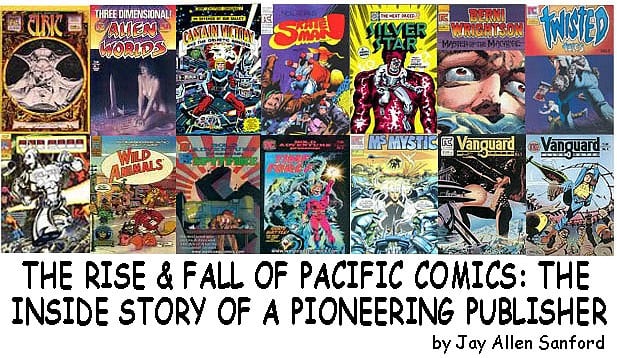
At one time, nearly all American comic books were created in New York City, distributed by union trucking firms, and sold on newsstands or in convenience stores. Only a few dozen comic-book stores existed. Throughout the '60s and '70s, two New York publishers had a stranglehold on comic production -- Marvel (birthplace of Spider-Man and the Hulk) and DC (Superman and Batman's home turf). Few competitors in the four-color field managed to swipe more than crumbs from the $400 million annual pie, either on the publishing side or in newsstand distribution, the latter business having reputed mob-related monopolies.
Then along came Bill and Steve Schanes.
 (Artwork by Scott Shaw!)
The siblings opened their first Pacific Comics retail store on Cass Street in P.B. in 1974, when Steve was 20 years old and Bill 16. "We started as a mail-order company, selling to consumers via ads in the Comics Buyer's Guide," says Bill. "Later on, we took out full-page ads inside Marvel comics. As our business built up, we decided to add some retail stores, and as that built up, we realized that we couldn't get merchandise for our stores, so we opened up a distributorship...other stores in the area didn't have a distributor to buy from, so they started ordering from us."
Due in no small part to the success of fantasy-themed movies like Superman and Star Wars, comics geared toward older readers were selling in record numbers, earning mainstream press, and becoming popular -- and collectible -- with adults and teenagers. To service the growing network of comic-book stores, Pacific expanded its distribution nationwide, after raising $200,000 by closing its four San Diego retail locations and selling off inventory. The Schaneses' rise in the industry put them atop a brand-new distribution network that would be called the "direct market," i.e., comic publishers bypassing the traditional distributors and making direct sales to comic shops through independent distributors like Pacific.
The explosion of comic shops from the late '70s onward was essentially made possible by the Schanes brothers and rivals such as Phil Seuling and his East Coast Seagate Distribution (begun in 1974). Direct-market distributors serviced comic shops almost exclusively, offering comics at a much cheaper nonreturnable rate than did newsstand distributors. Retailers had the luxury of pre-ordering comics and keeping their extra copies to sell later as backstock, thus enabling collectors to purchase older issues of their favorite titles. Retailers could make a 40 percent profit on new comics instead of the usual 20 percent, then earn even more by marking up the older (and ostensibly rarer) leftover "back issues."
By 1980, around 1500 comic or fantasy-related specialty shops operated nationwide, many of them part of multistore chains, up from an estimated 200 or 300 in 1974. Pacific was operating out of a 2200-square-foot office-warehouse on Ronson Road in Kearny Mesa. The company had 500 wholesale accounts and grossed just under a million dollars that year, according to Steve. It soon rented an adjacent 2200-square-foot space as well.
 (Artwork by Scott Shaw!)
Of course, Pacific's pipeline from the publishers direct to comic shops cut out the distribution firms that had long been supplying comics to retailers, under long-standing union contracts.
Greg Pharis ran a shop in Kensington called Golden State Comics. Currently the owner of San Diego Comics, near SDSU, Pharis recalls, "Steve was really worried about rumors that guys from the local ARA [periodical distributors], which was said to be Mafia controlled, were out to get him and Bill. He told me once that someone had knocked out his windows and he'd been personally threatened a few times...he was obviously anxious and scared, rightfully so, but you could tell he was also a little pleased and proud that he'd gotten the big guys' attention in such a big way."
Pacific's distributorship thrived in part because it carried titles produced specifically for the direct market -- Jack Katz's First Kingdom had debuted in 1974, Arcade (edited by Bill "Zippy the Pinhead" Griffith and Art "Maus" Spiegelman) and Harvey Pekar's American Splendor in 1975, and both Richard Corben's Bloodstar and Jim Steranko's Chandler: Red Tide appeared in 1976, qualifying them among the earliest graphic novels. Dave Sim's Cerebus the Aardvark debuted in late 1977. Two ongoing titles, Wendy and Richard Pini's Elfquest and Eclipse Comics' first publication, Don McGregor and Paul Gulacy's Sabre, both appeared in 1978, as did Will Eisner's acclaimed graphic novel A Contract with God. The Raw comics anthology premiered in 1980, and Zap Comix creator Robert Crumb launched his magazine-sized comic anthology Weirdo in 1981.
Also in 1981, rival distributor Capital City launched its own black-and-white title, Nexus, a futuristic superhero series by Mike Baron and Steve Rude. With their own distribution network already in place, the Schanes brothers decided they were in a perfect position to become publishers themselves. This seemed unlikely, given their modest financial means -- they were still paying off debt from a $300,000 bank loan taken out in 1979 at 25 percent interest -- but the brothers were industrious, not to mention ballsy.
The very first Pacific-published comic had already appeared back in summer 1977, One, a magazine sized and black and white one-shot that carried the same Pacific logo as their wholesale catalogs. Its contents were somewhat underwhelming, with much of it basically just poorly Xeroxed photos and word balloons. The lead story was written by Stephen Garris and Nathan Carter Kingsbury, referenced in the cover painting by Stephen's brother Phil Garris, best known for the Grateful Dead's Blues For Allah album cover. Garris - who also designed the Pacific logo seen on One - would later work for local comic imprints Rock 'N' Roll Comics and Carnal Comics.
Garris' cover model for One was a local character and friend of Stephen Garris' named Cliff Terry (a poster version of the cover artwork was pitched in the comic as well, sold for $3 plus shipping). A couple of backup stories created by San Diegans were included, one by Lionel Sanders and Lana Evans and the other by San Diego Comic-Con co-founder Will Lund and a letterer/penciller named David Cody Weiss and inker Brent Anderson, who'd later create the Somerset Holmes series for Pacific before going on to acclaim for his work on X-Men: God Loves, Man Kills and Astro City.
According to Lund, "Initially the backup story was scheduled to be illustrated by Robb Phipps and written by Johnny Lee Achziger, but Steve Schanes had bought another story and so I wrote a story instead. Robb later had work appear in First Comics. I don't believe that I have an issue, but I recall that Steve [Schanes] appeared as mad scientist and [album cover painter] John Pound illustrated a panel or two of the One. I was working as a co-editor on the book."
(Regarding the story switch, Achziger later recalled "I remember an inker stole all the art for one story I did with Robb")
Though an inauspicious publishing debut, One did set the template for future Pacific Comics by crediting the copyrights to the two backup features to the creators rather than the publishers. Although rarely seen outside boxes of underground comics hidden behind most store counters, One did indeed provide a fair dry run for their next publication a few year later.
And, this time, they weren't going to stick with local talent OR the underground bins.
The Schanes brothers first tried to obtain publishing rights to Blackmark by Green Lantern/Atom artist Gil Kane, a post-apocalyptic story first published in the early '70s and credited as one of the first stand-alone graphic novels that wasn't a mere compilation, but they failed to come to terms with Kane and scriptwriter Archie Goodwin.
Interviewed in October 2003, Steve Schanes explains, "I figured if you want to get people's attention with a new comic book, who better to do it with than the King of Comics, Jack Kirby! We were already friends with Jack. We used to send him free copies of comics he'd drawn for other publishers because they never sent him any! So I just went ahead and called him on the phone, and he turned out to be a nice guy, completely accessible...we negotiated a whole detailed publishing deal between the two of us. No middlemen."
Jack Kirby was living in Thousand Oaks and doing animation designs for TV shows like Thundarr the Barbarian. He'd basically quit the comic business in 1977, after having received little more than a weekly salary since the '40s, despite creating or cocreating iconic characters Captain America, the Hulk, the Boy Commandos, and the Silver Surfer. Kirby received no money from the spin-off comics, reprints, TV shows, cartoons, or movies, nor from the lunch boxes, action figures, board games, Halloween costumes, trading cards, posters, buttons, T-shirts, footie pajamas, or Underoos.
This was because creators at Marvel and DC labored on a "work for hire" basis; they were paid a per-page rate and forced to sign contracts that granted them no proprietary rights to their own creations. To cash their paychecks, they had to waive all rights to their work, even to characters, story lines, and entire series they had thought up and developed. The publisher owned it all, right down to the original hand-drawn artwork, and the notion of royalties was unheard of.
The Schaneses told Kirby that they wanted only publishing rights to new works; he could keep ownership of anything new and copyrightable he created. They'd even help him license characters for use overseas or in television, film, or other media. Pacific was also the first company to offer Kirby royalty payments according to a comic's sales figures: 8 cents on the dollar and 10 cents for comics selling over 100,000 copies. If Marvel comics, selling around 150,000 copies on average, had offered royalties akin to Pacific's, this would have worked out to $13,000 in payments to the artist.
But this was rarely done in comics previous to Pacific. In the '70s, Superman creators Jerry Siegel and Joe Shuster had to sue DC Comics just to get meager financial compensation and byline credit for their billion-dollar creation (each settled for $30,000 annual lifetime payments -- Siegel and Shuster were both 17 years old in 1939, when DC paid them $200 for the rights to Superman).
Kirby had a partially drawn project called "Captain Victory and the Galactic Rangers," originally the storyboard to a proposed screenplay and then planned as a book-length graphic novel with a publisher deal that never came to pass (he was considering self-publishing as Jack Kirby Comics, as seen on artwork mockup at left). The artist was happy to let the Schaneses break up his story line into chapters -- with Pacific staffers and freelancers inking and coloring the artwork to present Captain Victory as a bimonthly comic-book serial.
The first issue of Captain Victory hit comic shops in August 1981, selling around 70,000 copies. "Those were incredible numbers, right up there with Marvel and DC," Steve Schanes informs me. Within six months, circulation was up to 85,000 per issue, and the comic had been licensed for publication in seven foreign countries. The third issue of Captain Victory netted Kirby a $6000 royalty check, and Pacific's publishing and distribution ventures together that year grossed about $1.2 million.
1981 -- The Year in Comics: Marvel takes notice of the growing direct market and produces a title specifically for comic shops -- Dazzler #1, with a roller-skating heroine, sells 400,000 copies, about twice normal for a Marvel comic. Pacific Comics Distribution circulates 28,000 copies. Artist Frank Miller (who'd go on to revolutionize the Batman character in the Dark Knight Returns series) writes Daredevil, initiating a trend toward grim, urban story lines. John "X-Men" Byrne begins writing and drawing The Fantastic Four. The Flash hits issue #300. Dean and Jan Mullaney found Eclipse Magazine, an independent black-and-white series. Midwest distributor Big Rapids goes under -- two former employees, John Davis and Milton Griepp, form Capital City Distribution, headquartered in Madison, Wisconsin.
Steve Schanes says it fell upon him to find and negotiate deals with creators, while brother Bill took on the nuts-and-bolts aspects of business and accounting. "I just was a little older, with a little better vocabulary, not any smarter than Bill -- he's as smart as they come -- but I was a little more comfortable on the phone. And also I have a background in art, I have a degree in sculpture...so I'm very familiar with the terms of art, its vocabulary and how art is done, and that gave me insight into artists. It was natural that I was the one to talk to the creators."
Kirby agreed to let Pacific publish a second creation, Silver Star, and the Schaneses began to envision a line of comics representing a variety of genres. Not esoteric black-and-white low-print-run underground comics like those being self-published by Robert Crumb and other West Coast contemporaries in San Francisco and L.A., but full-color titles that emulated -- maybe even competed with -- the mainstream superhero comics from Marvel and DC. To that end, the Schaneses put out word that they were open to pitches, from pros and novices alike. Offered the chance to own and profit from their own creations, top-name talents from the Big Two were soon talking to Pacific.
Mike Grell was drawing the syndicated Tarzan comic strip and had written and drawn about 50 issues of the popular Warlord comic, a series he created for DC Comics under work-for-hire, when Steve Schanes first contacted him. "I was actually the first person to sign with them," says Grell on his website. "Jack Kirby signed a couple of weeks later. But because Jack was Jack, he'd draw half a book while we were speaking! [laughter] He delivered his first, and it was printed first, but I was actually the first person to sign."
Grell recalls, "I had Starslayer originally planned as a DC project, and it was destined to be a direct counterpoint of Warlord. Instead of a modern man in a primitive society, I decided to go the other way around and take a primitive man and put him into the middle of a very futuristic society and watch what happened there. It was actually on the schedule at DC...it had been announced, but it fell by the wayside. So Steve and Bill knew about Starslayer, and they said, 'I understand you have a project, and we'd be very interested in having you come over and do it.' "
Dave Stevens received a similar invite. An aspiring comic artist who'd shopped at Pacific's retail stores, Stevens met with the Schaneses at the 1981 San Diego Comic-Con, just weeks after Captain Victory hit comic shops and as Mike Grell's Starslayer was being launched. "The only reason I was even approached," Stevens says on his website, "was because Grell's second issue was shy a few pages and they had to fill those pages with something and they knew that I drew...they made the offer, 'Do whatever you want, but we need two installments of six pages.' So I said I'd see what I could come up with and went home and started kicking around some ideas."
After doing a promotional character drawing, Stevens devised his adventure strip, The Rocketeer, around that sketch: in Los Angeles in the 1930s, pilot Cliff Secord stumbles on a futuristic rocket pack, beginning an incredible world-spanning adventure. "It was my own personal homage to Commando Cody and all the other [movie] serial heroes of that era. I'd always been a huge fan of the serials. I loved all those edge-of-your-seat, cliff-hanging chapter plays...I wanted to do a real period aviation strip but with one small element of science fiction added -- the rocket pack! So I came up with the outfit and the name. You know, a funny take on the word 'racketeer': 'The Rocketeer.' I thought it sounded catchy, and the drawing seemed to work."
Stevens considered the strip as filler for Mike Grell's sci-fi comic, unaware that an ad for The Rocketeer in the back of Starslayer #1 had already generated letters from readers. The serial debuted in issue #2. "I just had fun with it. The Schaneses liked it, but nobody made a big deal about it. Well, by the time the second installment came out, it was suddenly a very big deal, because Pacific had gotten a ton of mail over it...the immediate thought was that they had a potential cash cow."
The majority of the meat from that cow eventually went to creator Stevens, not to the Schaneses, especially after the Village Voice called Rocketeer "The greatest comic book in the world," and even more so in 1991 when The Rocketeer became a high-profile Hollywood film. In 1981, however, when the character was chosen to headline the new Pacific Presents anthology title, Stevens says, "At the time, it was a flat rate of $100 to $150 per page for everything: art, story, pencils, lettering, coloring, everything, 'in advance against royalties'...I never viewed it as a job, per se. It was just something I was doing for myself, on my off-hours from advertising. I wasn't looking at it seriously in any financial sense at all. It was, like, bus fare."
Stevens says he could have made money had he been willing to drop everything and work full-time for the Schaneses, but he'd already signed an agreement to do some 30 book illustrations for another publisher, and six months passed between Rocketeer installments in Pacific Presents #1 and #2. This killed sales momentum. "I gave it a shot and tried to give them what they wanted in a reasonable amount of time, but I just wasn't able to. So, since Pacific couldn't get a regular, monthly book out of me, they quickly created another character called Cliffhanger, written by Bruce Jones and drawn by Al Williamson. Then they had another guy come in and do a book called Crash Ryan, which was just [another] Rocketeer clone. It was strange to see what I'd done being almost copied in a sense by my own publisher trying to tap the same audience for quick sales. I guess I shouldn't have been so surprised -- that is the nature of publishing."
1982 -- The Year in Comics: Camelot 3000, a 12-issue maxi-series, is the first comic DC produces exclusively for the direct market. Marvel caters to comic collectors with Wolverine, a four-issue X-Men spin-off. G.I. Joe comics outsell X-Men and Superman (whose sales hover around 200,000 per issue). Former Marvel creator Steve Gerber is suing the publisher over rights to a character he created, Howard the Duck. Slice-of-life series Love and Rockets (Fantagraphics) by the Hernandez brothers debuts. New indie publisher First Comics lures famed Dr. Strange artist Frank Brunner to do a new fantasy series, Warp. To stop the flood of defecting creators, DC Comics begins offering royalties to artists and writers of regular newsstand comics that sell more than 100,000 copies -- about 5 percent of the 60-cent cover price -- with Marvel soon following suit. Epic Magazine is Marvel's sanitized version of Heavy Metal, with the anthology's creators receiving royalty payments based on sales.
I bought my first fistful of Pacific Comics at the 1982 San Diego Comic-Con (where Dave Stevens won a Russ Manning Memorial Award as Most Promising New Artist). An aspiring comic artist myself, I was still 7 years away from my first professional assignment and 14 years away from launching the "Overheard in San Diego" comic strip for the Reader. I'd end up working on around 300 comic books, from a variety of publishing companies, including one I headed up -- Revolutionary Comics -- and one I owned -- Re-Visionary Press -- but at that time I was just another Jack Kirby fan who felt a thrill upon finding not only a new Kirby comic but one apparently released by a San Diego publisher. I paid my buck-a-pop and sat down to devour the first few Captain Victory issues on a busy staircase outside the dealer's room. The thrill quickly faded.
Kirby was 76 years old, two or three generations out of touch with much of his audience. Captain Victory reeks of unhip dialogue steeped in '60s kid-show tradition. If you doubt how bad the comic is, that first issue contains the line "You can bet your rootie toot tooties I'm a real alien!" Issue #4 introduces a troll-like character with a big red nose and 3-D glasses in a cringeworthy cover blurb reading, "Are you ready for the Goozlebobber!?!"
Not Kirby's best work -- some would say it's his worst -- but it wasn't as delusional as the Devil Dinosaur (and Moon-Boy) series he did for Marvel in 1978, rejected after nine issues by readers and employers alike. With Captain Victory, along with Kirby's equally joyless follow-up title Silver Star, now exposed to critical scrutiny, the comic-book kingdom could no longer ignore the fact that its king had lost his crown. Letters printed in later issues confirmed that readers were scratching their heads, not sure what to make of the return of King Kirby or of this new company, Pacific Comics.
Irrespective of hastily drawn artwork, the poor visuals of Captain Victory weren't entirely Kirby's fault. Early issues were printed on porous newsprint that absorbed the color ink, making for muddy and often illegible pages. Even the initial preproduction coloring was problematic, since nobody at Pacific had ever worked on a color comic book before.
Steve Oliff was freelancing at Marvel when Pacific contacted him to do catalog covers and to color Frank Cirocco's artwork for a set of Lord of the Rings portfolio prints. The Schaneses chose Oliff as the colorist for flagship titles Captain Victory and Starslayer. "It was the first time I'd tried flat, coded, hand separated color," he recalls in an essay posted on his olyoptics.com website. "I had visions of doing flat color like it had never been done before by using some of the full-color tricks I'd learned on the Hulk and Moon Knight. I even went so far as to add Zip-a-tone [pasted-on dot patterns] to Jack's original art on Captain Victory #1 to get the added tonal values. My good intentions aside, the coloring came out dark and muddy rather than dramatic and moody.
"It [Captain Victory] wasn't the best story Jack ever wrote, and I'm afraid I really wasn't giving it the look he wanted, so he fired me. I've never really been comfortable with flat color. Even though it was a shock to be fired by a boyhood idol, I probably deserved it. I still had Mike Grell's book, and I had some small side projects, so I just kept on searching for more full-color work." Oliff and his Olyoptics firm went on to color Marvel's X-Men: God Loves, Man Kills graphic novel, becoming one of the industry's most prolific and acclaimed production houses. Captain Victory ran for a total of 13 regular comic issues and a one-shot special.
"At that time," says Steve Schanes, "Marvel and DC were printing on the cheapest low-end newsprint paper with the most economical ink. We started experimenting, partly because we didn't know any better, with upgraded paper and ink. We went from standard newsprint to Mando book stock, coated covers, and then something called Baxter paper, perfectly white so that the inks don't bleed and the colors appear perfectly bright and almost three-dimensional. Our comics ended up looking far superior to what Marvel and DC were putting out."
Seeing the enthusiasm and the sales generated by comic-book shops, Marvel and DC began producing comics for the new, mostly adult and well-monied marketplace. Pacific's success in attracting top creators and generating sales forced Marvel and DC to play catch-up with Pacific by granting creator rights, paying royalties on sales, and upgrading printing processes and paper stock. The Big Two flooded the direct-sales market with glossy offerings, and Marvel even started up a creator-owned line known as Epic Comics with longtime comics editor Archie Goodwin at the helm.
Pacific continued distributing merchandise from others as well as publishing its own comics, running both companies out of a 17,000-square-foot office-warehouse where they'd moved in July 1982, just off Miramar Road at 8423 Production Avenue. That same year, the Schaneses purchased a firehouse in Steeleville, Illinois, for $50,100, near World Color Press in Sparta, where the majority of U.S. comic books were printed. Pacific converted the firehouse into a distribution hub. It was also operating warehouses in L.A. and Phoenix at the time.
The Schaneses were printing about 500,000 comic books in Sparta every month. They employed around 40 people at their San Diego operation alone. Steve Schanes told the Reader in a September 1982 cover story, "Two Boys and Their Comic Books," that Pacific had already grossed $3.5 million that year and expected to take in over $5 million in 1983.
I caught that Reader article and determined that I would get a job at Pacific Comics.
Arnold Hennings, a friend of a mutual friend, worked as Pacific's foreign shipping manager. Promising to recommend me for the next available gig in his department, Hennings invited me up to the Production Avenue headquarters to take a tour of the warehouse. I was in nerd nirvana, shuffling around wide-eyed and speechless as I checked out the seemingly endless, depthless shelves overflowing with new comics, graphic novels, magazines, toys, Japanese models, and hundreds of other items, including years' worth of back issues of Cerebus, Zap Comix, and The Fabulous Furry Freak Brothers. Pacific-published comics in sealed boxes were stacked up by the palletload and being shuffled around by guys on forklifts.
About a half dozen employees packed customer orders in various departments spread out over two floor levels in the warehouse. I didn't step into the offices in front of the building until several weeks later, when I was invited by Bill Schanes in response to a playfully constructed résumé I'd sent comprising drawings of various Pacific comic characters extolling the virtues of my work ethic and experience via hand-drawn word balloons.
Bill hired me as a shipping and receiving clerk. My job involved filling orders from backstock and breaking up shipments of new comics from dozens of publishers once a week. This last endeavor, "new-comic day," was everyone's favorite part of the workweek. The center aisle of the warehouse would be filled with rows and rows of brand-new issues, sometimes even overseas and underground comics, all fresh from the presses and smelling of damp ink and newsprint. First we had to fill invoices for San Diego customers, who'd be pounding at the door in a few hours to get their goodies in order to open their shops, but then there was time to read the comics, to catch up on the numerous titles and types of creative offerings coming out from publishers and producers all over the planet.
On a typical workday, I might be putting together sets of Elfquest magazines for an account in Germany or designing a start-up rack with Mobile Suit Gundam blueprints, Battle of the Planets toys, and Speed Racer Viewmaster reels for a local retail store about to go into Japanimation. Or I could be standing in an assembly line, going through hand-drawn animation cels from the movie Heavy Metal and throwing away damaged or chipped cels, stuffing the rest into portfolio packets printed by the Schaneses (they'd bought a huge stash of production cels from the film company). Of course, we put aside ports with the best cels for ourselves, using our 25 percent employee discount to pay only $56.25 (retail $75.00) for ten complete cels -- today, Heavy Metal animation cels go for $500 to $2000 each.
During my first few weeks at Pacific, I was given a peek at the production side of the business by new colorist Paul Tallerday. He took me into the artroom to show me a seat-of-the-pants technique he was using to add flesh tone to a drawing by Gray Morrow for the cover of the artist's new Pacific series Edge of Chaos.
Tallerday took a clear sheet with a line drawing of a bare-chested male centaur and laid it over a Playboy centerfold photo, the woman's midriff seen through the clear acetate and forming what now looked like the texture of the centaur's chest. "I'm just now figuring out how to shoot this stuff on the camera," he admitted. "I have no idea what I'm doing, but this seems to work, doesn't it?" I had to admit that it did, marveling at the inventive low-tech verve it took to just jump in and do something, learning how to do so as you go along.
That was the vibe in the front office at Pacific -- a bunch of overgrown kids whose clubhouse had suddenly, overnight, become a corporation, a corporation that published upward of a dozen comic books each month.
It didn't feel like a corporation, however -- running the company had become a family affair, with the duo's father, Steven E. Schanes, hired in 1982 as financial vice president and mother Christine Marra serving as office manager. Bill and Steve's older brother Paul (everyone called him Pablo) quit his job as a welder to work in the financial records department, and sister Chris, an L.A.-based attorney, provided counsel on legal affairs. The pay was good (I started at $6.50 an hour), and it was a more than pleasant workplace atmosphere, and not just because of the endless supply of reading material.
Underground comic icon Robert Crumb once agreed to spend a few hours autographing plates in an art portfolio containing prints by him and various other artists. The creator of Mr. Natural and Fritz the Cat and the cofounder of the original Zap Comix stubbornly insisted on signing with a pencil rather than a pen, causing many of his plates to get smudged and discarded. He signed the plates at home and had them delivered to Pacific.
Bill Schanes later posted online "Robert Crumb signed and numbered the prints, including some extra cuss words on selected plates, plus he included a hand written note to me, which was basically a long series of cuss words, yelling at me at how heavy the boxes were, and he might have hurt his back lifting them."
Crumb was once asked by an interview with Goldmine why he does bulk autographs in pencil. "I didn't even want to do this, but it's the only way I can get paid...I hate my fans, I hate autograph collectors, and I hope every one of my signatures rubs off later."
Much more personable was mainstream comic artist Neal Adams. His influential art style -- realistic, fluid, and dynamic, whether depicting subtleties such as facial expressions or exaggeratedly violent action sequences -- is credited with rejuvenating DC comics like Batman and Green Lantern/Green Arrow.
Adams came to Pacific's office with an art portfolio he'd published himself in 1979, "The New Heroes," containing a drawing of an ecologically correct superhero he was calling Ms. Mystic, which Pacific agreed to publish as a series.
The first ad in Captain Victory #2 read, "Against all the forces that set to despoil all that is good in nature stands...Ms. Mystic!" The series was originally announced for release "sometime in 1982." Artwork dribbled in a few pages per quarter, and the comic finally came out in September '82. It would be the end of 1983 before Adams would finish enough pages to publish a second issue.
One afternoon during this period while visiting the office, underground cartoonist Dan O'Neill agreed to step out to the railroad tracks behind the warehouse with several staffers to get high. After the five of us passed around a hastily rolled joint, O'Neill pulled out a candlestick-sized metal box from his pants pocket and removed his own superdoobie, a joint of heroic proportions, in keeping with the larger-than-life four-color characters he illustrated. The thing was like a roll of tarpaper with an ash on the end. You practically needed fireplace tongs for the roach clip.
After eschewing oxygen for the ten minutes it took to toast the monster joint, we all stumbled back into the building, squinting and giggling and reeking like Tommy Chong's beard. To my amazement, O'Neill made at least four more trips to the tracks that afternoon, though only one staffer to my knowledge managed to accompany him every time and apparently keep up with his prodigious intake. I was so zoned I could barely tell Robotech from Battletech from Star Trek.
The editorials for Pacific's comics were written by a shaggy, bearded, and bespectacled guy in the front office named David Scroggy. If you knew him back then, you won't be surprised to learn that he was the staffer who made it to the railroad tracks all five times with Dan O'Neill.
Scroggy had been working in comics since 1975 as a retailer and had been general manager in the late '70s of Pacific's four San Diego stores (at SDSU, and in P.B., Clairemont, and Oceanside). He proved to be a great go-between in working with often temperamental and almost always ego-fragile creators, helping to bring to Pacific one of comicdom's most reclusive artists, Steve Ditko, co-creator of Spider-Man and Doctor Strange.
"He [Ditko] has created an entirely original, decidedly different character for your enjoyment: The Missing Man," Scroggy announced in a July '82 editorial. "We will preview the Missing Man in the next issue of Captain Victory... after his debut in Captain Victory #6, The Missing Man will be featured in a new title: Pacific Presents. This will be a 'three-shot' mini-series...so our line is growing, slowly but surely. We have some outstanding projects in the works, featuring some of the greatest talents in the world of comics. Stick with us for an exciting and surprise-filled year."
Steve Ditko ranks among the most talented comic creators ever, and this Missing Man was a surprise, if not very exciting. Like Kirby's '80s work, Ditko's offering wasn't "retro" enough to be quaint, and yet it was far too removed from his classic Marvel work two decades earlier to appeal to fans expecting that sort of minimalist superhero adventuring.
Missing Man was ostensibly a private detective, drawn as a mostly transparent character -- nothing but hair, ears, arms, legs, and a set of glasses hanging suspended in midair where his face ought to be. The script, by Mark Evanier, had people standing around a lot with dopey "Wot the..." expressions, saying things to each other like "He's here and yet he's not here. I don't know where to stab!" Subsequent Missing Man stories in Pacific Presents were increasingly incoherent, and the series disappeared after issue #3.
1983 -- The Year in Comics: With the success of the direct market, First Comics now has four ongoing titles: American Flagg, E-Man, Jon Sable Freelance, and Warp! Canadian artist Dave Sim, creator of Cerebus the Aardvark, begins his own publishing imprint, Aardvark-Vanaheim, to present comics by indie artists, such as Neil the Horse by Arn Saba and Flaming Carrot by Bob Burden. Teenage Mutant Ninja Turtles creators Kevin Eastman and Peter Laird launch Mirage Studios. The motion picture Superman III, featuring Richard Pryor, marks the rapid descent of DC/Warners film franchise into camp and mediocrity, while Warren Publishing - home of Creepy, Eerie, and Vampirella - declares bankruptcy. The title Justice Machine goes from the defunct Noble Comics line to Texas Comics and then Comico, all in the same year, spawing along the way a T.H.U.N.D.E.R. Agents crossover and the first appearance of Bill Willingham's Elementals.
Pacific was releasing more than just monthly four-color comics. The company also published a magazine-sized black-and-white reprint of Rog 2000 stories that superstar Marvel artist John Byrne had done in the '70s for long-gone Charlton Comics. Under its parent company name, Blue Dolphin Enterprises, Pacific Comics published a 108-page sword-and-sorcery graphic novel called Ghita of Alizarr (1983) by Red Sonja artist Frank Thorne and a comic-strip reprint booklet Famous Movie Stars of the '30s (1984).
There was even a one-shot humor book, Wild Animals, by famous former neighbor Scott Shaw!
Schanes & Schanes was the firm behind over 40 portfolios and autographed prints, by the likes of Chris Miller, Rowena, and Mike Kaluta. All were designed and distributed out of the Production Avenue office-warehouse. (See below printing proof, signed off by Kaluta – did I promise “the Inside Story” or what!)
As word got around the industry about Pacific's sales momentum, more talents came over from the Big Two. Bruce Jones was a fairly established comics scribe who'd written Conan and Red Sonja comics for Marvel, as well as short horror tales for Creepy and Eerie.
"I got a call from Steve Schanes at Pacific Comics offering me just about carte blanche on my own line of books and the opportunity to move to sunny California," he says on his website. "It was too much to resist." Jones moved to Coronado and brainstormed and wrote two titles for Pacific: Twisted Tales and Alien Worlds, anthology comics designed in the old Tales From the Crypt/Weird Science vein, with three or more self-contained "mature readers" stories in each issue.
Jones's third Pacific series, Somerset Holmes, was a noir crime drama concerning a woman who wakes up one day unable to remember her own identity. Instantly embroiled in dangerous, life-threatening situations, she must solve the mystery of who she is while trying to stay alive. The suspenseful soap opera, co-created by artist Brent Anderson (later of Astro City) with wife April Campbell, who modeled as the lead character (Bill Schanes' then-wife wife Cynthia Lee Vice also took part in the photo sessions). It was unusual fare for comics, both dramatic and cinematic. "I was terribly manic about the production details, rushing around to printers and typesetters and moving logos and color schemes all over the covers to get them just right, redesigning this, tinkering with that."
Jones reflects, "It was very rewarding creatively...we were breaking new ground at every turn back then with technical things -- the coloring, the glossy stock, the painted covers, the whole darker, adult feel. It was a very kinetic, very experimental, and fun time. And scary. We had no idea how this stuff was going to finally look or how it might be received. But it was exhilarating. I had total autonomy on my books. I was the packager, PC was the publisher, and Steve and Bill Schanes just left me alone to run things my way. I doubt I'll ever see that kind of unbridled freedom again. I'm not sure anybody should have that much carte blanche; it's too easy to abuse it."
Jones’ comics for Pacific were among the first comic books sold on the open market – ie alongside Marvel and DC - to carry “Mature Readers” content labels, voluntarily, some half dozen years before the PMRC would form and demand similar labels for record albums.
“I think we’re still the only color comics publisher making that recommendation,” said Pacific’s David Scroggy in a 1984 issue of Telegraph Wire. “So we have titles like Twisted Tales and Alien Worlds that, within the context of a good, well-written story, are also not turning away from sex or violence in the context of their specific genres…we are not trying to be gratuitous with sex and violence, and we’re not trying to do X-rated comic books.”
Groo the Wanderer was a funny spoof of sword-and-sorcery comics drawn by popular Mad magazine doodler Sergio Aragonés and written by Mark Evanier. The character had first appeared in a 1981 comic, Destroyer Duck, from the independent publisher Eclipse. In his "POV" column for the trade magazine Comics Buyer's Guide (December 2, 1994), Evanier recalled that he and Aragonés originally considered forming their own company. "We talked for much of an afternoon, finally deciding that creating this new comic plus founding a firm to publish it equaled at least one task too many for the two of us...I suggested we offer the Schanes brothers the chance to publish Groo. We did, they agreed...and Pacific published Groo the Wanderer #1 in late 1982, after first previewing the little monster in the Starslayer comic then being done for them by Mike Grell."
Other than Mad magazine, humor titles had long suffered a poor track record in comic shops, but initial orders for Groo mirrored those of contemporary Pacific titles Alien Worlds and Kirby's Silver Star.
1984 -- The Year in Comics: Kevin Eastman and Peter Laird self-publish 3000 copies of a new humor comic called Teenage Mutant Ninja Turtles, while newer indie publishers are springing up such as Antarctic Press, Continuity Comics, Deluxe Comics, NBM Publishing, and Renegade Press. Americomics changes its name to AC Comics. At DC, British writer Alan Moore takes over Swamp Thing at issue #20. The Supergirl film fails to set any box office records. Marvel's creator-friendly Epic imprint releases four limited series: Six from Sirius, Timespirits, Crash Ryan, and The Sisterhood of Steel. Most newsstand comics from Marvel and DC cost 60 cents -- Pacific's direct-market titles, printed on upgraded Baxter bond paper, cost $1.00. Comic publishers going out of business include Gold Key/Whitman, Capital Comics, JC Comics, and Spectrum Comics.
In 1984, Steve announced his plan to bring 3-D back to comics, a fad that had flared briefly in the '50s, when printing techniques precluded satisfactory three-dimensional art separation. He'd been in contact with Ray Zone, whose production house, 3-D Zone, refined a way of reconstructing line artwork into three-dimensional images.
"I did a 3-D conversion job with Jack Kirby for Honeycomb cereal," remembers Zone. "Jack drew great images of a kid on a skateboard, a baseball player, and a scene with a BMX bicycle. I sent down a proposal to Bill and Steve Schanes at Pacific with copies of the Honeycomb 3-D sports action posters and a specific proposal for a 3-D comic that had all the prices I was charging, including the glasses that could bind into the book. They got back to me in late 1983 and said they wanted to do a book [Alien Worlds 3-D]. Early in 1984, the art started coming in, and again, I was just thrilled and amazed to see incredible art by John Bolton, Bill Wray, Dave Stevens, Rand Holmes, and Art Adams. That was Art Adams's first published work, by the way." Adams later gained fame doing Longshot and various X-Men titles for Marvel.
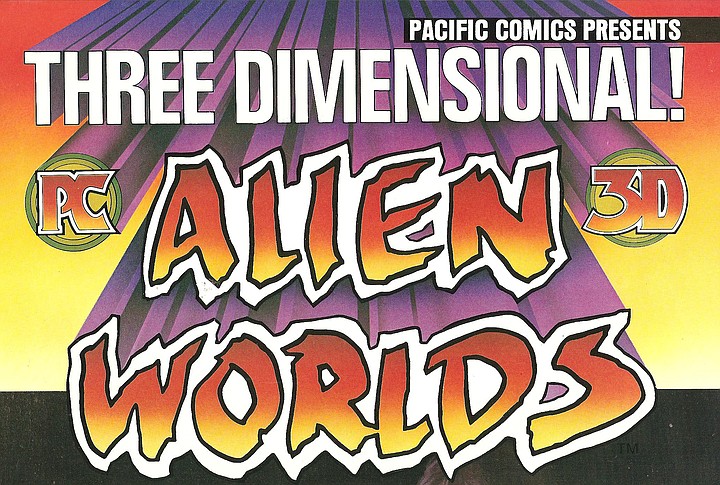
Unfortunately, sales on Alien Worlds 3-D were disappointing, and there were mountains of unsold, expensively printed 3-D comics taking up half a warehouse row. Sales on many Pacific titles were dropping, and one-shots like Darklon the Mystic (1983, by Captain Marvel artist Jim Starlin) and Demon Dreams (1984, horror stories by Arthur Suydam) became more common (Pathways To Fantasy, which kicked off with some rocking Barry Windsor Smith artwork, was scheduled to have subsequent issues, but the title was cancelled after #1).
Anthology titles such as the Pacific Presents series that had helped launch The Rocketeer were, other than Alien Worlds and Twisted Tales, uneven affairs. Vanguard Illustrated helped establish many talents and characters. According to Bill Schanes, for Vanguard, "We attempted to pair an established working professional and an up and comer who we felt needed to reach an audience." The series included work by young Michael T. Gilbert, creator of Mr. Monster.
"I was still working on my Mr. Monster synopsis for The Case of the Reluctant Werewolf," says Gilbert online. "In July of 1984, the first chapter appeared in Vanguard Illustrated number seven, with moody finished art by Bill Messner-Loebs. Craig [Russell] and I had just completed our first six-issue Elric series, and I was a few months away from working on series number two with George Freeman. I had some dead time, so my agent managed to get me this gig."
For Vanguard, Gilbert says that "David [Scroggy] knew that Bill was also a talented writer. However, I'd already had what I wanted to do firmly in mind. And part of that was adding Bill Loebs' very Eisner-esque inks to my story. Worked out great!"
Even as the anthologies gradually found their respective audiences, reprint series collecting specific artists, especially top talents such as Bernie Wrightson and Wally Wood, only had a finite number of available stories to license.
With so much attention paid to Pacific's creator owned titles, it's easy to forget just how much they relied on reprinting older comics, from other publishers (Charlton’s Rog2000, old comics by Jerry “Famous Features” Iger, Wrightson, Wood, etc.). Though it wasn’t always clear from the zingy repackaging that a Pacific comic with a brand-new Dave Stevens T&A cover may actually contain half-century old comic strip reprints.
The problem with this was the fact that the comic market was already being glutted by reprints, from Marvel and DC on down the line.
“Most of the reprints Pacific is doing,” said Dave Scroggy in 1984, “are material that’s never been in color before. And, also, it’s material that hasn’t been widely available before. Obviously, when you’re doing a reprint, you don’t have as much initial [cash] outlay, and when you’re commissioning a [new] comic book, you’re really putting out a lot of money that you don’t see a return on for quite a long time.”
Ms Mystic was running later and later; Neal Adams always promised "more soon," but a year passed and only a handful of finished pages had arrived. Adams did manage to turn in a one-shot comic in 1983 called Skateman, a tale of a roller-skating superhero that made Marvel's Dazzler seem like Proust by comparison. Several palletloads of unsold Skateman comics gathered dust, and no amount of salesmanship could unload them on accounts who were by now too savvy to believe that a "marquee name" on a comic cover guaranteed sales.
Not even T&A laden comics like Vanity (by Will Meugniot) and Legends of the Stargrazers (Bob McLeod) - no matter if they sported spiffy Dave Stevens covers - could pump up the income enough to avoid the looming inevitable cash flow crunch.
Several titles were constantly running late, in part due to creator-owned properties whose publication depended on the creator delivering on-time.
“Pacific’s business has expanded very rapidly,” said David Scroggy in May 1984, “and in several cases we’ve caused delays through both our inexperience as publishers and just the strain of having to expand our production facilities and acquire equipment and people…it takes a long time to do that when you don’t have the monetary resources of a Marvel or DC.”
We did moderate numbers with a six-part series called Elric of Melniboné (1984), featuring characters created by Michael Moorcock. But then First Comics acquired the rights to Elric, and Pacific, which had spent a lot of money to market and introduce Elric to comic shops, was put in the position of distributing it for a rival publisher.
Then Pacific lost Starslayer after only six issues when creator Mike Grell announced that he was taking his book to First Comics. It had been running late since the debut issue (originally announced for August '91, then October, and finally released just before Christmas). "Pacific had not succeeded in doing what they had intended," Grell said, "at least not very well, I had thought, and there was some organizational difficulty and some other problems they just couldn't surmount."
Though Starslayer probably generated more income for Grell than it did for the Schaneses, the loss of a high-profile title to a rival publisher engendered bad industry PR. Other creators negotiating with Pacific began to wonder what the problems were and whether they should also be talking to alternate indies. However, Pacific's reputation was the least of its problems.
"The reason Pacific Comics failed can be summed up very simply," Steve Schanes informs me. "We had two lines of activity: publishing and distribution. Most of our comic books still made money hand over fist, but there was a big problem in distribution. We extended too much credit to retailers who didn't pay us on a timely basis, and we were already working on a minuscule profit margin, maybe 5 percent to 8 percent. We didn't push hard enough to get the money from receivables, who owed us hundreds of thousands of dollars. If you had to boil down the single biggest reason we blew it, that would be our poor cash management on the distribution side."
Meanwhile, newer indie publishers, inspired by Pacific's success, competed with it for readers, as did resurgent underground publishers Kitchen Sink, Last Gasp, and Rip Off Press, whose titles were distributed through Pacific's warehouses. And surely other publishers -- Capital City (whose Nexus comic outsold several Pacific titles), Comico, Aardvark-Vanaheim, Educomics, Quality, Eagle, Eclipse, First, Vortex, New Media, Fantagraphics, Mirage -- feared that having Pacific, a rival publisher, as their distributor could result in their being cut off from comic shops.
Seeing and exploiting this, dozens of smaller distributors were springing up all over the country, even in San Diego. Nearly a quarter of Pacific's 800 or so comic-shop accounts defected to alternate distributors in 1984, skipping out on paying Pacific for upwards of three months' worth of comic books. Compounding matters, often those distributors were getting their comics through Pacific, and they too would stiff us on the bill, using their unpaid booty to lure away wholesale customers already in debt to Pacific.
Then there were internal struggles. Certain employees were accused of shirking duties, malfeasance, and outright theft. In addition, our customers had taken to stealing merchandise on pickup days from other comic shops' stock, forcing Pacific to rope off part of the warehouse and restrict access to merchandise.
Also, there were repeated sexual harassment allegations made against someone in the front office…
If you've never worked at a once-thriving company in its death throes, you can scarcely imagine the morale among the rapidly decreasing staff. During those final six months, before everyone became resigned to the fact that the company didn't have a chance, Pacific hired a new controller, George Dell, a corporate troubleshooter who spent his first day interviewing the staff about our respective duties. "At that point," recalls Steve Schanes, "we recognized our shortcomings and hired appropriately but hired too late."
The controller, a middle-aged, heavyset, stone-faced guy whose tie could have been welded to his thorax, was always prowling underfoot, studiously taking notes, and almost never making eye contact with those to whom he was speaking, thus increasing the uneasiness.
In the warehouse, shipping clerk Grant McKinnon was promoted to replace Hennings as foreign shipping manager. A few weeks later, McKinnon was gone and I replaced him, despite having little idea what the job entailed -- the controller just handed me a set of Rolodex and a stack of unfilled invoices and said, "You're our man." There was no pay increase.
On paydays, at one second after 5:00 p.m., the remaining two dozen or so employees would rush en masse out the doors and peel out of the parking lot in all directions, racing to the nearest check-cashing outlets and devising the most inventive shortcuts to ensure we'd get our paychecks cashed, because the final few inevitably bounced. Warehouse manager Joe Bougious quit after three successive rubber checks, and by this point the corridors of the back warehouse nearly echoed with emptiness and inactivity.
Word got around the staff about lawsuits, either in progress or threatened. Pacific's parent company, Blue Dolphin Enterprises Inc., was sued over "contract work" by Ready Data Services Inc. in Bergen, New Jersey, Superior Court, eventually losing a $7241.19 judgment in December 1984. An article published in a comic-industry trade journal said that Pacific was nearly a million dollars in debt. I fielded several terse phone calls from people claiming to represent comic creators like Sergio Aragonés and Neal Adams, attempting to confirm foreign circulation figures on titles for which their clients were owed royalties.
Office managers from nearby businesses were walking through the warehouse as we tried to pack and ship orders, literally buying the racks and desks out from under us while we worked. Several hundred square feet of heavy-duty shelves were disassembled and sold to the 10,000 Auto Parts store on University Avenue in North Park.
Warehouse merchandise was being sold off at absurd, desperate discounts via sales circulars that made it obvious just how badly Pacific needed to raise funds…
Only hours before a deal was to be signed with a liquidation company -- the San Diego Wholesale Credit Association -- Steve Schanes decided that he wanted to transport a truckload of Pacific backstock and personal property from Production Avenue to a rented storage locker about two miles away on Miramar Road. Soon, everything in Pacific's stock warehouse would become property of the liquidators, and then it would be illegal to remove from the premises. However, there was no money left to rent a truck.
Warehouse personnel took turns loading boxes onto forklift pallets and then driving out Production Avenue and down Miramar Road, tooling along on our forklifts at 12 mph, averaging one load per hour through rush hour until almost sunset. Aside from being scared of cops, we were scared of getting killed! It seemed like a risky endeavor just to stash away a few thousand Alien Worlds 3-D comics and the Schaneses' collection of Creepys and Eeries, .
It didn't help that, between trips, we were all sneaking off to the railroad tracks behind the warehouse and emboldening ourselves by passing around joints of increasingly Dan O'Neill-like proportions. We lived to tell, and nobody got arrested, but that day was one of many where just punching the time clock was akin to jumping out of an airplane -- we never knew for sure if the parachute was gonna work.
In August 1984, Bill and Steve assembled the employees and told us that Pacific Comics was closing and we'd be laid off by the end of September. Bill wrote me a somewhat overstated but effective letter of recommendation claiming I was "responsible for all aspects of export sales to over 20 countries," which had been technically true for only my last ten weeks with the company. I never got around to figuring out what the job description entailed. It was hard to do anything other than ship outstanding orders. We weren't allowed to answer the phones, and then one day they were disconnected anyway.
At left is an ad from my archive, for a group of Pacific issues that were either never published or ended up coming out from a different company. It’s fascinating to see what almost was! Note that among some British guys who were gonna work with Pacific in 1984, one of them was Alan Moore! With a little strip called V For Vendetta! That's right, V was originally going to show up in the U.S. way back in '84, from PC rather than DC. Another future movie property, like the Rocketeer…
After I first posted above ad online, I got an email from a reader named Jeff, who informs "I sent David Lloyd, who was the illustrator of V that image, and interestingly enough he said that Pacific was 'jumping the gun,' and they apparently didn't have a deal in place to publish it. Though Warrior publisher Dez Skinn was always trying to get the indies to publish their various stuff from the magazines, the creative teams were not convinced, and negotiations were sometimes difficult for them to allow it...my guess is that Dez probably had some deal in principal with Pacific but that he still needed to get Moore and Lloyd to agree, and that is where things were never resolved."
Also, note Pacific’s plans for future Vertigo Comics stars Peter Milligan and Brendan McCarthy, and Frank Brunner’s Seven Samuroid. I’ll have to look around to see if Frank Brunner's then-new story for Pathways to Fantasy #2 ever saw print -----
Other unrealized/unpublished Pacific comics included an all-new Sun Runners graphic novel by Pat Broderick & Roger McKenzie, more Axl Pressbutton reprints from the British magazine Warrior, an anthology comic called Challenger, a comic by future Concrete creator Paul Chadwick (whose work had never been published), and additional reprint packages by golden age creator Jerry Iger, featuring vintage work by Will Eisner, Frank Frazetta, Lou Fine, Matt Baker, and others.
Jeff emails "I found that the Chadwick story mentioned for Pacific Presents #6 was released later by Blackthorne, along with more stories for the character. And the Severin "Spitfire" story was published in Bold Adventure #3 by Pacific, which had a June 1984 date."
At the Pacific Comics plant, most everyone spent the final few days reading comics and trying to look busy and making deals with the Schaneses to purchase this or that. Tons of stuff was thrown out. Anything slightly defective or overstocked was tossed into Dumpster bins behind the warehouse -- art prints, portfolios, comics, magazines, posters, back issues, toys, even production-related stuff like photocopies of uninked artwork, cover photostats, and advertising slicks (some of which is reproduced in this article, including the internal memos that turned up as I sorted through the salvaged papers years later).
Employees tried to scavenge as much cool stuff as we could from the trash bins, but then Steve Schanes caught some San Diego comic shop owners loading up their cars with Dumpster treasure intended for resale. He became so upset that he grabbed a hose, climbed onto the Dumpster, and turned it on, hosing down the Pacific throwaways until the bin was a pulp-filled swimming pool.
That was the only time I ever heard Steve use the F-word, and he used it a lot, standing atop the soaking refuse of his once-thriving corporation: "Fucking vultures wanna make fucking money off my fucking dead hide, well, fuck them, I'll fucking teach 'em..."
Bruce Jones: "Unfortunately, when PC went belly-up and stopped with the paychecks, including mine, I was left holding the bag with the other creators to the tune of several thousand dollars. I wanted everyone I'd used on my books to get paid for what they did, even if it wasn't going to be published, so I did that by emptying my own bank account...there's a price to pay for creative freedom, sometimes quite a high one."
The final issues of Twisted Tales, Alien Worlds, and the last two installments of Somerset Holmes were published by Eclipse Comics. Jones went on to work for DC's Vertigo line and on Spider-Man and The Incredible Hulk for Marvel, as well as writing novels for Doubleday, Dutton, and others.
Mark Evanier: "Pacific published eight issues of Groo the Wanderer, but the scent of their pending demise started to drift northward, from San Diego to our L.A.-based nostrils...they had comic-shop distribution, not access to regulation news outlets [where readers were familiar with Sergio's work from Mad]. Not only that, but the firm was in financial trouble...while the lawyers were playing ping-pong, Pacific Comics went belly-up. And right here is a splendid example of why creator-owned comics can better serve the creative community. Had Groo been owned by Pacific instead of Sergio, we couldn't have taken it elsewhere to keep it alive." Sergio and Evanier followed Bruce Jones to Eclipse Comics, which published the expanded-length Groo Special originally planned for Pacific. The bumbling barbarian next wandered over to Marvel for about ten years, moving again in 1994 to Image Comics and then to Dark Horse.
Dave Stevens was illustrating covers for Pacific during its final few months, including titles he otherwise had little or nothing to do with such as Vanguard, earning from $300 to $500 per inked drawing.
"By summer of 1984," he says, "they wanted cover art for a Sheena 3-D book, and although nobody knew it at the time, the company would be bankrupt within a couple of months. I remember I had just finished the last issue of [Pacific Presents The] Rocketeer, handed it in; then I did the Sheena cover. And I waited and never heard anything. So I called and reminded them I hadn't gotten the original art back yet. There was a hesitation on the other end of the line, and it turned out that the original had 'disappeared' from the offices the day it was shot, and it's never been seen since. Someone there had decided to take home a bonus! Boy, that one hurt. I was crushed, because I felt it was my best work to date, and I didn't even have a negative of it. Anyway, they did a quick fade right after that. Within a matter of weeks, they were basically gone as a publishing entity."
A final Rocketeer special originally planned for Pacific (the cover had already been laid out with PC logos) was rushed to Eclipse for publication, hitting comic shops the very week that Pacific closed its doors.
It wasn't just upcoming comic book projects that ended abruptly. The Schanes & Schanes line of portfolio art print sets also ground to a halt, including advertised editions like The Martians: A Day in the Life, specially commissioned from future star artist Michael T. Gilbert. It was originally scheduled for release in June 1984, the same month that Gilbert's first Mr. Monster story was to appear in Vanguard Illustrated number 7.
Gilbert was already a regular at Pacific, co-illustrating Elric with P. Craig Russell, for which Gilbert had moved from Texas to Kent, Ohio to work alongside Russell. That's how solid a gig with Pacific must have seemed at the time.
Like many Schanes & Schanes portfolios, Gilbert's began as a single illustration. "A couple of years earlier I’d drawn this image featuring a Martian divorce," recalls Gilbert online. "The subject matter was inspired by the fact that my first wife had divorced me a few months earlier...in early 1982 I wasn’t feeling too happy. To make matters worse, I didn’t have any comic gigs in the pipeline. So I filled my time by drawing this piece to hone my drawing skills For the record, Pacific added the cheesy green glow lines for the ad you see here. I don’t recall if Pacific approached me to do a comic art portfolio or vice versa, but we signed a contract for a series devoted to life on Mars. The portfolio would be called The Martians: A Day In The Life. I slaved over these pieces in between Elric gigs and came up with a portfolio I was pretty proud of."
"Unfortunately," says Gilbert, "Pacific was in dire straits at the time, and folded soon after. The portfolio I’d worked so hard on never came out." Eight years later, in 1992, the artwork was finally published by Tundra, colorized for a three-part series called Mr. Monster Attacks! And Gilbert's relocation to Kent, Ohio to work on Elric comics, only to promptly see his publisher go kaput, did pay off - he met his future/second wife Janet in Ohio.
In September 1984, when Bill and Steve signed the company's assets over to liquidators, those assets included about $400,000 in receivable accounts. Around the same time, Seagate, the distributorship that had pretty much launched the direct market (begun by Phil Seuling, who passed away in 1984), also went out of business.
Pacific sold its Southern California distribution centers to Bud Plant Inc. (where I ended up working for awhile), and its Steeleville, Illinois, warehouse and accounts went to Capital City Distribution. Capital used those assets to open an expanded facility in Seagate's old space in Sparta, alongside the comic-book printing plant.
1985 -- The Year in Comics: DC celebrates its 50th anniversary. Half of all comic-book sales in North America are made in direct-market comic shops. Jack Kirby returns to DC for a graphic novel, Hunger Dogs. Kirby never revives Captain Victory or Silver Star; though, after his death in 1994, grandson Jeremy Kirby writes new Captain stories around the King's old artwork, releasing them through a new imprint called Kirby Comics (1999).
"After we closed down Pacific and laid everyone off," says Steve Schanes, "it took Bill and me about six or eight months to work everything out with the bankruptcy attorneys, the liquidators, and all the grueling stuff that entailed. That takes a lot out of you, but one has to make a living. I decided that with what I now knew about publishing, and since I still had a lot of creator contacts, and since I now needed a job, my wife [Ann Fera, whom he married in 1981] and I would form our own comic-book company."
"We needed to create a corporation quickly, so we set up a company headquarters in our two-story house and took the name of the street that we lived on, Blackthorne Avenue, and called it Blackthorne Publishing."
I went to work for Steve in his basement office and rented warehouses for several months. While I was disappointed in what had gone down at Pacific, Steve had always treated me fairly, paid me nicely and, well, he clearly needed some help getting Blackthorne off the ground.
Blackthorne's first release, in spring 1985, was Sheena, Queen of the Jungle, a comic book of reprinted quarter-century-old stories. It was originally scheduled as a Pacific publication, the one whose original Dave Stevens cover art had supposedly been stolen from Pacific's offices. "Dave didn't have a problem with me using it, and thanks to having his artwork on the cover, the comic was very successful."
Continuing on with cost-effective comic-strip reprints, Blackthorne's Dick Tracy series was overseen and edited by Shel Dorf, one of the co-founders of the San Diego Comic-Con and a friend of Steve's since the early '70s, when both were part of an informal local comic collector's club.
Steve next made a deal to repackage old Ripley's Believe It or Not columns into comic-book format, each issue having a theme such as "Crime and Murder" or "Feats of Wonder." It was cheap to produce, with no up-front artist fees, and yet lucrative, especially when marketed in bookstores and through mall-type outlets and animation-themed gift boutiques.
"We had point-of-purchase display racks in about 2000 retail stores, outside the comic-book market -- a network we basically built ourselves from the ground up. Our sales representatives were going out there into stores to sell our products, plus we were going to all the trade shows for the gift shops and licensing industries. That brought us into a marketplace that hadn't seen many comics before: America's malls."
Blackthorne next pursued licensed properties in order to produce comic-book tie-ins that exploited recognizable names with mass-market appeal. The problem was that rights to biggies like G.I. Joe and Transformers were already locked up by the Big Two, in particular by Marvel, which held a Star Wars license that Steve coveted.
"The only way for us to get a product license based on Star Wars was to create a new product category," Steve explains, "so I approached Lucasfilm with the idea of 3-D as a novelty comic book. It turned out there was a legal loophole in their contract with Marvel that didn't cover what we were proposing."
Blackthorne's three-issue Star Wars 3-D series (December 1987 to August 1988), despite stunningly shoddy artwork, pumped cash into the company coffers, allowing Steve to move its headquarters from his house near Grossmont High School, where around a half dozen people worked five days a week, to an office-warehouse complex in El Cajon.
In 1987, the same legal loophole that allowed Blackthorne to do Star Wars 3-D comics landed them a license for The Transformers, a popular TV cartoon that had been a big success as a Marvel Comics series. Blackthorne's G.I. Joe license, also swiped from Marvel thanks to 3-D, produced three interesting installments that weren't tied to the continuity of the TV show or the earlier comics.
Among the rising young artists to work on the Blackthorne 3-D comics was Jorge Pacheco, who went on to work for Harvey Comics and other publishers. "My first jobs were for a small comic company called Blackthorne Comics," he says online, "which at the time I lived only a few miles from in San Diego. So I'd go in and they'd give me work. I was lucky because I was fresh out of school [The Joe Kubert School] and I was working on these cool properties such as Underdog, Bullwinkle and Rocky, The California Raisins, The Flintstones and a handful of others. I really grew as an artist in the couple of years I worked for Blackthorne. And my work for them was the big reason I got my life changing job at Harvey Comics."
There was also a three-issue sketchbook series, The Official How to Draw G.I. Joe, which fell outside the parameters of Marvel's license agreement. These mammoth properties generated mammoth sales; however, Steve tells me, "Strangely enough, our all-time best-selling 3-D comic was the California Raisins. They were a pop-culture phenomenon for years. We kept having to reprint that one again and again, 5000 or 10,000 copies at a time."
Aside from licensed properties, Blackthorne launched several dozen creator-driven black-and-white comic series. Like Pacific, Blackthorne provided aspiring creators with some of their first professional comic work. Artist Paul Chadwick drew Salimba, a scantily clad jungle heroine with amnesia whose mostly ten-page adventures were written by Steve Perry (later to do Star Wars and Aliens comics). Chadwick went on to create the award-winning Concrete series for Dark Horse. Artist Jeff Johnson was hired by Blackthorne straight out of high school, drawing Kull 3-D years before gaining recognition for his work on The Amazing Spider-Man and Justice League.
Unfortunately, most of Blackthorne's nonlicensed comics were poorly drawn imitations of other publishers' successful comics, like Mirage's Teenage Mutant Ninja Turtles. Low-quality rip-offs Pre-Teen Dirty Jean Kung Fu Kangaroos and Cold-Blooded Chameleon Commandos did nothing to offset Blackthorne's growing reputation for exploitative, low-budget, lowest-common-denominator publishing. Mildly interesting Blackthorne titles like Nervous Rex (by future Disney Comics mainstay William Van Horn) were usually overlooked and failed after only a few issues.
An industry-award ceremony known as the Inkpot Awards was scheduled to be held at the 1987 San Diego Comic-Con, with important and influential figures in the comics field receiving "lifetime achievement" plaques. "Bill and I got an award for 'Fan Support,' " Steve told me, "and to this day I'm not really sure what it was for, exactly. I think they just wanted to recognize that these two guys had done something interesting -- nobody was exactly sure what -- that had somehow benefited and advanced the comic industry. People in the know, comics professionals and fans, they sometimes acknowledge and express appreciation to me about Pacific Comics and what we did, what we accomplished. It was nice to be recognized, but I still had to eke out a living and feed my family."
Figuring you can't beat the King of Pop for exploitable name recognition, Schanes bet the bank that a 3-D comic book based on Michael Jackson's Moonwalker, a longform 1988 video, would be a surefire sales success. He fronted a sizable licensing fee as well as signing a promise of royalty kickbacks to Moonwalker's "author," Jackson.
Released in 1989, six years after the breakthrough of Thriller, and falling between Jackson's 1987 Bad album and the child-molestation scandal that enveloped the singer-songwriter in 1993, Michael Jackson's Moonwalker in 3-D was a flop.
"We got involved with a distributor to the gift-store industry who promised all kinds of access-to-sales outlets, but unfortunately they never came through," explains Schanes. He declines to specify how much cash the fiasco cost Blackthorne, but my former employer at Revolutionary Comics, Todd Loren, once told me Steve claimed to him that Moonwalker incurred a loss of at least $50,000.
"Two events happened simultaneously that put Blackthorne in a position where it could no longer survive," Steve says today, with over a decade's worth of hindsight. "One was bad receivables accounting that had left the company about $150,000 in debt...in just one week, three different distributors went out of business, all of them owing us a ton of money." Unable to pay even his printer, 4L Printing, Blackthorne was sued in El Cajon Municipal Court, with the printer eventually winning a judgment in October 1994 for $22,972.00 ("that was all settled out of court," Steve claims).
"The second event was the fact that I had invested $80,000 or $90,000 in what I originally planned as a full line of color comic books under an imprint called Timeline, which Blackthorne was going to own outright. I had a hundred-page concept bible, there was planned product development for each character, we had sample artwork, character designs, everything. It never got off the ground, and all that time, effort, and especially money ended up being completely wasted."
On top of everything else, Steve says the IRS hit up Blackthorne with a bill for "well over six figures. The government basically used us as a test case to establish that freelance creators working from their own homes weren't classified as 'contract labor' but were actually employees, and I was responsible for paying all their taxes as such." He fought the matter for two years after Blackthorne ceased publishing ("We didn't go bankrupt; we just liquidated out," Steve says), losing his appeals. "We ended up getting the IRS to settle for a reduced payment plan from what they originally wanted...they eventually pretty much saw things our way."
In 1992, the California Franchise Tax Board suspended Blackthorne from operating for nonpayment of its taxes.
1988 -- The Year in Comics: Bud Plant Distribution, which in 1984 had purchased Pacific's wholesale accounts in Southern California, is up to seven warehouses with 80 employees. Plant sells the business to Diamond Comics Distributors, which has hired several Pacific mainstays. Ms Mystic is published on a semi-occasional basis by Neal Adams's own publishing company, Continuity. Sales on all comic books are dropping precipitously after a glut of self-published black-and-white comics. Retailers who overordered titles, hoping for another Teenage Mutant Ninja Turtlelike sales boom, are stuck with piles of unsold comics and going bankrupt.
I asked Steve Schanes what he was most proud of from his career as a comic-book publisher, which essentially ended with Blackthorne. "I'd say paving the way for creators to retain the rights to their own characters and to get royalties when their work is a success. That probably never would have happened if it weren't for those deals we worked out with Jack Kirby and Mike Grell. Once we proved it could be done, it became industry standard, but before we came along, there was no reason or incentive for a publisher to reward the creative people who made their comics possible and popular."
One longtime area comic retailer interviewed for this article scoffed at this proclamation. "Steve isn't a friend or supporter of creators' rights. Maybe he was in the early days at Pacific, but not anymore. Just recently, he was reprinting sets of Groo postcards, which were originally done as a promo item at Pacific, and auctioning them on eBay. The originals had a drawing of Groo by Sergio [Aragonés] printed on white cardstock. Steve totally exploits that this was a promotional item, not 'merchandise' like a comic book, and keeps reprinting and selling 'new' Groo postcards. He auctions them by the sheet, printed in hideous colors on flimsy laser paper so they aren't even technically postcards anymore. He gets $5 or $10 a pop, using a character that doesn't belong to him, that he has no rights to, and the auction description makes it sound like they're originals...it may technically be legal, but it's still lame."
Former Golden State Comics owner Greg Pharis says that Steve Schanes eventually showed little regard for comic-book artists and writers, despite Pacific's foundation on the notion of creators' rights and royalties. "He didn't seem to have much conscience or concern about all the people that they hung out to dry, people they owed money to. Like, how could Steve afford to immediately go into Blackthorne without paying off all those Pacific creators? How were those guys paying for their dinner while Steve signed some bankruptcy papers, bought a bunch of new equipment, and launched another comic-book company under another name?"
Several ex-Pacific staffers went on to notable gigs. Grant McKinnon took a job with Bill Graham Productions in San Francisco, as well as representing famed concert-poster artist Rick Griffith. Jon Hartz became the EVP of Valiant Comics, founded in 1989 by former Marvel honcho Jim Shooter.
David Scroggy began hosting comic-industry trade shows in San Diego and representing creators with his art-brokerage firm. In 1993, he was hired by Dark Horse Comics, one of the few indie publishers to survive the '80s. As vice president of product development, he's overseen that company's successful expansion into action figures, lunch boxes, stickers, toys, and resin-statue kits.
I began writing the series Rock 'N' Roll Comics in 1989, a title that became one of the best-selling comics of the '90s. In 1994, I founded Re-Visionary Press, whose Carnal Comics, cocreated with well-known adult film stars, remain the best-selling adults-only comic line in industry history.
Not all former Pacific employees fared so well. One secretary turned up working at a College Grove nudie nightclub, Jolar, where women in "private show booths" masturbated behind a glass partition for dollar tips. I know this because managing Jolar was my first post-Pacific job, and it was strange to now be a pimp for my former coworker.
Many of Pacific’s creator owned titles went on to thrive with other publishers: Groo the Wanderer (Marvel, Dark Horse, etc.), Vanguard Illustrated feature Legends of the Stargrazers (Innovation), Starslayer (First Comics), and others.
Jack Kirby’s Captain Victory was revived in the ‘90s, planned for a short-lived publisher called Topps Comics, owned by the baseball card company. Comics legend Steve Englehart wrote the revival. “I wrote three double-sized issues,” he says on his website, “but the artist they chose for the interiors - not Paul Gulacy, [who did the covers for #1 and #2 below] - turned out to be not ready for prime time. They chose not to publish the issues they had, and by the time they went to look for a new artist the company was abandoning comics.”
After Jack Kirby's death in 1994, his grandson Jeremy Kirby wrote new Captain Victory stories around the King's old artwork, releasing them through a new (short-lived) imprint called Kirby Comics (1999).
Bill Schanes was hired by Pacific's eventual successor, Diamond Comics Distribution. "When I first got here in '85," he says, "we were a rather small home office, so each person wore many different hats and performed many functions...I was working in customer service, sales, marketing, many different jobs. As time passed, we took over Bud Plant in 1988 with their more deluxe catalog system -- I took on the role of supervising Diamond's graphic arts department to help promote that part of this business as well."
A couple of years later, I took a job working for Bill and company at Diamond's distribution warehouse in Mission Valley.
1992/1993 -- The Year in Comics: Creator-owned comics are a hot topic once again, after the formation of Image Comics, cofounded by Spawn creator Todd McFarlane and several other defectors from Marvel's top series. Initially solicited and distributed by Malibu Comics, the titles are eventually taken over by the creators. DC ships between 2.5 and 3 million copies of Superman #75, featuring the (obviously temporary) "Death of Superman." They instantly vanish from shelves -- in Detroit alone, an estimated 175,000 copies sell in a single day. Many buyers think they're getting a surefire collector's item, unaware that the availability of so many copies guarantees them to be worth little.
In 1993, Steve Schanes decided to get back into comic retailing, opening two San Diego stores in a proposed chain of shops he called 100 Heroes. "There was a peak in the market in the early '90s, when it seemed like almost everybody was either reading or investing in comic books, around the time of the 'Death of Superman.' The first 100 Heroes store was at Parkway Plaza in El Cajon, and then I opened a second store the following year at North County Fair." Neither shop did well. The North County Fair shop closed first, after only a year in operation; the second location locked its doors about 18 months later.
Steve then moved to New Jersey to work for a start-up publisher, Broadway Comics, in Manhattan, serving as vice president of sales and marketing under Marvel's former editor in chief, Jim Shooter. A year later, that company too was about to close down, and Steve returned to San Diego to begin a home-based marketing-consulting firm.
Bill Schanes has risen at Diamond Comics Distribution to become vice president of purchasing, essentially second-in-command behind owner Steve Geppi. "My current responsibilities focus primarily on the purchasing of new product for Diamond. This includes reviewing all our contract negotiations with our suppliers, our vendors, making sure that the discounts and prices set by our brand managers are within our target goals to allow our customers to be competitive in the marketplace, while at the same time meeting our margin requirements. We've got about 25 people in the home office who report to me, as does the Diamond UK purchasing staff."
Diamond gained an advantage over other comic-book distributors in August 1995, when DC signed a deal to sell its comics exclusively through Diamond. In 1996, the company absorbed Capital City, and eventually, just about every other smaller-scale direct-market distributor, at least those that didn't go bankrupt or disappear.
When it comes to comic books and graphic novels, Diamond remains virtually the only full-service wholesale distributor to the comic-book, pop culture, gaming, specialty, and collectors' markets. The conglomerate enjoys exclusive handling arrangements with a number of publishers and provides the only sales network for all others. If Diamond doesn't carry a comic book, i.e., if Bill Schanes doesn't opt to purchase it, it has almost no chance of reaching the marketplace. Any marketplace.
Since absorbing Capital City and wheeling and dealing other rivals out of the comic business in the '90s, Diamond has become a monopoly similar in many ways to the union network that enjoyed exclusivity to newsstands in the '60s and '70s.
It would seem ironic that Bill Schanes, who had a hand in disassembling the original good ol' boy publication-and-distribution framework in the name of equal opportunity, ended up supervising the rise of a new corporate behemoth that today crowds out start-up competition.
In many ways, Pacific formed the template for Image Comics, today's most successful San Diego-based comic company. Image began in 1992 as a publishing imprint where creators could own and profit from their characters. It was founded by Todd McFarlane (who'd made his name drawing Spider-Man and the Hulk), San Diego illustrator Jim Lee (known for an acclaimed run on the Punisher comic), and several other mainstream Marvel artists. Others joined up to form a staff of creators, including Jim Valentino, who'd once worked as a shipping clerk at Pacific's San Diego warehouse (I'm told I was hired at Pacific as Valentino's replacement).
Sales of Image titles, such as Spawn and Wildcats, quickly rivaled Marvel and DC in numbers that nobody before them, not even Pacific, had ever managed to pull off. Once again, the Big Two were forced to play catch-up with an upstart new indie publisher. Reportedly over a million copies of Todd McFarlane's Spawn #1 were printed and snapped up in multiples by eager comic consumers who made Image comics the best-selling independent titles of the past quarter century.
So, if Pacific arrived on the scene first with the idea, the distribution, the printing upgrades, the diverse comic-book titles, and the top-name creators, why didn't the Schaneses manage to grab ahold of the same brass ring that allowed Todd McFarlane the luxury of purchasing Mark McGwire's record-breaking 70th home-run baseball in 1999 for $2.7 million?
Greg Pharis has been around the comic business long enough (31 consecutive years in San Diego) to have an informed opinion about the Schaneses' strengths and weaknesses, not to mention the duo's legacy in 20th-century comic books:
"Ultimately, what I recall most about Bill and Steve is that they were terrific fans. They had a lot of guts and some great ideas at times, but the actual execution and timing of their efforts always seemed to just sputter, if not completely fail. They're both very cool guys, excellent people to have in this hobby, in this industry, but together they were marginal to lousy businessmen."
Here's something you might be interested in.
The birth and death of Pacific Comics
Bill and Steve Schanes started on 5011 Cass Street in Pacific Beach

The birth and death of Pacific Comics
Bill and Steve Schanes started on 5011 Cass Street in Pacific Beach
At one time, nearly all American comic books were created in New York City, distributed by union trucking firms, and sold on newsstands or in convenience stores. Only a few dozen comic-book stores existed. Throughout the '60s and '70s, two New York publishers had a stranglehold on comic production -- Marvel (birthplace of Spider-Man and the Hulk) and DC (Superman and Batman's home turf). Few competitors in the four-color field managed to swipe more than crumbs from the $400 million annual pie, either on the publishing side or in newsstand distribution, the latter business having reputed mob-related monopolies.
Then along came Bill and Steve Schanes.
(Artwork by Scott Shaw!)The siblings opened their first Pacific Comics retail store on Cass Street in P.B. in 1974, when Steve was 20 years old and Bill 16. "We started as a mail-order company, selling to consumers via ads in the Comics Buyer's Guide," says Bill. "Later on, we took out full-page ads inside Marvel comics. As our business built up, we decided to add some retail stores, and as that built up, we realized that we couldn't get merchandise for our stores, so we opened up a distributorship...other stores in the area didn't have a distributor to buy from, so they started ordering from us."
Due in no small part to the success of fantasy-themed movies like Superman and Star Wars, comics geared toward older readers were selling in record numbers, earning mainstream press, and becoming popular -- and collectible -- with adults and teenagers. To service the growing network of comic-book stores, Pacific expanded its distribution nationwide, after raising $200,000 by closing its four San Diego retail locations and selling off inventory. The Schaneses' rise in the industry put them atop a brand-new distribution network that would be called the "direct market," i.e., comic publishers bypassing the traditional distributors and making direct sales to comic shops through independent distributors like Pacific.
The explosion of comic shops from the late '70s onward was essentially made possible by the Schanes brothers and rivals such as Phil Seuling and his East Coast Seagate Distribution (begun in 1974). Direct-market distributors serviced comic shops almost exclusively, offering comics at a much cheaper nonreturnable rate than did newsstand distributors. Retailers had the luxury of pre-ordering comics and keeping their extra copies to sell later as backstock, thus enabling collectors to purchase older issues of their favorite titles. Retailers could make a 40 percent profit on new comics instead of the usual 20 percent, then earn even more by marking up the older (and ostensibly rarer) leftover "back issues."
By 1980, around 1500 comic or fantasy-related specialty shops operated nationwide, many of them part of multistore chains, up from an estimated 200 or 300 in 1974. Pacific was operating out of a 2200-square-foot office-warehouse on Ronson Road in Kearny Mesa. The company had 500 wholesale accounts and grossed just under a million dollars that year, according to Steve. It soon rented an adjacent 2200-square-foot space as well.
(Artwork by Scott Shaw!)
Of course, Pacific's pipeline from the publishers direct to comic shops cut out the distribution firms that had long been supplying comics to retailers, under long-standing union contracts.
Greg Pharis ran a shop in Kensington called Golden State Comics. Currently the owner of San Diego Comics, near SDSU, Pharis recalls, "Steve was really worried about rumors that guys from the local ARA [periodical distributors], which was said to be Mafia controlled, were out to get him and Bill. He told me once that someone had knocked out his windows and he'd been personally threatened a few times...he was obviously anxious and scared, rightfully so, but you could tell he was also a little pleased and proud that he'd gotten the big guys' attention in such a big way."
Pacific's distributorship thrived in part because it carried titles produced specifically for the direct market -- Jack Katz's First Kingdom had debuted in 1974, Arcade (edited by Bill "Zippy the Pinhead" Griffith and Art "Maus" Spiegelman) and Harvey Pekar's American Splendor in 1975, and both Richard Corben's Bloodstar and Jim Steranko's Chandler: Red Tide appeared in 1976, qualifying them among the earliest graphic novels. Dave Sim's Cerebus the Aardvark debuted in late 1977. Two ongoing titles, Wendy and Richard Pini's Elfquest and Eclipse Comics' first publication, Don McGregor and Paul Gulacy's Sabre, both appeared in 1978, as did Will Eisner's acclaimed graphic novel A Contract with God. The Raw comics anthology premiered in 1980, and Zap Comix creator Robert Crumb launched his magazine-sized comic anthology Weirdo in 1981.
Also in 1981, rival distributor Capital City launched its own black-and-white title, Nexus, a futuristic superhero series by Mike Baron and Steve Rude. With their own distribution network already in place, the Schanes brothers decided they were in a perfect position to become publishers themselves. This seemed unlikely, given their modest financial means -- they were still paying off debt from a $300,000 bank loan taken out in 1979 at 25 percent interest -- but the brothers were industrious, not to mention ballsy.
The very first Pacific-published comic had already appeared back in summer 1977, One, a magazine sized and black and white one-shot that carried the same Pacific logo as their wholesale catalogs. Its contents were somewhat underwhelming, with much of it basically just poorly Xeroxed photos and word balloons. The lead story was written by Stephen Garris and Nathan Carter Kingsbury, referenced in the cover painting by Stephen's brother Phil Garris, best known for the Grateful Dead's Blues For Allah album cover. Garris - who also designed the Pacific logo seen on One - would later work for local comic imprints Rock 'N' Roll Comics and Carnal Comics.
Garris' cover model for One was a local character and friend of Stephen Garris' named Cliff Terry (a poster version of the cover artwork was pitched in the comic as well, sold for $3 plus shipping). A couple of backup stories created by San Diegans were included, one by Lionel Sanders and Lana Evans and the other by San Diego Comic-Con co-founder Will Lund and a letterer/penciller named David Cody Weiss and inker Brent Anderson, who'd later create the Somerset Holmes series for Pacific before going on to acclaim for his work on X-Men: God Loves, Man Kills and Astro City.
According to Lund, "Initially the backup story was scheduled to be illustrated by Robb Phipps and written by Johnny Lee Achziger, but Steve Schanes had bought another story and so I wrote a story instead. Robb later had work appear in First Comics. I don't believe that I have an issue, but I recall that Steve [Schanes] appeared as mad scientist and [album cover painter] John Pound illustrated a panel or two of the One. I was working as a co-editor on the book."
(Regarding the story switch, Achziger later recalled "I remember an inker stole all the art for one story I did with Robb")
Though an inauspicious publishing debut, One did set the template for future Pacific Comics by crediting the copyrights to the two backup features to the creators rather than the publishers. Although rarely seen outside boxes of underground comics hidden behind most store counters, One did indeed provide a fair dry run for their next publication a few year later.
And, this time, they weren't going to stick with local talent OR the underground bins.
The Schanes brothers first tried to obtain publishing rights to Blackmark by Green Lantern/Atom artist Gil Kane, a post-apocalyptic story first published in the early '70s and credited as one of the first stand-alone graphic novels that wasn't a mere compilation, but they failed to come to terms with Kane and scriptwriter Archie Goodwin.
Interviewed in October 2003, Steve Schanes explains, "I figured if you want to get people's attention with a new comic book, who better to do it with than the King of Comics, Jack Kirby! We were already friends with Jack. We used to send him free copies of comics he'd drawn for other publishers because they never sent him any! So I just went ahead and called him on the phone, and he turned out to be a nice guy, completely accessible...we negotiated a whole detailed publishing deal between the two of us. No middlemen."
Jack Kirby was living in Thousand Oaks and doing animation designs for TV shows like Thundarr the Barbarian. He'd basically quit the comic business in 1977, after having received little more than a weekly salary since the '40s, despite creating or cocreating iconic characters Captain America, the Hulk, the Boy Commandos, and the Silver Surfer. Kirby received no money from the spin-off comics, reprints, TV shows, cartoons, or movies, nor from the lunch boxes, action figures, board games, Halloween costumes, trading cards, posters, buttons, T-shirts, footie pajamas, or Underoos.
This was because creators at Marvel and DC labored on a "work for hire" basis; they were paid a per-page rate and forced to sign contracts that granted them no proprietary rights to their own creations. To cash their paychecks, they had to waive all rights to their work, even to characters, story lines, and entire series they had thought up and developed. The publisher owned it all, right down to the original hand-drawn artwork, and the notion of royalties was unheard of.
The Schaneses told Kirby that they wanted only publishing rights to new works; he could keep ownership of anything new and copyrightable he created. They'd even help him license characters for use overseas or in television, film, or other media. Pacific was also the first company to offer Kirby royalty payments according to a comic's sales figures: 8 cents on the dollar and 10 cents for comics selling over 100,000 copies. If Marvel comics, selling around 150,000 copies on average, had offered royalties akin to Pacific's, this would have worked out to $13,000 in payments to the artist.
But this was rarely done in comics previous to Pacific. In the '70s, Superman creators Jerry Siegel and Joe Shuster had to sue DC Comics just to get meager financial compensation and byline credit for their billion-dollar creation (each settled for $30,000 annual lifetime payments -- Siegel and Shuster were both 17 years old in 1939, when DC paid them $200 for the rights to Superman).
Kirby had a partially drawn project called "Captain Victory and the Galactic Rangers," originally the storyboard to a proposed screenplay and then planned as a book-length graphic novel with a publisher deal that never came to pass (he was considering self-publishing as Jack Kirby Comics, as seen on artwork mockup at left). The artist was happy to let the Schaneses break up his story line into chapters -- with Pacific staffers and freelancers inking and coloring the artwork to present Captain Victory as a bimonthly comic-book serial.
The first issue of Captain Victory hit comic shops in August 1981, selling around 70,000 copies. "Those were incredible numbers, right up there with Marvel and DC," Steve Schanes informs me. Within six months, circulation was up to 85,000 per issue, and the comic had been licensed for publication in seven foreign countries. The third issue of Captain Victory netted Kirby a $6000 royalty check, and Pacific's publishing and distribution ventures together that year grossed about $1.2 million.
1981 -- The Year in Comics: Marvel takes notice of the growing direct market and produces a title specifically for comic shops -- Dazzler #1, with a roller-skating heroine, sells 400,000 copies, about twice normal for a Marvel comic. Pacific Comics Distribution circulates 28,000 copies. Artist Frank Miller (who'd go on to revolutionize the Batman character in the Dark Knight Returns series) writes Daredevil, initiating a trend toward grim, urban story lines. John "X-Men" Byrne begins writing and drawing The Fantastic Four. The Flash hits issue #300. Dean and Jan Mullaney found Eclipse Magazine, an independent black-and-white series. Midwest distributor Big Rapids goes under -- two former employees, John Davis and Milton Griepp, form Capital City Distribution, headquartered in Madison, Wisconsin.
Steve Schanes says it fell upon him to find and negotiate deals with creators, while brother Bill took on the nuts-and-bolts aspects of business and accounting. "I just was a little older, with a little better vocabulary, not any smarter than Bill -- he's as smart as they come -- but I was a little more comfortable on the phone. And also I have a background in art, I have a degree in sculpture...so I'm very familiar with the terms of art, its vocabulary and how art is done, and that gave me insight into artists. It was natural that I was the one to talk to the creators."
Kirby agreed to let Pacific publish a second creation, Silver Star, and the Schaneses began to envision a line of comics representing a variety of genres. Not esoteric black-and-white low-print-run underground comics like those being self-published by Robert Crumb and other West Coast contemporaries in San Francisco and L.A., but full-color titles that emulated -- maybe even competed with -- the mainstream superhero comics from Marvel and DC. To that end, the Schaneses put out word that they were open to pitches, from pros and novices alike. Offered the chance to own and profit from their own creations, top-name talents from the Big Two were soon talking to Pacific.
Mike Grell was drawing the syndicated Tarzan comic strip and had written and drawn about 50 issues of the popular Warlord comic, a series he created for DC Comics under work-for-hire, when Steve Schanes first contacted him. "I was actually the first person to sign with them," says Grell on his website. "Jack Kirby signed a couple of weeks later. But because Jack was Jack, he'd draw half a book while we were speaking! [laughter] He delivered his first, and it was printed first, but I was actually the first person to sign."
Grell recalls, "I had Starslayer originally planned as a DC project, and it was destined to be a direct counterpoint of Warlord. Instead of a modern man in a primitive society, I decided to go the other way around and take a primitive man and put him into the middle of a very futuristic society and watch what happened there. It was actually on the schedule at DC...it had been announced, but it fell by the wayside. So Steve and Bill knew about Starslayer, and they said, 'I understand you have a project, and we'd be very interested in having you come over and do it.' "
Dave Stevens received a similar invite. An aspiring comic artist who'd shopped at Pacific's retail stores, Stevens met with the Schaneses at the 1981 San Diego Comic-Con, just weeks after Captain Victory hit comic shops and as Mike Grell's Starslayer was being launched. "The only reason I was even approached," Stevens says on his website, "was because Grell's second issue was shy a few pages and they had to fill those pages with something and they knew that I drew...they made the offer, 'Do whatever you want, but we need two installments of six pages.' So I said I'd see what I could come up with and went home and started kicking around some ideas."
After doing a promotional character drawing, Stevens devised his adventure strip, The Rocketeer, around that sketch: in Los Angeles in the 1930s, pilot Cliff Secord stumbles on a futuristic rocket pack, beginning an incredible world-spanning adventure. "It was my own personal homage to Commando Cody and all the other [movie] serial heroes of that era. I'd always been a huge fan of the serials. I loved all those edge-of-your-seat, cliff-hanging chapter plays...I wanted to do a real period aviation strip but with one small element of science fiction added -- the rocket pack! So I came up with the outfit and the name. You know, a funny take on the word 'racketeer': 'The Rocketeer.' I thought it sounded catchy, and the drawing seemed to work."
Stevens considered the strip as filler for Mike Grell's sci-fi comic, unaware that an ad for The Rocketeer in the back of Starslayer #1 had already generated letters from readers. The serial debuted in issue #2. "I just had fun with it. The Schaneses liked it, but nobody made a big deal about it. Well, by the time the second installment came out, it was suddenly a very big deal, because Pacific had gotten a ton of mail over it...the immediate thought was that they had a potential cash cow."
The majority of the meat from that cow eventually went to creator Stevens, not to the Schaneses, especially after the Village Voice called Rocketeer "The greatest comic book in the world," and even more so in 1991 when The Rocketeer became a high-profile Hollywood film. In 1981, however, when the character was chosen to headline the new Pacific Presents anthology title, Stevens says, "At the time, it was a flat rate of $100 to $150 per page for everything: art, story, pencils, lettering, coloring, everything, 'in advance against royalties'...I never viewed it as a job, per se. It was just something I was doing for myself, on my off-hours from advertising. I wasn't looking at it seriously in any financial sense at all. It was, like, bus fare."
Stevens says he could have made money had he been willing to drop everything and work full-time for the Schaneses, but he'd already signed an agreement to do some 30 book illustrations for another publisher, and six months passed between Rocketeer installments in Pacific Presents #1 and #2. This killed sales momentum. "I gave it a shot and tried to give them what they wanted in a reasonable amount of time, but I just wasn't able to. So, since Pacific couldn't get a regular, monthly book out of me, they quickly created another character called Cliffhanger, written by Bruce Jones and drawn by Al Williamson. Then they had another guy come in and do a book called Crash Ryan, which was just [another] Rocketeer clone. It was strange to see what I'd done being almost copied in a sense by my own publisher trying to tap the same audience for quick sales. I guess I shouldn't have been so surprised -- that is the nature of publishing."
1982 -- The Year in Comics: Camelot 3000, a 12-issue maxi-series, is the first comic DC produces exclusively for the direct market. Marvel caters to comic collectors with Wolverine, a four-issue X-Men spin-off. G.I. Joe comics outsell X-Men and Superman (whose sales hover around 200,000 per issue). Former Marvel creator Steve Gerber is suing the publisher over rights to a character he created, Howard the Duck. Slice-of-life series Love and Rockets (Fantagraphics) by the Hernandez brothers debuts. New indie publisher First Comics lures famed Dr. Strange artist Frank Brunner to do a new fantasy series, Warp. To stop the flood of defecting creators, DC Comics begins offering royalties to artists and writers of regular newsstand comics that sell more than 100,000 copies -- about 5 percent of the 60-cent cover price -- with Marvel soon following suit. Epic Magazine is Marvel's sanitized version of Heavy Metal, with the anthology's creators receiving royalty payments based on sales.
I bought my first fistful of Pacific Comics at the 1982 San Diego Comic-Con (where Dave Stevens won a Russ Manning Memorial Award as Most Promising New Artist). An aspiring comic artist myself, I was still 7 years away from my first professional assignment and 14 years away from launching the "Overheard in San Diego" comic strip for the Reader. I'd end up working on around 300 comic books, from a variety of publishing companies, including one I headed up -- Revolutionary Comics -- and one I owned -- Re-Visionary Press -- but at that time I was just another Jack Kirby fan who felt a thrill upon finding not only a new Kirby comic but one apparently released by a San Diego publisher. I paid my buck-a-pop and sat down to devour the first few Captain Victory issues on a busy staircase outside the dealer's room. The thrill quickly faded.
Kirby was 76 years old, two or three generations out of touch with much of his audience. Captain Victory reeks of unhip dialogue steeped in '60s kid-show tradition. If you doubt how bad the comic is, that first issue contains the line "You can bet your rootie toot tooties I'm a real alien!" Issue #4 introduces a troll-like character with a big red nose and 3-D glasses in a cringeworthy cover blurb reading, "Are you ready for the Goozlebobber!?!"
Not Kirby's best work -- some would say it's his worst -- but it wasn't as delusional as the Devil Dinosaur (and Moon-Boy) series he did for Marvel in 1978, rejected after nine issues by readers and employers alike. With Captain Victory, along with Kirby's equally joyless follow-up title Silver Star, now exposed to critical scrutiny, the comic-book kingdom could no longer ignore the fact that its king had lost his crown. Letters printed in later issues confirmed that readers were scratching their heads, not sure what to make of the return of King Kirby or of this new company, Pacific Comics.
Irrespective of hastily drawn artwork, the poor visuals of Captain Victory weren't entirely Kirby's fault. Early issues were printed on porous newsprint that absorbed the color ink, making for muddy and often illegible pages. Even the initial preproduction coloring was problematic, since nobody at Pacific had ever worked on a color comic book before.
Steve Oliff was freelancing at Marvel when Pacific contacted him to do catalog covers and to color Frank Cirocco's artwork for a set of Lord of the Rings portfolio prints. The Schaneses chose Oliff as the colorist for flagship titles Captain Victory and Starslayer. "It was the first time I'd tried flat, coded, hand separated color," he recalls in an essay posted on his olyoptics.com website. "I had visions of doing flat color like it had never been done before by using some of the full-color tricks I'd learned on the Hulk and Moon Knight. I even went so far as to add Zip-a-tone [pasted-on dot patterns] to Jack's original art on Captain Victory #1 to get the added tonal values. My good intentions aside, the coloring came out dark and muddy rather than dramatic and moody.
"It [Captain Victory] wasn't the best story Jack ever wrote, and I'm afraid I really wasn't giving it the look he wanted, so he fired me. I've never really been comfortable with flat color. Even though it was a shock to be fired by a boyhood idol, I probably deserved it. I still had Mike Grell's book, and I had some small side projects, so I just kept on searching for more full-color work." Oliff and his Olyoptics firm went on to color Marvel's X-Men: God Loves, Man Kills graphic novel, becoming one of the industry's most prolific and acclaimed production houses. Captain Victory ran for a total of 13 regular comic issues and a one-shot special.
"At that time," says Steve Schanes, "Marvel and DC were printing on the cheapest low-end newsprint paper with the most economical ink. We started experimenting, partly because we didn't know any better, with upgraded paper and ink. We went from standard newsprint to Mando book stock, coated covers, and then something called Baxter paper, perfectly white so that the inks don't bleed and the colors appear perfectly bright and almost three-dimensional. Our comics ended up looking far superior to what Marvel and DC were putting out."
Seeing the enthusiasm and the sales generated by comic-book shops, Marvel and DC began producing comics for the new, mostly adult and well-monied marketplace. Pacific's success in attracting top creators and generating sales forced Marvel and DC to play catch-up with Pacific by granting creator rights, paying royalties on sales, and upgrading printing processes and paper stock. The Big Two flooded the direct-sales market with glossy offerings, and Marvel even started up a creator-owned line known as Epic Comics with longtime comics editor Archie Goodwin at the helm.
Pacific continued distributing merchandise from others as well as publishing its own comics, running both companies out of a 17,000-square-foot office-warehouse where they'd moved in July 1982, just off Miramar Road at 8423 Production Avenue. That same year, the Schaneses purchased a firehouse in Steeleville, Illinois, for $50,100, near World Color Press in Sparta, where the majority of U.S. comic books were printed. Pacific converted the firehouse into a distribution hub. It was also operating warehouses in L.A. and Phoenix at the time.
The Schaneses were printing about 500,000 comic books in Sparta every month. They employed around 40 people at their San Diego operation alone. Steve Schanes told the Reader in a September 1982 cover story, "Two Boys and Their Comic Books," that Pacific had already grossed $3.5 million that year and expected to take in over $5 million in 1983.
I caught that Reader article and determined that I would get a job at Pacific Comics.
Arnold Hennings, a friend of a mutual friend, worked as Pacific's foreign shipping manager. Promising to recommend me for the next available gig in his department, Hennings invited me up to the Production Avenue headquarters to take a tour of the warehouse. I was in nerd nirvana, shuffling around wide-eyed and speechless as I checked out the seemingly endless, depthless shelves overflowing with new comics, graphic novels, magazines, toys, Japanese models, and hundreds of other items, including years' worth of back issues of Cerebus, Zap Comix, and The Fabulous Furry Freak Brothers. Pacific-published comics in sealed boxes were stacked up by the palletload and being shuffled around by guys on forklifts.
About a half dozen employees packed customer orders in various departments spread out over two floor levels in the warehouse. I didn't step into the offices in front of the building until several weeks later, when I was invited by Bill Schanes in response to a playfully constructed résumé I'd sent comprising drawings of various Pacific comic characters extolling the virtues of my work ethic and experience via hand-drawn word balloons.
Bill hired me as a shipping and receiving clerk. My job involved filling orders from backstock and breaking up shipments of new comics from dozens of publishers once a week. This last endeavor, "new-comic day," was everyone's favorite part of the workweek. The center aisle of the warehouse would be filled with rows and rows of brand-new issues, sometimes even overseas and underground comics, all fresh from the presses and smelling of damp ink and newsprint. First we had to fill invoices for San Diego customers, who'd be pounding at the door in a few hours to get their goodies in order to open their shops, but then there was time to read the comics, to catch up on the numerous titles and types of creative offerings coming out from publishers and producers all over the planet.
On a typical workday, I might be putting together sets of Elfquest magazines for an account in Germany or designing a start-up rack with Mobile Suit Gundam blueprints, Battle of the Planets toys, and Speed Racer Viewmaster reels for a local retail store about to go into Japanimation. Or I could be standing in an assembly line, going through hand-drawn animation cels from the movie Heavy Metal and throwing away damaged or chipped cels, stuffing the rest into portfolio packets printed by the Schaneses (they'd bought a huge stash of production cels from the film company). Of course, we put aside ports with the best cels for ourselves, using our 25 percent employee discount to pay only $56.25 (retail $75.00) for ten complete cels -- today, Heavy Metal animation cels go for $500 to $2000 each.
During my first few weeks at Pacific, I was given a peek at the production side of the business by new colorist Paul Tallerday. He took me into the artroom to show me a seat-of-the-pants technique he was using to add flesh tone to a drawing by Gray Morrow for the cover of the artist's new Pacific series Edge of Chaos.
Tallerday took a clear sheet with a line drawing of a bare-chested male centaur and laid it over a Playboy centerfold photo, the woman's midriff seen through the clear acetate and forming what now looked like the texture of the centaur's chest. "I'm just now figuring out how to shoot this stuff on the camera," he admitted. "I have no idea what I'm doing, but this seems to work, doesn't it?" I had to admit that it did, marveling at the inventive low-tech verve it took to just jump in and do something, learning how to do so as you go along.
That was the vibe in the front office at Pacific -- a bunch of overgrown kids whose clubhouse had suddenly, overnight, become a corporation, a corporation that published upward of a dozen comic books each month.
It didn't feel like a corporation, however -- running the company had become a family affair, with the duo's father, Steven E. Schanes, hired in 1982 as financial vice president and mother Christine Marra serving as office manager. Bill and Steve's older brother Paul (everyone called him Pablo) quit his job as a welder to work in the financial records department, and sister Chris, an L.A.-based attorney, provided counsel on legal affairs. The pay was good (I started at $6.50 an hour), and it was a more than pleasant workplace atmosphere, and not just because of the endless supply of reading material.
Underground comic icon Robert Crumb once agreed to spend a few hours autographing plates in an art portfolio containing prints by him and various other artists. The creator of Mr. Natural and Fritz the Cat and the cofounder of the original Zap Comix stubbornly insisted on signing with a pencil rather than a pen, causing many of his plates to get smudged and discarded. He signed the plates at home and had them delivered to Pacific.
Bill Schanes later posted online "Robert Crumb signed and numbered the prints, including some extra cuss words on selected plates, plus he included a hand written note to me, which was basically a long series of cuss words, yelling at me at how heavy the boxes were, and he might have hurt his back lifting them."
Crumb was once asked by an interview with Goldmine why he does bulk autographs in pencil. "I didn't even want to do this, but it's the only way I can get paid...I hate my fans, I hate autograph collectors, and I hope every one of my signatures rubs off later."
Much more personable was mainstream comic artist Neal Adams. His influential art style -- realistic, fluid, and dynamic, whether depicting subtleties such as facial expressions or exaggeratedly violent action sequences -- is credited with rejuvenating DC comics like Batman and Green Lantern/Green Arrow.
Adams came to Pacific's office with an art portfolio he'd published himself in 1979, "The New Heroes," containing a drawing of an ecologically correct superhero he was calling Ms. Mystic, which Pacific agreed to publish as a series.
The first ad in Captain Victory #2 read, "Against all the forces that set to despoil all that is good in nature stands...Ms. Mystic!" The series was originally announced for release "sometime in 1982." Artwork dribbled in a few pages per quarter, and the comic finally came out in September '82. It would be the end of 1983 before Adams would finish enough pages to publish a second issue.
One afternoon during this period while visiting the office, underground cartoonist Dan O'Neill agreed to step out to the railroad tracks behind the warehouse with several staffers to get high. After the five of us passed around a hastily rolled joint, O'Neill pulled out a candlestick-sized metal box from his pants pocket and removed his own superdoobie, a joint of heroic proportions, in keeping with the larger-than-life four-color characters he illustrated. The thing was like a roll of tarpaper with an ash on the end. You practically needed fireplace tongs for the roach clip.
After eschewing oxygen for the ten minutes it took to toast the monster joint, we all stumbled back into the building, squinting and giggling and reeking like Tommy Chong's beard. To my amazement, O'Neill made at least four more trips to the tracks that afternoon, though only one staffer to my knowledge managed to accompany him every time and apparently keep up with his prodigious intake. I was so zoned I could barely tell Robotech from Battletech from Star Trek.
The editorials for Pacific's comics were written by a shaggy, bearded, and bespectacled guy in the front office named David Scroggy. If you knew him back then, you won't be surprised to learn that he was the staffer who made it to the railroad tracks all five times with Dan O'Neill.
Scroggy had been working in comics since 1975 as a retailer and had been general manager in the late '70s of Pacific's four San Diego stores (at SDSU, and in P.B., Clairemont, and Oceanside). He proved to be a great go-between in working with often temperamental and almost always ego-fragile creators, helping to bring to Pacific one of comicdom's most reclusive artists, Steve Ditko, co-creator of Spider-Man and Doctor Strange.
"He [Ditko] has created an entirely original, decidedly different character for your enjoyment: The Missing Man," Scroggy announced in a July '82 editorial. "We will preview the Missing Man in the next issue of Captain Victory... after his debut in Captain Victory #6, The Missing Man will be featured in a new title: Pacific Presents. This will be a 'three-shot' mini-series...so our line is growing, slowly but surely. We have some outstanding projects in the works, featuring some of the greatest talents in the world of comics. Stick with us for an exciting and surprise-filled year."
Steve Ditko ranks among the most talented comic creators ever, and this Missing Man was a surprise, if not very exciting. Like Kirby's '80s work, Ditko's offering wasn't "retro" enough to be quaint, and yet it was far too removed from his classic Marvel work two decades earlier to appeal to fans expecting that sort of minimalist superhero adventuring.
Missing Man was ostensibly a private detective, drawn as a mostly transparent character -- nothing but hair, ears, arms, legs, and a set of glasses hanging suspended in midair where his face ought to be. The script, by Mark Evanier, had people standing around a lot with dopey "Wot the..." expressions, saying things to each other like "He's here and yet he's not here. I don't know where to stab!" Subsequent Missing Man stories in Pacific Presents were increasingly incoherent, and the series disappeared after issue #3.
1983 -- The Year in Comics: With the success of the direct market, First Comics now has four ongoing titles: American Flagg, E-Man, Jon Sable Freelance, and Warp! Canadian artist Dave Sim, creator of Cerebus the Aardvark, begins his own publishing imprint, Aardvark-Vanaheim, to present comics by indie artists, such as Neil the Horse by Arn Saba and Flaming Carrot by Bob Burden. Teenage Mutant Ninja Turtles creators Kevin Eastman and Peter Laird launch Mirage Studios. The motion picture Superman III, featuring Richard Pryor, marks the rapid descent of DC/Warners film franchise into camp and mediocrity, while Warren Publishing - home of Creepy, Eerie, and Vampirella - declares bankruptcy. The title Justice Machine goes from the defunct Noble Comics line to Texas Comics and then Comico, all in the same year, spawing along the way a T.H.U.N.D.E.R. Agents crossover and the first appearance of Bill Willingham's Elementals.
Pacific was releasing more than just monthly four-color comics. The company also published a magazine-sized black-and-white reprint of Rog 2000 stories that superstar Marvel artist John Byrne had done in the '70s for long-gone Charlton Comics. Under its parent company name, Blue Dolphin Enterprises, Pacific Comics published a 108-page sword-and-sorcery graphic novel called Ghita of Alizarr (1983) by Red Sonja artist Frank Thorne and a comic-strip reprint booklet Famous Movie Stars of the '30s (1984).
There was even a one-shot humor book, Wild Animals, by famous former neighbor Scott Shaw!
Schanes & Schanes was the firm behind over 40 portfolios and autographed prints, by the likes of Chris Miller, Rowena, and Mike Kaluta. All were designed and distributed out of the Production Avenue office-warehouse. (See below printing proof, signed off by Kaluta – did I promise “the Inside Story” or what!)
As word got around the industry about Pacific's sales momentum, more talents came over from the Big Two. Bruce Jones was a fairly established comics scribe who'd written Conan and Red Sonja comics for Marvel, as well as short horror tales for Creepy and Eerie.
"I got a call from Steve Schanes at Pacific Comics offering me just about carte blanche on my own line of books and the opportunity to move to sunny California," he says on his website. "It was too much to resist." Jones moved to Coronado and brainstormed and wrote two titles for Pacific: Twisted Tales and Alien Worlds, anthology comics designed in the old Tales From the Crypt/Weird Science vein, with three or more self-contained "mature readers" stories in each issue.
Jones's third Pacific series, Somerset Holmes, was a noir crime drama concerning a woman who wakes up one day unable to remember her own identity. Instantly embroiled in dangerous, life-threatening situations, she must solve the mystery of who she is while trying to stay alive. The suspenseful soap opera, co-created by artist Brent Anderson (later of Astro City) with wife April Campbell, who modeled as the lead character (Bill Schanes' then-wife wife Cynthia Lee Vice also took part in the photo sessions). It was unusual fare for comics, both dramatic and cinematic. "I was terribly manic about the production details, rushing around to printers and typesetters and moving logos and color schemes all over the covers to get them just right, redesigning this, tinkering with that."
Jones reflects, "It was very rewarding creatively...we were breaking new ground at every turn back then with technical things -- the coloring, the glossy stock, the painted covers, the whole darker, adult feel. It was a very kinetic, very experimental, and fun time. And scary. We had no idea how this stuff was going to finally look or how it might be received. But it was exhilarating. I had total autonomy on my books. I was the packager, PC was the publisher, and Steve and Bill Schanes just left me alone to run things my way. I doubt I'll ever see that kind of unbridled freedom again. I'm not sure anybody should have that much carte blanche; it's too easy to abuse it."
Jones’ comics for Pacific were among the first comic books sold on the open market – ie alongside Marvel and DC - to carry “Mature Readers” content labels, voluntarily, some half dozen years before the PMRC would form and demand similar labels for record albums.
“I think we’re still the only color comics publisher making that recommendation,” said Pacific’s David Scroggy in a 1984 issue of Telegraph Wire. “So we have titles like Twisted Tales and Alien Worlds that, within the context of a good, well-written story, are also not turning away from sex or violence in the context of their specific genres…we are not trying to be gratuitous with sex and violence, and we’re not trying to do X-rated comic books.”
Groo the Wanderer was a funny spoof of sword-and-sorcery comics drawn by popular Mad magazine doodler Sergio Aragonés and written by Mark Evanier. The character had first appeared in a 1981 comic, Destroyer Duck, from the independent publisher Eclipse. In his "POV" column for the trade magazine Comics Buyer's Guide (December 2, 1994), Evanier recalled that he and Aragonés originally considered forming their own company. "We talked for much of an afternoon, finally deciding that creating this new comic plus founding a firm to publish it equaled at least one task too many for the two of us...I suggested we offer the Schanes brothers the chance to publish Groo. We did, they agreed...and Pacific published Groo the Wanderer #1 in late 1982, after first previewing the little monster in the Starslayer comic then being done for them by Mike Grell."
Other than Mad magazine, humor titles had long suffered a poor track record in comic shops, but initial orders for Groo mirrored those of contemporary Pacific titles Alien Worlds and Kirby's Silver Star.
1984 -- The Year in Comics: Kevin Eastman and Peter Laird self-publish 3000 copies of a new humor comic called Teenage Mutant Ninja Turtles, while newer indie publishers are springing up such as Antarctic Press, Continuity Comics, Deluxe Comics, NBM Publishing, and Renegade Press. Americomics changes its name to AC Comics. At DC, British writer Alan Moore takes over Swamp Thing at issue #20. The Supergirl film fails to set any box office records. Marvel's creator-friendly Epic imprint releases four limited series: Six from Sirius, Timespirits, Crash Ryan, and The Sisterhood of Steel. Most newsstand comics from Marvel and DC cost 60 cents -- Pacific's direct-market titles, printed on upgraded Baxter bond paper, cost $1.00. Comic publishers going out of business include Gold Key/Whitman, Capital Comics, JC Comics, and Spectrum Comics.
In 1984, Steve announced his plan to bring 3-D back to comics, a fad that had flared briefly in the '50s, when printing techniques precluded satisfactory three-dimensional art separation. He'd been in contact with Ray Zone, whose production house, 3-D Zone, refined a way of reconstructing line artwork into three-dimensional images.
"I did a 3-D conversion job with Jack Kirby for Honeycomb cereal," remembers Zone. "Jack drew great images of a kid on a skateboard, a baseball player, and a scene with a BMX bicycle. I sent down a proposal to Bill and Steve Schanes at Pacific with copies of the Honeycomb 3-D sports action posters and a specific proposal for a 3-D comic that had all the prices I was charging, including the glasses that could bind into the book. They got back to me in late 1983 and said they wanted to do a book [Alien Worlds 3-D]. Early in 1984, the art started coming in, and again, I was just thrilled and amazed to see incredible art by John Bolton, Bill Wray, Dave Stevens, Rand Holmes, and Art Adams. That was Art Adams's first published work, by the way." Adams later gained fame doing Longshot and various X-Men titles for Marvel.
Unfortunately, sales on Alien Worlds 3-D were disappointing, and there were mountains of unsold, expensively printed 3-D comics taking up half a warehouse row. Sales on many Pacific titles were dropping, and one-shots like Darklon the Mystic (1983, by Captain Marvel artist Jim Starlin) and Demon Dreams (1984, horror stories by Arthur Suydam) became more common (Pathways To Fantasy, which kicked off with some rocking Barry Windsor Smith artwork, was scheduled to have subsequent issues, but the title was cancelled after #1).
Anthology titles such as the Pacific Presents series that had helped launch The Rocketeer were, other than Alien Worlds and Twisted Tales, uneven affairs. Vanguard Illustrated helped establish many talents and characters. According to Bill Schanes, for Vanguard, "We attempted to pair an established working professional and an up and comer who we felt needed to reach an audience." The series included work by young Michael T. Gilbert, creator of Mr. Monster.
"I was still working on my Mr. Monster synopsis for The Case of the Reluctant Werewolf," says Gilbert online. "In July of 1984, the first chapter appeared in Vanguard Illustrated number seven, with moody finished art by Bill Messner-Loebs. Craig [Russell] and I had just completed our first six-issue Elric series, and I was a few months away from working on series number two with George Freeman. I had some dead time, so my agent managed to get me this gig."
For Vanguard, Gilbert says that "David [Scroggy] knew that Bill was also a talented writer. However, I'd already had what I wanted to do firmly in mind. And part of that was adding Bill Loebs' very Eisner-esque inks to my story. Worked out great!"
Even as the anthologies gradually found their respective audiences, reprint series collecting specific artists, especially top talents such as Bernie Wrightson and Wally Wood, only had a finite number of available stories to license.
With so much attention paid to Pacific's creator owned titles, it's easy to forget just how much they relied on reprinting older comics, from other publishers (Charlton’s Rog2000, old comics by Jerry “Famous Features” Iger, Wrightson, Wood, etc.). Though it wasn’t always clear from the zingy repackaging that a Pacific comic with a brand-new Dave Stevens T&A cover may actually contain half-century old comic strip reprints.
The problem with this was the fact that the comic market was already being glutted by reprints, from Marvel and DC on down the line.
“Most of the reprints Pacific is doing,” said Dave Scroggy in 1984, “are material that’s never been in color before. And, also, it’s material that hasn’t been widely available before. Obviously, when you’re doing a reprint, you don’t have as much initial [cash] outlay, and when you’re commissioning a [new] comic book, you’re really putting out a lot of money that you don’t see a return on for quite a long time.”
Ms Mystic was running later and later; Neal Adams always promised "more soon," but a year passed and only a handful of finished pages had arrived. Adams did manage to turn in a one-shot comic in 1983 called Skateman, a tale of a roller-skating superhero that made Marvel's Dazzler seem like Proust by comparison. Several palletloads of unsold Skateman comics gathered dust, and no amount of salesmanship could unload them on accounts who were by now too savvy to believe that a "marquee name" on a comic cover guaranteed sales.
Not even T&A laden comics like Vanity (by Will Meugniot) and Legends of the Stargrazers (Bob McLeod) - no matter if they sported spiffy Dave Stevens covers - could pump up the income enough to avoid the looming inevitable cash flow crunch.
Several titles were constantly running late, in part due to creator-owned properties whose publication depended on the creator delivering on-time.
“Pacific’s business has expanded very rapidly,” said David Scroggy in May 1984, “and in several cases we’ve caused delays through both our inexperience as publishers and just the strain of having to expand our production facilities and acquire equipment and people…it takes a long time to do that when you don’t have the monetary resources of a Marvel or DC.”
We did moderate numbers with a six-part series called Elric of Melniboné (1984), featuring characters created by Michael Moorcock. But then First Comics acquired the rights to Elric, and Pacific, which had spent a lot of money to market and introduce Elric to comic shops, was put in the position of distributing it for a rival publisher.
Then Pacific lost Starslayer after only six issues when creator Mike Grell announced that he was taking his book to First Comics. It had been running late since the debut issue (originally announced for August '91, then October, and finally released just before Christmas). "Pacific had not succeeded in doing what they had intended," Grell said, "at least not very well, I had thought, and there was some organizational difficulty and some other problems they just couldn't surmount."
Though Starslayer probably generated more income for Grell than it did for the Schaneses, the loss of a high-profile title to a rival publisher engendered bad industry PR. Other creators negotiating with Pacific began to wonder what the problems were and whether they should also be talking to alternate indies. However, Pacific's reputation was the least of its problems.
"The reason Pacific Comics failed can be summed up very simply," Steve Schanes informs me. "We had two lines of activity: publishing and distribution. Most of our comic books still made money hand over fist, but there was a big problem in distribution. We extended too much credit to retailers who didn't pay us on a timely basis, and we were already working on a minuscule profit margin, maybe 5 percent to 8 percent. We didn't push hard enough to get the money from receivables, who owed us hundreds of thousands of dollars. If you had to boil down the single biggest reason we blew it, that would be our poor cash management on the distribution side."
Meanwhile, newer indie publishers, inspired by Pacific's success, competed with it for readers, as did resurgent underground publishers Kitchen Sink, Last Gasp, and Rip Off Press, whose titles were distributed through Pacific's warehouses. And surely other publishers -- Capital City (whose Nexus comic outsold several Pacific titles), Comico, Aardvark-Vanaheim, Educomics, Quality, Eagle, Eclipse, First, Vortex, New Media, Fantagraphics, Mirage -- feared that having Pacific, a rival publisher, as their distributor could result in their being cut off from comic shops.
Seeing and exploiting this, dozens of smaller distributors were springing up all over the country, even in San Diego. Nearly a quarter of Pacific's 800 or so comic-shop accounts defected to alternate distributors in 1984, skipping out on paying Pacific for upwards of three months' worth of comic books. Compounding matters, often those distributors were getting their comics through Pacific, and they too would stiff us on the bill, using their unpaid booty to lure away wholesale customers already in debt to Pacific.
Then there were internal struggles. Certain employees were accused of shirking duties, malfeasance, and outright theft. In addition, our customers had taken to stealing merchandise on pickup days from other comic shops' stock, forcing Pacific to rope off part of the warehouse and restrict access to merchandise.
Also, there were repeated sexual harassment allegations made against someone in the front office…
If you've never worked at a once-thriving company in its death throes, you can scarcely imagine the morale among the rapidly decreasing staff. During those final six months, before everyone became resigned to the fact that the company didn't have a chance, Pacific hired a new controller, George Dell, a corporate troubleshooter who spent his first day interviewing the staff about our respective duties. "At that point," recalls Steve Schanes, "we recognized our shortcomings and hired appropriately but hired too late."
The controller, a middle-aged, heavyset, stone-faced guy whose tie could have been welded to his thorax, was always prowling underfoot, studiously taking notes, and almost never making eye contact with those to whom he was speaking, thus increasing the uneasiness.
In the warehouse, shipping clerk Grant McKinnon was promoted to replace Hennings as foreign shipping manager. A few weeks later, McKinnon was gone and I replaced him, despite having little idea what the job entailed -- the controller just handed me a set of Rolodex and a stack of unfilled invoices and said, "You're our man." There was no pay increase.
On paydays, at one second after 5:00 p.m., the remaining two dozen or so employees would rush en masse out the doors and peel out of the parking lot in all directions, racing to the nearest check-cashing outlets and devising the most inventive shortcuts to ensure we'd get our paychecks cashed, because the final few inevitably bounced. Warehouse manager Joe Bougious quit after three successive rubber checks, and by this point the corridors of the back warehouse nearly echoed with emptiness and inactivity.
Word got around the staff about lawsuits, either in progress or threatened. Pacific's parent company, Blue Dolphin Enterprises Inc., was sued over "contract work" by Ready Data Services Inc. in Bergen, New Jersey, Superior Court, eventually losing a $7241.19 judgment in December 1984. An article published in a comic-industry trade journal said that Pacific was nearly a million dollars in debt. I fielded several terse phone calls from people claiming to represent comic creators like Sergio Aragonés and Neal Adams, attempting to confirm foreign circulation figures on titles for which their clients were owed royalties.
Office managers from nearby businesses were walking through the warehouse as we tried to pack and ship orders, literally buying the racks and desks out from under us while we worked. Several hundred square feet of heavy-duty shelves were disassembled and sold to the 10,000 Auto Parts store on University Avenue in North Park.
Warehouse merchandise was being sold off at absurd, desperate discounts via sales circulars that made it obvious just how badly Pacific needed to raise funds…
Only hours before a deal was to be signed with a liquidation company -- the San Diego Wholesale Credit Association -- Steve Schanes decided that he wanted to transport a truckload of Pacific backstock and personal property from Production Avenue to a rented storage locker about two miles away on Miramar Road. Soon, everything in Pacific's stock warehouse would become property of the liquidators, and then it would be illegal to remove from the premises. However, there was no money left to rent a truck.
Warehouse personnel took turns loading boxes onto forklift pallets and then driving out Production Avenue and down Miramar Road, tooling along on our forklifts at 12 mph, averaging one load per hour through rush hour until almost sunset. Aside from being scared of cops, we were scared of getting killed! It seemed like a risky endeavor just to stash away a few thousand Alien Worlds 3-D comics and the Schaneses' collection of Creepys and Eeries, .
It didn't help that, between trips, we were all sneaking off to the railroad tracks behind the warehouse and emboldening ourselves by passing around joints of increasingly Dan O'Neill-like proportions. We lived to tell, and nobody got arrested, but that day was one of many where just punching the time clock was akin to jumping out of an airplane -- we never knew for sure if the parachute was gonna work.
In August 1984, Bill and Steve assembled the employees and told us that Pacific Comics was closing and we'd be laid off by the end of September. Bill wrote me a somewhat overstated but effective letter of recommendation claiming I was "responsible for all aspects of export sales to over 20 countries," which had been technically true for only my last ten weeks with the company. I never got around to figuring out what the job description entailed. It was hard to do anything other than ship outstanding orders. We weren't allowed to answer the phones, and then one day they were disconnected anyway.
At left is an ad from my archive, for a group of Pacific issues that were either never published or ended up coming out from a different company. It’s fascinating to see what almost was! Note that among some British guys who were gonna work with Pacific in 1984, one of them was Alan Moore! With a little strip called V For Vendetta! That's right, V was originally going to show up in the U.S. way back in '84, from PC rather than DC. Another future movie property, like the Rocketeer…
After I first posted above ad online, I got an email from a reader named Jeff, who informs "I sent David Lloyd, who was the illustrator of V that image, and interestingly enough he said that Pacific was 'jumping the gun,' and they apparently didn't have a deal in place to publish it. Though Warrior publisher Dez Skinn was always trying to get the indies to publish their various stuff from the magazines, the creative teams were not convinced, and negotiations were sometimes difficult for them to allow it...my guess is that Dez probably had some deal in principal with Pacific but that he still needed to get Moore and Lloyd to agree, and that is where things were never resolved."
Also, note Pacific’s plans for future Vertigo Comics stars Peter Milligan and Brendan McCarthy, and Frank Brunner’s Seven Samuroid. I’ll have to look around to see if Frank Brunner's then-new story for Pathways to Fantasy #2 ever saw print -----
Other unrealized/unpublished Pacific comics included an all-new Sun Runners graphic novel by Pat Broderick & Roger McKenzie, more Axl Pressbutton reprints from the British magazine Warrior, an anthology comic called Challenger, a comic by future Concrete creator Paul Chadwick (whose work had never been published), and additional reprint packages by golden age creator Jerry Iger, featuring vintage work by Will Eisner, Frank Frazetta, Lou Fine, Matt Baker, and others.
Jeff emails "I found that the Chadwick story mentioned for Pacific Presents #6 was released later by Blackthorne, along with more stories for the character. And the Severin "Spitfire" story was published in Bold Adventure #3 by Pacific, which had a June 1984 date."
At the Pacific Comics plant, most everyone spent the final few days reading comics and trying to look busy and making deals with the Schaneses to purchase this or that. Tons of stuff was thrown out. Anything slightly defective or overstocked was tossed into Dumpster bins behind the warehouse -- art prints, portfolios, comics, magazines, posters, back issues, toys, even production-related stuff like photocopies of uninked artwork, cover photostats, and advertising slicks (some of which is reproduced in this article, including the internal memos that turned up as I sorted through the salvaged papers years later).
Employees tried to scavenge as much cool stuff as we could from the trash bins, but then Steve Schanes caught some San Diego comic shop owners loading up their cars with Dumpster treasure intended for resale. He became so upset that he grabbed a hose, climbed onto the Dumpster, and turned it on, hosing down the Pacific throwaways until the bin was a pulp-filled swimming pool.
That was the only time I ever heard Steve use the F-word, and he used it a lot, standing atop the soaking refuse of his once-thriving corporation: "Fucking vultures wanna make fucking money off my fucking dead hide, well, fuck them, I'll fucking teach 'em..."
Bruce Jones: "Unfortunately, when PC went belly-up and stopped with the paychecks, including mine, I was left holding the bag with the other creators to the tune of several thousand dollars. I wanted everyone I'd used on my books to get paid for what they did, even if it wasn't going to be published, so I did that by emptying my own bank account...there's a price to pay for creative freedom, sometimes quite a high one."
The final issues of Twisted Tales, Alien Worlds, and the last two installments of Somerset Holmes were published by Eclipse Comics. Jones went on to work for DC's Vertigo line and on Spider-Man and The Incredible Hulk for Marvel, as well as writing novels for Doubleday, Dutton, and others.
Mark Evanier: "Pacific published eight issues of Groo the Wanderer, but the scent of their pending demise started to drift northward, from San Diego to our L.A.-based nostrils...they had comic-shop distribution, not access to regulation news outlets [where readers were familiar with Sergio's work from Mad]. Not only that, but the firm was in financial trouble...while the lawyers were playing ping-pong, Pacific Comics went belly-up. And right here is a splendid example of why creator-owned comics can better serve the creative community. Had Groo been owned by Pacific instead of Sergio, we couldn't have taken it elsewhere to keep it alive." Sergio and Evanier followed Bruce Jones to Eclipse Comics, which published the expanded-length Groo Special originally planned for Pacific. The bumbling barbarian next wandered over to Marvel for about ten years, moving again in 1994 to Image Comics and then to Dark Horse.
Dave Stevens was illustrating covers for Pacific during its final few months, including titles he otherwise had little or nothing to do with such as Vanguard, earning from $300 to $500 per inked drawing.
"By summer of 1984," he says, "they wanted cover art for a Sheena 3-D book, and although nobody knew it at the time, the company would be bankrupt within a couple of months. I remember I had just finished the last issue of [Pacific Presents The] Rocketeer, handed it in; then I did the Sheena cover. And I waited and never heard anything. So I called and reminded them I hadn't gotten the original art back yet. There was a hesitation on the other end of the line, and it turned out that the original had 'disappeared' from the offices the day it was shot, and it's never been seen since. Someone there had decided to take home a bonus! Boy, that one hurt. I was crushed, because I felt it was my best work to date, and I didn't even have a negative of it. Anyway, they did a quick fade right after that. Within a matter of weeks, they were basically gone as a publishing entity."
A final Rocketeer special originally planned for Pacific (the cover had already been laid out with PC logos) was rushed to Eclipse for publication, hitting comic shops the very week that Pacific closed its doors.
It wasn't just upcoming comic book projects that ended abruptly. The Schanes & Schanes line of portfolio art print sets also ground to a halt, including advertised editions like The Martians: A Day in the Life, specially commissioned from future star artist Michael T. Gilbert. It was originally scheduled for release in June 1984, the same month that Gilbert's first Mr. Monster story was to appear in Vanguard Illustrated number 7.
Gilbert was already a regular at Pacific, co-illustrating Elric with P. Craig Russell, for which Gilbert had moved from Texas to Kent, Ohio to work alongside Russell. That's how solid a gig with Pacific must have seemed at the time.
Like many Schanes & Schanes portfolios, Gilbert's began as a single illustration. "A couple of years earlier I’d drawn this image featuring a Martian divorce," recalls Gilbert online. "The subject matter was inspired by the fact that my first wife had divorced me a few months earlier...in early 1982 I wasn’t feeling too happy. To make matters worse, I didn’t have any comic gigs in the pipeline. So I filled my time by drawing this piece to hone my drawing skills For the record, Pacific added the cheesy green glow lines for the ad you see here. I don’t recall if Pacific approached me to do a comic art portfolio or vice versa, but we signed a contract for a series devoted to life on Mars. The portfolio would be called The Martians: A Day In The Life. I slaved over these pieces in between Elric gigs and came up with a portfolio I was pretty proud of."
"Unfortunately," says Gilbert, "Pacific was in dire straits at the time, and folded soon after. The portfolio I’d worked so hard on never came out." Eight years later, in 1992, the artwork was finally published by Tundra, colorized for a three-part series called Mr. Monster Attacks! And Gilbert's relocation to Kent, Ohio to work on Elric comics, only to promptly see his publisher go kaput, did pay off - he met his future/second wife Janet in Ohio.
In September 1984, when Bill and Steve signed the company's assets over to liquidators, those assets included about $400,000 in receivable accounts. Around the same time, Seagate, the distributorship that had pretty much launched the direct market (begun by Phil Seuling, who passed away in 1984), also went out of business.
Pacific sold its Southern California distribution centers to Bud Plant Inc. (where I ended up working for awhile), and its Steeleville, Illinois, warehouse and accounts went to Capital City Distribution. Capital used those assets to open an expanded facility in Seagate's old space in Sparta, alongside the comic-book printing plant.
1985 -- The Year in Comics: DC celebrates its 50th anniversary. Half of all comic-book sales in North America are made in direct-market comic shops. Jack Kirby returns to DC for a graphic novel, Hunger Dogs. Kirby never revives Captain Victory or Silver Star; though, after his death in 1994, grandson Jeremy Kirby writes new Captain stories around the King's old artwork, releasing them through a new imprint called Kirby Comics (1999).
"After we closed down Pacific and laid everyone off," says Steve Schanes, "it took Bill and me about six or eight months to work everything out with the bankruptcy attorneys, the liquidators, and all the grueling stuff that entailed. That takes a lot out of you, but one has to make a living. I decided that with what I now knew about publishing, and since I still had a lot of creator contacts, and since I now needed a job, my wife [Ann Fera, whom he married in 1981] and I would form our own comic-book company."
"We needed to create a corporation quickly, so we set up a company headquarters in our two-story house and took the name of the street that we lived on, Blackthorne Avenue, and called it Blackthorne Publishing."
I went to work for Steve in his basement office and rented warehouses for several months. While I was disappointed in what had gone down at Pacific, Steve had always treated me fairly, paid me nicely and, well, he clearly needed some help getting Blackthorne off the ground.
Blackthorne's first release, in spring 1985, was Sheena, Queen of the Jungle, a comic book of reprinted quarter-century-old stories. It was originally scheduled as a Pacific publication, the one whose original Dave Stevens cover art had supposedly been stolen from Pacific's offices. "Dave didn't have a problem with me using it, and thanks to having his artwork on the cover, the comic was very successful."
Continuing on with cost-effective comic-strip reprints, Blackthorne's Dick Tracy series was overseen and edited by Shel Dorf, one of the co-founders of the San Diego Comic-Con and a friend of Steve's since the early '70s, when both were part of an informal local comic collector's club.
Steve next made a deal to repackage old Ripley's Believe It or Not columns into comic-book format, each issue having a theme such as "Crime and Murder" or "Feats of Wonder." It was cheap to produce, with no up-front artist fees, and yet lucrative, especially when marketed in bookstores and through mall-type outlets and animation-themed gift boutiques.
"We had point-of-purchase display racks in about 2000 retail stores, outside the comic-book market -- a network we basically built ourselves from the ground up. Our sales representatives were going out there into stores to sell our products, plus we were going to all the trade shows for the gift shops and licensing industries. That brought us into a marketplace that hadn't seen many comics before: America's malls."
Blackthorne next pursued licensed properties in order to produce comic-book tie-ins that exploited recognizable names with mass-market appeal. The problem was that rights to biggies like G.I. Joe and Transformers were already locked up by the Big Two, in particular by Marvel, which held a Star Wars license that Steve coveted.
"The only way for us to get a product license based on Star Wars was to create a new product category," Steve explains, "so I approached Lucasfilm with the idea of 3-D as a novelty comic book. It turned out there was a legal loophole in their contract with Marvel that didn't cover what we were proposing."
Blackthorne's three-issue Star Wars 3-D series (December 1987 to August 1988), despite stunningly shoddy artwork, pumped cash into the company coffers, allowing Steve to move its headquarters from his house near Grossmont High School, where around a half dozen people worked five days a week, to an office-warehouse complex in El Cajon.
In 1987, the same legal loophole that allowed Blackthorne to do Star Wars 3-D comics landed them a license for The Transformers, a popular TV cartoon that had been a big success as a Marvel Comics series. Blackthorne's G.I. Joe license, also swiped from Marvel thanks to 3-D, produced three interesting installments that weren't tied to the continuity of the TV show or the earlier comics.
Among the rising young artists to work on the Blackthorne 3-D comics was Jorge Pacheco, who went on to work for Harvey Comics and other publishers. "My first jobs were for a small comic company called Blackthorne Comics," he says online, "which at the time I lived only a few miles from in San Diego. So I'd go in and they'd give me work. I was lucky because I was fresh out of school [The Joe Kubert School] and I was working on these cool properties such as Underdog, Bullwinkle and Rocky, The California Raisins, The Flintstones and a handful of others. I really grew as an artist in the couple of years I worked for Blackthorne. And my work for them was the big reason I got my life changing job at Harvey Comics."
There was also a three-issue sketchbook series, The Official How to Draw G.I. Joe, which fell outside the parameters of Marvel's license agreement. These mammoth properties generated mammoth sales; however, Steve tells me, "Strangely enough, our all-time best-selling 3-D comic was the California Raisins. They were a pop-culture phenomenon for years. We kept having to reprint that one again and again, 5000 or 10,000 copies at a time."
Aside from licensed properties, Blackthorne launched several dozen creator-driven black-and-white comic series. Like Pacific, Blackthorne provided aspiring creators with some of their first professional comic work. Artist Paul Chadwick drew Salimba, a scantily clad jungle heroine with amnesia whose mostly ten-page adventures were written by Steve Perry (later to do Star Wars and Aliens comics). Chadwick went on to create the award-winning Concrete series for Dark Horse. Artist Jeff Johnson was hired by Blackthorne straight out of high school, drawing Kull 3-D years before gaining recognition for his work on The Amazing Spider-Man and Justice League.
Unfortunately, most of Blackthorne's nonlicensed comics were poorly drawn imitations of other publishers' successful comics, like Mirage's Teenage Mutant Ninja Turtles. Low-quality rip-offs Pre-Teen Dirty Jean Kung Fu Kangaroos and Cold-Blooded Chameleon Commandos did nothing to offset Blackthorne's growing reputation for exploitative, low-budget, lowest-common-denominator publishing. Mildly interesting Blackthorne titles like Nervous Rex (by future Disney Comics mainstay William Van Horn) were usually overlooked and failed after only a few issues.
An industry-award ceremony known as the Inkpot Awards was scheduled to be held at the 1987 San Diego Comic-Con, with important and influential figures in the comics field receiving "lifetime achievement" plaques. "Bill and I got an award for 'Fan Support,' " Steve told me, "and to this day I'm not really sure what it was for, exactly. I think they just wanted to recognize that these two guys had done something interesting -- nobody was exactly sure what -- that had somehow benefited and advanced the comic industry. People in the know, comics professionals and fans, they sometimes acknowledge and express appreciation to me about Pacific Comics and what we did, what we accomplished. It was nice to be recognized, but I still had to eke out a living and feed my family."
Figuring you can't beat the King of Pop for exploitable name recognition, Schanes bet the bank that a 3-D comic book based on Michael Jackson's Moonwalker, a longform 1988 video, would be a surefire sales success. He fronted a sizable licensing fee as well as signing a promise of royalty kickbacks to Moonwalker's "author," Jackson.
Released in 1989, six years after the breakthrough of Thriller, and falling between Jackson's 1987 Bad album and the child-molestation scandal that enveloped the singer-songwriter in 1993, Michael Jackson's Moonwalker in 3-D was a flop.
"We got involved with a distributor to the gift-store industry who promised all kinds of access-to-sales outlets, but unfortunately they never came through," explains Schanes. He declines to specify how much cash the fiasco cost Blackthorne, but my former employer at Revolutionary Comics, Todd Loren, once told me Steve claimed to him that Moonwalker incurred a loss of at least $50,000.
"Two events happened simultaneously that put Blackthorne in a position where it could no longer survive," Steve says today, with over a decade's worth of hindsight. "One was bad receivables accounting that had left the company about $150,000 in debt...in just one week, three different distributors went out of business, all of them owing us a ton of money." Unable to pay even his printer, 4L Printing, Blackthorne was sued in El Cajon Municipal Court, with the printer eventually winning a judgment in October 1994 for $22,972.00 ("that was all settled out of court," Steve claims).
"The second event was the fact that I had invested $80,000 or $90,000 in what I originally planned as a full line of color comic books under an imprint called Timeline, which Blackthorne was going to own outright. I had a hundred-page concept bible, there was planned product development for each character, we had sample artwork, character designs, everything. It never got off the ground, and all that time, effort, and especially money ended up being completely wasted."
On top of everything else, Steve says the IRS hit up Blackthorne with a bill for "well over six figures. The government basically used us as a test case to establish that freelance creators working from their own homes weren't classified as 'contract labor' but were actually employees, and I was responsible for paying all their taxes as such." He fought the matter for two years after Blackthorne ceased publishing ("We didn't go bankrupt; we just liquidated out," Steve says), losing his appeals. "We ended up getting the IRS to settle for a reduced payment plan from what they originally wanted...they eventually pretty much saw things our way."
In 1992, the California Franchise Tax Board suspended Blackthorne from operating for nonpayment of its taxes.
1988 -- The Year in Comics: Bud Plant Distribution, which in 1984 had purchased Pacific's wholesale accounts in Southern California, is up to seven warehouses with 80 employees. Plant sells the business to Diamond Comics Distributors, which has hired several Pacific mainstays. Ms Mystic is published on a semi-occasional basis by Neal Adams's own publishing company, Continuity. Sales on all comic books are dropping precipitously after a glut of self-published black-and-white comics. Retailers who overordered titles, hoping for another Teenage Mutant Ninja Turtlelike sales boom, are stuck with piles of unsold comics and going bankrupt.
I asked Steve Schanes what he was most proud of from his career as a comic-book publisher, which essentially ended with Blackthorne. "I'd say paving the way for creators to retain the rights to their own characters and to get royalties when their work is a success. That probably never would have happened if it weren't for those deals we worked out with Jack Kirby and Mike Grell. Once we proved it could be done, it became industry standard, but before we came along, there was no reason or incentive for a publisher to reward the creative people who made their comics possible and popular."
One longtime area comic retailer interviewed for this article scoffed at this proclamation. "Steve isn't a friend or supporter of creators' rights. Maybe he was in the early days at Pacific, but not anymore. Just recently, he was reprinting sets of Groo postcards, which were originally done as a promo item at Pacific, and auctioning them on eBay. The originals had a drawing of Groo by Sergio [Aragonés] printed on white cardstock. Steve totally exploits that this was a promotional item, not 'merchandise' like a comic book, and keeps reprinting and selling 'new' Groo postcards. He auctions them by the sheet, printed in hideous colors on flimsy laser paper so they aren't even technically postcards anymore. He gets $5 or $10 a pop, using a character that doesn't belong to him, that he has no rights to, and the auction description makes it sound like they're originals...it may technically be legal, but it's still lame."
Former Golden State Comics owner Greg Pharis says that Steve Schanes eventually showed little regard for comic-book artists and writers, despite Pacific's foundation on the notion of creators' rights and royalties. "He didn't seem to have much conscience or concern about all the people that they hung out to dry, people they owed money to. Like, how could Steve afford to immediately go into Blackthorne without paying off all those Pacific creators? How were those guys paying for their dinner while Steve signed some bankruptcy papers, bought a bunch of new equipment, and launched another comic-book company under another name?"
Several ex-Pacific staffers went on to notable gigs. Grant McKinnon took a job with Bill Graham Productions in San Francisco, as well as representing famed concert-poster artist Rick Griffith. Jon Hartz became the EVP of Valiant Comics, founded in 1989 by former Marvel honcho Jim Shooter.
David Scroggy began hosting comic-industry trade shows in San Diego and representing creators with his art-brokerage firm. In 1993, he was hired by Dark Horse Comics, one of the few indie publishers to survive the '80s. As vice president of product development, he's overseen that company's successful expansion into action figures, lunch boxes, stickers, toys, and resin-statue kits.
I began writing the series Rock 'N' Roll Comics in 1989, a title that became one of the best-selling comics of the '90s. In 1994, I founded Re-Visionary Press, whose Carnal Comics, cocreated with well-known adult film stars, remain the best-selling adults-only comic line in industry history.
Not all former Pacific employees fared so well. One secretary turned up working at a College Grove nudie nightclub, Jolar, where women in "private show booths" masturbated behind a glass partition for dollar tips. I know this because managing Jolar was my first post-Pacific job, and it was strange to now be a pimp for my former coworker.
Many of Pacific’s creator owned titles went on to thrive with other publishers: Groo the Wanderer (Marvel, Dark Horse, etc.), Vanguard Illustrated feature Legends of the Stargrazers (Innovation), Starslayer (First Comics), and others.
Jack Kirby’s Captain Victory was revived in the ‘90s, planned for a short-lived publisher called Topps Comics, owned by the baseball card company. Comics legend Steve Englehart wrote the revival. “I wrote three double-sized issues,” he says on his website, “but the artist they chose for the interiors - not Paul Gulacy, [who did the covers for #1 and #2 below] - turned out to be not ready for prime time. They chose not to publish the issues they had, and by the time they went to look for a new artist the company was abandoning comics.”
After Jack Kirby's death in 1994, his grandson Jeremy Kirby wrote new Captain Victory stories around the King's old artwork, releasing them through a new (short-lived) imprint called Kirby Comics (1999).
Bill Schanes was hired by Pacific's eventual successor, Diamond Comics Distribution. "When I first got here in '85," he says, "we were a rather small home office, so each person wore many different hats and performed many functions...I was working in customer service, sales, marketing, many different jobs. As time passed, we took over Bud Plant in 1988 with their more deluxe catalog system -- I took on the role of supervising Diamond's graphic arts department to help promote that part of this business as well."
A couple of years later, I took a job working for Bill and company at Diamond's distribution warehouse in Mission Valley.
1992/1993 -- The Year in Comics: Creator-owned comics are a hot topic once again, after the formation of Image Comics, cofounded by Spawn creator Todd McFarlane and several other defectors from Marvel's top series. Initially solicited and distributed by Malibu Comics, the titles are eventually taken over by the creators. DC ships between 2.5 and 3 million copies of Superman #75, featuring the (obviously temporary) "Death of Superman." They instantly vanish from shelves -- in Detroit alone, an estimated 175,000 copies sell in a single day. Many buyers think they're getting a surefire collector's item, unaware that the availability of so many copies guarantees them to be worth little.
In 1993, Steve Schanes decided to get back into comic retailing, opening two San Diego stores in a proposed chain of shops he called 100 Heroes. "There was a peak in the market in the early '90s, when it seemed like almost everybody was either reading or investing in comic books, around the time of the 'Death of Superman.' The first 100 Heroes store was at Parkway Plaza in El Cajon, and then I opened a second store the following year at North County Fair." Neither shop did well. The North County Fair shop closed first, after only a year in operation; the second location locked its doors about 18 months later.
Steve then moved to New Jersey to work for a start-up publisher, Broadway Comics, in Manhattan, serving as vice president of sales and marketing under Marvel's former editor in chief, Jim Shooter. A year later, that company too was about to close down, and Steve returned to San Diego to begin a home-based marketing-consulting firm.
Bill Schanes has risen at Diamond Comics Distribution to become vice president of purchasing, essentially second-in-command behind owner Steve Geppi. "My current responsibilities focus primarily on the purchasing of new product for Diamond. This includes reviewing all our contract negotiations with our suppliers, our vendors, making sure that the discounts and prices set by our brand managers are within our target goals to allow our customers to be competitive in the marketplace, while at the same time meeting our margin requirements. We've got about 25 people in the home office who report to me, as does the Diamond UK purchasing staff."
Diamond gained an advantage over other comic-book distributors in August 1995, when DC signed a deal to sell its comics exclusively through Diamond. In 1996, the company absorbed Capital City, and eventually, just about every other smaller-scale direct-market distributor, at least those that didn't go bankrupt or disappear.
When it comes to comic books and graphic novels, Diamond remains virtually the only full-service wholesale distributor to the comic-book, pop culture, gaming, specialty, and collectors' markets. The conglomerate enjoys exclusive handling arrangements with a number of publishers and provides the only sales network for all others. If Diamond doesn't carry a comic book, i.e., if Bill Schanes doesn't opt to purchase it, it has almost no chance of reaching the marketplace. Any marketplace.
Since absorbing Capital City and wheeling and dealing other rivals out of the comic business in the '90s, Diamond has become a monopoly similar in many ways to the union network that enjoyed exclusivity to newsstands in the '60s and '70s.
It would seem ironic that Bill Schanes, who had a hand in disassembling the original good ol' boy publication-and-distribution framework in the name of equal opportunity, ended up supervising the rise of a new corporate behemoth that today crowds out start-up competition.
In many ways, Pacific formed the template for Image Comics, today's most successful San Diego-based comic company. Image began in 1992 as a publishing imprint where creators could own and profit from their characters. It was founded by Todd McFarlane (who'd made his name drawing Spider-Man and the Hulk), San Diego illustrator Jim Lee (known for an acclaimed run on the Punisher comic), and several other mainstream Marvel artists. Others joined up to form a staff of creators, including Jim Valentino, who'd once worked as a shipping clerk at Pacific's San Diego warehouse (I'm told I was hired at Pacific as Valentino's replacement).
Sales of Image titles, such as Spawn and Wildcats, quickly rivaled Marvel and DC in numbers that nobody before them, not even Pacific, had ever managed to pull off. Once again, the Big Two were forced to play catch-up with an upstart new indie publisher. Reportedly over a million copies of Todd McFarlane's Spawn #1 were printed and snapped up in multiples by eager comic consumers who made Image comics the best-selling independent titles of the past quarter century.
So, if Pacific arrived on the scene first with the idea, the distribution, the printing upgrades, the diverse comic-book titles, and the top-name creators, why didn't the Schaneses manage to grab ahold of the same brass ring that allowed Todd McFarlane the luxury of purchasing Mark McGwire's record-breaking 70th home-run baseball in 1999 for $2.7 million?
Greg Pharis has been around the comic business long enough (31 consecutive years in San Diego) to have an informed opinion about the Schaneses' strengths and weaknesses, not to mention the duo's legacy in 20th-century comic books:
"Ultimately, what I recall most about Bill and Steve is that they were terrific fans. They had a lot of guts and some great ideas at times, but the actual execution and timing of their efforts always seemed to just sputter, if not completely fail. They're both very cool guys, excellent people to have in this hobby, in this industry, but together they were marginal to lousy businessmen."
Comments