

Here's something you might be interested in.
Ask a Hipster — Advice you didn't know you needed
Big Screen — Movie commentary
Blurt — Music's inside track
Booze News — San Diego spirits
Classical Music — Immortal beauty
Classifieds — Free and easy
Close to Home — What it’s like on the street where you live
Cover Stories — Front-page features
Drinks All Around — Bartenders' drink recipes
Excerpts — Literary and spiritual excerpts
Feast! — Food & drink reviews
Feature Stories — Local news & stories
Fishing Report — What’s getting hooked from ship and shore
From the Archives — Spotlight on the past
Golden Dreams — Talk of the town
The Gonzo Report — Making the musical scene, or at least reporting from it
Letters — Our inbox
Movies@Home — Local movie buffs share favorites
Movie Reviews — Our critics' picks and pans
Musician Interviews — Up close with local artists
Neighborhood News from Stringers — Hyperlocal news
News Ticker — News & politics
Obermeyer — San Diego politics illustrated
Outdoors — Weekly changes in flora and fauna
Overheard in San Diego — Eavesdropping illustrated
Poetry — The old and the new
Reader Travel — Travel section built by travelers
Reading — The hunt for intellectuals
Roam-O-Rama — SoCal's best hiking/biking trails
San Diego Beer — Inside San Diego suds
SD on the QT — Almost factual news
Sheep and Goats — Places of worship
Special Issues — The best of
Street Style — San Diego streets have style
Surf Diego — Real stories from those braving the waves
Theater — On stage in San Diego this week
Tin Fork — Silver spoon alternative
Under the Radar — Matt Potter's undercover work
Unforgettable — Long-ago San Diego
Unreal Estate — San Diego's priciest pads
Your Week — Daily event picks
KFMB-TV's Kathi Diamant and her love of Kafka
Dora Diamant burned his last writing
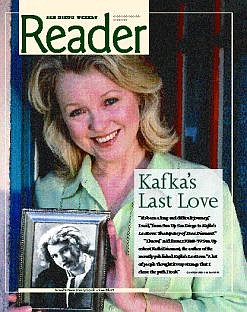
“It’s been a long and difficult journey,”
I said, “from Sun Up San Diego to Kafka’s Last Love: The Mystery of Dora Diamant.”
“I know,” said former KFMB-TV Sun Up cohost Kathi Diamant, the author of the recently published Kafka’s Last Love. “A lot of people thought it very strange that I chose the path I took.”
"I loved my seven years on Sun Up, and I loved the perks — the beautiful clothes from Saks Fifth Avenue, the hair and makeup artists who made me look as good as I possibly could every morning. But perhaps it was because on Sun Up that I interviewed so many people about their passions that made me want to follow my own — my longing to find out about Dora Diamant’s life and to tell her story. Led by Dora, I found myself entered into a world far from television studios. I found myself spending weeks in Nazi archives in Berlin and feeling my heart pound when I approached a shelf where there might be some Kafka or Dora treasure. I found myself at a gravesite in Poland and in the room in the Kierling Sanatorium outside Vienna where Kafka died. I often asked myself, ‘Kathi, how did you get here?’ ”
The short version of what took Kathi Diamant from the Channel 8 studios in Kearny Mesa to Prague and Berlin and Athens and London and Jerusalem is that Kathi Diamant was drawn to those places by Dora Diamant. Under normal circumstances, Kathi would never have known Dora existed. But in the long-ago summer of 1923, events drew 25-year-old Dora to the Berlin Jewish People’s holiday camp for refugee children on the Baltic Sea. Over dinner at the camp, Dora attracted the attention of novelist and short-story writer Franz Kafka (1883–1924). After the meal (Kafka, a vegetarian, eschewed the fish), Dora read to the frail 40-year-old, in Hebrew, from the book of the prophet Isaiah. That evening, a romance budded between the two. Eleven months after their first meeting, the tubercular Kafka, one month short of his 41st birthday, breathed his last stertorous breaths in Dora’s arms.
Kafka’s story collections and novels — The Metamorphosis and Other Stories, The Castle, The Trial, and Amerika — make for unsettling reading. In “The Metamorphosis,” traveling salesman Gregor Samsa awakens one morning to discover that while he slept he had been transformed into a “monstrous vermin,” or insect — “As Gregor Samsa awoke one morning from uneasy dreams he found himself transformed in his bed into a gigantic insect.” Kafka’s Trial opens with this: “Someone must have traduced Joseph K., for without having done anything wrong he was arrested one fine morning.” Kafka’s disturbing fictions provoked coinage of the term Kafkaesque. A situation that is Kafkaesque is absurd, terrifying, and hopeless. When people are caught — trapped — in Kafkaesque situations they tend to feel a sense of doom, of guilt both earned and unearned, of dizzying uneasiness and despair. “The true way leads along a tightrope not stretched aloft but just above the ground,” Kafka wrote. “It seems designed more to trip one than to be walked along.”
Kafka’s name, converted to the adjectival, began to show up regularly after World War II. Kafkaesque, like the terms angst and nausea and Sisyphean and absurdity, became a catchword in the language of postwar existentialist despair. To this day one regularly hears and reads radio and television and print commentators invoke Kafka’s name. Poor Kafka, one cannot help but think, would feel each usage as a dull object’s heavy blow.
Dora Diamant was born in 1898 in Poland and died in a London hospital in 1952, three months after Kathi Diamant was born in Bronx Hospital in New York. Kathi Diamant’s new book, Kafka’s Last Love: The Mystery of Dora Diamant, has received praise from Kirkus Reviews and Publishers Weekly. The latter writes:
Kafka’s story is well known, Dora Diamant’s is not. She was, as the title states, his “last love,” and the author…has assiduously tracked the traces of her subjects through personal recollections, private papers and newly opened archives in the former Soviet bloc. Dora and Kafka first met at a Baltic resort, and she was instantly captivated by his intelligence and deep sensitivity. Kafka in turn was swept away by the vivacious 25-year-old Polish-born Jew, who had fled her Orthodox family for the broader intellectual currents of Weimar Germany. But Yiddish was her first language and she knew Jewish traditions, and Kafka found her a beacon for the religion his own family had rejected. The author describes at great length the one year the lovers lived together in Berlin, but more interesting is the account of Dora and her larger family history after Kafka’s painful death in 1924. Here was a woman intent on keeping Kafka’s flame alive, who was forced by war and political upheaval to flee from one country after another. Many relatives died in the Holocaust. Her treasured possessions, Kafka’s last diaries, were seized by the Gestapo and have never been found. For 15 years her husband, having served time in Nazi prisons and the Soviet gulag, lived in East Berlin, unaware that Dora and their daughter had survived the war. The remarkable story continues in Moscow, London, San Francisco and Tel Aviv, the far-flung points of dispersal of a family caught in the maelstroms of fascism, communism and the Holocaust.
Were you to knock on the fire-engine-red door that opens into Kathi Diamant’s Normal Heights home and were she to answer that knock, you would find yourself face-to-face with a well-conditioned attractive blonde, her shoulder-length hair tucked up into a black ball cap. On the front of the cap Chinese characters, embroidered in white and red lettering, read, “Wu Style Tai Chi: Return to Simplicity.” Earrings — pearl drops — dangle from her earlobes. She wears a black cotton sweatshirt and black cotton pants and, on her bare feet, Earth Shoes. You’d be surprised to learn that this blonde — her smiling face washed clean of makeup — is a bit more than half a century old.
Ms. Diamant and her husband, 52-year-old actor and writer Byron La Due, live and work in this modest two-bedroom cottage built in the 1920s. Sweet-smelling jasmine vine twines around the porch trellis. Ivy, impatiens, geraniums, begonias, and gerbera daisies fill containers on the porch. About the bright red door, Ms. Diamant confesses that on a whim several years ago, days before Chinese New Year, she painted the door with that bright red lacquer. “I was hoping,” she said, “for good luck and prosperity. It worked. That was the year Dora’s book sold.”
Parked outside the house is Ms. Diamant’s 1985 dark blue Honda Accord. A bumper sticker on the back of the car reads, “Don’t follow me, I’m following my bliss.” Ms. Diamant said about her reliable four-door Honda, “I call it ‘The Doramobile,’ for its long service to the cause. I cry when I think of having someday to buy a new car.”
Follow Ms. Diamant into her workroom and you enter a light-filled space reigned over by two cluttered desks and two glowing computer monitors. When not serving as tech support for Gateway, Byron La Due works here, on plays and custom-made mystery events for his company, Mystery Makers. La Due and Ms. Diamant met in 1985, but they didn’t start dating, Ms. Diamant said, “until we were cast opposite each other in The Nerd at the Gaslamp Quarter Theatre Company in 1988. He’s been with me throughout this Dora adventure. He married me — in 1996 — but got us both.”
Wind chimes hang outside the workroom’s front window. The breeze shifts through the chimes, and the chimes ping and swish and ping. Bookshelves, overflowing with books, line the walls. Two framed photographs claim space above Ms. Diamant’s desk. One shows dark-eyed Kafka, and the other shows Ms. Diamant’s maternal grandfather, author Wyatt Blassingame. The rest of the room is taken up with file cabinets densely packed with Ms. Diamant’s research and correspondence. Boxes with drafts of the Dora book are heaped on top of the bookshelves. Nearest Ms. Diamant’s desk is the Dora archive — a dozen or more binders with documents, letters, papers, and translations. The titles on the binders read Bodleian; Klopstock papers; Dora–Letters; Dora–Original Documents; Russian Archive; Düsseldorf; Cahier #1; Cahier #2; Berlin; Lask Family; Marianne Lask. On Ms. Diamant’s desk is a framed photograph of Dora.
I asked Ms. Diamant for a Dora for Dummies lecture.
“Dora, born into an Orthodox Jewish family, was a Chasid and Zionist with dreams of immigrating to Palestine. After Kafka’s death she studied acting and worked as an actress. In the early 1930s, she married a Jewish Communist Party leader, economist Ludwig Lask. In 1934 in Berlin she gave birth to their daughter, whom she named after Kafka — Franziska Marianne Lask. In 1936, Dora, targeted by the Nazis, escaped Berlin for Russia. Escaping Stalin’s purges, Dora left Russia by unknown means in 1938 and was admitted to England one week before Hitler invaded Poland in 1939. There, she was arrested as an enemy alien and sent to an internment camp on the Isle of Man. Following the war, she lived in London, where, before her death in 1952, she was cofounder of the Friends of Yiddish, organizing play and poetry readings in London’s East End to keep the Yiddish language alive.
“Dora has been known — erroneously — as the woman who burned the writing that Kafka did during his last months — his diaries and notebooks and unknown and unpublished manuscripts — and his 35 letters to her. Kafka asked Dora to reduce to ashes any work of his she had in her possession upon his death, a detail my University of Georgia German professor had left out. She didn’t burn the work. She kept it. When the Nazis came to power in 1933, Dora’s home in Berlin was ransacked by the Gestapo and every scrap of paper carried off, including Dora’s collection of Kafka’s letters and notebooks and writings.”
I interrupted Ms. Diamant to ask about this carrying off of papers.
“Generally it happened in the middle of the night just like you see in the movies. There would be the truck and the Gestapo. Why they confiscated everything from Dora’s home was that her husband was suspected of being a Communist, which, of course, he was. That’s why the papers were confiscated. They were looking for Communist propaganda.”
Ms. Diamant returned, then, to Dora. “Dora’s views on Kafka and her life story,” she said, “have been largely ignored by Kafka scholars until now — probably because Kafka’s letters to her are still missing. Another reason that Dora was discounted was because it was commonly believed that she was only 19 or 20, as Max Brod [Kafka’s friend and first biographer] reported. One thing my book will do is correct every Kafka biography that claimed Dora was barely out of her teens and that because she was so young they probably had a brother/sister relationship. In fact, when Kafka and Dora met she was quite a woman of the world. She’d been around.”
“She’s pretty,” I said, as I gazed at Dora’s photo on the cover of Ms. Diamant’s book.
“She is pretty. People who knew her say how pretty she was. You look at her pictures, and, well, she wasn’t that pretty. I think that a lot of beauty doesn’t translate onto the page, but there was so much life in her and so much that came out, that people experienced this beauty.”
About Dora’s appearance, Ms. Diamant told me a story that involved Ms. Diamant’s meeting with Luise Rainer, the Academy Award–winning Best Actress in 1936 and 1937: “When I met then 93-year-old Luise Rainer, who had been Dora’s classmate in the Düsseldorf acting classes that both women attended, Ms. Rainer gasped and said: ‘But it is extraordinary: You are Dora’s opposite!’ I was amazed, because I feel so closely aligned with Dora and believe that I understand and share Dora’s thoughts and feelings. But apparently our appearance — or at least the way we present ourselves — is very different. Dora described herself as ‘a dark creature from the East,’ and I’m usually described as ‘cheerful and sunny,’ albeit mostly by those who don’t know me very well.”
Kathi Diamant first heard Dora Diamant’s name when she was a 19-year-old student in a German-language literature class at the University of Georgia. She explained, “We were translating Kafka’s ‘Metamorphosis’ when the instructor interrupted the class and asked, ‘Fräulein Diamant, are you related to Dora Diamant?’ I wasn’t doing very well in the class. I had taken the class because I had grown up in Germany and I thought that I could ace it, but I hadn’t counted on either Thomas Mann or Franz Kafka.
“I said, ‘Who is she?’ One reason I responded that way was because I had never in my entire life, up until that point, heard of anybody else with my last name. I asked who she was, and the professor said, ‘She was Kafka’s last mistress. They were very much in love, he died in her arms.’ He gripped the lectern and looked right into my eyes and said, ‘And she burned his last work.’ ”
“How did you feel when he told you about Dora?”
“Oh, very special. The instructor was talking to me. I had a dialogue going with him. My next question to him was, ‘Was she Jewish?’ I remember all the heads in the class whipping around to look at me. I guess in Georgia at that point you still whispered ‘Jewish.’ My father’s Jewish, but I was not raised as an observant Jew, although I had a great deal of pride in my Jewishness. I was surprised at how my fellow students responded — you know, all of a sudden they were staring at me. The German professor said, ‘Well, Kafka was Jewish, and, yes, I think Dora was Jewish.’ And I said, ‘Well, then, we’re probably related.’
“I went running to the library that afternoon. I found Dora’s name in the Max Brod biography of Kafka. I found a picture of her smiling at me up from the page. I was hooked.”
By the time Kathi Diamant arrived in the small college town of Athens, Georgia, she already had lived an out-of-the-ordinary life. Her father, William Diamant, received an M.F.A. in playwriting from Yale. Her mother was an actress. The two met while playing in summer stock in Connecticut. “My father’s family,” she said, “was Jewish and had come to the United States from somewhere in Europe a long time ago. I was the product of a mixed marriage — less than 5 percent of Jews were married to non-Jews in 1950 — and my father’s first Christmas was also my own. My mother was born Margaret Mary and nicknamed Peggy. Peggy’s birthday is December 25, which we call ‘Pegmas,’ and we have developed deeply loved family traditions, such as matzah brei for Christmas breakfast and a Star of David on the top of the tree. My dad’s eggnog also plays an important role.”
Kathi is the oldest of the five Diamant children. Her family moved from New York to France in 1954, where they lived, Ms. Diamant said, “in a huge house in Chevilly, near Orleans. The house is now a hotel, La Gerbe de Blé. My memories of France are limited to running through fields of wildflowers taller than me and walking to the wine dealer on the corner, giving him the bottle, and asking for vin ordinaire, s’il vous plaît.
“When I was five, we moved to Germany, where two of my three sisters were born. I was famous for organizing theatrical events with the neighborhood kids. I produced some real extravaganzas. I joined my first theater company at the age of seven — the Helen Hayes Theatre for Children — and got my first professional acting work that same year, playing Juliette Low, the founder of the Girl Scouts, as a child on a radio broadcast on Armed Forces Network–Europe. Playing Baden-Powell was a young soldier named Gary Collins, who went to TV fame — and now obscurity. My mother played the adult Juliette. My main memory of that experience was being unable, no matter how many times I practiced, to pronounce the word ‘Savannah.’ ”
After World War II William Diamant was hired by Special Services Entertainment for the United States Army, a unit funded by the Marshall Plan. Mr. Diamant served SSE as a theater director. The Diamants moved to Germany when Mr. Diamant was named director of the Frankfurt Playhouse, then the largest English-speaking theater in Europe. Kathi Diamant remembers that during the time they lived in Frankfurt, she and her brother “were not particularly supportive of our mother’s acting career. Whenever she’d leave for rehearsal, our drama would start and the tears would flow: ‘Pllleeessse don’t leave us, Mommy!’ I think Mom would have been in a lot more plays had we not been so dramatic ourselves.”
Ms. Diamant recalled that her parents gave “wonderful theater parties — opening night and closing night with the cast and crew. Their New Year’s Eve parties were just like you’d see in old movies, with hats and confetti. My mother was so beautiful — and she still is. I loved watching her get ready, putting on her makeup and her pearls. But the parties that my parents threw for us, the kids, were for us the most fun, especially on Halloween. Mom designed and made our costumes, which were always the best. Before we all went out trick or treating, the party was at our place, complete with games like bobbing for apples and special effects. Just as Dora described Kafka, my dad is a natural playmate. For Halloween, for instance, he would string a wire across the living room with a paper skeleton attached, which worked with a pulley. As Mom dramatically read the scary poem ‘Little Orphant Annie’ by James Whitcomb Riley, holding a flashlight under her chin to create scary shadows on her face, Dad operated the pulley, making the skeleton dance over our heads as all the neighborhood kids screamed in delight.”
Another of Ms. Diamant’s memories of Frankfurt that has stayed with her, she said, “are the burned buildings and bombed ruins in the city center. When I was still a little girl, we went to Dachau, near Munich, where I realized that had I been living during the early 1940s, because of my Jewish father, I, too, would have been put to death.”
In 1964 the Diamants moved to Atlanta. In 1968, when Kathi Diamant was 16 and a junior in high school, they moved to Korea. “Life in Seoul for a teenager was pretty different from the life that teenagers lived in the States,” Ms. Diamant recalled. “Curfew was midnight. You couldn’t drive. So the adventures we had were in exploring Buddhist temples and monasteries rather than cruising the strip. I graduated from high school in Korea. I enrolled then in the University of Georgia because that was the only place we had lived and had state residency. I transferred to Florida State University and graduated from there in 1974 with a degree in theater arts.”
Summing up, Ms. Diamant said, “I had a happy, secure childhood and am still very close to my entire family. We had wonderful times together, great adventures. When we lived in Europe, for instance, every summer we went camping in Switzerland and Italy. We were always encouraged to try new things and had a very safe base from which to venture out on our own.”
Her parents, she said, “are so excited about this book. They live off the west coast of Florida on a little island called Anna Maria. That’s where my mother grew up. My mother’s father — Wyatt Blassingame — was a writer and published 60 books. He was from New York and he had heard that F. Scott Fitzgerald was on Anna Maria, and he was on the track of him. So he went down there. He didn’t find Fitzgerald, but he found the island and moved my mom and grandmother down there, and that’s where he lived for the rest of his life.”
The evening of that day in 1971 when then University of Georgia coed Kathi Diamant first heard Dora Diamant’s name, Kathi telephoned her father, who was working in Korea. “It was a trans-Pacific phone call. People didn’t do that in those days except in an emergency. But I was so excited at hearing about Dora. Once I got past my parents’ ‘Are you all right, are you all right?’ I asked, ‘Are we related to Dora?’ ”
William Diamant wasn’t sure if they were related or not. But for the first time, he talked with his oldest daughter about letters that his parents had received in the late 1930s from Europe from people named Diamant. These Diamants were pleading for help in escaping Europe. The letters, he said, were never answered.
Nineteen-year-old Kathi demanded to know why no one responded. Her father explained, “We weren’t sure who these people really were, how they had our address, or what they really wanted. We couldn’t get involved.”
That night, for the first time, William Diamant talked to his oldest daughter about the anti-Semitism he’d experienced growing up in New York City. He told her about quota systems in schools, restrictions in hotels and clubs and residential neighborhoods. “That was a huge shock to me, what my dad had gone through,” Ms. Diamant said. “I didn’t question him anymore that night. I returned the books about Kafka to the library and forgot about finding out if I was related to Dora Diamant.”
Not until she wanted to pledge a sorority had Ms. Diamant encountered prejudicial treatment of Jews. “I wanted to pledge a sorority. I put down my religion as Jewish. There I was at one of the pledge parties, and one of the sorority girls came to me and said, ‘You want the Jewish sorority.’ ”
“What did you say?”
“I don’t remember what I said, but I remember what I did. The way it worked at the University of Georgia was, there were so many sororities, and so many girls who wanted to pledge, that they took you around in buses to sorority houses. The first day was what they called ‘water parties.’ You just got water. The second time, if you were invited back, you got tea. After that, if you got invited back, then you went into the whole pledging process. But it was just the water party where the woman told me that about the Jewish sorority. I remember I couldn’t get back on the bus with all the other girls. They got on the bus, and the bus drove away and I just stood there. I don’t even remember how I got back to my little dormitory. But I couldn’t participate in that process. I was pretty devastated.”
After graduation from college, Ms. Diamant returned to Korea and worked for two years as a service club director in Wonju. Back in the States she did a bit of everything; she taught dance lessons at an Arthur Murray studio, cooked in a restaurant, managed a plant store, and acted in summer stock. In 1980 Ms. Diamant signed up for her first job in television on a North Carolina morning farm show, whose audience she served as host and coproducer. In 1981 she moved to California and became cohost and producer on Good Morning California, at Sacramento’s KOVR-TV.
May 1983, Ms. Diamant joined Sun Up San Diego as cohost. When Ms. Diamant came aboard Sun Up San Diego, the hour-long morning show was in its 23rd year at KFMB-TV. Sun Up aired at eight in the morning, and until its last year, when it aired at nine, the show was filmed live. Among hosts who preceded Ms. Diamant were Sarah Purcell and Raquel Welch. The glamorous Ms. Welch (then Raquel Tejada) was Sun Up’s weather girl. “Before they had cohosts,” Ms. Diamant explained, “they had ‘weather girls.’ ”
Ms. Diamant and her cohost, Jerry G. Bishop, entertained San Diego Zoo dwellers and local newsmakers, advice-givers, sports figures, and chefs. They interviewed authors who were on national book tours, and they talked with show-business celebrities — Sammy Davis Jr., George Burns, Carol Burnett, Alan Alda, George C. Scott. Ms. Diamant produced specials at Disneyland and backstage at soap operas. She submitted herself to stunts — being buried under six feet of snow at Lake Tahoe. She hosted numerous telethons.
“We had regulars,” she said, “like Natasha Josefowitz, our poet-philosopher in residence, and cooking experts Donna Roll, Connie Hom, and Judi Strada. Jerry G. interviewed the studio audience, while I anchored the SUN UPdate, a short newscast within the show. The last three years of the show, from 1988 to 1990, I also traveled on the weekends, to Los Angeles and New York usually, but sometimes Vancouver and Puerto Vallarta, attending CBS press screenings and movie junkets, which was great fun. I interviewed hundreds of movie stars this way, from Sean Connery, Julia Roberts, Kevin Spacey, Arnold Schwarzenegger to Keanu Reeves and George Burns, and on and on. Some of my most memorable in-studio interviews were with Elisabeth Kübler-Ross and Carol Channing. I was also very impressed with Lily Tomlin, John Chancellor, and the film director Robert Wise. One of my favorite interviews was with an eight-year-old girl in glasses and pigtails from Stella Maris Academy in La Jolla, who demonstrated how to use a newly developed glucose-monitoring system to treat her diabetes.”
I asked if Ms. Diamant spent much time in preparation for the show.
She didn’t, she said. “The preparation was minimal: the show was not hard news, and we weren’t journalists, so a lot of research wasn’t necessary. If the guest was an author, I’d have a book to read, which I’d get several days in advance. I might have two, three books per week, mostly nonfiction, how-to or self-help. I got a lot of really good free advice in those days. Usually our producer, first Dean Elwood, who was followed by his wife Patricia Elwood, provided all the background materials we needed for the purposes of a six- to eight-minute interview. I always spent time with the guests in the green room before the interview, going over my notes with them, asking them what they wanted to cover, and making sure that they were comfortable — at least, as much as possible. A big part of my job was to help relax the guests and to assure them that my job was to help them tell their story. If I asked them a question they didn’t know the answer to, the best thing to do, I told them, was say, ‘I don’t know,’ and then the onus was on me to come up with a better question. That’s why I like the old Mark Twain quote: ‘I was gratified to be able to answer promptly, and I did. I said I didn’t know.’ ”
In 1985 Ms. Diamant not only received an Emmy for Outstanding Performer for her work on Sun Up but she also completed her first film, Happy Hour. The film was directed by John De Bello, who directed The Return of the Killer Tomatoes. Happy Hour starred Diamant, Eddie Deezen, Jamie Farr, Richard Gilliland, Ty Henderson, Tawny Kitaen, and Rich Little. Ms. Diamant laughed about Happy Hour. “That was filmed in San Diego. I had fun making it, and I’m glad I did it. But it’s a terrible movie, it manages to insult just about everyone. The actors were good, and I had a juicy part and some funny scenes. Still, it’s a tasteless movie, and I’ve been buying up all the copies I can find.”
On Sun Up, who did Ms. Diamant’s hair?
“Ah,” she said, “I had Merle. Merle the Pearl. Merle didn’t have a last name, but he came to me when I first came to town and asked if he could do my hair. He told me his vision and his goal, which was to have a woman on every local station in San Diego. He had Bree Walker at Channel 10, he had Laura Buxton at 39, and he chose me at Channel 8, although I was only on in the morning. His plan was that when we got to go up to the big time, when we made network, he’d go with us. Bree made it. But Merle didn’t, because he got AIDS and he didn’t survive. But he was one of my major image consultants. He bought me my earrings and he did my hair.”
“What did Merle look like?”
“Oh, he was so handsome. I have a picture of Bree and Laura and me with Merle sitting in the hairdresser’s chair; we’re all clustered behind him. He was adorable. He was so sweet. I loved Merle.”
“What did he do to your hair?”
“He’d put highlights in the front because the sun would bleach out my hair and he said it looked like it was dyed so he did dye it so it wouldn’t look dyed. He cut it, he permed it, he blew it dry and styled it every morning.”
“And when did Merle do all this?”
“He did my hair at seven. I’d come in with it wet. I just had on a baseball cap, and then there was a makeup artist who did my makeup every morning. It was a perfect job for a woman in her 30s in the 1980s.
“Saks Fifth Avenue provided my clothes for the show. I’d go every two weeks to Jeannette Maxwell, who was in charge of the Fifth Avenue Club at Saks, and she’d choose ten outfits for the next two weeks on the air. She’d tell me what color hose to wear, what shoes, which earrings, which bra, and if I didn’t wear the navy blue hose with that outfit, I would get a call from her.” All of this, Ms. Diamant went on to explain, was placed, by Ms. Maxwell, “into a fail-safe container. She had plastic bags that had the earrings and the hose and everything packed into them. So every outfit was prepared for me. It was Fashion for Dummies.”
Every two weeks, Ms. Diamant returned her on-air clothes to Saks. “They took them back and put them on the rack, and they sold right away. I didn’t have to pay for any of it. I didn’t have to pay for Merle. Merle did it all for credit at the end of the show — ‘Makeup and hair by Merle of Chequers’ was at the end of the show. And then after Merle passed, another salon took it up, and they’d get the credit to be on the show. I had to have those fake nails because I was showing books and other things. All of it was free. It just took my time.
“Often,” Ms. Diamant continued, “after the show, I did appearances — a luncheon or talk or visit to an orphanage or something. Also, in those days, I did plays. I’d nap in the afternoon and do a play at night. It was a very social, out-in-front life. This last ten years of writing and working on my own, working in obscurity, has been good for me. It is a different life. But the confidence I gained from those ten years on television helped fuel this life. One of the things I learned on Sun Up was how to ask questions. And I learned, too, how to listen to the answers. All that served me well in my life as a writer and researcher.”
“Were you sad when your years on Sun Up were over?”
“I can’t say that I was sad. I was getting a little grouchy being cheerful all the time. It was part of my job. I was only a part of myself when I was on that show. And it was fine, because I’m a trained performer. I understand performance art and what it is and how to turn that off. The problem was, when I was out in public, I also needed to be that person who was on television or people were disappointed.”
“Did people recognize you everywhere you went?”
“Pretty much, yes. It still happens. I’m amazed. I do KPBS now. I’m a volunteer with their membership campaign. So I’m still occasionally on camera and on television. Now people say, ‘Oh, you’re the lady from PBS!’ But still I hear people say, ‘Oh, I see you on Sun Up,’ or ‘I see you on television.’ I say, ‘You haven’t seen me for a while, thank you.’ ”
“But to people who recognize you it must seem just like yesterday that you were on Sun Up.”
“Yes, in some cases. Or they don’t quite know how they know me, and then they hear my voice, and that sort of triggers something, then they remember. Sun Up has now been off the air since August 1990, so it’s been 13 years. But yes, I was recognized a lot.
“One of the things that I noticed a month or two after I was off the air was that I was breathing more deeply than I had been in a long time. I could really let my breath out. I since then have really no desire to go back on, on a regular basis. Maybe when I’m in my 80s. I think it’s not really a natural thing. And the fame, while it got me some wonderful meals in restaurants and it was really great because I could go places by myself and I’d never be alone for long, again I think it’s not a natural way to live. Somebody would always come up to me. I’d always wanted in high school to be very popular and had never really gotten my fill of what I thought that was. I sort of achieved that on television. I got to be popular. I fulfilled that. I got satisfied and got what I needed.”
During the Sun Up years the radiant Kathi Diamant was having less than sunny moments. In an essay titled “A Memory Come Alive,” Ms. Diamant confesses:
In 1984, I joined a journal-writing group called “Live Your Dream.” An elegant silver-haired grandmother, Joyce Chapman, brought together a group of twelve women. We would try first to discover our dreams in life through journaling, and then set about making them come true. The trick, of course, was truly knowing what we wanted.
I was thirty-two years old, and had what I considered the best job in town. As the co-host of a popular morning TV talk show in San Diego, California, I was in the spotlight. Every day I met fascinating people, movers and shakers, movie stars, best-selling authors, sports heroes and political leaders.
But through the journaling and other writing exercises, I realized that I was living a life based on appearance rather than substance, and that my five-year marriage had withered on the vine. At the end of the sixteen weeks of journaling, my new dream was to live a life with more magic, more meaning. I still wasn’t sure what that meant, though, not entirely.
In the fall of 1985, for a Sun Up segment, Ms. Diamant previewed an exhibit at the San Diego Museum of Art. She said, about this exhibit, “It was a traveling show from the Smithsonian entitled The Precious Legacy: Judaic Treasures from the Czechoslovakian State Archives. It was a stunning collection, based on items catalogued and saved by the Nazis for Hitler’s planned ‘museum to an extinct race.’
“This exhibit returned Dora to my focus after 13 years. What happened to her after Kafka’s death? Why did she burn his work? Or, did she burn his work? Did she survive the Holocaust? Was she alive?”
In late 1985, Kathi Diamant decided to find answers to her questions about Dora. “I went to Prague, to Kafka’s grave. One in a series of coincidences then led me to the sanatorium room outside Vienna where Kafka died. I left Vienna and flew El Al to Tel Aviv. Five days later I left, on the first flight I could get out of Israel, for Athens, Greece. I thought I had suffered a mini–nervous breakdown. It was a nightmare like I’ve never encountered since, although it was over a year before I realized what happened to me.”
I asked, “What did happen?”
“Ah,” Ms. Diamant sighed, “it’s a long story. My troubles began in Vienna, when I was tagged as suspicious at the airport by Israeli security. I was on my way to Tel Aviv and my final destination, Jerusalem, where I was going to Hebrew University to see the Diamant Collection, a genealogy of over 300 Diamant families, to find out if I were related to Dora. My first evening in Jerusalem I had a run-in with the Mossad, the Israeli secret police, a Bedouin was beaten up in front of me, and I had my purse stolen and returned later that night by strangers — but without my cash or hotel-room key. As I tried to find my way back to the King David Hotel, I met a wild cast of characters, including a British-Israeli broadcaster with Radio Kol, the Voice of Israel, who kept insisting I confide in him, and a man introduced to me as ‘the prince of thieves,’ who told me how to get my purse back, and another Bedouin claiming to be the cousin of the beaten man, who threatened me and followed me everywhere, even when I left Jerusalem two days later for Tel Aviv. I was denied access to the Diamant Collection, and when I tried to go to the U.S. Embassy, I was told that it was closed! When I left Tel Aviv on the last flight out of the country before the airport closed down on Yom Kippur, 1985, I was talking to myself into my tape recorder, calming myself down. I really did believe that I had had a nervous breakdown.
“It wasn’t until I interviewed a guest on Sun Up, Dr. Sabi Shabtai, one year after I returned, that I began to understand what had happened. Dr. Shabtai had worked as a consultant for the Israeli Ministry of Defense and had produced a video, ‘How to protect yourself from political violence and international terrorism.’ He had developed the profiles of terrorists who were operating out of Vienna and told me that I had been mistaken for one of them. Apparently I fit the profiles of not one but two members of the Baader-Meinhof gang. He told me that there was no doubt that I was followed, my room was bugged, and I was under surveillance the entire time I was in the country.
“There was a moment, that first day in Israel, after my purse was taken, when I had nothing. No passport, no money, no way to prove I was me, and no one in the country who knew me or could vouch for me. It was a harrowing experience to be robbed of my identity — a great contrast to my usual experience as a celebrity in San Diego. All alone in a strange land, in some real danger, with no proof of who I was, I was confronted with the ultimate existential question: ‘Who am I?’
“Fortunately, the first plane I could take out of the country went to Athens, where I stayed with a friend from San Diego who had moved to Athens. She was a Jungian therapist. She took me to hear Joseph Campbell, who was the keynote speaker for a mythology conference. Campbell spoke of The Odyssey and helped me understand that whether or not we know the stories of the myths, the myths have significance in our lives. I began to understand that what happened to me in Israel was part of my own ‘hero’s journey.’ Part of this journey, according to Campbell, is to get to the point where the answer to the question of ‘Who am I’ is ‘I am no man (or woman).’ As Kafka said, ‘There is a point of no return. This point has to be reached.’ I reached that point in Israel in 1985. After that, there was no turning back.”
Over the next years, Dora was never far from Kathi Diamant’s thoughts. She said, “I started writing about Dora in 1985, when I returned from my trip. At first, I was simply telling her story and writing about her love affair with Kafka, but the whole story filled only a couple of pages and was largely plagiarized. So I started writing about my experiences in trying to find out about her.”
Every year Ms. Diamant resolved to keep on with her Dora project. “My New Year’s resolution beginning in 1988 was ‘Do Dora daily.’ I’d tell myself, ‘Write a little bit every day and you’ll have a book someday.’ ”
When Sun Up was canceled in August 1990, Ms. Diamant decided “to become a full-time freelance writer — in order to tell Dora’s story. Since then I’ve finished two drafts of a novel, a play, a screenplay, and the biography, each of these in one way or another about Dora’s love affair with Kafka and the results of my search for her.
“In part, what motivated me,” she said, “was that Dora’s story was such a great story. I had recognized that as early as 1985. This was a story that needed to be told, and nobody was telling it. I didn’t necessarily think that I was the best person to tell it, but I finally came to the conclusion that nobody else was going to do it, so it had to be me.
“So much was mysterious about Dora’s life. So, somewhat in the spirit of Nancy Drew, the heroine of one of my favorite childhood books, a girl who would not let a mystery go unsolved, I set out on my journey to discover and to tell Dora’s story.
“In October 1990, I went to London to search for Dora’s records. Because of Ernst Pawel’s book, The Nightmare of Reason, published in 1984, I knew that Dora had died in London in 1952. But because she was buried under the last name, Lask, which I didn’t know yet, it took me six weeks before I was able to find her unmarked grave in East Ham. The key was meeting Anthony Rudolf, a writer who worked at the BBC and who had written an article about Dora. Tony was able to give me the names and phone numbers of Kafka’s niece and oldest living relative, Marianne Steiner, and Dora’s friends, Hanny Lichtenstern and Ottie McCrea, who shared their Dora stories with me, telling me what had happened to Dora after Kafka’s death. With the exception of Tony, nobody had ever asked them before about Dora, and they were eager to talk about her. Marianne Steiner was at Dora’s bedside when she died. She told me that Dora’s last words were ‘Do what you can.’ ”
Kathi Diamant, by 1990, was well on the way on her journey to tell Dora Diamant’s story. She had no idea, though, as the last decade of the 20th Century opened, how long that journey would be, nor how difficult. “From 1991 to 1993,” she said, “I traveled as a stringer for Copley News Service, writing travel articles. It was an extraordinary opportunity for me to see the world and get lots of practical experience writing, meeting deadlines, getting the facts straight, and translating experiences into words. In 1992, after returning from some fabulous trip somewhere, one of the members of my writing group, Writing Women, said, ‘We don’t care about your travels, what’s happening with Dora?’ I had to admit that I was so busy writing travel articles that I hadn’t worked on Dora’s story for years.
“The point of becoming a writer had been to tell Dora’s story, and I realized I had to get back to my original goal. I applied to a writer’s colony on Whidbey Island, north of Seattle, and received a five-week residency at the beginning of 1993. While there I worked on a one-woman show, in which I would play the parts of Dora and her friends, the LOLOL, the little old ladies of London, as I privately dubbed them. Before leaving for Washington, I set up three performances of the play as a work-in-progress at the Better Worlde Galeria in Mission Hills, a wonderful bookstore and performance space that no longer exists. The performances were scheduled one month apart for three months. I planned to rework the play after each performance and hoped at the end to have a finished product. Because I finished the play only one week before the first scheduled performance, I couldn’t possibly perform all the parts myself, so I asked several San Diego actresses to read the other parts and I played myself. Rosina Reynolds played Marianne Steiner and then went on to direct the play — Dora’s Story: A Memory Come Alive — when it was selected the following year for the 1994 Streisand Festival of New Jewish Plays.
“In 1994, because of the play’s success, I got a Manhattan literary agent who helped me prepare a proposal for a novel based on the play. While the agent shopped it around, I took off six months to work on the book. When I was halfway through, the agent told me the proposal had received six rejections. The consensus was that while there might be some reflected interest in Dora, no one was the slightest bit interested in my story. So the agent suggested I change the book to reflect their concerns. While I knew he might be right, I was halfway through and had to see it through. That novel, completed, sits in a box, unread. When I finished it, I knew that it wasn’t good enough, and I decided to learn more about writing and structure.”
Criticism Ms. Diamant received from Streisand Festival judges was that the play lacked a strong ending. “The play ended,” she said, “at Dora’s grave, with my pledge to someday place a memorial there.”
In late 1995, Ms. Diamant enrolled in a class at the American Film Institute in Los Angeles, commuting from her home in San Diego. She explained her decision to do this. “It wasn’t that I wanted necessarily to write a screenplay, but rather that I wanted to learn screenplay structure. I had always seen Dora’s story cinematically — in scenes — so I decided to learn screenplay structure and hang the novel on that, so it could be more easily converted into a film. In the process of doing that, I began in 1996 to work with another writer and fledgling screenwriter, Divina Infusino, an entertainment and arts writer for the San Diego Union-Tribune, on the Dora screenplay. We entered the treatment and the first ten pages of our script in the Sundance Screenwriter’s Lab. The screenplay, which we titled Kafka’s Last Mistress, became one of the finalists. We then had six or seven months to complete the screenplay, which we did, finishing it in the summer of 1997. It didn’t make the final cut, and although we rewrote it at least once and shopped it in Hollywood, it never sold.
“One day,” Ms. Diamant said, “while all this was happening I called my sister Trudi to wish her a happy birthday. Trudi said, ‘Oh my God, I was going to call you because I had the strangest dream last night. It was just you and Dora, and she kept saying the same thing over and over again to you and you didn’t know what she was talking about, and you just kept getting more frustrated and she kept saying this same thing over and over again. She kept saying, “It’s all about the papers, find the papers.” ’ And I’d say in Trudi’s dream, ‘What papers, what are you talking about?’ And Dora kept saying, ‘It’s all about the papers, find the papers.’ And I’d say, ‘What papers?’
“Trudi said this went on and on. She said, ‘I have no idea what it meant.’ Well, the Berlin Wall came down in 1989, bunkers, basements, and warehouses were found all over the former East Berlin stacked to the ceilings with documents confiscated by the Gestapo. Gradually their contents were opened to researchers. Also, after the fall of Communism, there came the issue of Holocaust-era assets. Suddenly it became possible to petition the German government for return of items that had been stolen or confiscated during the war by the Nazis. Paintings and gold were primarily the issue, but I thought perhaps papers would fall into that category. Here I was, trying to come up with a new ending to the story, and I realized that I would have to go to Berlin to try and find Kafka’s lost papers. I thought that Dora had been responsible for the loss of Kafka’s work in trying to protect it, and perhaps through me she could be responsible for getting it found.
“Along the way I had stumbled onto what might have happened to this work. I found the will written in 1977 by Dora’s daughter, Marianne, who died in 1982. Marianne’s will was never probated, but one of Dora’s friends had it in her papers. One of the items in the will noted that any correspondence relating to Dora Diamant and Franz Kafka was to be turned over to the Kafka estate, to Marianne Steiner and the Kafkas, to dispose of as they wished. This was 25 years after Dora’s death, Marianne is writing about these letters. So that indicated to me that Dora had had such a belief that they might turn up that Marianne, 25 years after her mother’s death, mentioned these letters in her own will.”
I asked Ms. Diamant how she financed her Dora work, given that just travel alone — trips to Europe and Israel — was not inexpensive.
“Well, I saved my money from Sun Up and then I spent that. I worked as a freelance writer. I got grants. I’m driving that same Honda I’ve driven since 1985. I’m living in the same house in Normal Heights. It’s been a matter of simplifying my life and managing credit cards. And it’s been an investment. I’m hoping to break even at the end of it all.”
In 1996, Ms. Diamant established the Kafka Project, stating as the project’s aim that it would make the first official search since the 1950s for Kafka’s lost papers. “I realized,” Ms. Diamant said, “that the hunt for Dora’s and Kafka’s lost papers was bigger than I was. I started doing research into fiscal sponsorship. I set up the Kafka Project so that I could fit under somebody else’s 501(c)(3) because I was too small potatoes to try and do my own not-for-profit.
“In 1998, the San Diego State University Foundation took the Kafka Project under its administrative wing and gave it an academic home, which I needed to apply for grants and funding. Along with that was a great blessing, one of those gifts that’s been bestowed upon my head as I pursued this, and that was an adjunct professor position, which made all the difference when I needed to get into archives in Germany.”
Through the Kafka Project, Ms. Diamant intensified her search for lost papers associated with Kafka and Dora. “One reason that I began the search was a story I read while traveling on an airplane. The Nazis, when Berlin started to get bombed, took trainloads of confiscated documents out of Berlin, for safekeeping in Eastern Europe. These trainloads were deposited throughout Eastern Europe. In this article there was a photograph of a storeroom that had been uncovered in East Berlin, and the photograph showed white cloth or canvas bags, like mail bags, that held confiscated papers. These bags were tied up and stacked as far up as you could see. The photo showed this little bare lightbulb on a wire and then all these stacks.
“One of these Berlin warehouses had all these boxes of Communists’ or suspected Communists’ papers that had been confiscated. For one event, the loss of nationality and citizenship, and the confiscation of their property, there were three different documents in three different offices. The German government in 1998 estimated it would take up to ten years to catalog everything that they found stored in deposits throughout Eastern Germany.
“The archives I was going through were known as ‘captured German documents.’ They were taken out of Germany, some of them, and they were photocopied. What is odd — in Washington, D.C., the photocopies are at the National Archives in D.C. I saw them there. They had to give the originals back to the Germans after reunification.
“There was a story in the New Yorker about what a disaster this was going to be, that because of German privacy laws, researchers were no longer going to be able to gain access to files. The truth was that in Berlin, they’re so good at cataloging and organizing that my search went well. You would submit what you wanted and make a reservation. You would show up on your day. There were all these tables at which researchers sat, each in his and her own place.
“When I went to the National Archives and asked, it was a zoo. I was there two days and couldn’t find anything. There was nobody to help you, you had to go all through all this microfiche trying to find something. When I did find a reference, I was never able to find the boxes where it was supposed to be. So I think one of the best things that happened to researchers was that these files had to go back to Germany.”
In 1999, Ms. Diamant proposed a nonfiction version of Dora’s story, interspersed with the story of her search for Dora. “While at this point I no longer had an agent,” she said, “I did have two publishers interested — Schocken Books and Granta. I took the month of May and lived alone in a cabin in the mountains near Big Bear. I had no telephone and no television. All I did was work. In October the proposal was ready and I sent it out. In early December, both publishers rejected it. Schocken said that I was trying to write two different books. They said they would be interested in a biography.
“I was so depressed. I was deeply in debt. I was thinking about taking on a paper route, to bring in income to reduce the debt from the travel, translations, and other research costs so I could work on the next attempt, whatever it was going to be, during the day. I thought about Schocken’s suggestion over the Christmas holidays and decided that if they wanted a biography, damn it, I would give them a biography. I had invested so much time and money, so much heart and soul, that I somehow had to make it pay off.
“January 1, 2000, I made a resolution: to write a biography of Dora. I went back to my writing group and asked advice. Although I loved to read biographies I had no idea how to write one. One of our members, Mary Duncan, a real SDSU professor, knew Noël Riley Fitch, who taught at the University of Southern California and who had written three biographies — Sylvia Beach, Anaïs Nin, Julia Child — and who, at Mary’s request, agreed to help me. After I’d worked with Ms. Fitch for several weeks, she asked if I had an agent. ‘No,’ I sobbed, ‘No.’ One of her editors, Betsy Lerner, had recently become an agent, and Ms. Fitch asked if she could mention Dora to her.
“Could she? Wow. So the rest is history. In March, Betsy Lerner signed me, and in June she began shopping the proposal, and in August she sold it to Basic Books, followed by sales to Germany and the UK. So by summer’s end, Dora had three publishers.
“Then,” said Ms. Diamant, “everything started to break.” A handwritten notebook that Dora had kept in the year before she died was found in Paris. This notebook, Dora wrote, represented an attempt “to say once what is necessary to say in connection with Kafka. Everything. Without reservation.” Then, Ms. Diamant was given a list of 70 letters that Dora wrote to Kafka’s friend and initial biographer, Max Brod.
In 2001, Brandeis awarded Ms. Diamant a $5000 senior biography research fellowship, which allowed her to visit the Kibbutz En Charod, where Dora lived for two months in 1952. At the kibbutz Ms. Diamant met the daughter of the family with whom Dora had stayed. The daughter showed Ms. Diamant two items that Dora left with them when she went back to England — a framed photograph of Kafka and Kafka’s hairbrush, which is, according to Ms. Diamant, the “only personal item of Kakfa’s known to still exist.” The brush, a military-style hairbrush, was made by G.B. Kent & Sons in England. Why Dora left these items behind was that she expected, soon, to immigrate to Israel. But she returned to England and fell ill.
I asked Ms. Diamant to tell me more about the hairbrush. She did. “It is a light wood material. It has no handle and has golden bristles. Its bristles are worn down on both sides from the pressure of the heel of his hand. There’s a small K burned into the wood, but I think that stands for Kent rather than Kafka. Except for the dust, it was clean — no hairs — although that is the question that everyone asks. I was afraid the scholars would discount it, but when I met with Dr. Hans-Gerd Koch, Germany’s leading Kafka scholars and editor of the critical edition of his letters, and showed the photographs, he was very excited and congratulated me. Except for Kafka’s books, a desk that may or may not have belonged to him — his Prague nieces deny it — it’s the only possession of Kafka’s known to exist. Officially all I am saying about the whereabouts of the hairbrush is that it is in Israel. This is in order to protect it and the family.”
The Brandeis grant also made possible Ms. Diamant’s trip to Poland to visit Dora’s birthplace and Dora’s parents’ graves.
“When I found Dora’s father’s grave,” she said, “I had a stone from Dora’s grave in London and I was able to place that on her father’s tombstone. While it was a tearful moment, it was also, I felt, a full-circle moment in that I was able to do something that Dora had not been able to do. And with that I felt really blessed.”
At the end of 2001, just when it seemed that all was going well, Ms. Diamant found herself with writer’s block. “What I did,” she said, “was sign up for surf lessons through the Mission Bay Aquatic Center. It was winter, cold and incredibly miserable — not the weather, just me — and physically punishing. At the end of the class, all the others — guys half my age — had quit, and with all the attention from my instructor, I finally managed to stand up once or twice. But it worked: when I threatened myself with signing up again, I found myself eager to sit at my warm and safe computer. The writer’s block was cured.”
By August 2002, Kafka’s Last Love was, essentially, finished. Ms. Diamant, however, still has questions she wishes to answer. Soon she will resume the work of the Kafka Project. She said, about this, “The scholar in Germany who did the last search for letters that Kafka wrote to his friend Max Brod was told by the Berlin chief of police in the mid-1950s that the papers could be in a deposit in Silesia. That’s the place that I want to resume the Kafka Project. We’ll start the searches in Eastern Europe. Right now, as confiscated material is being catalogued, often nobody knows what it is they are cataloguing. Part of what I have done through the Kafka Project was to produce samples of Kafka’s handwriting and Dora’s handwriting and the addresses from which they wrote, so that if documents are found they can be identified.”
“For the last decade plus a few years,” I said, “your life has been planned around Dora.”
“True, and I have made choices based on what I think she would do. I knew that I needed to do things in the best way possible, which is something that Dora got from Kafka. He, Kafka, has been more of an influence on my life than I’ve realized, and certainly his writing has kept me going and helped inform me and encourage and motivate me. One reason I wrote this book, one reason I’ve felt compelled to tell Dora’s story, is that I believe she wanted people to take another look at Kafka, to see him as she did, rather than in the distorted image that the world holds of him as this lonely and alienated man, when in fact, he loved others deeply and was loved — even revered — by almost everyone who knew him. Dora wanted to tell this story. She intended to.”
“Dora,” I said, “in a way for all these years has been your best friend.”
“True, again. I ponder my relationship with Dora. I told somebody once that if I could have anything in the world it would be to be able to meet Dora. And yet, in some ways, I have met her.” Ms. Diamant paused, then added in her mellifluous, well-modulated voice, “I always said if I ever had a daughter, her name would be Dora. And instead I have a book.”
One outcome of Ms. Diamant’s researches has been the reunification of Dora’s relatives in Israel and Dora’s husband’s family in Berlin. Through a complicated series of events and the intervention of the Internet, Zvi Diamant, the son of Dora’s older brother, in September 1998, made contact with Ms. Diamant. Almost a year later, on August 15, 1999, on the 47th anniversary of Dora Diamant’s death, Dora’s friends and family, together with Kafka scholars and Kafka Project researchers and supporters, gathered for a memorial stone setting at Dora Diamant’s unmarked grave. Zvi Diamant flew from his home in Israel and recited the Kaddish at the gravesite. Dora’s white marble tombstone is engraved with a quotation from something that a friend of Kafka’s, present when Kafka died in Dora’s arms, had written. “Who knows Dora, knows what love means.”
We talked, Ms. Diamant and I, about endings. “I wanted,” she said, “to find a happy ending to Dora’s story. In some ways I did, with the reunification of her family. Her family members are still turning up. I got an e-mail recently from Denmark, from a woman who remembered that her father, who had been born in Warsaw, Poland, in 1908, was a Diamant. Dora was his cousin. He wouldn’t talk about the Holocaust. She grew up not knowing anything about her family. Her father died in 1980. She found me on the Internet, and I introduced her to her cousins in Israel. They’ve got plans to meet. For me, that is a happy ending. That’s when I really feel Dora smiling.”
I asked, “Did you ever find the answer to the question that years ago your professor of German lit asked — ‘Fräulein Diamant, are you related to Dora Diamant?’ Are you related to Dora?”
“I’ve never learned whether we are or aren’t — but it’s ceased to be the point. We are connected. I am the person I am today because of Dora.”
Here's something you might be interested in.
KFMB-TV's Kathi Diamant and her love of Kafka
Dora Diamant burned his last writing

KFMB-TV's Kathi Diamant and her love of Kafka
Dora Diamant burned his last writing
“It’s been a long and difficult journey,”
I said, “from Sun Up San Diego to Kafka’s Last Love: The Mystery of Dora Diamant.”
“I know,” said former KFMB-TV Sun Up cohost Kathi Diamant, the author of the recently published Kafka’s Last Love. “A lot of people thought it very strange that I chose the path I took.”
"I loved my seven years on Sun Up, and I loved the perks — the beautiful clothes from Saks Fifth Avenue, the hair and makeup artists who made me look as good as I possibly could every morning. But perhaps it was because on Sun Up that I interviewed so many people about their passions that made me want to follow my own — my longing to find out about Dora Diamant’s life and to tell her story. Led by Dora, I found myself entered into a world far from television studios. I found myself spending weeks in Nazi archives in Berlin and feeling my heart pound when I approached a shelf where there might be some Kafka or Dora treasure. I found myself at a gravesite in Poland and in the room in the Kierling Sanatorium outside Vienna where Kafka died. I often asked myself, ‘Kathi, how did you get here?’ ”
The short version of what took Kathi Diamant from the Channel 8 studios in Kearny Mesa to Prague and Berlin and Athens and London and Jerusalem is that Kathi Diamant was drawn to those places by Dora Diamant. Under normal circumstances, Kathi would never have known Dora existed. But in the long-ago summer of 1923, events drew 25-year-old Dora to the Berlin Jewish People’s holiday camp for refugee children on the Baltic Sea. Over dinner at the camp, Dora attracted the attention of novelist and short-story writer Franz Kafka (1883–1924). After the meal (Kafka, a vegetarian, eschewed the fish), Dora read to the frail 40-year-old, in Hebrew, from the book of the prophet Isaiah. That evening, a romance budded between the two. Eleven months after their first meeting, the tubercular Kafka, one month short of his 41st birthday, breathed his last stertorous breaths in Dora’s arms.
Kafka’s story collections and novels — The Metamorphosis and Other Stories, The Castle, The Trial, and Amerika — make for unsettling reading. In “The Metamorphosis,” traveling salesman Gregor Samsa awakens one morning to discover that while he slept he had been transformed into a “monstrous vermin,” or insect — “As Gregor Samsa awoke one morning from uneasy dreams he found himself transformed in his bed into a gigantic insect.” Kafka’s Trial opens with this: “Someone must have traduced Joseph K., for without having done anything wrong he was arrested one fine morning.” Kafka’s disturbing fictions provoked coinage of the term Kafkaesque. A situation that is Kafkaesque is absurd, terrifying, and hopeless. When people are caught — trapped — in Kafkaesque situations they tend to feel a sense of doom, of guilt both earned and unearned, of dizzying uneasiness and despair. “The true way leads along a tightrope not stretched aloft but just above the ground,” Kafka wrote. “It seems designed more to trip one than to be walked along.”
Kafka’s name, converted to the adjectival, began to show up regularly after World War II. Kafkaesque, like the terms angst and nausea and Sisyphean and absurdity, became a catchword in the language of postwar existentialist despair. To this day one regularly hears and reads radio and television and print commentators invoke Kafka’s name. Poor Kafka, one cannot help but think, would feel each usage as a dull object’s heavy blow.
Dora Diamant was born in 1898 in Poland and died in a London hospital in 1952, three months after Kathi Diamant was born in Bronx Hospital in New York. Kathi Diamant’s new book, Kafka’s Last Love: The Mystery of Dora Diamant, has received praise from Kirkus Reviews and Publishers Weekly. The latter writes:
Kafka’s story is well known, Dora Diamant’s is not. She was, as the title states, his “last love,” and the author…has assiduously tracked the traces of her subjects through personal recollections, private papers and newly opened archives in the former Soviet bloc. Dora and Kafka first met at a Baltic resort, and she was instantly captivated by his intelligence and deep sensitivity. Kafka in turn was swept away by the vivacious 25-year-old Polish-born Jew, who had fled her Orthodox family for the broader intellectual currents of Weimar Germany. But Yiddish was her first language and she knew Jewish traditions, and Kafka found her a beacon for the religion his own family had rejected. The author describes at great length the one year the lovers lived together in Berlin, but more interesting is the account of Dora and her larger family history after Kafka’s painful death in 1924. Here was a woman intent on keeping Kafka’s flame alive, who was forced by war and political upheaval to flee from one country after another. Many relatives died in the Holocaust. Her treasured possessions, Kafka’s last diaries, were seized by the Gestapo and have never been found. For 15 years her husband, having served time in Nazi prisons and the Soviet gulag, lived in East Berlin, unaware that Dora and their daughter had survived the war. The remarkable story continues in Moscow, London, San Francisco and Tel Aviv, the far-flung points of dispersal of a family caught in the maelstroms of fascism, communism and the Holocaust.
Were you to knock on the fire-engine-red door that opens into Kathi Diamant’s Normal Heights home and were she to answer that knock, you would find yourself face-to-face with a well-conditioned attractive blonde, her shoulder-length hair tucked up into a black ball cap. On the front of the cap Chinese characters, embroidered in white and red lettering, read, “Wu Style Tai Chi: Return to Simplicity.” Earrings — pearl drops — dangle from her earlobes. She wears a black cotton sweatshirt and black cotton pants and, on her bare feet, Earth Shoes. You’d be surprised to learn that this blonde — her smiling face washed clean of makeup — is a bit more than half a century old.
Ms. Diamant and her husband, 52-year-old actor and writer Byron La Due, live and work in this modest two-bedroom cottage built in the 1920s. Sweet-smelling jasmine vine twines around the porch trellis. Ivy, impatiens, geraniums, begonias, and gerbera daisies fill containers on the porch. About the bright red door, Ms. Diamant confesses that on a whim several years ago, days before Chinese New Year, she painted the door with that bright red lacquer. “I was hoping,” she said, “for good luck and prosperity. It worked. That was the year Dora’s book sold.”
Parked outside the house is Ms. Diamant’s 1985 dark blue Honda Accord. A bumper sticker on the back of the car reads, “Don’t follow me, I’m following my bliss.” Ms. Diamant said about her reliable four-door Honda, “I call it ‘The Doramobile,’ for its long service to the cause. I cry when I think of having someday to buy a new car.”
Follow Ms. Diamant into her workroom and you enter a light-filled space reigned over by two cluttered desks and two glowing computer monitors. When not serving as tech support for Gateway, Byron La Due works here, on plays and custom-made mystery events for his company, Mystery Makers. La Due and Ms. Diamant met in 1985, but they didn’t start dating, Ms. Diamant said, “until we were cast opposite each other in The Nerd at the Gaslamp Quarter Theatre Company in 1988. He’s been with me throughout this Dora adventure. He married me — in 1996 — but got us both.”
Wind chimes hang outside the workroom’s front window. The breeze shifts through the chimes, and the chimes ping and swish and ping. Bookshelves, overflowing with books, line the walls. Two framed photographs claim space above Ms. Diamant’s desk. One shows dark-eyed Kafka, and the other shows Ms. Diamant’s maternal grandfather, author Wyatt Blassingame. The rest of the room is taken up with file cabinets densely packed with Ms. Diamant’s research and correspondence. Boxes with drafts of the Dora book are heaped on top of the bookshelves. Nearest Ms. Diamant’s desk is the Dora archive — a dozen or more binders with documents, letters, papers, and translations. The titles on the binders read Bodleian; Klopstock papers; Dora–Letters; Dora–Original Documents; Russian Archive; Düsseldorf; Cahier #1; Cahier #2; Berlin; Lask Family; Marianne Lask. On Ms. Diamant’s desk is a framed photograph of Dora.
I asked Ms. Diamant for a Dora for Dummies lecture.
“Dora, born into an Orthodox Jewish family, was a Chasid and Zionist with dreams of immigrating to Palestine. After Kafka’s death she studied acting and worked as an actress. In the early 1930s, she married a Jewish Communist Party leader, economist Ludwig Lask. In 1934 in Berlin she gave birth to their daughter, whom she named after Kafka — Franziska Marianne Lask. In 1936, Dora, targeted by the Nazis, escaped Berlin for Russia. Escaping Stalin’s purges, Dora left Russia by unknown means in 1938 and was admitted to England one week before Hitler invaded Poland in 1939. There, she was arrested as an enemy alien and sent to an internment camp on the Isle of Man. Following the war, she lived in London, where, before her death in 1952, she was cofounder of the Friends of Yiddish, organizing play and poetry readings in London’s East End to keep the Yiddish language alive.
“Dora has been known — erroneously — as the woman who burned the writing that Kafka did during his last months — his diaries and notebooks and unknown and unpublished manuscripts — and his 35 letters to her. Kafka asked Dora to reduce to ashes any work of his she had in her possession upon his death, a detail my University of Georgia German professor had left out. She didn’t burn the work. She kept it. When the Nazis came to power in 1933, Dora’s home in Berlin was ransacked by the Gestapo and every scrap of paper carried off, including Dora’s collection of Kafka’s letters and notebooks and writings.”
I interrupted Ms. Diamant to ask about this carrying off of papers.
“Generally it happened in the middle of the night just like you see in the movies. There would be the truck and the Gestapo. Why they confiscated everything from Dora’s home was that her husband was suspected of being a Communist, which, of course, he was. That’s why the papers were confiscated. They were looking for Communist propaganda.”
Ms. Diamant returned, then, to Dora. “Dora’s views on Kafka and her life story,” she said, “have been largely ignored by Kafka scholars until now — probably because Kafka’s letters to her are still missing. Another reason that Dora was discounted was because it was commonly believed that she was only 19 or 20, as Max Brod [Kafka’s friend and first biographer] reported. One thing my book will do is correct every Kafka biography that claimed Dora was barely out of her teens and that because she was so young they probably had a brother/sister relationship. In fact, when Kafka and Dora met she was quite a woman of the world. She’d been around.”
“She’s pretty,” I said, as I gazed at Dora’s photo on the cover of Ms. Diamant’s book.
“She is pretty. People who knew her say how pretty she was. You look at her pictures, and, well, she wasn’t that pretty. I think that a lot of beauty doesn’t translate onto the page, but there was so much life in her and so much that came out, that people experienced this beauty.”
About Dora’s appearance, Ms. Diamant told me a story that involved Ms. Diamant’s meeting with Luise Rainer, the Academy Award–winning Best Actress in 1936 and 1937: “When I met then 93-year-old Luise Rainer, who had been Dora’s classmate in the Düsseldorf acting classes that both women attended, Ms. Rainer gasped and said: ‘But it is extraordinary: You are Dora’s opposite!’ I was amazed, because I feel so closely aligned with Dora and believe that I understand and share Dora’s thoughts and feelings. But apparently our appearance — or at least the way we present ourselves — is very different. Dora described herself as ‘a dark creature from the East,’ and I’m usually described as ‘cheerful and sunny,’ albeit mostly by those who don’t know me very well.”
Kathi Diamant first heard Dora Diamant’s name when she was a 19-year-old student in a German-language literature class at the University of Georgia. She explained, “We were translating Kafka’s ‘Metamorphosis’ when the instructor interrupted the class and asked, ‘Fräulein Diamant, are you related to Dora Diamant?’ I wasn’t doing very well in the class. I had taken the class because I had grown up in Germany and I thought that I could ace it, but I hadn’t counted on either Thomas Mann or Franz Kafka.
“I said, ‘Who is she?’ One reason I responded that way was because I had never in my entire life, up until that point, heard of anybody else with my last name. I asked who she was, and the professor said, ‘She was Kafka’s last mistress. They were very much in love, he died in her arms.’ He gripped the lectern and looked right into my eyes and said, ‘And she burned his last work.’ ”
“How did you feel when he told you about Dora?”
“Oh, very special. The instructor was talking to me. I had a dialogue going with him. My next question to him was, ‘Was she Jewish?’ I remember all the heads in the class whipping around to look at me. I guess in Georgia at that point you still whispered ‘Jewish.’ My father’s Jewish, but I was not raised as an observant Jew, although I had a great deal of pride in my Jewishness. I was surprised at how my fellow students responded — you know, all of a sudden they were staring at me. The German professor said, ‘Well, Kafka was Jewish, and, yes, I think Dora was Jewish.’ And I said, ‘Well, then, we’re probably related.’
“I went running to the library that afternoon. I found Dora’s name in the Max Brod biography of Kafka. I found a picture of her smiling at me up from the page. I was hooked.”
By the time Kathi Diamant arrived in the small college town of Athens, Georgia, she already had lived an out-of-the-ordinary life. Her father, William Diamant, received an M.F.A. in playwriting from Yale. Her mother was an actress. The two met while playing in summer stock in Connecticut. “My father’s family,” she said, “was Jewish and had come to the United States from somewhere in Europe a long time ago. I was the product of a mixed marriage — less than 5 percent of Jews were married to non-Jews in 1950 — and my father’s first Christmas was also my own. My mother was born Margaret Mary and nicknamed Peggy. Peggy’s birthday is December 25, which we call ‘Pegmas,’ and we have developed deeply loved family traditions, such as matzah brei for Christmas breakfast and a Star of David on the top of the tree. My dad’s eggnog also plays an important role.”
Kathi is the oldest of the five Diamant children. Her family moved from New York to France in 1954, where they lived, Ms. Diamant said, “in a huge house in Chevilly, near Orleans. The house is now a hotel, La Gerbe de Blé. My memories of France are limited to running through fields of wildflowers taller than me and walking to the wine dealer on the corner, giving him the bottle, and asking for vin ordinaire, s’il vous plaît.
“When I was five, we moved to Germany, where two of my three sisters were born. I was famous for organizing theatrical events with the neighborhood kids. I produced some real extravaganzas. I joined my first theater company at the age of seven — the Helen Hayes Theatre for Children — and got my first professional acting work that same year, playing Juliette Low, the founder of the Girl Scouts, as a child on a radio broadcast on Armed Forces Network–Europe. Playing Baden-Powell was a young soldier named Gary Collins, who went to TV fame — and now obscurity. My mother played the adult Juliette. My main memory of that experience was being unable, no matter how many times I practiced, to pronounce the word ‘Savannah.’ ”
After World War II William Diamant was hired by Special Services Entertainment for the United States Army, a unit funded by the Marshall Plan. Mr. Diamant served SSE as a theater director. The Diamants moved to Germany when Mr. Diamant was named director of the Frankfurt Playhouse, then the largest English-speaking theater in Europe. Kathi Diamant remembers that during the time they lived in Frankfurt, she and her brother “were not particularly supportive of our mother’s acting career. Whenever she’d leave for rehearsal, our drama would start and the tears would flow: ‘Pllleeessse don’t leave us, Mommy!’ I think Mom would have been in a lot more plays had we not been so dramatic ourselves.”
Ms. Diamant recalled that her parents gave “wonderful theater parties — opening night and closing night with the cast and crew. Their New Year’s Eve parties were just like you’d see in old movies, with hats and confetti. My mother was so beautiful — and she still is. I loved watching her get ready, putting on her makeup and her pearls. But the parties that my parents threw for us, the kids, were for us the most fun, especially on Halloween. Mom designed and made our costumes, which were always the best. Before we all went out trick or treating, the party was at our place, complete with games like bobbing for apples and special effects. Just as Dora described Kafka, my dad is a natural playmate. For Halloween, for instance, he would string a wire across the living room with a paper skeleton attached, which worked with a pulley. As Mom dramatically read the scary poem ‘Little Orphant Annie’ by James Whitcomb Riley, holding a flashlight under her chin to create scary shadows on her face, Dad operated the pulley, making the skeleton dance over our heads as all the neighborhood kids screamed in delight.”
Another of Ms. Diamant’s memories of Frankfurt that has stayed with her, she said, “are the burned buildings and bombed ruins in the city center. When I was still a little girl, we went to Dachau, near Munich, where I realized that had I been living during the early 1940s, because of my Jewish father, I, too, would have been put to death.”
In 1964 the Diamants moved to Atlanta. In 1968, when Kathi Diamant was 16 and a junior in high school, they moved to Korea. “Life in Seoul for a teenager was pretty different from the life that teenagers lived in the States,” Ms. Diamant recalled. “Curfew was midnight. You couldn’t drive. So the adventures we had were in exploring Buddhist temples and monasteries rather than cruising the strip. I graduated from high school in Korea. I enrolled then in the University of Georgia because that was the only place we had lived and had state residency. I transferred to Florida State University and graduated from there in 1974 with a degree in theater arts.”
Summing up, Ms. Diamant said, “I had a happy, secure childhood and am still very close to my entire family. We had wonderful times together, great adventures. When we lived in Europe, for instance, every summer we went camping in Switzerland and Italy. We were always encouraged to try new things and had a very safe base from which to venture out on our own.”
Her parents, she said, “are so excited about this book. They live off the west coast of Florida on a little island called Anna Maria. That’s where my mother grew up. My mother’s father — Wyatt Blassingame — was a writer and published 60 books. He was from New York and he had heard that F. Scott Fitzgerald was on Anna Maria, and he was on the track of him. So he went down there. He didn’t find Fitzgerald, but he found the island and moved my mom and grandmother down there, and that’s where he lived for the rest of his life.”
The evening of that day in 1971 when then University of Georgia coed Kathi Diamant first heard Dora Diamant’s name, Kathi telephoned her father, who was working in Korea. “It was a trans-Pacific phone call. People didn’t do that in those days except in an emergency. But I was so excited at hearing about Dora. Once I got past my parents’ ‘Are you all right, are you all right?’ I asked, ‘Are we related to Dora?’ ”
William Diamant wasn’t sure if they were related or not. But for the first time, he talked with his oldest daughter about letters that his parents had received in the late 1930s from Europe from people named Diamant. These Diamants were pleading for help in escaping Europe. The letters, he said, were never answered.
Nineteen-year-old Kathi demanded to know why no one responded. Her father explained, “We weren’t sure who these people really were, how they had our address, or what they really wanted. We couldn’t get involved.”
That night, for the first time, William Diamant talked to his oldest daughter about the anti-Semitism he’d experienced growing up in New York City. He told her about quota systems in schools, restrictions in hotels and clubs and residential neighborhoods. “That was a huge shock to me, what my dad had gone through,” Ms. Diamant said. “I didn’t question him anymore that night. I returned the books about Kafka to the library and forgot about finding out if I was related to Dora Diamant.”
Not until she wanted to pledge a sorority had Ms. Diamant encountered prejudicial treatment of Jews. “I wanted to pledge a sorority. I put down my religion as Jewish. There I was at one of the pledge parties, and one of the sorority girls came to me and said, ‘You want the Jewish sorority.’ ”
“What did you say?”
“I don’t remember what I said, but I remember what I did. The way it worked at the University of Georgia was, there were so many sororities, and so many girls who wanted to pledge, that they took you around in buses to sorority houses. The first day was what they called ‘water parties.’ You just got water. The second time, if you were invited back, you got tea. After that, if you got invited back, then you went into the whole pledging process. But it was just the water party where the woman told me that about the Jewish sorority. I remember I couldn’t get back on the bus with all the other girls. They got on the bus, and the bus drove away and I just stood there. I don’t even remember how I got back to my little dormitory. But I couldn’t participate in that process. I was pretty devastated.”
After graduation from college, Ms. Diamant returned to Korea and worked for two years as a service club director in Wonju. Back in the States she did a bit of everything; she taught dance lessons at an Arthur Murray studio, cooked in a restaurant, managed a plant store, and acted in summer stock. In 1980 Ms. Diamant signed up for her first job in television on a North Carolina morning farm show, whose audience she served as host and coproducer. In 1981 she moved to California and became cohost and producer on Good Morning California, at Sacramento’s KOVR-TV.
May 1983, Ms. Diamant joined Sun Up San Diego as cohost. When Ms. Diamant came aboard Sun Up San Diego, the hour-long morning show was in its 23rd year at KFMB-TV. Sun Up aired at eight in the morning, and until its last year, when it aired at nine, the show was filmed live. Among hosts who preceded Ms. Diamant were Sarah Purcell and Raquel Welch. The glamorous Ms. Welch (then Raquel Tejada) was Sun Up’s weather girl. “Before they had cohosts,” Ms. Diamant explained, “they had ‘weather girls.’ ”
Ms. Diamant and her cohost, Jerry G. Bishop, entertained San Diego Zoo dwellers and local newsmakers, advice-givers, sports figures, and chefs. They interviewed authors who were on national book tours, and they talked with show-business celebrities — Sammy Davis Jr., George Burns, Carol Burnett, Alan Alda, George C. Scott. Ms. Diamant produced specials at Disneyland and backstage at soap operas. She submitted herself to stunts — being buried under six feet of snow at Lake Tahoe. She hosted numerous telethons.
“We had regulars,” she said, “like Natasha Josefowitz, our poet-philosopher in residence, and cooking experts Donna Roll, Connie Hom, and Judi Strada. Jerry G. interviewed the studio audience, while I anchored the SUN UPdate, a short newscast within the show. The last three years of the show, from 1988 to 1990, I also traveled on the weekends, to Los Angeles and New York usually, but sometimes Vancouver and Puerto Vallarta, attending CBS press screenings and movie junkets, which was great fun. I interviewed hundreds of movie stars this way, from Sean Connery, Julia Roberts, Kevin Spacey, Arnold Schwarzenegger to Keanu Reeves and George Burns, and on and on. Some of my most memorable in-studio interviews were with Elisabeth Kübler-Ross and Carol Channing. I was also very impressed with Lily Tomlin, John Chancellor, and the film director Robert Wise. One of my favorite interviews was with an eight-year-old girl in glasses and pigtails from Stella Maris Academy in La Jolla, who demonstrated how to use a newly developed glucose-monitoring system to treat her diabetes.”
I asked if Ms. Diamant spent much time in preparation for the show.
She didn’t, she said. “The preparation was minimal: the show was not hard news, and we weren’t journalists, so a lot of research wasn’t necessary. If the guest was an author, I’d have a book to read, which I’d get several days in advance. I might have two, three books per week, mostly nonfiction, how-to or self-help. I got a lot of really good free advice in those days. Usually our producer, first Dean Elwood, who was followed by his wife Patricia Elwood, provided all the background materials we needed for the purposes of a six- to eight-minute interview. I always spent time with the guests in the green room before the interview, going over my notes with them, asking them what they wanted to cover, and making sure that they were comfortable — at least, as much as possible. A big part of my job was to help relax the guests and to assure them that my job was to help them tell their story. If I asked them a question they didn’t know the answer to, the best thing to do, I told them, was say, ‘I don’t know,’ and then the onus was on me to come up with a better question. That’s why I like the old Mark Twain quote: ‘I was gratified to be able to answer promptly, and I did. I said I didn’t know.’ ”
In 1985 Ms. Diamant not only received an Emmy for Outstanding Performer for her work on Sun Up but she also completed her first film, Happy Hour. The film was directed by John De Bello, who directed The Return of the Killer Tomatoes. Happy Hour starred Diamant, Eddie Deezen, Jamie Farr, Richard Gilliland, Ty Henderson, Tawny Kitaen, and Rich Little. Ms. Diamant laughed about Happy Hour. “That was filmed in San Diego. I had fun making it, and I’m glad I did it. But it’s a terrible movie, it manages to insult just about everyone. The actors were good, and I had a juicy part and some funny scenes. Still, it’s a tasteless movie, and I’ve been buying up all the copies I can find.”
On Sun Up, who did Ms. Diamant’s hair?
“Ah,” she said, “I had Merle. Merle the Pearl. Merle didn’t have a last name, but he came to me when I first came to town and asked if he could do my hair. He told me his vision and his goal, which was to have a woman on every local station in San Diego. He had Bree Walker at Channel 10, he had Laura Buxton at 39, and he chose me at Channel 8, although I was only on in the morning. His plan was that when we got to go up to the big time, when we made network, he’d go with us. Bree made it. But Merle didn’t, because he got AIDS and he didn’t survive. But he was one of my major image consultants. He bought me my earrings and he did my hair.”
“What did Merle look like?”
“Oh, he was so handsome. I have a picture of Bree and Laura and me with Merle sitting in the hairdresser’s chair; we’re all clustered behind him. He was adorable. He was so sweet. I loved Merle.”
“What did he do to your hair?”
“He’d put highlights in the front because the sun would bleach out my hair and he said it looked like it was dyed so he did dye it so it wouldn’t look dyed. He cut it, he permed it, he blew it dry and styled it every morning.”
“And when did Merle do all this?”
“He did my hair at seven. I’d come in with it wet. I just had on a baseball cap, and then there was a makeup artist who did my makeup every morning. It was a perfect job for a woman in her 30s in the 1980s.
“Saks Fifth Avenue provided my clothes for the show. I’d go every two weeks to Jeannette Maxwell, who was in charge of the Fifth Avenue Club at Saks, and she’d choose ten outfits for the next two weeks on the air. She’d tell me what color hose to wear, what shoes, which earrings, which bra, and if I didn’t wear the navy blue hose with that outfit, I would get a call from her.” All of this, Ms. Diamant went on to explain, was placed, by Ms. Maxwell, “into a fail-safe container. She had plastic bags that had the earrings and the hose and everything packed into them. So every outfit was prepared for me. It was Fashion for Dummies.”
Every two weeks, Ms. Diamant returned her on-air clothes to Saks. “They took them back and put them on the rack, and they sold right away. I didn’t have to pay for any of it. I didn’t have to pay for Merle. Merle did it all for credit at the end of the show — ‘Makeup and hair by Merle of Chequers’ was at the end of the show. And then after Merle passed, another salon took it up, and they’d get the credit to be on the show. I had to have those fake nails because I was showing books and other things. All of it was free. It just took my time.
“Often,” Ms. Diamant continued, “after the show, I did appearances — a luncheon or talk or visit to an orphanage or something. Also, in those days, I did plays. I’d nap in the afternoon and do a play at night. It was a very social, out-in-front life. This last ten years of writing and working on my own, working in obscurity, has been good for me. It is a different life. But the confidence I gained from those ten years on television helped fuel this life. One of the things I learned on Sun Up was how to ask questions. And I learned, too, how to listen to the answers. All that served me well in my life as a writer and researcher.”
“Were you sad when your years on Sun Up were over?”
“I can’t say that I was sad. I was getting a little grouchy being cheerful all the time. It was part of my job. I was only a part of myself when I was on that show. And it was fine, because I’m a trained performer. I understand performance art and what it is and how to turn that off. The problem was, when I was out in public, I also needed to be that person who was on television or people were disappointed.”
“Did people recognize you everywhere you went?”
“Pretty much, yes. It still happens. I’m amazed. I do KPBS now. I’m a volunteer with their membership campaign. So I’m still occasionally on camera and on television. Now people say, ‘Oh, you’re the lady from PBS!’ But still I hear people say, ‘Oh, I see you on Sun Up,’ or ‘I see you on television.’ I say, ‘You haven’t seen me for a while, thank you.’ ”
“But to people who recognize you it must seem just like yesterday that you were on Sun Up.”
“Yes, in some cases. Or they don’t quite know how they know me, and then they hear my voice, and that sort of triggers something, then they remember. Sun Up has now been off the air since August 1990, so it’s been 13 years. But yes, I was recognized a lot.
“One of the things that I noticed a month or two after I was off the air was that I was breathing more deeply than I had been in a long time. I could really let my breath out. I since then have really no desire to go back on, on a regular basis. Maybe when I’m in my 80s. I think it’s not really a natural thing. And the fame, while it got me some wonderful meals in restaurants and it was really great because I could go places by myself and I’d never be alone for long, again I think it’s not a natural way to live. Somebody would always come up to me. I’d always wanted in high school to be very popular and had never really gotten my fill of what I thought that was. I sort of achieved that on television. I got to be popular. I fulfilled that. I got satisfied and got what I needed.”
During the Sun Up years the radiant Kathi Diamant was having less than sunny moments. In an essay titled “A Memory Come Alive,” Ms. Diamant confesses:
In 1984, I joined a journal-writing group called “Live Your Dream.” An elegant silver-haired grandmother, Joyce Chapman, brought together a group of twelve women. We would try first to discover our dreams in life through journaling, and then set about making them come true. The trick, of course, was truly knowing what we wanted.
I was thirty-two years old, and had what I considered the best job in town. As the co-host of a popular morning TV talk show in San Diego, California, I was in the spotlight. Every day I met fascinating people, movers and shakers, movie stars, best-selling authors, sports heroes and political leaders.
But through the journaling and other writing exercises, I realized that I was living a life based on appearance rather than substance, and that my five-year marriage had withered on the vine. At the end of the sixteen weeks of journaling, my new dream was to live a life with more magic, more meaning. I still wasn’t sure what that meant, though, not entirely.
In the fall of 1985, for a Sun Up segment, Ms. Diamant previewed an exhibit at the San Diego Museum of Art. She said, about this exhibit, “It was a traveling show from the Smithsonian entitled The Precious Legacy: Judaic Treasures from the Czechoslovakian State Archives. It was a stunning collection, based on items catalogued and saved by the Nazis for Hitler’s planned ‘museum to an extinct race.’
“This exhibit returned Dora to my focus after 13 years. What happened to her after Kafka’s death? Why did she burn his work? Or, did she burn his work? Did she survive the Holocaust? Was she alive?”
In late 1985, Kathi Diamant decided to find answers to her questions about Dora. “I went to Prague, to Kafka’s grave. One in a series of coincidences then led me to the sanatorium room outside Vienna where Kafka died. I left Vienna and flew El Al to Tel Aviv. Five days later I left, on the first flight I could get out of Israel, for Athens, Greece. I thought I had suffered a mini–nervous breakdown. It was a nightmare like I’ve never encountered since, although it was over a year before I realized what happened to me.”
I asked, “What did happen?”
“Ah,” Ms. Diamant sighed, “it’s a long story. My troubles began in Vienna, when I was tagged as suspicious at the airport by Israeli security. I was on my way to Tel Aviv and my final destination, Jerusalem, where I was going to Hebrew University to see the Diamant Collection, a genealogy of over 300 Diamant families, to find out if I were related to Dora. My first evening in Jerusalem I had a run-in with the Mossad, the Israeli secret police, a Bedouin was beaten up in front of me, and I had my purse stolen and returned later that night by strangers — but without my cash or hotel-room key. As I tried to find my way back to the King David Hotel, I met a wild cast of characters, including a British-Israeli broadcaster with Radio Kol, the Voice of Israel, who kept insisting I confide in him, and a man introduced to me as ‘the prince of thieves,’ who told me how to get my purse back, and another Bedouin claiming to be the cousin of the beaten man, who threatened me and followed me everywhere, even when I left Jerusalem two days later for Tel Aviv. I was denied access to the Diamant Collection, and when I tried to go to the U.S. Embassy, I was told that it was closed! When I left Tel Aviv on the last flight out of the country before the airport closed down on Yom Kippur, 1985, I was talking to myself into my tape recorder, calming myself down. I really did believe that I had had a nervous breakdown.
“It wasn’t until I interviewed a guest on Sun Up, Dr. Sabi Shabtai, one year after I returned, that I began to understand what had happened. Dr. Shabtai had worked as a consultant for the Israeli Ministry of Defense and had produced a video, ‘How to protect yourself from political violence and international terrorism.’ He had developed the profiles of terrorists who were operating out of Vienna and told me that I had been mistaken for one of them. Apparently I fit the profiles of not one but two members of the Baader-Meinhof gang. He told me that there was no doubt that I was followed, my room was bugged, and I was under surveillance the entire time I was in the country.
“There was a moment, that first day in Israel, after my purse was taken, when I had nothing. No passport, no money, no way to prove I was me, and no one in the country who knew me or could vouch for me. It was a harrowing experience to be robbed of my identity — a great contrast to my usual experience as a celebrity in San Diego. All alone in a strange land, in some real danger, with no proof of who I was, I was confronted with the ultimate existential question: ‘Who am I?’
“Fortunately, the first plane I could take out of the country went to Athens, where I stayed with a friend from San Diego who had moved to Athens. She was a Jungian therapist. She took me to hear Joseph Campbell, who was the keynote speaker for a mythology conference. Campbell spoke of The Odyssey and helped me understand that whether or not we know the stories of the myths, the myths have significance in our lives. I began to understand that what happened to me in Israel was part of my own ‘hero’s journey.’ Part of this journey, according to Campbell, is to get to the point where the answer to the question of ‘Who am I’ is ‘I am no man (or woman).’ As Kafka said, ‘There is a point of no return. This point has to be reached.’ I reached that point in Israel in 1985. After that, there was no turning back.”
Over the next years, Dora was never far from Kathi Diamant’s thoughts. She said, “I started writing about Dora in 1985, when I returned from my trip. At first, I was simply telling her story and writing about her love affair with Kafka, but the whole story filled only a couple of pages and was largely plagiarized. So I started writing about my experiences in trying to find out about her.”
Every year Ms. Diamant resolved to keep on with her Dora project. “My New Year’s resolution beginning in 1988 was ‘Do Dora daily.’ I’d tell myself, ‘Write a little bit every day and you’ll have a book someday.’ ”
When Sun Up was canceled in August 1990, Ms. Diamant decided “to become a full-time freelance writer — in order to tell Dora’s story. Since then I’ve finished two drafts of a novel, a play, a screenplay, and the biography, each of these in one way or another about Dora’s love affair with Kafka and the results of my search for her.
“In part, what motivated me,” she said, “was that Dora’s story was such a great story. I had recognized that as early as 1985. This was a story that needed to be told, and nobody was telling it. I didn’t necessarily think that I was the best person to tell it, but I finally came to the conclusion that nobody else was going to do it, so it had to be me.
“So much was mysterious about Dora’s life. So, somewhat in the spirit of Nancy Drew, the heroine of one of my favorite childhood books, a girl who would not let a mystery go unsolved, I set out on my journey to discover and to tell Dora’s story.
“In October 1990, I went to London to search for Dora’s records. Because of Ernst Pawel’s book, The Nightmare of Reason, published in 1984, I knew that Dora had died in London in 1952. But because she was buried under the last name, Lask, which I didn’t know yet, it took me six weeks before I was able to find her unmarked grave in East Ham. The key was meeting Anthony Rudolf, a writer who worked at the BBC and who had written an article about Dora. Tony was able to give me the names and phone numbers of Kafka’s niece and oldest living relative, Marianne Steiner, and Dora’s friends, Hanny Lichtenstern and Ottie McCrea, who shared their Dora stories with me, telling me what had happened to Dora after Kafka’s death. With the exception of Tony, nobody had ever asked them before about Dora, and they were eager to talk about her. Marianne Steiner was at Dora’s bedside when she died. She told me that Dora’s last words were ‘Do what you can.’ ”
Kathi Diamant, by 1990, was well on the way on her journey to tell Dora Diamant’s story. She had no idea, though, as the last decade of the 20th Century opened, how long that journey would be, nor how difficult. “From 1991 to 1993,” she said, “I traveled as a stringer for Copley News Service, writing travel articles. It was an extraordinary opportunity for me to see the world and get lots of practical experience writing, meeting deadlines, getting the facts straight, and translating experiences into words. In 1992, after returning from some fabulous trip somewhere, one of the members of my writing group, Writing Women, said, ‘We don’t care about your travels, what’s happening with Dora?’ I had to admit that I was so busy writing travel articles that I hadn’t worked on Dora’s story for years.
“The point of becoming a writer had been to tell Dora’s story, and I realized I had to get back to my original goal. I applied to a writer’s colony on Whidbey Island, north of Seattle, and received a five-week residency at the beginning of 1993. While there I worked on a one-woman show, in which I would play the parts of Dora and her friends, the LOLOL, the little old ladies of London, as I privately dubbed them. Before leaving for Washington, I set up three performances of the play as a work-in-progress at the Better Worlde Galeria in Mission Hills, a wonderful bookstore and performance space that no longer exists. The performances were scheduled one month apart for three months. I planned to rework the play after each performance and hoped at the end to have a finished product. Because I finished the play only one week before the first scheduled performance, I couldn’t possibly perform all the parts myself, so I asked several San Diego actresses to read the other parts and I played myself. Rosina Reynolds played Marianne Steiner and then went on to direct the play — Dora’s Story: A Memory Come Alive — when it was selected the following year for the 1994 Streisand Festival of New Jewish Plays.
“In 1994, because of the play’s success, I got a Manhattan literary agent who helped me prepare a proposal for a novel based on the play. While the agent shopped it around, I took off six months to work on the book. When I was halfway through, the agent told me the proposal had received six rejections. The consensus was that while there might be some reflected interest in Dora, no one was the slightest bit interested in my story. So the agent suggested I change the book to reflect their concerns. While I knew he might be right, I was halfway through and had to see it through. That novel, completed, sits in a box, unread. When I finished it, I knew that it wasn’t good enough, and I decided to learn more about writing and structure.”
Criticism Ms. Diamant received from Streisand Festival judges was that the play lacked a strong ending. “The play ended,” she said, “at Dora’s grave, with my pledge to someday place a memorial there.”
In late 1995, Ms. Diamant enrolled in a class at the American Film Institute in Los Angeles, commuting from her home in San Diego. She explained her decision to do this. “It wasn’t that I wanted necessarily to write a screenplay, but rather that I wanted to learn screenplay structure. I had always seen Dora’s story cinematically — in scenes — so I decided to learn screenplay structure and hang the novel on that, so it could be more easily converted into a film. In the process of doing that, I began in 1996 to work with another writer and fledgling screenwriter, Divina Infusino, an entertainment and arts writer for the San Diego Union-Tribune, on the Dora screenplay. We entered the treatment and the first ten pages of our script in the Sundance Screenwriter’s Lab. The screenplay, which we titled Kafka’s Last Mistress, became one of the finalists. We then had six or seven months to complete the screenplay, which we did, finishing it in the summer of 1997. It didn’t make the final cut, and although we rewrote it at least once and shopped it in Hollywood, it never sold.
“One day,” Ms. Diamant said, “while all this was happening I called my sister Trudi to wish her a happy birthday. Trudi said, ‘Oh my God, I was going to call you because I had the strangest dream last night. It was just you and Dora, and she kept saying the same thing over and over again to you and you didn’t know what she was talking about, and you just kept getting more frustrated and she kept saying this same thing over and over again. She kept saying, “It’s all about the papers, find the papers.” ’ And I’d say in Trudi’s dream, ‘What papers, what are you talking about?’ And Dora kept saying, ‘It’s all about the papers, find the papers.’ And I’d say, ‘What papers?’
“Trudi said this went on and on. She said, ‘I have no idea what it meant.’ Well, the Berlin Wall came down in 1989, bunkers, basements, and warehouses were found all over the former East Berlin stacked to the ceilings with documents confiscated by the Gestapo. Gradually their contents were opened to researchers. Also, after the fall of Communism, there came the issue of Holocaust-era assets. Suddenly it became possible to petition the German government for return of items that had been stolen or confiscated during the war by the Nazis. Paintings and gold were primarily the issue, but I thought perhaps papers would fall into that category. Here I was, trying to come up with a new ending to the story, and I realized that I would have to go to Berlin to try and find Kafka’s lost papers. I thought that Dora had been responsible for the loss of Kafka’s work in trying to protect it, and perhaps through me she could be responsible for getting it found.
“Along the way I had stumbled onto what might have happened to this work. I found the will written in 1977 by Dora’s daughter, Marianne, who died in 1982. Marianne’s will was never probated, but one of Dora’s friends had it in her papers. One of the items in the will noted that any correspondence relating to Dora Diamant and Franz Kafka was to be turned over to the Kafka estate, to Marianne Steiner and the Kafkas, to dispose of as they wished. This was 25 years after Dora’s death, Marianne is writing about these letters. So that indicated to me that Dora had had such a belief that they might turn up that Marianne, 25 years after her mother’s death, mentioned these letters in her own will.”
I asked Ms. Diamant how she financed her Dora work, given that just travel alone — trips to Europe and Israel — was not inexpensive.
“Well, I saved my money from Sun Up and then I spent that. I worked as a freelance writer. I got grants. I’m driving that same Honda I’ve driven since 1985. I’m living in the same house in Normal Heights. It’s been a matter of simplifying my life and managing credit cards. And it’s been an investment. I’m hoping to break even at the end of it all.”
In 1996, Ms. Diamant established the Kafka Project, stating as the project’s aim that it would make the first official search since the 1950s for Kafka’s lost papers. “I realized,” Ms. Diamant said, “that the hunt for Dora’s and Kafka’s lost papers was bigger than I was. I started doing research into fiscal sponsorship. I set up the Kafka Project so that I could fit under somebody else’s 501(c)(3) because I was too small potatoes to try and do my own not-for-profit.
“In 1998, the San Diego State University Foundation took the Kafka Project under its administrative wing and gave it an academic home, which I needed to apply for grants and funding. Along with that was a great blessing, one of those gifts that’s been bestowed upon my head as I pursued this, and that was an adjunct professor position, which made all the difference when I needed to get into archives in Germany.”
Through the Kafka Project, Ms. Diamant intensified her search for lost papers associated with Kafka and Dora. “One reason that I began the search was a story I read while traveling on an airplane. The Nazis, when Berlin started to get bombed, took trainloads of confiscated documents out of Berlin, for safekeeping in Eastern Europe. These trainloads were deposited throughout Eastern Europe. In this article there was a photograph of a storeroom that had been uncovered in East Berlin, and the photograph showed white cloth or canvas bags, like mail bags, that held confiscated papers. These bags were tied up and stacked as far up as you could see. The photo showed this little bare lightbulb on a wire and then all these stacks.
“One of these Berlin warehouses had all these boxes of Communists’ or suspected Communists’ papers that had been confiscated. For one event, the loss of nationality and citizenship, and the confiscation of their property, there were three different documents in three different offices. The German government in 1998 estimated it would take up to ten years to catalog everything that they found stored in deposits throughout Eastern Germany.
“The archives I was going through were known as ‘captured German documents.’ They were taken out of Germany, some of them, and they were photocopied. What is odd — in Washington, D.C., the photocopies are at the National Archives in D.C. I saw them there. They had to give the originals back to the Germans after reunification.
“There was a story in the New Yorker about what a disaster this was going to be, that because of German privacy laws, researchers were no longer going to be able to gain access to files. The truth was that in Berlin, they’re so good at cataloging and organizing that my search went well. You would submit what you wanted and make a reservation. You would show up on your day. There were all these tables at which researchers sat, each in his and her own place.
“When I went to the National Archives and asked, it was a zoo. I was there two days and couldn’t find anything. There was nobody to help you, you had to go all through all this microfiche trying to find something. When I did find a reference, I was never able to find the boxes where it was supposed to be. So I think one of the best things that happened to researchers was that these files had to go back to Germany.”
In 1999, Ms. Diamant proposed a nonfiction version of Dora’s story, interspersed with the story of her search for Dora. “While at this point I no longer had an agent,” she said, “I did have two publishers interested — Schocken Books and Granta. I took the month of May and lived alone in a cabin in the mountains near Big Bear. I had no telephone and no television. All I did was work. In October the proposal was ready and I sent it out. In early December, both publishers rejected it. Schocken said that I was trying to write two different books. They said they would be interested in a biography.
“I was so depressed. I was deeply in debt. I was thinking about taking on a paper route, to bring in income to reduce the debt from the travel, translations, and other research costs so I could work on the next attempt, whatever it was going to be, during the day. I thought about Schocken’s suggestion over the Christmas holidays and decided that if they wanted a biography, damn it, I would give them a biography. I had invested so much time and money, so much heart and soul, that I somehow had to make it pay off.
“January 1, 2000, I made a resolution: to write a biography of Dora. I went back to my writing group and asked advice. Although I loved to read biographies I had no idea how to write one. One of our members, Mary Duncan, a real SDSU professor, knew Noël Riley Fitch, who taught at the University of Southern California and who had written three biographies — Sylvia Beach, Anaïs Nin, Julia Child — and who, at Mary’s request, agreed to help me. After I’d worked with Ms. Fitch for several weeks, she asked if I had an agent. ‘No,’ I sobbed, ‘No.’ One of her editors, Betsy Lerner, had recently become an agent, and Ms. Fitch asked if she could mention Dora to her.
“Could she? Wow. So the rest is history. In March, Betsy Lerner signed me, and in June she began shopping the proposal, and in August she sold it to Basic Books, followed by sales to Germany and the UK. So by summer’s end, Dora had three publishers.
“Then,” said Ms. Diamant, “everything started to break.” A handwritten notebook that Dora had kept in the year before she died was found in Paris. This notebook, Dora wrote, represented an attempt “to say once what is necessary to say in connection with Kafka. Everything. Without reservation.” Then, Ms. Diamant was given a list of 70 letters that Dora wrote to Kafka’s friend and initial biographer, Max Brod.
In 2001, Brandeis awarded Ms. Diamant a $5000 senior biography research fellowship, which allowed her to visit the Kibbutz En Charod, where Dora lived for two months in 1952. At the kibbutz Ms. Diamant met the daughter of the family with whom Dora had stayed. The daughter showed Ms. Diamant two items that Dora left with them when she went back to England — a framed photograph of Kafka and Kafka’s hairbrush, which is, according to Ms. Diamant, the “only personal item of Kakfa’s known to still exist.” The brush, a military-style hairbrush, was made by G.B. Kent & Sons in England. Why Dora left these items behind was that she expected, soon, to immigrate to Israel. But she returned to England and fell ill.
I asked Ms. Diamant to tell me more about the hairbrush. She did. “It is a light wood material. It has no handle and has golden bristles. Its bristles are worn down on both sides from the pressure of the heel of his hand. There’s a small K burned into the wood, but I think that stands for Kent rather than Kafka. Except for the dust, it was clean — no hairs — although that is the question that everyone asks. I was afraid the scholars would discount it, but when I met with Dr. Hans-Gerd Koch, Germany’s leading Kafka scholars and editor of the critical edition of his letters, and showed the photographs, he was very excited and congratulated me. Except for Kafka’s books, a desk that may or may not have belonged to him — his Prague nieces deny it — it’s the only possession of Kafka’s known to exist. Officially all I am saying about the whereabouts of the hairbrush is that it is in Israel. This is in order to protect it and the family.”
The Brandeis grant also made possible Ms. Diamant’s trip to Poland to visit Dora’s birthplace and Dora’s parents’ graves.
“When I found Dora’s father’s grave,” she said, “I had a stone from Dora’s grave in London and I was able to place that on her father’s tombstone. While it was a tearful moment, it was also, I felt, a full-circle moment in that I was able to do something that Dora had not been able to do. And with that I felt really blessed.”
At the end of 2001, just when it seemed that all was going well, Ms. Diamant found herself with writer’s block. “What I did,” she said, “was sign up for surf lessons through the Mission Bay Aquatic Center. It was winter, cold and incredibly miserable — not the weather, just me — and physically punishing. At the end of the class, all the others — guys half my age — had quit, and with all the attention from my instructor, I finally managed to stand up once or twice. But it worked: when I threatened myself with signing up again, I found myself eager to sit at my warm and safe computer. The writer’s block was cured.”
By August 2002, Kafka’s Last Love was, essentially, finished. Ms. Diamant, however, still has questions she wishes to answer. Soon she will resume the work of the Kafka Project. She said, about this, “The scholar in Germany who did the last search for letters that Kafka wrote to his friend Max Brod was told by the Berlin chief of police in the mid-1950s that the papers could be in a deposit in Silesia. That’s the place that I want to resume the Kafka Project. We’ll start the searches in Eastern Europe. Right now, as confiscated material is being catalogued, often nobody knows what it is they are cataloguing. Part of what I have done through the Kafka Project was to produce samples of Kafka’s handwriting and Dora’s handwriting and the addresses from which they wrote, so that if documents are found they can be identified.”
“For the last decade plus a few years,” I said, “your life has been planned around Dora.”
“True, and I have made choices based on what I think she would do. I knew that I needed to do things in the best way possible, which is something that Dora got from Kafka. He, Kafka, has been more of an influence on my life than I’ve realized, and certainly his writing has kept me going and helped inform me and encourage and motivate me. One reason I wrote this book, one reason I’ve felt compelled to tell Dora’s story, is that I believe she wanted people to take another look at Kafka, to see him as she did, rather than in the distorted image that the world holds of him as this lonely and alienated man, when in fact, he loved others deeply and was loved — even revered — by almost everyone who knew him. Dora wanted to tell this story. She intended to.”
“Dora,” I said, “in a way for all these years has been your best friend.”
“True, again. I ponder my relationship with Dora. I told somebody once that if I could have anything in the world it would be to be able to meet Dora. And yet, in some ways, I have met her.” Ms. Diamant paused, then added in her mellifluous, well-modulated voice, “I always said if I ever had a daughter, her name would be Dora. And instead I have a book.”
One outcome of Ms. Diamant’s researches has been the reunification of Dora’s relatives in Israel and Dora’s husband’s family in Berlin. Through a complicated series of events and the intervention of the Internet, Zvi Diamant, the son of Dora’s older brother, in September 1998, made contact with Ms. Diamant. Almost a year later, on August 15, 1999, on the 47th anniversary of Dora Diamant’s death, Dora’s friends and family, together with Kafka scholars and Kafka Project researchers and supporters, gathered for a memorial stone setting at Dora Diamant’s unmarked grave. Zvi Diamant flew from his home in Israel and recited the Kaddish at the gravesite. Dora’s white marble tombstone is engraved with a quotation from something that a friend of Kafka’s, present when Kafka died in Dora’s arms, had written. “Who knows Dora, knows what love means.”
We talked, Ms. Diamant and I, about endings. “I wanted,” she said, “to find a happy ending to Dora’s story. In some ways I did, with the reunification of her family. Her family members are still turning up. I got an e-mail recently from Denmark, from a woman who remembered that her father, who had been born in Warsaw, Poland, in 1908, was a Diamant. Dora was his cousin. He wouldn’t talk about the Holocaust. She grew up not knowing anything about her family. Her father died in 1980. She found me on the Internet, and I introduced her to her cousins in Israel. They’ve got plans to meet. For me, that is a happy ending. That’s when I really feel Dora smiling.”
I asked, “Did you ever find the answer to the question that years ago your professor of German lit asked — ‘Fräulein Diamant, are you related to Dora Diamant?’ Are you related to Dora?”
“I’ve never learned whether we are or aren’t — but it’s ceased to be the point. We are connected. I am the person I am today because of Dora.”
Comments