

Here's something you might be interested in.
Ask a Hipster — Advice you didn't know you needed
Big Screen — Movie commentary
Blurt — Music's inside track
Booze News — San Diego spirits
Classical Music — Immortal beauty
Classifieds — Free and easy
Close to Home — What it’s like on the street where you live
Cover Stories — Front-page features
Drinks All Around — Bartenders' drink recipes
Excerpts — Literary and spiritual excerpts
Feast! — Food & drink reviews
Feature Stories — Local news & stories
Fishing Report — What’s getting hooked from ship and shore
From the Archives — Spotlight on the past
Golden Dreams — Talk of the town
The Gonzo Report — Making the musical scene, or at least reporting from it
Letters — Our inbox
Movies@Home — Local movie buffs share favorites
Movie Reviews — Our critics' picks and pans
Musician Interviews — Up close with local artists
Neighborhood News from Stringers — Hyperlocal news
News Ticker — News & politics
Obermeyer — San Diego politics illustrated
Outdoors — Weekly changes in flora and fauna
Overheard in San Diego — Eavesdropping illustrated
Poetry — The old and the new
Reader Travel — Travel section built by travelers
Reading — The hunt for intellectuals
Roam-O-Rama — SoCal's best hiking/biking trails
San Diego Beer — Inside San Diego suds
SD on the QT — Almost factual news
Sheep and Goats — Places of worship
Special Issues — The best of
Street Style — San Diego streets have style
Surf Diego — Real stories from those braving the waves
Theater — On stage in San Diego this week
Tin Fork — Silver spoon alternative
Under the Radar — Matt Potter's undercover work
Unforgettable — Long-ago San Diego
Unreal Estate — San Diego's priciest pads
Your Week — Daily event picks
Fallbrook’s home ec teacher spoils daughter's hot chocolate with strychnine
The death of Judy Huscher
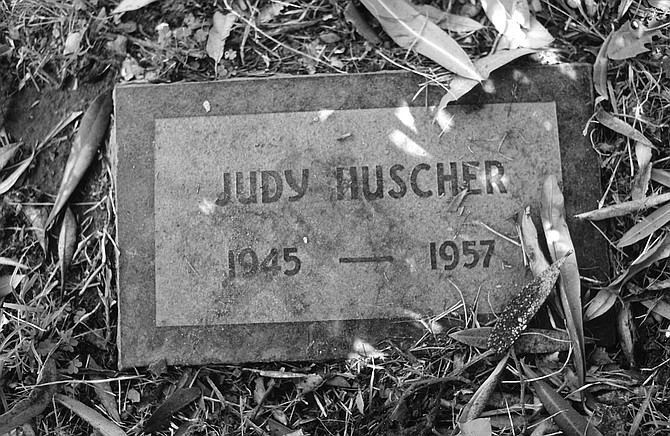
Judy’s stone, which says simply “Judy Huscher, 1945–1957,” sits between Hank Decking and an oleander tree, whose long, poisonous leaves make flickering shadows on her name.
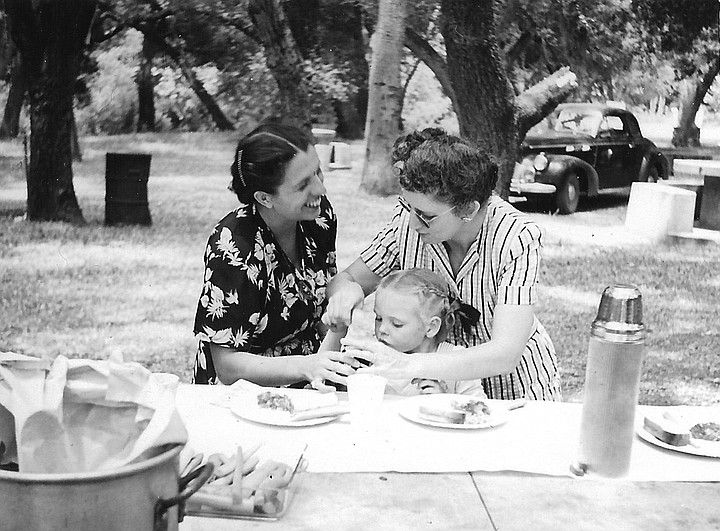
Lorraine Flippen, Judy, and Gladys, Live Oak Park, 1948. Lorraine’s face is blurred with happiness, and Gladys looks efficient and capable, leaning over Judy to scoop something out of a jar.
The body lies in a position of repose, a 12-year-old girl in pajamas, on her bed, in Fallbrook, California. Her blue eyes, though open, see nothing, and for ten more minutes, no one sees her. No one knows yet that the sheets and Judy’s pajama top are stained with chocolate, that her neck is stained with chocolate, that a section of yellow toilet paper on the bed beside her is stained with chocolate, or that her arms are folded across her chest and will not be, cannot be, unfolded again. No one knows that a spoon lies balanced on her lips.
In the kitchen, the Sunday-morning light has long fallen on a saucepan, a coffee cup still puddled with brown liquid, a jar of Sanka, and an empty brown bottle of strychnine, from which the label has been peeled. No one has eaten breakfast here or read the paper or turned on the radio to hear the weather forecast for March 31, 1957. There’s an empty carton of chocolate ice cream in the trash can. In the dining room, four pill bottles and a handwritten note rest on the table, high above the head of the woman stretched out on the floor, snoring through the morning she had meant not to see.
Dean,
I told you last October I was too weary and then to get the terrific shock after I had tried so hard. Well, maybe this is what you wanted??
Best to you,
Gladys
Please thank Johnsons and Rileys.
Then, as an afterthought, in shaky red pencil, nearly illegible:
If you had stayed away as you desired I think I could have come out of it. You tantalized me.
A horse stands at some distance from the house, waiting for tires on the driveway, the sound of footsteps, the approach of hay. It’s 10:30. Judy’s father, Carroll Dean Huscher, is already in his car, driving slowly through downtown Fallbrook, population 3000, the shops closed and silent, his daughter’s horse waiting to be fed, his daughter’s body undiscovered, unseen, the clouds dissolving like footprints in the sky above Knoll Park Lane.
Talk
Around town, they will say she was given strychnine in an ice cream cone. They will say Gladys told Judy that if she went to bed early, she could have ice cream. They will say it was pudding, hot chocolate, a milkshake. They will say that Mrs. Huscher (Mrs. Husher, as they will unconsciously revise her name) spent quite a bit of time stuffing toilet paper into Judy’s mouth to keep her screams from arousing the neighbors. They will say it’s a black spot on the town.
They will not believe Gladys did it — not the home ec teacher, not the Girls’ League advisor, not the woman who taught you to set the table and make white sauce. Some, including her family, will say Carroll drove her to it. Some will say she was out of her mind with love for him, and when he left her, she came unhinged. Some will say he beat her, that he beat Judy, that she did it to protect Judy from him. Darker still, that he molested Judy. “Maybe he abused her, or maybe he was going to abandon them both,” said a man who knew Judy from church and school. “He could get rid of both his problems. People were saying how it didn’t take him long to get a new girlfriend.”
Children will come to their own conclusions. “The children who knew Judy,” said a woman who was 11 when Judy died. “What were we supposed to do? Knowing that she was dead, and, we were told — absolutely — killed by her own mother. How do you file information like that? Under what?”
“Judy wasn’t gorgeous or brilliant,” said a man who was in Judy’s sixth-grade class. “She was just as smart as the rest of us, but her mother was really educated, and that wasn’t good enough for her.”
Some will have nightmares. Some will forget about it. Some will talk about it in the new high school home ec room, the one Gladys was busy moving into that weary, unbearable spring. Some will stay in Fallbrook, and some will move to other states, countries, continents. They will grow up and have troubles that make them wonder what really happened 45 years ago and what they have just imagined.
“As we repeat a story to ourselves, in our own mind, some flaw in the accuracy of that story becomes embedded as part of the ‘memory,’ ” said another classmate. “Most of us trust our own memories.”
The memories they trust are part fiction, part fact.
“…I will tell you what I know, based on what my older sister and mother told me way back then,” said still another classmate. “Mr. Huscher got his divorce. I wouldn’t know if he had played around or had good reason to get out of his marriage. But a few years later, he was remarried and wanted his daughter to live with him and his new wife. He prevailed in court and was awarded custody. In the night (or final weekend) Mrs. Huscher retaliated by cooking up a good mug of delicious hot chocolate and served her daughter some laced with strychnine. She herself took only enough sleeping pills to conk herself out. When they found her later, she was sleeping peacefully and very much alive. But Judy had died. What a coward this lady was…fast asleep while her daughter suffered.”
As they go on forgetting and remembering, moving away, staying on, Carroll Dean Huscher will live for 31 more years. He will store Judy’s things in a box — 25 figurines of animals, a vase the size of a thimble, a Mickey Mouse bowl that says “Hello Judy,” a postcard of a deer. In the basement of the San Diego Courthouse, someone will file a tight dark spool of film containing documents from the trial. Transcripts, reports, certificates, and forms will be entombed in the library, the sheriff’s archives, the coroner’s office, the bureau of vital statistics.
In Fallbrook, the memories of all three of them, false or true, bitter or fond, will move like the Mexican ghost La Llorona, the woman who, having killed her own children, haunts the streets, crying as if to remind you that the worst thing of all can happen, the thing you could not before imagine.
Dean
Judy called him Daddy, of course, and his wife called him Dean, but everyone else called him Carroll. He was small, thin, and bowlegged, partial to bow ties and cowboy boots, though not at the same time. He wasn’t a handsome man, really, but his glasses, his high forehead, his pointed nose, and his close-cut oiled hair made him look congenial and spruce, especially when he was clapping his hands together at the end of a good joke.
On that Sunday morning in 1957, 49-year-old Carroll Huscher was a successful man.
“A signal honor was bestowed on Fallbrook’s popular Carroll D. Huscher last week,” announced the Fallbrook Enterprise, “when he was elected President of the National Frozen Food Locker Institute at a huge meeting of members attending the industry’s annual National Convention at Hotel Morrison, Chicago.”
Food had always been his livelihood. At 10, he delivered it, at 24, he helped his father sell it, and at 31, he preserved it at Huscher’s Froz-N Foods, which he later called “C” Huscher’s Meats. There you could freeze the deer you shot, the pig you raised, the side of beef you intended to eat all winter. You rented a drawer, large or small, and after Mr. Huscher cut and wrapped the various parts, into the drawer they went, all ready for you to pick up once a week on your way through town. He sold regular cuts of meat too, and frozen vegetables.
“Mr. Huscher liked kids,” remembered a woman who shopped there as a child. “When I’d want to go into the locker with Mother, or any other child wanted to go in with his or her parent, Mr. Huscher would be buttoning up fronts, rolling up sleeves, and wrapping up little ones right along with the parent. All the jackets were for adults, so much rolling, wrapping, and buttoning was necessary (and then we probably looked pretty bizarre!). If you didn’t go into the locker but waited out in the main room and Mr. Huscher wasn’t busy, he’d chat with you, something most adults aren’t comfortable doing.”
Mr. Huscher kept his name on the meat locker even after he left the daily operation in 1955 to open a strawberry freezing co-op a block away.
“My sister and a lot of her age group worked evenings at the strawberry plant processing berries for freezing,” said a graduate of ’55. “They washed, sorted, picked rot (the worst job), and put them in freezer containers,” five-gallon gold tins with lots of sugar on top.
“I remember him opening the strawberry packing plant — it meant lots of jobs for people in Fallbrook,” said the son of a high school teacher.
Carroll and Gladys had been married for 23 years, but by 1957 they weren’t living together. Gladys and Judy lived in the house on Knoll Park Lane, and Carroll lived in the strawberry plant. The reasons for this were about to become public knowledge.
He started his car on Sunday morning, March 31st, and set out to see Judy and feed her horse. The weather was mild and encouraging, the cool, bright spring that came every year with its orange blossoms and roses and pink India hawthorn hedges.
In downtown Fallbrook, the shops were closed and silent, the windows full of stuffed rabbits and Easter eggs, the sorts of things Judy would like. On Valentine’s Day, the last holiday that had involved gifts of chocolate, Mr. Huscher had driven through town with two Valentines, one for Gladys and one for Judy, because this had seemed like the best course, but it wasn’t. Gladys refused hers, and then Judy said, “Why are you so mean to my daddy?”
He turned left onto Knoll Park Lane. It was a street, then, of respectable teachers and plumbers and shopkeepers, a street of arrival and relative prosperity. The grass in the yards was bright green. He knew the neighbors up and down the street: Leighton Harrison of the drugstore, his boys Eddie and Kermit, Bill Toomey of the high school, the Reeds, Ogdens, Aabergs, and Earls. He wasn’t really one of them anymore, but his daughter’s horse was waiting to be fed, and Judy was waiting too, in his mind, because he’d told her he was coming when she called to say good night.
The newspapers were still at the curb, though. Two fat Sunday papers, the Union and the Times. “It startled me for a second because the youngster is always out to get the funny papers,” he told police.
Judy had seemed fine the day before. When Gladys picked Judy up from the strawberry co-op at 4:30, Gladys had complained about how many hours it took her to buy supplies for the home ec students — “as many hours on a Saturday, when she wasn’t paid to work, as on weekdays, when she was.”
He parked the car and turned off the ignition. It was 10:35 a.m. No one came out, and no one appeared at the living room window when his car door shut. He walked behind the house to lead the horse up for water, passing, as usual, the window of his former bedroom and Judy’s window, where the blinds weren’t open. There was a gap of four inches, he noticed. He walked on and fetched the horse, then led him to the trough. There’s nothing to do while a horse drinks, so he walked back to the front of the silent house. That’s when he noticed the shades were down in Gladys’s room too. The shades were down, and the light was on.
“Something about it startled me, so I came around and took the horse back and tied him up real quick and came and looked in the window, here, the youngster’s.”
At Judy’s window, he cupped his hands around his face. Everything changed then, past, present, and future. “I shaded my eyes from the sun and I seen that her lips were blue.”
He’d worked at an undertaker’s before, and he knew how a body looks. Her bed was so close to the window that he could see the strange color of her lips, the teaspoon that was balanced across her mouth. Still, he reached in his pocket and found a 50-cent piece. He tapped hard on the window, to attract her attention, but she didn’t move. She didn’t move at all.
He had a key to the house, of course, so he went to the service porch and unlocked the back door. He shoved it open, but the chain was on. He went back to the yard to find a stick, then used it to push the chain up and down, trying to free the knob from the slot. It didn’t work, so he slit the screen, reached in, and slid out the chain.
It was then that he saw his wife.
“I saw Mrs. Huscher. She was lying on the floor with her head towards the kitchen door, and her feet towards the hall door going into the bedroom, and she was snoring.” Snoring in spite of how close she was to the door he had just rattled and fiddled with and poked and pushed open.
“And I turned her over on her stomach. She was on her side. I turned her over on her stomach, removed her glasses and tried artificial respiration, and I got nowhere. I ran into the bedroom to see how the child was. I was sure she was gone. I found her in the condition you see her in, cold and stiff, rigor mortis had set in, and a spoon was laying across her mouth, and I picked up the spoon and as I picked up the spoon, I realized that I had picked up something that wasn’t right, and I dropped it, and there was also, it looked like a piece of Kleenex, or a roll of toilet paper, and I didn’t know whether it looked like it had been a gag or not, but it had the appearance to me that it could have been used for such, and I came out here and then into the dining room, and I called Dr. Powell and he was out here within three or four minutes, and he took over.”
Dr. Powell had been in Fallbrook since 1941. He delivered babies and saw older patients too, such as Gladys, for whom he had prescribed the pills that were collected on the dining room table.
Dr. Powell told Mr. Huscher that his wife was in bad shape and that his daughter had been dead a number of hours. He assured Carroll there was nothing he could have done for Judy. He said it was too bad, though, that Judy hadn’t lain on her side when she was vomiting. “Maybe she could have gotten rid of some of it,” he said.
“Up to then,” Carroll told the police, “he didn’t know anything about this damn strychnine, and that stuff, so I don’t know, I’m just relating the conversation.”
Dr. Powell called an ambulance to take Gladys to the hospital, and one of the Harrison boys came out to watch. He wasn’t the only one to notice the police cars, of course, the going in and coming out. In a town where the constable’s usual job was to grab Carlin Yokum by the ear and make him roll the stop sign back to its place on the corner of Main and Alvarado (Carlin and his friends were always hiding the sign behind Westfall’s in hopes there’d be a crash), somebody was bound to tell somebody why there were cops at the Huscher place on Sunday.
It was one o’clock when Deputy Bob Majors, head of what was called the crimes of violence division, walked into the house. He wore a dark suit, a white shirt, a tie, and a hat. His steel-rimmed glasses were round and official-looking, like the hat. He was there to detect things.
Judy was still in her bedroom, but Gladys was gone. A sergeant was taking photographs of Judy, of the kitchen sink, of the ice cream carton in the trash. Another sergeant was dusting for fingerprints. Carroll Huscher had been in the house with his daughter’s body for two and a half hours when Deputy Majors and the coroner sat him down for the first interrogation.
“Would you state your full name, Mr. Huscher?” Majors asked.
Carroll stated it, but the deputy wrote it down wrong. “Harold B. Huscher” Majors wrote.
“And your age?”
“Forty-nine.”
And so on, through the address, Judy’s full name, his wife’s full name, all the easy questions.
“And now, about how long have you been estranged from your wife, or separated and not living here?” asked the deputy.
“Better than 90 days,” Carroll said.
“And during that time, the daughter has been living with her. Now, as I understand it, yesterday you had the daughter with you for part of the day. Is that right?”
“From a quarter of one,” Huscher said, “to approximately 4:30 in the afternoon.”
“Did you come here to the house and get her?”
“Her mother brought her to me and came and picked her up.”
“Is that a usual circumstance?”
“That is the usual circumstance. Either I come here and get her or she will bring her to me.”
In those days, Fallbrook was a small town with the usual small-town attractions. The air-conditioned Mission Theater was three short blocks away from Huscher’s business, and on the weekend of Judy’s death, the main feature was Oklahoma! The soda fountain was two blocks away, as was Reader’s store. Sometimes, at the far end of Main Street, a company like a traveling circus would lay down a wooden floor, set up a canvas tent, and let you skate all day for 25 cents. A lady played the organ, and when she stopped, you stopped.
“It was the kind of town where you could walk up Main Street and not get hit by a car,” said a woman who was 16 in 1957. “We never locked our doors, never locked our cars, everybody knew everybody else. You could walk to the Mission Theater and back after a movie in the dark without being afraid.”
“Now briefly,” asked Deputy Majors, “what is the reason that you and your wife are separated?”
“Well, briefly,” Carroll said, “is that I apparently couldn’t satisfy her in any shape, way, or form, just a condition that piled up over a number of years, and I felt that if I would move out of the house — I asked in about last October. I thought it would be best, and she said that she would prefer that I would stay here but come and go as I please, if that was agreeable.”
But it wasn’t agreeable.
“About Christmastime or shortly before, she said she felt that maybe I was right, and she was wrong, and possibly that I should leave the premises and stay elsewhere, that I would have the right of visitation and have the child and come here and take care of matters, which I have done daily. The daughter has a horse and I have fed it each morning and each evening. I picked up the laundry, and once or twice a week I brought the cleaning woman here, each day of the week, and brought her here and picked her up and taken her back. Our relation has been very amicable, we agreed upon a property settlement between us, it was all arranged so far, and she seemed to be agreeable to it. She’s a teacher in high school and people come in to visit her on that score, but I think it was just a case of too much career in the family.”
Carroll Huscher came close to the truth in that moment. Sitting in his house for those two and a half hours, next to the empty bottles of pills, the strange note, the strychnine bottles, remembering what Gladys had said to him and he to her, he fixed upon their work. It was his work and her work that had driven them apart. They were separated because there was “too much career in the family.” Gladys was weary and he was often gone.
“Now, briefly, what is the reason that you and your wife are separated?”
Carroll Huscher was a private man. He didn’t gossip, and he didn’t talk about his personal life with men at the Rotary. When he drove a baby-sitter to his house and back, he didn’t ask questions about how she liked school, what her plans were for the summer. He was quiet. He just drove.
So when a man he’d never met before, a man wearing a badge and holding a pencil, asked him why he and his wife separated, Carroll Huscher omitted two important details. He never mentioned that he was having an affair, and he never mentioned what might have been considered motive for that affair, his banishment to the living room sofa. Perhaps he hoped these two things wouldn’t need to be known.
“Were you planning on getting a divorce?” the deputy asked.
“Well, Mrs. Huscher had gone to see her lawyer,” Carroll said, “and then I’d talked it over with her, and she told me what she had had to say,” and Carroll went down around the first of March and had the papers drawn up. With the lawyer, Charles Provence, they’d agreed upon joint custody of Judy. “We seemed to have an understanding,” he told the deputy. “If we lived in the same town, I was to have her six months out of the year, and if we didn’t, why, she would have her during the school year, and I would have her at all vacation times.”
They talked a little about the attorney, about Carroll’s occupation, about where he was living, at 129 E. Hawthorne Street, the same address as the strawberry plant.
“Now, do you live there alone,” asked the deputy, “or do you live with somebody else?”
“I live alone.”
“Have you ever been arrested?”
“No, sir, other than for traffic.”
“Now, has your wife been doctoring any?”
“Yeah, she had a, she had a tumble, I think, in November, and injured her neck or back or something of the type, and the local doctors couldn’t do anything for her, and we sent her to a neurologist and a nerve specialist in San Diego, and they worked on her, and she has been under treatment by the local doctor, Dr. Powell — oh, the usual things that go along with a family _. She did have one serious illness last August. She had galloping pneumonia. She was in the hospital for 15 days.” (Whenever the police reporter couldn’t make out what Mr. Huscher had said, he wrote a long straight line to indicate “unintelligible.”)
“Has she been treated for any mental disorder?” asked the deputy.
“No,” Carroll said, “nothing like that.”
Carroll had already told the police, while they were walking through the house earlier, that his wife had threatened suicide. Majors remembered that, and he asked Carroll to tell him when and where those threats had taken place.
“Well, going back,” Carroll recalled, “just for seeming no apparent reason, it was ‘What good am I?’ ‘What’s the use of this?’ or ‘What’s the use of that?’ which didn’t add up, on subject matters. I can’t tell you what the subject was about.”
“I see. Did she state what type of suicide she would commit?”
“Well, it was always she was going to jump off the end of the pier.”
“I see.”
“I heard that so much — well, I shouldn’t say ‘so much,’ but probably on as many as eight or ten times, like the story__didn’t pay much attention__. Just one of those things I considered just part of the conversation.”
“I see. When were you folks married?”
“January 1934.”
“And this little girl, the victim here, is the only child?”
“Only child.”
“Is she your true child, or is she adopted?”
“No, we adopted her. We got her through the court. Down in Superior Judge Joe Schell’s.”
“At what age?”
“She was 16 months.”
In the eyes of every police official who wrote about the case, Judy would not be their “true child.” Carroll Huscher would be listed twice as Judy’s “foster father” and three times as the “stepfather” in the police report. Only Gladys would refer to Carroll as Judy’s “father.”
“I see,” said the deputy. “Had the wife ever threatened to kill her?”
“No.”
They talked about strychnine, how Gladys had asked him to buy some three or four months ago. During the interview, Carroll kept calling it arsenic, something Deputy Majors straightened out with him afterwards and then fixed in the transcript.
Carroll said Gladys wanted him to kill mice using her mother’s technique. “Her mother had lived in this home for some ten years,” Carroll explained, so he knew that old Mrs. Teeple spread the strychnine on a piece of bread and left it lying around for the mice.
“I guess about a week or ten days ago, I was out here,” Carroll said, “and she said, ‘I’m having a little trouble with them,’ meaning the mice, and I said, ‘Didn’t you get them with that stuff?’ and she said, ‘You didn’t give it to me,’ and I said, ‘I did give it to you,’ ” and Gladys told Carroll that she’d gone down and bought some more.
Carroll then had to describe his drive that morning, the startling fact of the newspapers at the curb, the moment that he shielded his eyes from the sun and looked into his daughter’s bedroom.
The deputy listened. He turned to the coroner. “Now, Mr. Creason,” said Deputy Majors, “is there any facts you want to go back over?”
Mr. Creason nodded. “Just one, briefly, Mr. Huscher,” he said. “Can you offer any explanation or give any reason why your wife might have wanted to your daughter any harm?”
Mr. Huscher must have been startled by the question. “What’s your name?” he asked the coroner.
“Creason.”
“There’s . Pardon me. There’s a dozen things go through your mind in a situation like this.”
“Maybe I could make it a little clearer for you, Mr. Huscher. Has your wife and daughter been close?”
“No, they haven’t been real close, and that was probably the reason she and I, in our separation… I felt that the two of them just weren’t good for one another. My mother felt the same way. In fact, I had received a letter from my mother less than a month ago stating the fact that she hoped I could get a place where I could take Judy and have proper supervision and discipline, and Judy and I both would be far better off.”
“Have you and Judy been ?”
“No.”
“Is there any possibility that your wife might have resented your actions towards your daughter, _ being close?”
“Well, I am sure _ , but I am afraid that was, in part of it.”
“You think there was a jealousy here between your wife and your daughter, then?”
“I’m afraid there was. Because I can see now, I can, I have seen just recently why the welfare department thinks it best not to let a couple over 35 years old, or women particularly over 35, have a child, a tiny child, because their patience are not as long, and we have had too much freedom up to that many years without a youngster. In other words, when a woman is 38 years old, normally she’s 40 or 42 years old, 45 years old [Gladys’s age when they adopted Judy], hell, she’s got a family practically raised and half married.”
“Have you and Mrs. Huscher ever conversed among yourselves that possibly she strongly indicated to you that she was jealous of the child? Has she ever ridiculed you for being so close to the child?”
“Well, I wouldn’t say ridiculed, no, I wouldn’t say ridiculed. But she felt, as I say, that maybe I wasn’t strong in disciplinary problems as I should. She ridiculed me for that. She is a perfectionist and in her business, and having qualified in her particular line, which is home ec.”
“Was she a schoolteacher?”
“Yes, she’s a schoolteacher. She’s presently employed as a schoolteacher, yes, in the high school, and she is a topnotcher, and she is a perfectionist. Well, she wanted the child to be just a grown, I mean, an adult teenager — a girl, in fact, a child growing up that young is just not that way. She thinks, ‘Do it this way,’ and the child wants to do it another. Now that was a conflict, I am trying to put over to you. As far as hatred, no, I couldn’t say that.”
“That’s about all?”
“Have I made myself clear to you?” Carroll asked.
“Yes,” said the coroner. “You have.”
They weren’t finished, though. There was still the suicide note. They had to sort out what it said and where Carroll had found it, and then later they’d try to figure out what it meant.
Carroll reiterated that he’d found the note lying on the pill bottles. He said his name was facing up. The detective asked Carroll to read the note aloud.
“ ‘As I told you last October, I was too worried,’ ” Carroll read, although the word they eventually settled on was “weary.” “ ‘And then to get the terrific shock after I had tried so hard, and maybe this is what you wanted?’ ”
Deputy Majors noted that this part of the letter was written in green ink. Then he asked Huscher to read the part written in red pencil, the part that was just “little scribbles.”
“What does that say?” he asked Carroll.
“ ‘Why you had stayed away,’ this looks like. I can’t make the next one out. Maybe you can.” Huscher handed the note back to the detective.
“I can’t,” Majors said. “It looks like ‘I think I could have some.’ ”
Huscher took the letter back and studied it. That didn’t make sense to him, because there were still three words after “some.” “ ‘I think I could have come out of it,’ ” he offered.
“And then on the other side,” Majors said, “it looks like it says, ‘You tantalize me.’ ” Then Deputy Majors said something the reporter couldn’t make out, and Mr. Huscher made an unintelligible reply.
“Okay, that’s all then,” Majors said.
It was two o’clock in the afternoon. There were funeral arrangements to think about. Carroll had to call his mother and his sisters. At some point, he would also have to tell the other woman, the woman he’d been seeing, the woman he had not mentioned. Everything was different now. He walked out of his own house, but it would never really be his house again, just as this would cease to be his town. At some point, he would collect Judy’s figurines, her clothes, and her photographs. He would take them all with him. He would sell the house, the business. But he would not sell Judy’s things, or give them away, or part with them in any shape, way, or form.
Gladys
She was born Gladys Bowes Teeple on August 24, 1901, the third unwanted daughter of an unsuccessful Minnesota salesman and clothier. There were “severe financial problems,” she told one of two court-appointed psychiatrists, which made children “unwelcome burdens.” She grew up, she went to college, and she made her way west by teaching home economics, first in White Bear, Minnesota, and then in El Centro, where her sister Ruth was living. From there Miss Teeple went west to Oceanside-Carlsbad Union High School and was featured in the 1933-4 yearbook above the epigraph “According to the situation.”
When Dr. John Robuck and Dr. G.W. Shannon were asked to evaluate her sanity 23 years later, Gladys remembered this period of her life as sacrificial. She had “shouldered the responsibility for support of her parents upon leaving college when she first took employment as a teacher” in 1923. She said that for ten years she had supported parents who, in her recollection, had not wanted to support her.
But Ruth and Madalene, Gladys’s older sisters, were helping too.
“My grandmother lived with Ruth,” recalled Elizabeth Sage Gord, who was Gladys’s niece and Madalene’s daughter. In later years, Gladys’s mother did live with the Huschers in Fallbrook, but in the early 1930s, when Gladys’s parents got what amounted to a geographical divorce, Eleanor Teeple left Minnesota and moved in with Ruth. Edgar Teeple, Gladys’s father, stayed in Minnesota and lived with Madalene.
Elizabeth also recalled, fondly, that Aunt Gladys took a trip to Hawaii in those years and had a lovely time. That she had a set of silver monogrammed with a T for Teeple. That she was well-loved by the family.
Perhaps Gladys felt her own sacrifice more keenly, as the unmarried sister, the one who had to use her own salary, not her husband’s, to support her parents. Or perhaps, sitting in jail and waiting to be tried for the murder of her daughter, she knew she needed to point out those times — numerous times, difficult times — when she had been a good daughter herself.
Gladys Teeple met Carroll Huscher in the fall of 1933, in the fourth year of the Great Depression. She was 32 years old and well on her way to schoolmistress spinsterhood, carrying around with her the recent advice (of a friend? a sister? a doctor?) not to devote herself to her parents, but to marry instead.
Carroll was six years younger than Gladys. He had dark hair and a promising business. At 26, he worked with his father at Huscher’s Grocery, which in a time of nationwide want and failure, in a town of fewer than a thousand people, Fred E. Huscher and son had had enough cash or credit to enlarge. Right after enlarging, the Huschers had paid for a new storefront, new paint, and new wallpaper. It wasn’t just the store either. Carroll Dean Huscher had gas and a car to drive to Idyllwild just for pleasure on New Year’s Day. He’d had gas and a car to attend, with his friend Harry Palm, a party at the Hotel Del Coronado.
Gladys Bowes Teeple was short but not small, not lithe, not flapper thin. Where Carroll was hard, she was soft, soft in the nose, chin, ankles, and shoulders. Miss Teeple (so old not to be married yet!) had an oval face and deeply recessed eyes. She wore her dark hair marcelled. A woman who’d been her student in Oceanside, who became the wife of the contractor who built the house on Knoll Park Lane, said Miss Teeple was “very pretty, very attractive, better than average.” Perhaps this helped her to attract a man six years her junior — Gladys was old, for a maiden, and Carroll was short, for a man — or perhaps they simply loved one another, found each other perfect in every way.
In any case, Carroll D. Huscher courted Miss Teeple for three months. When they married on January 13, 1934, they did so before a justice of the peace in Florence, Arizona, not in the pretty white clapboard church on the hill above Huscher’s Grocery. Although the Fallbrook Enterprise recorded practically everything the Huschers did (“Mr. and Mrs. F. E. Huscher celebrated their 25th wedding anniversary with a family dinner party on Sunday”), especially if it required a motor car (“Miss Florence Huscher accompanied Harry Palm to Idyllwild to enjoy the snow sports,” and “Mr. and Mrs. Fred E. Huscher and daughters Florence and Winifred drove to Riverside and San Bernardino, returning by way of Chino and Corona”), no notice of the marriage appeared there, no mention of their route home from Arizona, no party in honor of Carroll’s new bride.
Within a year, Mrs. Gladys Huscher had become the homemaking teacher at Fallbrook High School, a job with spectacular facilities built by out-of-work men and New Deal dollars. Named the best rural high school in the state, it consisted of ten teachers, a pool, an elegant Spanish-style building, a home ec facility, a gymnasium, and something called the Girls’ Practice House, or Model Home, a place in which to iron, sew, cook, and entertain, a dollhouse built to human scale.
Gladys was the only married woman on the staff, which was fitting, since she was preparing young women for life, not examinations. The model home and home ec building stood high on the highest hill of Iowa Street, looking down on Huscher’s Grocery, Mobilgas, Safeway, the stationer’s, a smattering of houses, the baseball field. Through the large-paned windows of the home ec building, stocked with Singer sewing machines and six aqua-tiled kitchenettes, you could see crows, black phoebes, white streaks of clouds, and the blue, un-Minnesota-like sky. They put on a musical that year, Hearts in Holland, that the students wrote all by themselves, and Gladys sat at the sewing machine for hours to make costumes.
The Huscher name was already known at Fallbrook High through Carroll’s younger sisters, Florence and Winifred. In 1934, the painstakingly typed and mimeographed Monthly Buzz quipped, “Just Suppose That… The Spanish teacher were a Trademark instead of a Brand… The commercial teacher were a Faulsitt instead of a Truitt… Florence were a Waker instead of a Huscher,” and so on through the surnames of the staff and student body.
It was the kind of joke the Monthly Buzz specialized in, but Gladys Huscher was a Waker, of sorts, rousing girls in middy blouses to the almost certain future: motherhood and domestic toil. Homemaking was a major in those days, a path you could choose for yourself and then write on the forms you filled out each semester.
“The vocational homemaking and related courses are planned to help the girl of today not only to live as a member of her family group, but to live well,” said the student information packet of 1936. “Through these courses the girl will learn interesting and approved ways of doing those things every girl wants to do in her home.
“In the course Homemaking I, the girl will study food preservation; selection, preparation, and serving of breakfasts and luncheons at home and for school; personal home problems and family relationships; factors influencing health; care of the body (skin, throat, mouth and teeth, hands and nails, eyes, nose, hair, and feet); simple first aid remedies; invalid cookery and tray arrangements; arrangement and care of a girl’s room; use and care of materials suitable for shorts, brassiere, and a wash dress. She will also make shorts, brassiere, and a wash dress.”
Having mastered invalid cookery, personal home problems, and the construction of brassieres, the Homemaking II student would construct a silk blouse and a wool skirt and study the acquisition of becoming footwear. Of course, there was also the baby’s layette, child care and management, the selection of food to meet the needs of oneself and family, “and every day courtesies for harmonious individual, family, and community relationships.”
Although Mrs. Huscher taught interesting and approved ways of doing those things every girl wants to do in her home, she produced no children.
“We felt we could not afford it,” Gladys told Dr. Shannon.
In 1939, after just five years of marriage, someone told Gladys to leave her husband.
“I was advised to leave him,” she said, “but I loved him too much.”
Carroll was president of the State Frozen Food & Butcher Association that year, and Gladys had a nervous breakdown. She cried a great deal. She cried so much that she went all the way to Pasadena to see a psychiatrist, who diagnosed her with a term she remembered ever after: “involutional signs,” the psychiatrist said, referring to the “regressive alterations of a body or its parts characteristic of the aging process; specifically, decline marked…in women by the menopause.”
Gladys was just 38 years old. She went back to teaching what the school called “art and its relation to food, silver, dishes, and linens.”
The war came, and Carroll became a noncommissioned officer. He was in charge of the Camp Pendleton commissary, receiving and issuing all food supplies — a million dollars’ worth of groceries went through his hands every month. He had his work and he had Boots, his beloved half-Morgan/half-Arabian horse, and Gladys had her work. She taught girls in bobby socks to make Eggs à la Goldenrod, to serve their mothers from the left at the annual mother-daughter tea, to wear gloves, to wash gloves, to iron tablecloths, to sew pin-tucks into batiste.
The Monthly Buzz became the Monthly Warrior, and in the “What’s Buzzin’, Cousin?” column of October 1943, Frances Geyer joked, “My next stop was Homemaking I, where I found the Freshmen trying to poison themselves. Imagine, them offering me some of their ‘delicious’ food!”
Mrs. Huscher kept cooking, she kept sewing. Although one of her closest friends, Ruby Aaberg, would testify that Gladys had been mentally ill since 1939, the year of that trip to Pasadena, Gladys worked hard and made a good impression. She helped the Girls’ League decorate the gym for the spring dance, the fall dance, the spring dance, the fall dance. She helped them make a Fountain of Youth and a Horror House. Her nephew died in the war, Madalene’s only boy. The war ended, and other boys came home.
With his wife’s teaching salary — so sure, so dependable — Carroll could take a chance on a new venture: frozen foods. Huscher’s Froz-N Foods was right there on Alvarado Street, three blocks from the high school, close enough that high school boys could run over in the Huschers’ car and pick up meat for home ec classes.
But the Teeple women tended to break down at menopause, and Gladys already knew what that felt like, how it had gripped her in 1939. By the time the war ended, she was 44. She wore glasses. She’d become one of those women in the ads for Dr. Pierce’s tonic, gazing at numbers on a blackboard: 43, 44, 45, 46…50.
Physicians call this period menopause. It is the dreaded change of life. Women should face this period with well-balanced health or dangerous symptoms may appear. This is the time when deficiencies in general health must be helped. Every woman approaching middle age should take Dr. Pierce’s favorite prescription, Blended Herbal Tonic.
Meanwhile, Dean was 38, no fatter than he’d been on their wedding day, a thin, small, dark-haired man who hadn’t even begun to go bald. The Fallbrook Enterprise was full of babies and children, children and babies.
On Sunday, Mr. and Mrs. N.A. Waller and their children, Ann and Mary, and Mr. and Mrs. R.J. Beeman and their son, Bruce, drove to Palomar Mountain, where they had a delightful day. The children experienced their first snow.
Every week, the Enterprise ran a syndicated column from Washington called “Memo to Mrs. Housewife”: Did you know that baby sweater frames can be purchased that will “grow” right along with his or her nibs? Preventing shrinking or stretching they come in adjustable sizes with a helpful booklet of washing instructions.
In 1946, a child came up for adoption, a one-year-old girl. Another Fallbrook family, a man named John and his wife, were the girl’s foster family. Mr. and Mrs. John X wanted to adopt the child too, and why not? A beautiful blond girl, so perfect-looking, so sweet. But they already had three children of their own.
The welfare department thought it best not to let people over 35 adopt babies, but in 1946 or early 1947 (accounts of Judy’s age at adoption contradict the dates given in various reports, and the official adoption record remains sealed) Judge Schell awarded Judy to Carroll Dean and Gladys Huscher, worthy, hardworking, childless people, a second-generation Fallbrook grocer (age: 39) and his Minnesota-born wife (age: 45).
Not everyone in Fallbrook agreed with Judge Schell. Some thought the Huschers were too old. “It was politics. Carroll pulled strings. Out of the clear blue sky they adopted her.”
Still, Judy became theirs, and for the first time in 23 years Gladys stopped teaching homemaking in order to make home.
The 1947 yearbook shows Gladys stirring something at the model house’s model stove, spruce in her glasses and her curled gray hair, a button-up dress with three-quarter-length sleeves. Her students wrote a caption that called her “efficient and capable…fastidious but chic…digressive…now home practicing what she preached.”
Now she had a child to take to the Memorial Day picnic at Live Oak Park. Tree games for children, the egg race, musical chairs! Judy would be old enough for all of it someday, would be in her friend Elta’s class at the grammar school, perhaps, could learn to sew and cook with her mother, to make shorts, a brassiere, and a wash dress.
Memo to Mrs. Housewife: Either the full or slim silhouette is stylish this year. But, ladies, they’re both fitted closely to the figure, accenting a small waistline and the natural curves.
By Christmas of 1948, Judy was old enough for play school with Cal and John and Katie. In the photograph that someone else’s mother kept (the names dutifully recorded on the back) little Judy holds a doll. She seems, in fact, to be a doll, a three-year-old girl-doll in a dark cabled turtleneck sweater, the corners of her red lips turned down, her eyebrows a neat pair of curves. Her face is pure and unimprovable, perfectly round, wisps of hair escaping from two minutely cinched rows of braids.
Judy wears her hair the same way in another photograph, one in which Gladys and her friend Lorraine Flippen (who would die of polio in Mexico not too many years later) laugh together and help Judy to a picnic lunch. A glass tray of carrots sits on the table beside a huge tin pot. A silver-tipped thermos gleams like a silo. Lorraine’s face is blurred with happiness, and Gladys looks efficient and capable, leaning over Judy to scoop something out of a jar, to help her dear little girl, her passage to the picnic, to the world she has taught as a sort of puppet show all her adult life. The trees of Live Oak Park are thick and dark behind her, casting gray shadows on the grass.
“She was an adorable little girl when they first got her, but they just didn’t do well with her,” said a former student. “She was completely out of hand.”
In 1949, when Judy was four, Gladys Huscher became severely depressed. She wanted to kill herself but didn’t. That was the year Carroll Dean was president of the Chamber, the year he had his picture taken with Congressman Richard Nixon and a federal judge’s wife and the chairwoman of the San Diego County Republican Central Committee.
Memo to Mrs. Housewife: Junior can now be tempted to brush his teeth with a new tablet dentifrice that tastes like candy. All you do is take the tablet, a sip of water, then chew and brush.
Household Good
In September of 1950, Judy started kindergarten and Mrs. Huscher returned to Fallbrook High, her hair the color of iron, her smile determined. “Nothing lovelier can be found in woman,” said her yearbook caption, “than to study household good, and good works in her husband promote.”
In 1951, Carroll Dean Huscher helped fight the federal government for Fallbrook’s water rights, and Fallbrook won. Judy went to school with her hair cut short, uncurled, unbraided. She wore a frilly plaid jumper in Mrs. Jameson’s class.
In 1952, Carroll Dean and Gladys (in a becoming dress, in a becoming hat) attended a dinner for William Knowland, state senator, where they were seated between a writer for the L.A. Times and the president of Bandini Fertilizer.
Judy entered Mrs. Gosnell’s third-grade class in 1953 with Suzie Johnson and Carlin Yokum. Her hair was chin-length, the bangs high above her eyebrows, her eyes far apart, and her nose quite flat. On picture day, she wore the dress with the big plaid collar.
“I felt sorry for Mrs. Huscher,” said a graduate of 1955, “because, you know, they adopted Judy. And I think motherhood was not very natural for Mrs. Huscher because she just couldn’t control this young girl. I mean, boy, she would just get so frazzled. I remember one particular prom, it was a Christmas prom or something like that because we were making soap out of Lux flakes and water. You know, making a lake out in front of the gymnasium, and Mrs. Huscher was there — that must have been part of her advisor thing — and Judy was just out of control. She was trying to kick the stuff we were making, and the girls were screaming at her. And I just remember how frustrated she was that she could not control this young lady. At all. And I couldn’t either when I baby-sat. I mean, [Judy] would just tell me, ‘No.’
“Judy was about, oh, I’d say, nine years old. Very spoiled. I hated that. I mean, I did not like baby-sitting for her. And my mother said, ‘You should baby-sit for her. I said yes for you.’ And I’d go, ‘Oh, no!’ You know, you’d tell her to go to bed and she’d say, ‘I don’t have to.’ She was a little pill. She didn’t think she had to do anything a baby-sitter told her to do, and I’m not real assertive, so it was very difficult for me.”
“She was as mean as she could be,” said a woman who was a year behind Judy in school. “I remember coming home in tears one day.”
“She was unattractive, with red hair and missing teeth,” recalled the son of a high school teacher. Growing up, he used to see Judy at meetings of the 50/50 Club, the youth group of the Methodist church. “She was always running, always wild. Today, they’d probably say she was ADD.”
Judy became a Camp Fire Girl, attended the meetings at Live Oak Park and other girls’ houses. She heard the talk about character, crafts, outdoor interests, and the annual peanut fund-raiser. She met with Firemakers, Woodgatherers, Trail Seekers, and Torch Bearers.
“As an adult, looking back on the girl I knew named Judy, I would say there was something wrong with Judy,” said one of the Camp Fire Girls. “That doesn’t mean she might not have grown up to be just fine. But as a child, there was something ‘off’ about her. She was too loud, she laughed inappropriately (at inappropriate times), and she seemed to enjoy hurting others. Having said that, I also can’t remember a single specific instance as an example. One of my strongest memories is that I remember her teeth.… I didn’t like seeing them…because when she was going to be mean, she’d smile and show a lot of teeth.”
A younger girl who saw her from afar at Live Oak Park also thought there was something wrong.
“I wonder what I really thought at the time, but looking back, what I recollected was that you just felt uncomfortable because she didn’t seem to have any idea how to do among people. You felt sorry. There was something strange, something odd. She was in trouble. And you didn’t feel she was mean at all. You just felt she was lost.”
Judy turned ten. Along came the Slinky, Silly Putty, Peyton Place, and Elvis. Judy got a horse (she was a town girl, but Carroll was in the Rider’s Club), and they tied it in the front yard. Or sometimes Judy tied it; sometimes she forgot, and the horse wandered off.
Gladys kept teaching and smiling.
“Mrs. Huscher, I remember,” said a graduate of ’55. “The first thing we made was Eggs à la Goldenrod — creamed eggs on toast. Mrs. Huscher was a wonderful person. She was always immaculately dressed. I don’t know if she was quite in touch with the way things were in the ’50s, but she was — we all liked her a lot.”
With this student, Gladys talked affectionately about Carroll and Judy. “She used to talk about her husband and her daughter all the time.”
“She was really in her element as a home ec teacher,” remembered another girl from that class. “As a home ec teacher she was very demanding.” Students starched and ironed the napkins and the tablecloth. “I remember setting the table, and folding the napkins, and the tablecloth had to be the same length on both sides of the table, and mine wasn’t one time, and…she said, ‘This will never do.’ ”
Boys, too, took her classes, learned to form a “family” of five and make white sauce and a stuffed, rolled roast. She’d give her keys to a boy she trusted and send him down to get the meat from Dean at the locker.
“When I was there, she had gray hair, kind of plump — she seemed old,” said one of those boys. “Mrs. Huscher would send me after meat, and I’d get in the clunky old Dodge, and I’d go down to the meat place and get the meat. It would be ready for me — I didn’t have to go into the freezer itself.
“Some kids did give her a hard time, but I didn’t. I think she enjoyed some of the little jokes and pranks they pulled. I didn’t pull the pranks. I had a granny. I respected older people. Yes, I remember Judy. She was a real brat. I saw her lots of times with Mrs. Huscher. Judy was always barking what she wanted. I guess Mrs. Huscher didn’t know how to discipline her.”
Love, Labor, & Laugh
For most of Judy’s life, she had not just one grandmother nearby, but two. Her father’s mother, Evelyn Huscher Hibbs, lived in town (Carroll’s father, Fred Huscher, died in a car accident before Judy was born), and Gladys’s mother lived with them when she wasn’t living with Ruth or in the Chula Vista Methodist home.
“After we had the child, I was happy,” Gladys told Dr. Shannon, “but I had to go back to work. He has never made a living wage. He is not a good businessman. It bothered him when I had to have Mother live with us for a time.”
“For a time.” This is how it seemed to Gladys, or how she wanted it to appear. Carroll, on the other hand, told Deputy Majors, “Her mother had lived in this home for some ten years.”
The Huscher home had two bedrooms, one for Judy and one for Carroll and Gladys. There was no spare room. Gladys’s mother had her own way of doing things, naturally. Like spreading a little strychnine on the piece of bread and putting it where the mice were.
In the fall of 1955, another person came to live with the Huschers, a live-in nanny. Gladys’s mother was apparently elsewhere at that time. Although Judy was old enough, at ten, to help her mother — to set the table, vacuum the floor, wash the dishes — the Huschers didn’t ask her to, or she didn’t comply.
“She was very hard to manage,” said a home ec student of Mrs. Huscher’s. “That was why they had a college girl to help out with taking care of her.”
The college girl was Bette, a Fallbrook High graduate with impeccable credentials: student body officer, president of the scholarship federation, a member of the Girl’s Athletic Association, class secretary for two years, two years in the house of representatives. “Love, labor, and laugh,” said her yearbook caption the year she left Fallbrook High, a phrase her fellow editors thought was perfect, though Bette wasn’t quite sure.
Bette also took home ec, and she got along well with Mrs. Huscher, who liked things done properly, done well.
“My impression of her was positive,” Bette said of Gladys, “i.e., she was very pleasant all the time, well-groomed, and seemingly a good ‘role model’ for a homemaker (I speak in terms of the ’50s). For me, her class wasn’t very helpful as I came from a family where the girls started housekeeping at age ten. However, I realized that there were many in the class that found it educative.”
The summer after graduation, in June of 1955, Bette had gotten a job inspecting strawberries at the co-op on Hawthorne Street. The farmers were paid according to Bette’s gradings, and since Mr. Huscher was one of the chief officers of the co-op, he’d noticed her, and it was he who approached her for the sitter job.
Bette came to live with the Huschers in their pale house, attractive by middle-class standards, no bigger or smaller than most houses in Fallbrook. “Mrs. Huscher had a sense for interior decoration of that period. She was very tidy. I do recall vacuuming the living room often.”
Bette shared Judy’s room, and in the evenings, Mrs. Huscher was always busy with her work or housework. She treated Bette with courtesy, let her know that she had confidence in Bette’s ability to help out with the house and Judy, but Gladys did not at any time talk about her problems with Bette. “She had a veil of formality with me, always kind and never confiding her inner turmoils.”
As for Judy, Bette said she was “a beautiful child, a little bit Shirley Temple with her golden locks. However, she was a handful, very strung out and unpredictable when she had a mood swing. I recall once when her parents were trying to help her with some homework and she refused to sit still and listen. I agreed to help her, and I had better success calming her down for about 20 or 30 minutes. Today, she would probably be diagnosed with some sort of learning disability.”
To Bette, Mr. Huscher seemed very busy with his business affairs and community activities. Her sister heard bad things about him: other teenagers called him sleazy or slimy. Mr. Huscher made a remark to Bette, once, about a boy making out with her, and she thought that was in very bad taste. But Bette mostly felt neutral about him until the fall of 1956.
“One day, Mr. Huscher approached me and said he would have to let me go because ‘I wasn’t doing enough.’ I was flabbergasted.”
Although Mrs. Huscher had never indicated to Bette that anything was wrong, Bette said, Mrs. Huscher didn’t intervene.
“I thought I earned my keep, as I was their maid as well as their sitter,” Bette said. “When I was leaving, Mrs. Huscher said she was sorry that I was leaving, so I felt perhaps it was solely Mr. Huscher’s decision.”
Gladys Huscher mentioned Bette only twice in the surviving documents: a police interrogation and a psychiatric report. To Dr. Shannon, the female psychiatrist who interviewed Gladys in jail, Bette was simply “the high school girl.”
“During the past two years [Mr. Huscher] has not been himself,” Gladys told Dr. Shannon. “He wouldn’t fix things around the house. The garage is a mess, and he hasn’t done anything to clean it up. Two years ago he sold his locker plant and is in a new business with several other men. They process strawberries, and they are just getting on their feet during the past year. About one year ago, he moved out of the bedroom into the living room. I had to have a high school girl to take care of Judy and keep house for me. Of course, we didn’t live a normal life, and he complained because I was cold but really I was just weary. All summer he was still sleeping out there. Mother came in July or August. Even though he has been making $150.00 per week, I had to pay all the bills. He has had another woman since April. When school opened last September, I was too ill to start, but I went back in October. I had wanted to quit, but he said, ‘no’ — that we needed the money.”
Gladys mentioned Bette by name during an exchange with the police about strychnine bottles. “Where did you keep the strychnine in the house, Mrs. Huscher?” Deputy Majors asked. “That strychnine that you bought to kill the field mice with?”
“I don’t remember,” she said.
“Did you keep it in the house or in the garage?”
“I think it was in the garage. My husband wouldn’t do nothing about the mice.”
“Did you use some on the mice and get them?”
“Yes, I did.”
“What did you do with the strychnine afterwards?”
“I don’t remember.”
“Don’t you remember having it in the kitchen last Saturday night?”
“I didn’t have it in the kitchen.”
“Your fingerprints are on the bottle.”
“They may be there, but I don’t remember. Bette helped me get the mice too, because they were all over the house, and he wouldn’t get them. He was too interested in somebody else.”
That is all Gladys Huscher said about Bette — an offhand remark that her fingerprints might have been on the bottle of poison that killed Judy. Of the possible reasons that a conscientious live-in nanny might be asked to go (jealousy, financial strain, a desire to stop performing imperfectly before a live audience), all seem possible but none provable. According to Carroll Huscher, the illness Gladys mentioned to Dr. Shannon (When school opened last September, I was too ill to start) was “galloping pneumonia,” and Gladys was in the hospital with it for 15 days. It’s peculiar that after an illness, when presumably Mrs. Huscher would have needed even more help, Bette was dismissed.
But Mrs. Huscher’s suspicions about her husband’s fidelity were very strong in the fall of 1956. She told Dr. Shannon that Dean promised to take her places on the weekends and then later refused, which made Gladys fear he’d spent time with another woman instead. Dean told her he was going to Idyllwild, but she checked his odometer and saw that he’d traveled only 30 miles. She confronted him with this, and she told him a friend had seen his car parked at a certain place. He admitted he had been with someone else. At such a time would Gladys Huscher have wanted a beautiful 18-year-old girl near her husband? At such a time would Gladys have wanted anyone to see what was really going on in the home ec teacher’s Model Home?
The Blonde
Subterfuge followed suspicion. Gladys began to spy on her husband, to try to “catch him in lies.” Once, while the Huscher family was in a restaurant, Carroll excused himself to talk on the telephone, and Gladys sent Judy to eavesdrop.
In November, Carroll told Gladys he was going to a business meeting at the Fireside Inn in Escondido (the city where Carroll’s mistress did, in fact, live, so this time there would be no discrepancy if Gladys checked the odometer). A domestic problem of some kind came up, so Gladys called the restaurant. The employee who answered the phone informed Gladys that there was no meeting to interrupt. Gladys put down the phone, and then she picked it up again, calling everyone she could think of. She tried to find him, but she failed.
So she waited up for him. At 3:00 a.m., when Mr. Huscher entered the house (the ornate dining room table, the vacuumed rug), he admitted that he hadn’t been at a meeting.
“I pinned him down, and he admitted that he had a woman and told me her name. Next day I called her up very sweetly and thanked her for taking care of one side of my husband’s life. She was surprised; she didn’t know what to say.”
Mr. Huscher’s version of it, given to police on the day that he found Judy’s body, was that he offered to move out in October because he couldn’t satisfy Gladys in any shape, way, or form, but Gladys asked him to stay. Then, in December, Gladys suggested that Dean go ahead and move out. They went to see Charles Provence, the lawyer friend of Madalene’s, and they worked out the terms of the divorce.
Divorce was still unusual in Fallbrook, although the national divorce rate was rising. A contemporary of Judy’s, one who graduated in 1964, recalled that she didn’t know anyone personally whose parents were divorced until a cousin’s parents separated in 1959. Another, who graduated in 1963, said that when she was in high school, a divorcée in town was raped. The woman’s name wasn’t mentioned, but the ages and genders of her children were specified, permitting everyone in town to identify her.
“This woman was divorced (not acceptable), lived in a small rental house near the back gate to Camp Pendleton (clearly a ‘wrong’ place to live) and didn’t have important friends, etc., in Fallbrook. Hence, she was fair game for the newspaper.”
Since Gladys was the high school’s model of motherhood, the woman entrusted to teach girls the most important lessons they learned at Fallbrook High School, divorce could not have been ideal. A graduate of 1955 said, when asked what she felt she was supposed to learn at Fallbrook High, “How to be a good wife, and how to cook and take care of the family.”
To Carroll, Gladys seemed agreeable to the terms of the divorce, but she was consumed by jealousy. She drove from the house on Knoll Park Lane to the strawberry co-op, which was just one block east of Main Street. Carroll had started living there after the separation, probably since it was convenient and free. It was also very close to the center of town. The shopkeepers knew Gladys by name and by sight, as did their teenaged children. Nearly everyone in town, really, would have known who she was. Nevertheless, Gladys parked her car and walked up to the little block building on Hawthorne Street, where she tried to look through the windows. She tried to see her husband’s lover, referred to in police reports only as “the blonde.”
Gladys told Dr. Shannon that she had agreed to let Dean take care of Judy when Gladys went to visit Madalene, Ruth, or her mother in Chula Vista. Gladys had even agreed that Dean could take Judy with him when he went to visit the blonde, but it seemed deceitful to her later, and she told Dr. Shannon that it was.
“[Gladys] frequently referred to this other woman as an unprincipled person and said, ‘I couldn’t stand the thought of Judy going to live with a person living in deceit.’ ”
Judy, meanwhile, liked the other woman, or she enjoyed the power of saying that she did. Judy said nice things to her mother about the other woman, about staying overnight there and having “nice times together.”
This would have been especially galling since Gladys and Judy were not having nice times together. Judy was 12, nearly a teenager. She was as tall as her mother, though she weighed much less. She liked to run around outside, not to play like a girl. She was a tetherball ace at school. The only schoolmate who remembered her fondly — the only one who did not think there was something wrong with Judy — was the boy who shared a double desk with her, who shared with her the distinction of achieving less, academically, than other children and who was glad to hear the bell ring for the end of recess because that meant the end of Judy’s domination at the tetherball pole.
She had always been this way, physical in the extreme. “I remember taking moving pictures of my oldest son’s first birthday party,” Gladys’s niece, Elizabeth, recalled, “and under the table were these feet that were always moving.” The feet were Judy’s.
“Judy was a handful,” said Elizabeth, who was 23 when Gladys adopted Judy. “Whenever they came to visit, poor Gladys, Judy was everywhere. And Gladys was always having to watch Judy to see that she didn’t do what she shouldn’t. I don’t know that Dean knew how to handle her either.”
When asked if Madalene and Ruth and their mother tried to tell Gladys how to handle Judy, Elizabeth couldn’t recall.
“It’s hard to tell someone how to manage her own child,” she said.
When told that some people in Fallbrook had implied it was Gladys’s fault that Judy was out of control, Elizabeth said, “They have?” Then she said, “It’s true that Gladys wasn’t emotionally prepared for a child like Judy.”
But Elizabeth doesn’t believe it was Gladys’s troubles with Judy that led Gladys to walk into the garage and pick up two bottles of strychnine. “I think it was Dean that put her in a mental state to do what she did.”
He wasn’t really popular in the family?
“Not really. Of course, they accepted him because he was her husband.”
Tantalus
In Greek mythology, there is a favored king named Tantalus who wants to impress the gods with his devotion. He can think of no greater sacrifice than his beloved son, Pelops. He kills his son and offers him up, in the form of a stew, to the gods. The gods are horrified. They bring the son back to life and condemn Tantalus to stand forever in a lake. The water is all around him, but when he tries to bend over and drink, the water dries up. A tree of ripe fruit hangs over his head, but when he tries to pick it, the fruit swings away.
All through the winter, Dean came to the house. He came every day to feed the horse. She saw him through the window, she saw him at the door. She saw him on weekends when they traded Judy back and forth. Always hungry, and always in sight of food. Always thirsty, and always standing in the receding lake. “If you had stayed away as you desired, I think I could have come out of it. You tantalized me.”
Toward the end of March, Gladys Huscher withdrew money from a joint bank account and placed it in her own account. She made a new will that excluded Dean. She and Dean had discussed the division of property on several occasions, but it still wasn’t settled to her satisfaction. She would get the house and equity in the car but no part of the business, which according to Gladys was just beginning to show promise of a profit and which, according to Gladys, had been kept afloat for many years with Gladys’s savings and inheritance.
On Friday, March 29th, Gladys came home from school to find a letter from Charles Provence in the mailbox. It suggested she wait until after school was out — ten more weeks — to get the divorce.
“I was floored,” she told Dr. Shannon. “I couldn’t stand having him come every day and call Judy. It was very disturbing. I didn’t see how I could pay the bills. I needed new teeth. On that afternoon I went to see the minister and told him all about it.”
After confiding in the Reverend Stanley Smith, Gladys wrote a cryptic letter to her friends the Kelseys and Ruby Aaberg.
Josephine, George, and Ruby,
Please forgive me. You tried hard to help me. I hope God will bless you in more ways than one. Gladys — I tried and J. you know I did, but I was not equal to those cocky smirky looks and conversations, and no understandings or chance to work it out. Always chaperoned in our home.
Cocky smirky looks and conversations? Whose looks did Gladys mean? And who is the chaperone?
Perhaps the cocky smirky looks were exchanged by Judy and Carroll, who tantalized Gladys with the happiness and love they still shared, who were on their way to a life beyond Gladys, a life with the blonde. But the most likely chaperone is Carroll (Bette was gone by the spring of 1957, and Gladys’s mother was elsewhere), and it’s hard to see Carroll as both a watchful guardian, an escort whose job is to enforce propriety, and a conspirator exchanging cocky smirky looks with his daughter.
With no further elaboration, Gladys folded the letter and mailed it to the Kelseys on Stage Coach Lane.
On Saturday morning, March 30, Judy played with the Kirk girl, and Gladys cleaned house. That afternoon, Judy stayed with her father at the strawberry co-op, and Gladys went to Safeway, picking item after item off the shelves for the cakes and roasts and sauces of her home economics classes, which were now taught at the raw new high school south of town, far from the Girls’ Practice House and the aqua-tiled kitchenettes, from the bird’s-eye view of the unlimited future.
“I was all in Saturday night,” she told Dr. Shannon. “In the back of my head was the thought of suicide.” She had thought about suicide so often in the past two years that she had saved four bottles of sedatives.
“Every day in school I had been wondering what was to happen. I put on a bold front, but inside I was weary and worried and it took three Seconals every night to get me to sleep.”
She picked up Judy at 4:30 and came home. There was supper to think about. She made ground meat and string beans, the yellow ones. Perhaps Judy went out to play while Gladys cooked, because as Gladys recalled it, “Judy came home late, had her supper, then her father called her. She sat and watched television and had her ice cream on a TV tray.”
In those days, you could watch three channels in Fallbrook: 6, 8, and 10. Judy always watched The Jackie Gleason Show at eight o’clock. The ice cream that she ate while she watched “Mr. Saturday Night” was endlessly discussed in the police interrogations.
“Did Judy have any ice cream or any chocolate before she went to bed?” the deputy asked Gladys.
“I think she did,” Gladys said.
“What was it? Do you recall?”
“I think she had chocolate ice cream.”
“What did you have?”
“I didn’t have anything.”
“Did you drink anything?”
“No.”
“You didn’t drink any coffee?”
“I had Sanka.”
“You had some Sanka coffee?”
“Yes.”
“Did you take any pills with your coffee?”
“No.”
“Do you recall giving the ice cream to Judy?”
“No.”
“Did she eat ice cream before or after she got in bed?”
“She ate it watching television.”
“Did you fix the ice cream for her?”
“No, she fixed it herself.”
“What did she eat it out of?”
“The carton.”
“Right out of the carton?”
“Yes. Majors, I don’t know who you are.”
“I’m with the sheriff’s office, Mrs. Huscher. Did they tell you what happened to Judy?”
“No.”
Judy ate the ice cream right out of the carton, put on her pajamas, and either did or didn’t put on the black elastic head brace she was supposed to hook onto her braces and wear in her sleep. She went to bed in a room that was now her own — no college girl, no grandmother. She had two dozen figurines to keep her company: hippo, deer, bird, owl, dog, squirrel, camel, and so on, all of them known, all of them mute. She lay down near her tiny vases and souvenir spoons.
Gladys collected all the money she had in the house and put it in an envelope. It was $50. She left Judy asleep in bed, alone in the house. She got in the Dodge, drove downtown in a night absolutely unlit by the moon, and mailed $50 to her mother. Then she drove home. She shut the car door and went into the house. Then she walked into the garage, which was a mess, filled with things Dean couldn’t store in the strawberry plant, his papers and his desk, and she fetched two bottles, each as thin as her little finger. The bottles were brown. You had to sign for them at the pharmacy. He had to know you, the pharmacist did, and of course he did know Gladys.
She got the pills too, the four bottles of prescription medicine she’d been saving for a night like this. She had Seconal for sleeping, belladonna for her bowels. There were red ones and white ones, tablets and capsules. These she would take herself.
But first (or was it first? she told the story differently each time), she stood at the stove. She mixed bitter strychnine with sweet cocoa and milk in a pan. She stirred it, but she couldn’t remember, later, if she heated it.
She would have known that it killed not only mice, but dogs too, killed them all the time in Fallbrook. Strychnine was also used to treat atonic constipation during Gladys’s lifetime. This medicinal strychnine, called strychnine sulfate, was sold, like strychnine alkaloid, in brown bottles. The bottles were larger and were shaped differently. A bottle labeled “strychnine sulfate” described the adult dose as “one tablet as directed by a physician.” It also said, right on the front, POISON.
Gladys stirred the cocoa. She poured one whole bottle of powdered strychnine alkaloid in, and she picked the labels off both bottles. She didn’t throw the incriminating labels into the trash, where the empty carton of ice cream and an empty mayonnaise jar were. Nor did she burn them, flush them down the toilet, or do anything else that would have delayed the discovery of poison in Judy’s body. She left the torn pieces that said “poison” in the sink, and she walked toward her daughter’s room.
Strychnos
The Huscher house still sits on a quiet street. It has the air of the past about it, the late ’40s and early ’50s, when Knoll Park Lane was called “Principal Row” or “the Donath and Pierce Tract” and women wore aprons with high-heeled shoes. The house has doubled in size since Judy lived there, pushed out backwards to give everyone more space. A software developer rents it because it’s large enough to be both home and office, and he has yet to find the right use for Judy’s room, so it remains empty. The kitchen that Mrs. Huscher badgered Donath about, wanting it just so, was ripped out during the renovation. There’s a plain, outdated wet bar in its place — no stove, no freezer.
Still, the doors and windows are original. The window glass in the rear bedroom is the glass that Mr. Huscher tapped on with a 50-cent piece, the glass that was cold beside Judy when the poison started to work.
Strychnine is the principal alkaloid in the seeds of a tree native to India called Strychnos nux-vomica. Although nux-vomica has been translated to mean “emetic nut,” and although everyone who saw Judy’s bed that Sunday morning feared the chocolate stains were of that nature, strychnine does not induce vomiting. The word “vomica” actually means depression or cavity, “a feature of the strychnos seed attributed by legend to the digital imprint of the Creator.”
“I’m with the sheriff’s office, Mrs. Huscher. Did they tell you what happened to Judy?”
“No.”
“You knew she got sick Saturday night, didn’t you?”
“No.”
“You don’t recall her being sick?”
“No.”
“Do you recall taking the toilet tissue in the bed to her when she threw up?”
“No, I didn’t know she threw up.”
“Did you take the spoon into the bed, or did she take it in with her?”
“She didn’t take the spoon into the bed with her. She ate at the television.”
Strychnine works fast. It could have awakened Judy within 15 minutes. The muscle spasms it causes are uncontrollable and total, affecting the face, arms, legs, throat, lungs, and heart. Noises and lights — the barking of a dog, the glare of a bulb — can trigger violent contractions.
“Did they tell you what happened to Judy?”
“No.”
“You know she got terrifically sick that night, don’t you?”
“No, I didn’t know.”
It probably started with Judy’s legs and arms. They stiffened and extended themselves, threw themselves out in a violent unbending. Then she had her first tetanic convulsion, meaning her body arched and hyperextended until only the crown of her head and the heels of her feet were touching the bed.
The undersigned also observed what appeared to be the same chocolate substance on a small electric heater next to the toilet. On the water closet, behind the toilet, there was a black elastic head brace, which the victim’s foster father stated the victim wore to bed nightly and which hooked onto the braces of her teeth. The chocolate substance on the electric heater and the child’s head brace on the water closet both tended to indicate to the undersigned that the child had gone to the bathroom, where she got the towel and the toilet paper found in her bedroom, probably after becoming sick.
Deputy Majors believed that Judy “got sick,” as did nearly every official who came to the house. That may be, however, because people had the erroneous idea that strychnine was an emetic. No one ever explained satisfactorily why Judy’s head brace was on the water tank. The first possibility is that Judy never put it on before she went to bed. Maybe she forgot, or maybe she hoped she’d get away with skipping a night. The second possibility is that, as the officers speculated, she felt sick and walked to the bathroom, where she took off her head brace and threw up, and then took the toilet paper and the towel back to bed with her. The third possibility is that Gladys helped Judy remove her head brace when she brought in the cup of hot chocolate and the spoon. In that case, Gladys could have left the head brace on the toilet tank when she was done. But Gladys said that Judy was asleep, and it’s hard to understand how Judy could remain asleep through so much activity.
“Didn’t they tell you Judy passed away?”
“No.”
“You knew she did, didn’t you?”
“No, I didn’t know.”
“But you knew she would when you fed her ice cream with strychnine in it?”
“I didn’t feed her. She ate. She had her ice cream while she was watching TV.”
“Mrs. Huscher, now, look,” said Deputy Majors. “You aren’t telling me the truth on everything.”
“Yes.”
“You are?”
“I think so.”
“I don’t think you are.”
“What’s the matter?”
“You are not telling me about the pills you took nor about what Judy took that night before she went to bed.”
“Judy took chocolate ice cream. She always likes chocolate ice cream. Her daddy knows that.”
“Did she have anything else?”
“Not that I know of.”
“Did she have some hot chocolate?”
“No.”
All voluntary muscles, including Judy’s mouth and eyes, were in full contraction. Her diaphragm contracted too, as did her throat and stomach muscles. She tried to draw breath, but she couldn’t. She was absolutely conscious, more conscious than she’d ever been. “The patient is extremely apprehensive and fearful of impending death, as he awaits the next tetanic spasm.”
“Do you know what happened to Judy?”
“No.”
“Didn’t anybody tell you?”
“No.”
“I just told you, didn’t I?”
“Yes.”
“What did I tell you?”
“You told me she had died.”
“That’s right, and…”
“I didn’t know.”
“Aren’t you really sorry?”
“Certainly I’m sorry.”
“Do you wish you would have died also?”
“No.”
“You didn’t mean, then, for both of you to die? Just her?”
“I didn’t mean for anybody to die.”
If Gladys had already taken 50 belladonna pills (as she told one psychiatrist) or if she had taken one-fourth of a bottle of belladonna and a large number of sleeping pills (as she told another), she might have been poisoned herself by the time the strychnine began to throttle Judy. Belladonna is not a sleeping pill, but it contains an alkaloid, scopolamine, that can be used to induce drowsiness and dreamless sleep. Belladonna poisoning can cause delirium, psychosis, fever, flushed skin, dry mouth, dry skin, dry eyes, and pupils so dilated that bright light causes severe pain — a state described in Alice in Wonderland as “mad as a hatter, blind as a bat, red as a beet, hot as a hare, dry as a bone.” An overdose of Seconal can cause staggering, blurred vision, impaired thinking, slurred speech, impaired perception of time and space, slowed reflexes and breathing, and reduced sensitivity to pain. Whatever the mixture of capsules and tablets, once they dissolved and began to move through her blood, Gladys Huscher was no help to anyone.
Judy was alone. Only the figurines, glossy and helpless, were watching as the convulsions came. Hippo, bird, deer, owl. Judy could do nothing to prevent her muscles from stretching her out in the full-body equivalent of a childbirth contraction. Hippo, bird, deer, owl. She couldn’t breathe, and she was in searing pain. She had no idea why. It was the middle of the night. She had a spoon in her hand. She died the way mice die in garages and pantries, the way coyotes die in hilltop groves. No one heard her, and no one came. The spoon, when she died, lay perfectly still across her lips.
At 1:00 p.m. on Sunday, March 31, Deputy Bob Majors walked into the Huscher house, having driven from downtown San Diego. He included the following note in his description of Judy’s body: “In bed with her were three teddy bears…”
Tiny Shipley’s Hospital
Cars came and went all day on Knoll Park Lane. An ambulance took Mrs. Huscher to a little Spanish-style house on Main Street. Officially, it was Fallbrook Hospital, but everyone just called it Tiny’s or Tiny Shipley’s, after the diminutive nurse who ran it. Dr. Powell delivered babies there, Lionel Gray had entered into rest there Thursday, and now, in one of its small rooms, Mrs. Huscher was placed under watch. The nurses must have known her already, having seen her through the bout with pneumonia last fall. She was different now, though, from that innocent patient. She was a woman who had killed her own child.
Judy’s body remained in bed with the teddy bears until she had been photographed by Sergeant Stables and Coroner Creason. Then she went by ambulance to Berry-Bell mortuary. At 5:40 p.m., Mr. Bell called Deputy Jim Moore to say that he and Dr. Fairchild had removed Judy’s pajamas and put them in a brown cardboard box. Jim Moore drove over right away to pick them up and carried them down the street to the sheriff’s office. That very night, a team of San Diego deputies made the long, dark drive to Fallbrook — a 90-minute trip each way — to fetch that box.
On Main Street, lights dimmed at the Mission Theater and the audience heard, for the first time, the thrumming of violins at the start of Oklahoma! Gordon MacRae fell in love with Shirley Jones. The undertakers stood next to Judy as Dr. Fairchild, the autopsy surgeon, made “the usual Y incision.” “In opening the chest, I find the lungs are only partially expanded with air… The heart is normal in size… On opening a window in the calvaria, I find the veins over the superior surface of the brain are distended with blood.” Tiny parts of Judy were excised and labeled so they could be examined microscopically. Staring at the evidence, the coroner noted that her ovaries were immature.
Sometimes the wind picks up in Fallbrook and blows things to pieces. On Monday, April 1st, Mrs. Margaret Slate received an early-morning phone call asking her to substitute in the high school home ec department. The hospital matron obtained a urine specimen from Mrs. Huscher for drug testing. A wind blew hard across the bare ground around the new high school. In people’s yards, the wind knocked branches out of eucalyptus trees and bent TV antennas in half. Lemons and limes rained down. Orange blossoms flew like snow. Sheets circled clotheslines and towels ripped free. Downtown, the wind caught hold of the back door to Reader’s Mercantile and smashed it. A whirlwind burst open the front door of Glad’s Flower Shop, rocking potted plants and hurling imported glass plates to the floor.
On Stage Coach Lane, the mailman delivered a letter to the Kelsey house.
Josephine, George, and Ruby,
Please forgive me. You tried hard to help me. I hope God will bless you in more ways than one. Gladys — I tried and J. you know I did, but I was not equal to those cocky smirky looks and conversations, and no understandings or chance to work it out. Always chaperoned in our home.
Josephine opened the letter, read it, and showed it to her husband, who threw the envelope away. Josephine called Ruby Aaberg, a real estate saleswoman and grower of prize roses. It’s possible that both of them had already read the article on the front page of the San Diego Union that morning: “Girl Dies of Poison, Fallbrook Mother Ill.” Josephine and Ruby talked about the letter, but they didn’t call the sheriff.
As the wind blew, Deputy Majors unlocked the house on Knoll Park Lane. He walked through the empty house collecting evidence: one soiled pillowcase, one soiled bed pad, one soiled towel. He removed a roll of toilet tissue from the bathroom. He picked up the teaspoon that had lain on Judy’s lips and had been dusted for fingerprints. He picked up everything else that might make the story clear.
“From the dining room table, five pill bottles.” Actually, the coroner described only four: “Four prescription bottles on the dining room table: Bottle #1, 1585, issued by Dr. Powell, contains 15 small white tablets; Bottle #2, 535550, issued by Dr. Powell, contains 18 red tablets; Bottle #3, 239796-H, issued by Dr. Powell, contains 7 white capsules; Bottle #4, 212970, issued by Dr. Powell, is empty.”
Deputy Majors continued to move about the room. “From the dining room floor, one piece of paper, on which Mrs. Huscher’s head was lying.” Two white pills that had fallen to the floor. A red pencil and a green ball-point pen, both used by Mrs. Huscher to write the note. “From the kitchen, rolled up pieces of paper from the sink, which was believed to be the labels from the strychnine bottles. Two strychnine bottles. One aluminum pan.”
In Encinitas, the mother of the strawberry co-op’s accountant called to Bette, the Huscher family’s former employee. Bette had come to live with her as a companion when the Huschers let her go. She told Bette what had happened to Judy, the story that was spreading, person to person, house to house, town to town. Like everyone else, Bette couldn’t quite take it in. The word she used to describe the feeling was “horror.” She was horrified.
At Maie Ellis Grammar School, Judy’s sixth-grade teacher told the class that Judy wouldn’t be coming back. Down the road at the high school, Mrs. Slate introduced herself, with a slight Southern accent, to each of Mrs. Huscher’s home economics classes. She said she was the substitute. She drove over to the meat locker and picked up the meat that had been stored in a bin for the high school classes. The packages of frozen meat were rock hard, and once she unwrapped them, she saw they were white with freezer burn.
Tuesday
On Tuesday morning, April 2nd, Carroll Huscher drove to the house, just as he had done every day when Judy was alive. He still had to take care of Judy’s horse. It seemed to him, however, that the horse had stopped drinking. He wouldn’t drink on Monday, and he wouldn’t drink now. Maybe the water was poisoned too.
Carroll drove back to the strawberry co-op and called Deputy Majors. He told Majors he wanted someone to test the horse’s water for poison, so Deputy Majors drove back to the house and collected water from the trough, water that would later prove to be perfectly fine.
That same morning, on Tuesday, two visitors came to see Gladys. One was her older sister, Ruth, and one was her lawyer, Charles Provence. While they were there, Gladys Huscher regained consciousness.
Deputy Majors entered the room with two nurses and a shorthand stenographer at 1:20 p.m.
“Has there been somebody up to see you today?” he asked Mrs. Huscher.
“Yes,” she said. “My sister came.”
“Anybody else here?”
“No.”
“Anybody come with your sister?”
“None that I know of.”
Deputy Majors knew otherwise, but he didn’t press further. “Are you in any pain now?”
“No.”
“My name is Majors, Mrs. Huscher. I’m with the Sheriff’s Department. I was the one who came up to your house the other day when you were sick and transferred to the hospital. Do you recall that?”
“No.”
On that first conscious afternoon, Mrs. Huscher said she didn’t recall Dr. Powell coming to the house, or Dean. She could remember the shopping trip to Safeway, and picking up Judy at the strawberry co-op, and what they ate for supper, and how Judy ate her ice cream right out of the carton. She emphatically denied poisoning Judy, and initially, she denied attempting suicide.
“Do you recall writing a note to your husband when you were sitting there at the dining room table?”
“No.”
“You must remember the note, don’t you?”
“No.”
“Can you see all right without your glasses?”
“I can’t see without my glasses.”
“Who is Dean?”
“My husband.”
“And you wrote the note to him, don’t you recall now?”
“No. I can’t see without my glasses.”
“What did you mean by ‘terrific shock’ that Dean gave you? In the note you talked about a terrific shock, Mrs. Huscher.”
“He told me he was leaving me.”
“How long ago had he told you that?”
“He told me last November.”
“That’s the shock you were talking about in the note?”
“I don’t know. I didn’t know he was leaving me.”
“Why was he leaving you?”
“I don’t know.”
“Was it because you just didn’t get along, or had he found some other woman?”
“He’d found another woman.”
“That made you very mad, did it?”
“No, it made me very sad, because I wasn’t aware we weren’t getting along.”
“Is that the reason you tried to do away with yourself and Judy that night?”
“No.”
“What is the reason?”
“I didn’t try to do away with ourselves.”
“You didn’t?”
“No.”
“Do you recall having strychnine in the house?”
“No.”
“No?”
“No.”
“We must know the facts now, Mrs. Huscher.”
“Yes.”
“Do you want to rest a little while, and then I will talk to you later?”
“No.”
“You’re all right to talk now?”
“Yes.”
“Do you recall putting strychnine in the food?”
“No, I didn’t. She ate the chocolate ice cream herself, she really did.”
“Did you take any of the strychnine, or did you just take the pills?”
“I didn’t know I took the strychnine.”
“You don’t recall taking the pills you got at the drugstore?”
“I don’t know.”
“Getting back to this note you wrote, Mrs. Huscher. I will read it to you if you want me to.”
“Yes.”
“Okay.”
“You mean the one about the shock?”
“Yes.”
“Well, I told you that it shocked me terribly.”
“Well, let me read this to you. Can you understand it now if I read it to you?”
“I told you that. It’s going on with teaching, and I asked if I could quit, and he told me no, I couldn’t quit. I had been sick with pneumonia and didn’t want to do any more teaching.”
“But Dean didn’t want you to quit?”
“No.”
“It goes on to say, ‘And then to get the terrific shock after I had tried so hard.’ That was for another woman?”
“Yes.”
“Then it says, ‘Well, maybe this is what you wanted.’ What did you mean by that?”
“I don’t know.”
“Did you mean that what you thought he wanted was you and Judy out of the way?”
“I don’t know.”
“What did you mean, then?”
“I don’t know.”
She told Deputy Majors that she wanted Dean to thank their friends the Johnsons and Rileys because she hadn’t seen them all weekend, not because she would never see them again. She denied so many things that Deputy Majors became impatient.
“Did they inform you when the funeral would be?” he asked.
“No,” she said.
“You know what funeral I mean, don’t you?”
Mrs. Huscher said, no, she didn’t.
The interview concluded with the icy exchange about whether or not Gladys was sorry that Judy had died.
“Aren’t you really sorry?”
“Certainly I’m sorry.”
“Do you wish you would have died also?”
“No.”
“You didn’t mean, then, for both of you to die? Just her?”
“I didn’t mean for anybody to die.”
“Okay, Mrs. Huscher. Now I’m going. Maybe see you later, I don’t know. And next time you probably will be feeling better, and then you can tell me all the truth?”
“I hope so.”
It was 1:50 p.m. The interview had lasted 30 minutes, and Deputy Majors was leaving Tiny’s hospital without a confession. He had evidence in the works, of course, the urine samples, the autopsy, the fingerprints, the scraped-off labels, the red pencil, the green pen, but he had no confession.
That evening, however, something happened. Ruth Teeple Reid, Gladys’s sister, called Deputy Majors and told him that she had talked to Gladys “at great length” that Tuesday morning. Ruth told Deputy Majors that Gladys had admitted to her and Chuck Provence that she’d poisoned Judy intentionally and had taken sleeping pills in order to kill herself.
Wednesday
The next morning, Deputy Majors was doing detective work in Fallbrook, talking to people who knew the Huschers. He got an anonymous tip that somebody in town had received a letter from Mrs. Huscher on Monday morning. The person who had received the letter, said the informant, was one of Mrs. Huscher’s closest friends. Deputy Majors called Carroll Huscher and asked who this could be.
Carroll said it was either Ruby Aaberg or Josephine Kelsey.
Deputy Majors called Ruby Aaberg first. Ruby didn’t especially want to talk about the letter. She hesitantly admitted that a letter had been received, but not by her, personally. The salutation had included her name, but the letter had been received, she said, by the Kelseys. Ruby asked Majors not to give this information out.
With these two new pieces of information, Deputy Majors proceeded in a different mood to Tiny’s Hospital. He arrived a few minutes before noon on April 3rd, while Margaret Slate was teaching classes that had heard, by now, why Mrs. Huscher wasn’t in school. Deputy Majors brought witnesses into the hospital room: just Beatrice Tassey, this time, and Mr. Edwin C. Waltz, the stenographer. But Deputy Majors told Mr. Waltz not to write down the conversation unless Mrs. Huscher gave him permission.
“Having this information, the undersigned [Deputy Majors] on April 3, 1957, in the second interview with Mrs. Huscher, informed her that we wished her to tell us the same story she had told her sister on the day previous. She at first denied that she had told her sister these facts. However, during the interview, the undersigned informed Mrs. Huscher that we could, if she wished, have her sister come to the hospital and refresh her memory regarding what their conversation was on the day previous. Mrs. Huscher replied that she did not wish to do this as her sister would probably be busy.”
Gladys began to talk. As Deputy Majors heard, at last, the words he wanted to hear, the words he had been trying to summon from Gladys Huscher, he tried to turn on a Dictaphone in his head, tried to remember every word so that he could reconstruct the unrecorded and thus unprovable confession he was about to hear.
“Why did you put the strychnine in the ice cream?” Majors asked.
“I didn’t put it in the ice cream,” Gladys said.
“What did you put it in?”
“I put it in some chocolate. I don’t know why I did it.”
“You don’t know why you did it? Wasn’t it because you wished to kill the child and then commit suicide?”
“Yes,” Gladys said. “I did it so the other woman wouldn’t be able to have her if I died.”
“Was this the other woman, the blond woman, who your husband was seeing in Escondido?”
“Yes.”
“Is that the reason you separated? Because Mr. Huscher had found another woman?”
“Yes,” Gladys said, and she broke down. At the mention of the other woman, she began to sob.
“Who is this woman? What is her name?”
“I promised I would never tell who she was. You can ask him. He’ll tell you.”
“Where did you get the strychnine from that was brought in the house that evening?”
“From the garage.”
“Did you bring it into the kitchen?”
“Yes.”
“How much strychnine did you put in the chocolate drink?”
“I guess I put a whole bottle in.”
“Was it mixed hot or cold?”
“I don’t know. I don’t remember.”
“Did you mix it in an aluminum pan?”
“Yes.”
“Did you take the chocolate drink in to Judith, who was in bed?”
“Yes.”
“Was the chocolate on the bedsheets from Judy throwing up?”
“She didn’t throw up. I spilled it on the bed.”
“Did you clean it up after spilling it?”
“I didn’t clean it up.”
“Do you know, definitely, that it was strychnine you placed in the drink for Judy and what it would do if she drank it?”
“Yes.”
“Do you recall scratching the labels from the strychnine bottles so no one could tell what they had contained and then putting the torn labels into the sink?”
“Yes.”
“Did you take any of the strychnine yourself?”
“No.”
“What became of the strychnine which was in the other bottle?”
“I don’t recall.”
“Were both bottles full of strychnine?”
“No. Only one of them, and that is the one I put in the chocolate drink for Judy.”
“Did you originally purchase the strychnine to be used in poisoning mice in the house and the garage?”
“Yes, he wouldn’t do anything about it, but I did find out later he had also bought a bottle of strychnine to be used for this.”
“Do you recall taking sleeping pills before or after giving the chocolate drink to Judy?”
“I don’t know.”
“Do you know what you were going to do when you fixed the drink for Judy with strychnine in it?”
“Yes.”
“How many pills do you recall taking?”
“I don’t know. There was two bottles of them there. How many did you find left?”
The coroner knew the answer to this question, and Deputy Majors may also have known, but he didn’t tell Gladys how many were left or say that there were four bottles, not two. “Were those bottles both full?” he asked.
“Yes.”
“Did you know what these pills were?”
“Yes. Sleeping pills.”
“Isn’t it true that you told your sister this same story yesterday when she was here, and also that you told her that Judy had told you that she had been out with her father when he was out with the other woman on a couple of occasions?”
“Yes.”
“Is this the woman who you were referring to when you stated that you didn’t want the other woman to have Judy?”
“Yes, I didn’t want her to have Judy. Judy loved her father and it was all right for him to have her, but I didn’t want the other woman to have her.”
“Just why did you put yourself to sleep, Mrs. Huscher?”
“Because I loved him.”
“And you didn’t want to put yourself out of the way and leave Judy?”
“That’s right. I didn’t.”
“Did you write the note addressed to Dean which was found in the house?”
“Yes.”
“Was this note written before or after you had taken the pills?”
“I don’t recall.”
At some point, Deputy Majors also asked Gladys if she recalled writing a letter to any of her friends. Gladys said she didn’t. In his report, Deputy Majors wrote that Mrs. Huscher seemed to “bear up” under his questions until the end, when Majors asked permission to go over the story again so that Mr. Waltz could write it down. Mrs. Huscher then began to sob. “I’ve already told you that,” she said, and she didn’t want any more questions.
Deputy Majors, Mrs. Tassey, and Mr. Waltz went into the next room. Together they reconstructed the conversation, with Mr. Waltz making rapid marks in his book. Then Deputy Majors went to the telephone. He called Sergeant Strange in San Diego and told him to call the deputy district attorney, Claude Brown, to obtain a complaint charging Gladys Bowes Teeple Huscher with homicide.
Mrs. Huscher told Deputy Majors and the hospital superintendent, Beatrice Tassey, that she wanted to see her husband. She hadn’t wanted to see him before, but she wanted to see him now, she said, so she could forgive him.
While the district attorney was issuing a warrant for the arrest of his wife, Carroll Huscher was driving down Main Street to Tiny’s hospital.
The People of the State of California vs. Gladys Bowes Teeple Huscher. “You are therefore Commanded, forthwith, to arrest the above-named defendant and bring her before me forthwith, at my office in the City of San Diego, San Diego Township, in said County of San Diego, to be dealt with according to the law.”
Carroll Huscher parked his car, prepared himself, and walked in.
Their conversation was not, of course, recorded. It was their first encounter since Judy’s death, and it’s hard to believe that Carroll would have felt the need to be forgiven.
After an unmeasured period of time, Carroll came out of Gladys’s room. He told Deputy Majors that Gladys had asked for permission to go to the mortuary because she wanted to see Judy. While Gladys was getting dressed for the trip, Carroll told Deputy Majors that Dr. Powell and a San Diego doctor had been treating Gladys for several months for injuries to the back of her neck and the base of her brain. She’d injured herself falling off a stool at Fallbrook High School, Carroll said. Maybe this had some bearing on the crime, he suggested. Maybe that’s why she wasn’t right in the head. He said this even though he had, three days before, answered in the negative when Deputy Majors had asked, “Has she been treated for any mental disorder?”
Gladys was finally ready to make her last drive down Main Street as a relatively free citizen. She went to the car with Mrs. Tassey, Deputy Majors, Mr. Waltz, and her husband. They drove past the familiar sights, past Leighton Harrison’s pharmacy, Jo Reader’s mercantile, Jack Geyer’s laundry, Glad Kuhns’s flower shop. The police car stopped at the corner of Juniper and Vine. She’d passed the mortuary a thousand times because it lay between her house and the high school, between her house and the meat locker, between her house and everything else. It was a small, white building with three sets of doors. “The Chapel of the Hills,” it was called.
The mortuary is still there. Rooms have been added on, padding the sides and the back, but once you get through the new lobby, the old chapel is there, small and silent, lit by stained-glass windows. The light coming through the cream-colored diamonds, purple diamonds, brown pine cones, and green diamonds is muted. Fourteen high-backed pews wait beneath paneled walls and an open-beamed ceiling, facing the emptiness that precedes the bier. Behind that empty space is a cupboard that, when opened, reveals a hand-painted scene of Fallbrook hills and oaks, a tranquil, uninhabited vista before which another bier might sit on a busy day, locked in the dark, waiting for the next funeral.
On the day that Gladys Huscher walked past those 14 pews, Judy’s coffin was open. A dress covered the Y-incision. Judy’s hair and scalp had been carefully arranged to cover the incision on the back of her head.
“Why did it have to happen?” Gladys asked.
She didn’t ask to stay for the funeral, Deputy Majors informed reporters. The Reverend Stanley Smith, the minister Gladys had visited in despair on Friday afternoon, conducted the services at two. Children were let out of school to attend, but not all of them came, and fewer still approached the casket. The boy who had shared Judy’s desk all year, who had hit tetherballs back to her on sunny day after sunny day, stayed in his pew and did not look at her. Carroll sat in the family viewing room, a recessed annex beside the bier, that allowed him to cry or stare in peace, unseen by neighbors, friends, or enemies. Then Judith Ann Huscher, aged 12, was cremated.
San Diego County Jail, Women’s Division
Gladys approached the county jail booking window at about the time mourners were leaving Judy’s funeral. She wore her coat over her shoulders like a cloak, and she held up her hand as though she were making an oath or a vow. She looked solemnly down, not at the newspaper cameras.
The next day, her image as a murderess hovered in the hands of mothers and fathers all over the county. They lifted the morning paper, scanned the front page, and read “Mother Confesses Poisoning Daughter — Fallbrook Teacher Admits She Gave Fatal Chocolate Mixture to Adopted Child.” The toast grew cold, and coffee steam floated up as they read that strange, disembodied question, “Why did it have to happen?”
If any of the women who read the paper that morning had given birth to a female child out of wedlock 12 years earlier, the news would have had particular, sickening force. Judy’s biological mother, identity unknown, could have read the details about strychnine and mice, her brain all the while doing mathematical calculations, the months and years since her baby became a county case.
Gladys’s family, of course, saw the papers. Her sisters, Madalene and Ruth; her mother, Eleanor; her brothers-in-law; her nieces and nephews.
Her oldest sister, Madalene, was shocked by what Gladys had done, but “she was very supportive of Gladys,” said Madalene’s daughter, Elizabeth. “She wanted to go down to the jail and see her,” but Madalene didn’t drive, so she had to wait until Elizabeth, who was teaching and raising two young boys, could go. They went on Saturdays or Sundays.
“I remember the first time we went down,” Elizabeth said. “Gladys was wearing red oxfords and a blue dress” — the jail uniform.
Gladys’s mother, too, wanted to visit, so Elizabeth took her once. The Teeple family seems to have forgiven Gladys, as families will, and blamed her husband for what happened.
“I felt real bad,” Elizabeth recalled, “except I understood because I remember Dean. He wasn’t always supportive of her. He always wanted her to do things that she didn’t want to do. He was a meat man, and he got very politically involved. And he wanted her to do what he wanted her to do. He had a mind of his own.”
Gladys had told her family that she was afraid Carroll would take Judy from her. She told them that she changed the locks. This does not appear to be true, since Carroll successfully unlocked the kitchen door on the morning of Judy’s death, but Gladys gave them the impression, just the same, that she had to protect herself from Carroll, and they believed her.
Gladys’s sister, Madalene Sage, and her husband, Warren, were sympathetic enough to hire an attorney for Gladys. Through them, Gladys obtained the help of Charles Provence, who had been her divorce attorney. When Provence wrote about the Huscher case in his autobiography, he was less sympathetic than Elizabeth. He implied, in fact, that Gladys would have been better off dead.
“Gladys Huscher, a school teacher in the Fallbrook area,” he wrote, “poisoned her ten-year-old daughter and herself. When their bodies were found, it was too late to save the child, but unfortunately for her, her friends and relatives, they were able to revive Mrs. Huscher. She was charged with first-degree murder.
“She was a sister of a very good friend of ours, a nice lady, and she and her husband were very good and longtime friends of ours and of many of our Imperial Valley friends. We had been in a bridge group with them for many years. We didn’t know the defendant socially, but I had represented her in her divorce case a short time before.
“When Mr. Sage [Gladys’s brother-in-law] came to me and asked if I would help them and defend her, I didn’t like the idea, but I could not refuse. The child had been adopted by the Huschers and there was some evidence that Mrs. Huscher was jealous of the loving relationship between Mr. Huscher and the child. In favor of Mrs. Huscher was the fact that her attempt to commit suicide was bonafide. She had taken plenty and in just a few minutes more would have been gone.”
Provence said he realized from the outset that the only possible defense was insanity.
“There is a presumption of sanity,” he wrote, “and the defendant must produce sufficient evidence to overcome this presumption, and prove her insanity by a preponderance of the evidence.”
Provence hadn’t tried a criminal case in 20 years, but he talked to people in Fallbrook, and these conversations convinced him he had a “good case of insanity.” He didn’t want to try the case alone, however. He asked a criminal lawyer named Eddie Langford, who was “in court almost constantly,” to be the expert on criminal procedure and technicalities so that Provence could focus on proving insanity.
At least one person thought Langford was a peculiar choice if you wanted your client to walk away after the trial. One of the court clerks asked Provence why he associated Eddie Langford with the case. “He’s just a ticket to San Quentin,” the clerk said.
Provence said he didn’t think Langford was “that bad.” He told the clerk that insanity was the issue, but Provence did wonder, later on, how Langford could prepare for so many cases at once. According to Eddie Langford’s son, Perry, Langford was famous for taking notes in a tiny notebook — 1 inch x 2 inches — that he could keep in his pocket. “How can you talk to all those witnesses?” Provence asked.
“Hell,” Langford said, “I don’t have to prepare for trial. I just depend upon the weakness of the prosecution.”
On April 22, the San Diego Union ran a story about two mothers accused of killing their daughters: Gladys Huscher and Amelia Steward. Amelia Steward had allegedly stabbed her three-year-old daughter 39 times. The district attorney was seeking the death penalty in Steward’s case, and Steward had entered a plea of not guilty by reason of insanity. Gladys Huscher, the article said, had not yet entered a formal plea, but that was exactly the plea Provence had in mind for her.
Provence apparently surprised Gladys when he entered the plea at her preliminary hearing.
“You mean you think I am crazy?” she asked him when the hearing ended.
“No, not at this time,” Provence said.
Although Provence didn’t recall it in his memoir, the hearing was the only time when Gladys reacted to Judy’s death in a way that readers might recognize as sane. The Fallbrook Enterprise reported on April 25 that Gladys “broke into sobs when Deputy District Attorney Claude Brown introduced pictures of the girl.”
While Provence set about proving that Gladys had, in the past, been crazy, Gladys assumed the same role in jail she’d held in Fallbrook.
“She was teaching a prostitute, Ruth, how to knit,” Provence wrote. “When Ruth let go with some top line vulgarity, Gladys said to her, ‘Now, Ruth, if you are going to use language like that, I won’t let you use my needles, and I won’t teach you.’ ”
Friends and acquaintances, meanwhile, rallied to Gladys Huscher’s aid in the only way they could. They called Provence and told him stories about “unusual conduct” and “aberrations” that convinced Provence that Gladys was “off her rocker.”
“I asked them to get me names of similar witnesses and incidents,” Provence wrote, “which they did.”
At least one Fallbrook teacher, Harry Vix, visited Gladys in jail, and his son recalled that Gladys said to him, “Harry, what is it they say I’ve done?” The Vix family believed not that Gladys had gone insane but that she was innocent. They wondered if the circumstantial evidence didn’t point at another killer.
“Much was made at the time of how a home ec teacher would know how to poison someone,” said Gary Vix, who graduated in 1961, four years after Judy’s death. “But Carroll owned a meat locker, and he would have had knowledge too.” Furthermore, he sold ice cream.
Deputy Majors had also considered the possibility that the poison was in the ice cream carton, although it doesn’t seem that he suspected Carroll of putting it there. Among the items Deputy Majors removed from the Huscher house for laboratory testing were the empty ice cream carton from the kitchen trash and bits of congealed ice cream found on the refrigerator tray. He submitted these to the lab, which reported them free of strychnine.
An Interview with Dr. Shannon
In May, the rain set records in Fallbrook. The Camp Fire Girls, minus Judy Huscher, got together for the annual awards ceremony, honoring the Firemakers, Woodgatherers, Trail Seekers, and Torch Bearers. The Reverend Stanley Smith wrote a sermon called “The Land of Milk and Honey” and led his worshippers in the prayer of confession:
Our Heavenly Father, who by Thy love hast made us, and in Thy love wouldst make us perfect, we humbly confess that we have not loved Thee with all our heart and soul and mind and strength.
The Calvin Shelds family of Knoll Park Lane went to San Francisco and left their cocker spaniel, Floppsie, to be fed by a neighbor, Robert Ogden. It was Carroll Huscher, though, not Ogden, who found the dog convulsing, obviously poisoned. It was Carroll Huscher who rushed the dog to the veterinarian.
When Mrs. Shelds came home and reported the incident to the Fallbrook Enterprise, she said that the poisoning had been deliberate, though she didn’t point her finger at anyone in particular. Dr. Miller argued, just as cryptically, that such cases are usually accidental, “unless several cases of poisoning occur in the same neighborhood.”
Floppsie recovered and came home the next day, in time for his story to be included in the same edition of the paper that told locals about Gladys Huscher’s insanity plea and the appointment of two psychiatrists.
On May 16, Dr. G.W. Shannon, a female psychiatrist employed by Patton Hospital, introduced herself to Gladys Huscher. She asked questions about the past. She nodded and she made extensive notes.
In her letter to the Honorable John A. Hewicker, a judge known as “Hanging John,” Dr. Shannon complained that she had spent two hours and 20 minutes with Gladys on May 16, 1957.
“The examination was unduly long,” Dr. Shannon wrote, “because of the defendant’s insistence on giving minute details and recounting events, which, although not directly connected with the criminal offense, served (she thought) to fill in the background of her marital disharmony. She also recounted at great length her many physical symptoms and her own sterling characteristics.”
While it seems odd to fault a defendant for giving “minute details” about the events that led to a murder and that could lead to her own execution, Dr. Shannon’s description of Gladys makes it clear how flimsy she found Gladys’s arguments in her own defense.
“Mrs. Huscher is a rather short, stockily-built, middle-aged woman,” Shannon wrote, “who related well but was self-centered and opinionated. She was obviously attempting to put herself in a good light and recounted that she, for many years, was the sole support of the family. There is a marked tendency to belittle her husband in his efforts and, by contrast, to point up her own character of hardworking, self-sacrificing, devoted wife and mother, who, in spite of poor health, maintained the family against all these terrible difficulties.”
Dr. Shannon then proceeded, in great detail, to recount what Gladys told her about Carroll’s infidelity. She quoted Gladys extensively and recorded her own reactions to what Gladys said.
“In a not too convincing way,” Dr. Shannon wrote, “she stated that she accepted some responsibility for her husband’s attitude and interest in another woman.” When Gladys told Dr. Shannon about checking Carroll’s odometer and learning where he had really parked his car, Dr. Shannon described Gladys as “smug.” When Gladys told Dr. Shannon about the Valentine’s Day visit, at which Carroll brought a valentine for both Judy and his wife, Dr. Shannon observed that “the defendant caused quite a scene, refused the Valentine in such a way that Judy became extremely upset and said, ‘Why are you so mean to my daddy?’ ”
Gladys also described her own illnesses and ailments in great detail, but Dr. Shannon was unmoved. “Three years ago I had arthritis so bad that they had to dress and undress me,” Gladys told her, and Dr. Shannon noted, “While saying this, [Gladys] smiled and assumed a martyrlike expression.”
Dr. Shannon even pointed out discrepancies in Gladys’s remarks. She told Gladys that despite claiming to have told no one about her difficulties with Carroll, “in the course of her conversation with me she had mentioned about six people with whom she had discussed the problem.”
Gladys continued, nevertheless, to talk. She told Dr. Shannon about the weekend of Judy’s death, relating her feelings of despair and weariness. She described the steps she took prior to sedating herself — how she gathered up her money, mailed it to her mother, and drove back home. Gladys said that she recalled mixing the strychnine, going to Judy’s room, and spilling the liquid on the bed.
“She was asleep,” Gladys told Dr. Shannon. “I remember spilling it. She swallowed it.”
Dr. Shannon asked if Judy made any noise, and Gladys said that Judy did not cry out.
“[Gladys] does not remember how long she stayed with [Judy],” Dr. Shannon reported. “She does not remember how many sleeping pills she, herself, ingested.”
Gladys did, however, recall writing the note to Dean, and Gladys “insisted” that she wrote it before taking one-quarter of a bottle of belladonna and an unknown quantity of sleeping pills. Gladys added that she left the note in the bedroom, not the dining room, and that the next thing she remembered was waking up in the hospital on Tuesday.
It was to Dr. Shannon that Gladys confessed the same motive she had confessed to Deputy Majors: an unwillingness to give Judy to her husband’s mistress.
“Two bottles of strychnine were in the garage,” Gladys told Dr. Shannon. “I brought them to the sink and mixed them with something from the cupboard. I just couldn’t see Judy going to the other woman. I couldn’t stand her going to live with a person living in deceit.” Gladys also told Dr. Shannon, confusingly, “I stirred up the strychnine for myself.”
After hearing two hours and 20 minutes of self-justification and incrimination, Dr. Shannon wrote a scathing assessment of the woman Judge Joe Schell had chosen as Judy’s mother.
First, in the midst of relating what Gladys had told her about Judy’s death, Shannon interjected: “She shows remarkably little emotional affect when talking about the death of the girl, although she verbalizes that she loved her dearly. I get the distinct impression of this woman being a self-centered, planning, scheming, cold, hostile person, who must have displayed, for at least 18 years, many neurotic symptoms.”
For at least 18 years. For 6 years, in other words, before Judy’s birth, and 4 years prior to the moment when Judge Schell decided Gladys Huscher would be the best mother for Judith Ann.
In the formal conclusion to her report, Dr. Shannon wrote: “The defendant gave a clear, concise, and detailed description of her past life and of all the events which led to the attempted suicide and death of her adopted daughter. Obviously, she was in good contact with her surroundings and knew the nature of the actions and their consequences. We have only her own statement of her intention of using the strychnine for herself. It is evident that she had felt resentment about the child’s devotion to her father and her growing fondness for her ‘to-be-stepmother.’
“The acts were those of a frustrated woman, who was going to punish the man she claims to love. Her whole statement reveals a self-interested, neurotic woman who could not stand frustrations.
“It is my opinion that Gladys Bowes Teeple Huscher is sane and was sane at the time of the commission of her acts.”
Dr. Shannon agreed with the district attorney, who charged that Gladys did “willfully, unlawfully, and with malice aforethought, kill and murder one Judith Ann Huscher, a human being.” Dr. Shannon signed the letter that same afternoon and mailed it to Hanging John.
Hot as a Hare
A week later, another psychiatrist came to call on Gladys Huscher. Dr. John Robuck spent just over an hour with Gladys Huscher on May 23, 1957 — about half as much time as Dr. Shannon spent. Perhaps Gladys had sensed Dr. Shannon’s impatience with her lengthy explanations, or perhaps she simply went into less detail, having told the full story a week before. Although Dr. Robuck’s reaction to Gladys was much milder than Dr. Shannon’s, he did feel that Gladys’s way of talking about her daughter’s murder was not quite normal.
“Mrs. Huscher presented herself to me as a 55-year-old woman of short stature who was neatly dressed and who appeared to be fully aware of her surroundings and to understand the purpose of my visit. She chatted rather amiably about herself and the subjects under discussion, crying briefly once when she mentioned her daughter. I was impressed with the rather inappropriateness of her feeling tone or affect throughout the interview and, in general, did not feel that she was normal in this respect. She was well-oriented in all spheres, showed no defects of memory of intellection (other than those to be described later), and gave no evidence suggesting the presence of hallucinations or delusions.”
Gladys seems, during this rather amiable chat, to have told Dr. Robuck a very different story about Judy’s death.
“On the day of the daughter’s death, Mrs. Huscher stated that she carried out a not unusual routine until her daughter had gone to bed at which point she finally determined that she was going to commit suicide. She gathered several containers of medication that had accumulated about the house and took about fifty tablets of belladonna (strength unknown). Her memory is hazy for events thereafter but she does recall thinking, ‘Judy will find my body,’ and being very concerned about the probable shock of this to her daughter. She believes, from what she has been told about the circumstances, that she then probably obtained some strychnine from the garage, where it had been used to kill rodents, and administered some to her daughter in order to insure her against the prospect of finding her mother dead. Her next clear recollection is of awaking in a hospital bed, with her sister at her side, some two or three days later.”
In this version of events, Gladys is merely confused. She is the Gladys Huscher who asked a fellow teacher, “What is it they say I have done?” She is the Gladys Huscher who made a fatal, psychotic, but sympathetic error of judgment — thinking that strychnine would protect her daughter from the trauma of finding her mother’s dead body. Gladys did not tell Dr. Robuck what she told Dr. Shannon: that she remembered fetching the strychnine from the garage and mixing it with cocoa and spilling it on Judy’s bed. She did not tell him that she abhorred the idea of giving Judy to a person living in deceit. She told him, instead, that she had inferred, from what other people said, that she had gone to the garage and gotten the poison. If Gladys did not remember poisoning Judy, then how could she have planned her death?
Although Gladys had told Deputy Majors that she didn’t know whether she took “sleeping pills” before or after mixing the strychnine, Gladys clearly told Dr. Robuck that she took the pills first and that the pills were belladonna. Gladys’s urine had tested “strongly positive” for barbiturates (Seconal is a barbiturate) and negative for strychnine, but no test, apparently, was done for belladonna, and Dr. Robuck didn’t seem to be aware of the test results. Believing that Gladys was both drugged and confused, and believing that he knew what drug she had taken, Dr. Robuck came to a different conclusion about Gladys’s guilt.
“It would be my opinion,” he wrote, “that Mrs. Huscher was probably psychotic at least during the evening that preceded her daughter’s death. Diagnostically, this would fall in the category of Psychotic Depressive Reaction and be the result of the emotional stress she had been experiencing in the dissolution of her marriage. It also seems probable that a dosage of fifty tablets of belladonna in any size likely to be prescribed by a physician would also produce a psychotic state in a relatively short time.”
Mad as a hatter, blind as a bat, red as a beet, hot as a hare, dry as a bone.
“Since the exact time span between her ingestion of the belladonna and the act toward her daughter is not known, it seems very possible that a drug-induced psychosis was also a factor in her behavior. At the time of my examination, I found the aforementioned inappropriateness of affect as the chief deviation from normal in Mrs. Huscher. I did not feel that it was of such a degree that I would classify her as psychotic at that time although a more comprehensive examination consisting of observation by trained personnel over several days might demonstrate the current presence of psychosis.”
In Fallbrook, the talk was mostly of the rain. If you didn’t count May of 1955, it was the wettest year on record. Olallie berries at Rancho Lem-O-Lall-ee began to darken and plump up. Girls bought dresses for the junior-senior prom, and Queen Judy Diamond prepared to wave from her float as the Pioneer Days parade moved slowly down Main Street.
Trial
In June, the weather turned stifling. Temperatures soared to 100, and kids stood dumbstruck in the fields of Rancho Lem-O-Lall-ee, their fingers stained with olallie berry juice. Jimmy Armstrong, 13-year-old son of Mr. and Mrs. P.C. Armstrong, killed a rattler with a hoe. He said he intended to take the rattles off, skin the snake, and hang the skin in his bedroom.
Future Homemakers of America held their installation dinner at the new Fallbrook High School. The Reverend Stanley Smith gave a speech on aiming for the future, and gifts that would have gone to Gladys Huscher were given to her sweet young replacement, Margaret Slate, mother of an 11-month-old daughter, Barbara Faye.
Thirty prospective jurors assembled in the San Diego Courthouse on Monday, June 17. Claude Brown had not yet decided whether to seek the death penalty for Gladys, so he prepared to question the jurors on their attitudes toward capital punishment, then make his decision after he heard Mrs. Huscher’s testimony. The prosecution’s case was that Gladys poisoned Judy as an act of revenge — that she did it to hurt Carroll.
Eddie Langford told reporters it was practically a certainty that Mrs. Huscher would take the stand and that she would testify she did not remember poisoning the child. She would refute her confession to Deputy Majors. Langford then went a step beyond what Gladys had told Dr. Robuck. He imagined a Gladys Huscher who never carried the strychnine into Judy’s room and spooned it into her sleeping daughter’s mouth.
“It’s probable Mrs. Huscher intended to take the poison herself after the sleeping tablets,” Langford said. “The child could have picked it up and drunk it.” What Langford does not address in this theory is the presence of the spoon. What was a spoon doing in her bed?
Oddly, the defense and the prosecution said they would stipulate that Judy died of poisoning. “This will eliminate the necessity of bringing much unpleasant medical testimony and evidence before the jury,” said the San Diego Union.
The jury, then, would never have to hear the coroner describe tetanic convulsions, the violent extension of her arms and legs, the terror that a poisoning victim feels as she waits for the next spasm. The tiny segments of Judy’s organs, removed by the autopsy surgeon and sent to Thompson’s medical laboratory, had done all the speaking they were going to do on her behalf: she was poisoned, sure enough. Perhaps Claude Brown intended to arouse the jurors’ outrage by some other means.
On Monday, the hottest June 17th on record, 30 veniremen and women were questioned about their views on the death penalty. Brown asked prospective jurors if they had scruples about capital punishment and if they believed that a person who attempted suicide or killed another human being was necessarily insane. Upon hearing their responses, Brown eliminated 12 people, and the judge excused 4 who said that they saw the death penalty as the only suitable punishment for a convicted murderer. Langford eliminated 4 more. With sufficient time left to start the trial that same afternoon, the judge and the attorneys had agreed on 8 women and 4 men.
Gladys’s niece, Elizabeth, does not remember attending the trial. It was early summer, so she wouldn’t have been teaching, but she had two boys to take care of. Elizabeth was her mother’s source of transportation, so Madalene probably didn’t attend either. If Ruth attended, she did so under strange conditions. Ruth Teeple Reid, a music teacher, an upstanding member of the Altrusa women’s club, which dedicated itself to the assistance of abused women and children, would have been sitting in the courtroom as her sister refuted the confession she, Ruth, had heard first and had reported to the police.
On that unpleasantly warm June afternoon, with temperatures downtown in the mid-90s, Gladys sat beside her attorneys, Chuck and Eddie. She wore jeweled cat’s-eye glasses. She waited as Claude Brown called the first witness for the prosecution: her husband, Carroll Huscher.
Huscher told the story that was bound to affect everyone in the room, the story of a father coming to his house and discovering his child, dead, in her room. He said he and Gladys had been estranged for some time. He said he’d purchased the strychnine at his wife’s request.
Then Josephine Kelsey took the stand. She said that Gladys had been one of her dearest friends for 22 years. She identified the letter she’d received on the morning after Judy’s death, and the letter became evidence for the jury to see.
Please forgive me. You tried hard to help me. I hope God will bless you in more ways than one. Gladys — I tried and J. you know I did, but I was not equal to those cocky smirky looks and conversations, and no understandings or chance to work it out. Always chaperoned in our home.
Although the letter would also be useful to Charles Provence — wasn’t this letter of a paranoid woman, a woman who was “off her rocker”? — the first sentence is certainly useful to the prosecution. A plea for forgiveness suggests that Gladys planned to do something hard to forgive and that she was planning it as early as Friday, March 29th.
When Eddie Langford cross-examined Kelsey, he asked if she had received a phone call from Gladys Huscher.
Kelsey said she had. She had talked to Mrs. Huscher by telephone on Saturday, March 30.
“Did she appear to be disturbed?” Langford asked.
“Objection,” Brown said, and Judge Glen agreed, forbidding further questions in this line.
The next witness was Deputy Majors. He had time only to identify a few exhibits and pictures before Judge Glen recessed the trial. In the morning, Deputy Majors would come back to relate what he’d heard in Tiny’s hospital.
Whatever Majors said on that Tuesday morning, which promised to be as hot as the morning before, the jurors found it convincing. They did not doubt his ability to remember Mrs. Huscher saying, “I did it so the other woman wouldn’t be able to have her if I died.” When Gladys took the stand and denied what Majors had said about her confession, they did not believe her. In his closing arguments, Claude Brown asked the jury to “consider the fact that Judy, an innocent child, is dead. It is reasonable to suppose it was done vindictively.”
The jurors agreed with him. They decided, after just two and a half days of testimony and 85 minutes of deliberation, during three days of record-breaking heat, that Gladys Huscher was guilty of first-degree murder — that the circumstances attending the killing showed what the jury instructions called “an abandoned and malignant heart.” They did not recommend her execution, but they said she should spend the rest of her life in prison.
“Mrs. Huscher, a gray-haired teacher of home economics in Fallbrook High School for 15 years,” the San Diego Union reported on the front page, “heard the verdict calmly. It was some minutes before she started to weep.”
The Sanity Hearing
The heat wave was over, but the trial was not. In 1957, a murder trial such as Mrs. Huscher’s was conducted in two parts. First the jury would decide if the defendant was guilty or not guilty. Then, if they found the defendant guilty, they would hear testimony regarding her sanity. If they found her sane on March 31st, Judge Glen would set a date to hear motions for a new trial and formal sentencing. A sane Gladys Huscher would face an average of 11H years in prison before parole.
If, however, they found she was insane that night, the life sentence would be set aside. Gladys Huscher would be committed to a state mental hospital for at least one year.
In the 1950s, statisticians calculated that one family in three would admit a family member to a mental institution. By 1959, some 800,000 Americans were in mental hospitals, and few of them would ever win release. In 1955, only 4700 psychiatrists were licensed to practice in the United States, and only 500 new psychiatrists joined them each year. Despite the impressive amount of money spent during this decade on medical research, little of it went to mental health. “As a result,” wrote Bruccoli and Layman in American Decades: 1950–1959, “many mental institutions became overcrowded warehouses where tormented people waited to die.”
Mrs. Huscher’s jury took a short recess. During the recess, Provence met with the Fallbrook residents he had called to testify. “I won’t have a chance to meet with you again before you go on the stand this afternoon,” he told them, “but do this for me. You know what we need, so write out a list of questions for each of you that will bring out the best you have on the subject.”
Gladys Huscher’s fellow teachers and friends had heard the sentence: Murder in the first degree. Life in prison. They did what Provence asked. They wrote questions that would elicit their best anecdotes about insane behavior.
“I had to modify their questions slightly, to avoid objections,” Provence wrote. “The result was one of the easiest and most effective examinations of witnesses I had ever done.”
When the recess was over, Provence stood before the jury and said the defense would prove, through the testimony of Gladys Huscher’s friends and relatives, that Mrs. Huscher was a manic-depressive. Manic depression is not temporary insanity. It doesn’t descend, in a flash, after you’ve taken too many pills or received a hard blow to the heart. It doesn’t disappear afterwards. But manic-depressive is the diagnosis Provence chose.
He called to the stand four women who had known Gladys for at least 22 years, who had associated with her since Gladys came to Fallbrook High. They all testified that Gladys “must have been insane” on March 31.
Mrs. Owens testified that Gladys was fine on Saturday, the 30th, but insane by Sunday, the 31st. Mrs. Kelsey said, “If she had been sane she couldn’t have committed the deed.”
Mrs. Martha Scott, a former Fallbrook resident who had moved to La Mesa, said Gladys “could not have been sane at the time if I’m to take the jury’s opinion that she was guilty.” Mrs. Scott believed, as did the Vixes, that her guilt was in some doubt.
Claude Brown asked Mrs. Scott when she’d last seen Gladys. Mrs. Scott said she’d seen her on February 22nd.
“Did you have an opinion then that she didn’t know the difference between right and wrong?” Brown asked.
“Well, hardly,” said Mrs. Scott.
Ruby Aaberg said that she believed Gladys had been mentally ill since 1939 — for 18 years, just as Dr. Shannon theorized. Gladys had threatened to jump off a bridge because of her troubles with Dean, but Ruby said she hadn’t taken her seriously.
When it was the prosecution’s turn to question Ruby, Claude Brown asked about Gladys’s return to work after her breakdown in 1939. “But she went back to teaching?” he asked.
“She sure did,” Mrs. Aaberg said. “She was a good teacher.”
Brown asked Aaberg, Owens, Scott, and Kelsey if they believed Judy was in danger. No, they said. No.
Judge Glen listened to these witnesses and said, in front of the jury, “Mr. Provence, don’t you think you have produced enough witnesses to support your contentions?”
“Yes, your honor,” Provence said, “we have many more, but I will call only one or two more after this.”
On Thursday, June 20, it was time for the experts to speak. Three psychiatrists were called to testify about Gladys’s mental state that night: Dr. Robuck, Dr. Shannon, and Dr. Albin F. Meyer. Robuck said he believed Mrs. Huscher to be a psychotic depressive. Dr. Meyer described her as a “seriously disturbed, emotionally ill person.” Perhaps because Dr. Shannon was the assistant superintendent of Patton State Hospital, she was accorded the most space in the newspaper account of Thursday’s testimony. She said she had received the impression, during her examination of Gladys, that Mrs. Huscher had “an unspoken hostility toward the girl because she was a daddy’s girl and because she was not brilliant in school.”
Carroll Huscher, called to testify yet again, said, “My wife’s first love was her school, her second was her mother, her third was myself, and her fourth was Judy.”
Ruth Reid and Madalene Sage were present for this part of the trial. They said their sister had threatened to kill herself. They said that Gladys, their sister, was insane.
The jurors considered this in light of what they had been told in the jury instructions: “You must determine the condition of her mind at the precise time of the criminal conduct of which she has been found guilty. Although you may consider evidence of her mental state before and after that time, such evidence is to be considered only for the purpose of throwing light upon her mental condition as it was when the offense was committed.”
Was she insane, meaning in such a “diseased and deranged condition of the mental faculties as to render her incapable of knowing the nature and quality of her act”? Did she “know and understand that it was a violation of the rights of another, and in itself wrong”?
“Temporary insanity as a defense to crime,” they were told, “is as fully recognized by law as is insanity of long duration.” Temporary insanity was a defense, but moral insanity was not.
“Moral insanity, in itself, is not a bar to responsibility for criminal acts; hence, howsoever perverted, if at all, the feelings, conscience, affections, and sentiments of a person may be, unless the intellectual faculties and reasoning powers are so affected by mental disease as to render him incapable of distinguishing between right and wrong…he is responsible to the law for his criminal acts.”
In Dr. Shannon’s opinion, Gladys was morally insane: her feelings, conscience, affections, and sentiments were perverted. She was a “cold-blooded person who deliberately planned to do as much harm as she could.” According to this reasoning, the reasoning of the prosecution, Gladys blamed her daughter for being a poor student and for being so easily, so completely loved by Carroll Huscher. She loved her work more, Carroll testified, than she loved her daughter.
To Dr. Meyer and Dr. Robuck, however, and to Gladys’s friends and relatives, Gladys was in a less culpable state. She could not help it.
Friday, June 21st, was a balmy, salt-scented day, the kind of day when the bay was a cool blue stripe at the west end of Broadway. The jurors left the exterior world, with its white sails and summer prospects, for the room where they thought about Mrs. Huscher and wondered which psychiatrist to believe, which of the words in their instructions applied to a woman who had walked into her daughter’s room and spooned chocolate poison into her sleeping mouth. The foreman, Nolan Wright, asked Judge Glen to read portions of the testimony back. Wright told the judge he and the other jurors found the psychiatrists’ testimony vague and contradictory.
“It’s your job to resolve the conflicts,” Glen told them.
That evening, the bay lost its color and the cars moved slowly up and down Broadway, red lights following white lights following red lights. It was the longest day of the year, the first day of summer. The jurors talked and talked. They talked through dinner, past the hours of seven, eight, and nine. The bay was black when they made their decision. Gladys Huscher was insane when she walked into her daughter’s room with a coffee cup of poisoned chocolate. She was insane when she picked up that spoon. She was insane when she looked at her sleeping child, a child whose immature ovaries would be examined the next day by an autopsy surgeon, and got the smell of the sweet chocolate close to Judy’s face.
“Thus Mrs. Huscher escapes the life sentence imposed Wednesday by the same jury,” the Union reporter wrote. “The county psychiatrist now will examine her and if he determines Mrs. Huscher now is sane, she will go free. If he finds that she is insane, she faces commitment to Patton State Hospital.”
A strange loosening had occurred between Wednesday and Friday. On Wednesday, Gladys Huscher had been told she would spend the rest of her life in prison. Now she didn’t have to go. She might go to the lunatic asylum, the funny farm, the loony bin, the nuthouse, or she might, just might, walk blinking and well-shod into the general world, a world where, to be sure, she had no job, no town, no husband, and no daughter, but one where she would nevertheless be free to walk, drive, shop, cook, sew, and eat dinner on a well-ironed tablecloth.
Two more psychiatrists came to see her, different ones this time. Dr. C.E. Lengyel and Dr. W.G. Wiegand asked her questions, studied her face, her movements, her reactions to this and that. Whether they asked Gladys Huscher about Judy’s death or her husband, they didn’t say.
“She presents the overt picture of an affable, sociably inclined individual…” they observed. “She has exhibited no evidence of any emotional or mental disorder…she does not entertain any bizarre trends.”
She was not manic-depressive. She had suffered a psychotic depressive reaction, and it was over now.
Provence was uneasy. He didn’t entirely agree with Lengyel and Wiegand. “The rule, then, was that if a defendant was found not guilty by reason of insanity, the judge could, nevertheless, if he thought she was dangerously insane, order her detained for one year for observation and treatment.”
Provence didn’t think she was dangerous, but he thought she was “still nuts a good part of the time and that she would go to pieces as soon as she was released and have to have medical treatment.”
Provence suggested to Langford that they tell the judge to detain her.
“Hell, no,” Langford said. “Let’s walk her out onto the street.”
A different judge, the Honorable L.N. Turrentine, ordered the jail wardens to release Gladys Huscher on June 28. “The law compels it,” he said.
Gladys’s family was evidently surprised. “I don’t know how Chuck got her off,” Gladys’s niece, Elizabeth, said 45 years later.
On Saturday morning, June 29, the headline “Mrs. Huscher Judged Sane, Wins Freedom” appeared on the front page of the San Diego Union, next to a photograph of Elmer David Vorce and his wife Wilma, at graveside ceremonies for their six-year-old daughter, Mallory Sue. As Union subscribers and summer tourists read about Gladys’s future plans (“she will reside temporarily with relatives in Chula Vista”), they read, also, about Mr. Vorce, whose guilt and sorrow were more familiarly expressed.
“Elmer David Vorce, 32, sobbed uncontrollably yesterday at the funeral of his stepdaughter, Mallory Sue, 6, whom he is accused of beating to death. Vorce, a milkman, is charged with the fatal beating of Mallory Sue last Monday in his North Park apartment. Police said he admitted slapping the girl because she hadn’t washed dishes properly. The girl died six hours later of a brain hemorrhage and a ruptured spleen.”
Charles Provence told reporters that “efforts would be made” to persuade Gladys to enter the mental hospital of her own free will. He knew that people would be outraged at the verdict. “As usual, when a defendant otherwise obviously guilty, is released by a defense of insanity, the public is very aggravated, and so was the Grand Jury that was in session at the time of our verdict.”
Charles Provence’s wife, Winifred, was a member of the grand jury, and Provence was, he said, a little surprised to read in the papers that his wife and the other jurors were investigating his defense of Mrs. Huscher. “What’s this?” he asked, but he wasn’t especially concerned. “I wasn’t worried at all,” he wrote, “and after they learned a little about the law of insanity and the evidence in our case, they backed off fast.”
It was June, almost July. The Enterprise still carried ads for “C” Huscher’s Meats: round steak, ground beef, rolled roast, and wieners. “Buy Your Meat at “C” Huscher’s Where You Save $$$$$$.”
Rancho Lem-O-Lall-ee still invited pickers to select berries from its fields, and Safeway had a sale on Snow Star chocolate ice cream. High school students on holiday walked in the twilight to the ticket counter of the Mission Theater, brushing hands as they paid to see James Stewart play Lucky Lindy in The Spirit of St. Louis. Then they filled their lungs with sweetly cooled night air and walked home in the dark, passing house after house where the lamps and the televisions were on, where the windows were open, where death did not lie very still behind a closed bedroom door, on a girl’s empty bed.
Epilogue
As Charles Provence had predicted, Gladys Huscher went to pieces after her release. She came apart, as he put it. For this she was hospitalized and given shock treatment.
Electroshock therapy was the preferred form of treatment for mental health patients in the ’50s because it was cheap. It was thought particularly useful in treating depression, manic-depression, and involuntary melancholia. An electric current passed through Gladys Huscher’s brain. It induced convulsions not unlike those that Judy felt before she died. The convulsions could, in some cases, be so violent that patients broke bones pulling against the restraints, but if Gladys Huscher suffered in this way, her niece Elizabeth did not remember it. She didn’t remember, at first, that Gladys had been in a hospital at all.
“A little glimmer comes. I may have heard about it,” she said. “I haven’t thought about it for a long time.”
Gladys left the hospital without a job. She didn’t have enough money to retire on and she wasn’t old enough to begin collecting Social Security. She began to live under her maiden name, which nobody knew. It was Gladys Huscher who had been in all the papers, not Gladys Bowes Teeple.
“After she was released,” Charles Provence wrote, “she would call me at home, at dinner time, too frequently. I would get mad and say, ‘That woman is crazy,’ and Winifred would say, ‘Yes, Dear, she is. You proved that.’ ”
Gladys’s niece did remember what her aunt did next. Gladys Teeple moved to Culver City, where she got a job as a saleswoman in a “very fancy dress shop” by the name of Quist’s. “She knew style and she knew fabric and the whole thing. They were glad to get her,” Elizabeth said. “Oh, they liked her.” The Quist family even included Gladys in their family gatherings, such as Christmas.
It was a long drive to Culver City from Chula Vista, but Gladys’s sisters and their children drove up to see Gladys every August, to celebrate her birthday.
On March 31, 1958, the first anniversary of Judy’s death, Gladys’s mother died. She had been living in Fredericka Manor, a community of bungalows, apartments, and hospital rooms that formed the Chula Vista Methodist home.
In 1959, Warren Sage, the brother-in-law who had persuaded Charles Provence to be Gladys’s attorney, died there too. Gladys kept selling clothes, suggesting outfits, remarking on the suitability of this color and that. In 1967, when she was finally old enough to collect Social Security, she said good-bye to the Quists and moved into Fredericka Manor herself, into a little house on Saylor Drive. She brought with her the silver monogrammed with a T, her mother’s hand-painted china, and the jewelry, hats, suits, and dresses she’d bought with her discount at Quist’s.
“She always was so well-dressed,” Elizabeth said from her own apartment at Fredericka Manor. “A lady who eats at my table remembers my aunt. She had these gorgeous clothes and hats, and that’s because she’d worked at Quist’s.”
In 1974, Gladys became ill and entered the Manor’s hospital. “My husband took over her expenses after Gladys went in the hospital,” Elizabeth said. “We went to the hospital to visit Gladys, and what she always wanted was hand lotion. She had a thing about hand lotion.”
It was time to dispose of Gladys’s things. For herself, Elizabeth kept a desk and the hand-painted Teeple family china. Elizabeth found a grandniece whose last name started with T and gave her the silver Gladys had kept since she was a young teacher in Oceanside. Elizabeth does not recall any mementos or photographs of Judy. She and her husband held a garage sale and sold the fashionable clothes from Quist’s, the suits of a bygone era, the hats out of date, the brooches, earrings, pins, and chokers.
At 4:30 p.m., on December 7, 1974, Gladys Bowes Teeple died of heart failure. What remained of her after cremation was placed in a niche long occupied by the ashes of the person her former husband had said she loved most of all: her mother.
On August 7, 1957, the property department of the San Diego sheriff’s office sent a memo to Deputy Majors, requesting advice about the evidence collected at the Huscher house: Box containing two sheets, a pillowcase, bedpad, and a towel. Box containing four jars. Box containing victim’s clothing: Judith Ann Huscher.
When the memo reached Deputy Majors, he wrote, “Please inform and request Mr. Dean Huscher of Fallbrook, Oak Knoll Lane, to pick up articles except the jars. Throw them away.” Two days later, Carroll Huscher drove to San Diego to collect those terrible boxes and to sign his name beside a statement that he was the legal owner of two spoons, two cups, one towel, one saucepan, one roll of toilet paper, and the pajamas his daughter put on before she died.
Bette, meanwhile, was preparing to leave Fallbrook for Northern California. The strawberry cooperative once managed, in part, by Carroll Huscher had failed, and local farmers had lost money. The president of the co-op had subsequently committed suicide, and Bette’s opinion of Mr. Huscher “changed from dislike to a deeper sense of dread.”
In the fall, Bette transferred to the University of California at Berkeley. “I lived at the International House with a roommate. Sometime during my first year there, I received a call from Mr. Huscher from downstairs. I asked my roommate to take it and give him an excuse for not talking to him. Simply, I did not want to have anything to do with him. After a week or so, he gave up.”
Carroll may have found himself in Berkeley because he was, by then, a salesman based in Sacramento. His territory included the Rexall pharmacy on Mission and 16th Street in San Francisco, where he found himself drawn to one of the employees. He learned her name was Constance Martinez and that she had a daughter. “They married when I was ten years old,” said the daughter, whose name is Linda, “and we moved to Sacramento.”
What follows are excerpts from letters Linda Huscher wrote about her stepfather, whose name she took out of respect for him and what he had done for her and her family.
“My Dad was bowlegged,” she wrote. “He liked cowboy hats and boots. He loved to laugh and he would clap his hands when he told a funny joke. He loved to tease. He would try to speak Spanish and roll his rs and we would laugh. He called us the ‘tribe.’ ”
When told that rumors circulated in Fallbrook that Carroll Huscher was a womanizer and may have been abusive to both Judy and Gladys, Linda wrote:
“My mother was born in Mexico, one of six children. She has two sisters and three brothers (only one surviving). Her mother raised all of them by herself. They were very poor. My grandmother, though illiterate, felt education was the only way her children would do better. The oldest daughter went to work and put my mother and the others through school. My mother graduated from college and became a teacher. English was her major and she speaks it fluently. The family was very united and helped each other. My mother married when she was 31 and I was born in 1952 (she was 32). I was born in San Antonio, Texas, while she was on a visit to my aunt.
“A few days after my birth she went back to Mexico. My biological father left when I was born and refused to help in any way. She and I went to live alongside the river in Piedras Negras (a border town on the other side of Eagle Pass, Texas). We lived in a one-room shack with a dirt floor, no windows, no running water and no electricity, until my mother received her papers to cross into the United States. We then moved in with my aunt (her sister). From there we went to live in San Francisco with her other sister, her husband and four kids. I was five years old. My mother found a job at the Rexall Pharmacy on Mission and 16th Street,” where Carroll Huscher came to call.
In 1962, Constance and Linda joined Carroll in Sacramento. If Carroll had been in the habit of abusing a wife and daughter, he had now created a situation very like the one he had lost, far away from anyone who knew his past.
Linda was not particularly happy to have Carroll for a father at first. “I was resentful that this man was taking me away from my cousins and the only secure place I had known. When you describe Judy, it feels like you’re describing me when I was that age. I was [un]attractive, socially inadequate, fearful and angry. It amazes me that my father would take such a risk again. I can only imagine he truly loved us.”
Linda saw no abuse of her mother, and Carroll didn’t try to hide his past from them, or even to blame Gladys.
“I have always thought that Gladys was a poor desperate soul. My father never spoke a harsh word against Gladys and he most definitely never said anything negative about Judy. That he loved Judy dearly was very clear. In fact, he was the kind of man who would not gossip, or speak harshly to anyone. He never raised his voice or a hand against my mother or me. My mother has always said that he was a gentle man and he treated her like she was made out of glass — fragile. And, there was also never any indication that he was not loyal to his marriage vows.”
She doesn’t think her mother would have accepted a marriage like that.
“My mother is a very independent, assertive, courageous woman. She speaks her mind and stands up for her rights. I’ve heard stories about her chasing a chicken thief, organizing a group of men to stop trucks going to feed the rich and bypassing the poor people when our town in Mexico suffered a flood. I’ve seen her confront injustice and defend those who she felt needed defending. She is loved and respected by her neighbors and friends. She is not a person who would let anyone raise a hand against her or anyone she loved. She would never tolerate infidelity or disrespect.”
After Carroll married Constance, he continued to visit his sisters in Fallbrook. He kept Judy’s photograph over his dresser. He kept Judy’s clothes too, and a box of her possessions, the little figurines of animals, tiny vases, souvenir spoons from Chicago, San Francisco, Palm Springs, and Ireland. He kept the Mickey Mouse ceramic bowl with the inscription that says “Hello Judy.” He kept a miniature bride.
“Why did he leave Fallbrook? My guess is that the memories were too painful. If we were watching TV and there was a scene with a woman or child screaming, he would close his eyes as tight as he could, cover his ears with his hands, trying to block out the sound, and he would leave the room crying. He told me once that he imagined that Judy must have died in a great deal of pain.
“I’ve always suspected he left a prosperous business in Fallbrook. However, he never said one way or the other and he never seemed to regret the decision. I suspect that the day Judy died, he really lost everything that mattered to him.
“Our life was comfortable; one I would describe as middle-class to lower middle-class. We never lacked for the essentials, and he was not frivolous with money.”
He worked as a credit manager for a supermarket chain, then as a marketing consultant. “Once he retired, it was like he went downhill. He was a very social person, and he liked to be useful.” He got sick in 1988, when he was 81 years old, and he died two weeks later.
“When he died, I was actually worried we would not have the funds for his burial; however, he managed to save a few thousand, which is amazing since he did not make a lot of money.
“I said to you that he was the best thing that ever happened to me. Let me explain. My only memory of my biological father was my mother asking him for money so that she could buy milk for me. He refused. My mother wrote him when I was 12 asking if she could send me so that I could get to know him. He said yes, but I would have to pay rent. You can imagine the baggage I was carrying when my dad married my mother. What story would I use to support the statement I made to you? The story of his life with me. He was always there for me. He loved me no matter what I did or what I said. He never judged me. He showed me unconditional love. He showed me kindness. He showed me integrity. He gave me respect. He gave me a life.”
Linda Huscher wrote these letters in spite of her doubts about what her father would have wanted. He was a private man, she said.
“For a few days I wondered whether I actually needed to defend him or set the record straight. Knowing him, he would say, ‘Let people think and say what they want to; it’s no business of theirs.’ ”
Judy Huscher’s grave is in Oceanside, in a cemetery called Eternal Hills. You can hear the train from there and the rush of cars. The Court of the Cross Urn Garden, where her ashes were buried 45 years ago, is a green slope with wide prospects. Small rectangular stones lie flat on the ground. The grass tries to cover them and is mown on Wednesdays. Some stones are so completely buried by clipped grass that you have to sweep them with your hand to read the names. They are old people, by and large, her neighbors. Only “Baby Girl” Powroznik died younger than she. Judy’s stone, which says simply “Judy Huscher, 1945–1957,” sits between Hank Decking and an oleander tree, whose long, poisonous leaves make flickering shadows on her name. The heavy roseate blooms drop down on her stone and wither, leaving dark blottings of themselves, a curled hieroglyphic that will wash away, little by little, when the sprinklers come on.
Here's something you might be interested in.
Fallbrook’s home ec teacher spoils daughter's hot chocolate with strychnine
The death of Judy Huscher

Fallbrook’s home ec teacher spoils daughter's hot chocolate with strychnine
The death of Judy Huscher
Judy’s stone, which says simply “Judy Huscher, 1945–1957,” sits between Hank Decking and an oleander tree, whose long, poisonous leaves make flickering shadows on her name.
Lorraine Flippen, Judy, and Gladys, Live Oak Park, 1948. Lorraine’s face is blurred with happiness, and Gladys looks efficient and capable, leaning over Judy to scoop something out of a jar.
The body lies in a position of repose, a 12-year-old girl in pajamas, on her bed, in Fallbrook, California. Her blue eyes, though open, see nothing, and for ten more minutes, no one sees her. No one knows yet that the sheets and Judy’s pajama top are stained with chocolate, that her neck is stained with chocolate, that a section of yellow toilet paper on the bed beside her is stained with chocolate, or that her arms are folded across her chest and will not be, cannot be, unfolded again. No one knows that a spoon lies balanced on her lips.
In the kitchen, the Sunday-morning light has long fallen on a saucepan, a coffee cup still puddled with brown liquid, a jar of Sanka, and an empty brown bottle of strychnine, from which the label has been peeled. No one has eaten breakfast here or read the paper or turned on the radio to hear the weather forecast for March 31, 1957. There’s an empty carton of chocolate ice cream in the trash can. In the dining room, four pill bottles and a handwritten note rest on the table, high above the head of the woman stretched out on the floor, snoring through the morning she had meant not to see.
Dean,
I told you last October I was too weary and then to get the terrific shock after I had tried so hard. Well, maybe this is what you wanted??
Best to you,
Gladys
Please thank Johnsons and Rileys.
Then, as an afterthought, in shaky red pencil, nearly illegible:
If you had stayed away as you desired I think I could have come out of it. You tantalized me.
A horse stands at some distance from the house, waiting for tires on the driveway, the sound of footsteps, the approach of hay. It’s 10:30. Judy’s father, Carroll Dean Huscher, is already in his car, driving slowly through downtown Fallbrook, population 3000, the shops closed and silent, his daughter’s horse waiting to be fed, his daughter’s body undiscovered, unseen, the clouds dissolving like footprints in the sky above Knoll Park Lane.
Talk
Around town, they will say she was given strychnine in an ice cream cone. They will say Gladys told Judy that if she went to bed early, she could have ice cream. They will say it was pudding, hot chocolate, a milkshake. They will say that Mrs. Huscher (Mrs. Husher, as they will unconsciously revise her name) spent quite a bit of time stuffing toilet paper into Judy’s mouth to keep her screams from arousing the neighbors. They will say it’s a black spot on the town.
They will not believe Gladys did it — not the home ec teacher, not the Girls’ League advisor, not the woman who taught you to set the table and make white sauce. Some, including her family, will say Carroll drove her to it. Some will say she was out of her mind with love for him, and when he left her, she came unhinged. Some will say he beat her, that he beat Judy, that she did it to protect Judy from him. Darker still, that he molested Judy. “Maybe he abused her, or maybe he was going to abandon them both,” said a man who knew Judy from church and school. “He could get rid of both his problems. People were saying how it didn’t take him long to get a new girlfriend.”
Children will come to their own conclusions. “The children who knew Judy,” said a woman who was 11 when Judy died. “What were we supposed to do? Knowing that she was dead, and, we were told — absolutely — killed by her own mother. How do you file information like that? Under what?”
“Judy wasn’t gorgeous or brilliant,” said a man who was in Judy’s sixth-grade class. “She was just as smart as the rest of us, but her mother was really educated, and that wasn’t good enough for her.”
Some will have nightmares. Some will forget about it. Some will talk about it in the new high school home ec room, the one Gladys was busy moving into that weary, unbearable spring. Some will stay in Fallbrook, and some will move to other states, countries, continents. They will grow up and have troubles that make them wonder what really happened 45 years ago and what they have just imagined.
“As we repeat a story to ourselves, in our own mind, some flaw in the accuracy of that story becomes embedded as part of the ‘memory,’ ” said another classmate. “Most of us trust our own memories.”
The memories they trust are part fiction, part fact.
“…I will tell you what I know, based on what my older sister and mother told me way back then,” said still another classmate. “Mr. Huscher got his divorce. I wouldn’t know if he had played around or had good reason to get out of his marriage. But a few years later, he was remarried and wanted his daughter to live with him and his new wife. He prevailed in court and was awarded custody. In the night (or final weekend) Mrs. Huscher retaliated by cooking up a good mug of delicious hot chocolate and served her daughter some laced with strychnine. She herself took only enough sleeping pills to conk herself out. When they found her later, she was sleeping peacefully and very much alive. But Judy had died. What a coward this lady was…fast asleep while her daughter suffered.”
As they go on forgetting and remembering, moving away, staying on, Carroll Dean Huscher will live for 31 more years. He will store Judy’s things in a box — 25 figurines of animals, a vase the size of a thimble, a Mickey Mouse bowl that says “Hello Judy,” a postcard of a deer. In the basement of the San Diego Courthouse, someone will file a tight dark spool of film containing documents from the trial. Transcripts, reports, certificates, and forms will be entombed in the library, the sheriff’s archives, the coroner’s office, the bureau of vital statistics.
In Fallbrook, the memories of all three of them, false or true, bitter or fond, will move like the Mexican ghost La Llorona, the woman who, having killed her own children, haunts the streets, crying as if to remind you that the worst thing of all can happen, the thing you could not before imagine.
Dean
Judy called him Daddy, of course, and his wife called him Dean, but everyone else called him Carroll. He was small, thin, and bowlegged, partial to bow ties and cowboy boots, though not at the same time. He wasn’t a handsome man, really, but his glasses, his high forehead, his pointed nose, and his close-cut oiled hair made him look congenial and spruce, especially when he was clapping his hands together at the end of a good joke.
On that Sunday morning in 1957, 49-year-old Carroll Huscher was a successful man.
“A signal honor was bestowed on Fallbrook’s popular Carroll D. Huscher last week,” announced the Fallbrook Enterprise, “when he was elected President of the National Frozen Food Locker Institute at a huge meeting of members attending the industry’s annual National Convention at Hotel Morrison, Chicago.”
Food had always been his livelihood. At 10, he delivered it, at 24, he helped his father sell it, and at 31, he preserved it at Huscher’s Froz-N Foods, which he later called “C” Huscher’s Meats. There you could freeze the deer you shot, the pig you raised, the side of beef you intended to eat all winter. You rented a drawer, large or small, and after Mr. Huscher cut and wrapped the various parts, into the drawer they went, all ready for you to pick up once a week on your way through town. He sold regular cuts of meat too, and frozen vegetables.
“Mr. Huscher liked kids,” remembered a woman who shopped there as a child. “When I’d want to go into the locker with Mother, or any other child wanted to go in with his or her parent, Mr. Huscher would be buttoning up fronts, rolling up sleeves, and wrapping up little ones right along with the parent. All the jackets were for adults, so much rolling, wrapping, and buttoning was necessary (and then we probably looked pretty bizarre!). If you didn’t go into the locker but waited out in the main room and Mr. Huscher wasn’t busy, he’d chat with you, something most adults aren’t comfortable doing.”
Mr. Huscher kept his name on the meat locker even after he left the daily operation in 1955 to open a strawberry freezing co-op a block away.
“My sister and a lot of her age group worked evenings at the strawberry plant processing berries for freezing,” said a graduate of ’55. “They washed, sorted, picked rot (the worst job), and put them in freezer containers,” five-gallon gold tins with lots of sugar on top.
“I remember him opening the strawberry packing plant — it meant lots of jobs for people in Fallbrook,” said the son of a high school teacher.
Carroll and Gladys had been married for 23 years, but by 1957 they weren’t living together. Gladys and Judy lived in the house on Knoll Park Lane, and Carroll lived in the strawberry plant. The reasons for this were about to become public knowledge.
He started his car on Sunday morning, March 31st, and set out to see Judy and feed her horse. The weather was mild and encouraging, the cool, bright spring that came every year with its orange blossoms and roses and pink India hawthorn hedges.
In downtown Fallbrook, the shops were closed and silent, the windows full of stuffed rabbits and Easter eggs, the sorts of things Judy would like. On Valentine’s Day, the last holiday that had involved gifts of chocolate, Mr. Huscher had driven through town with two Valentines, one for Gladys and one for Judy, because this had seemed like the best course, but it wasn’t. Gladys refused hers, and then Judy said, “Why are you so mean to my daddy?”
He turned left onto Knoll Park Lane. It was a street, then, of respectable teachers and plumbers and shopkeepers, a street of arrival and relative prosperity. The grass in the yards was bright green. He knew the neighbors up and down the street: Leighton Harrison of the drugstore, his boys Eddie and Kermit, Bill Toomey of the high school, the Reeds, Ogdens, Aabergs, and Earls. He wasn’t really one of them anymore, but his daughter’s horse was waiting to be fed, and Judy was waiting too, in his mind, because he’d told her he was coming when she called to say good night.
The newspapers were still at the curb, though. Two fat Sunday papers, the Union and the Times. “It startled me for a second because the youngster is always out to get the funny papers,” he told police.
Judy had seemed fine the day before. When Gladys picked Judy up from the strawberry co-op at 4:30, Gladys had complained about how many hours it took her to buy supplies for the home ec students — “as many hours on a Saturday, when she wasn’t paid to work, as on weekdays, when she was.”
He parked the car and turned off the ignition. It was 10:35 a.m. No one came out, and no one appeared at the living room window when his car door shut. He walked behind the house to lead the horse up for water, passing, as usual, the window of his former bedroom and Judy’s window, where the blinds weren’t open. There was a gap of four inches, he noticed. He walked on and fetched the horse, then led him to the trough. There’s nothing to do while a horse drinks, so he walked back to the front of the silent house. That’s when he noticed the shades were down in Gladys’s room too. The shades were down, and the light was on.
“Something about it startled me, so I came around and took the horse back and tied him up real quick and came and looked in the window, here, the youngster’s.”
At Judy’s window, he cupped his hands around his face. Everything changed then, past, present, and future. “I shaded my eyes from the sun and I seen that her lips were blue.”
He’d worked at an undertaker’s before, and he knew how a body looks. Her bed was so close to the window that he could see the strange color of her lips, the teaspoon that was balanced across her mouth. Still, he reached in his pocket and found a 50-cent piece. He tapped hard on the window, to attract her attention, but she didn’t move. She didn’t move at all.
He had a key to the house, of course, so he went to the service porch and unlocked the back door. He shoved it open, but the chain was on. He went back to the yard to find a stick, then used it to push the chain up and down, trying to free the knob from the slot. It didn’t work, so he slit the screen, reached in, and slid out the chain.
It was then that he saw his wife.
“I saw Mrs. Huscher. She was lying on the floor with her head towards the kitchen door, and her feet towards the hall door going into the bedroom, and she was snoring.” Snoring in spite of how close she was to the door he had just rattled and fiddled with and poked and pushed open.
“And I turned her over on her stomach. She was on her side. I turned her over on her stomach, removed her glasses and tried artificial respiration, and I got nowhere. I ran into the bedroom to see how the child was. I was sure she was gone. I found her in the condition you see her in, cold and stiff, rigor mortis had set in, and a spoon was laying across her mouth, and I picked up the spoon and as I picked up the spoon, I realized that I had picked up something that wasn’t right, and I dropped it, and there was also, it looked like a piece of Kleenex, or a roll of toilet paper, and I didn’t know whether it looked like it had been a gag or not, but it had the appearance to me that it could have been used for such, and I came out here and then into the dining room, and I called Dr. Powell and he was out here within three or four minutes, and he took over.”
Dr. Powell had been in Fallbrook since 1941. He delivered babies and saw older patients too, such as Gladys, for whom he had prescribed the pills that were collected on the dining room table.
Dr. Powell told Mr. Huscher that his wife was in bad shape and that his daughter had been dead a number of hours. He assured Carroll there was nothing he could have done for Judy. He said it was too bad, though, that Judy hadn’t lain on her side when she was vomiting. “Maybe she could have gotten rid of some of it,” he said.
“Up to then,” Carroll told the police, “he didn’t know anything about this damn strychnine, and that stuff, so I don’t know, I’m just relating the conversation.”
Dr. Powell called an ambulance to take Gladys to the hospital, and one of the Harrison boys came out to watch. He wasn’t the only one to notice the police cars, of course, the going in and coming out. In a town where the constable’s usual job was to grab Carlin Yokum by the ear and make him roll the stop sign back to its place on the corner of Main and Alvarado (Carlin and his friends were always hiding the sign behind Westfall’s in hopes there’d be a crash), somebody was bound to tell somebody why there were cops at the Huscher place on Sunday.
It was one o’clock when Deputy Bob Majors, head of what was called the crimes of violence division, walked into the house. He wore a dark suit, a white shirt, a tie, and a hat. His steel-rimmed glasses were round and official-looking, like the hat. He was there to detect things.
Judy was still in her bedroom, but Gladys was gone. A sergeant was taking photographs of Judy, of the kitchen sink, of the ice cream carton in the trash. Another sergeant was dusting for fingerprints. Carroll Huscher had been in the house with his daughter’s body for two and a half hours when Deputy Majors and the coroner sat him down for the first interrogation.
“Would you state your full name, Mr. Huscher?” Majors asked.
Carroll stated it, but the deputy wrote it down wrong. “Harold B. Huscher” Majors wrote.
“And your age?”
“Forty-nine.”
And so on, through the address, Judy’s full name, his wife’s full name, all the easy questions.
“And now, about how long have you been estranged from your wife, or separated and not living here?” asked the deputy.
“Better than 90 days,” Carroll said.
“And during that time, the daughter has been living with her. Now, as I understand it, yesterday you had the daughter with you for part of the day. Is that right?”
“From a quarter of one,” Huscher said, “to approximately 4:30 in the afternoon.”
“Did you come here to the house and get her?”
“Her mother brought her to me and came and picked her up.”
“Is that a usual circumstance?”
“That is the usual circumstance. Either I come here and get her or she will bring her to me.”
In those days, Fallbrook was a small town with the usual small-town attractions. The air-conditioned Mission Theater was three short blocks away from Huscher’s business, and on the weekend of Judy’s death, the main feature was Oklahoma! The soda fountain was two blocks away, as was Reader’s store. Sometimes, at the far end of Main Street, a company like a traveling circus would lay down a wooden floor, set up a canvas tent, and let you skate all day for 25 cents. A lady played the organ, and when she stopped, you stopped.
“It was the kind of town where you could walk up Main Street and not get hit by a car,” said a woman who was 16 in 1957. “We never locked our doors, never locked our cars, everybody knew everybody else. You could walk to the Mission Theater and back after a movie in the dark without being afraid.”
“Now briefly,” asked Deputy Majors, “what is the reason that you and your wife are separated?”
“Well, briefly,” Carroll said, “is that I apparently couldn’t satisfy her in any shape, way, or form, just a condition that piled up over a number of years, and I felt that if I would move out of the house — I asked in about last October. I thought it would be best, and she said that she would prefer that I would stay here but come and go as I please, if that was agreeable.”
But it wasn’t agreeable.
“About Christmastime or shortly before, she said she felt that maybe I was right, and she was wrong, and possibly that I should leave the premises and stay elsewhere, that I would have the right of visitation and have the child and come here and take care of matters, which I have done daily. The daughter has a horse and I have fed it each morning and each evening. I picked up the laundry, and once or twice a week I brought the cleaning woman here, each day of the week, and brought her here and picked her up and taken her back. Our relation has been very amicable, we agreed upon a property settlement between us, it was all arranged so far, and she seemed to be agreeable to it. She’s a teacher in high school and people come in to visit her on that score, but I think it was just a case of too much career in the family.”
Carroll Huscher came close to the truth in that moment. Sitting in his house for those two and a half hours, next to the empty bottles of pills, the strange note, the strychnine bottles, remembering what Gladys had said to him and he to her, he fixed upon their work. It was his work and her work that had driven them apart. They were separated because there was “too much career in the family.” Gladys was weary and he was often gone.
“Now, briefly, what is the reason that you and your wife are separated?”
Carroll Huscher was a private man. He didn’t gossip, and he didn’t talk about his personal life with men at the Rotary. When he drove a baby-sitter to his house and back, he didn’t ask questions about how she liked school, what her plans were for the summer. He was quiet. He just drove.
So when a man he’d never met before, a man wearing a badge and holding a pencil, asked him why he and his wife separated, Carroll Huscher omitted two important details. He never mentioned that he was having an affair, and he never mentioned what might have been considered motive for that affair, his banishment to the living room sofa. Perhaps he hoped these two things wouldn’t need to be known.
“Were you planning on getting a divorce?” the deputy asked.
“Well, Mrs. Huscher had gone to see her lawyer,” Carroll said, “and then I’d talked it over with her, and she told me what she had had to say,” and Carroll went down around the first of March and had the papers drawn up. With the lawyer, Charles Provence, they’d agreed upon joint custody of Judy. “We seemed to have an understanding,” he told the deputy. “If we lived in the same town, I was to have her six months out of the year, and if we didn’t, why, she would have her during the school year, and I would have her at all vacation times.”
They talked a little about the attorney, about Carroll’s occupation, about where he was living, at 129 E. Hawthorne Street, the same address as the strawberry plant.
“Now, do you live there alone,” asked the deputy, “or do you live with somebody else?”
“I live alone.”
“Have you ever been arrested?”
“No, sir, other than for traffic.”
“Now, has your wife been doctoring any?”
“Yeah, she had a, she had a tumble, I think, in November, and injured her neck or back or something of the type, and the local doctors couldn’t do anything for her, and we sent her to a neurologist and a nerve specialist in San Diego, and they worked on her, and she has been under treatment by the local doctor, Dr. Powell — oh, the usual things that go along with a family _. She did have one serious illness last August. She had galloping pneumonia. She was in the hospital for 15 days.” (Whenever the police reporter couldn’t make out what Mr. Huscher had said, he wrote a long straight line to indicate “unintelligible.”)
“Has she been treated for any mental disorder?” asked the deputy.
“No,” Carroll said, “nothing like that.”
Carroll had already told the police, while they were walking through the house earlier, that his wife had threatened suicide. Majors remembered that, and he asked Carroll to tell him when and where those threats had taken place.
“Well, going back,” Carroll recalled, “just for seeming no apparent reason, it was ‘What good am I?’ ‘What’s the use of this?’ or ‘What’s the use of that?’ which didn’t add up, on subject matters. I can’t tell you what the subject was about.”
“I see. Did she state what type of suicide she would commit?”
“Well, it was always she was going to jump off the end of the pier.”
“I see.”
“I heard that so much — well, I shouldn’t say ‘so much,’ but probably on as many as eight or ten times, like the story__didn’t pay much attention__. Just one of those things I considered just part of the conversation.”
“I see. When were you folks married?”
“January 1934.”
“And this little girl, the victim here, is the only child?”
“Only child.”
“Is she your true child, or is she adopted?”
“No, we adopted her. We got her through the court. Down in Superior Judge Joe Schell’s.”
“At what age?”
“She was 16 months.”
In the eyes of every police official who wrote about the case, Judy would not be their “true child.” Carroll Huscher would be listed twice as Judy’s “foster father” and three times as the “stepfather” in the police report. Only Gladys would refer to Carroll as Judy’s “father.”
“I see,” said the deputy. “Had the wife ever threatened to kill her?”
“No.”
They talked about strychnine, how Gladys had asked him to buy some three or four months ago. During the interview, Carroll kept calling it arsenic, something Deputy Majors straightened out with him afterwards and then fixed in the transcript.
Carroll said Gladys wanted him to kill mice using her mother’s technique. “Her mother had lived in this home for some ten years,” Carroll explained, so he knew that old Mrs. Teeple spread the strychnine on a piece of bread and left it lying around for the mice.
“I guess about a week or ten days ago, I was out here,” Carroll said, “and she said, ‘I’m having a little trouble with them,’ meaning the mice, and I said, ‘Didn’t you get them with that stuff?’ and she said, ‘You didn’t give it to me,’ and I said, ‘I did give it to you,’ ” and Gladys told Carroll that she’d gone down and bought some more.
Carroll then had to describe his drive that morning, the startling fact of the newspapers at the curb, the moment that he shielded his eyes from the sun and looked into his daughter’s bedroom.
The deputy listened. He turned to the coroner. “Now, Mr. Creason,” said Deputy Majors, “is there any facts you want to go back over?”
Mr. Creason nodded. “Just one, briefly, Mr. Huscher,” he said. “Can you offer any explanation or give any reason why your wife might have wanted to your daughter any harm?”
Mr. Huscher must have been startled by the question. “What’s your name?” he asked the coroner.
“Creason.”
“There’s . Pardon me. There’s a dozen things go through your mind in a situation like this.”
“Maybe I could make it a little clearer for you, Mr. Huscher. Has your wife and daughter been close?”
“No, they haven’t been real close, and that was probably the reason she and I, in our separation… I felt that the two of them just weren’t good for one another. My mother felt the same way. In fact, I had received a letter from my mother less than a month ago stating the fact that she hoped I could get a place where I could take Judy and have proper supervision and discipline, and Judy and I both would be far better off.”
“Have you and Judy been ?”
“No.”
“Is there any possibility that your wife might have resented your actions towards your daughter, _ being close?”
“Well, I am sure _ , but I am afraid that was, in part of it.”
“You think there was a jealousy here between your wife and your daughter, then?”
“I’m afraid there was. Because I can see now, I can, I have seen just recently why the welfare department thinks it best not to let a couple over 35 years old, or women particularly over 35, have a child, a tiny child, because their patience are not as long, and we have had too much freedom up to that many years without a youngster. In other words, when a woman is 38 years old, normally she’s 40 or 42 years old, 45 years old [Gladys’s age when they adopted Judy], hell, she’s got a family practically raised and half married.”
“Have you and Mrs. Huscher ever conversed among yourselves that possibly she strongly indicated to you that she was jealous of the child? Has she ever ridiculed you for being so close to the child?”
“Well, I wouldn’t say ridiculed, no, I wouldn’t say ridiculed. But she felt, as I say, that maybe I wasn’t strong in disciplinary problems as I should. She ridiculed me for that. She is a perfectionist and in her business, and having qualified in her particular line, which is home ec.”
“Was she a schoolteacher?”
“Yes, she’s a schoolteacher. She’s presently employed as a schoolteacher, yes, in the high school, and she is a topnotcher, and she is a perfectionist. Well, she wanted the child to be just a grown, I mean, an adult teenager — a girl, in fact, a child growing up that young is just not that way. She thinks, ‘Do it this way,’ and the child wants to do it another. Now that was a conflict, I am trying to put over to you. As far as hatred, no, I couldn’t say that.”
“That’s about all?”
“Have I made myself clear to you?” Carroll asked.
“Yes,” said the coroner. “You have.”
They weren’t finished, though. There was still the suicide note. They had to sort out what it said and where Carroll had found it, and then later they’d try to figure out what it meant.
Carroll reiterated that he’d found the note lying on the pill bottles. He said his name was facing up. The detective asked Carroll to read the note aloud.
“ ‘As I told you last October, I was too worried,’ ” Carroll read, although the word they eventually settled on was “weary.” “ ‘And then to get the terrific shock after I had tried so hard, and maybe this is what you wanted?’ ”
Deputy Majors noted that this part of the letter was written in green ink. Then he asked Huscher to read the part written in red pencil, the part that was just “little scribbles.”
“What does that say?” he asked Carroll.
“ ‘Why you had stayed away,’ this looks like. I can’t make the next one out. Maybe you can.” Huscher handed the note back to the detective.
“I can’t,” Majors said. “It looks like ‘I think I could have some.’ ”
Huscher took the letter back and studied it. That didn’t make sense to him, because there were still three words after “some.” “ ‘I think I could have come out of it,’ ” he offered.
“And then on the other side,” Majors said, “it looks like it says, ‘You tantalize me.’ ” Then Deputy Majors said something the reporter couldn’t make out, and Mr. Huscher made an unintelligible reply.
“Okay, that’s all then,” Majors said.
It was two o’clock in the afternoon. There were funeral arrangements to think about. Carroll had to call his mother and his sisters. At some point, he would also have to tell the other woman, the woman he’d been seeing, the woman he had not mentioned. Everything was different now. He walked out of his own house, but it would never really be his house again, just as this would cease to be his town. At some point, he would collect Judy’s figurines, her clothes, and her photographs. He would take them all with him. He would sell the house, the business. But he would not sell Judy’s things, or give them away, or part with them in any shape, way, or form.
Gladys
She was born Gladys Bowes Teeple on August 24, 1901, the third unwanted daughter of an unsuccessful Minnesota salesman and clothier. There were “severe financial problems,” she told one of two court-appointed psychiatrists, which made children “unwelcome burdens.” She grew up, she went to college, and she made her way west by teaching home economics, first in White Bear, Minnesota, and then in El Centro, where her sister Ruth was living. From there Miss Teeple went west to Oceanside-Carlsbad Union High School and was featured in the 1933-4 yearbook above the epigraph “According to the situation.”
When Dr. John Robuck and Dr. G.W. Shannon were asked to evaluate her sanity 23 years later, Gladys remembered this period of her life as sacrificial. She had “shouldered the responsibility for support of her parents upon leaving college when she first took employment as a teacher” in 1923. She said that for ten years she had supported parents who, in her recollection, had not wanted to support her.
But Ruth and Madalene, Gladys’s older sisters, were helping too.
“My grandmother lived with Ruth,” recalled Elizabeth Sage Gord, who was Gladys’s niece and Madalene’s daughter. In later years, Gladys’s mother did live with the Huschers in Fallbrook, but in the early 1930s, when Gladys’s parents got what amounted to a geographical divorce, Eleanor Teeple left Minnesota and moved in with Ruth. Edgar Teeple, Gladys’s father, stayed in Minnesota and lived with Madalene.
Elizabeth also recalled, fondly, that Aunt Gladys took a trip to Hawaii in those years and had a lovely time. That she had a set of silver monogrammed with a T for Teeple. That she was well-loved by the family.
Perhaps Gladys felt her own sacrifice more keenly, as the unmarried sister, the one who had to use her own salary, not her husband’s, to support her parents. Or perhaps, sitting in jail and waiting to be tried for the murder of her daughter, she knew she needed to point out those times — numerous times, difficult times — when she had been a good daughter herself.
Gladys Teeple met Carroll Huscher in the fall of 1933, in the fourth year of the Great Depression. She was 32 years old and well on her way to schoolmistress spinsterhood, carrying around with her the recent advice (of a friend? a sister? a doctor?) not to devote herself to her parents, but to marry instead.
Carroll was six years younger than Gladys. He had dark hair and a promising business. At 26, he worked with his father at Huscher’s Grocery, which in a time of nationwide want and failure, in a town of fewer than a thousand people, Fred E. Huscher and son had had enough cash or credit to enlarge. Right after enlarging, the Huschers had paid for a new storefront, new paint, and new wallpaper. It wasn’t just the store either. Carroll Dean Huscher had gas and a car to drive to Idyllwild just for pleasure on New Year’s Day. He’d had gas and a car to attend, with his friend Harry Palm, a party at the Hotel Del Coronado.
Gladys Bowes Teeple was short but not small, not lithe, not flapper thin. Where Carroll was hard, she was soft, soft in the nose, chin, ankles, and shoulders. Miss Teeple (so old not to be married yet!) had an oval face and deeply recessed eyes. She wore her dark hair marcelled. A woman who’d been her student in Oceanside, who became the wife of the contractor who built the house on Knoll Park Lane, said Miss Teeple was “very pretty, very attractive, better than average.” Perhaps this helped her to attract a man six years her junior — Gladys was old, for a maiden, and Carroll was short, for a man — or perhaps they simply loved one another, found each other perfect in every way.
In any case, Carroll D. Huscher courted Miss Teeple for three months. When they married on January 13, 1934, they did so before a justice of the peace in Florence, Arizona, not in the pretty white clapboard church on the hill above Huscher’s Grocery. Although the Fallbrook Enterprise recorded practically everything the Huschers did (“Mr. and Mrs. F. E. Huscher celebrated their 25th wedding anniversary with a family dinner party on Sunday”), especially if it required a motor car (“Miss Florence Huscher accompanied Harry Palm to Idyllwild to enjoy the snow sports,” and “Mr. and Mrs. Fred E. Huscher and daughters Florence and Winifred drove to Riverside and San Bernardino, returning by way of Chino and Corona”), no notice of the marriage appeared there, no mention of their route home from Arizona, no party in honor of Carroll’s new bride.
Within a year, Mrs. Gladys Huscher had become the homemaking teacher at Fallbrook High School, a job with spectacular facilities built by out-of-work men and New Deal dollars. Named the best rural high school in the state, it consisted of ten teachers, a pool, an elegant Spanish-style building, a home ec facility, a gymnasium, and something called the Girls’ Practice House, or Model Home, a place in which to iron, sew, cook, and entertain, a dollhouse built to human scale.
Gladys was the only married woman on the staff, which was fitting, since she was preparing young women for life, not examinations. The model home and home ec building stood high on the highest hill of Iowa Street, looking down on Huscher’s Grocery, Mobilgas, Safeway, the stationer’s, a smattering of houses, the baseball field. Through the large-paned windows of the home ec building, stocked with Singer sewing machines and six aqua-tiled kitchenettes, you could see crows, black phoebes, white streaks of clouds, and the blue, un-Minnesota-like sky. They put on a musical that year, Hearts in Holland, that the students wrote all by themselves, and Gladys sat at the sewing machine for hours to make costumes.
The Huscher name was already known at Fallbrook High through Carroll’s younger sisters, Florence and Winifred. In 1934, the painstakingly typed and mimeographed Monthly Buzz quipped, “Just Suppose That… The Spanish teacher were a Trademark instead of a Brand… The commercial teacher were a Faulsitt instead of a Truitt… Florence were a Waker instead of a Huscher,” and so on through the surnames of the staff and student body.
It was the kind of joke the Monthly Buzz specialized in, but Gladys Huscher was a Waker, of sorts, rousing girls in middy blouses to the almost certain future: motherhood and domestic toil. Homemaking was a major in those days, a path you could choose for yourself and then write on the forms you filled out each semester.
“The vocational homemaking and related courses are planned to help the girl of today not only to live as a member of her family group, but to live well,” said the student information packet of 1936. “Through these courses the girl will learn interesting and approved ways of doing those things every girl wants to do in her home.
“In the course Homemaking I, the girl will study food preservation; selection, preparation, and serving of breakfasts and luncheons at home and for school; personal home problems and family relationships; factors influencing health; care of the body (skin, throat, mouth and teeth, hands and nails, eyes, nose, hair, and feet); simple first aid remedies; invalid cookery and tray arrangements; arrangement and care of a girl’s room; use and care of materials suitable for shorts, brassiere, and a wash dress. She will also make shorts, brassiere, and a wash dress.”
Having mastered invalid cookery, personal home problems, and the construction of brassieres, the Homemaking II student would construct a silk blouse and a wool skirt and study the acquisition of becoming footwear. Of course, there was also the baby’s layette, child care and management, the selection of food to meet the needs of oneself and family, “and every day courtesies for harmonious individual, family, and community relationships.”
Although Mrs. Huscher taught interesting and approved ways of doing those things every girl wants to do in her home, she produced no children.
“We felt we could not afford it,” Gladys told Dr. Shannon.
In 1939, after just five years of marriage, someone told Gladys to leave her husband.
“I was advised to leave him,” she said, “but I loved him too much.”
Carroll was president of the State Frozen Food & Butcher Association that year, and Gladys had a nervous breakdown. She cried a great deal. She cried so much that she went all the way to Pasadena to see a psychiatrist, who diagnosed her with a term she remembered ever after: “involutional signs,” the psychiatrist said, referring to the “regressive alterations of a body or its parts characteristic of the aging process; specifically, decline marked…in women by the menopause.”
Gladys was just 38 years old. She went back to teaching what the school called “art and its relation to food, silver, dishes, and linens.”
The war came, and Carroll became a noncommissioned officer. He was in charge of the Camp Pendleton commissary, receiving and issuing all food supplies — a million dollars’ worth of groceries went through his hands every month. He had his work and he had Boots, his beloved half-Morgan/half-Arabian horse, and Gladys had her work. She taught girls in bobby socks to make Eggs à la Goldenrod, to serve their mothers from the left at the annual mother-daughter tea, to wear gloves, to wash gloves, to iron tablecloths, to sew pin-tucks into batiste.
The Monthly Buzz became the Monthly Warrior, and in the “What’s Buzzin’, Cousin?” column of October 1943, Frances Geyer joked, “My next stop was Homemaking I, where I found the Freshmen trying to poison themselves. Imagine, them offering me some of their ‘delicious’ food!”
Mrs. Huscher kept cooking, she kept sewing. Although one of her closest friends, Ruby Aaberg, would testify that Gladys had been mentally ill since 1939, the year of that trip to Pasadena, Gladys worked hard and made a good impression. She helped the Girls’ League decorate the gym for the spring dance, the fall dance, the spring dance, the fall dance. She helped them make a Fountain of Youth and a Horror House. Her nephew died in the war, Madalene’s only boy. The war ended, and other boys came home.
With his wife’s teaching salary — so sure, so dependable — Carroll could take a chance on a new venture: frozen foods. Huscher’s Froz-N Foods was right there on Alvarado Street, three blocks from the high school, close enough that high school boys could run over in the Huschers’ car and pick up meat for home ec classes.
But the Teeple women tended to break down at menopause, and Gladys already knew what that felt like, how it had gripped her in 1939. By the time the war ended, she was 44. She wore glasses. She’d become one of those women in the ads for Dr. Pierce’s tonic, gazing at numbers on a blackboard: 43, 44, 45, 46…50.
Physicians call this period menopause. It is the dreaded change of life. Women should face this period with well-balanced health or dangerous symptoms may appear. This is the time when deficiencies in general health must be helped. Every woman approaching middle age should take Dr. Pierce’s favorite prescription, Blended Herbal Tonic.
Meanwhile, Dean was 38, no fatter than he’d been on their wedding day, a thin, small, dark-haired man who hadn’t even begun to go bald. The Fallbrook Enterprise was full of babies and children, children and babies.
On Sunday, Mr. and Mrs. N.A. Waller and their children, Ann and Mary, and Mr. and Mrs. R.J. Beeman and their son, Bruce, drove to Palomar Mountain, where they had a delightful day. The children experienced their first snow.
Every week, the Enterprise ran a syndicated column from Washington called “Memo to Mrs. Housewife”: Did you know that baby sweater frames can be purchased that will “grow” right along with his or her nibs? Preventing shrinking or stretching they come in adjustable sizes with a helpful booklet of washing instructions.
In 1946, a child came up for adoption, a one-year-old girl. Another Fallbrook family, a man named John and his wife, were the girl’s foster family. Mr. and Mrs. John X wanted to adopt the child too, and why not? A beautiful blond girl, so perfect-looking, so sweet. But they already had three children of their own.
The welfare department thought it best not to let people over 35 adopt babies, but in 1946 or early 1947 (accounts of Judy’s age at adoption contradict the dates given in various reports, and the official adoption record remains sealed) Judge Schell awarded Judy to Carroll Dean and Gladys Huscher, worthy, hardworking, childless people, a second-generation Fallbrook grocer (age: 39) and his Minnesota-born wife (age: 45).
Not everyone in Fallbrook agreed with Judge Schell. Some thought the Huschers were too old. “It was politics. Carroll pulled strings. Out of the clear blue sky they adopted her.”
Still, Judy became theirs, and for the first time in 23 years Gladys stopped teaching homemaking in order to make home.
The 1947 yearbook shows Gladys stirring something at the model house’s model stove, spruce in her glasses and her curled gray hair, a button-up dress with three-quarter-length sleeves. Her students wrote a caption that called her “efficient and capable…fastidious but chic…digressive…now home practicing what she preached.”
Now she had a child to take to the Memorial Day picnic at Live Oak Park. Tree games for children, the egg race, musical chairs! Judy would be old enough for all of it someday, would be in her friend Elta’s class at the grammar school, perhaps, could learn to sew and cook with her mother, to make shorts, a brassiere, and a wash dress.
Memo to Mrs. Housewife: Either the full or slim silhouette is stylish this year. But, ladies, they’re both fitted closely to the figure, accenting a small waistline and the natural curves.
By Christmas of 1948, Judy was old enough for play school with Cal and John and Katie. In the photograph that someone else’s mother kept (the names dutifully recorded on the back) little Judy holds a doll. She seems, in fact, to be a doll, a three-year-old girl-doll in a dark cabled turtleneck sweater, the corners of her red lips turned down, her eyebrows a neat pair of curves. Her face is pure and unimprovable, perfectly round, wisps of hair escaping from two minutely cinched rows of braids.
Judy wears her hair the same way in another photograph, one in which Gladys and her friend Lorraine Flippen (who would die of polio in Mexico not too many years later) laugh together and help Judy to a picnic lunch. A glass tray of carrots sits on the table beside a huge tin pot. A silver-tipped thermos gleams like a silo. Lorraine’s face is blurred with happiness, and Gladys looks efficient and capable, leaning over Judy to scoop something out of a jar, to help her dear little girl, her passage to the picnic, to the world she has taught as a sort of puppet show all her adult life. The trees of Live Oak Park are thick and dark behind her, casting gray shadows on the grass.
“She was an adorable little girl when they first got her, but they just didn’t do well with her,” said a former student. “She was completely out of hand.”
In 1949, when Judy was four, Gladys Huscher became severely depressed. She wanted to kill herself but didn’t. That was the year Carroll Dean was president of the Chamber, the year he had his picture taken with Congressman Richard Nixon and a federal judge’s wife and the chairwoman of the San Diego County Republican Central Committee.
Memo to Mrs. Housewife: Junior can now be tempted to brush his teeth with a new tablet dentifrice that tastes like candy. All you do is take the tablet, a sip of water, then chew and brush.
Household Good
In September of 1950, Judy started kindergarten and Mrs. Huscher returned to Fallbrook High, her hair the color of iron, her smile determined. “Nothing lovelier can be found in woman,” said her yearbook caption, “than to study household good, and good works in her husband promote.”
In 1951, Carroll Dean Huscher helped fight the federal government for Fallbrook’s water rights, and Fallbrook won. Judy went to school with her hair cut short, uncurled, unbraided. She wore a frilly plaid jumper in Mrs. Jameson’s class.
In 1952, Carroll Dean and Gladys (in a becoming dress, in a becoming hat) attended a dinner for William Knowland, state senator, where they were seated between a writer for the L.A. Times and the president of Bandini Fertilizer.
Judy entered Mrs. Gosnell’s third-grade class in 1953 with Suzie Johnson and Carlin Yokum. Her hair was chin-length, the bangs high above her eyebrows, her eyes far apart, and her nose quite flat. On picture day, she wore the dress with the big plaid collar.
“I felt sorry for Mrs. Huscher,” said a graduate of 1955, “because, you know, they adopted Judy. And I think motherhood was not very natural for Mrs. Huscher because she just couldn’t control this young girl. I mean, boy, she would just get so frazzled. I remember one particular prom, it was a Christmas prom or something like that because we were making soap out of Lux flakes and water. You know, making a lake out in front of the gymnasium, and Mrs. Huscher was there — that must have been part of her advisor thing — and Judy was just out of control. She was trying to kick the stuff we were making, and the girls were screaming at her. And I just remember how frustrated she was that she could not control this young lady. At all. And I couldn’t either when I baby-sat. I mean, [Judy] would just tell me, ‘No.’
“Judy was about, oh, I’d say, nine years old. Very spoiled. I hated that. I mean, I did not like baby-sitting for her. And my mother said, ‘You should baby-sit for her. I said yes for you.’ And I’d go, ‘Oh, no!’ You know, you’d tell her to go to bed and she’d say, ‘I don’t have to.’ She was a little pill. She didn’t think she had to do anything a baby-sitter told her to do, and I’m not real assertive, so it was very difficult for me.”
“She was as mean as she could be,” said a woman who was a year behind Judy in school. “I remember coming home in tears one day.”
“She was unattractive, with red hair and missing teeth,” recalled the son of a high school teacher. Growing up, he used to see Judy at meetings of the 50/50 Club, the youth group of the Methodist church. “She was always running, always wild. Today, they’d probably say she was ADD.”
Judy became a Camp Fire Girl, attended the meetings at Live Oak Park and other girls’ houses. She heard the talk about character, crafts, outdoor interests, and the annual peanut fund-raiser. She met with Firemakers, Woodgatherers, Trail Seekers, and Torch Bearers.
“As an adult, looking back on the girl I knew named Judy, I would say there was something wrong with Judy,” said one of the Camp Fire Girls. “That doesn’t mean she might not have grown up to be just fine. But as a child, there was something ‘off’ about her. She was too loud, she laughed inappropriately (at inappropriate times), and she seemed to enjoy hurting others. Having said that, I also can’t remember a single specific instance as an example. One of my strongest memories is that I remember her teeth.… I didn’t like seeing them…because when she was going to be mean, she’d smile and show a lot of teeth.”
A younger girl who saw her from afar at Live Oak Park also thought there was something wrong.
“I wonder what I really thought at the time, but looking back, what I recollected was that you just felt uncomfortable because she didn’t seem to have any idea how to do among people. You felt sorry. There was something strange, something odd. She was in trouble. And you didn’t feel she was mean at all. You just felt she was lost.”
Judy turned ten. Along came the Slinky, Silly Putty, Peyton Place, and Elvis. Judy got a horse (she was a town girl, but Carroll was in the Rider’s Club), and they tied it in the front yard. Or sometimes Judy tied it; sometimes she forgot, and the horse wandered off.
Gladys kept teaching and smiling.
“Mrs. Huscher, I remember,” said a graduate of ’55. “The first thing we made was Eggs à la Goldenrod — creamed eggs on toast. Mrs. Huscher was a wonderful person. She was always immaculately dressed. I don’t know if she was quite in touch with the way things were in the ’50s, but she was — we all liked her a lot.”
With this student, Gladys talked affectionately about Carroll and Judy. “She used to talk about her husband and her daughter all the time.”
“She was really in her element as a home ec teacher,” remembered another girl from that class. “As a home ec teacher she was very demanding.” Students starched and ironed the napkins and the tablecloth. “I remember setting the table, and folding the napkins, and the tablecloth had to be the same length on both sides of the table, and mine wasn’t one time, and…she said, ‘This will never do.’ ”
Boys, too, took her classes, learned to form a “family” of five and make white sauce and a stuffed, rolled roast. She’d give her keys to a boy she trusted and send him down to get the meat from Dean at the locker.
“When I was there, she had gray hair, kind of plump — she seemed old,” said one of those boys. “Mrs. Huscher would send me after meat, and I’d get in the clunky old Dodge, and I’d go down to the meat place and get the meat. It would be ready for me — I didn’t have to go into the freezer itself.
“Some kids did give her a hard time, but I didn’t. I think she enjoyed some of the little jokes and pranks they pulled. I didn’t pull the pranks. I had a granny. I respected older people. Yes, I remember Judy. She was a real brat. I saw her lots of times with Mrs. Huscher. Judy was always barking what she wanted. I guess Mrs. Huscher didn’t know how to discipline her.”
Love, Labor, & Laugh
For most of Judy’s life, she had not just one grandmother nearby, but two. Her father’s mother, Evelyn Huscher Hibbs, lived in town (Carroll’s father, Fred Huscher, died in a car accident before Judy was born), and Gladys’s mother lived with them when she wasn’t living with Ruth or in the Chula Vista Methodist home.
“After we had the child, I was happy,” Gladys told Dr. Shannon, “but I had to go back to work. He has never made a living wage. He is not a good businessman. It bothered him when I had to have Mother live with us for a time.”
“For a time.” This is how it seemed to Gladys, or how she wanted it to appear. Carroll, on the other hand, told Deputy Majors, “Her mother had lived in this home for some ten years.”
The Huscher home had two bedrooms, one for Judy and one for Carroll and Gladys. There was no spare room. Gladys’s mother had her own way of doing things, naturally. Like spreading a little strychnine on the piece of bread and putting it where the mice were.
In the fall of 1955, another person came to live with the Huschers, a live-in nanny. Gladys’s mother was apparently elsewhere at that time. Although Judy was old enough, at ten, to help her mother — to set the table, vacuum the floor, wash the dishes — the Huschers didn’t ask her to, or she didn’t comply.
“She was very hard to manage,” said a home ec student of Mrs. Huscher’s. “That was why they had a college girl to help out with taking care of her.”
The college girl was Bette, a Fallbrook High graduate with impeccable credentials: student body officer, president of the scholarship federation, a member of the Girl’s Athletic Association, class secretary for two years, two years in the house of representatives. “Love, labor, and laugh,” said her yearbook caption the year she left Fallbrook High, a phrase her fellow editors thought was perfect, though Bette wasn’t quite sure.
Bette also took home ec, and she got along well with Mrs. Huscher, who liked things done properly, done well.
“My impression of her was positive,” Bette said of Gladys, “i.e., she was very pleasant all the time, well-groomed, and seemingly a good ‘role model’ for a homemaker (I speak in terms of the ’50s). For me, her class wasn’t very helpful as I came from a family where the girls started housekeeping at age ten. However, I realized that there were many in the class that found it educative.”
The summer after graduation, in June of 1955, Bette had gotten a job inspecting strawberries at the co-op on Hawthorne Street. The farmers were paid according to Bette’s gradings, and since Mr. Huscher was one of the chief officers of the co-op, he’d noticed her, and it was he who approached her for the sitter job.
Bette came to live with the Huschers in their pale house, attractive by middle-class standards, no bigger or smaller than most houses in Fallbrook. “Mrs. Huscher had a sense for interior decoration of that period. She was very tidy. I do recall vacuuming the living room often.”
Bette shared Judy’s room, and in the evenings, Mrs. Huscher was always busy with her work or housework. She treated Bette with courtesy, let her know that she had confidence in Bette’s ability to help out with the house and Judy, but Gladys did not at any time talk about her problems with Bette. “She had a veil of formality with me, always kind and never confiding her inner turmoils.”
As for Judy, Bette said she was “a beautiful child, a little bit Shirley Temple with her golden locks. However, she was a handful, very strung out and unpredictable when she had a mood swing. I recall once when her parents were trying to help her with some homework and she refused to sit still and listen. I agreed to help her, and I had better success calming her down for about 20 or 30 minutes. Today, she would probably be diagnosed with some sort of learning disability.”
To Bette, Mr. Huscher seemed very busy with his business affairs and community activities. Her sister heard bad things about him: other teenagers called him sleazy or slimy. Mr. Huscher made a remark to Bette, once, about a boy making out with her, and she thought that was in very bad taste. But Bette mostly felt neutral about him until the fall of 1956.
“One day, Mr. Huscher approached me and said he would have to let me go because ‘I wasn’t doing enough.’ I was flabbergasted.”
Although Mrs. Huscher had never indicated to Bette that anything was wrong, Bette said, Mrs. Huscher didn’t intervene.
“I thought I earned my keep, as I was their maid as well as their sitter,” Bette said. “When I was leaving, Mrs. Huscher said she was sorry that I was leaving, so I felt perhaps it was solely Mr. Huscher’s decision.”
Gladys Huscher mentioned Bette only twice in the surviving documents: a police interrogation and a psychiatric report. To Dr. Shannon, the female psychiatrist who interviewed Gladys in jail, Bette was simply “the high school girl.”
“During the past two years [Mr. Huscher] has not been himself,” Gladys told Dr. Shannon. “He wouldn’t fix things around the house. The garage is a mess, and he hasn’t done anything to clean it up. Two years ago he sold his locker plant and is in a new business with several other men. They process strawberries, and they are just getting on their feet during the past year. About one year ago, he moved out of the bedroom into the living room. I had to have a high school girl to take care of Judy and keep house for me. Of course, we didn’t live a normal life, and he complained because I was cold but really I was just weary. All summer he was still sleeping out there. Mother came in July or August. Even though he has been making $150.00 per week, I had to pay all the bills. He has had another woman since April. When school opened last September, I was too ill to start, but I went back in October. I had wanted to quit, but he said, ‘no’ — that we needed the money.”
Gladys mentioned Bette by name during an exchange with the police about strychnine bottles. “Where did you keep the strychnine in the house, Mrs. Huscher?” Deputy Majors asked. “That strychnine that you bought to kill the field mice with?”
“I don’t remember,” she said.
“Did you keep it in the house or in the garage?”
“I think it was in the garage. My husband wouldn’t do nothing about the mice.”
“Did you use some on the mice and get them?”
“Yes, I did.”
“What did you do with the strychnine afterwards?”
“I don’t remember.”
“Don’t you remember having it in the kitchen last Saturday night?”
“I didn’t have it in the kitchen.”
“Your fingerprints are on the bottle.”
“They may be there, but I don’t remember. Bette helped me get the mice too, because they were all over the house, and he wouldn’t get them. He was too interested in somebody else.”
That is all Gladys Huscher said about Bette — an offhand remark that her fingerprints might have been on the bottle of poison that killed Judy. Of the possible reasons that a conscientious live-in nanny might be asked to go (jealousy, financial strain, a desire to stop performing imperfectly before a live audience), all seem possible but none provable. According to Carroll Huscher, the illness Gladys mentioned to Dr. Shannon (When school opened last September, I was too ill to start) was “galloping pneumonia,” and Gladys was in the hospital with it for 15 days. It’s peculiar that after an illness, when presumably Mrs. Huscher would have needed even more help, Bette was dismissed.
But Mrs. Huscher’s suspicions about her husband’s fidelity were very strong in the fall of 1956. She told Dr. Shannon that Dean promised to take her places on the weekends and then later refused, which made Gladys fear he’d spent time with another woman instead. Dean told her he was going to Idyllwild, but she checked his odometer and saw that he’d traveled only 30 miles. She confronted him with this, and she told him a friend had seen his car parked at a certain place. He admitted he had been with someone else. At such a time would Gladys Huscher have wanted a beautiful 18-year-old girl near her husband? At such a time would Gladys have wanted anyone to see what was really going on in the home ec teacher’s Model Home?
The Blonde
Subterfuge followed suspicion. Gladys began to spy on her husband, to try to “catch him in lies.” Once, while the Huscher family was in a restaurant, Carroll excused himself to talk on the telephone, and Gladys sent Judy to eavesdrop.
In November, Carroll told Gladys he was going to a business meeting at the Fireside Inn in Escondido (the city where Carroll’s mistress did, in fact, live, so this time there would be no discrepancy if Gladys checked the odometer). A domestic problem of some kind came up, so Gladys called the restaurant. The employee who answered the phone informed Gladys that there was no meeting to interrupt. Gladys put down the phone, and then she picked it up again, calling everyone she could think of. She tried to find him, but she failed.
So she waited up for him. At 3:00 a.m., when Mr. Huscher entered the house (the ornate dining room table, the vacuumed rug), he admitted that he hadn’t been at a meeting.
“I pinned him down, and he admitted that he had a woman and told me her name. Next day I called her up very sweetly and thanked her for taking care of one side of my husband’s life. She was surprised; she didn’t know what to say.”
Mr. Huscher’s version of it, given to police on the day that he found Judy’s body, was that he offered to move out in October because he couldn’t satisfy Gladys in any shape, way, or form, but Gladys asked him to stay. Then, in December, Gladys suggested that Dean go ahead and move out. They went to see Charles Provence, the lawyer friend of Madalene’s, and they worked out the terms of the divorce.
Divorce was still unusual in Fallbrook, although the national divorce rate was rising. A contemporary of Judy’s, one who graduated in 1964, recalled that she didn’t know anyone personally whose parents were divorced until a cousin’s parents separated in 1959. Another, who graduated in 1963, said that when she was in high school, a divorcée in town was raped. The woman’s name wasn’t mentioned, but the ages and genders of her children were specified, permitting everyone in town to identify her.
“This woman was divorced (not acceptable), lived in a small rental house near the back gate to Camp Pendleton (clearly a ‘wrong’ place to live) and didn’t have important friends, etc., in Fallbrook. Hence, she was fair game for the newspaper.”
Since Gladys was the high school’s model of motherhood, the woman entrusted to teach girls the most important lessons they learned at Fallbrook High School, divorce could not have been ideal. A graduate of 1955 said, when asked what she felt she was supposed to learn at Fallbrook High, “How to be a good wife, and how to cook and take care of the family.”
To Carroll, Gladys seemed agreeable to the terms of the divorce, but she was consumed by jealousy. She drove from the house on Knoll Park Lane to the strawberry co-op, which was just one block east of Main Street. Carroll had started living there after the separation, probably since it was convenient and free. It was also very close to the center of town. The shopkeepers knew Gladys by name and by sight, as did their teenaged children. Nearly everyone in town, really, would have known who she was. Nevertheless, Gladys parked her car and walked up to the little block building on Hawthorne Street, where she tried to look through the windows. She tried to see her husband’s lover, referred to in police reports only as “the blonde.”
Gladys told Dr. Shannon that she had agreed to let Dean take care of Judy when Gladys went to visit Madalene, Ruth, or her mother in Chula Vista. Gladys had even agreed that Dean could take Judy with him when he went to visit the blonde, but it seemed deceitful to her later, and she told Dr. Shannon that it was.
“[Gladys] frequently referred to this other woman as an unprincipled person and said, ‘I couldn’t stand the thought of Judy going to live with a person living in deceit.’ ”
Judy, meanwhile, liked the other woman, or she enjoyed the power of saying that she did. Judy said nice things to her mother about the other woman, about staying overnight there and having “nice times together.”
This would have been especially galling since Gladys and Judy were not having nice times together. Judy was 12, nearly a teenager. She was as tall as her mother, though she weighed much less. She liked to run around outside, not to play like a girl. She was a tetherball ace at school. The only schoolmate who remembered her fondly — the only one who did not think there was something wrong with Judy — was the boy who shared a double desk with her, who shared with her the distinction of achieving less, academically, than other children and who was glad to hear the bell ring for the end of recess because that meant the end of Judy’s domination at the tetherball pole.
She had always been this way, physical in the extreme. “I remember taking moving pictures of my oldest son’s first birthday party,” Gladys’s niece, Elizabeth, recalled, “and under the table were these feet that were always moving.” The feet were Judy’s.
“Judy was a handful,” said Elizabeth, who was 23 when Gladys adopted Judy. “Whenever they came to visit, poor Gladys, Judy was everywhere. And Gladys was always having to watch Judy to see that she didn’t do what she shouldn’t. I don’t know that Dean knew how to handle her either.”
When asked if Madalene and Ruth and their mother tried to tell Gladys how to handle Judy, Elizabeth couldn’t recall.
“It’s hard to tell someone how to manage her own child,” she said.
When told that some people in Fallbrook had implied it was Gladys’s fault that Judy was out of control, Elizabeth said, “They have?” Then she said, “It’s true that Gladys wasn’t emotionally prepared for a child like Judy.”
But Elizabeth doesn’t believe it was Gladys’s troubles with Judy that led Gladys to walk into the garage and pick up two bottles of strychnine. “I think it was Dean that put her in a mental state to do what she did.”
He wasn’t really popular in the family?
“Not really. Of course, they accepted him because he was her husband.”
Tantalus
In Greek mythology, there is a favored king named Tantalus who wants to impress the gods with his devotion. He can think of no greater sacrifice than his beloved son, Pelops. He kills his son and offers him up, in the form of a stew, to the gods. The gods are horrified. They bring the son back to life and condemn Tantalus to stand forever in a lake. The water is all around him, but when he tries to bend over and drink, the water dries up. A tree of ripe fruit hangs over his head, but when he tries to pick it, the fruit swings away.
All through the winter, Dean came to the house. He came every day to feed the horse. She saw him through the window, she saw him at the door. She saw him on weekends when they traded Judy back and forth. Always hungry, and always in sight of food. Always thirsty, and always standing in the receding lake. “If you had stayed away as you desired, I think I could have come out of it. You tantalized me.”
Toward the end of March, Gladys Huscher withdrew money from a joint bank account and placed it in her own account. She made a new will that excluded Dean. She and Dean had discussed the division of property on several occasions, but it still wasn’t settled to her satisfaction. She would get the house and equity in the car but no part of the business, which according to Gladys was just beginning to show promise of a profit and which, according to Gladys, had been kept afloat for many years with Gladys’s savings and inheritance.
On Friday, March 29th, Gladys came home from school to find a letter from Charles Provence in the mailbox. It suggested she wait until after school was out — ten more weeks — to get the divorce.
“I was floored,” she told Dr. Shannon. “I couldn’t stand having him come every day and call Judy. It was very disturbing. I didn’t see how I could pay the bills. I needed new teeth. On that afternoon I went to see the minister and told him all about it.”
After confiding in the Reverend Stanley Smith, Gladys wrote a cryptic letter to her friends the Kelseys and Ruby Aaberg.
Josephine, George, and Ruby,
Please forgive me. You tried hard to help me. I hope God will bless you in more ways than one. Gladys — I tried and J. you know I did, but I was not equal to those cocky smirky looks and conversations, and no understandings or chance to work it out. Always chaperoned in our home.
Cocky smirky looks and conversations? Whose looks did Gladys mean? And who is the chaperone?
Perhaps the cocky smirky looks were exchanged by Judy and Carroll, who tantalized Gladys with the happiness and love they still shared, who were on their way to a life beyond Gladys, a life with the blonde. But the most likely chaperone is Carroll (Bette was gone by the spring of 1957, and Gladys’s mother was elsewhere), and it’s hard to see Carroll as both a watchful guardian, an escort whose job is to enforce propriety, and a conspirator exchanging cocky smirky looks with his daughter.
With no further elaboration, Gladys folded the letter and mailed it to the Kelseys on Stage Coach Lane.
On Saturday morning, March 30, Judy played with the Kirk girl, and Gladys cleaned house. That afternoon, Judy stayed with her father at the strawberry co-op, and Gladys went to Safeway, picking item after item off the shelves for the cakes and roasts and sauces of her home economics classes, which were now taught at the raw new high school south of town, far from the Girls’ Practice House and the aqua-tiled kitchenettes, from the bird’s-eye view of the unlimited future.
“I was all in Saturday night,” she told Dr. Shannon. “In the back of my head was the thought of suicide.” She had thought about suicide so often in the past two years that she had saved four bottles of sedatives.
“Every day in school I had been wondering what was to happen. I put on a bold front, but inside I was weary and worried and it took three Seconals every night to get me to sleep.”
She picked up Judy at 4:30 and came home. There was supper to think about. She made ground meat and string beans, the yellow ones. Perhaps Judy went out to play while Gladys cooked, because as Gladys recalled it, “Judy came home late, had her supper, then her father called her. She sat and watched television and had her ice cream on a TV tray.”
In those days, you could watch three channels in Fallbrook: 6, 8, and 10. Judy always watched The Jackie Gleason Show at eight o’clock. The ice cream that she ate while she watched “Mr. Saturday Night” was endlessly discussed in the police interrogations.
“Did Judy have any ice cream or any chocolate before she went to bed?” the deputy asked Gladys.
“I think she did,” Gladys said.
“What was it? Do you recall?”
“I think she had chocolate ice cream.”
“What did you have?”
“I didn’t have anything.”
“Did you drink anything?”
“No.”
“You didn’t drink any coffee?”
“I had Sanka.”
“You had some Sanka coffee?”
“Yes.”
“Did you take any pills with your coffee?”
“No.”
“Do you recall giving the ice cream to Judy?”
“No.”
“Did she eat ice cream before or after she got in bed?”
“She ate it watching television.”
“Did you fix the ice cream for her?”
“No, she fixed it herself.”
“What did she eat it out of?”
“The carton.”
“Right out of the carton?”
“Yes. Majors, I don’t know who you are.”
“I’m with the sheriff’s office, Mrs. Huscher. Did they tell you what happened to Judy?”
“No.”
Judy ate the ice cream right out of the carton, put on her pajamas, and either did or didn’t put on the black elastic head brace she was supposed to hook onto her braces and wear in her sleep. She went to bed in a room that was now her own — no college girl, no grandmother. She had two dozen figurines to keep her company: hippo, deer, bird, owl, dog, squirrel, camel, and so on, all of them known, all of them mute. She lay down near her tiny vases and souvenir spoons.
Gladys collected all the money she had in the house and put it in an envelope. It was $50. She left Judy asleep in bed, alone in the house. She got in the Dodge, drove downtown in a night absolutely unlit by the moon, and mailed $50 to her mother. Then she drove home. She shut the car door and went into the house. Then she walked into the garage, which was a mess, filled with things Dean couldn’t store in the strawberry plant, his papers and his desk, and she fetched two bottles, each as thin as her little finger. The bottles were brown. You had to sign for them at the pharmacy. He had to know you, the pharmacist did, and of course he did know Gladys.
She got the pills too, the four bottles of prescription medicine she’d been saving for a night like this. She had Seconal for sleeping, belladonna for her bowels. There were red ones and white ones, tablets and capsules. These she would take herself.
But first (or was it first? she told the story differently each time), she stood at the stove. She mixed bitter strychnine with sweet cocoa and milk in a pan. She stirred it, but she couldn’t remember, later, if she heated it.
She would have known that it killed not only mice, but dogs too, killed them all the time in Fallbrook. Strychnine was also used to treat atonic constipation during Gladys’s lifetime. This medicinal strychnine, called strychnine sulfate, was sold, like strychnine alkaloid, in brown bottles. The bottles were larger and were shaped differently. A bottle labeled “strychnine sulfate” described the adult dose as “one tablet as directed by a physician.” It also said, right on the front, POISON.
Gladys stirred the cocoa. She poured one whole bottle of powdered strychnine alkaloid in, and she picked the labels off both bottles. She didn’t throw the incriminating labels into the trash, where the empty carton of ice cream and an empty mayonnaise jar were. Nor did she burn them, flush them down the toilet, or do anything else that would have delayed the discovery of poison in Judy’s body. She left the torn pieces that said “poison” in the sink, and she walked toward her daughter’s room.
Strychnos
The Huscher house still sits on a quiet street. It has the air of the past about it, the late ’40s and early ’50s, when Knoll Park Lane was called “Principal Row” or “the Donath and Pierce Tract” and women wore aprons with high-heeled shoes. The house has doubled in size since Judy lived there, pushed out backwards to give everyone more space. A software developer rents it because it’s large enough to be both home and office, and he has yet to find the right use for Judy’s room, so it remains empty. The kitchen that Mrs. Huscher badgered Donath about, wanting it just so, was ripped out during the renovation. There’s a plain, outdated wet bar in its place — no stove, no freezer.
Still, the doors and windows are original. The window glass in the rear bedroom is the glass that Mr. Huscher tapped on with a 50-cent piece, the glass that was cold beside Judy when the poison started to work.
Strychnine is the principal alkaloid in the seeds of a tree native to India called Strychnos nux-vomica. Although nux-vomica has been translated to mean “emetic nut,” and although everyone who saw Judy’s bed that Sunday morning feared the chocolate stains were of that nature, strychnine does not induce vomiting. The word “vomica” actually means depression or cavity, “a feature of the strychnos seed attributed by legend to the digital imprint of the Creator.”
“I’m with the sheriff’s office, Mrs. Huscher. Did they tell you what happened to Judy?”
“No.”
“You knew she got sick Saturday night, didn’t you?”
“No.”
“You don’t recall her being sick?”
“No.”
“Do you recall taking the toilet tissue in the bed to her when she threw up?”
“No, I didn’t know she threw up.”
“Did you take the spoon into the bed, or did she take it in with her?”
“She didn’t take the spoon into the bed with her. She ate at the television.”
Strychnine works fast. It could have awakened Judy within 15 minutes. The muscle spasms it causes are uncontrollable and total, affecting the face, arms, legs, throat, lungs, and heart. Noises and lights — the barking of a dog, the glare of a bulb — can trigger violent contractions.
“Did they tell you what happened to Judy?”
“No.”
“You know she got terrifically sick that night, don’t you?”
“No, I didn’t know.”
It probably started with Judy’s legs and arms. They stiffened and extended themselves, threw themselves out in a violent unbending. Then she had her first tetanic convulsion, meaning her body arched and hyperextended until only the crown of her head and the heels of her feet were touching the bed.
The undersigned also observed what appeared to be the same chocolate substance on a small electric heater next to the toilet. On the water closet, behind the toilet, there was a black elastic head brace, which the victim’s foster father stated the victim wore to bed nightly and which hooked onto the braces of her teeth. The chocolate substance on the electric heater and the child’s head brace on the water closet both tended to indicate to the undersigned that the child had gone to the bathroom, where she got the towel and the toilet paper found in her bedroom, probably after becoming sick.
Deputy Majors believed that Judy “got sick,” as did nearly every official who came to the house. That may be, however, because people had the erroneous idea that strychnine was an emetic. No one ever explained satisfactorily why Judy’s head brace was on the water tank. The first possibility is that Judy never put it on before she went to bed. Maybe she forgot, or maybe she hoped she’d get away with skipping a night. The second possibility is that, as the officers speculated, she felt sick and walked to the bathroom, where she took off her head brace and threw up, and then took the toilet paper and the towel back to bed with her. The third possibility is that Gladys helped Judy remove her head brace when she brought in the cup of hot chocolate and the spoon. In that case, Gladys could have left the head brace on the toilet tank when she was done. But Gladys said that Judy was asleep, and it’s hard to understand how Judy could remain asleep through so much activity.
“Didn’t they tell you Judy passed away?”
“No.”
“You knew she did, didn’t you?”
“No, I didn’t know.”
“But you knew she would when you fed her ice cream with strychnine in it?”
“I didn’t feed her. She ate. She had her ice cream while she was watching TV.”
“Mrs. Huscher, now, look,” said Deputy Majors. “You aren’t telling me the truth on everything.”
“Yes.”
“You are?”
“I think so.”
“I don’t think you are.”
“What’s the matter?”
“You are not telling me about the pills you took nor about what Judy took that night before she went to bed.”
“Judy took chocolate ice cream. She always likes chocolate ice cream. Her daddy knows that.”
“Did she have anything else?”
“Not that I know of.”
“Did she have some hot chocolate?”
“No.”
All voluntary muscles, including Judy’s mouth and eyes, were in full contraction. Her diaphragm contracted too, as did her throat and stomach muscles. She tried to draw breath, but she couldn’t. She was absolutely conscious, more conscious than she’d ever been. “The patient is extremely apprehensive and fearful of impending death, as he awaits the next tetanic spasm.”
“Do you know what happened to Judy?”
“No.”
“Didn’t anybody tell you?”
“No.”
“I just told you, didn’t I?”
“Yes.”
“What did I tell you?”
“You told me she had died.”
“That’s right, and…”
“I didn’t know.”
“Aren’t you really sorry?”
“Certainly I’m sorry.”
“Do you wish you would have died also?”
“No.”
“You didn’t mean, then, for both of you to die? Just her?”
“I didn’t mean for anybody to die.”
If Gladys had already taken 50 belladonna pills (as she told one psychiatrist) or if she had taken one-fourth of a bottle of belladonna and a large number of sleeping pills (as she told another), she might have been poisoned herself by the time the strychnine began to throttle Judy. Belladonna is not a sleeping pill, but it contains an alkaloid, scopolamine, that can be used to induce drowsiness and dreamless sleep. Belladonna poisoning can cause delirium, psychosis, fever, flushed skin, dry mouth, dry skin, dry eyes, and pupils so dilated that bright light causes severe pain — a state described in Alice in Wonderland as “mad as a hatter, blind as a bat, red as a beet, hot as a hare, dry as a bone.” An overdose of Seconal can cause staggering, blurred vision, impaired thinking, slurred speech, impaired perception of time and space, slowed reflexes and breathing, and reduced sensitivity to pain. Whatever the mixture of capsules and tablets, once they dissolved and began to move through her blood, Gladys Huscher was no help to anyone.
Judy was alone. Only the figurines, glossy and helpless, were watching as the convulsions came. Hippo, bird, deer, owl. Judy could do nothing to prevent her muscles from stretching her out in the full-body equivalent of a childbirth contraction. Hippo, bird, deer, owl. She couldn’t breathe, and she was in searing pain. She had no idea why. It was the middle of the night. She had a spoon in her hand. She died the way mice die in garages and pantries, the way coyotes die in hilltop groves. No one heard her, and no one came. The spoon, when she died, lay perfectly still across her lips.
At 1:00 p.m. on Sunday, March 31, Deputy Bob Majors walked into the Huscher house, having driven from downtown San Diego. He included the following note in his description of Judy’s body: “In bed with her were three teddy bears…”
Tiny Shipley’s Hospital
Cars came and went all day on Knoll Park Lane. An ambulance took Mrs. Huscher to a little Spanish-style house on Main Street. Officially, it was Fallbrook Hospital, but everyone just called it Tiny’s or Tiny Shipley’s, after the diminutive nurse who ran it. Dr. Powell delivered babies there, Lionel Gray had entered into rest there Thursday, and now, in one of its small rooms, Mrs. Huscher was placed under watch. The nurses must have known her already, having seen her through the bout with pneumonia last fall. She was different now, though, from that innocent patient. She was a woman who had killed her own child.
Judy’s body remained in bed with the teddy bears until she had been photographed by Sergeant Stables and Coroner Creason. Then she went by ambulance to Berry-Bell mortuary. At 5:40 p.m., Mr. Bell called Deputy Jim Moore to say that he and Dr. Fairchild had removed Judy’s pajamas and put them in a brown cardboard box. Jim Moore drove over right away to pick them up and carried them down the street to the sheriff’s office. That very night, a team of San Diego deputies made the long, dark drive to Fallbrook — a 90-minute trip each way — to fetch that box.
On Main Street, lights dimmed at the Mission Theater and the audience heard, for the first time, the thrumming of violins at the start of Oklahoma! Gordon MacRae fell in love with Shirley Jones. The undertakers stood next to Judy as Dr. Fairchild, the autopsy surgeon, made “the usual Y incision.” “In opening the chest, I find the lungs are only partially expanded with air… The heart is normal in size… On opening a window in the calvaria, I find the veins over the superior surface of the brain are distended with blood.” Tiny parts of Judy were excised and labeled so they could be examined microscopically. Staring at the evidence, the coroner noted that her ovaries were immature.
Sometimes the wind picks up in Fallbrook and blows things to pieces. On Monday, April 1st, Mrs. Margaret Slate received an early-morning phone call asking her to substitute in the high school home ec department. The hospital matron obtained a urine specimen from Mrs. Huscher for drug testing. A wind blew hard across the bare ground around the new high school. In people’s yards, the wind knocked branches out of eucalyptus trees and bent TV antennas in half. Lemons and limes rained down. Orange blossoms flew like snow. Sheets circled clotheslines and towels ripped free. Downtown, the wind caught hold of the back door to Reader’s Mercantile and smashed it. A whirlwind burst open the front door of Glad’s Flower Shop, rocking potted plants and hurling imported glass plates to the floor.
On Stage Coach Lane, the mailman delivered a letter to the Kelsey house.
Josephine, George, and Ruby,
Please forgive me. You tried hard to help me. I hope God will bless you in more ways than one. Gladys — I tried and J. you know I did, but I was not equal to those cocky smirky looks and conversations, and no understandings or chance to work it out. Always chaperoned in our home.
Josephine opened the letter, read it, and showed it to her husband, who threw the envelope away. Josephine called Ruby Aaberg, a real estate saleswoman and grower of prize roses. It’s possible that both of them had already read the article on the front page of the San Diego Union that morning: “Girl Dies of Poison, Fallbrook Mother Ill.” Josephine and Ruby talked about the letter, but they didn’t call the sheriff.
As the wind blew, Deputy Majors unlocked the house on Knoll Park Lane. He walked through the empty house collecting evidence: one soiled pillowcase, one soiled bed pad, one soiled towel. He removed a roll of toilet tissue from the bathroom. He picked up the teaspoon that had lain on Judy’s lips and had been dusted for fingerprints. He picked up everything else that might make the story clear.
“From the dining room table, five pill bottles.” Actually, the coroner described only four: “Four prescription bottles on the dining room table: Bottle #1, 1585, issued by Dr. Powell, contains 15 small white tablets; Bottle #2, 535550, issued by Dr. Powell, contains 18 red tablets; Bottle #3, 239796-H, issued by Dr. Powell, contains 7 white capsules; Bottle #4, 212970, issued by Dr. Powell, is empty.”
Deputy Majors continued to move about the room. “From the dining room floor, one piece of paper, on which Mrs. Huscher’s head was lying.” Two white pills that had fallen to the floor. A red pencil and a green ball-point pen, both used by Mrs. Huscher to write the note. “From the kitchen, rolled up pieces of paper from the sink, which was believed to be the labels from the strychnine bottles. Two strychnine bottles. One aluminum pan.”
In Encinitas, the mother of the strawberry co-op’s accountant called to Bette, the Huscher family’s former employee. Bette had come to live with her as a companion when the Huschers let her go. She told Bette what had happened to Judy, the story that was spreading, person to person, house to house, town to town. Like everyone else, Bette couldn’t quite take it in. The word she used to describe the feeling was “horror.” She was horrified.
At Maie Ellis Grammar School, Judy’s sixth-grade teacher told the class that Judy wouldn’t be coming back. Down the road at the high school, Mrs. Slate introduced herself, with a slight Southern accent, to each of Mrs. Huscher’s home economics classes. She said she was the substitute. She drove over to the meat locker and picked up the meat that had been stored in a bin for the high school classes. The packages of frozen meat were rock hard, and once she unwrapped them, she saw they were white with freezer burn.
Tuesday
On Tuesday morning, April 2nd, Carroll Huscher drove to the house, just as he had done every day when Judy was alive. He still had to take care of Judy’s horse. It seemed to him, however, that the horse had stopped drinking. He wouldn’t drink on Monday, and he wouldn’t drink now. Maybe the water was poisoned too.
Carroll drove back to the strawberry co-op and called Deputy Majors. He told Majors he wanted someone to test the horse’s water for poison, so Deputy Majors drove back to the house and collected water from the trough, water that would later prove to be perfectly fine.
That same morning, on Tuesday, two visitors came to see Gladys. One was her older sister, Ruth, and one was her lawyer, Charles Provence. While they were there, Gladys Huscher regained consciousness.
Deputy Majors entered the room with two nurses and a shorthand stenographer at 1:20 p.m.
“Has there been somebody up to see you today?” he asked Mrs. Huscher.
“Yes,” she said. “My sister came.”
“Anybody else here?”
“No.”
“Anybody come with your sister?”
“None that I know of.”
Deputy Majors knew otherwise, but he didn’t press further. “Are you in any pain now?”
“No.”
“My name is Majors, Mrs. Huscher. I’m with the Sheriff’s Department. I was the one who came up to your house the other day when you were sick and transferred to the hospital. Do you recall that?”
“No.”
On that first conscious afternoon, Mrs. Huscher said she didn’t recall Dr. Powell coming to the house, or Dean. She could remember the shopping trip to Safeway, and picking up Judy at the strawberry co-op, and what they ate for supper, and how Judy ate her ice cream right out of the carton. She emphatically denied poisoning Judy, and initially, she denied attempting suicide.
“Do you recall writing a note to your husband when you were sitting there at the dining room table?”
“No.”
“You must remember the note, don’t you?”
“No.”
“Can you see all right without your glasses?”
“I can’t see without my glasses.”
“Who is Dean?”
“My husband.”
“And you wrote the note to him, don’t you recall now?”
“No. I can’t see without my glasses.”
“What did you mean by ‘terrific shock’ that Dean gave you? In the note you talked about a terrific shock, Mrs. Huscher.”
“He told me he was leaving me.”
“How long ago had he told you that?”
“He told me last November.”
“That’s the shock you were talking about in the note?”
“I don’t know. I didn’t know he was leaving me.”
“Why was he leaving you?”
“I don’t know.”
“Was it because you just didn’t get along, or had he found some other woman?”
“He’d found another woman.”
“That made you very mad, did it?”
“No, it made me very sad, because I wasn’t aware we weren’t getting along.”
“Is that the reason you tried to do away with yourself and Judy that night?”
“No.”
“What is the reason?”
“I didn’t try to do away with ourselves.”
“You didn’t?”
“No.”
“Do you recall having strychnine in the house?”
“No.”
“No?”
“No.”
“We must know the facts now, Mrs. Huscher.”
“Yes.”
“Do you want to rest a little while, and then I will talk to you later?”
“No.”
“You’re all right to talk now?”
“Yes.”
“Do you recall putting strychnine in the food?”
“No, I didn’t. She ate the chocolate ice cream herself, she really did.”
“Did you take any of the strychnine, or did you just take the pills?”
“I didn’t know I took the strychnine.”
“You don’t recall taking the pills you got at the drugstore?”
“I don’t know.”
“Getting back to this note you wrote, Mrs. Huscher. I will read it to you if you want me to.”
“Yes.”
“Okay.”
“You mean the one about the shock?”
“Yes.”
“Well, I told you that it shocked me terribly.”
“Well, let me read this to you. Can you understand it now if I read it to you?”
“I told you that. It’s going on with teaching, and I asked if I could quit, and he told me no, I couldn’t quit. I had been sick with pneumonia and didn’t want to do any more teaching.”
“But Dean didn’t want you to quit?”
“No.”
“It goes on to say, ‘And then to get the terrific shock after I had tried so hard.’ That was for another woman?”
“Yes.”
“Then it says, ‘Well, maybe this is what you wanted.’ What did you mean by that?”
“I don’t know.”
“Did you mean that what you thought he wanted was you and Judy out of the way?”
“I don’t know.”
“What did you mean, then?”
“I don’t know.”
She told Deputy Majors that she wanted Dean to thank their friends the Johnsons and Rileys because she hadn’t seen them all weekend, not because she would never see them again. She denied so many things that Deputy Majors became impatient.
“Did they inform you when the funeral would be?” he asked.
“No,” she said.
“You know what funeral I mean, don’t you?”
Mrs. Huscher said, no, she didn’t.
The interview concluded with the icy exchange about whether or not Gladys was sorry that Judy had died.
“Aren’t you really sorry?”
“Certainly I’m sorry.”
“Do you wish you would have died also?”
“No.”
“You didn’t mean, then, for both of you to die? Just her?”
“I didn’t mean for anybody to die.”
“Okay, Mrs. Huscher. Now I’m going. Maybe see you later, I don’t know. And next time you probably will be feeling better, and then you can tell me all the truth?”
“I hope so.”
It was 1:50 p.m. The interview had lasted 30 minutes, and Deputy Majors was leaving Tiny’s hospital without a confession. He had evidence in the works, of course, the urine samples, the autopsy, the fingerprints, the scraped-off labels, the red pencil, the green pen, but he had no confession.
That evening, however, something happened. Ruth Teeple Reid, Gladys’s sister, called Deputy Majors and told him that she had talked to Gladys “at great length” that Tuesday morning. Ruth told Deputy Majors that Gladys had admitted to her and Chuck Provence that she’d poisoned Judy intentionally and had taken sleeping pills in order to kill herself.
Wednesday
The next morning, Deputy Majors was doing detective work in Fallbrook, talking to people who knew the Huschers. He got an anonymous tip that somebody in town had received a letter from Mrs. Huscher on Monday morning. The person who had received the letter, said the informant, was one of Mrs. Huscher’s closest friends. Deputy Majors called Carroll Huscher and asked who this could be.
Carroll said it was either Ruby Aaberg or Josephine Kelsey.
Deputy Majors called Ruby Aaberg first. Ruby didn’t especially want to talk about the letter. She hesitantly admitted that a letter had been received, but not by her, personally. The salutation had included her name, but the letter had been received, she said, by the Kelseys. Ruby asked Majors not to give this information out.
With these two new pieces of information, Deputy Majors proceeded in a different mood to Tiny’s Hospital. He arrived a few minutes before noon on April 3rd, while Margaret Slate was teaching classes that had heard, by now, why Mrs. Huscher wasn’t in school. Deputy Majors brought witnesses into the hospital room: just Beatrice Tassey, this time, and Mr. Edwin C. Waltz, the stenographer. But Deputy Majors told Mr. Waltz not to write down the conversation unless Mrs. Huscher gave him permission.
“Having this information, the undersigned [Deputy Majors] on April 3, 1957, in the second interview with Mrs. Huscher, informed her that we wished her to tell us the same story she had told her sister on the day previous. She at first denied that she had told her sister these facts. However, during the interview, the undersigned informed Mrs. Huscher that we could, if she wished, have her sister come to the hospital and refresh her memory regarding what their conversation was on the day previous. Mrs. Huscher replied that she did not wish to do this as her sister would probably be busy.”
Gladys began to talk. As Deputy Majors heard, at last, the words he wanted to hear, the words he had been trying to summon from Gladys Huscher, he tried to turn on a Dictaphone in his head, tried to remember every word so that he could reconstruct the unrecorded and thus unprovable confession he was about to hear.
“Why did you put the strychnine in the ice cream?” Majors asked.
“I didn’t put it in the ice cream,” Gladys said.
“What did you put it in?”
“I put it in some chocolate. I don’t know why I did it.”
“You don’t know why you did it? Wasn’t it because you wished to kill the child and then commit suicide?”
“Yes,” Gladys said. “I did it so the other woman wouldn’t be able to have her if I died.”
“Was this the other woman, the blond woman, who your husband was seeing in Escondido?”
“Yes.”
“Is that the reason you separated? Because Mr. Huscher had found another woman?”
“Yes,” Gladys said, and she broke down. At the mention of the other woman, she began to sob.
“Who is this woman? What is her name?”
“I promised I would never tell who she was. You can ask him. He’ll tell you.”
“Where did you get the strychnine from that was brought in the house that evening?”
“From the garage.”
“Did you bring it into the kitchen?”
“Yes.”
“How much strychnine did you put in the chocolate drink?”
“I guess I put a whole bottle in.”
“Was it mixed hot or cold?”
“I don’t know. I don’t remember.”
“Did you mix it in an aluminum pan?”
“Yes.”
“Did you take the chocolate drink in to Judith, who was in bed?”
“Yes.”
“Was the chocolate on the bedsheets from Judy throwing up?”
“She didn’t throw up. I spilled it on the bed.”
“Did you clean it up after spilling it?”
“I didn’t clean it up.”
“Do you know, definitely, that it was strychnine you placed in the drink for Judy and what it would do if she drank it?”
“Yes.”
“Do you recall scratching the labels from the strychnine bottles so no one could tell what they had contained and then putting the torn labels into the sink?”
“Yes.”
“Did you take any of the strychnine yourself?”
“No.”
“What became of the strychnine which was in the other bottle?”
“I don’t recall.”
“Were both bottles full of strychnine?”
“No. Only one of them, and that is the one I put in the chocolate drink for Judy.”
“Did you originally purchase the strychnine to be used in poisoning mice in the house and the garage?”
“Yes, he wouldn’t do anything about it, but I did find out later he had also bought a bottle of strychnine to be used for this.”
“Do you recall taking sleeping pills before or after giving the chocolate drink to Judy?”
“I don’t know.”
“Do you know what you were going to do when you fixed the drink for Judy with strychnine in it?”
“Yes.”
“How many pills do you recall taking?”
“I don’t know. There was two bottles of them there. How many did you find left?”
The coroner knew the answer to this question, and Deputy Majors may also have known, but he didn’t tell Gladys how many were left or say that there were four bottles, not two. “Were those bottles both full?” he asked.
“Yes.”
“Did you know what these pills were?”
“Yes. Sleeping pills.”
“Isn’t it true that you told your sister this same story yesterday when she was here, and also that you told her that Judy had told you that she had been out with her father when he was out with the other woman on a couple of occasions?”
“Yes.”
“Is this the woman who you were referring to when you stated that you didn’t want the other woman to have Judy?”
“Yes, I didn’t want her to have Judy. Judy loved her father and it was all right for him to have her, but I didn’t want the other woman to have her.”
“Just why did you put yourself to sleep, Mrs. Huscher?”
“Because I loved him.”
“And you didn’t want to put yourself out of the way and leave Judy?”
“That’s right. I didn’t.”
“Did you write the note addressed to Dean which was found in the house?”
“Yes.”
“Was this note written before or after you had taken the pills?”
“I don’t recall.”
At some point, Deputy Majors also asked Gladys if she recalled writing a letter to any of her friends. Gladys said she didn’t. In his report, Deputy Majors wrote that Mrs. Huscher seemed to “bear up” under his questions until the end, when Majors asked permission to go over the story again so that Mr. Waltz could write it down. Mrs. Huscher then began to sob. “I’ve already told you that,” she said, and she didn’t want any more questions.
Deputy Majors, Mrs. Tassey, and Mr. Waltz went into the next room. Together they reconstructed the conversation, with Mr. Waltz making rapid marks in his book. Then Deputy Majors went to the telephone. He called Sergeant Strange in San Diego and told him to call the deputy district attorney, Claude Brown, to obtain a complaint charging Gladys Bowes Teeple Huscher with homicide.
Mrs. Huscher told Deputy Majors and the hospital superintendent, Beatrice Tassey, that she wanted to see her husband. She hadn’t wanted to see him before, but she wanted to see him now, she said, so she could forgive him.
While the district attorney was issuing a warrant for the arrest of his wife, Carroll Huscher was driving down Main Street to Tiny’s hospital.
The People of the State of California vs. Gladys Bowes Teeple Huscher. “You are therefore Commanded, forthwith, to arrest the above-named defendant and bring her before me forthwith, at my office in the City of San Diego, San Diego Township, in said County of San Diego, to be dealt with according to the law.”
Carroll Huscher parked his car, prepared himself, and walked in.
Their conversation was not, of course, recorded. It was their first encounter since Judy’s death, and it’s hard to believe that Carroll would have felt the need to be forgiven.
After an unmeasured period of time, Carroll came out of Gladys’s room. He told Deputy Majors that Gladys had asked for permission to go to the mortuary because she wanted to see Judy. While Gladys was getting dressed for the trip, Carroll told Deputy Majors that Dr. Powell and a San Diego doctor had been treating Gladys for several months for injuries to the back of her neck and the base of her brain. She’d injured herself falling off a stool at Fallbrook High School, Carroll said. Maybe this had some bearing on the crime, he suggested. Maybe that’s why she wasn’t right in the head. He said this even though he had, three days before, answered in the negative when Deputy Majors had asked, “Has she been treated for any mental disorder?”
Gladys was finally ready to make her last drive down Main Street as a relatively free citizen. She went to the car with Mrs. Tassey, Deputy Majors, Mr. Waltz, and her husband. They drove past the familiar sights, past Leighton Harrison’s pharmacy, Jo Reader’s mercantile, Jack Geyer’s laundry, Glad Kuhns’s flower shop. The police car stopped at the corner of Juniper and Vine. She’d passed the mortuary a thousand times because it lay between her house and the high school, between her house and the meat locker, between her house and everything else. It was a small, white building with three sets of doors. “The Chapel of the Hills,” it was called.
The mortuary is still there. Rooms have been added on, padding the sides and the back, but once you get through the new lobby, the old chapel is there, small and silent, lit by stained-glass windows. The light coming through the cream-colored diamonds, purple diamonds, brown pine cones, and green diamonds is muted. Fourteen high-backed pews wait beneath paneled walls and an open-beamed ceiling, facing the emptiness that precedes the bier. Behind that empty space is a cupboard that, when opened, reveals a hand-painted scene of Fallbrook hills and oaks, a tranquil, uninhabited vista before which another bier might sit on a busy day, locked in the dark, waiting for the next funeral.
On the day that Gladys Huscher walked past those 14 pews, Judy’s coffin was open. A dress covered the Y-incision. Judy’s hair and scalp had been carefully arranged to cover the incision on the back of her head.
“Why did it have to happen?” Gladys asked.
She didn’t ask to stay for the funeral, Deputy Majors informed reporters. The Reverend Stanley Smith, the minister Gladys had visited in despair on Friday afternoon, conducted the services at two. Children were let out of school to attend, but not all of them came, and fewer still approached the casket. The boy who had shared Judy’s desk all year, who had hit tetherballs back to her on sunny day after sunny day, stayed in his pew and did not look at her. Carroll sat in the family viewing room, a recessed annex beside the bier, that allowed him to cry or stare in peace, unseen by neighbors, friends, or enemies. Then Judith Ann Huscher, aged 12, was cremated.
San Diego County Jail, Women’s Division
Gladys approached the county jail booking window at about the time mourners were leaving Judy’s funeral. She wore her coat over her shoulders like a cloak, and she held up her hand as though she were making an oath or a vow. She looked solemnly down, not at the newspaper cameras.
The next day, her image as a murderess hovered in the hands of mothers and fathers all over the county. They lifted the morning paper, scanned the front page, and read “Mother Confesses Poisoning Daughter — Fallbrook Teacher Admits She Gave Fatal Chocolate Mixture to Adopted Child.” The toast grew cold, and coffee steam floated up as they read that strange, disembodied question, “Why did it have to happen?”
If any of the women who read the paper that morning had given birth to a female child out of wedlock 12 years earlier, the news would have had particular, sickening force. Judy’s biological mother, identity unknown, could have read the details about strychnine and mice, her brain all the while doing mathematical calculations, the months and years since her baby became a county case.
Gladys’s family, of course, saw the papers. Her sisters, Madalene and Ruth; her mother, Eleanor; her brothers-in-law; her nieces and nephews.
Her oldest sister, Madalene, was shocked by what Gladys had done, but “she was very supportive of Gladys,” said Madalene’s daughter, Elizabeth. “She wanted to go down to the jail and see her,” but Madalene didn’t drive, so she had to wait until Elizabeth, who was teaching and raising two young boys, could go. They went on Saturdays or Sundays.
“I remember the first time we went down,” Elizabeth said. “Gladys was wearing red oxfords and a blue dress” — the jail uniform.
Gladys’s mother, too, wanted to visit, so Elizabeth took her once. The Teeple family seems to have forgiven Gladys, as families will, and blamed her husband for what happened.
“I felt real bad,” Elizabeth recalled, “except I understood because I remember Dean. He wasn’t always supportive of her. He always wanted her to do things that she didn’t want to do. He was a meat man, and he got very politically involved. And he wanted her to do what he wanted her to do. He had a mind of his own.”
Gladys had told her family that she was afraid Carroll would take Judy from her. She told them that she changed the locks. This does not appear to be true, since Carroll successfully unlocked the kitchen door on the morning of Judy’s death, but Gladys gave them the impression, just the same, that she had to protect herself from Carroll, and they believed her.
Gladys’s sister, Madalene Sage, and her husband, Warren, were sympathetic enough to hire an attorney for Gladys. Through them, Gladys obtained the help of Charles Provence, who had been her divorce attorney. When Provence wrote about the Huscher case in his autobiography, he was less sympathetic than Elizabeth. He implied, in fact, that Gladys would have been better off dead.
“Gladys Huscher, a school teacher in the Fallbrook area,” he wrote, “poisoned her ten-year-old daughter and herself. When their bodies were found, it was too late to save the child, but unfortunately for her, her friends and relatives, they were able to revive Mrs. Huscher. She was charged with first-degree murder.
“She was a sister of a very good friend of ours, a nice lady, and she and her husband were very good and longtime friends of ours and of many of our Imperial Valley friends. We had been in a bridge group with them for many years. We didn’t know the defendant socially, but I had represented her in her divorce case a short time before.
“When Mr. Sage [Gladys’s brother-in-law] came to me and asked if I would help them and defend her, I didn’t like the idea, but I could not refuse. The child had been adopted by the Huschers and there was some evidence that Mrs. Huscher was jealous of the loving relationship between Mr. Huscher and the child. In favor of Mrs. Huscher was the fact that her attempt to commit suicide was bonafide. She had taken plenty and in just a few minutes more would have been gone.”
Provence said he realized from the outset that the only possible defense was insanity.
“There is a presumption of sanity,” he wrote, “and the defendant must produce sufficient evidence to overcome this presumption, and prove her insanity by a preponderance of the evidence.”
Provence hadn’t tried a criminal case in 20 years, but he talked to people in Fallbrook, and these conversations convinced him he had a “good case of insanity.” He didn’t want to try the case alone, however. He asked a criminal lawyer named Eddie Langford, who was “in court almost constantly,” to be the expert on criminal procedure and technicalities so that Provence could focus on proving insanity.
At least one person thought Langford was a peculiar choice if you wanted your client to walk away after the trial. One of the court clerks asked Provence why he associated Eddie Langford with the case. “He’s just a ticket to San Quentin,” the clerk said.
Provence said he didn’t think Langford was “that bad.” He told the clerk that insanity was the issue, but Provence did wonder, later on, how Langford could prepare for so many cases at once. According to Eddie Langford’s son, Perry, Langford was famous for taking notes in a tiny notebook — 1 inch x 2 inches — that he could keep in his pocket. “How can you talk to all those witnesses?” Provence asked.
“Hell,” Langford said, “I don’t have to prepare for trial. I just depend upon the weakness of the prosecution.”
On April 22, the San Diego Union ran a story about two mothers accused of killing their daughters: Gladys Huscher and Amelia Steward. Amelia Steward had allegedly stabbed her three-year-old daughter 39 times. The district attorney was seeking the death penalty in Steward’s case, and Steward had entered a plea of not guilty by reason of insanity. Gladys Huscher, the article said, had not yet entered a formal plea, but that was exactly the plea Provence had in mind for her.
Provence apparently surprised Gladys when he entered the plea at her preliminary hearing.
“You mean you think I am crazy?” she asked him when the hearing ended.
“No, not at this time,” Provence said.
Although Provence didn’t recall it in his memoir, the hearing was the only time when Gladys reacted to Judy’s death in a way that readers might recognize as sane. The Fallbrook Enterprise reported on April 25 that Gladys “broke into sobs when Deputy District Attorney Claude Brown introduced pictures of the girl.”
While Provence set about proving that Gladys had, in the past, been crazy, Gladys assumed the same role in jail she’d held in Fallbrook.
“She was teaching a prostitute, Ruth, how to knit,” Provence wrote. “When Ruth let go with some top line vulgarity, Gladys said to her, ‘Now, Ruth, if you are going to use language like that, I won’t let you use my needles, and I won’t teach you.’ ”
Friends and acquaintances, meanwhile, rallied to Gladys Huscher’s aid in the only way they could. They called Provence and told him stories about “unusual conduct” and “aberrations” that convinced Provence that Gladys was “off her rocker.”
“I asked them to get me names of similar witnesses and incidents,” Provence wrote, “which they did.”
At least one Fallbrook teacher, Harry Vix, visited Gladys in jail, and his son recalled that Gladys said to him, “Harry, what is it they say I’ve done?” The Vix family believed not that Gladys had gone insane but that she was innocent. They wondered if the circumstantial evidence didn’t point at another killer.
“Much was made at the time of how a home ec teacher would know how to poison someone,” said Gary Vix, who graduated in 1961, four years after Judy’s death. “But Carroll owned a meat locker, and he would have had knowledge too.” Furthermore, he sold ice cream.
Deputy Majors had also considered the possibility that the poison was in the ice cream carton, although it doesn’t seem that he suspected Carroll of putting it there. Among the items Deputy Majors removed from the Huscher house for laboratory testing were the empty ice cream carton from the kitchen trash and bits of congealed ice cream found on the refrigerator tray. He submitted these to the lab, which reported them free of strychnine.
An Interview with Dr. Shannon
In May, the rain set records in Fallbrook. The Camp Fire Girls, minus Judy Huscher, got together for the annual awards ceremony, honoring the Firemakers, Woodgatherers, Trail Seekers, and Torch Bearers. The Reverend Stanley Smith wrote a sermon called “The Land of Milk and Honey” and led his worshippers in the prayer of confession:
Our Heavenly Father, who by Thy love hast made us, and in Thy love wouldst make us perfect, we humbly confess that we have not loved Thee with all our heart and soul and mind and strength.
The Calvin Shelds family of Knoll Park Lane went to San Francisco and left their cocker spaniel, Floppsie, to be fed by a neighbor, Robert Ogden. It was Carroll Huscher, though, not Ogden, who found the dog convulsing, obviously poisoned. It was Carroll Huscher who rushed the dog to the veterinarian.
When Mrs. Shelds came home and reported the incident to the Fallbrook Enterprise, she said that the poisoning had been deliberate, though she didn’t point her finger at anyone in particular. Dr. Miller argued, just as cryptically, that such cases are usually accidental, “unless several cases of poisoning occur in the same neighborhood.”
Floppsie recovered and came home the next day, in time for his story to be included in the same edition of the paper that told locals about Gladys Huscher’s insanity plea and the appointment of two psychiatrists.
On May 16, Dr. G.W. Shannon, a female psychiatrist employed by Patton Hospital, introduced herself to Gladys Huscher. She asked questions about the past. She nodded and she made extensive notes.
In her letter to the Honorable John A. Hewicker, a judge known as “Hanging John,” Dr. Shannon complained that she had spent two hours and 20 minutes with Gladys on May 16, 1957.
“The examination was unduly long,” Dr. Shannon wrote, “because of the defendant’s insistence on giving minute details and recounting events, which, although not directly connected with the criminal offense, served (she thought) to fill in the background of her marital disharmony. She also recounted at great length her many physical symptoms and her own sterling characteristics.”
While it seems odd to fault a defendant for giving “minute details” about the events that led to a murder and that could lead to her own execution, Dr. Shannon’s description of Gladys makes it clear how flimsy she found Gladys’s arguments in her own defense.
“Mrs. Huscher is a rather short, stockily-built, middle-aged woman,” Shannon wrote, “who related well but was self-centered and opinionated. She was obviously attempting to put herself in a good light and recounted that she, for many years, was the sole support of the family. There is a marked tendency to belittle her husband in his efforts and, by contrast, to point up her own character of hardworking, self-sacrificing, devoted wife and mother, who, in spite of poor health, maintained the family against all these terrible difficulties.”
Dr. Shannon then proceeded, in great detail, to recount what Gladys told her about Carroll’s infidelity. She quoted Gladys extensively and recorded her own reactions to what Gladys said.
“In a not too convincing way,” Dr. Shannon wrote, “she stated that she accepted some responsibility for her husband’s attitude and interest in another woman.” When Gladys told Dr. Shannon about checking Carroll’s odometer and learning where he had really parked his car, Dr. Shannon described Gladys as “smug.” When Gladys told Dr. Shannon about the Valentine’s Day visit, at which Carroll brought a valentine for both Judy and his wife, Dr. Shannon observed that “the defendant caused quite a scene, refused the Valentine in such a way that Judy became extremely upset and said, ‘Why are you so mean to my daddy?’ ”
Gladys also described her own illnesses and ailments in great detail, but Dr. Shannon was unmoved. “Three years ago I had arthritis so bad that they had to dress and undress me,” Gladys told her, and Dr. Shannon noted, “While saying this, [Gladys] smiled and assumed a martyrlike expression.”
Dr. Shannon even pointed out discrepancies in Gladys’s remarks. She told Gladys that despite claiming to have told no one about her difficulties with Carroll, “in the course of her conversation with me she had mentioned about six people with whom she had discussed the problem.”
Gladys continued, nevertheless, to talk. She told Dr. Shannon about the weekend of Judy’s death, relating her feelings of despair and weariness. She described the steps she took prior to sedating herself — how she gathered up her money, mailed it to her mother, and drove back home. Gladys said that she recalled mixing the strychnine, going to Judy’s room, and spilling the liquid on the bed.
“She was asleep,” Gladys told Dr. Shannon. “I remember spilling it. She swallowed it.”
Dr. Shannon asked if Judy made any noise, and Gladys said that Judy did not cry out.
“[Gladys] does not remember how long she stayed with [Judy],” Dr. Shannon reported. “She does not remember how many sleeping pills she, herself, ingested.”
Gladys did, however, recall writing the note to Dean, and Gladys “insisted” that she wrote it before taking one-quarter of a bottle of belladonna and an unknown quantity of sleeping pills. Gladys added that she left the note in the bedroom, not the dining room, and that the next thing she remembered was waking up in the hospital on Tuesday.
It was to Dr. Shannon that Gladys confessed the same motive she had confessed to Deputy Majors: an unwillingness to give Judy to her husband’s mistress.
“Two bottles of strychnine were in the garage,” Gladys told Dr. Shannon. “I brought them to the sink and mixed them with something from the cupboard. I just couldn’t see Judy going to the other woman. I couldn’t stand her going to live with a person living in deceit.” Gladys also told Dr. Shannon, confusingly, “I stirred up the strychnine for myself.”
After hearing two hours and 20 minutes of self-justification and incrimination, Dr. Shannon wrote a scathing assessment of the woman Judge Joe Schell had chosen as Judy’s mother.
First, in the midst of relating what Gladys had told her about Judy’s death, Shannon interjected: “She shows remarkably little emotional affect when talking about the death of the girl, although she verbalizes that she loved her dearly. I get the distinct impression of this woman being a self-centered, planning, scheming, cold, hostile person, who must have displayed, for at least 18 years, many neurotic symptoms.”
For at least 18 years. For 6 years, in other words, before Judy’s birth, and 4 years prior to the moment when Judge Schell decided Gladys Huscher would be the best mother for Judith Ann.
In the formal conclusion to her report, Dr. Shannon wrote: “The defendant gave a clear, concise, and detailed description of her past life and of all the events which led to the attempted suicide and death of her adopted daughter. Obviously, she was in good contact with her surroundings and knew the nature of the actions and their consequences. We have only her own statement of her intention of using the strychnine for herself. It is evident that she had felt resentment about the child’s devotion to her father and her growing fondness for her ‘to-be-stepmother.’
“The acts were those of a frustrated woman, who was going to punish the man she claims to love. Her whole statement reveals a self-interested, neurotic woman who could not stand frustrations.
“It is my opinion that Gladys Bowes Teeple Huscher is sane and was sane at the time of the commission of her acts.”
Dr. Shannon agreed with the district attorney, who charged that Gladys did “willfully, unlawfully, and with malice aforethought, kill and murder one Judith Ann Huscher, a human being.” Dr. Shannon signed the letter that same afternoon and mailed it to Hanging John.
Hot as a Hare
A week later, another psychiatrist came to call on Gladys Huscher. Dr. John Robuck spent just over an hour with Gladys Huscher on May 23, 1957 — about half as much time as Dr. Shannon spent. Perhaps Gladys had sensed Dr. Shannon’s impatience with her lengthy explanations, or perhaps she simply went into less detail, having told the full story a week before. Although Dr. Robuck’s reaction to Gladys was much milder than Dr. Shannon’s, he did feel that Gladys’s way of talking about her daughter’s murder was not quite normal.
“Mrs. Huscher presented herself to me as a 55-year-old woman of short stature who was neatly dressed and who appeared to be fully aware of her surroundings and to understand the purpose of my visit. She chatted rather amiably about herself and the subjects under discussion, crying briefly once when she mentioned her daughter. I was impressed with the rather inappropriateness of her feeling tone or affect throughout the interview and, in general, did not feel that she was normal in this respect. She was well-oriented in all spheres, showed no defects of memory of intellection (other than those to be described later), and gave no evidence suggesting the presence of hallucinations or delusions.”
Gladys seems, during this rather amiable chat, to have told Dr. Robuck a very different story about Judy’s death.
“On the day of the daughter’s death, Mrs. Huscher stated that she carried out a not unusual routine until her daughter had gone to bed at which point she finally determined that she was going to commit suicide. She gathered several containers of medication that had accumulated about the house and took about fifty tablets of belladonna (strength unknown). Her memory is hazy for events thereafter but she does recall thinking, ‘Judy will find my body,’ and being very concerned about the probable shock of this to her daughter. She believes, from what she has been told about the circumstances, that she then probably obtained some strychnine from the garage, where it had been used to kill rodents, and administered some to her daughter in order to insure her against the prospect of finding her mother dead. Her next clear recollection is of awaking in a hospital bed, with her sister at her side, some two or three days later.”
In this version of events, Gladys is merely confused. She is the Gladys Huscher who asked a fellow teacher, “What is it they say I have done?” She is the Gladys Huscher who made a fatal, psychotic, but sympathetic error of judgment — thinking that strychnine would protect her daughter from the trauma of finding her mother’s dead body. Gladys did not tell Dr. Robuck what she told Dr. Shannon: that she remembered fetching the strychnine from the garage and mixing it with cocoa and spilling it on Judy’s bed. She did not tell him that she abhorred the idea of giving Judy to a person living in deceit. She told him, instead, that she had inferred, from what other people said, that she had gone to the garage and gotten the poison. If Gladys did not remember poisoning Judy, then how could she have planned her death?
Although Gladys had told Deputy Majors that she didn’t know whether she took “sleeping pills” before or after mixing the strychnine, Gladys clearly told Dr. Robuck that she took the pills first and that the pills were belladonna. Gladys’s urine had tested “strongly positive” for barbiturates (Seconal is a barbiturate) and negative for strychnine, but no test, apparently, was done for belladonna, and Dr. Robuck didn’t seem to be aware of the test results. Believing that Gladys was both drugged and confused, and believing that he knew what drug she had taken, Dr. Robuck came to a different conclusion about Gladys’s guilt.
“It would be my opinion,” he wrote, “that Mrs. Huscher was probably psychotic at least during the evening that preceded her daughter’s death. Diagnostically, this would fall in the category of Psychotic Depressive Reaction and be the result of the emotional stress she had been experiencing in the dissolution of her marriage. It also seems probable that a dosage of fifty tablets of belladonna in any size likely to be prescribed by a physician would also produce a psychotic state in a relatively short time.”
Mad as a hatter, blind as a bat, red as a beet, hot as a hare, dry as a bone.
“Since the exact time span between her ingestion of the belladonna and the act toward her daughter is not known, it seems very possible that a drug-induced psychosis was also a factor in her behavior. At the time of my examination, I found the aforementioned inappropriateness of affect as the chief deviation from normal in Mrs. Huscher. I did not feel that it was of such a degree that I would classify her as psychotic at that time although a more comprehensive examination consisting of observation by trained personnel over several days might demonstrate the current presence of psychosis.”
In Fallbrook, the talk was mostly of the rain. If you didn’t count May of 1955, it was the wettest year on record. Olallie berries at Rancho Lem-O-Lall-ee began to darken and plump up. Girls bought dresses for the junior-senior prom, and Queen Judy Diamond prepared to wave from her float as the Pioneer Days parade moved slowly down Main Street.
Trial
In June, the weather turned stifling. Temperatures soared to 100, and kids stood dumbstruck in the fields of Rancho Lem-O-Lall-ee, their fingers stained with olallie berry juice. Jimmy Armstrong, 13-year-old son of Mr. and Mrs. P.C. Armstrong, killed a rattler with a hoe. He said he intended to take the rattles off, skin the snake, and hang the skin in his bedroom.
Future Homemakers of America held their installation dinner at the new Fallbrook High School. The Reverend Stanley Smith gave a speech on aiming for the future, and gifts that would have gone to Gladys Huscher were given to her sweet young replacement, Margaret Slate, mother of an 11-month-old daughter, Barbara Faye.
Thirty prospective jurors assembled in the San Diego Courthouse on Monday, June 17. Claude Brown had not yet decided whether to seek the death penalty for Gladys, so he prepared to question the jurors on their attitudes toward capital punishment, then make his decision after he heard Mrs. Huscher’s testimony. The prosecution’s case was that Gladys poisoned Judy as an act of revenge — that she did it to hurt Carroll.
Eddie Langford told reporters it was practically a certainty that Mrs. Huscher would take the stand and that she would testify she did not remember poisoning the child. She would refute her confession to Deputy Majors. Langford then went a step beyond what Gladys had told Dr. Robuck. He imagined a Gladys Huscher who never carried the strychnine into Judy’s room and spooned it into her sleeping daughter’s mouth.
“It’s probable Mrs. Huscher intended to take the poison herself after the sleeping tablets,” Langford said. “The child could have picked it up and drunk it.” What Langford does not address in this theory is the presence of the spoon. What was a spoon doing in her bed?
Oddly, the defense and the prosecution said they would stipulate that Judy died of poisoning. “This will eliminate the necessity of bringing much unpleasant medical testimony and evidence before the jury,” said the San Diego Union.
The jury, then, would never have to hear the coroner describe tetanic convulsions, the violent extension of her arms and legs, the terror that a poisoning victim feels as she waits for the next spasm. The tiny segments of Judy’s organs, removed by the autopsy surgeon and sent to Thompson’s medical laboratory, had done all the speaking they were going to do on her behalf: she was poisoned, sure enough. Perhaps Claude Brown intended to arouse the jurors’ outrage by some other means.
On Monday, the hottest June 17th on record, 30 veniremen and women were questioned about their views on the death penalty. Brown asked prospective jurors if they had scruples about capital punishment and if they believed that a person who attempted suicide or killed another human being was necessarily insane. Upon hearing their responses, Brown eliminated 12 people, and the judge excused 4 who said that they saw the death penalty as the only suitable punishment for a convicted murderer. Langford eliminated 4 more. With sufficient time left to start the trial that same afternoon, the judge and the attorneys had agreed on 8 women and 4 men.
Gladys’s niece, Elizabeth, does not remember attending the trial. It was early summer, so she wouldn’t have been teaching, but she had two boys to take care of. Elizabeth was her mother’s source of transportation, so Madalene probably didn’t attend either. If Ruth attended, she did so under strange conditions. Ruth Teeple Reid, a music teacher, an upstanding member of the Altrusa women’s club, which dedicated itself to the assistance of abused women and children, would have been sitting in the courtroom as her sister refuted the confession she, Ruth, had heard first and had reported to the police.
On that unpleasantly warm June afternoon, with temperatures downtown in the mid-90s, Gladys sat beside her attorneys, Chuck and Eddie. She wore jeweled cat’s-eye glasses. She waited as Claude Brown called the first witness for the prosecution: her husband, Carroll Huscher.
Huscher told the story that was bound to affect everyone in the room, the story of a father coming to his house and discovering his child, dead, in her room. He said he and Gladys had been estranged for some time. He said he’d purchased the strychnine at his wife’s request.
Then Josephine Kelsey took the stand. She said that Gladys had been one of her dearest friends for 22 years. She identified the letter she’d received on the morning after Judy’s death, and the letter became evidence for the jury to see.
Please forgive me. You tried hard to help me. I hope God will bless you in more ways than one. Gladys — I tried and J. you know I did, but I was not equal to those cocky smirky looks and conversations, and no understandings or chance to work it out. Always chaperoned in our home.
Although the letter would also be useful to Charles Provence — wasn’t this letter of a paranoid woman, a woman who was “off her rocker”? — the first sentence is certainly useful to the prosecution. A plea for forgiveness suggests that Gladys planned to do something hard to forgive and that she was planning it as early as Friday, March 29th.
When Eddie Langford cross-examined Kelsey, he asked if she had received a phone call from Gladys Huscher.
Kelsey said she had. She had talked to Mrs. Huscher by telephone on Saturday, March 30.
“Did she appear to be disturbed?” Langford asked.
“Objection,” Brown said, and Judge Glen agreed, forbidding further questions in this line.
The next witness was Deputy Majors. He had time only to identify a few exhibits and pictures before Judge Glen recessed the trial. In the morning, Deputy Majors would come back to relate what he’d heard in Tiny’s hospital.
Whatever Majors said on that Tuesday morning, which promised to be as hot as the morning before, the jurors found it convincing. They did not doubt his ability to remember Mrs. Huscher saying, “I did it so the other woman wouldn’t be able to have her if I died.” When Gladys took the stand and denied what Majors had said about her confession, they did not believe her. In his closing arguments, Claude Brown asked the jury to “consider the fact that Judy, an innocent child, is dead. It is reasonable to suppose it was done vindictively.”
The jurors agreed with him. They decided, after just two and a half days of testimony and 85 minutes of deliberation, during three days of record-breaking heat, that Gladys Huscher was guilty of first-degree murder — that the circumstances attending the killing showed what the jury instructions called “an abandoned and malignant heart.” They did not recommend her execution, but they said she should spend the rest of her life in prison.
“Mrs. Huscher, a gray-haired teacher of home economics in Fallbrook High School for 15 years,” the San Diego Union reported on the front page, “heard the verdict calmly. It was some minutes before she started to weep.”
The Sanity Hearing
The heat wave was over, but the trial was not. In 1957, a murder trial such as Mrs. Huscher’s was conducted in two parts. First the jury would decide if the defendant was guilty or not guilty. Then, if they found the defendant guilty, they would hear testimony regarding her sanity. If they found her sane on March 31st, Judge Glen would set a date to hear motions for a new trial and formal sentencing. A sane Gladys Huscher would face an average of 11H years in prison before parole.
If, however, they found she was insane that night, the life sentence would be set aside. Gladys Huscher would be committed to a state mental hospital for at least one year.
In the 1950s, statisticians calculated that one family in three would admit a family member to a mental institution. By 1959, some 800,000 Americans were in mental hospitals, and few of them would ever win release. In 1955, only 4700 psychiatrists were licensed to practice in the United States, and only 500 new psychiatrists joined them each year. Despite the impressive amount of money spent during this decade on medical research, little of it went to mental health. “As a result,” wrote Bruccoli and Layman in American Decades: 1950–1959, “many mental institutions became overcrowded warehouses where tormented people waited to die.”
Mrs. Huscher’s jury took a short recess. During the recess, Provence met with the Fallbrook residents he had called to testify. “I won’t have a chance to meet with you again before you go on the stand this afternoon,” he told them, “but do this for me. You know what we need, so write out a list of questions for each of you that will bring out the best you have on the subject.”
Gladys Huscher’s fellow teachers and friends had heard the sentence: Murder in the first degree. Life in prison. They did what Provence asked. They wrote questions that would elicit their best anecdotes about insane behavior.
“I had to modify their questions slightly, to avoid objections,” Provence wrote. “The result was one of the easiest and most effective examinations of witnesses I had ever done.”
When the recess was over, Provence stood before the jury and said the defense would prove, through the testimony of Gladys Huscher’s friends and relatives, that Mrs. Huscher was a manic-depressive. Manic depression is not temporary insanity. It doesn’t descend, in a flash, after you’ve taken too many pills or received a hard blow to the heart. It doesn’t disappear afterwards. But manic-depressive is the diagnosis Provence chose.
He called to the stand four women who had known Gladys for at least 22 years, who had associated with her since Gladys came to Fallbrook High. They all testified that Gladys “must have been insane” on March 31.
Mrs. Owens testified that Gladys was fine on Saturday, the 30th, but insane by Sunday, the 31st. Mrs. Kelsey said, “If she had been sane she couldn’t have committed the deed.”
Mrs. Martha Scott, a former Fallbrook resident who had moved to La Mesa, said Gladys “could not have been sane at the time if I’m to take the jury’s opinion that she was guilty.” Mrs. Scott believed, as did the Vixes, that her guilt was in some doubt.
Claude Brown asked Mrs. Scott when she’d last seen Gladys. Mrs. Scott said she’d seen her on February 22nd.
“Did you have an opinion then that she didn’t know the difference between right and wrong?” Brown asked.
“Well, hardly,” said Mrs. Scott.
Ruby Aaberg said that she believed Gladys had been mentally ill since 1939 — for 18 years, just as Dr. Shannon theorized. Gladys had threatened to jump off a bridge because of her troubles with Dean, but Ruby said she hadn’t taken her seriously.
When it was the prosecution’s turn to question Ruby, Claude Brown asked about Gladys’s return to work after her breakdown in 1939. “But she went back to teaching?” he asked.
“She sure did,” Mrs. Aaberg said. “She was a good teacher.”
Brown asked Aaberg, Owens, Scott, and Kelsey if they believed Judy was in danger. No, they said. No.
Judge Glen listened to these witnesses and said, in front of the jury, “Mr. Provence, don’t you think you have produced enough witnesses to support your contentions?”
“Yes, your honor,” Provence said, “we have many more, but I will call only one or two more after this.”
On Thursday, June 20, it was time for the experts to speak. Three psychiatrists were called to testify about Gladys’s mental state that night: Dr. Robuck, Dr. Shannon, and Dr. Albin F. Meyer. Robuck said he believed Mrs. Huscher to be a psychotic depressive. Dr. Meyer described her as a “seriously disturbed, emotionally ill person.” Perhaps because Dr. Shannon was the assistant superintendent of Patton State Hospital, she was accorded the most space in the newspaper account of Thursday’s testimony. She said she had received the impression, during her examination of Gladys, that Mrs. Huscher had “an unspoken hostility toward the girl because she was a daddy’s girl and because she was not brilliant in school.”
Carroll Huscher, called to testify yet again, said, “My wife’s first love was her school, her second was her mother, her third was myself, and her fourth was Judy.”
Ruth Reid and Madalene Sage were present for this part of the trial. They said their sister had threatened to kill herself. They said that Gladys, their sister, was insane.
The jurors considered this in light of what they had been told in the jury instructions: “You must determine the condition of her mind at the precise time of the criminal conduct of which she has been found guilty. Although you may consider evidence of her mental state before and after that time, such evidence is to be considered only for the purpose of throwing light upon her mental condition as it was when the offense was committed.”
Was she insane, meaning in such a “diseased and deranged condition of the mental faculties as to render her incapable of knowing the nature and quality of her act”? Did she “know and understand that it was a violation of the rights of another, and in itself wrong”?
“Temporary insanity as a defense to crime,” they were told, “is as fully recognized by law as is insanity of long duration.” Temporary insanity was a defense, but moral insanity was not.
“Moral insanity, in itself, is not a bar to responsibility for criminal acts; hence, howsoever perverted, if at all, the feelings, conscience, affections, and sentiments of a person may be, unless the intellectual faculties and reasoning powers are so affected by mental disease as to render him incapable of distinguishing between right and wrong…he is responsible to the law for his criminal acts.”
In Dr. Shannon’s opinion, Gladys was morally insane: her feelings, conscience, affections, and sentiments were perverted. She was a “cold-blooded person who deliberately planned to do as much harm as she could.” According to this reasoning, the reasoning of the prosecution, Gladys blamed her daughter for being a poor student and for being so easily, so completely loved by Carroll Huscher. She loved her work more, Carroll testified, than she loved her daughter.
To Dr. Meyer and Dr. Robuck, however, and to Gladys’s friends and relatives, Gladys was in a less culpable state. She could not help it.
Friday, June 21st, was a balmy, salt-scented day, the kind of day when the bay was a cool blue stripe at the west end of Broadway. The jurors left the exterior world, with its white sails and summer prospects, for the room where they thought about Mrs. Huscher and wondered which psychiatrist to believe, which of the words in their instructions applied to a woman who had walked into her daughter’s room and spooned chocolate poison into her sleeping mouth. The foreman, Nolan Wright, asked Judge Glen to read portions of the testimony back. Wright told the judge he and the other jurors found the psychiatrists’ testimony vague and contradictory.
“It’s your job to resolve the conflicts,” Glen told them.
That evening, the bay lost its color and the cars moved slowly up and down Broadway, red lights following white lights following red lights. It was the longest day of the year, the first day of summer. The jurors talked and talked. They talked through dinner, past the hours of seven, eight, and nine. The bay was black when they made their decision. Gladys Huscher was insane when she walked into her daughter’s room with a coffee cup of poisoned chocolate. She was insane when she picked up that spoon. She was insane when she looked at her sleeping child, a child whose immature ovaries would be examined the next day by an autopsy surgeon, and got the smell of the sweet chocolate close to Judy’s face.
“Thus Mrs. Huscher escapes the life sentence imposed Wednesday by the same jury,” the Union reporter wrote. “The county psychiatrist now will examine her and if he determines Mrs. Huscher now is sane, she will go free. If he finds that she is insane, she faces commitment to Patton State Hospital.”
A strange loosening had occurred between Wednesday and Friday. On Wednesday, Gladys Huscher had been told she would spend the rest of her life in prison. Now she didn’t have to go. She might go to the lunatic asylum, the funny farm, the loony bin, the nuthouse, or she might, just might, walk blinking and well-shod into the general world, a world where, to be sure, she had no job, no town, no husband, and no daughter, but one where she would nevertheless be free to walk, drive, shop, cook, sew, and eat dinner on a well-ironed tablecloth.
Two more psychiatrists came to see her, different ones this time. Dr. C.E. Lengyel and Dr. W.G. Wiegand asked her questions, studied her face, her movements, her reactions to this and that. Whether they asked Gladys Huscher about Judy’s death or her husband, they didn’t say.
“She presents the overt picture of an affable, sociably inclined individual…” they observed. “She has exhibited no evidence of any emotional or mental disorder…she does not entertain any bizarre trends.”
She was not manic-depressive. She had suffered a psychotic depressive reaction, and it was over now.
Provence was uneasy. He didn’t entirely agree with Lengyel and Wiegand. “The rule, then, was that if a defendant was found not guilty by reason of insanity, the judge could, nevertheless, if he thought she was dangerously insane, order her detained for one year for observation and treatment.”
Provence didn’t think she was dangerous, but he thought she was “still nuts a good part of the time and that she would go to pieces as soon as she was released and have to have medical treatment.”
Provence suggested to Langford that they tell the judge to detain her.
“Hell, no,” Langford said. “Let’s walk her out onto the street.”
A different judge, the Honorable L.N. Turrentine, ordered the jail wardens to release Gladys Huscher on June 28. “The law compels it,” he said.
Gladys’s family was evidently surprised. “I don’t know how Chuck got her off,” Gladys’s niece, Elizabeth, said 45 years later.
On Saturday morning, June 29, the headline “Mrs. Huscher Judged Sane, Wins Freedom” appeared on the front page of the San Diego Union, next to a photograph of Elmer David Vorce and his wife Wilma, at graveside ceremonies for their six-year-old daughter, Mallory Sue. As Union subscribers and summer tourists read about Gladys’s future plans (“she will reside temporarily with relatives in Chula Vista”), they read, also, about Mr. Vorce, whose guilt and sorrow were more familiarly expressed.
“Elmer David Vorce, 32, sobbed uncontrollably yesterday at the funeral of his stepdaughter, Mallory Sue, 6, whom he is accused of beating to death. Vorce, a milkman, is charged with the fatal beating of Mallory Sue last Monday in his North Park apartment. Police said he admitted slapping the girl because she hadn’t washed dishes properly. The girl died six hours later of a brain hemorrhage and a ruptured spleen.”
Charles Provence told reporters that “efforts would be made” to persuade Gladys to enter the mental hospital of her own free will. He knew that people would be outraged at the verdict. “As usual, when a defendant otherwise obviously guilty, is released by a defense of insanity, the public is very aggravated, and so was the Grand Jury that was in session at the time of our verdict.”
Charles Provence’s wife, Winifred, was a member of the grand jury, and Provence was, he said, a little surprised to read in the papers that his wife and the other jurors were investigating his defense of Mrs. Huscher. “What’s this?” he asked, but he wasn’t especially concerned. “I wasn’t worried at all,” he wrote, “and after they learned a little about the law of insanity and the evidence in our case, they backed off fast.”
It was June, almost July. The Enterprise still carried ads for “C” Huscher’s Meats: round steak, ground beef, rolled roast, and wieners. “Buy Your Meat at “C” Huscher’s Where You Save $$$$$$.”
Rancho Lem-O-Lall-ee still invited pickers to select berries from its fields, and Safeway had a sale on Snow Star chocolate ice cream. High school students on holiday walked in the twilight to the ticket counter of the Mission Theater, brushing hands as they paid to see James Stewart play Lucky Lindy in The Spirit of St. Louis. Then they filled their lungs with sweetly cooled night air and walked home in the dark, passing house after house where the lamps and the televisions were on, where the windows were open, where death did not lie very still behind a closed bedroom door, on a girl’s empty bed.
Epilogue
As Charles Provence had predicted, Gladys Huscher went to pieces after her release. She came apart, as he put it. For this she was hospitalized and given shock treatment.
Electroshock therapy was the preferred form of treatment for mental health patients in the ’50s because it was cheap. It was thought particularly useful in treating depression, manic-depression, and involuntary melancholia. An electric current passed through Gladys Huscher’s brain. It induced convulsions not unlike those that Judy felt before she died. The convulsions could, in some cases, be so violent that patients broke bones pulling against the restraints, but if Gladys Huscher suffered in this way, her niece Elizabeth did not remember it. She didn’t remember, at first, that Gladys had been in a hospital at all.
“A little glimmer comes. I may have heard about it,” she said. “I haven’t thought about it for a long time.”
Gladys left the hospital without a job. She didn’t have enough money to retire on and she wasn’t old enough to begin collecting Social Security. She began to live under her maiden name, which nobody knew. It was Gladys Huscher who had been in all the papers, not Gladys Bowes Teeple.
“After she was released,” Charles Provence wrote, “she would call me at home, at dinner time, too frequently. I would get mad and say, ‘That woman is crazy,’ and Winifred would say, ‘Yes, Dear, she is. You proved that.’ ”
Gladys’s niece did remember what her aunt did next. Gladys Teeple moved to Culver City, where she got a job as a saleswoman in a “very fancy dress shop” by the name of Quist’s. “She knew style and she knew fabric and the whole thing. They were glad to get her,” Elizabeth said. “Oh, they liked her.” The Quist family even included Gladys in their family gatherings, such as Christmas.
It was a long drive to Culver City from Chula Vista, but Gladys’s sisters and their children drove up to see Gladys every August, to celebrate her birthday.
On March 31, 1958, the first anniversary of Judy’s death, Gladys’s mother died. She had been living in Fredericka Manor, a community of bungalows, apartments, and hospital rooms that formed the Chula Vista Methodist home.
In 1959, Warren Sage, the brother-in-law who had persuaded Charles Provence to be Gladys’s attorney, died there too. Gladys kept selling clothes, suggesting outfits, remarking on the suitability of this color and that. In 1967, when she was finally old enough to collect Social Security, she said good-bye to the Quists and moved into Fredericka Manor herself, into a little house on Saylor Drive. She brought with her the silver monogrammed with a T, her mother’s hand-painted china, and the jewelry, hats, suits, and dresses she’d bought with her discount at Quist’s.
“She always was so well-dressed,” Elizabeth said from her own apartment at Fredericka Manor. “A lady who eats at my table remembers my aunt. She had these gorgeous clothes and hats, and that’s because she’d worked at Quist’s.”
In 1974, Gladys became ill and entered the Manor’s hospital. “My husband took over her expenses after Gladys went in the hospital,” Elizabeth said. “We went to the hospital to visit Gladys, and what she always wanted was hand lotion. She had a thing about hand lotion.”
It was time to dispose of Gladys’s things. For herself, Elizabeth kept a desk and the hand-painted Teeple family china. Elizabeth found a grandniece whose last name started with T and gave her the silver Gladys had kept since she was a young teacher in Oceanside. Elizabeth does not recall any mementos or photographs of Judy. She and her husband held a garage sale and sold the fashionable clothes from Quist’s, the suits of a bygone era, the hats out of date, the brooches, earrings, pins, and chokers.
At 4:30 p.m., on December 7, 1974, Gladys Bowes Teeple died of heart failure. What remained of her after cremation was placed in a niche long occupied by the ashes of the person her former husband had said she loved most of all: her mother.
On August 7, 1957, the property department of the San Diego sheriff’s office sent a memo to Deputy Majors, requesting advice about the evidence collected at the Huscher house: Box containing two sheets, a pillowcase, bedpad, and a towel. Box containing four jars. Box containing victim’s clothing: Judith Ann Huscher.
When the memo reached Deputy Majors, he wrote, “Please inform and request Mr. Dean Huscher of Fallbrook, Oak Knoll Lane, to pick up articles except the jars. Throw them away.” Two days later, Carroll Huscher drove to San Diego to collect those terrible boxes and to sign his name beside a statement that he was the legal owner of two spoons, two cups, one towel, one saucepan, one roll of toilet paper, and the pajamas his daughter put on before she died.
Bette, meanwhile, was preparing to leave Fallbrook for Northern California. The strawberry cooperative once managed, in part, by Carroll Huscher had failed, and local farmers had lost money. The president of the co-op had subsequently committed suicide, and Bette’s opinion of Mr. Huscher “changed from dislike to a deeper sense of dread.”
In the fall, Bette transferred to the University of California at Berkeley. “I lived at the International House with a roommate. Sometime during my first year there, I received a call from Mr. Huscher from downstairs. I asked my roommate to take it and give him an excuse for not talking to him. Simply, I did not want to have anything to do with him. After a week or so, he gave up.”
Carroll may have found himself in Berkeley because he was, by then, a salesman based in Sacramento. His territory included the Rexall pharmacy on Mission and 16th Street in San Francisco, where he found himself drawn to one of the employees. He learned her name was Constance Martinez and that she had a daughter. “They married when I was ten years old,” said the daughter, whose name is Linda, “and we moved to Sacramento.”
What follows are excerpts from letters Linda Huscher wrote about her stepfather, whose name she took out of respect for him and what he had done for her and her family.
“My Dad was bowlegged,” she wrote. “He liked cowboy hats and boots. He loved to laugh and he would clap his hands when he told a funny joke. He loved to tease. He would try to speak Spanish and roll his rs and we would laugh. He called us the ‘tribe.’ ”
When told that rumors circulated in Fallbrook that Carroll Huscher was a womanizer and may have been abusive to both Judy and Gladys, Linda wrote:
“My mother was born in Mexico, one of six children. She has two sisters and three brothers (only one surviving). Her mother raised all of them by herself. They were very poor. My grandmother, though illiterate, felt education was the only way her children would do better. The oldest daughter went to work and put my mother and the others through school. My mother graduated from college and became a teacher. English was her major and she speaks it fluently. The family was very united and helped each other. My mother married when she was 31 and I was born in 1952 (she was 32). I was born in San Antonio, Texas, while she was on a visit to my aunt.
“A few days after my birth she went back to Mexico. My biological father left when I was born and refused to help in any way. She and I went to live alongside the river in Piedras Negras (a border town on the other side of Eagle Pass, Texas). We lived in a one-room shack with a dirt floor, no windows, no running water and no electricity, until my mother received her papers to cross into the United States. We then moved in with my aunt (her sister). From there we went to live in San Francisco with her other sister, her husband and four kids. I was five years old. My mother found a job at the Rexall Pharmacy on Mission and 16th Street,” where Carroll Huscher came to call.
In 1962, Constance and Linda joined Carroll in Sacramento. If Carroll had been in the habit of abusing a wife and daughter, he had now created a situation very like the one he had lost, far away from anyone who knew his past.
Linda was not particularly happy to have Carroll for a father at first. “I was resentful that this man was taking me away from my cousins and the only secure place I had known. When you describe Judy, it feels like you’re describing me when I was that age. I was [un]attractive, socially inadequate, fearful and angry. It amazes me that my father would take such a risk again. I can only imagine he truly loved us.”
Linda saw no abuse of her mother, and Carroll didn’t try to hide his past from them, or even to blame Gladys.
“I have always thought that Gladys was a poor desperate soul. My father never spoke a harsh word against Gladys and he most definitely never said anything negative about Judy. That he loved Judy dearly was very clear. In fact, he was the kind of man who would not gossip, or speak harshly to anyone. He never raised his voice or a hand against my mother or me. My mother has always said that he was a gentle man and he treated her like she was made out of glass — fragile. And, there was also never any indication that he was not loyal to his marriage vows.”
She doesn’t think her mother would have accepted a marriage like that.
“My mother is a very independent, assertive, courageous woman. She speaks her mind and stands up for her rights. I’ve heard stories about her chasing a chicken thief, organizing a group of men to stop trucks going to feed the rich and bypassing the poor people when our town in Mexico suffered a flood. I’ve seen her confront injustice and defend those who she felt needed defending. She is loved and respected by her neighbors and friends. She is not a person who would let anyone raise a hand against her or anyone she loved. She would never tolerate infidelity or disrespect.”
After Carroll married Constance, he continued to visit his sisters in Fallbrook. He kept Judy’s photograph over his dresser. He kept Judy’s clothes too, and a box of her possessions, the little figurines of animals, tiny vases, souvenir spoons from Chicago, San Francisco, Palm Springs, and Ireland. He kept the Mickey Mouse ceramic bowl with the inscription that says “Hello Judy.” He kept a miniature bride.
“Why did he leave Fallbrook? My guess is that the memories were too painful. If we were watching TV and there was a scene with a woman or child screaming, he would close his eyes as tight as he could, cover his ears with his hands, trying to block out the sound, and he would leave the room crying. He told me once that he imagined that Judy must have died in a great deal of pain.
“I’ve always suspected he left a prosperous business in Fallbrook. However, he never said one way or the other and he never seemed to regret the decision. I suspect that the day Judy died, he really lost everything that mattered to him.
“Our life was comfortable; one I would describe as middle-class to lower middle-class. We never lacked for the essentials, and he was not frivolous with money.”
He worked as a credit manager for a supermarket chain, then as a marketing consultant. “Once he retired, it was like he went downhill. He was a very social person, and he liked to be useful.” He got sick in 1988, when he was 81 years old, and he died two weeks later.
“When he died, I was actually worried we would not have the funds for his burial; however, he managed to save a few thousand, which is amazing since he did not make a lot of money.
“I said to you that he was the best thing that ever happened to me. Let me explain. My only memory of my biological father was my mother asking him for money so that she could buy milk for me. He refused. My mother wrote him when I was 12 asking if she could send me so that I could get to know him. He said yes, but I would have to pay rent. You can imagine the baggage I was carrying when my dad married my mother. What story would I use to support the statement I made to you? The story of his life with me. He was always there for me. He loved me no matter what I did or what I said. He never judged me. He showed me unconditional love. He showed me kindness. He showed me integrity. He gave me respect. He gave me a life.”
Linda Huscher wrote these letters in spite of her doubts about what her father would have wanted. He was a private man, she said.
“For a few days I wondered whether I actually needed to defend him or set the record straight. Knowing him, he would say, ‘Let people think and say what they want to; it’s no business of theirs.’ ”
Judy Huscher’s grave is in Oceanside, in a cemetery called Eternal Hills. You can hear the train from there and the rush of cars. The Court of the Cross Urn Garden, where her ashes were buried 45 years ago, is a green slope with wide prospects. Small rectangular stones lie flat on the ground. The grass tries to cover them and is mown on Wednesdays. Some stones are so completely buried by clipped grass that you have to sweep them with your hand to read the names. They are old people, by and large, her neighbors. Only “Baby Girl” Powroznik died younger than she. Judy’s stone, which says simply “Judy Huscher, 1945–1957,” sits between Hank Decking and an oleander tree, whose long, poisonous leaves make flickering shadows on her name. The heavy roseate blooms drop down on her stone and wither, leaving dark blottings of themselves, a curled hieroglyphic that will wash away, little by little, when the sprinklers come on.
Comments