

Here's something you might be interested in.
Ask a Hipster — Advice you didn't know you needed
Big Screen — Movie commentary
Blurt — Music's inside track
Booze News — San Diego spirits
Classical Music — Immortal beauty
Classifieds — Free and easy
Cover Stories — Front-page features
Drinks All Around — Bartenders' drink recipes
Excerpts — Literary and spiritual excerpts
Feast! — Food & drink reviews
Feature Stories — Local news & stories
Fishing Report — What’s getting hooked from ship and shore
From the Archives — Spotlight on the past
Golden Dreams — Talk of the town
The Gonzo Report — Making the musical scene, or at least reporting from it
Letters — Our inbox
Movies@Home — Local movie buffs share favorites
Movie Reviews — Our critics' picks and pans
Musician Interviews — Up close with local artists
Neighborhood News from Stringers — Hyperlocal news
News Ticker — News & politics
Obermeyer — San Diego politics illustrated
Outdoors — Weekly changes in flora and fauna
Overheard in San Diego — Eavesdropping illustrated
Poetry — The old and the new
Reader Travel — Travel section built by travelers
Reading — The hunt for intellectuals
Roam-O-Rama — SoCal's best hiking/biking trails
San Diego Beer — Inside San Diego suds
SD on the QT — Almost factual news
Sheep and Goats — Places of worship
Special Issues — The best of
Street Style — San Diego streets have style
Surf Diego — Real stories from those braving the waves
Theater — On stage in San Diego this week
Tin Fork — Silver spoon alternative
Under the Radar — Matt Potter's undercover work
Unforgettable — Long-ago San Diego
Unreal Estate — San Diego's priciest pads
Your Week — Daily event picks
La Jollan David Fogel invented Blondie – she can beat you at checkers
"I understood evolution at an early age"
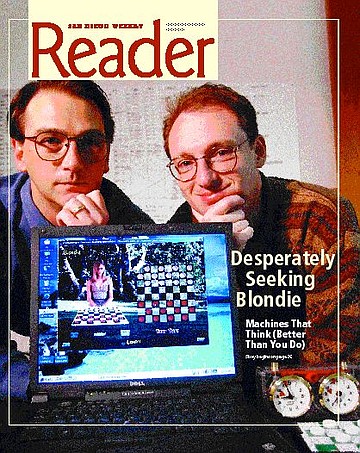
“It’s humbling to be beaten by Blondie,” says David Fogel, who many times has stayed up late to play checkers with her.
I tell him I wouldn’t be humbled if Blondie beat me. I don’t want to be any good at checkers.
You shouldn’t be dismissive of checkers, he tells me. Yes, he realizes that the game lacks the snob appeal of chess. He himself characterizes checkers as being one step below chess. But checkers deserves its measure of respect, he says. He quotes Marion Tinsley, who is regarded as the best checkers player who ever lived. (He died in 1995.) “Chess is like looking out over a vast open ocean; checkers is like looking into a bottomless well.”
If a movie were made of 38-year-old David’s life, casting might call for a brainy-looking Tom Cruise. His brown hair slicks straight back. His face is clean-shaven, his complexion creamy. The blue eyes behind the glasses look directly at a questioner. This valedictorian of La Jolla High School’s class of 1981 (who skipped kindergarten) has given a lot of right answers in his lifetime.
David and his parents and younger brother, who all live in La Jolla, run Natural Selection, Inc. The company was founded in 1993 by David and his father, Larry, the year after David received his Ph.D. in engineering sciences from UCSD. Their offices are high up on the cliffs above Torrey Pines beach, close to the Torrey Pines Gliderport. Just as some clans produce successive generations of clerics or chiropractors, the Fogels have produced successive members of an unusual computer-science specialty. The term for what they do is called evolutionary computation. The technique simulates in a computer the twin Darwinian principles of random variation and selection. It’s used to find solutions to complex human problems. The Fogels, for example, have won grants and contracts to improve breast-cancer detection, design new drugs to fight HIV, and devise battle plans for the military.
The technique isn’t new; it’s been around for four decades. The 74-year-old Larry is one of its acknowledged pioneers. In 1960, he conceived of what he called evolutionary programming. But early computers weren’t fast enough to capitalize on the idea. Only within the last decade has it become practical. In 1997, David predicted in his keynote address to a conference on BioComputing and Emergent Computation in Skövde, Sweden, that as desktop computers become even speedier, evolutionary computation will become “routine.”
David is currently the best-known member of the family outside its professional circle. He has become something of a celebrity for inventing a program that uses evolutionary computation to play checkers at the expert level. The program is known as Blondie. That’s short for its official Internet name, Blondie24. If one measure of fame is being part of an answer on Jeopardy! then David has achieved it. “A computer programmed by Dr. David Fogel taught itself to play this game that includes jumping and crowning” was the answer that the Jeopardy! players were told. (And one of them did guess the question correctly.)
Note that the computer taught itself to play. While people have been using computerized algorithms (step-by-step problem-solving procedures) for game-playing since before David was born, no one else’s program has used them without being primed with openings, endgames, good moves, and strategies. David’s earlier ticktacktoe program, which he developed for his doctoral dissertation, produced a “merely” proficient player. Blondie wasn’t even told if she was winning or losing as she went on to become good enough to beat 99 percent of her opponents.
Both Blondie and the ticktacktoe program are products of this so-called “electronic” evolution. As it worked in Blondie’s case, a colony of computer-programmed, checkers-playing “parents” and “offspring,” each slightly different from one another, competed in game after game. Chronic losers were killed off; winners were allowed to reproduce. After thousands of cycles of play, Blondie was the result.
The Blondie persona was fabricated by David and his computer programmer, Kumar Chellapilla, who works as a senior staff scientist at Natural Selection. They competed on the Internet with people who did not know that Blondie wasn’t a real person. David and Kumar imagined a 24-year-old female graduate student in mathematics at UCSD — “single, attractive, and looking for a boyfriend” — and impersonated her when chatting with their Internet checkers opposition. They resorted to this ploy after noticing they weren’t getting as much action as they wanted at www.zone.com — known as “zone” to aficionados — when using the program to play as David1101 and Kumar1201 or even as Obi_WanTheJedi. They not only wanted the action; they needed it in order for their program to excel by attracting high-class competition of a wide variety. In sum, it learned by losing. That is how it evolved new and improved generations of itself.
They invented the Blondie character for another reason. They were tired of being on the receiving end of expletives that losers sent flaming through the chatbox. While they found that opponents with expert or higher ratings were gracious in either victory or defeat, that was not the case for less skilled players. David and Kumar figured that most of the sore losers were male. Maybe the guys would display better manners if they lost to a woman? Not exactly. Instead of being flamed, the duo’s Blondie started receiving requests for dates. She was also subjected to more than a few raunchy propositions. David and Kumar were so convincing as Blondie, they even chatted with other checkers-playing women, comparing notes on the various jerks they’d encountered on the zone website. “Girl power!” David would regularly remark to his sister sympathizers.
But how did their imaginary Blondie get so good at checkers? David and Kumar needed to come up with a story, so they elaborated on their theme. Not only an ace at math, Blondie surfed and skied. While recuperating after a skiing accident, she had decided to use her time to get really good at checkers. Eventually, Blondie, a work both of science and fiction, earned a spot in the top 500 of zone and won a tournament at another Internet address, www.playsite.com.
Earlier this year, David published a book, Blondie24: Playing at the Edge of AI — i.e., artificial intelligence. That’s the broad term for what David and the other Fogels do. (The book explains, in very readable form, exactly how Blondie was developed and how she works. It’s also a good primer on evolutionary computation in general and gives a concise history of the development of artificial intelligence too.) “To date, however, artificial intelligence has focused mainly on creating machines that emulate us,” David writes. “We capture what we already know and inscribe that knowledge in a computer program.”
IBM’s chess-playing Deep Blue is perhaps the best-known example of traditional artificial intelligence. When it beat world chess champion Garry Kasparov in the historic match in New York on May 11, 1997, it did so by evaluating 200 million chessboards every second. But while Deep Blue is “intensely good” at chess, writes David, it is “brittle.” That’s jargon meaning “good for only one thing.” It can’t do anything but play chess. It can’t make the first move in checkers. It cannot think for itself. It cannot adapt. IBM merely created “an illusion of intelligence,” in David’s words. “That isn’t what the dream of artificial intelligence is all about.”
Knowledge is a wonderful thing, David avers in Blondie24. “But learning is the key element missing from the majority of efforts in what’s routinely called artificial intelligence.” Programs that cannot learn “have nothing to do with intelligence; they instead merely recapitulate things we already know, just like Deep Blue does. Programs that are incapable of learning will never solve the problem of how to solve problems.”
“Where is the intelligence in an automaton like Deep Blue?” he asks. “A system that never learns, and has no capability of ever learning, does not deserve the description of intelligent.”
He regrets that, 50 years ago, pre-programming became the standard approach to creating artificial intelligence. He thinks the seeming triumphs of expert or knowledge-based systems are shallow, and hubristic.
Blondie, by contrast to Deep Blue, is “robust,” another jargon word, meaning “useful across a broad spectrum.”
True, Blondie can’t play at the master or grand-master level. But she could easily be fitted out to do so — by loading her up, as Deep Blue was, with human expertise. But then what? The point of the Blondie research was not to create the checkers equivalent of Deep Blue. The real trick, “the evolutionary thing,” as David is fond of saying, was to create a machine that is itself intelligent. Not only intelligent, but more intelligent than its creators.
It’s an unsettling notion for many people — that a machine could think of a solution that a human couldn’t. Unsettling, but a reality all the same.
“It’s already happened. Already been done, many times,” says David’s younger brother, 34-year-old Gary Fogel, who received his Ph.D. in biology from UCLA in 1998 and joined the company the same year. He would tell me this in the course of my interviews with all four Fogels over a period of days last December. “Even when you begin with the human expertise in a field, it quickly gets superseded by the computer. The evolution finds something better. Almost invariably the humans don’t know it yet. That’s just the way it is.”
David, Larry, and Gary all defend the notion that the word “intelligence” should not be narrowly defined. Cats, dogs, colonies of ants — yes, even colonies of computer programs — can be intelligent, if you take the word to mean, as David writes, “the capability of a decision-making system to adapt its behavior to meet its goal in a range of environments.”
Following that logic, they argue that the processes of natural evolution and of evolutionary computation themselves are intelligent.
“Evolution is constantly inventing new solutions to problems,” says Gary. Look at the organisms in a kelp forest, he suggests. How do they survive and continue to survive? “There are so many amazing solutions that have been invented by evolution. Look at some of the sea horses. Amazing. Amazing variety. Amazing solutions.”
He compares this process to the scientific method he’s used innumerable times in biology labs. In those instances, he has a set of hypotheses that he is “contending” for a solution. He can see by his experiments how well these hypotheses work on the problem he’s trying to solve. And he saves the best hypotheses and continues experimenting. “And on and on and on. So it’s as if — my father said this back in the ’60s — evolution is a recapitulation of the scientific method. And in that regard I think that the technique itself is intelligent.
“And that’s a leap,” Gary admits. “That’s a little different. And it’s out there. And I’ll stop there.”
Squadrons of pelicans fly into the cove, their pouched bills an ingenious design for catching and carrying fish. On the beach, the lolling sea lions use their chests and finlike feet to gain a few more lengths of sand. To your or my eye, the locomotion looks clumsy. But their anatomy is another adroit adaptation of nature. They visit dry land to breed the next generation of themselves. Living in La Jolla, only a very convinced creationist could doubt Darwin, who revolutionized the study of biology at mid-19th Century with his startling theory that organisms change with the passage of time.
Not far from the cove, at the Natural Selection offices, Eva Fogel buzzes me into the reception area. In 1962, David has told me, the 34-year-old Brooklyn, New York–born Larry, who had already been living and working in La Jolla for several years, was traveling around the world in one direction while the 24-year-old Eva Fogel–to–be was traveling in the other. They met in the Copenhagen airport, where she caught Larry’s eye. The young woman with golden hair must have attracted the notice of countless others, I would realize when shown a photo of her at that age. According to Fogel family folklore, Larry used the following line to strike up a conversation with Eva, who is of Finnish ancestry but who was born in Australia after her parents immigrated there: “I see your Qantas bag, and I haven’t spoken to anyone in English for a very long time. I wonder if you would mind if we chatted.”
Talk about random variation and selection: they were married the next year.
At 64, Eva is attractive, with a warm, nurturing, but efficient manner; and it doesn’t come as a surprise to learn that she was trained as a nurse. At Natural Selection her duties are payroll and human resources. She also serves unofficially as corporate financial officer. Her official title is “owner.”
Today she wears a flower-print dress with a black cardigan sweater. Her step is quick as she leads me from the reception area across the hall to Gary, who is waiting for me in a small conference room with two glass walls. There is a wooden box of fragrant clementines on the table.
Across the way I can see David in his office, because, like the conference room, it has glass walls. He wears a dark suit and tie with white shirt and works at his laptop. Preparing for a noontime appointment, he doesn’t look up.
Originally, Gary and I had planned, after our interview, to go to the gliderport, where he sometimes takes lunch breaks. “If I can, I take my model sailplane and off I go. I have a good half-hour flight and come back a new man.” But today’s weather isn’t cooperating. There’s no wind. We decide that we’ll try another day.
Gary has set up his laptop to project images onto the conference-room wall. He will give me a tutorial on the kind of work he does here, on biological problems. A lighter-haired, slenderer version of his older brother, he has a more sharply defined face, but the same creamy complexion. He wears a dark blue dress shirt and charcoal gray dress pants. The style is young professor, with a dash of perennial student.
In fact, Gary and David both remind me of some of my own former students; I see in them older versions of the brightest ones I taught when I was in the English department at a private boarding school in the East, beginning at about the time that Gary was at La Jolla High — he was graduated with the class of 1986.
I hope those students have grown up to be as successful as these brothers. Well spoken, always well prepared, they were too polite to fidget while their less gifted classmates struggled with the material or offered their excuses — or failed to hide their envy-laden contempt for achievement.
That last dynamic can lead some elite students to be socially isolated. David and Gary were, Eva would tell me. “I tried to get them into [a local cotillion] — dancing with girls, all dressed up.” Neither was interested. “I would say that they didn’t have a whole lot of friends. They were gifted kids, you know? Regular kids were boring. That was how it was. They were never ready to go to the parties.”
The two have done some teaching themselves. Gary won awards as a graduate-school teaching assistant at UCLA. “I enjoy teaching a lot,” he says. “And I miss it,” although when he gives potential clients the kind of presentation he’s about to give me, he realizes, he is using his teaching skills. “Later on, I hope I’ll return to teaching. But at the moment I see so many problems, like cancer diagnosis, that I’d feel bad about not making the contribution that I know I can. I think there’s a bigger calling for me right now.”
Like his sons, Larry has ventured into academia now and then. Gary ranks him as his own most important mentor. “On long car trips, my father would say, ‘So tell me something I don’t know about,’ ” he recalls. “That was a challenge to a ten-year-old, because clearly my father ‘knew everything’ already. So at first I was hesitant.” But Gary did eventually tell him about, for example, going fossil hunting up on Mount Soledad, where he would find “scallops, and snail shells, and all sorts of stuff.” He credits his father’s questions with teaching him how to articulate concepts. That experience, he says, helped when he began to face classrooms of students of his own at UCLA.
“I remember my father asking me about the difference between Darwin and Lamarck.” (French naturalist Jean-Baptiste-Pierre-Antoine de Monet, Chevalier de Lamarck formulated some of the earliest ideas about evolution and influenced Darwin’s theory.) “These things came up, because he was interested in them. In my childhood I guess I was brainwashed. I understood evolution at an early age. And so when I got up to high school biology, it was easy.”
For that class at La Jolla High, Gary had another gifted teacher, Stephen Brown. “And he’s still there — a great guy, a great man, who allowed me the privilege of doing extra credit by going and looking at fossils and then writing little papers. It was practice science — in high school.”
At UC Santa Cruz he initially pursued paleontology. The influence there was Leo Laporte, now retired. “He was in paleontology, with an eye focused on evolution. He clarified the concepts that my father had gotten wrong” — a smile — “and set me on the right course.”
But there weren’t a lot of jobs in paleontology, Gary was beginning to realize, “and there wasn’t a lot of money in it either. You have to do it for love. And a lot of people work on dinosaurs, not the shells and things that interested me. So I looked into biology and discovered that people were using biological information in the same way that paleontologists were using fossils — to figure out evolutionary history.” This biological information, which became his academic focus and which is one of the things he works on at Natural Selection, he likens to “molecular fossils.”
Later, he would go into this in detail, with many visuals projected on the conference-room wall. But more than this technical subject, Gary wants people to understand the nature of the problems, biological or otherwise, that evolutionary computation is best suited to solve.
“Some real-world problems,” he says, “are so big that no one could search all the possible solutions. There are so many that, to go through them all exhaustively one by one by one in order to see how good each might be, even at one-second intervals, would take a lifetime, or several lifetimes.” A computer couldn’t do it. The “space” is just too big.
“Some problems are more difficult than that. They change with time. In the current conflict with Afghanistan, for example, you hear one day that someone’s on our side and the next day they’re not. Or something else changes. And your solution that worked today may not work tomorrow. It’s now a different type of problem.”
Sometimes people simplify a big problem, so they can handle it with mathematics. The trouble is, distortion often occurs. “Their answer is usually the right answer to the wrong problem — it’s the answer to the simplified problem. They have failed to address the problem that’s really there.”
Gary uses Natural Selection’s research into designing a drug to inhibit HIV as an example of one such big problem that evolutionary computation has been able to handle. The problem is akin to finding a key for a lock. If that lock (a protein crucial for HIV) is fitted with the right key (a certain drug “shape” that fits both physically and chemically), then HIV is blocked. HIV, which is the same “shape” as the drug, can’t bind to that protein. Something is already in its place.
There may be other ways to discourage HIV, but so far, many of the drugs that have been developed do it in this way.
When you begin to look for that key, you can start purely at random, says Gary. “Or you might use expert knowledge to get started. But you have to be able to develop what is called a ‘fitness score’ to compare the worth of these different solutions to the task they’ve been given.” (It’s a phrase meant to hark back to Darwin’s own “survival of the fittest.”) “If you can’t score how well this structure does versus that structure, then it makes no sense to use this technique.”
Similarly, Blondie was given fitness scores for her relative wins and losses as she progressed on her way to the expert checkers level, even though she herself wasn’t aware of them.
“During the process of selection, the solutions that score the lowest are thrown away; the ones that do the task the best are saved,” says Gary. “The remaining solutions become new individuals in the population. The cycle is repeated over and over. The program is always generating a new population of solutions; evaluating the worth of each individual in the population; discarding the ones that do the job poorly; leaving only the ones that do the job well enough to serve as parents for the next generation of solutions.”
I don’t have to take Gary’s word for it. He shows me on the screen a demonstration of this technique as applied to the HIV drug example. It’s a video in real time and takes just a few minutes to run. In that time, what at first look like random Tinkertoy shapes eventually become two shapes that fit snugly one inside the other.
“So the whole population arrived at this solution,” says Gary.
It’s not a magic bullet, not yet, and even if it becomes one, it may not stay one forever.
“Once you arrive at this, what you can do is take it out and look at it, as a chemist, and say, ‘Hey, we already know that this compound is toxic in rats.’ Or, ‘Some other company has a patent on this one.’ So we do the evolution again and look at the top 100 solutions.”
A pharmaceutical company may then use these “leads,” as they’re called. (“Yes, just like ‘leads’ for the FBI,” says Gary.) Trials for the Food and Drug Administration routinely follow. Natural Selection has developed such leads for Agouron Pharmaceuticals, Inc., maker of Viracept, the well-known anti-HIV drug. “We help them find leads very fast. Much faster than they could if they were searching one at a time, which is the way they used to do it. They used to just sit there and say, ‘I think this’ll fit. Let’s try it.’ Lots of work. Lots of time and effort in that whole process.”
Unfortunately, even if a new drug does work, says Gary, natural evolution can develop other places for HIV to bind, so that the “key” will no longer be useful. HIV will continue to work just fine.
Viruses, like all of nature, adapt in order to survive.
I do not necessarily plan to bring up the idea of God with Gary or any of the Fogels. Over the course of the morning, however, I have an opening with Gary when he says, “The solutions that evolution can come up with are sometimes so inventive they make you think that maybe some other force did this.”
Does he ever personally contemplate the idea of a divine intelligence? I ask.
It’s clear that his comment about “some other force” was a slip; he would prefer not to discuss the subject. He says, “I find that when discussing these concepts of evolution with nonscientists” — like me, for example — “there is a much greater tendency to polarize the issue of divinity, to either believe or not believe.”
Still, he does answer my question, even if it is in somewhat lawyer-like fashion. Or should I say “scientist”-like? Men and women of science do like to measure things, as Gary’s statement proves.
“I guess the answer is no,” he says. He doesn’t ever contemplate the idea of a divine intelligence. “I truly believe that all of life on earth is the result of a historical process of evolution. And given that over the last 200 years, science has developed a very plausible hypothesis for the history of life on earth via that process, I tend more to believe this than I do any theory of divine intervention. That is, science works in the realm of testable hypotheses, and there is no current test that I’m aware of for divine intervention — it’s a matter of belief. So, given that I consider evolution to be the best current testable hypothesis for life on earth, I’m quite content with that. Besides, I’d rather focus my energy on utilizing the process of evolution as a tool for the good of everyone rather than debating the religious implications of life on earth.”
Whether or not you believe that it actually happened in nature, he says, is a different question; but you have really got to believe in the electronic process of evolution, because you can demonstrate it.
He just did, of course — with the HIV-drug demonstration. Now he shows me another demonstration of the same process with a different example — a fictional one. “It’s a real-time solution to the Traveling Salesman Problem. Do you know this problem?” he asks.
I do; I’ve read about it in Blondie24. As David writes, “Suppose you have to find the shortest path from Los Angeles that leads to San Francisco, Seattle, Las Vegas, Phoenix, San Diego, and then returns to Los Angeles. The salesman starts at his home and must visit each city in his area once and only once, then return home in minimum distance.”
How many alternative routes do you think there are? It may or may not surprise you to learn that the number is 120. Even so, a human could just look at a map and deduce the best route. A computer wouldn’t be necessary.
But what if the salesman had to visit 50 cities? Then he would have one of those big problems on his hands that evolutionary computation could help him solve, because the number of alternative routes in that case is 1063, which written out looks like this: 1,000,000,000,000,000,000,000,000,000,000,000,000,000,000,000,000,000,000, 000, 000,000. And as David points out in Blondie24, “This number is far larger than the number of seconds in the history of the universe,” which is only about 1016.
“So I’ve got this grid,” Gary says of the next image he has projected onto the wall. “Think of it as the United States of America. And I’m going to put a hundred cities on it, randomly placed.” These are represented by green dots.
“Then I take a random population of solutions to the problem of visiting all those cities once and only once. In this case, it’s going to be a hundred solutions, where each individual in that population represents a potential tour across those hundred cities, a potential path that my traveling salesman could take.”
He runs the program. A few seconds later, the green dots are haphazardly connected with crisscrossing red lines all over the map: the route is that of a very, very disorganized salesman. “We can certainly do better,” says Gary. “That was randomly generated, remember.”
He runs it a second time, for 10,000 generations. It takes less than a minute. The result is the route of a much more efficient salesman. There are many fewer crisscrosses, backtracks, wasted miles. But better salesmen are waiting to be born.
Like the solutions to the HIV-drug problem, these, too, are given fitness scores. Gary knows from experience with this program that 749 is the best score possible. “That’s the best it’s ever going to do. What that number really is, let’s say, is the least number of miles between the dots. We’re not interested in frequent flier miles here. We want to minimize our travel time.”
So what score did the 10,000th generation get? It was 772.5. “Let’s see if we can do better than that with 15,000 generations,” he says. It takes perhaps a full minute this time. The score is 767, and the route of this salesman looks pretty darn good; in fact, it’s impressive.
And remember, Gary says, he didn’t tell it to minimize the crisscrosses by visiting all neighboring cities before going on to another region. It figured out that strategy.
He could go on generating parents and children of salesmen, smarter and smarter ones. The number of possible routes is 10150. (That’s a 1 followed by 150 zeroes.) There is no perfect score, however. No perfect salesman. There will always be a number of best answers — a group of best possible routes, all with fitness scores approaching 749.
Neither does natural evolution strive for perfection, David notes in Blondie24. Things change. New adaptations are required. A so-called perfect solution would soon enough (in 30 years or 300,000,000,000) be obsolete. There is no perfect solution to any of nature’s most vexing problems. Nor to any of our own.
Natural Selection has used a Traveling Salesman Problem–type program to help Greyhound with its U.S. bus routes. And it has worked on routing problems around a factory for Levi Strauss. The assignment there was to figure out which garments should go in which machines in which order. “Factory optimization” is the consultant’s term for this systems specialty.
It’s Larry who tells me about these contracts on another morning as we sit on opposite sides of a worktable in his office — a sunny room furnished with light-colored Scandinavian pieces. On the wall is a plaque awarded to “Lawrence Jerome Fogel.” (It’s next to a small sepia-toned photograph of a white-bearded Darwin.) “Lawrence is official, but I like Larry better,” he says. Even in print it’s his preference.
He speaks rapidly. He’s intense, energized. He has a Ph.D. in electrical engineering from UCLA, six patents for communication devices and cockpit instruments, and must hate free time. Four nights a week he plays tenor sax at Moray’s Lounge in the Catamaran. He accompanies singer and pianist Larry Moore. Known to their regulars as Los Dos Lorenzos, they’ve been playing together for eight years. At Moray’s on a recent Sunday night he wore the same outfit he wears today: black pants, a black corduroy jacket, and a pearl gray shirt. The only thing missing is his Greek sailor’s cap. “It hides the bald spot,” says Larry. “When you’re in public playing music you don’t want to look like an old man.” With or without it, he doesn’t look old. My impression is that he’s been too busy to age.
I ask Larry to reminisce about the days when most artificial-intelligence systems were attempting to model the brain, neuron by neuron. He tells me about it in dramatic fashion. That seems to be his habitual way of speaking. Like an actor, he relates the action in dialogue, taking all the parts, varying his speech’s timbre as the characters change.
“When you realize how complex the brain is and how little we know about it and how unstable, this approach becomes obscene,” he says. “ ‘We’re never going to get there this way!’ Expert systems,” he scoffs. “It was called heuristic programming back then. ‘They’re only solving problems that are already solved. And real intelligence is defined as the ability to solve new problems in new ways. New problems in new ways! They’re preventing themselves from solving new problems. There must be another approach.’ ” And he figured one out.
He went to his director of research at the National Science Foundation. “He said, ‘That’s terrible. The number of possibilities is so great, you’ll never be able to search this immense space. You’ll go down to your death like Galileo, wasting his time.’ But I was convinced I was right.”
So in 1962 he left that boss and took a job as assistant director of research at Convair, where he had the freedom to do whatever he wanted. “That’s where I started working on this problem: evolving intelligent capabilities. And I met two guys. One was a pure mathematician who said, ‘Gee, we ought to be able to prove this mathematically.’ The other was director of research in computers, who said, ‘We could make simulations.’ He saw what a poor programmer I was. And we formed a trio. And in a matter of a year we had won a few contracts. And the next thing Convair said was, ‘We don’t want research, because you can’t make money on research. We want to build Atlas weapons systems. You can’t work on that. Leave.’ ”
The three formed a new company, Decision Science, Inc. The offices were in Pacific Beach, directly next door to the original Rubio’s Baja Grill. For 17 years Larry was president of Decision Science. “And we did a lot of things with evolutionary programming.”
From Decision Science he went to Titan Systems, where he worked on other projects, most of them unrelated to electronic evolution. He credits David with his renewed interest in its possibilities.
In 1993, when he and David started Natural Selection, they were the sole employees. Now there are 13. From the beginning, Larry’s niche was military applications, and there it remains. What he has found, however, is that the military often doesn’t have a well-defined mission. And evolutionary computation can’t work well without one.
“Newton started with a pencil and paper,” says Larry. “Poor guy. Now we have computers. It’s a sin to use a computer to do what the pencil-and-paper guy tried. That’s wrong. Let computers do what they can do. But if the problem isn’t well defined, I’m not going to solve it. No one will. And I can tell you, ‘Sir, this problem is not well defined, and unless you can make a problem well defined, there’s no answer.’ ”
Ten years ago, while returning to San Diego from a discouraging meeting at Nellis Air Force Base, near Las Vegas, he began to understand this difficulty all too well and arrived at a solution.
“Ordinarily, people’s purposes are oversimplified. When you ask a person, ‘What do you want out of life?’ he’ll describe his golden future. He’ll say, ‘Oh, I want to be rich and happy and have a Rolls-Royce.’ ‘Well, thank you very much. But suppose you can’t have those things?’ ‘Well, I’ll take this silver future.’ ‘Suppose you can’t have that?’ ‘Well, I’ll have a copper future.’ Pretty soon we’re talking about catastrophes, the worst possible situation, because, whether people realize it or not, their goals are as much about what they want to avoid as what they want.
“What do we want in Afghanistan? ‘To achieve success with no casualties, at no cost, and in two days.’ ‘Well, let’s be realistic.’ ‘Okay, we’ll tolerate a few casualties and we’ll take another month.’ That’s the silver future. ‘What if you can’t have that? Then what?’ ”
Unfortunately, says Larry, the military doesn’t think about silver or copper; only gold. “When I was at Nellis talking with the F-16 drivers, I asked them, ‘If you don’t succeed in this mission, what’s your best fall-back position?’ ‘Oh, we don’t talk about losing; we talk about winning.’ ”
Larry says he left there convinced that the logic he had presented to them was correct but knowing that they were incapable of understanding it, because they wouldn’t consider “their different fall-back positions and the relative worth of each.”
So driving home — it’s about six hours — Larry invented a technique he gave the less-than-snappy moniker “Valuated State Space Approach.” This is his own new contribution to problem-solving with electronic evolution. “It’s a way to write missions, purposes, goals, aims, aspirations, intents — in quantitative form. It helps make the problem concise. And we have used it now on a number of contracts.”
Natural Selection is currently under contract for cruise missile missions. With its program it looks at each prospective plan. “ ‘We want this to hit that target, but we don’t want it to fall short on this mosque.’ In a real-world situation, you have several targets out there. And a few ships. ‘Which ship? And which weapon? At which time?’ It takes 12, 13 hours for real people to sit down and plan this, because they take into account the inventory, the types of weaponry, the placement of the ships. If this ship is firing from here, you don’t want to fire over that ship, because if there’s a misfire… And if your ship just came into the Gulf with a missile inventory, I’d rather not use your inventory until I use theirs, because they’re going home soon. ‘And they’re going to take their missiles home? What for?’ ”
There are other reasons why evolutionary computation can be a hard sell to the military, says Larry.
“I have met many officers who have trained 20 years on tactics. They know tactics. They know Gettysburg. They say, ‘Lee should have moved in two days earlier.’ They say, ‘How can you replace my 20 years’ experience with a computer program?’ ”
I tell him it sounds like ego talking, but Larry says, “It’s a valid objection. My response is, ‘You can “flavor” it with your own suggestions.’ And that’s fine. It’s their plan. But the program can suggest things that they may not have thought of, because it’s unbiased. It doesn’t care about the usual conventional approach. We draw out of our own experience. It has no experience. It just says, ‘Here’s what can be done.’ ”
Alternatively, Larry says he can build expert knowledge into the population of initially suggested behaviors, just as Gary did in the search for the HIV drug. “ ‘You think right flanks should go in here? I’m going to put in right flanks. Now it’s going to be scored. If it’s good, if it’s the best one, it’s going to come out on top. If it’s bad, it’s going to be ex-gorged. And, in fact, I can tell how bad it is by how fast it’s ex-gorged — if you want to know. You may not want to know.’ ”
There is a second common objection that Larry hears. “I was sent to a two-star admiral who had a new job at the Pentagon. I talked to him about the Valuated State Space Approach as a way to help him manage his new responsibilities. So I went through the briefing. Gave him a slow-motion presentation. I wanted to make sure he understood. I said, ‘Well, can I do this for you?’ And he said, ‘Not a chance.’ ‘What?’ ‘I don’t want anybody to be able to measure how well I am doing my job, because then I’m open to criticism. If they don’t know what my purpose is, how can they score me? So I’d rather not. I’m doing a job in which I don’t know my purpose, and I don’t want anybody to know I don’t know. So I’m just going to let it go at that.’ And he did.”
He really confided, I say. “In my view he was shirking responsibility,” says Larry, “which is to try to understand his mission as crisply as he can. I even offered to do it sub rosa; he could have used it as a secret management tool. He was afraid to have it around. People are afraid of responsibility. They would rather wait two years and go out to another assignment.”
Larry tells me about other contracts, including one that Natural Selection had not yet won. It would improve the inspection of overseas containers. Some 17 million a year come into the United States. Made of steel, they are at minimum the size of large, rectangular Dumpsters (8 feet by 8 feet by 20 feet) — and a major threat to domestic security, in Larry’s opinion.
“I’m going to show you a picture,” he says, handing me a color photo. “Look at the number of containers on that ship.”
What I see is a Rubik’s Cube of dozens and dozens of containers on a huge ship’s deck.
“And they’re inside the ship too. And do you know what it costs to send a container from Hong Kong to San Francisco? Twelve hundred dollars. Can you imagine? That’s nothing! And as you may know, some of them have contained human beings. Some people have died. A terrorist was captured recently. He was going from Cairo, in a container, all fitted out with food, toiletries, a computer. They picked him up in Italy. He was going to Canada, then into the United States. I don’t know what his mission was, but they caught him. What worries me is not a terrorist but weapons in containers that could easily get delivered to some place and explode. You could ship one to the heartland.” Its point of delivery could be determined by GPS, the global positioning system, says Larry. “This could be on a bridge or next to a factory. And it could be set to explode at a certain time after it gets there.
“To prevent this we would look at the data — shipment dates, weights, and so on — searching for anomalies, inconsistencies. ‘They claim it weighs this much, but it weighs that much.’ We want to find ways of increasing inspection accuracy. Right now they inspect between 1 and 2 percent of containers. That’s nothing! And they inspect them randomly. ‘Okay, we’ll do that one.’
“So we’re working with a nonprofit corporation in Washington, D.C., and bidding now to Customs and Treasury and Coast Guard and trying to get someone to do this, because I think it’s a very good project.”
Though he doesn’t appear to be tired after speaking nearly nonstop for 90 minutes, I am. And before our conversation is over, I want to be sure to fulfill the other half of my own mission — to learn more from him about the Fogel family history. He understands what I’m looking for and launches right in.
“My grandparents came from Europe, on one side from the Ukraine and on the other side, Bavaria. My parents met and were married in Brooklyn, and we lived through the Depression. It had a tremendous effect on me. ‘Don’t spend that dollar.’ I remember the 1939 World’s Fair in New York. It started to broaden my view. I was 11 and spent some time by myself at the fair. I also used to go to the museums alone: the American Museum of Natural History, the Planetarium. On a weekend I would wander around New York by myself all day long, get back on the subway, come home for the night. It was very safe. I go back there for business on occasion. I know the city well. But I wouldn’t want to live there now, for obvious reasons. It’s changed. I’m much happier living here than anywhere on the East Coast. Socially and weather-wise, it’s just a friendly place to be.”
He’s a San Diego booster, yes; but more than that, he’s a scientist who has studied objectively the “problem” of finding the best place to live. He believes he’s found it.
This is certainly the best place to raise a family, he says.
I ask about the Fogels’ child-rearing secrets. Here, for the first time, he’s at a loss for words. “I think you’ll have to ask my wife about that,” he says, rising from his chair. “Let me ask her to come in. I’m not a disciplinarian. I don’t like to do it. If somebody won’t do what they’re supposed to, I’ll do it for them. But she knows how to discipline and is graceful in it. I’ll bring her in.”
He leaves the room and, less than a minute later, returns with Eva. She takes a seat in his chair while he pulls up another beside her. In her presence he seems physically diminished. She’s small, too: it’s not a literal diminishment, but a distinct impression all the same. This is the man who referred to the F-16 flyers at Nellis as “drivers” — a disrespectful term, he has told me, because it’s overfamiliar. Yet here he is, subdued, deferential, like a boy who can’t believe his good fortune of having been chosen by a lovely girl with the charming accent who might easily have chosen someone else.
Sitting with her back straight, she folds her hands and puts them on the tabletop. The posture reminds me of the training I got long ago, in a Catholic grammar school. (“I got my discipline as a nurse from a private school in Australia,” Eva would tell me. “It was an all-girls’ school. We didn’t have any interaction with boys except after school. So it was a very different atmosphere from the one my boys grew up in. We had the school uniforms and so on. And the nursing program itself was very strict.”)
After I repeat my request for details about how the boys were raised, the first thing — perhaps the main thing — she wants to say is that she was a stay-at-home mother. “I didn’t have to go out and work. I strongly stress that for everyone who possibly can,” says Eva, who wasn’t conflicted by this decision. At age 25, she gave birth to David; four years and two months later, she had Gary. Nursing would be in her past thereafter. “I always wanted to have kids. So kids were my thing.”
She read to them “very early on,” played games with them, did all sorts of crafts with them, took them to museums and the zoo. It’s what many devoted mothers do, but perhaps here, too, there are levels of the game. Wherever their interests led them, she would help them get there. “If they asked a question, there was always an answer,” says Eva. “If I didn’t know the answer, I’d go find it.”
Of pressure on the boys to perform well in school, she says, “There wasn’t any. They just did it on their own.”
They never had to be told to do their homework?
“I think they finished their homework before they got home.”
It must have been awfully easy for them.
“Well, not so much for Gary. Gary struggled, I have to say. It wasn’t as easy for him as it was for David. I think Gary has really worked harder than David. Things were really very intellectually easy for David.”
David, not Gary, attended the Seminar Program that’s run by the San Diego school system. “They pick bright kids that go to a special class. I think there were 15 in his class, with one teacher teaching everything. They got motivated to do a lot of stuff that kids [not in the program] normally wouldn’t do.”
But the egalitarian Eva wasn’t entirely happy with the distinction. “They were in this environment in which they knew they were special, and sometimes that’s not so good. This was from grades third through sixth.”
David attended Muirlands Junior High; Gary, La Jolla Country Day School, having transferred to the private system, Eva says, because some public schools, including Muirlands, were having drug problems in those years of the early 1980s. Gary got a good education there, but again she mentions the issue of privilege, this time the economic variety. “Gary sensed that some children there could get everything they asked for. He could see through that. He got good schooling there but didn’t feel akin to those kids.” (Gary, for his part, expresses the same idea more positively: at La Jolla Country Day, while “snobbishness provided its own set of problems,” he did learn valuable lessons about “class.”)
All four Fogels, at various points, laud La Jolla High. “A tremendous school,” says Eva. (“Plain and simple, without a doubt, the best of my pre-college education,” says Gary.)
I remember from both my own student days and my time as a teacher that so-called naturals were often more highly esteemed than hard workers, even though they may have achieved the same results. This is a theme in our culture. It’s unfair, but it’s a fact. What about this dichotomy? I ask Eva. Was there sibling rivalry between David and Gary for this or any other reason?
“I have to say that Gary was David’s little brother for many, many, many years,” says Eva. “He lived under that umbrella until he got out of high school and went off on his own and finally got rid of that brother business. When he went up to Santa Cruz, he was well away from everybody. And David had already gone his way. So I think Gary finally came into his own then. And yeah, it was a bit of a struggle for him.”
What about religious upbringing? Moral training for the boys? After Gary’s comments, I had been wondering.
“They didn’t have formal religious training,” says Eva. There were family discussions about religion, but the boys were free to believe what they wanted to believe. Larry’s religious heritage is Judaism, but he doesn’t practice it. Of her own religious beliefs, Eva says: “When I did my nurse’s training, I saw a lot of pain and suffering, and I thought, ‘Well, gee, how could there be — ?’ I questioned it a lot. And I decided, ‘Well, okay, I won’t worry too much about it. I’ll just be a good person, myself. Do whatever I can do, myself. And whatever follows, follows.’ ”
Though the boys were less than partygoers, they pursued many serious leisure-time activities, just as they do today. “Once the kids got to high school we had the rock band. Gary was in a rock band. The guitar.” (The band was called the Verdict, with a repertoire that was part rock, part heavy metal. “If it wasn’t loud, it wasn’t good,” says Gary.) “I used to hate that,” says Eva.
But she didn’t deny him this pleasure. “No. And David was into surfing. And I picked him up after school and took him down to the beach every day. Did my shopping, whatever I had to do, picked him up again. So I was a dutiful mother.”
Larry traveled a lot for work, but the family also traveled together, often to radio-controlled sailplane meets in the boys’ adolescent years. “Larry was always teaching them stuff in the car” on the trips to and from these events, where, once again, David dominated Gary. In 1977, a 13-year-old David became junior national champion of the National Soaring Society. Gary never attained the same level of that particular game, although in 1995, when he was 27, he set a declared distance record for Class A radio-controlled sailplanes at Torrey Pines. (After adolescence David gave up this activity in favor of other interests, including real flying. He holds a single-engine commercial pilot’s license and has over 500 hours of flight time. In high school his ambition was to become a fighter pilot. He went so far as to visit the Air Force Academy, in Colorado Springs, Colorado, where he had been accepted. His father would tell me of David’s decision not to attend: “He said before he went for the visit, ‘If they have rules that have no meaning, I’m not going there.’ ”)
Foreign travel was another experience the Fogels provided to the boys. “We went to Australia to visit my family,” says Eva. “And they had the knowledge that there were people related to them in other parts of the world. I think that helped broaden them too.”
Her parents, Eva says, “were a big part of our lives.” And that, perhaps, is the second most important thing she wants to say. Often she had the help of her mother, who made frequent, extended trips to La Jolla, especially after being widowed in the early ’70s, and who allowed Eva and Larry “some freedom in our own personal life, to get away for brief vacations without the boys, especially in the early years of our marriage.”
Music was part of their life as a couple. “I played piano in Australia, and when I came here, I learned to play Larry’s harpsichord. It has a different touch, but the keyboard and the music are the same. Over the years, ever since we were married, we’ve played harpsichord and flute duets. Later on, we played in a quartet with another flute player and a cellist. Unfortunately, the cellist has since moved away and we haven’t found one to replace her.”
Eva describes her mother, at 93, as “mentally sharp as a tack.” She hopes to “follow in her footsteps.” She was “a stabilizing force,” says Eva. She “never got flustered” by two teenage boys. And it’s easy to imagine that Eva is describing herself when she describes her mother as “patient but firm in a gentle way.”
“I have to say I disciplined the kids pretty well,” says Eva. “Larry and I figured out between the two of us what was important and what they could get away with and what they couldn’t.” But it was she who “went around and around and around” with them daily. “We really didn’t have too many battles, just about normal teenage things. But David was always testing, Gary not quite so much. David was always trying to challenge Mum.” She laughs. “David was a bit of a rebel, I have to say.”
I ask both Larry and Eva about the veracity of an anecdote in Blondie24. The book, in addition to telling about Blondie and evolutionary computation, gives some personal history about David. But there is one scene I don’t quite believe; it takes place in Colorado Springs after his and Larry’s visit to the Air Force Academy.
David writes: “I can remember the first time my father told me about the concept of simulating evolution on a computer. We were waiting in the airport, after I had visited the Air Force Academy in early 1981. I wanted to be a fighter pilot and had been accepted to the academy. My father wisely suggested that we go see what the place was like before I signed up. I recall the beauty of the mountains and the campus, but I also recall being disappointed in the rules and regulations that lay ahead of me. I wanted to fly, not be pushed around by upperclassmen asking me questions like how many days there were before they graduated.
“While we waited for the flight back to San Diego, my father asked me how I would design the best fly. Yes, that’s right, the insect. This was sort of a strange application, but still, some flies are better at being flies than others. He took me through the process of creating a fly that had legs that were the right length, wings that were the right shape, eyes that were optimally designed, and so forth, all by evolution. I was, of course, familiar with evolution as the explanation of the diversity of life on the planet, but I hadn’t considered it as a design principle or something that could be captured in a computer.”
The part I didn’t believe was that Larry had waited until David was 17 to tell him about evolutionary programming.
“No, that’s not true,” Larry confirms. “He had gotten that in the car, a thousand times before. He knew about it, very well.”
Eva agrees.
Maybe it was a bit of poetic license, then?
Larry shrugs. “He now knows more about evolutionary programming than I do.”
“He saved it for you, really,” says Eva.
“Yes, he did. A lot of people were badgering against it, because it’s a nontraditional approach.”
It’s good he was a rebel, then, I offer.
Larry and Eva together: “Yes!”
Larry: “I take my hat off to him. He’s a fantastic kid. They’re both still kids to me. They always will be. They’re both fantastic.”
Eva: “Each in his own way.”
Three sexy young women purr their hellos, one after the other.
Hi, I’m Shannon, says the brunette.
Hi, I’m Amber, says the redhead.
Hi, I’m Blondie, says the blonde.
Shannon, Amber, and Blondie are San Diego–based models whose video images are being projected onto the Natural Selection conference-room wall via David’s laptop.
“So you go in and select a player here,” says David, choosing Amber with a mouse click.
It’s my last day at Natural Selection, and David is giving me a demonstration of his new computerized checkers game available on CD-ROM. It’s called Evolutionary Checkers, starring Blondie24. “Checkers with an Attitude!” is its promotional slogan. The soundtrack includes the electric jazz guitar of San Diego–based musician Hank Easton.
“Since Blondie plays at the expert level, if you want to play at a little more congenial level, you have to play with Shannon or Amber,” says David.
The model who portrays Blondie has long, platinum-hued hair; her eyebrows have been plucked to pencil lines; and she wears a skimpy, spaghetti-strapped outfit. In a sassy little introductory speech she explains what she’s all about:
Hi, my name is Blondie. My checkers opponents know me by my screen name, Blondie24. If you think I’m just a computerized doll that uses programmed moves, you couldn’t be more wrong. The moves I make haven’t been input by a programmer. Unlike other expert checkers programs that rely on a bunch of checkers-playing strategies or endgames that were supplied by human checkers experts, I try to look ahead to see what might happen, as I observe the options available to me. The truth is, there has never been a nonhuman checkers player like me. What makes me so different? How about this? I taught myself how to play, and I continue to learn, and get better, and better, and better. I’m rated as an expert, and I have proven myself better than 99 percent of my online opponents.
The demographics of the target audience seem clear. But David says, “The target audience is, in fact, ‘kids from 1 to 92,’ perhaps emphasizing men from 14 to 35. Truly, though, the kids who come to my book signings enjoy playing it just as much as the adults do. I mean, kids like 9 years old. They really enjoy, not just the game, I mean, checkers, but having the video characters. And when I tell them that the computer taught itself to play, they say, ‘Wow!’ ”
Not Natural Selection but another company, Digenetics, Inc., has developed Blondie24 as its “debut product.”
“Digenetics. Beyond Intelligence. The Future of Evolutionary Entertainment,” says the company website at www.digenetics.com. Next it quotes company executive vice president and chief scientist — “Dr. David Fogel.”
“The future of artificial intelligence doesn’t rely on having computers learn what we already know but rather on having them learn what we don’t know,” reads a familiar statement from David. “To build a computer that is truly artificially intelligent, we’ll need programs that can adapt to new situations and garner their own knowledge.”
Douglas Johnson is Digenetics’ chief executive officer and cocreator of the trademarked Evolutionary Entertainment concept. In 1995, another computer game invented by Johnson, Reelect JFK, won an award in the annual competition sponsored by the magazine Macworld.
Programming for the Blondie24 game was done by Kumar Chellapilla of Natural Selection and by Digenetics programmer Timothy Hays, who, says David, has “something like 42 game titles to his name.” (He is also a jazz musician, the Digenetics website notes. In his Digenetics bio, David doesn’t reveal his own musical talent: like his father, he plays at Moray’s Lounge — piano, two nights a week.)
“Johnson had this idea for artificial thoroughbred horse racing, where you would own the horse and be able to breed the horse and do all this stuff. And he just didn’t have the technology behind the idea to figure out how to do it. So he was looking on the Internet for people who knew evolutionary computing.” As it turned out, they were only about a mile from each other in La Jolla.
“He came in and said, ‘This is what I had in mind. Can you guys do it?’ ”
The result is a first. “It’s the first software game that allows someone to compete against an artificially intelligent program with an interface that simulates playing against a real person who interacts with the player. It’s the first that I know of, anyway,” says David.
He switches from Blondie back to Amber. She has green, almond-shaped eyes and a smirky smile.
Let’s start, she says.
“Starting a new game. You go first,” David says to Amber.
On the right side of the screen is the checkerboard, all set up, waiting to go. One of Amber’s pieces moves in response, even though Amber’s hand doesn’t. She just sits there, looking smug.
He could have shown her hand moving the pieces, says David, but it would have required a great deal of extra photography. In the end, he and the others didn’t think it was worth the trouble. “So when you’re dealing with live models versus animation you’re limited in some ways and freed in other ways.”
There is built-in “think time” for Amber, Shannon, and Blondie, says David, its length determined by the level at which you have chosen to play. “With Amber we’re down at the novice level. So that’s the fastest level; she does the least thinking of the three. If you have a slow computer, playing Blondie can be a bit tedious, because she’s going to take a long time to make her move. If you take a very long time, Amber will say, ‘Hel-lo-oh?’ ”
David gets Amber to speak some of the other lines she would say during an actual game. Each of the characters has her own personality, he explains. “Amber is kind of the Don Rickles of the trio,” he says. “Shannon is more intelligent and a bit more cordial. Blondie takes her game seriously.”
Oh! You want a second opinion? Okay! How about “Those are really ugly shoes”?
Sorry. I’m not giving up on this game that easily.
Aha! I beat your little butt that time. Wanna try again?
I’m not worried. I’ll catch up with you.
Hmmm. This is a toughie. Okay. You’re on.
A draw? Amber laughs an ego-shriveling laugh. No! Your move.
What am I gonna do now? says Amber.
“What are you gonna do?” David says to her. “Okay, I’m going to let her win now,” David says to me, adding, “It’s fun having a game that people enjoy that doesn’t involve violence.” He makes a series of moves and so does she. “Do you see that she’s smiling more now that she’s winning?”
You came so close, she says when the game is over. You came this close. Maybe you’ll get me next time, says Amber, displaying her smirky grin.
“The seriously good checkers player — masters, grand masters — will be able to beat Blondie even at her level,” says David. And since they want superior competition that will help them hone their skills, the game isn’t very useful to them — “although they may find some entertainment value in its novelty and the fact that AI and EC [evolutionary computation] were used to get a result.”
David offers to let me play. I decline. Suddenly I do care whether or not I’m any good at checkers. And surely I’ll be beaten, even by the bimbo Amber. He gives me a copy of the CD-ROM, perhaps imagining that I’ll give it a whirl at home. (It’s been several weeks now, and I haven’t.)
We talk now about the work that David does at Natural Selection. Like Gary, he has a presentation for me on his laptop. It begins with a projection of a picture of a camouflage-colored frog on the conference-room wall.
“This is what I use to convince audiences who have never seen evolutionary computation before that, when we talk about intelligence, we shouldn’t limit it to humans, to ourselves. So, see that frog? That frog has an ingenious solution to the most vexing problem it faces. Every individual in nature does. It’s the problem of avoiding being someone else’s lunch. This frog has learned very little in its lifetime. It’s just a dumb frog. It may be a smart frog, as far as frogs go, but it’s dumb as other things go. But that solution to this problem is darn creative, inventive, intelligent. If the photographer hadn’t put the frog in the middle of the picture, and if the frog’s eyes weren’t open, and if we were just walking along, we’d be very unlikely to see it. So what learned to blend into the background? Clearly, it was not the individual frog. It was the evolving line of frogs that learned over time.
“There are many different strategies for avoiding being someone else’s lunch. Another is to be poisonous.”
He shows a picture of another frog, with yellow-and-black banding.
“But if you are poisonous, you’ll want to advertise the fact, since there’s an evolutionary advantage to it. Obviously, if you don’t have a reliable signal that you’re poisonous, it’s not going to do you much good. The bird might still eat you, even though it might become sick or even die. So this frog is wearing the striped symbol of a warning. But did that frog wake up one morning and decide that stripes would be a good deterrent to birds or whatever predator he might face? Clearly not. The symbol evolved in concert between the frog and its predators.”
Next, he shows a picture of a honey bee — a seeming honey bee — who wears the same yellow-and-black caution stripes as the frog.
“Same sort of idea — a reliable pattern that shows you the thing in question is to be avoided, right?”
More honesty in advertising, I venture.
Not exactly. “The trick here is that this is not a honey bee. This is a fly. It just wants you to think it’s a bee with a stinger. And, again, this fly is just a fly. You can’t argue with a fly’s level of intelligence. There is some capability for problem-solving, but mostly it’s all hardwired.
“In the book, I’m very emphatic about defining ‘intelligence.’ I mean, you don’t want to write a book about AI and walk away from what intelligence is or say it’s too hard to define. That’s a cop-out. If you want to talk about intelligence as it relates to humans only — that’s fine: we can narrow it down to that. But intelligence is so much more than that. If intelligence has to do with problem-solving — and in the book I think I make the case pretty well that it does — then it doesn’t matter whether the problem-solving is done by that fly over a series of generations, or by you and me in a conversation, or by an author writing a book to pass along to somebody else.”
Does David wish there were another word besides “intelligence” that he might use in this context?
“No, I don’t mind challenging what other people think in terms of their definitions,” says the rebel.
Besides, words evolve too.
“Sure! Absolutely!”
Speaking of challenges, I tell him that his parents challenged his story in Blondie24 about what his father told him at the Colorado Springs airport.
“Oh, well, it’s totally from the heart,” says David.
But your father and mother both said that wasn’t the first time you had heard about evolutionary computation. They said you had heard about it constantly in the car.
“Really? Well, they never told me that.” And Larry read Blondie24 in draft stages.
You remember it as the first time.
“Oh, yeah. I remember it as an event in my life. I remember it the same way I remember — negative example — in the same way I remember waking up and turning on the TV and seeing big black smoke clouds coming out of the towers in Manhattan.”
How about this for an interpretation? Your father was constantly talking about it, but you never heard it until then.
“Yeah, sure, right. Well, communication does require both a sender and a receiver. The receiver has to be ready to receive the message.”
Another family story from Blondie24 no one doubts. It’s about Eva’s diagnosis with breast cancer in January 1995. “In the morning we confirmed that she had breast cancer; in the afternoon I went over to UCSD and taught my first graduate-school class. That was a good day,” David says, his voice heavy with sarcasm. “And I attempted to be of good cheer for the students.” He sighs. “But we [the family] made it through.”
That same year, Natural Selection received a $70,000 contract for breast-cancer research. His mother’s diagnosis, says David, is “mainly why we got into it.”
His description of the strategy for disease detection reminds me of Larry’s proposal for better container inspection. He says, “You want to detect more cancers, of course, but you also want to correctly reject more cases that are not cancer, because most cases will not be cancer. It’s like screening for guns at Lindbergh Field. Most bags won’t have them. You’ve always got to look, but it gets tedious. So if you can correctly identify benign cases at a rate that is, say, ten times faster than what’s current, it not only saves a huge amount of time but allows the resident or whoever to focus more attention on cases that really are suspicious. So with better time management, you can increase your odds of detection just by increasing your probability of correct rejection.”
Other people are working on the same problem, says David, but tend to get stuck in what are called “locally optimal solutions.” The concept is explained well in Blondie24 with an analogy of mountain climbers who, trying to climb the highest peak in a fog, get stuck on a lower peak.
“With an evolutionary search for a peak,” he writes, “there might be less chance of becoming stuck on a lower peak, since other individuals are searching simultaneously. All it takes is for one of them to pinpoint a higher peak, and the reproductive attention of the evolving population shifts to that new winner.”
Eva is healthy again, and David hasn’t worked on the problem recently. “We haven’t been funded. That doesn’t mean we haven’t tried. We’re talking with another company; we’re hopeful we can work with them on this. Since 1995, there are new patents, trade secrets, things like that — they’re the land mines of the intellectual property field. So we have to be careful about how we integrate this work into what other people are doing. But we’re still actively trying to do it.”
I tell David that I noticed on his curriculum vitae that he transferred from UCSD to UC Santa Barbara after his second year. It’s from UC Santa Barbara that he received his bachelor of science degree. Why did he transfer? I ask. It’s an idle question, but it elicits some unexpected personal history.
“I transferred because I was a really lousy student,” he says.
You were?
“Oh, God, yes.”
But why? You got straight A’s in high school. What happened?
“You know, it’s a difficult time to remember exactly. I was disinterested a bit in school. I didn’t really like my physics class, and the calculus was only okay. And I think — it’s easy to rationalize now — but I think I was disappointed in the Air Force Academy thing not working out. So I went to UCSD and lived in an apartment — I was out of the house — but the first quarter I had straight C’s.”
The first C’s of his life.
“UCSD was very competitive — much more so than I was used to. Lots of students were willing to put in the time to get very good grades. It was discouraging. I took one computer course, Pascal, and got a B in it. And I enjoyed it. But I could see that I really didn’t want to learn about operating systems and compilers and the hardware of the computer. I didn’t have any passion for that. The problem was, I didn’t know what I had a passion for. So it was a bit tough.
“I went through that for a couple of years, of getting a few B’s and one A. And a couple of D’s. And some people were telling me that I should get my act together. It’s funny. Certain people I remember, certain people who have long been out of my life, were telling me that. I wish I could thank them. Maybe they’ll read this story.
“Anyway, one of my friends from high school, David Hughes, had gone to Santa Barbara. And I said to myself, ‘Well, gee, I need a new start.’ So my new start was, ‘Okay, I’ll go up there.’ ”
At UC Santa Barbara David took a psychology of statistics course. “And I really related to that course. I had played a lot of poker in high school, just for fun. So I had an idea of what gambling was about. And I had an intrinsic idea of what odds were about. And probabilities. And if someone gave me an example with dice and with cards and coins, I would immediately lock into what it was.
“So the psychology course was concrete. You take a sample from the ocean. How do you decide that it contains three parts per million of a pollutant? What are the rules that you use? And why do you make those rules? It was just the basics in statistics for psychology majors. It was basic statistical testing, right? But I had never seen it before.
“I aced the course. I didn’t miss a single point the entire quarter — 180 out of 180. Since one of my roommates had gotten a C+, I got no end of razzing from him. But I remember feeling really good about it, especially after doing so badly at UCSD. I finished the final exam in 30 minutes — for a three-hour exam. David [Hughes] asked me how I thought I had done. ‘Oh, I got ’em all.’ ‘That fast?’ He made the point to me that other people in the class, seeing me leaving so early, must have thought, ‘That poor guy. He didn’t remember anything. He gave up in 30 minutes.’ Anyway, I had found something I liked.
“After that, I took all the statistics courses that I could and all the probability — something like 13 courses. And I graduated with a degree in math with an emphasis in probability and statistics. But the real lesson is that you have to find things you like to do. And when you find them, you can achieve way more than you ever expected.”
While David went to school in Santa Barbara, he worked one day a week in San Diego for his father, who was by then at Titan Systems. “I commuted back and forth. I had Monday-Wednesday and Tuesday-Thursday classes; so I’d leave Thursday, drive down here, work Friday, and drive back up Sunday night.”
After graduation, he continued with Titan, then a couple of years later, went to Orincon. While working there as a senior principal engineer, he returned to UCSD to work on his Ph.D.
What’s the opposite of hallowed ground?
“Yeah, well, that was tough. But nobody remembered me or anything — I was long forgotten — but I remembered. The good thing is that the courses I took were systems science. That’s what I wanted to study — mathematical modeling. It was an extension of stuff I had already started to appreciate. Also, I had enough of a background from the math side, the pure math side, to be able to get through it. And I had another advantage in those courses, because I understood the probability and statistical aspects of the modeling. So although I was anxious about finding out how I would do, it all worked out fine.”
He wants to credit two professors at UCSD. “Tony Sebald was my advisor; he took a lot of time with me and gave me good advice and the freedom to do what I wanted to do on my dissertation. This was great, because it certainly wasn’t what everybody else was doing. It was an evolutionary programming dissertation. And Dave Sworder gave good, tough tests. We always studied real hard for them. Dave’s were all closed-book tests; Tony used to let you take your notes in there, or whatever you wanted. But I did all right.”
At Titan, he began for the first time to be paid to work on evolutionary computation; when he got a job at Orincon in 1988, he continued doing the same. “And I’ve been doing it [evolutionary computation] full-time ever since.”
A truly happy ending.
“A truly happy beginning. Yeah, sometimes things work out okay.”
Just as I asked Larry, I ask David, Who doesn’t buy into the idea of evolutionary computation?
“There are different measures of disbelief,” he says. “Some say, ‘We reject this totally as being a method that will generate anything useful.’ And if you take that position, I can show you a long list of successful applications. But it won’t make any difference, because you’re not going to believe it anyway. So what the heck? That’s at one end of the continuum.
“Others say, ‘Well, it might be good in these cases, but it’s not good in my case, and I know more about my case than you do.’ At least, that would be the claim. And sometimes, they’re right. There’s no hammer that will beat every problem in the world optimally. That’s mathematically proven, by the way.
“So you try to understand the problem and tailor what you do. The evolutionary approach is just like a Swiss army knife. It gives you a lot of versatility. Instead of saying, ‘Okay, I’ve got this screw and this board and my trusty hammer’ and bang-bang-banging it in, you can pick up your Swiss army knife and say, ‘I’ve got my Phillips-head screwdriver and it’s not quite as good as a real Phillips-head screwdriver, but it’s handy and it gets the job done.’ And it does it fast. You don’t have to search forever to find the perfect tool, when your problem’s long gone by the time you find it. Right?
“That’s the essence of the evolutionary approach to problem-solving. We’re not trying to find the perfect solution, just something that’s good enough and fast enough, which is often much better than what anybody else has done on the problem.”
Finally, though, David says, the traditional artificial intelligence community is most antipathetical to what he’s doing.
“It’s because, for the longest time, that community has said what we’re doing wouldn’t work. So they have the most backpedaling to do. And what happens in all these academic things is that, eventually, after it becomes successful, people will say, ‘Well, we knew it was going to be successful all along.’ And ‘This is nothing new. This is old hat.’ That’s the next phase.”
To be fair, he adds, there are a lot of smart people on the other side making strong cases for what they believe. “But, in the end, you really can’t argue with success, can you?”
At lunchtime, while Gary and I are waiting for David to return with sandwiches from Schlotzsky’s, I mention what Eva said about their sibling relationship.
“Oh, we were rivals,” Gary says. “At a very early age, we were. But that’s sort of stopped.”
In what ways were they rivals? I ask, adding that, like him, I’m the second child of two.
“You understand, then. There was a lot of competition, especially playing board games and things like that.”
Checkers?
“I don’t know if we ever did play checkers early on or not. Chess is more of our game. But I think, when David went off to college, when we were finally apart, that helped us realize how important brotherhood is. And when I was in college, I was always following what David and my father were doing. And, in fact, I was writing papers with them while I was in school — just for fun, on the side. And that helped us bond in a different way. So the common theme of being interested in evolution brought us back together again.”
When David returns, Gary looks up at him and asks, “Are we competitive?”
“You and I? Not anymore.”
Somebody won, I joke.
“That’s what it usually means,” says Gary.
David disagrees. “All that winning usually means is that you’re first to the finish line. Whether you’ve actually won or not depends on what and where that finish line is.”
We eat and talk about our spouses, about the randomness of those selections.
“My parents picked mine,” David says of his wife, Jacquelyn. That is, he met her after she was hired to be Natural Selection’s receptionist. She once thought of getting a Ph.D. in history, David says, but dropped out of the program when she realized it would not necessarily lead to her goal of a museum job. Today she has her own handmade jewelry business and acts as secretary for the two scholarly journals that David edits.
Gary met his wife, Joanne, at Santa Cruz. “We were in college together,” he says. “We were good friends there. And then when I moved to L.A. she had moved to Washington, D.C. When she came back to L.A., we started dating and got married. And Joanne’s great. She doesn’t share the expertise in computers. She’s a human resources administrator for Computer Sciences Corporation. So she’s working in something completely different. I don’t think I could have married someone who had the same professional interests. Too much focus on a work environment.”
We check the weather. Are conditions right for radio-controlled soaring today? Unfortunately, no. It’s windy enough, but rainy. I’ll have to take a rain check.
In 2000, Gary published a book called Wind and Wings: The History of Soaring in San Diego. It begins with John J. Montgomery’s first attempts at gliding flight at Otay Mesa in 1883 and ends with the advent of hang-gliding and paragliding at Torrey Pines a hundred years later. An epilogue describes how Larry and Gary managed to get the gliderport designated a local, state, and federal landmark.
“My father and I worked very hard in the early 1990s to do the paperwork to put in for those historical designations on that site,” he says. “In importance it’s second only to Kitty Hawk, in my opinion.”
I tell Gary that I see parallels between the work he and his fellow Fogels do at Natural Selection and the model flying he does at Torrey Pines. Both are simulations; both rely on nature’s example.
His understanding of the parallels goes deeper. “In each case you’re not working against nature; you’re working with nature. If you don’t understand nature, you don’t stay up very long. The sport teaches you meteorology, ergonomics, physics. And that’s what I grew up with, when my father started teaching me how to fly models. It’s the same thing. When you change the airfoil this way, what happens to your plane? I learned all that science very early on, and that got translated into asking other questions of science. It all fits together.”
Gary doesn’t pilot real sailplanes at Torrey Pines. “I go up with my buddies,” he says, “and they let me fool around. I don’t have my license yet; I would love to, but I just haven’t had the time or the money. And with a kid on the way I think I’ll wait for a little while.”
As these interviews took place, all the Fogels were awaiting the arrival of Gary and Joanne’s first child.
Carrying the Fogel genes, this latest member of the extended family, Sabrina Catherine Fogel, was born on March 7, 2002.
Here's something you might be interested in.
La Jollan David Fogel invented Blondie – she can beat you at checkers
"I understood evolution at an early age"

La Jollan David Fogel invented Blondie – she can beat you at checkers
"I understood evolution at an early age"
“It’s humbling to be beaten by Blondie,” says David Fogel, who many times has stayed up late to play checkers with her.
I tell him I wouldn’t be humbled if Blondie beat me. I don’t want to be any good at checkers.
You shouldn’t be dismissive of checkers, he tells me. Yes, he realizes that the game lacks the snob appeal of chess. He himself characterizes checkers as being one step below chess. But checkers deserves its measure of respect, he says. He quotes Marion Tinsley, who is regarded as the best checkers player who ever lived. (He died in 1995.) “Chess is like looking out over a vast open ocean; checkers is like looking into a bottomless well.”
If a movie were made of 38-year-old David’s life, casting might call for a brainy-looking Tom Cruise. His brown hair slicks straight back. His face is clean-shaven, his complexion creamy. The blue eyes behind the glasses look directly at a questioner. This valedictorian of La Jolla High School’s class of 1981 (who skipped kindergarten) has given a lot of right answers in his lifetime.
David and his parents and younger brother, who all live in La Jolla, run Natural Selection, Inc. The company was founded in 1993 by David and his father, Larry, the year after David received his Ph.D. in engineering sciences from UCSD. Their offices are high up on the cliffs above Torrey Pines beach, close to the Torrey Pines Gliderport. Just as some clans produce successive generations of clerics or chiropractors, the Fogels have produced successive members of an unusual computer-science specialty. The term for what they do is called evolutionary computation. The technique simulates in a computer the twin Darwinian principles of random variation and selection. It’s used to find solutions to complex human problems. The Fogels, for example, have won grants and contracts to improve breast-cancer detection, design new drugs to fight HIV, and devise battle plans for the military.
The technique isn’t new; it’s been around for four decades. The 74-year-old Larry is one of its acknowledged pioneers. In 1960, he conceived of what he called evolutionary programming. But early computers weren’t fast enough to capitalize on the idea. Only within the last decade has it become practical. In 1997, David predicted in his keynote address to a conference on BioComputing and Emergent Computation in Skövde, Sweden, that as desktop computers become even speedier, evolutionary computation will become “routine.”
David is currently the best-known member of the family outside its professional circle. He has become something of a celebrity for inventing a program that uses evolutionary computation to play checkers at the expert level. The program is known as Blondie. That’s short for its official Internet name, Blondie24. If one measure of fame is being part of an answer on Jeopardy! then David has achieved it. “A computer programmed by Dr. David Fogel taught itself to play this game that includes jumping and crowning” was the answer that the Jeopardy! players were told. (And one of them did guess the question correctly.)
Note that the computer taught itself to play. While people have been using computerized algorithms (step-by-step problem-solving procedures) for game-playing since before David was born, no one else’s program has used them without being primed with openings, endgames, good moves, and strategies. David’s earlier ticktacktoe program, which he developed for his doctoral dissertation, produced a “merely” proficient player. Blondie wasn’t even told if she was winning or losing as she went on to become good enough to beat 99 percent of her opponents.
Both Blondie and the ticktacktoe program are products of this so-called “electronic” evolution. As it worked in Blondie’s case, a colony of computer-programmed, checkers-playing “parents” and “offspring,” each slightly different from one another, competed in game after game. Chronic losers were killed off; winners were allowed to reproduce. After thousands of cycles of play, Blondie was the result.
The Blondie persona was fabricated by David and his computer programmer, Kumar Chellapilla, who works as a senior staff scientist at Natural Selection. They competed on the Internet with people who did not know that Blondie wasn’t a real person. David and Kumar imagined a 24-year-old female graduate student in mathematics at UCSD — “single, attractive, and looking for a boyfriend” — and impersonated her when chatting with their Internet checkers opposition. They resorted to this ploy after noticing they weren’t getting as much action as they wanted at www.zone.com — known as “zone” to aficionados — when using the program to play as David1101 and Kumar1201 or even as Obi_WanTheJedi. They not only wanted the action; they needed it in order for their program to excel by attracting high-class competition of a wide variety. In sum, it learned by losing. That is how it evolved new and improved generations of itself.
They invented the Blondie character for another reason. They were tired of being on the receiving end of expletives that losers sent flaming through the chatbox. While they found that opponents with expert or higher ratings were gracious in either victory or defeat, that was not the case for less skilled players. David and Kumar figured that most of the sore losers were male. Maybe the guys would display better manners if they lost to a woman? Not exactly. Instead of being flamed, the duo’s Blondie started receiving requests for dates. She was also subjected to more than a few raunchy propositions. David and Kumar were so convincing as Blondie, they even chatted with other checkers-playing women, comparing notes on the various jerks they’d encountered on the zone website. “Girl power!” David would regularly remark to his sister sympathizers.
But how did their imaginary Blondie get so good at checkers? David and Kumar needed to come up with a story, so they elaborated on their theme. Not only an ace at math, Blondie surfed and skied. While recuperating after a skiing accident, she had decided to use her time to get really good at checkers. Eventually, Blondie, a work both of science and fiction, earned a spot in the top 500 of zone and won a tournament at another Internet address, www.playsite.com.
Earlier this year, David published a book, Blondie24: Playing at the Edge of AI — i.e., artificial intelligence. That’s the broad term for what David and the other Fogels do. (The book explains, in very readable form, exactly how Blondie was developed and how she works. It’s also a good primer on evolutionary computation in general and gives a concise history of the development of artificial intelligence too.) “To date, however, artificial intelligence has focused mainly on creating machines that emulate us,” David writes. “We capture what we already know and inscribe that knowledge in a computer program.”
IBM’s chess-playing Deep Blue is perhaps the best-known example of traditional artificial intelligence. When it beat world chess champion Garry Kasparov in the historic match in New York on May 11, 1997, it did so by evaluating 200 million chessboards every second. But while Deep Blue is “intensely good” at chess, writes David, it is “brittle.” That’s jargon meaning “good for only one thing.” It can’t do anything but play chess. It can’t make the first move in checkers. It cannot think for itself. It cannot adapt. IBM merely created “an illusion of intelligence,” in David’s words. “That isn’t what the dream of artificial intelligence is all about.”
Knowledge is a wonderful thing, David avers in Blondie24. “But learning is the key element missing from the majority of efforts in what’s routinely called artificial intelligence.” Programs that cannot learn “have nothing to do with intelligence; they instead merely recapitulate things we already know, just like Deep Blue does. Programs that are incapable of learning will never solve the problem of how to solve problems.”
“Where is the intelligence in an automaton like Deep Blue?” he asks. “A system that never learns, and has no capability of ever learning, does not deserve the description of intelligent.”
He regrets that, 50 years ago, pre-programming became the standard approach to creating artificial intelligence. He thinks the seeming triumphs of expert or knowledge-based systems are shallow, and hubristic.
Blondie, by contrast to Deep Blue, is “robust,” another jargon word, meaning “useful across a broad spectrum.”
True, Blondie can’t play at the master or grand-master level. But she could easily be fitted out to do so — by loading her up, as Deep Blue was, with human expertise. But then what? The point of the Blondie research was not to create the checkers equivalent of Deep Blue. The real trick, “the evolutionary thing,” as David is fond of saying, was to create a machine that is itself intelligent. Not only intelligent, but more intelligent than its creators.
It’s an unsettling notion for many people — that a machine could think of a solution that a human couldn’t. Unsettling, but a reality all the same.
“It’s already happened. Already been done, many times,” says David’s younger brother, 34-year-old Gary Fogel, who received his Ph.D. in biology from UCLA in 1998 and joined the company the same year. He would tell me this in the course of my interviews with all four Fogels over a period of days last December. “Even when you begin with the human expertise in a field, it quickly gets superseded by the computer. The evolution finds something better. Almost invariably the humans don’t know it yet. That’s just the way it is.”
David, Larry, and Gary all defend the notion that the word “intelligence” should not be narrowly defined. Cats, dogs, colonies of ants — yes, even colonies of computer programs — can be intelligent, if you take the word to mean, as David writes, “the capability of a decision-making system to adapt its behavior to meet its goal in a range of environments.”
Following that logic, they argue that the processes of natural evolution and of evolutionary computation themselves are intelligent.
“Evolution is constantly inventing new solutions to problems,” says Gary. Look at the organisms in a kelp forest, he suggests. How do they survive and continue to survive? “There are so many amazing solutions that have been invented by evolution. Look at some of the sea horses. Amazing. Amazing variety. Amazing solutions.”
He compares this process to the scientific method he’s used innumerable times in biology labs. In those instances, he has a set of hypotheses that he is “contending” for a solution. He can see by his experiments how well these hypotheses work on the problem he’s trying to solve. And he saves the best hypotheses and continues experimenting. “And on and on and on. So it’s as if — my father said this back in the ’60s — evolution is a recapitulation of the scientific method. And in that regard I think that the technique itself is intelligent.
“And that’s a leap,” Gary admits. “That’s a little different. And it’s out there. And I’ll stop there.”
Squadrons of pelicans fly into the cove, their pouched bills an ingenious design for catching and carrying fish. On the beach, the lolling sea lions use their chests and finlike feet to gain a few more lengths of sand. To your or my eye, the locomotion looks clumsy. But their anatomy is another adroit adaptation of nature. They visit dry land to breed the next generation of themselves. Living in La Jolla, only a very convinced creationist could doubt Darwin, who revolutionized the study of biology at mid-19th Century with his startling theory that organisms change with the passage of time.
Not far from the cove, at the Natural Selection offices, Eva Fogel buzzes me into the reception area. In 1962, David has told me, the 34-year-old Brooklyn, New York–born Larry, who had already been living and working in La Jolla for several years, was traveling around the world in one direction while the 24-year-old Eva Fogel–to–be was traveling in the other. They met in the Copenhagen airport, where she caught Larry’s eye. The young woman with golden hair must have attracted the notice of countless others, I would realize when shown a photo of her at that age. According to Fogel family folklore, Larry used the following line to strike up a conversation with Eva, who is of Finnish ancestry but who was born in Australia after her parents immigrated there: “I see your Qantas bag, and I haven’t spoken to anyone in English for a very long time. I wonder if you would mind if we chatted.”
Talk about random variation and selection: they were married the next year.
At 64, Eva is attractive, with a warm, nurturing, but efficient manner; and it doesn’t come as a surprise to learn that she was trained as a nurse. At Natural Selection her duties are payroll and human resources. She also serves unofficially as corporate financial officer. Her official title is “owner.”
Today she wears a flower-print dress with a black cardigan sweater. Her step is quick as she leads me from the reception area across the hall to Gary, who is waiting for me in a small conference room with two glass walls. There is a wooden box of fragrant clementines on the table.
Across the way I can see David in his office, because, like the conference room, it has glass walls. He wears a dark suit and tie with white shirt and works at his laptop. Preparing for a noontime appointment, he doesn’t look up.
Originally, Gary and I had planned, after our interview, to go to the gliderport, where he sometimes takes lunch breaks. “If I can, I take my model sailplane and off I go. I have a good half-hour flight and come back a new man.” But today’s weather isn’t cooperating. There’s no wind. We decide that we’ll try another day.
Gary has set up his laptop to project images onto the conference-room wall. He will give me a tutorial on the kind of work he does here, on biological problems. A lighter-haired, slenderer version of his older brother, he has a more sharply defined face, but the same creamy complexion. He wears a dark blue dress shirt and charcoal gray dress pants. The style is young professor, with a dash of perennial student.
In fact, Gary and David both remind me of some of my own former students; I see in them older versions of the brightest ones I taught when I was in the English department at a private boarding school in the East, beginning at about the time that Gary was at La Jolla High — he was graduated with the class of 1986.
I hope those students have grown up to be as successful as these brothers. Well spoken, always well prepared, they were too polite to fidget while their less gifted classmates struggled with the material or offered their excuses — or failed to hide their envy-laden contempt for achievement.
That last dynamic can lead some elite students to be socially isolated. David and Gary were, Eva would tell me. “I tried to get them into [a local cotillion] — dancing with girls, all dressed up.” Neither was interested. “I would say that they didn’t have a whole lot of friends. They were gifted kids, you know? Regular kids were boring. That was how it was. They were never ready to go to the parties.”
The two have done some teaching themselves. Gary won awards as a graduate-school teaching assistant at UCLA. “I enjoy teaching a lot,” he says. “And I miss it,” although when he gives potential clients the kind of presentation he’s about to give me, he realizes, he is using his teaching skills. “Later on, I hope I’ll return to teaching. But at the moment I see so many problems, like cancer diagnosis, that I’d feel bad about not making the contribution that I know I can. I think there’s a bigger calling for me right now.”
Like his sons, Larry has ventured into academia now and then. Gary ranks him as his own most important mentor. “On long car trips, my father would say, ‘So tell me something I don’t know about,’ ” he recalls. “That was a challenge to a ten-year-old, because clearly my father ‘knew everything’ already. So at first I was hesitant.” But Gary did eventually tell him about, for example, going fossil hunting up on Mount Soledad, where he would find “scallops, and snail shells, and all sorts of stuff.” He credits his father’s questions with teaching him how to articulate concepts. That experience, he says, helped when he began to face classrooms of students of his own at UCLA.
“I remember my father asking me about the difference between Darwin and Lamarck.” (French naturalist Jean-Baptiste-Pierre-Antoine de Monet, Chevalier de Lamarck formulated some of the earliest ideas about evolution and influenced Darwin’s theory.) “These things came up, because he was interested in them. In my childhood I guess I was brainwashed. I understood evolution at an early age. And so when I got up to high school biology, it was easy.”
For that class at La Jolla High, Gary had another gifted teacher, Stephen Brown. “And he’s still there — a great guy, a great man, who allowed me the privilege of doing extra credit by going and looking at fossils and then writing little papers. It was practice science — in high school.”
At UC Santa Cruz he initially pursued paleontology. The influence there was Leo Laporte, now retired. “He was in paleontology, with an eye focused on evolution. He clarified the concepts that my father had gotten wrong” — a smile — “and set me on the right course.”
But there weren’t a lot of jobs in paleontology, Gary was beginning to realize, “and there wasn’t a lot of money in it either. You have to do it for love. And a lot of people work on dinosaurs, not the shells and things that interested me. So I looked into biology and discovered that people were using biological information in the same way that paleontologists were using fossils — to figure out evolutionary history.” This biological information, which became his academic focus and which is one of the things he works on at Natural Selection, he likens to “molecular fossils.”
Later, he would go into this in detail, with many visuals projected on the conference-room wall. But more than this technical subject, Gary wants people to understand the nature of the problems, biological or otherwise, that evolutionary computation is best suited to solve.
“Some real-world problems,” he says, “are so big that no one could search all the possible solutions. There are so many that, to go through them all exhaustively one by one by one in order to see how good each might be, even at one-second intervals, would take a lifetime, or several lifetimes.” A computer couldn’t do it. The “space” is just too big.
“Some problems are more difficult than that. They change with time. In the current conflict with Afghanistan, for example, you hear one day that someone’s on our side and the next day they’re not. Or something else changes. And your solution that worked today may not work tomorrow. It’s now a different type of problem.”
Sometimes people simplify a big problem, so they can handle it with mathematics. The trouble is, distortion often occurs. “Their answer is usually the right answer to the wrong problem — it’s the answer to the simplified problem. They have failed to address the problem that’s really there.”
Gary uses Natural Selection’s research into designing a drug to inhibit HIV as an example of one such big problem that evolutionary computation has been able to handle. The problem is akin to finding a key for a lock. If that lock (a protein crucial for HIV) is fitted with the right key (a certain drug “shape” that fits both physically and chemically), then HIV is blocked. HIV, which is the same “shape” as the drug, can’t bind to that protein. Something is already in its place.
There may be other ways to discourage HIV, but so far, many of the drugs that have been developed do it in this way.
When you begin to look for that key, you can start purely at random, says Gary. “Or you might use expert knowledge to get started. But you have to be able to develop what is called a ‘fitness score’ to compare the worth of these different solutions to the task they’ve been given.” (It’s a phrase meant to hark back to Darwin’s own “survival of the fittest.”) “If you can’t score how well this structure does versus that structure, then it makes no sense to use this technique.”
Similarly, Blondie was given fitness scores for her relative wins and losses as she progressed on her way to the expert checkers level, even though she herself wasn’t aware of them.
“During the process of selection, the solutions that score the lowest are thrown away; the ones that do the task the best are saved,” says Gary. “The remaining solutions become new individuals in the population. The cycle is repeated over and over. The program is always generating a new population of solutions; evaluating the worth of each individual in the population; discarding the ones that do the job poorly; leaving only the ones that do the job well enough to serve as parents for the next generation of solutions.”
I don’t have to take Gary’s word for it. He shows me on the screen a demonstration of this technique as applied to the HIV drug example. It’s a video in real time and takes just a few minutes to run. In that time, what at first look like random Tinkertoy shapes eventually become two shapes that fit snugly one inside the other.
“So the whole population arrived at this solution,” says Gary.
It’s not a magic bullet, not yet, and even if it becomes one, it may not stay one forever.
“Once you arrive at this, what you can do is take it out and look at it, as a chemist, and say, ‘Hey, we already know that this compound is toxic in rats.’ Or, ‘Some other company has a patent on this one.’ So we do the evolution again and look at the top 100 solutions.”
A pharmaceutical company may then use these “leads,” as they’re called. (“Yes, just like ‘leads’ for the FBI,” says Gary.) Trials for the Food and Drug Administration routinely follow. Natural Selection has developed such leads for Agouron Pharmaceuticals, Inc., maker of Viracept, the well-known anti-HIV drug. “We help them find leads very fast. Much faster than they could if they were searching one at a time, which is the way they used to do it. They used to just sit there and say, ‘I think this’ll fit. Let’s try it.’ Lots of work. Lots of time and effort in that whole process.”
Unfortunately, even if a new drug does work, says Gary, natural evolution can develop other places for HIV to bind, so that the “key” will no longer be useful. HIV will continue to work just fine.
Viruses, like all of nature, adapt in order to survive.
I do not necessarily plan to bring up the idea of God with Gary or any of the Fogels. Over the course of the morning, however, I have an opening with Gary when he says, “The solutions that evolution can come up with are sometimes so inventive they make you think that maybe some other force did this.”
Does he ever personally contemplate the idea of a divine intelligence? I ask.
It’s clear that his comment about “some other force” was a slip; he would prefer not to discuss the subject. He says, “I find that when discussing these concepts of evolution with nonscientists” — like me, for example — “there is a much greater tendency to polarize the issue of divinity, to either believe or not believe.”
Still, he does answer my question, even if it is in somewhat lawyer-like fashion. Or should I say “scientist”-like? Men and women of science do like to measure things, as Gary’s statement proves.
“I guess the answer is no,” he says. He doesn’t ever contemplate the idea of a divine intelligence. “I truly believe that all of life on earth is the result of a historical process of evolution. And given that over the last 200 years, science has developed a very plausible hypothesis for the history of life on earth via that process, I tend more to believe this than I do any theory of divine intervention. That is, science works in the realm of testable hypotheses, and there is no current test that I’m aware of for divine intervention — it’s a matter of belief. So, given that I consider evolution to be the best current testable hypothesis for life on earth, I’m quite content with that. Besides, I’d rather focus my energy on utilizing the process of evolution as a tool for the good of everyone rather than debating the religious implications of life on earth.”
Whether or not you believe that it actually happened in nature, he says, is a different question; but you have really got to believe in the electronic process of evolution, because you can demonstrate it.
He just did, of course — with the HIV-drug demonstration. Now he shows me another demonstration of the same process with a different example — a fictional one. “It’s a real-time solution to the Traveling Salesman Problem. Do you know this problem?” he asks.
I do; I’ve read about it in Blondie24. As David writes, “Suppose you have to find the shortest path from Los Angeles that leads to San Francisco, Seattle, Las Vegas, Phoenix, San Diego, and then returns to Los Angeles. The salesman starts at his home and must visit each city in his area once and only once, then return home in minimum distance.”
How many alternative routes do you think there are? It may or may not surprise you to learn that the number is 120. Even so, a human could just look at a map and deduce the best route. A computer wouldn’t be necessary.
But what if the salesman had to visit 50 cities? Then he would have one of those big problems on his hands that evolutionary computation could help him solve, because the number of alternative routes in that case is 1063, which written out looks like this: 1,000,000,000,000,000,000,000,000,000,000,000,000,000,000,000,000,000,000, 000, 000,000. And as David points out in Blondie24, “This number is far larger than the number of seconds in the history of the universe,” which is only about 1016.
“So I’ve got this grid,” Gary says of the next image he has projected onto the wall. “Think of it as the United States of America. And I’m going to put a hundred cities on it, randomly placed.” These are represented by green dots.
“Then I take a random population of solutions to the problem of visiting all those cities once and only once. In this case, it’s going to be a hundred solutions, where each individual in that population represents a potential tour across those hundred cities, a potential path that my traveling salesman could take.”
He runs the program. A few seconds later, the green dots are haphazardly connected with crisscrossing red lines all over the map: the route is that of a very, very disorganized salesman. “We can certainly do better,” says Gary. “That was randomly generated, remember.”
He runs it a second time, for 10,000 generations. It takes less than a minute. The result is the route of a much more efficient salesman. There are many fewer crisscrosses, backtracks, wasted miles. But better salesmen are waiting to be born.
Like the solutions to the HIV-drug problem, these, too, are given fitness scores. Gary knows from experience with this program that 749 is the best score possible. “That’s the best it’s ever going to do. What that number really is, let’s say, is the least number of miles between the dots. We’re not interested in frequent flier miles here. We want to minimize our travel time.”
So what score did the 10,000th generation get? It was 772.5. “Let’s see if we can do better than that with 15,000 generations,” he says. It takes perhaps a full minute this time. The score is 767, and the route of this salesman looks pretty darn good; in fact, it’s impressive.
And remember, Gary says, he didn’t tell it to minimize the crisscrosses by visiting all neighboring cities before going on to another region. It figured out that strategy.
He could go on generating parents and children of salesmen, smarter and smarter ones. The number of possible routes is 10150. (That’s a 1 followed by 150 zeroes.) There is no perfect score, however. No perfect salesman. There will always be a number of best answers — a group of best possible routes, all with fitness scores approaching 749.
Neither does natural evolution strive for perfection, David notes in Blondie24. Things change. New adaptations are required. A so-called perfect solution would soon enough (in 30 years or 300,000,000,000) be obsolete. There is no perfect solution to any of nature’s most vexing problems. Nor to any of our own.
Natural Selection has used a Traveling Salesman Problem–type program to help Greyhound with its U.S. bus routes. And it has worked on routing problems around a factory for Levi Strauss. The assignment there was to figure out which garments should go in which machines in which order. “Factory optimization” is the consultant’s term for this systems specialty.
It’s Larry who tells me about these contracts on another morning as we sit on opposite sides of a worktable in his office — a sunny room furnished with light-colored Scandinavian pieces. On the wall is a plaque awarded to “Lawrence Jerome Fogel.” (It’s next to a small sepia-toned photograph of a white-bearded Darwin.) “Lawrence is official, but I like Larry better,” he says. Even in print it’s his preference.
He speaks rapidly. He’s intense, energized. He has a Ph.D. in electrical engineering from UCLA, six patents for communication devices and cockpit instruments, and must hate free time. Four nights a week he plays tenor sax at Moray’s Lounge in the Catamaran. He accompanies singer and pianist Larry Moore. Known to their regulars as Los Dos Lorenzos, they’ve been playing together for eight years. At Moray’s on a recent Sunday night he wore the same outfit he wears today: black pants, a black corduroy jacket, and a pearl gray shirt. The only thing missing is his Greek sailor’s cap. “It hides the bald spot,” says Larry. “When you’re in public playing music you don’t want to look like an old man.” With or without it, he doesn’t look old. My impression is that he’s been too busy to age.
I ask Larry to reminisce about the days when most artificial-intelligence systems were attempting to model the brain, neuron by neuron. He tells me about it in dramatic fashion. That seems to be his habitual way of speaking. Like an actor, he relates the action in dialogue, taking all the parts, varying his speech’s timbre as the characters change.
“When you realize how complex the brain is and how little we know about it and how unstable, this approach becomes obscene,” he says. “ ‘We’re never going to get there this way!’ Expert systems,” he scoffs. “It was called heuristic programming back then. ‘They’re only solving problems that are already solved. And real intelligence is defined as the ability to solve new problems in new ways. New problems in new ways! They’re preventing themselves from solving new problems. There must be another approach.’ ” And he figured one out.
He went to his director of research at the National Science Foundation. “He said, ‘That’s terrible. The number of possibilities is so great, you’ll never be able to search this immense space. You’ll go down to your death like Galileo, wasting his time.’ But I was convinced I was right.”
So in 1962 he left that boss and took a job as assistant director of research at Convair, where he had the freedom to do whatever he wanted. “That’s where I started working on this problem: evolving intelligent capabilities. And I met two guys. One was a pure mathematician who said, ‘Gee, we ought to be able to prove this mathematically.’ The other was director of research in computers, who said, ‘We could make simulations.’ He saw what a poor programmer I was. And we formed a trio. And in a matter of a year we had won a few contracts. And the next thing Convair said was, ‘We don’t want research, because you can’t make money on research. We want to build Atlas weapons systems. You can’t work on that. Leave.’ ”
The three formed a new company, Decision Science, Inc. The offices were in Pacific Beach, directly next door to the original Rubio’s Baja Grill. For 17 years Larry was president of Decision Science. “And we did a lot of things with evolutionary programming.”
From Decision Science he went to Titan Systems, where he worked on other projects, most of them unrelated to electronic evolution. He credits David with his renewed interest in its possibilities.
In 1993, when he and David started Natural Selection, they were the sole employees. Now there are 13. From the beginning, Larry’s niche was military applications, and there it remains. What he has found, however, is that the military often doesn’t have a well-defined mission. And evolutionary computation can’t work well without one.
“Newton started with a pencil and paper,” says Larry. “Poor guy. Now we have computers. It’s a sin to use a computer to do what the pencil-and-paper guy tried. That’s wrong. Let computers do what they can do. But if the problem isn’t well defined, I’m not going to solve it. No one will. And I can tell you, ‘Sir, this problem is not well defined, and unless you can make a problem well defined, there’s no answer.’ ”
Ten years ago, while returning to San Diego from a discouraging meeting at Nellis Air Force Base, near Las Vegas, he began to understand this difficulty all too well and arrived at a solution.
“Ordinarily, people’s purposes are oversimplified. When you ask a person, ‘What do you want out of life?’ he’ll describe his golden future. He’ll say, ‘Oh, I want to be rich and happy and have a Rolls-Royce.’ ‘Well, thank you very much. But suppose you can’t have those things?’ ‘Well, I’ll take this silver future.’ ‘Suppose you can’t have that?’ ‘Well, I’ll have a copper future.’ Pretty soon we’re talking about catastrophes, the worst possible situation, because, whether people realize it or not, their goals are as much about what they want to avoid as what they want.
“What do we want in Afghanistan? ‘To achieve success with no casualties, at no cost, and in two days.’ ‘Well, let’s be realistic.’ ‘Okay, we’ll tolerate a few casualties and we’ll take another month.’ That’s the silver future. ‘What if you can’t have that? Then what?’ ”
Unfortunately, says Larry, the military doesn’t think about silver or copper; only gold. “When I was at Nellis talking with the F-16 drivers, I asked them, ‘If you don’t succeed in this mission, what’s your best fall-back position?’ ‘Oh, we don’t talk about losing; we talk about winning.’ ”
Larry says he left there convinced that the logic he had presented to them was correct but knowing that they were incapable of understanding it, because they wouldn’t consider “their different fall-back positions and the relative worth of each.”
So driving home — it’s about six hours — Larry invented a technique he gave the less-than-snappy moniker “Valuated State Space Approach.” This is his own new contribution to problem-solving with electronic evolution. “It’s a way to write missions, purposes, goals, aims, aspirations, intents — in quantitative form. It helps make the problem concise. And we have used it now on a number of contracts.”
Natural Selection is currently under contract for cruise missile missions. With its program it looks at each prospective plan. “ ‘We want this to hit that target, but we don’t want it to fall short on this mosque.’ In a real-world situation, you have several targets out there. And a few ships. ‘Which ship? And which weapon? At which time?’ It takes 12, 13 hours for real people to sit down and plan this, because they take into account the inventory, the types of weaponry, the placement of the ships. If this ship is firing from here, you don’t want to fire over that ship, because if there’s a misfire… And if your ship just came into the Gulf with a missile inventory, I’d rather not use your inventory until I use theirs, because they’re going home soon. ‘And they’re going to take their missiles home? What for?’ ”
There are other reasons why evolutionary computation can be a hard sell to the military, says Larry.
“I have met many officers who have trained 20 years on tactics. They know tactics. They know Gettysburg. They say, ‘Lee should have moved in two days earlier.’ They say, ‘How can you replace my 20 years’ experience with a computer program?’ ”
I tell him it sounds like ego talking, but Larry says, “It’s a valid objection. My response is, ‘You can “flavor” it with your own suggestions.’ And that’s fine. It’s their plan. But the program can suggest things that they may not have thought of, because it’s unbiased. It doesn’t care about the usual conventional approach. We draw out of our own experience. It has no experience. It just says, ‘Here’s what can be done.’ ”
Alternatively, Larry says he can build expert knowledge into the population of initially suggested behaviors, just as Gary did in the search for the HIV drug. “ ‘You think right flanks should go in here? I’m going to put in right flanks. Now it’s going to be scored. If it’s good, if it’s the best one, it’s going to come out on top. If it’s bad, it’s going to be ex-gorged. And, in fact, I can tell how bad it is by how fast it’s ex-gorged — if you want to know. You may not want to know.’ ”
There is a second common objection that Larry hears. “I was sent to a two-star admiral who had a new job at the Pentagon. I talked to him about the Valuated State Space Approach as a way to help him manage his new responsibilities. So I went through the briefing. Gave him a slow-motion presentation. I wanted to make sure he understood. I said, ‘Well, can I do this for you?’ And he said, ‘Not a chance.’ ‘What?’ ‘I don’t want anybody to be able to measure how well I am doing my job, because then I’m open to criticism. If they don’t know what my purpose is, how can they score me? So I’d rather not. I’m doing a job in which I don’t know my purpose, and I don’t want anybody to know I don’t know. So I’m just going to let it go at that.’ And he did.”
He really confided, I say. “In my view he was shirking responsibility,” says Larry, “which is to try to understand his mission as crisply as he can. I even offered to do it sub rosa; he could have used it as a secret management tool. He was afraid to have it around. People are afraid of responsibility. They would rather wait two years and go out to another assignment.”
Larry tells me about other contracts, including one that Natural Selection had not yet won. It would improve the inspection of overseas containers. Some 17 million a year come into the United States. Made of steel, they are at minimum the size of large, rectangular Dumpsters (8 feet by 8 feet by 20 feet) — and a major threat to domestic security, in Larry’s opinion.
“I’m going to show you a picture,” he says, handing me a color photo. “Look at the number of containers on that ship.”
What I see is a Rubik’s Cube of dozens and dozens of containers on a huge ship’s deck.
“And they’re inside the ship too. And do you know what it costs to send a container from Hong Kong to San Francisco? Twelve hundred dollars. Can you imagine? That’s nothing! And as you may know, some of them have contained human beings. Some people have died. A terrorist was captured recently. He was going from Cairo, in a container, all fitted out with food, toiletries, a computer. They picked him up in Italy. He was going to Canada, then into the United States. I don’t know what his mission was, but they caught him. What worries me is not a terrorist but weapons in containers that could easily get delivered to some place and explode. You could ship one to the heartland.” Its point of delivery could be determined by GPS, the global positioning system, says Larry. “This could be on a bridge or next to a factory. And it could be set to explode at a certain time after it gets there.
“To prevent this we would look at the data — shipment dates, weights, and so on — searching for anomalies, inconsistencies. ‘They claim it weighs this much, but it weighs that much.’ We want to find ways of increasing inspection accuracy. Right now they inspect between 1 and 2 percent of containers. That’s nothing! And they inspect them randomly. ‘Okay, we’ll do that one.’
“So we’re working with a nonprofit corporation in Washington, D.C., and bidding now to Customs and Treasury and Coast Guard and trying to get someone to do this, because I think it’s a very good project.”
Though he doesn’t appear to be tired after speaking nearly nonstop for 90 minutes, I am. And before our conversation is over, I want to be sure to fulfill the other half of my own mission — to learn more from him about the Fogel family history. He understands what I’m looking for and launches right in.
“My grandparents came from Europe, on one side from the Ukraine and on the other side, Bavaria. My parents met and were married in Brooklyn, and we lived through the Depression. It had a tremendous effect on me. ‘Don’t spend that dollar.’ I remember the 1939 World’s Fair in New York. It started to broaden my view. I was 11 and spent some time by myself at the fair. I also used to go to the museums alone: the American Museum of Natural History, the Planetarium. On a weekend I would wander around New York by myself all day long, get back on the subway, come home for the night. It was very safe. I go back there for business on occasion. I know the city well. But I wouldn’t want to live there now, for obvious reasons. It’s changed. I’m much happier living here than anywhere on the East Coast. Socially and weather-wise, it’s just a friendly place to be.”
He’s a San Diego booster, yes; but more than that, he’s a scientist who has studied objectively the “problem” of finding the best place to live. He believes he’s found it.
This is certainly the best place to raise a family, he says.
I ask about the Fogels’ child-rearing secrets. Here, for the first time, he’s at a loss for words. “I think you’ll have to ask my wife about that,” he says, rising from his chair. “Let me ask her to come in. I’m not a disciplinarian. I don’t like to do it. If somebody won’t do what they’re supposed to, I’ll do it for them. But she knows how to discipline and is graceful in it. I’ll bring her in.”
He leaves the room and, less than a minute later, returns with Eva. She takes a seat in his chair while he pulls up another beside her. In her presence he seems physically diminished. She’s small, too: it’s not a literal diminishment, but a distinct impression all the same. This is the man who referred to the F-16 flyers at Nellis as “drivers” — a disrespectful term, he has told me, because it’s overfamiliar. Yet here he is, subdued, deferential, like a boy who can’t believe his good fortune of having been chosen by a lovely girl with the charming accent who might easily have chosen someone else.
Sitting with her back straight, she folds her hands and puts them on the tabletop. The posture reminds me of the training I got long ago, in a Catholic grammar school. (“I got my discipline as a nurse from a private school in Australia,” Eva would tell me. “It was an all-girls’ school. We didn’t have any interaction with boys except after school. So it was a very different atmosphere from the one my boys grew up in. We had the school uniforms and so on. And the nursing program itself was very strict.”)
After I repeat my request for details about how the boys were raised, the first thing — perhaps the main thing — she wants to say is that she was a stay-at-home mother. “I didn’t have to go out and work. I strongly stress that for everyone who possibly can,” says Eva, who wasn’t conflicted by this decision. At age 25, she gave birth to David; four years and two months later, she had Gary. Nursing would be in her past thereafter. “I always wanted to have kids. So kids were my thing.”
She read to them “very early on,” played games with them, did all sorts of crafts with them, took them to museums and the zoo. It’s what many devoted mothers do, but perhaps here, too, there are levels of the game. Wherever their interests led them, she would help them get there. “If they asked a question, there was always an answer,” says Eva. “If I didn’t know the answer, I’d go find it.”
Of pressure on the boys to perform well in school, she says, “There wasn’t any. They just did it on their own.”
They never had to be told to do their homework?
“I think they finished their homework before they got home.”
It must have been awfully easy for them.
“Well, not so much for Gary. Gary struggled, I have to say. It wasn’t as easy for him as it was for David. I think Gary has really worked harder than David. Things were really very intellectually easy for David.”
David, not Gary, attended the Seminar Program that’s run by the San Diego school system. “They pick bright kids that go to a special class. I think there were 15 in his class, with one teacher teaching everything. They got motivated to do a lot of stuff that kids [not in the program] normally wouldn’t do.”
But the egalitarian Eva wasn’t entirely happy with the distinction. “They were in this environment in which they knew they were special, and sometimes that’s not so good. This was from grades third through sixth.”
David attended Muirlands Junior High; Gary, La Jolla Country Day School, having transferred to the private system, Eva says, because some public schools, including Muirlands, were having drug problems in those years of the early 1980s. Gary got a good education there, but again she mentions the issue of privilege, this time the economic variety. “Gary sensed that some children there could get everything they asked for. He could see through that. He got good schooling there but didn’t feel akin to those kids.” (Gary, for his part, expresses the same idea more positively: at La Jolla Country Day, while “snobbishness provided its own set of problems,” he did learn valuable lessons about “class.”)
All four Fogels, at various points, laud La Jolla High. “A tremendous school,” says Eva. (“Plain and simple, without a doubt, the best of my pre-college education,” says Gary.)
I remember from both my own student days and my time as a teacher that so-called naturals were often more highly esteemed than hard workers, even though they may have achieved the same results. This is a theme in our culture. It’s unfair, but it’s a fact. What about this dichotomy? I ask Eva. Was there sibling rivalry between David and Gary for this or any other reason?
“I have to say that Gary was David’s little brother for many, many, many years,” says Eva. “He lived under that umbrella until he got out of high school and went off on his own and finally got rid of that brother business. When he went up to Santa Cruz, he was well away from everybody. And David had already gone his way. So I think Gary finally came into his own then. And yeah, it was a bit of a struggle for him.”
What about religious upbringing? Moral training for the boys? After Gary’s comments, I had been wondering.
“They didn’t have formal religious training,” says Eva. There were family discussions about religion, but the boys were free to believe what they wanted to believe. Larry’s religious heritage is Judaism, but he doesn’t practice it. Of her own religious beliefs, Eva says: “When I did my nurse’s training, I saw a lot of pain and suffering, and I thought, ‘Well, gee, how could there be — ?’ I questioned it a lot. And I decided, ‘Well, okay, I won’t worry too much about it. I’ll just be a good person, myself. Do whatever I can do, myself. And whatever follows, follows.’ ”
Though the boys were less than partygoers, they pursued many serious leisure-time activities, just as they do today. “Once the kids got to high school we had the rock band. Gary was in a rock band. The guitar.” (The band was called the Verdict, with a repertoire that was part rock, part heavy metal. “If it wasn’t loud, it wasn’t good,” says Gary.) “I used to hate that,” says Eva.
But she didn’t deny him this pleasure. “No. And David was into surfing. And I picked him up after school and took him down to the beach every day. Did my shopping, whatever I had to do, picked him up again. So I was a dutiful mother.”
Larry traveled a lot for work, but the family also traveled together, often to radio-controlled sailplane meets in the boys’ adolescent years. “Larry was always teaching them stuff in the car” on the trips to and from these events, where, once again, David dominated Gary. In 1977, a 13-year-old David became junior national champion of the National Soaring Society. Gary never attained the same level of that particular game, although in 1995, when he was 27, he set a declared distance record for Class A radio-controlled sailplanes at Torrey Pines. (After adolescence David gave up this activity in favor of other interests, including real flying. He holds a single-engine commercial pilot’s license and has over 500 hours of flight time. In high school his ambition was to become a fighter pilot. He went so far as to visit the Air Force Academy, in Colorado Springs, Colorado, where he had been accepted. His father would tell me of David’s decision not to attend: “He said before he went for the visit, ‘If they have rules that have no meaning, I’m not going there.’ ”)
Foreign travel was another experience the Fogels provided to the boys. “We went to Australia to visit my family,” says Eva. “And they had the knowledge that there were people related to them in other parts of the world. I think that helped broaden them too.”
Her parents, Eva says, “were a big part of our lives.” And that, perhaps, is the second most important thing she wants to say. Often she had the help of her mother, who made frequent, extended trips to La Jolla, especially after being widowed in the early ’70s, and who allowed Eva and Larry “some freedom in our own personal life, to get away for brief vacations without the boys, especially in the early years of our marriage.”
Music was part of their life as a couple. “I played piano in Australia, and when I came here, I learned to play Larry’s harpsichord. It has a different touch, but the keyboard and the music are the same. Over the years, ever since we were married, we’ve played harpsichord and flute duets. Later on, we played in a quartet with another flute player and a cellist. Unfortunately, the cellist has since moved away and we haven’t found one to replace her.”
Eva describes her mother, at 93, as “mentally sharp as a tack.” She hopes to “follow in her footsteps.” She was “a stabilizing force,” says Eva. She “never got flustered” by two teenage boys. And it’s easy to imagine that Eva is describing herself when she describes her mother as “patient but firm in a gentle way.”
“I have to say I disciplined the kids pretty well,” says Eva. “Larry and I figured out between the two of us what was important and what they could get away with and what they couldn’t.” But it was she who “went around and around and around” with them daily. “We really didn’t have too many battles, just about normal teenage things. But David was always testing, Gary not quite so much. David was always trying to challenge Mum.” She laughs. “David was a bit of a rebel, I have to say.”
I ask both Larry and Eva about the veracity of an anecdote in Blondie24. The book, in addition to telling about Blondie and evolutionary computation, gives some personal history about David. But there is one scene I don’t quite believe; it takes place in Colorado Springs after his and Larry’s visit to the Air Force Academy.
David writes: “I can remember the first time my father told me about the concept of simulating evolution on a computer. We were waiting in the airport, after I had visited the Air Force Academy in early 1981. I wanted to be a fighter pilot and had been accepted to the academy. My father wisely suggested that we go see what the place was like before I signed up. I recall the beauty of the mountains and the campus, but I also recall being disappointed in the rules and regulations that lay ahead of me. I wanted to fly, not be pushed around by upperclassmen asking me questions like how many days there were before they graduated.
“While we waited for the flight back to San Diego, my father asked me how I would design the best fly. Yes, that’s right, the insect. This was sort of a strange application, but still, some flies are better at being flies than others. He took me through the process of creating a fly that had legs that were the right length, wings that were the right shape, eyes that were optimally designed, and so forth, all by evolution. I was, of course, familiar with evolution as the explanation of the diversity of life on the planet, but I hadn’t considered it as a design principle or something that could be captured in a computer.”
The part I didn’t believe was that Larry had waited until David was 17 to tell him about evolutionary programming.
“No, that’s not true,” Larry confirms. “He had gotten that in the car, a thousand times before. He knew about it, very well.”
Eva agrees.
Maybe it was a bit of poetic license, then?
Larry shrugs. “He now knows more about evolutionary programming than I do.”
“He saved it for you, really,” says Eva.
“Yes, he did. A lot of people were badgering against it, because it’s a nontraditional approach.”
It’s good he was a rebel, then, I offer.
Larry and Eva together: “Yes!”
Larry: “I take my hat off to him. He’s a fantastic kid. They’re both still kids to me. They always will be. They’re both fantastic.”
Eva: “Each in his own way.”
Three sexy young women purr their hellos, one after the other.
Hi, I’m Shannon, says the brunette.
Hi, I’m Amber, says the redhead.
Hi, I’m Blondie, says the blonde.
Shannon, Amber, and Blondie are San Diego–based models whose video images are being projected onto the Natural Selection conference-room wall via David’s laptop.
“So you go in and select a player here,” says David, choosing Amber with a mouse click.
It’s my last day at Natural Selection, and David is giving me a demonstration of his new computerized checkers game available on CD-ROM. It’s called Evolutionary Checkers, starring Blondie24. “Checkers with an Attitude!” is its promotional slogan. The soundtrack includes the electric jazz guitar of San Diego–based musician Hank Easton.
“Since Blondie plays at the expert level, if you want to play at a little more congenial level, you have to play with Shannon or Amber,” says David.
The model who portrays Blondie has long, platinum-hued hair; her eyebrows have been plucked to pencil lines; and she wears a skimpy, spaghetti-strapped outfit. In a sassy little introductory speech she explains what she’s all about:
Hi, my name is Blondie. My checkers opponents know me by my screen name, Blondie24. If you think I’m just a computerized doll that uses programmed moves, you couldn’t be more wrong. The moves I make haven’t been input by a programmer. Unlike other expert checkers programs that rely on a bunch of checkers-playing strategies or endgames that were supplied by human checkers experts, I try to look ahead to see what might happen, as I observe the options available to me. The truth is, there has never been a nonhuman checkers player like me. What makes me so different? How about this? I taught myself how to play, and I continue to learn, and get better, and better, and better. I’m rated as an expert, and I have proven myself better than 99 percent of my online opponents.
The demographics of the target audience seem clear. But David says, “The target audience is, in fact, ‘kids from 1 to 92,’ perhaps emphasizing men from 14 to 35. Truly, though, the kids who come to my book signings enjoy playing it just as much as the adults do. I mean, kids like 9 years old. They really enjoy, not just the game, I mean, checkers, but having the video characters. And when I tell them that the computer taught itself to play, they say, ‘Wow!’ ”
Not Natural Selection but another company, Digenetics, Inc., has developed Blondie24 as its “debut product.”
“Digenetics. Beyond Intelligence. The Future of Evolutionary Entertainment,” says the company website at www.digenetics.com. Next it quotes company executive vice president and chief scientist — “Dr. David Fogel.”
“The future of artificial intelligence doesn’t rely on having computers learn what we already know but rather on having them learn what we don’t know,” reads a familiar statement from David. “To build a computer that is truly artificially intelligent, we’ll need programs that can adapt to new situations and garner their own knowledge.”
Douglas Johnson is Digenetics’ chief executive officer and cocreator of the trademarked Evolutionary Entertainment concept. In 1995, another computer game invented by Johnson, Reelect JFK, won an award in the annual competition sponsored by the magazine Macworld.
Programming for the Blondie24 game was done by Kumar Chellapilla of Natural Selection and by Digenetics programmer Timothy Hays, who, says David, has “something like 42 game titles to his name.” (He is also a jazz musician, the Digenetics website notes. In his Digenetics bio, David doesn’t reveal his own musical talent: like his father, he plays at Moray’s Lounge — piano, two nights a week.)
“Johnson had this idea for artificial thoroughbred horse racing, where you would own the horse and be able to breed the horse and do all this stuff. And he just didn’t have the technology behind the idea to figure out how to do it. So he was looking on the Internet for people who knew evolutionary computing.” As it turned out, they were only about a mile from each other in La Jolla.
“He came in and said, ‘This is what I had in mind. Can you guys do it?’ ”
The result is a first. “It’s the first software game that allows someone to compete against an artificially intelligent program with an interface that simulates playing against a real person who interacts with the player. It’s the first that I know of, anyway,” says David.
He switches from Blondie back to Amber. She has green, almond-shaped eyes and a smirky smile.
Let’s start, she says.
“Starting a new game. You go first,” David says to Amber.
On the right side of the screen is the checkerboard, all set up, waiting to go. One of Amber’s pieces moves in response, even though Amber’s hand doesn’t. She just sits there, looking smug.
He could have shown her hand moving the pieces, says David, but it would have required a great deal of extra photography. In the end, he and the others didn’t think it was worth the trouble. “So when you’re dealing with live models versus animation you’re limited in some ways and freed in other ways.”
There is built-in “think time” for Amber, Shannon, and Blondie, says David, its length determined by the level at which you have chosen to play. “With Amber we’re down at the novice level. So that’s the fastest level; she does the least thinking of the three. If you have a slow computer, playing Blondie can be a bit tedious, because she’s going to take a long time to make her move. If you take a very long time, Amber will say, ‘Hel-lo-oh?’ ”
David gets Amber to speak some of the other lines she would say during an actual game. Each of the characters has her own personality, he explains. “Amber is kind of the Don Rickles of the trio,” he says. “Shannon is more intelligent and a bit more cordial. Blondie takes her game seriously.”
Oh! You want a second opinion? Okay! How about “Those are really ugly shoes”?
Sorry. I’m not giving up on this game that easily.
Aha! I beat your little butt that time. Wanna try again?
I’m not worried. I’ll catch up with you.
Hmmm. This is a toughie. Okay. You’re on.
A draw? Amber laughs an ego-shriveling laugh. No! Your move.
What am I gonna do now? says Amber.
“What are you gonna do?” David says to her. “Okay, I’m going to let her win now,” David says to me, adding, “It’s fun having a game that people enjoy that doesn’t involve violence.” He makes a series of moves and so does she. “Do you see that she’s smiling more now that she’s winning?”
You came so close, she says when the game is over. You came this close. Maybe you’ll get me next time, says Amber, displaying her smirky grin.
“The seriously good checkers player — masters, grand masters — will be able to beat Blondie even at her level,” says David. And since they want superior competition that will help them hone their skills, the game isn’t very useful to them — “although they may find some entertainment value in its novelty and the fact that AI and EC [evolutionary computation] were used to get a result.”
David offers to let me play. I decline. Suddenly I do care whether or not I’m any good at checkers. And surely I’ll be beaten, even by the bimbo Amber. He gives me a copy of the CD-ROM, perhaps imagining that I’ll give it a whirl at home. (It’s been several weeks now, and I haven’t.)
We talk now about the work that David does at Natural Selection. Like Gary, he has a presentation for me on his laptop. It begins with a projection of a picture of a camouflage-colored frog on the conference-room wall.
“This is what I use to convince audiences who have never seen evolutionary computation before that, when we talk about intelligence, we shouldn’t limit it to humans, to ourselves. So, see that frog? That frog has an ingenious solution to the most vexing problem it faces. Every individual in nature does. It’s the problem of avoiding being someone else’s lunch. This frog has learned very little in its lifetime. It’s just a dumb frog. It may be a smart frog, as far as frogs go, but it’s dumb as other things go. But that solution to this problem is darn creative, inventive, intelligent. If the photographer hadn’t put the frog in the middle of the picture, and if the frog’s eyes weren’t open, and if we were just walking along, we’d be very unlikely to see it. So what learned to blend into the background? Clearly, it was not the individual frog. It was the evolving line of frogs that learned over time.
“There are many different strategies for avoiding being someone else’s lunch. Another is to be poisonous.”
He shows a picture of another frog, with yellow-and-black banding.
“But if you are poisonous, you’ll want to advertise the fact, since there’s an evolutionary advantage to it. Obviously, if you don’t have a reliable signal that you’re poisonous, it’s not going to do you much good. The bird might still eat you, even though it might become sick or even die. So this frog is wearing the striped symbol of a warning. But did that frog wake up one morning and decide that stripes would be a good deterrent to birds or whatever predator he might face? Clearly not. The symbol evolved in concert between the frog and its predators.”
Next, he shows a picture of a honey bee — a seeming honey bee — who wears the same yellow-and-black caution stripes as the frog.
“Same sort of idea — a reliable pattern that shows you the thing in question is to be avoided, right?”
More honesty in advertising, I venture.
Not exactly. “The trick here is that this is not a honey bee. This is a fly. It just wants you to think it’s a bee with a stinger. And, again, this fly is just a fly. You can’t argue with a fly’s level of intelligence. There is some capability for problem-solving, but mostly it’s all hardwired.
“In the book, I’m very emphatic about defining ‘intelligence.’ I mean, you don’t want to write a book about AI and walk away from what intelligence is or say it’s too hard to define. That’s a cop-out. If you want to talk about intelligence as it relates to humans only — that’s fine: we can narrow it down to that. But intelligence is so much more than that. If intelligence has to do with problem-solving — and in the book I think I make the case pretty well that it does — then it doesn’t matter whether the problem-solving is done by that fly over a series of generations, or by you and me in a conversation, or by an author writing a book to pass along to somebody else.”
Does David wish there were another word besides “intelligence” that he might use in this context?
“No, I don’t mind challenging what other people think in terms of their definitions,” says the rebel.
Besides, words evolve too.
“Sure! Absolutely!”
Speaking of challenges, I tell him that his parents challenged his story in Blondie24 about what his father told him at the Colorado Springs airport.
“Oh, well, it’s totally from the heart,” says David.
But your father and mother both said that wasn’t the first time you had heard about evolutionary computation. They said you had heard about it constantly in the car.
“Really? Well, they never told me that.” And Larry read Blondie24 in draft stages.
You remember it as the first time.
“Oh, yeah. I remember it as an event in my life. I remember it the same way I remember — negative example — in the same way I remember waking up and turning on the TV and seeing big black smoke clouds coming out of the towers in Manhattan.”
How about this for an interpretation? Your father was constantly talking about it, but you never heard it until then.
“Yeah, sure, right. Well, communication does require both a sender and a receiver. The receiver has to be ready to receive the message.”
Another family story from Blondie24 no one doubts. It’s about Eva’s diagnosis with breast cancer in January 1995. “In the morning we confirmed that she had breast cancer; in the afternoon I went over to UCSD and taught my first graduate-school class. That was a good day,” David says, his voice heavy with sarcasm. “And I attempted to be of good cheer for the students.” He sighs. “But we [the family] made it through.”
That same year, Natural Selection received a $70,000 contract for breast-cancer research. His mother’s diagnosis, says David, is “mainly why we got into it.”
His description of the strategy for disease detection reminds me of Larry’s proposal for better container inspection. He says, “You want to detect more cancers, of course, but you also want to correctly reject more cases that are not cancer, because most cases will not be cancer. It’s like screening for guns at Lindbergh Field. Most bags won’t have them. You’ve always got to look, but it gets tedious. So if you can correctly identify benign cases at a rate that is, say, ten times faster than what’s current, it not only saves a huge amount of time but allows the resident or whoever to focus more attention on cases that really are suspicious. So with better time management, you can increase your odds of detection just by increasing your probability of correct rejection.”
Other people are working on the same problem, says David, but tend to get stuck in what are called “locally optimal solutions.” The concept is explained well in Blondie24 with an analogy of mountain climbers who, trying to climb the highest peak in a fog, get stuck on a lower peak.
“With an evolutionary search for a peak,” he writes, “there might be less chance of becoming stuck on a lower peak, since other individuals are searching simultaneously. All it takes is for one of them to pinpoint a higher peak, and the reproductive attention of the evolving population shifts to that new winner.”
Eva is healthy again, and David hasn’t worked on the problem recently. “We haven’t been funded. That doesn’t mean we haven’t tried. We’re talking with another company; we’re hopeful we can work with them on this. Since 1995, there are new patents, trade secrets, things like that — they’re the land mines of the intellectual property field. So we have to be careful about how we integrate this work into what other people are doing. But we’re still actively trying to do it.”
I tell David that I noticed on his curriculum vitae that he transferred from UCSD to UC Santa Barbara after his second year. It’s from UC Santa Barbara that he received his bachelor of science degree. Why did he transfer? I ask. It’s an idle question, but it elicits some unexpected personal history.
“I transferred because I was a really lousy student,” he says.
You were?
“Oh, God, yes.”
But why? You got straight A’s in high school. What happened?
“You know, it’s a difficult time to remember exactly. I was disinterested a bit in school. I didn’t really like my physics class, and the calculus was only okay. And I think — it’s easy to rationalize now — but I think I was disappointed in the Air Force Academy thing not working out. So I went to UCSD and lived in an apartment — I was out of the house — but the first quarter I had straight C’s.”
The first C’s of his life.
“UCSD was very competitive — much more so than I was used to. Lots of students were willing to put in the time to get very good grades. It was discouraging. I took one computer course, Pascal, and got a B in it. And I enjoyed it. But I could see that I really didn’t want to learn about operating systems and compilers and the hardware of the computer. I didn’t have any passion for that. The problem was, I didn’t know what I had a passion for. So it was a bit tough.
“I went through that for a couple of years, of getting a few B’s and one A. And a couple of D’s. And some people were telling me that I should get my act together. It’s funny. Certain people I remember, certain people who have long been out of my life, were telling me that. I wish I could thank them. Maybe they’ll read this story.
“Anyway, one of my friends from high school, David Hughes, had gone to Santa Barbara. And I said to myself, ‘Well, gee, I need a new start.’ So my new start was, ‘Okay, I’ll go up there.’ ”
At UC Santa Barbara David took a psychology of statistics course. “And I really related to that course. I had played a lot of poker in high school, just for fun. So I had an idea of what gambling was about. And I had an intrinsic idea of what odds were about. And probabilities. And if someone gave me an example with dice and with cards and coins, I would immediately lock into what it was.
“So the psychology course was concrete. You take a sample from the ocean. How do you decide that it contains three parts per million of a pollutant? What are the rules that you use? And why do you make those rules? It was just the basics in statistics for psychology majors. It was basic statistical testing, right? But I had never seen it before.
“I aced the course. I didn’t miss a single point the entire quarter — 180 out of 180. Since one of my roommates had gotten a C+, I got no end of razzing from him. But I remember feeling really good about it, especially after doing so badly at UCSD. I finished the final exam in 30 minutes — for a three-hour exam. David [Hughes] asked me how I thought I had done. ‘Oh, I got ’em all.’ ‘That fast?’ He made the point to me that other people in the class, seeing me leaving so early, must have thought, ‘That poor guy. He didn’t remember anything. He gave up in 30 minutes.’ Anyway, I had found something I liked.
“After that, I took all the statistics courses that I could and all the probability — something like 13 courses. And I graduated with a degree in math with an emphasis in probability and statistics. But the real lesson is that you have to find things you like to do. And when you find them, you can achieve way more than you ever expected.”
While David went to school in Santa Barbara, he worked one day a week in San Diego for his father, who was by then at Titan Systems. “I commuted back and forth. I had Monday-Wednesday and Tuesday-Thursday classes; so I’d leave Thursday, drive down here, work Friday, and drive back up Sunday night.”
After graduation, he continued with Titan, then a couple of years later, went to Orincon. While working there as a senior principal engineer, he returned to UCSD to work on his Ph.D.
What’s the opposite of hallowed ground?
“Yeah, well, that was tough. But nobody remembered me or anything — I was long forgotten — but I remembered. The good thing is that the courses I took were systems science. That’s what I wanted to study — mathematical modeling. It was an extension of stuff I had already started to appreciate. Also, I had enough of a background from the math side, the pure math side, to be able to get through it. And I had another advantage in those courses, because I understood the probability and statistical aspects of the modeling. So although I was anxious about finding out how I would do, it all worked out fine.”
He wants to credit two professors at UCSD. “Tony Sebald was my advisor; he took a lot of time with me and gave me good advice and the freedom to do what I wanted to do on my dissertation. This was great, because it certainly wasn’t what everybody else was doing. It was an evolutionary programming dissertation. And Dave Sworder gave good, tough tests. We always studied real hard for them. Dave’s were all closed-book tests; Tony used to let you take your notes in there, or whatever you wanted. But I did all right.”
At Titan, he began for the first time to be paid to work on evolutionary computation; when he got a job at Orincon in 1988, he continued doing the same. “And I’ve been doing it [evolutionary computation] full-time ever since.”
A truly happy ending.
“A truly happy beginning. Yeah, sometimes things work out okay.”
Just as I asked Larry, I ask David, Who doesn’t buy into the idea of evolutionary computation?
“There are different measures of disbelief,” he says. “Some say, ‘We reject this totally as being a method that will generate anything useful.’ And if you take that position, I can show you a long list of successful applications. But it won’t make any difference, because you’re not going to believe it anyway. So what the heck? That’s at one end of the continuum.
“Others say, ‘Well, it might be good in these cases, but it’s not good in my case, and I know more about my case than you do.’ At least, that would be the claim. And sometimes, they’re right. There’s no hammer that will beat every problem in the world optimally. That’s mathematically proven, by the way.
“So you try to understand the problem and tailor what you do. The evolutionary approach is just like a Swiss army knife. It gives you a lot of versatility. Instead of saying, ‘Okay, I’ve got this screw and this board and my trusty hammer’ and bang-bang-banging it in, you can pick up your Swiss army knife and say, ‘I’ve got my Phillips-head screwdriver and it’s not quite as good as a real Phillips-head screwdriver, but it’s handy and it gets the job done.’ And it does it fast. You don’t have to search forever to find the perfect tool, when your problem’s long gone by the time you find it. Right?
“That’s the essence of the evolutionary approach to problem-solving. We’re not trying to find the perfect solution, just something that’s good enough and fast enough, which is often much better than what anybody else has done on the problem.”
Finally, though, David says, the traditional artificial intelligence community is most antipathetical to what he’s doing.
“It’s because, for the longest time, that community has said what we’re doing wouldn’t work. So they have the most backpedaling to do. And what happens in all these academic things is that, eventually, after it becomes successful, people will say, ‘Well, we knew it was going to be successful all along.’ And ‘This is nothing new. This is old hat.’ That’s the next phase.”
To be fair, he adds, there are a lot of smart people on the other side making strong cases for what they believe. “But, in the end, you really can’t argue with success, can you?”
At lunchtime, while Gary and I are waiting for David to return with sandwiches from Schlotzsky’s, I mention what Eva said about their sibling relationship.
“Oh, we were rivals,” Gary says. “At a very early age, we were. But that’s sort of stopped.”
In what ways were they rivals? I ask, adding that, like him, I’m the second child of two.
“You understand, then. There was a lot of competition, especially playing board games and things like that.”
Checkers?
“I don’t know if we ever did play checkers early on or not. Chess is more of our game. But I think, when David went off to college, when we were finally apart, that helped us realize how important brotherhood is. And when I was in college, I was always following what David and my father were doing. And, in fact, I was writing papers with them while I was in school — just for fun, on the side. And that helped us bond in a different way. So the common theme of being interested in evolution brought us back together again.”
When David returns, Gary looks up at him and asks, “Are we competitive?”
“You and I? Not anymore.”
Somebody won, I joke.
“That’s what it usually means,” says Gary.
David disagrees. “All that winning usually means is that you’re first to the finish line. Whether you’ve actually won or not depends on what and where that finish line is.”
We eat and talk about our spouses, about the randomness of those selections.
“My parents picked mine,” David says of his wife, Jacquelyn. That is, he met her after she was hired to be Natural Selection’s receptionist. She once thought of getting a Ph.D. in history, David says, but dropped out of the program when she realized it would not necessarily lead to her goal of a museum job. Today she has her own handmade jewelry business and acts as secretary for the two scholarly journals that David edits.
Gary met his wife, Joanne, at Santa Cruz. “We were in college together,” he says. “We were good friends there. And then when I moved to L.A. she had moved to Washington, D.C. When she came back to L.A., we started dating and got married. And Joanne’s great. She doesn’t share the expertise in computers. She’s a human resources administrator for Computer Sciences Corporation. So she’s working in something completely different. I don’t think I could have married someone who had the same professional interests. Too much focus on a work environment.”
We check the weather. Are conditions right for radio-controlled soaring today? Unfortunately, no. It’s windy enough, but rainy. I’ll have to take a rain check.
In 2000, Gary published a book called Wind and Wings: The History of Soaring in San Diego. It begins with John J. Montgomery’s first attempts at gliding flight at Otay Mesa in 1883 and ends with the advent of hang-gliding and paragliding at Torrey Pines a hundred years later. An epilogue describes how Larry and Gary managed to get the gliderport designated a local, state, and federal landmark.
“My father and I worked very hard in the early 1990s to do the paperwork to put in for those historical designations on that site,” he says. “In importance it’s second only to Kitty Hawk, in my opinion.”
I tell Gary that I see parallels between the work he and his fellow Fogels do at Natural Selection and the model flying he does at Torrey Pines. Both are simulations; both rely on nature’s example.
His understanding of the parallels goes deeper. “In each case you’re not working against nature; you’re working with nature. If you don’t understand nature, you don’t stay up very long. The sport teaches you meteorology, ergonomics, physics. And that’s what I grew up with, when my father started teaching me how to fly models. It’s the same thing. When you change the airfoil this way, what happens to your plane? I learned all that science very early on, and that got translated into asking other questions of science. It all fits together.”
Gary doesn’t pilot real sailplanes at Torrey Pines. “I go up with my buddies,” he says, “and they let me fool around. I don’t have my license yet; I would love to, but I just haven’t had the time or the money. And with a kid on the way I think I’ll wait for a little while.”
As these interviews took place, all the Fogels were awaiting the arrival of Gary and Joanne’s first child.
Carrying the Fogel genes, this latest member of the extended family, Sabrina Catherine Fogel, was born on March 7, 2002.
Comments