

Here's something you might be interested in.
Ask a Hipster — Advice you didn't know you needed
Big Screen — Movie commentary
Blurt — Music's inside track
Booze News — San Diego spirits
Classical Music — Immortal beauty
Classifieds — Free and easy
Close to Home — What it’s like on the street where you live
Cover Stories — Front-page features
Drinks All Around — Bartenders' drink recipes
Excerpts — Literary and spiritual excerpts
Feast! — Food & drink reviews
Feature Stories — Local news & stories
Fishing Report — What’s getting hooked from ship and shore
From the Archives — Spotlight on the past
Golden Dreams — Talk of the town
The Gonzo Report — Making the musical scene, or at least reporting from it
Letters — Our inbox
Movies@Home — Local movie buffs share favorites
Movie Reviews — Our critics' picks and pans
Musician Interviews — Up close with local artists
Neighborhood News from Stringers — Hyperlocal news
News Ticker — News & politics
Obermeyer — San Diego politics illustrated
Outdoors — Weekly changes in flora and fauna
Overheard in San Diego — Eavesdropping illustrated
Poetry — The old and the new
Reader Travel — Travel section built by travelers
Reading — The hunt for intellectuals
Roam-O-Rama — SoCal's best hiking/biking trails
San Diego Beer — Inside San Diego suds
SD on the QT — Almost factual news
Sheep and Goats — Places of worship
Special Issues — The best of
Street Style — San Diego streets have style
Surf Diego — Real stories from those braving the waves
Theater — On stage in San Diego this week
Tin Fork — Silver spoon alternative
Under the Radar — Matt Potter's undercover work
Unforgettable — Long-ago San Diego
Unreal Estate — San Diego's priciest pads
Your Week — Daily event picks
San Diego an ideal place for Italians to garden like the old country
Hands in the dirt and Heaven in the mouth
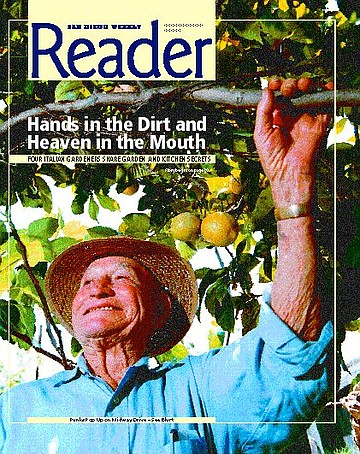
There’s a reason why Italian cooking is one of the world’s great cuisines, and it doesn’t have much to do with four-star chefs, innovative cooking techniques, or secret ingredients. The reason can be summed up in a common Italian saying: Dalla terra alla tavola, “From the earth to the table.” Freshness is all. Italian food is usually homegrown and hand-picked just hours before it is eaten.
This simple fact makes San Diego an ideal place for Italians to practice the ways of the old country and keep their traditions alive. San Diego is a gardener’s haven — a bit more rain would make that haven “heaven” — and over 200 edible crops are grown here. I set out to find some Italian gardeners who kept their gardens primarily for the purpose of supplying fruits and vegetables for their daily meals, or for the daily meals of others.
In America, we’re used to making tomato sauce from canned tomatoes, serving an antipasto of red and yellow peppers dug out of a Trader Joe’s jar, and getting our herbs in small plastic bags from Ralphs. In a real Italian kitchen, these items, as well as the eggplant that is the main ingredient in melanzane parmigiano, the basil and oregano that marry their flavors with the tomato sauce, the beans that make up a white bean salad, the rosemary that lends the olive oil a sweeter edge for dipping, and the arugula that gives any salad a superior lift, would be found in the back yard.
Certainly they can be found in Santino Giametta’s back yard in Burlingame, where he and his wife have lived for the past half century. Giametta was born on October 25, 1912, in a small fishing village on the southwest tip of Sicily called Mazara del Vallo. He lived on a farm where the family grew wheat and grapes, primarily to provide bread and wine — the basic sustenance of Sicilian life — for the table. At mid-century, Sicily was going through difficult economic times, and Giametta, along with many of his countrymen, left for a better life in New York City. Since the climate and surroundings in New York were not suitable for farming, he took a number of odd jobs, working in the garment district and in construction — anything he could get to feed his family, a wife and four daughters he had brought with him from Sicily.
The family lived in New York from 1949 through 1954, in cramped quarters on Knickerbocker Avenue in Brooklyn. Giametta became intrigued by the letters his wife Antonina was getting from her sister Katie, who lived in San Diego with her husband Antonio, a tuna fisherman. Katie waxed eloquent about the weather, the ocean, and the thriving Italian neighborhood around India Street and its environs. In 1954, Giametta packed the family onto a train at New York’s Penn Station and set out for San Diego. They joined the Italian-American community in Little Italy and for four years lived in an apartment house on the corner of Union and Laurel.
One of the attractions of San Diego was the climate — a lot closer to that of southwestern Sicily than that of New York City. Here Giametta could do what he loved best: till the earth and bring forth its bounty. He could garden virtually all year round. He established a gardening business, tending gardens for fashionable homes in Point Loma, Mission Hills, and Kensington. In 1958, the family moved to a modest single-family house in Burlingame. A son, Salvatore, was born in 1960.
I sat with Giametta, a small, slim man, wearing a baseball cap that said “God Bless America” on it, at his dining room table. His son Salvatore, now 42, beaming with pride, sat with us, translating the Sicilian dialect his father still speaks. Santino said he found the transition from Sicilian farmer to San Diego gardener relatively easy. And as soon as they moved to the Burlingame house, he could keep his own garden and grow more things than he could in Sicily.
In 1974 he suffered a mild heart attack, after which he continued to do a few odd gardening jobs until he retired from “professional” gardening in 1977 and devoted himself fully to growing his own plants and vegetables. Salvatore says that doctors have attributed his longevity — especially his relatively good health after his heart attack — both to the fact that he is so active in the garden and works at something he loves and to his diet of fresh fruits and vegetables, pasta, and olive oil, along with some fish and fowl.
It’s clear when you talk to Santino that gardening is his first love. We got up from the table to tour the garden, and as we strolled around his property, he pointed out fruits, vegetables, and herbs growing everywhere. Though I visited him in late January, many perennials and other plants were still in bloom. The primary vegetable garden is a plot of tilled land about 30' x 30' in the back yard. I was surprised to see it so green and thriving at this time of year.
“That’s the pleasure of being in San Diego,” said Salvatore, who is the vice president of community relations for the San Diego Convention and Visitors Bureau, “you get ‘fresh’ produce all year round.” In fact, perhaps taking his cue from his father’s garden, Sal enthusiastically talked up a promotion touting San Diego as a great dining destination because chefs can get newly picked ingredients here anytime. The Food Network recently aired a special about San Diego facilitated by the visitors’ bureau and emphasizing “The Art of the Fresh,” as the camera follows four well-known San Diego chefs on their quests for high-quality ingredients from local farms and farmer’s markets. And so Santino Giametta’s garden may end up having more influence on our community than he would have ever imagined.
Santino makes a sweeping gesture, taking in the green sea of growing vegetables. “In the summer,” he says in broken English, “all this is tomato.” Right now it is primarily covered with a spinach-like green the Sicilians call burani, as well as another green called gyrie. Here and there are arugula-like plants called gardela. All of these will find their way to some member of the family’s table. At various times of the year you can discover fava beans, green onions, eggplant, peppers, garlic, onions, and, one of Santino’s favorites, zucchini, which the Giamettas refer to by its Sicilian name, cucuzza. Some of these zucchini grow taller than a person. Sal points to a metal tomato stake nailed to a tall pole. “That’s to hold the cucuzza,” he says.
I asked Santino what kinds of tomatoes he grows, expecting him to reel off a variety of types. “Roma,” he says, “only Roma.” Roma is, of course, the familiar pear-shaped tomato that is excellent for Italian sauces. Since Santino likes to can large quantities of these for use during the winter, it makes sense that he limits his crop to Roma tomatoes. The whole family is well supplied throughout the year.
Unlike many San Diego gardeners who stagger their plantings, enabling them to have several harvests one after another, Santino likes his tomatoes to come in all at once so he can do the canning just once a year. He plants 10 to 15 seeds evenly spaced in five-gallon pots during the first week of March. It is important that the soil in the pots be kept moist. If the soil dries up, the seedlings are history. After about six weeks, he removes the small tomato plants from the pots and transplants them in the garden. If done carefully, few plants will be lost. Santino uses steer manure for fertilizer and stakes the individual plants with traditional round-wire tomato stakes. Most of the tomatoes will be ready for picking in late July and early August. Each year he harvests enough for about 50 large Ball jars; the jars are packed back into their cartons and stored on shelves in the garage.
The Giametta family has many special recipes that come from the bounty of its garden. Before I left, I asked Santino for one of them and he generously obliged. With Salvatore translating, we managed to put on paper a wonderful and distinctive recipe. It has all the qualities of a great Italian dish: it’s fresh, it’s simple to prepare, it’s nutritious, and it’s satisfying. As soon as I got home, I used the jar of home-canned tomatoes he gave me to make it, and I pass Santino Giametta’s gift on to you. (See recipe on page 31.) You can get it from the earth (or at least your fridge and cupboard) to your table in a half hour, and you’ll not only enjoy the food but the smile on everyone’s face.
I met Enzo Condina at Arrivederci in Hillcrest, one of the many Italian restaurants in San Diego that he supplies with fresh produce — especially the signature “spring mix” of lettuces, greens, and herbs grown on his 26-acre farm in Escondido. We were supposed to meet for lunch at 1:00 p.m., but Condina did not show up until nearly 2:00, and I had just about finished a dish of pasta with arugula grown on his farm. Antonino Mastellone, the owner of Arrivederci, had arranged the meeting. Condina apologized profusely for being so late and said he could not stay long. He is a diminutive man in his 50s who seems constantly in motion. His cell phone rang several times while we talked, and we spent most of our brief time together that afternoon trying to arrange another meeting the next day in Escondido.
Condina’s farm is tucked into a grove of eucalyptus and oak trees. When I arrived, I was struck by the conjunction of the beautiful natural landscape and the discarded refuse of contemporary civilization. The place is strewn with automobile parts, rusting lawn mowers, plastic chairs, pipes of all sizes, piles of rubber tubing, discarded furniture, old refrigerators, and other junk, all dramatically lit by the sunlight filtering through the dense oak and eucalyptus branches. Condina greeted me wearing a plaid flannel shirt and baseball cap and apologized for the mess the place was in. “I’ve got to clean all this up,” he said, sweeping his arm to take in the littered landscape. He pointed me in the direction of a makeshift shed where a trio of workers sorted and washed piles of lettuce on a table frame covered with black netting. Speaking to one of the workers in an engaging mix of Spanish, Italian, and English, Condina told him to show me around and that he would be back in ten minutes.
I took a quick tour of the front garden, a plot about 50 yards square where row after row of spring greens flourished. (Again, it was January, so “spring greens” may be a misnomer.) Condina did return shortly, and we sat down at a nearby table and talked about his thriving produce business and how he got into it.
He was born in S. Eufémia d’Aspromonte, a little town in the very toe of the Italian boot, close to Reggio di Calabria. Like Salvatore Giametta, he originally arrived in New York but was drawn to California because of the climate. “Southern Italians,” he told me, “don’t like the cold. In 1971, I started a restaurant business, and I was in the restaurant business for nearly 20 years, but I got tired of it. All the time I was running restaurants, I always kept a garden and grew my own produce. One of the reasons I decided to get out of the restaurant business is to work outdoors. From practically the beginning, I knew I liked gardening more than being inside all day. It started off just as a hobby — more for relaxing than anything else — but soon I discovered that I enjoyed it much more than I enjoyed taking care of restaurants. I love seeing things grow. So I started to plant more seeds, to grow a little bit more. Expanded. And you know, I have no experience in the beginning. But I know because my family in Italy had a farm. I was a kid then. I grew up on a farm. I remember so many things. When I was a kid I worked on the farm too. So I take the knowledge, and I remember from my father and my grandfather, my relatives over there.”
As Condina shifts the conversation from operating restaurants to planting gardens, I notice a change in his demeanor. His face gets rosier; his manner becomes more animated. All the gardeners I spoke to talk of planting and growing vegetables in an almost mystical way. They seem in touch with age-old rituals connected to the cycles of nature. It is this connection that has been severed for so many of us who buy our food in supermarkets, and this is what T.S. Eliot had in mind when he wrote, “April is the cruelest month.” It’s cruel because as nature blooms it reminds us how out of touch we are with the regenerative powers of the natural world.
“It’s an instinct,” Condina says. “I use the common sense and the knowledge I got from growing up on a farm. Sometimes I call my uncle or my aunt over in Italy and say, ‘How do you do this?’ and they give me tips. But most of the time it was just instinct. So when I started growing these things, it was just for myself, for the restaurants. I have lots of friends in the restaurant business. We would be talking and I would say come and see the farm. And they liked what they saw, and I began selling to a lot of Italian restaurants in the area: La Strada, Panevino, Portobello, Greystone, Bella Luna, Arrivederci, all these restaurants. For nearly two years now, they get all their salad greens and herbs from me.
“It’s a very small operation. Sometimes I sell larger amounts to distributors, but I prefer to sell to restaurants because the other is too much pressure. When you sell to distributors you need to produce big quantities, and I don’t want that pressure. For me, watching these things grow is a pleasure, not work. When you need to meet deadlines and produce huge amounts, that’s work.”
Originally, Condina grew all sorts of vegetables, but he learned that to succeed in a small business, it’s best to specialize. As nearly all restaurants serve salad, he set about to “design” a salad that would have a distinctive flavor and could be a refreshing accompaniment to virtually any meal. “When you have a restaurant you always look for something new, so I tested a lot of salad combinations. I wanted something special, something different. Mizuna and totsoy give it some taste, make it a little spicy. Arugula is a little bitter. And the radicchio gives color. So we try to put together a combination of a lettuce with different taste to give it a nice crispy texture as well.” Condina spoke disparagingly of some of the supermarket salads called mesclun: “They put a few items together just to look good with the color. We want it to look good, but we pick our salad to really put a whole range of favors in one dish; they have to go together, they have to blend. Each one tastes a little different. People are tired of Caesar salad and tasteless iceberg lettuce, so we have to make something more distinctive.”
He settled on a mix of 13 to 14 greens and lettuces: lollo rosso, red oak, red romaine, green romaine, and tango; to that he adds friseé, some arugula, radicchio, and three items that are essentially oriental greens: mizuna, totsoy, and red mustard. Various other lettuces and greens are added depending on what flourishes in a particular season. As Condina described this, he made it sound like a formula for a fine Italian wine.
Condina walked me around the farm showing me the varieties and explaining how each was grown. Each large plot of tilled land consists of long three-foot-wide mounds. In each mound there are three rows of different greens. Two long rubber hoses or metal pipes run between the rows. This is the irrigation drip system that provides a steady supply of water, keeping the soil always moist.
“The first thing we do is to prepare the soil by mixing some steer manure in it and tilling it by machine. Then we dig channels about three feet apart, so we create small mounds of very fertile soil. After that we sow the seeds, making three long rows in each mound. The greens start growing right away. When the weather is normal, the arugula, mizuna, and totsoy start coming up after three or four days. Unlike tomato plants, which are usually started in containers, lettuce can be started right in the ground.
“Generally, from when you seed, to get to the first cut takes 35 to 40 days. Some kinds of lettuce will grow quicker than others. Lollo rosso, spinach, and Italian parsley take more time to grow than some other greens. But the arugula and the Japanese greens grow very fast when the weather is right. Of course, we grow the herbs in the greenhouse: rosemary, chives, dill, basil, oregano, mint, thyme, and marjoram.”
The lettuce is cut every morning. Each plant survives about three cuts. The day’s cut is brought to the shed and sorted on the table frame covered with black netting. Workers pick through the leaves to remove dead and inorganic matter. They are washed in a machine with a drum that spins out the water, packed in large plastic bags, and boxed. Condina then loads them in a van and delivers them personally to his restaurant friends in San Diego. He is the Italian greengrocer connection.
I asked him if he missed the restaurant business. “No, not at all. With the farm I get to spend time with my family.” Condina has 14-year-old twin girls and a daughter of 18. He and his wife Marisol, a Mexican woman he met on a vacation in Mexico, own a lovely home in Rancho Bernardo, not far from the Escondido farm. His is a busy but fulfilling life, lived close to the land, in touch with the cycle of the seasons, even in the eternal summer of Southern California. “How about a recipe for some of these greens?” I asked. “Ask Antonino,” he said, “he’s a much better cook than I am.” So I did. You can find this dish, Fettuccini with Arugula and Goat Cheese, on the menu at Antonino Mastellone’s Arrivederci Restaurant in Hillcrest, where you can have it with the arugula grown with love at Enzo Condina’s farm in Escondido. Or you can make it yourself at home with the recipe on page 37.
Tony Di Bona is a San Diego native, born in the heart of Little Italy.
He reminds one of a character out of Lorenzo Madalena’s Confetti for Gino, the Italian-American novel serialized in the Reader a couple of years ago. His family came originally from Castellamare del Golfo in Sicily, just near Palermo, and they were mostly mariners. Di Bona’s father, Mario, became a tuna fisherman, and his family worked in the tuna-fishing industry in San Diego for many years.
I met Di Bona in the garden of a house he owns on Pontiac Street in the College Area. Though he and his wife Giovanna live in Kensington now, he rents this house to his father-in-law and maintains the garden here that he started many years ago. Di Bona is a jovial and upbeat man in his late 50s, with distinguished gray-black hair. On the day we talked, he wore a black “Roma” T-shirt with a drawing of the Roman Coliseum embroidered on it. Everything about Di Bona says “Italian.”
“I can’t remember not having a garden,” he said. “All the houses that we lived in, starting in Little Italy on Columbia Street, always had a little garden. I think it comes from Sicily, where around their own villages back home they had little gardens. My father used to grow vegetables — carrots and tomatoes, of course — and whenever he would go out to sea fishing, I would be given the task of maintaining the garden, especially the tomatoes. That was his main pride. I had to make sure they were watered and nourished, and I picked the ripe ones when they came due, and so that tradition sort of prevailed in my blood. Ever since that time when I was a little boy, until today, I have been always interested and inspired to continue that tradition. I was thrilled the other day when my son, who is 30 now, just bought a house in La Mesa and he got a little curious about this and said, ‘Dad, give me some tips, I want to start my garden.’ So I think the tradition is going to keep going.
“We used to have a large yard here with just nothing but grass, which I thought was a waste of water in this arid climate — to just keep watering the lawn and have it turn into crabgrass and all sorts of terrible things. I thought, well, I am going to expand the garden that I have here, which was very small at the time, to something that contains raised beds. I constructed 12 raised beds 3' by 12' and filled them with very good topsoil, nourished them with organic materials, and planted tomatoes. We had bumper crops of tomatoes for several years. I even canned the tomatoes and made nice sauce out of them. We still have a few bottles left from last summer.”
The garden at Pontiac Street is an area about 50' by 50'. For sheer variety of vegetation, Di Bona’s is the most diverse garden I have seen. In the center sits a large apple tree that Di Bona says has acclimated itself to San Diego and makes Delicious apples in the summer. There are also citrus trees — lemon, lime, grapefruit, and orange — lining the garden’s edges. I looked around for a fig tree, since fig trees are ubiquitous in Italian gardens. “Where’s the fig tree?” I asked.
“When you go to someone’s house you can tell if they’re Italian because you will see a tomato plant for sure and a fig tree. I don’t have a fig tree. I did but it died. The reason I put one in is because that is part of the icon of the yard.”
Since Di Bona’s was the first garden I’d seen that was partitioned by wooden framed beds, I wondered aloud if gardening this way helped him to control weeds. “Weeds always seem to find their way into any place you put dirt, it seems. That is the devil’s playground; when you don’t have anything else in there, they’ll be there. The bed is not so much for weed control but for drainage. The drainage is much improved; I can control the water situation with the plants in the soil. As it is, there is a lot of adobe in the soil around here, and it maintains a very wet kind of substructure, which is not too healthy for the roots. So I find this method is really very good. The soil is better controlled, and I can till it much easier. I have an automatic watering system here which I nourish the plants with. It has four zones which feed all of the boxes, and they are on timers. When it is not so hot I will water every other day. I can adjust the length of watering, so it is very well managed in that respect. I have my water set to run daily for four minutes during warm periods and every other day if it’s cool and overcast. I don’t want to get the soil excessively saturated. I have read that it is best to water during the day (1:00 p.m.). This prevents dampness and moisture to build up overnight, attracting bugs. Also it’s good to keep the bed clear of dead foliage, as this will attract snails and slugs that can chew your young seedlings down to a stub. I use snail bait at times to control that problem. I haven’t tried beer. I understand that will attract the critters too.”
The variety of plants and vegetables grown in Di Bona’s garden is impressive. He has something different coming up in every season. When I visited in early February, there were lettuces and radishes and artichokes, and many root plants, like beets and carrots, and onions, which can be grown year-round. Di Bona pointed to the various lettuce plants, which were thriving.
“We try to keep lettuces going during the summer, even when it is not usually the best time to grow them. I try to grow those in the shady part of the yard so that they don’t wilt too badly. We love fresh garden lettuce. I have not been to the store in ten years to buy lettuce. We pick it right from the yard here at all times. We even share that with some of the bugs once in a while. I never use chemical pesticides in any produce here. Sometimes we use garlic, some lemon and soap spray — those types of organic things. And sometimes I will put flowers in that attract the insects to them rather than to our tomatoes. These are some of the secrets I pass on to my son.
“We also grow arugula, which is a very nice thing to add to your salads. Of course, it’s too early for tomatoes, but soon I’ll be planting them. I usually put down 30 tomato plants of various types. Like right now, I have some seedlings growing right there in the center, which I formed a little greenhouse sort of with a plastic wrap over. So those are coming up, as well as peppers, and once they are large enough and it gets a little warmer — I anticipate this spring will be a little warmer than normal, so I can probably start a little earlier. I can start putting down my peppers and onions and tomatoes and things like that.
“Each time I plant, I move from one box to the other, changing the plants. I don’t put the same plants in the same box every year. That’s something I read about that you should do, and another thing a Chinese gardener told me: you have got to till the soil and let it breathe and rest for a while. That’s what I have been doing here: I tilled this about a couple of weeks ago and I let it breathe. Then I put my addition of manure and other organic materials in there, let it breathe more, then rake it smooth and start planting there. That keeps the soil full of nutrients. And you have to rotate your plants, and I think that is what most farmers practice as well: they rotate their plants. The thing you have got to watch out for is, if you do put chemicals in the soil, it eventually gets leached and becomes very high on the pH scale one way or the other. It gets either too acidic or too alkaline, which is more the case here with our water. You have got to watch the alkaline content, and I do test the soil for pH.”
I asked Di Bona if he could recommend some specific books about gardening. “I read some books, but it is really all a matter of experimentation and the school of hard knocks, if things don’t work. You just have to watch your seasons when it is too cold for things to sprout or to survive. These days, the Internet provides a lot of great information. There is a tremendous database of information available through the Internet, especially about organic gardening. That’s becoming very, very popular for obvious reasons: because we are trying to eat food that is not tainted with poisons — toxins — and you can do best with that when you grow the food yourself. One of the best ways to get gardening information is to open up the web browser Google and just type in ‘gardening, chard’ or ‘gardening, lettuce.’ It will give you literally hundreds of contacts. I think that’s the best way to go. If you want some scientific information, UC Davis is a very big agricultural school, and you’ll find a lot of information on olives, tomatoes, everything like that.”
Di Bona reinforced my primary idea about Italian food. “The Mediterranean folk always like their food to be fresh, even the fish, so everything from the sea, from the land, to your table has got to be not more than one day old. If you recall, in Italy, and in Europe generally, you go shopping for your food every day; even if you have a refrigerator, it’s almost always a small refrigerator. We have big refrigerators. There you shop every day — go to the market and get fresh produce — and it tastes so much better and different than what we get here.”
Unlike Santino Giametta, who grows only Romas and plants them all at the same time, Di Bona grows a variety of tomatoes and staggers their planting throughout the spring. “We really love tomatoes,” he says, “our whole family loves tomatoes, and of course, being Italian, we like them in our sauce, we like them in our salads, and we love them with basil. We love that, so as soon as possible I start to put basil in the ground and get it going so it goes along with the tomato plants, because basil and tomato is a marriage made in heaven. I do quite a mix of tomatoes. The San Diego tomato, the beefsteak, we like; the Romas, of course; and I always will have four to five cherry tomato plants. Even though they are small, their sauce, their juice, is very, very sweet. It is a very good tomato, although it takes many more to make the sauce. But it is very sweet. There is one favorite dish I love to do, which is with tomatoes, basil, and onions and vinegar and a little bit of olive oil with the peppers. It is pure ambrosia when everything is just fresh and very ripe. If we get a big harvest of tomatoes we will make sauce with them. I do that. I make the sauce — usually a mixture of many kinds of tomatoes — then bottle it up in Mason jars.”
Di Bona pointed to a green leafy plant in one of the beds. “That’s Swiss chard,” he said, “one of the most underrated garden vegetables there is. It’s very easy to grow and grows almost any time of the year, especially in the summer. It sprouts very easily from seed, and you can plant the seeds directly in the earth. And the beauty of it is that as you cut its leaves, it keeps growing; it will continue to grow until the plant gets a little old and you replace it. To keep it coming in, the secret is keep planting the seed every couple of weeks or so, keep putting some seeds down so that new sprouts come in and you keep getting a nice new generation. I put new seeds right in between the rows of established plants. When the old plant dies out, I’ll pull it out and put in new seeds; meanwhile, the other generation is coming up and you have a continual, fresh, real tender leaf. In my opinion, it is better than spinach — it tastes better than spinach and is even more nutritious. People gravitate more towards spinach because they’ve been told that’s the main best leafy vegetable, but they’re missing the boat if they don’t get onto chard. Especially if you can grow it in your yard, it is easier to grow than spinach and is more tolerant with water and diseases and that kind of thing. It is a marvelous thing to eat, especially when you grow it yourself; you’ll marvel at the taste this plant has. That’s what I made us for lunch. You can sauté it in olive oil and garlic, and that’s how we are having it today. Garlic and olive oil and whatever else your imagination dictates. You can chop it very finely. My wife makes it with a very fine chopped technique, or sometimes you get a larger leaf — like today, we have a larger chop, or the peasant style.”
All this talk of Italian food was getting my digestive juices flowing, so I was glad Di Bona brought up lunch. And we did enjoy a wonderful vegetarian lunch starting with a radicchio salad with balsamic vinegar and extra-virgin olive oil, followed by Swiss chard sautéed in olive oil, baked Portobello mushrooms with garlic and green and red peppers sprinkled with arugula, a delicious sweet chopped cabbage with onions and fresh olives from the olive tree at Di Bona’s house in Kensington. All of this was accompanied by fresh Italian bread from Solunto in Little Italy and washed down with a Chianti Classico. Needless to say, it was a marvelous afternoon. The Swiss chard recipe is the essence of simplicity. (See above.)
To speak to my last gardener, I merely walked across campus at San Diego State University, where I teach, to the School of Public Administration, where my colleague, Nico Calavita, is a faculty member. I’ve known Calavita for many years. We have in common the fact that both of our families are from Apulia, the heel of the Italian boot, although Calavita’s family is from the port city of Bríndisi on the Adriatic coast (he was born and grew up there), while mine is from a small inland village called Gravina. A few years ago we began trading recipes we remembered from our childhoods, and we’ve assembled a substantial collection of distinctive Apulian dishes.
Calavita is a tall (about 6'6"), dark-haired man with an aristocratic bearing. He speaks a deliberate, carefully pronounced English. I knew he kept a garden because we’ve cooked together at his house many times and rummaged through the back yard for herbs, greens, tomatoes, and other staples of the Italian table. Calavita lives in University City with his wife Kitty, and his garden is much smaller than any of the others I’ve described. These days, he gardens mostly in pots and around the edges of his terrace because much of his back yard is paved over. Nonetheless, he almost always has something growing and would rarely think, for example, of going to the store to buy herbs like basil, oregano, and rosemary.
When I asked Calavita how he got interested in gardening, he told me a story about his childhood, growing up in the region around Bríndisi, and about the summers he spent at his family’s country home in Latiano. The images Calavita evoked spoke of a long-vanished way of life.
“Although I grew up in Bríndisi, my father came from a smaller town about 20 minutes away called Latiano, and the family had a country estate. There was a house and about ten acres around it, which had mostly olive and fruit trees and also a vineyard. We would go there in the summer for about two and a half months. That was a ritual that we had. Every summer a cart would come from Latiano and would get everything we needed to spend summer in the country house. The cart would come and we would be all excited because there would be a horse and a cart that would be piled up with stuff, and then the cart would leave and then we would wait and finish and take with us the things which were more delicate, and then we would get in the car, and we as children would also be anxious to finally meet the cart, and then we would pass the cart to ride to the house.”
The image of the Calavita family in an automobile passing a horse-drawn cart filled with their possessions struck me as charming and a kind of image from the first half of the 20th Century that now belongs to history. “You passed the cart?” I said. “Yes, I remember that happening regularly. We passed the cart and then we arrived at the house; we would wait for it to arrive and set up for another summer.
“And my father, in the days before we arrived, would go to the small town to a place he had stored not only all the furniture but also all the windows and doors. At the end of every summer we would just strip the house of everything so that during the winter it would remain a shell, because what would happen otherwise is that thieves would just break in and steal everything. So we would get back there and put in all the windows and doors and the furniture which had been in storage. And then the cart would come and we would just set up during the day. The house did not have running water or electricity, and there was a sharecropper couple on the property — Peppino and Peppina, (yes, those were their real names!). I remember them well — and Peppino would go to the well and bring us water as we needed it.
“At night we would have lights on outdoors, and that created a romantic setting because the people from other country homes in the area would come to our house at night. We would talk, we would eat, there was dancing, and it is really a great memory to have of those evenings. Peppino kept a vegetable garden that was for his and our use. So we would have fresh vegetables every day, and the typical things he would grow during the summer would be eggplants, peppers, cucumbers and tomatoes, lettuce, and melons.
“Generally these are the same vegetables that you would have during the summer season here, and often we would have these salads where we would put all the ingredients that we had in it, from the tomatoes to the cucumbers to lettuce. One way to do the salad was to have old bread, stale bread which had been placed in water and then would be squeezed and mixed with all the fresh vegetables, which is generally how it is done in Florence.
“Nothing was ever wasted in those days; the bread was usually baked on a weekly basis. So you would have fresh bread in the first couple of days, and the bread would get more and more stale and by the end of the week it would be hard bread and so you usually had something left over that could be utilized to do all sorts of different things — some would be grated, some would be crumbs, and some would be used in salad and for other things.
“The weather in Latiano was often very dry, so almost every night Peppino would go irrigate the plants, and I would be there helping him. He made an irrigation system like little rivers. The water would be thrown from buckets and run down a channel alongside the vegetables as a river. I would help Peppino with a little hoe to open and close the water entry to the different rows of the different vegetables.
“So I was very much part of that particular environment. I was fascinated with that, and of course I was part of the vendemmia. Just before we would leave the countryside, there would be the vendemmia, the harvest of the grapes. Other people would come from all around. There was a system of sharing. If you needed help on the day when you harvest your grapes, different farmers would come and help whoever had a harvest on a particular day, so there would always be lots of people doing that.
“It obviously was a great deal of fun for us kids when that would take place. There were lots of fruit trees, there were fig trees — there were so many fig trees that when we played, we would just use figs to throw at each other, like mock battles. We would choose the ripest of the figs and then throw them at each other.
“We had hoards of grapes — the table type of grapes — and I remember a particular grape which was called zibibbo, which was extremely sweet. I can still taste it today. During the season you had different fruits which would come in at different times, and that’s something that we have lost connection to — that there is an appropriate time for particular fruits and vegetables to come up.”
Calavita echoed a refrain I heard from all the Italian gardeners: “These days we go to supermarkets and we have everything all year round. You can buy corn at Christmas, which doesn’t make any sense, and of course peaches and other crops, which are summer crops, are available year-round. But when I was growing up it was a particular fruit appropriate to a particular time. So there were pears in the spring and then the figs, different types of figs would come earlier. In fact, fig trees often produced a small number of figs in June and then seemed to take a break for a period of a month or a month and a half, when no figs grew, and then in late summer or early fall you have figs in great abundance.
“We would have persimmons at the end of the season. Just before we left, it would be the time for persimmons. So there was this complete communion with the growing and the consuming of vegetables and fruits throughout the entire time. We never bought fruits or vegetables for the entire two and a half months that we were there. Of course, there were no chemicals, nothing of that sort of stuff. Today we would call what we had organic fruits and vegetables, though nobody used the word ‘organic’ in those days.”
“So how did you bring those traditions to this country when you arrived here?” I asked.
“I was 28 when I first came to the U.S. I was trained in urban planning, and I found a job as a planner in New Castle County Planning Department in Delaware. Kitty and I bought a house with a very long back yard, and immediately I started to grow vegetables and herbs in large quantities. The land was much more fertile than it is here in San Diego. We would go back to Italy almost every summer, and when we came back after three weeks or so, the garden would be all grown with weeds. Just because of the heavy summer rains and the fertility of the soil. But I would pull out the weeds and voilà, there were the fruits and vegetables. You could never leave a garden for three weeks in the summer in San Diego and find anything growing when you got back.
“So I grew again a typical spring-and-summer crop, especially tomatoes and peppers and eggplants and so on. We had also a place where we had rhubarb, which actually had been left there from the previous owner of the house. At the end of the garden, there were two apple trees, which again provided continually because they were winter crops. Gardening was something that I enjoyed doing when I would come back from work, during late spring and summer nights. For me, working the earth with your hands is a very enjoyable way to relax.” Sounding almost exactly like Tony Di Bona, Calavita added, “There is great pleasure in putting seeds into the ground and seeing them come up — the cycle of life that is continuous and sustains us — and there is great satisfaction in having the fresh taste of all the vegetables that you grow yourself, as opposed to the ones that you buy in the supermarket.”
Even though Calavita does most of his gardening these days in pots, his harvest can be abundant. “You’d be surprised how many things you can grow in the pots. I grow tomatoes in the summer. I grow melons and herbs, especially basil. Basil is a must — you can never have enough basil. And I almost always grow zucchini, but not in pots, because they need room to spread out. I have several orange, tangerine, lemon trees in the back yard. The same thing with Italian parsley and other herbs. I grow lettuce.” Like Tony Di Bona, Calavita grows lettuce year-round. “I think lettuce is also one of those plants that everybody should grow, because in the winter and springtime they grow very well, and you want a salad, you go in the back yard and there is your fresh lettuce. I don’t let it grow to be very large. I like to grow different varieties of baby lettuce in large quantities so I can cut them at the base and always have lettuce coming in.”
I asked him how he feeds all these plants. “We do composting, so we use that in the soil. But generally I use Miracle-Gro, the kind that you dissolve in a container of water and pour over the plants. But my son introduced me to fish meal, and that works very well with basil. I don’t mind the more chemical fertilizers; I am not too stuck on heavy organic stuff. I try to recycle. We have a container in the kitchen where we put all the kitchen scraps and so on and put it in the drum that my neighbor bought and then mix it with leaves and other garden types of things and create compost. I share that with my neighbor. But I am not averse to using chemicals.”
Calavita has a number of fruit trees in his garden. Planting them was one of the first things he did when he bought the house 15 years ago. “I planted four orange trees, one lemon tree, and a tangerine tree. The lemon tree is amazing; it’s always producing huge lemons. During my travels in Italy in the past few years I noticed this new custom, especially in the south. I was in Naples often the past few years, and after meals in restaurants they often offer a liqueur called limoncello. Limone is lemon and limoncello is a lemon liqueur. So I asked relatives in Italy — actually, through an e-mail I received a recipe for limoncello from a nephew of mine, and it is very easy to do and extremely delicious. You want the recipe now?”
I told him of course I did, and it seems fitting to close this survey of Italian gardeners in San Diego with a little after-dinner liqueur. You find the limoncello recipe on page 39. Enjoy! n
— Fred Moramarco
Fred Moramarco is editor of Poetry International and teaches American literature and creative writing at San Diego State. He is the coauthor of Containing Multitudes: Poetry in the United States Since 1950. His most recent book, coauthored with his son Stephen, is Italian Pride: 101 Reasons to Be Proud You’re Italian.
Here's something you might be interested in.
San Diego an ideal place for Italians to garden like the old country
Hands in the dirt and Heaven in the mouth

San Diego an ideal place for Italians to garden like the old country
Hands in the dirt and Heaven in the mouth
There’s a reason why Italian cooking is one of the world’s great cuisines, and it doesn’t have much to do with four-star chefs, innovative cooking techniques, or secret ingredients. The reason can be summed up in a common Italian saying: Dalla terra alla tavola, “From the earth to the table.” Freshness is all. Italian food is usually homegrown and hand-picked just hours before it is eaten.
This simple fact makes San Diego an ideal place for Italians to practice the ways of the old country and keep their traditions alive. San Diego is a gardener’s haven — a bit more rain would make that haven “heaven” — and over 200 edible crops are grown here. I set out to find some Italian gardeners who kept their gardens primarily for the purpose of supplying fruits and vegetables for their daily meals, or for the daily meals of others.
In America, we’re used to making tomato sauce from canned tomatoes, serving an antipasto of red and yellow peppers dug out of a Trader Joe’s jar, and getting our herbs in small plastic bags from Ralphs. In a real Italian kitchen, these items, as well as the eggplant that is the main ingredient in melanzane parmigiano, the basil and oregano that marry their flavors with the tomato sauce, the beans that make up a white bean salad, the rosemary that lends the olive oil a sweeter edge for dipping, and the arugula that gives any salad a superior lift, would be found in the back yard.
Certainly they can be found in Santino Giametta’s back yard in Burlingame, where he and his wife have lived for the past half century. Giametta was born on October 25, 1912, in a small fishing village on the southwest tip of Sicily called Mazara del Vallo. He lived on a farm where the family grew wheat and grapes, primarily to provide bread and wine — the basic sustenance of Sicilian life — for the table. At mid-century, Sicily was going through difficult economic times, and Giametta, along with many of his countrymen, left for a better life in New York City. Since the climate and surroundings in New York were not suitable for farming, he took a number of odd jobs, working in the garment district and in construction — anything he could get to feed his family, a wife and four daughters he had brought with him from Sicily.
The family lived in New York from 1949 through 1954, in cramped quarters on Knickerbocker Avenue in Brooklyn. Giametta became intrigued by the letters his wife Antonina was getting from her sister Katie, who lived in San Diego with her husband Antonio, a tuna fisherman. Katie waxed eloquent about the weather, the ocean, and the thriving Italian neighborhood around India Street and its environs. In 1954, Giametta packed the family onto a train at New York’s Penn Station and set out for San Diego. They joined the Italian-American community in Little Italy and for four years lived in an apartment house on the corner of Union and Laurel.
One of the attractions of San Diego was the climate — a lot closer to that of southwestern Sicily than that of New York City. Here Giametta could do what he loved best: till the earth and bring forth its bounty. He could garden virtually all year round. He established a gardening business, tending gardens for fashionable homes in Point Loma, Mission Hills, and Kensington. In 1958, the family moved to a modest single-family house in Burlingame. A son, Salvatore, was born in 1960.
I sat with Giametta, a small, slim man, wearing a baseball cap that said “God Bless America” on it, at his dining room table. His son Salvatore, now 42, beaming with pride, sat with us, translating the Sicilian dialect his father still speaks. Santino said he found the transition from Sicilian farmer to San Diego gardener relatively easy. And as soon as they moved to the Burlingame house, he could keep his own garden and grow more things than he could in Sicily.
In 1974 he suffered a mild heart attack, after which he continued to do a few odd gardening jobs until he retired from “professional” gardening in 1977 and devoted himself fully to growing his own plants and vegetables. Salvatore says that doctors have attributed his longevity — especially his relatively good health after his heart attack — both to the fact that he is so active in the garden and works at something he loves and to his diet of fresh fruits and vegetables, pasta, and olive oil, along with some fish and fowl.
It’s clear when you talk to Santino that gardening is his first love. We got up from the table to tour the garden, and as we strolled around his property, he pointed out fruits, vegetables, and herbs growing everywhere. Though I visited him in late January, many perennials and other plants were still in bloom. The primary vegetable garden is a plot of tilled land about 30' x 30' in the back yard. I was surprised to see it so green and thriving at this time of year.
“That’s the pleasure of being in San Diego,” said Salvatore, who is the vice president of community relations for the San Diego Convention and Visitors Bureau, “you get ‘fresh’ produce all year round.” In fact, perhaps taking his cue from his father’s garden, Sal enthusiastically talked up a promotion touting San Diego as a great dining destination because chefs can get newly picked ingredients here anytime. The Food Network recently aired a special about San Diego facilitated by the visitors’ bureau and emphasizing “The Art of the Fresh,” as the camera follows four well-known San Diego chefs on their quests for high-quality ingredients from local farms and farmer’s markets. And so Santino Giametta’s garden may end up having more influence on our community than he would have ever imagined.
Santino makes a sweeping gesture, taking in the green sea of growing vegetables. “In the summer,” he says in broken English, “all this is tomato.” Right now it is primarily covered with a spinach-like green the Sicilians call burani, as well as another green called gyrie. Here and there are arugula-like plants called gardela. All of these will find their way to some member of the family’s table. At various times of the year you can discover fava beans, green onions, eggplant, peppers, garlic, onions, and, one of Santino’s favorites, zucchini, which the Giamettas refer to by its Sicilian name, cucuzza. Some of these zucchini grow taller than a person. Sal points to a metal tomato stake nailed to a tall pole. “That’s to hold the cucuzza,” he says.
I asked Santino what kinds of tomatoes he grows, expecting him to reel off a variety of types. “Roma,” he says, “only Roma.” Roma is, of course, the familiar pear-shaped tomato that is excellent for Italian sauces. Since Santino likes to can large quantities of these for use during the winter, it makes sense that he limits his crop to Roma tomatoes. The whole family is well supplied throughout the year.
Unlike many San Diego gardeners who stagger their plantings, enabling them to have several harvests one after another, Santino likes his tomatoes to come in all at once so he can do the canning just once a year. He plants 10 to 15 seeds evenly spaced in five-gallon pots during the first week of March. It is important that the soil in the pots be kept moist. If the soil dries up, the seedlings are history. After about six weeks, he removes the small tomato plants from the pots and transplants them in the garden. If done carefully, few plants will be lost. Santino uses steer manure for fertilizer and stakes the individual plants with traditional round-wire tomato stakes. Most of the tomatoes will be ready for picking in late July and early August. Each year he harvests enough for about 50 large Ball jars; the jars are packed back into their cartons and stored on shelves in the garage.
The Giametta family has many special recipes that come from the bounty of its garden. Before I left, I asked Santino for one of them and he generously obliged. With Salvatore translating, we managed to put on paper a wonderful and distinctive recipe. It has all the qualities of a great Italian dish: it’s fresh, it’s simple to prepare, it’s nutritious, and it’s satisfying. As soon as I got home, I used the jar of home-canned tomatoes he gave me to make it, and I pass Santino Giametta’s gift on to you. (See recipe on page 31.) You can get it from the earth (or at least your fridge and cupboard) to your table in a half hour, and you’ll not only enjoy the food but the smile on everyone’s face.
I met Enzo Condina at Arrivederci in Hillcrest, one of the many Italian restaurants in San Diego that he supplies with fresh produce — especially the signature “spring mix” of lettuces, greens, and herbs grown on his 26-acre farm in Escondido. We were supposed to meet for lunch at 1:00 p.m., but Condina did not show up until nearly 2:00, and I had just about finished a dish of pasta with arugula grown on his farm. Antonino Mastellone, the owner of Arrivederci, had arranged the meeting. Condina apologized profusely for being so late and said he could not stay long. He is a diminutive man in his 50s who seems constantly in motion. His cell phone rang several times while we talked, and we spent most of our brief time together that afternoon trying to arrange another meeting the next day in Escondido.
Condina’s farm is tucked into a grove of eucalyptus and oak trees. When I arrived, I was struck by the conjunction of the beautiful natural landscape and the discarded refuse of contemporary civilization. The place is strewn with automobile parts, rusting lawn mowers, plastic chairs, pipes of all sizes, piles of rubber tubing, discarded furniture, old refrigerators, and other junk, all dramatically lit by the sunlight filtering through the dense oak and eucalyptus branches. Condina greeted me wearing a plaid flannel shirt and baseball cap and apologized for the mess the place was in. “I’ve got to clean all this up,” he said, sweeping his arm to take in the littered landscape. He pointed me in the direction of a makeshift shed where a trio of workers sorted and washed piles of lettuce on a table frame covered with black netting. Speaking to one of the workers in an engaging mix of Spanish, Italian, and English, Condina told him to show me around and that he would be back in ten minutes.
I took a quick tour of the front garden, a plot about 50 yards square where row after row of spring greens flourished. (Again, it was January, so “spring greens” may be a misnomer.) Condina did return shortly, and we sat down at a nearby table and talked about his thriving produce business and how he got into it.
He was born in S. Eufémia d’Aspromonte, a little town in the very toe of the Italian boot, close to Reggio di Calabria. Like Salvatore Giametta, he originally arrived in New York but was drawn to California because of the climate. “Southern Italians,” he told me, “don’t like the cold. In 1971, I started a restaurant business, and I was in the restaurant business for nearly 20 years, but I got tired of it. All the time I was running restaurants, I always kept a garden and grew my own produce. One of the reasons I decided to get out of the restaurant business is to work outdoors. From practically the beginning, I knew I liked gardening more than being inside all day. It started off just as a hobby — more for relaxing than anything else — but soon I discovered that I enjoyed it much more than I enjoyed taking care of restaurants. I love seeing things grow. So I started to plant more seeds, to grow a little bit more. Expanded. And you know, I have no experience in the beginning. But I know because my family in Italy had a farm. I was a kid then. I grew up on a farm. I remember so many things. When I was a kid I worked on the farm too. So I take the knowledge, and I remember from my father and my grandfather, my relatives over there.”
As Condina shifts the conversation from operating restaurants to planting gardens, I notice a change in his demeanor. His face gets rosier; his manner becomes more animated. All the gardeners I spoke to talk of planting and growing vegetables in an almost mystical way. They seem in touch with age-old rituals connected to the cycles of nature. It is this connection that has been severed for so many of us who buy our food in supermarkets, and this is what T.S. Eliot had in mind when he wrote, “April is the cruelest month.” It’s cruel because as nature blooms it reminds us how out of touch we are with the regenerative powers of the natural world.
“It’s an instinct,” Condina says. “I use the common sense and the knowledge I got from growing up on a farm. Sometimes I call my uncle or my aunt over in Italy and say, ‘How do you do this?’ and they give me tips. But most of the time it was just instinct. So when I started growing these things, it was just for myself, for the restaurants. I have lots of friends in the restaurant business. We would be talking and I would say come and see the farm. And they liked what they saw, and I began selling to a lot of Italian restaurants in the area: La Strada, Panevino, Portobello, Greystone, Bella Luna, Arrivederci, all these restaurants. For nearly two years now, they get all their salad greens and herbs from me.
“It’s a very small operation. Sometimes I sell larger amounts to distributors, but I prefer to sell to restaurants because the other is too much pressure. When you sell to distributors you need to produce big quantities, and I don’t want that pressure. For me, watching these things grow is a pleasure, not work. When you need to meet deadlines and produce huge amounts, that’s work.”
Originally, Condina grew all sorts of vegetables, but he learned that to succeed in a small business, it’s best to specialize. As nearly all restaurants serve salad, he set about to “design” a salad that would have a distinctive flavor and could be a refreshing accompaniment to virtually any meal. “When you have a restaurant you always look for something new, so I tested a lot of salad combinations. I wanted something special, something different. Mizuna and totsoy give it some taste, make it a little spicy. Arugula is a little bitter. And the radicchio gives color. So we try to put together a combination of a lettuce with different taste to give it a nice crispy texture as well.” Condina spoke disparagingly of some of the supermarket salads called mesclun: “They put a few items together just to look good with the color. We want it to look good, but we pick our salad to really put a whole range of favors in one dish; they have to go together, they have to blend. Each one tastes a little different. People are tired of Caesar salad and tasteless iceberg lettuce, so we have to make something more distinctive.”
He settled on a mix of 13 to 14 greens and lettuces: lollo rosso, red oak, red romaine, green romaine, and tango; to that he adds friseé, some arugula, radicchio, and three items that are essentially oriental greens: mizuna, totsoy, and red mustard. Various other lettuces and greens are added depending on what flourishes in a particular season. As Condina described this, he made it sound like a formula for a fine Italian wine.
Condina walked me around the farm showing me the varieties and explaining how each was grown. Each large plot of tilled land consists of long three-foot-wide mounds. In each mound there are three rows of different greens. Two long rubber hoses or metal pipes run between the rows. This is the irrigation drip system that provides a steady supply of water, keeping the soil always moist.
“The first thing we do is to prepare the soil by mixing some steer manure in it and tilling it by machine. Then we dig channels about three feet apart, so we create small mounds of very fertile soil. After that we sow the seeds, making three long rows in each mound. The greens start growing right away. When the weather is normal, the arugula, mizuna, and totsoy start coming up after three or four days. Unlike tomato plants, which are usually started in containers, lettuce can be started right in the ground.
“Generally, from when you seed, to get to the first cut takes 35 to 40 days. Some kinds of lettuce will grow quicker than others. Lollo rosso, spinach, and Italian parsley take more time to grow than some other greens. But the arugula and the Japanese greens grow very fast when the weather is right. Of course, we grow the herbs in the greenhouse: rosemary, chives, dill, basil, oregano, mint, thyme, and marjoram.”
The lettuce is cut every morning. Each plant survives about three cuts. The day’s cut is brought to the shed and sorted on the table frame covered with black netting. Workers pick through the leaves to remove dead and inorganic matter. They are washed in a machine with a drum that spins out the water, packed in large plastic bags, and boxed. Condina then loads them in a van and delivers them personally to his restaurant friends in San Diego. He is the Italian greengrocer connection.
I asked him if he missed the restaurant business. “No, not at all. With the farm I get to spend time with my family.” Condina has 14-year-old twin girls and a daughter of 18. He and his wife Marisol, a Mexican woman he met on a vacation in Mexico, own a lovely home in Rancho Bernardo, not far from the Escondido farm. His is a busy but fulfilling life, lived close to the land, in touch with the cycle of the seasons, even in the eternal summer of Southern California. “How about a recipe for some of these greens?” I asked. “Ask Antonino,” he said, “he’s a much better cook than I am.” So I did. You can find this dish, Fettuccini with Arugula and Goat Cheese, on the menu at Antonino Mastellone’s Arrivederci Restaurant in Hillcrest, where you can have it with the arugula grown with love at Enzo Condina’s farm in Escondido. Or you can make it yourself at home with the recipe on page 37.
Tony Di Bona is a San Diego native, born in the heart of Little Italy.
He reminds one of a character out of Lorenzo Madalena’s Confetti for Gino, the Italian-American novel serialized in the Reader a couple of years ago. His family came originally from Castellamare del Golfo in Sicily, just near Palermo, and they were mostly mariners. Di Bona’s father, Mario, became a tuna fisherman, and his family worked in the tuna-fishing industry in San Diego for many years.
I met Di Bona in the garden of a house he owns on Pontiac Street in the College Area. Though he and his wife Giovanna live in Kensington now, he rents this house to his father-in-law and maintains the garden here that he started many years ago. Di Bona is a jovial and upbeat man in his late 50s, with distinguished gray-black hair. On the day we talked, he wore a black “Roma” T-shirt with a drawing of the Roman Coliseum embroidered on it. Everything about Di Bona says “Italian.”
“I can’t remember not having a garden,” he said. “All the houses that we lived in, starting in Little Italy on Columbia Street, always had a little garden. I think it comes from Sicily, where around their own villages back home they had little gardens. My father used to grow vegetables — carrots and tomatoes, of course — and whenever he would go out to sea fishing, I would be given the task of maintaining the garden, especially the tomatoes. That was his main pride. I had to make sure they were watered and nourished, and I picked the ripe ones when they came due, and so that tradition sort of prevailed in my blood. Ever since that time when I was a little boy, until today, I have been always interested and inspired to continue that tradition. I was thrilled the other day when my son, who is 30 now, just bought a house in La Mesa and he got a little curious about this and said, ‘Dad, give me some tips, I want to start my garden.’ So I think the tradition is going to keep going.
“We used to have a large yard here with just nothing but grass, which I thought was a waste of water in this arid climate — to just keep watering the lawn and have it turn into crabgrass and all sorts of terrible things. I thought, well, I am going to expand the garden that I have here, which was very small at the time, to something that contains raised beds. I constructed 12 raised beds 3' by 12' and filled them with very good topsoil, nourished them with organic materials, and planted tomatoes. We had bumper crops of tomatoes for several years. I even canned the tomatoes and made nice sauce out of them. We still have a few bottles left from last summer.”
The garden at Pontiac Street is an area about 50' by 50'. For sheer variety of vegetation, Di Bona’s is the most diverse garden I have seen. In the center sits a large apple tree that Di Bona says has acclimated itself to San Diego and makes Delicious apples in the summer. There are also citrus trees — lemon, lime, grapefruit, and orange — lining the garden’s edges. I looked around for a fig tree, since fig trees are ubiquitous in Italian gardens. “Where’s the fig tree?” I asked.
“When you go to someone’s house you can tell if they’re Italian because you will see a tomato plant for sure and a fig tree. I don’t have a fig tree. I did but it died. The reason I put one in is because that is part of the icon of the yard.”
Since Di Bona’s was the first garden I’d seen that was partitioned by wooden framed beds, I wondered aloud if gardening this way helped him to control weeds. “Weeds always seem to find their way into any place you put dirt, it seems. That is the devil’s playground; when you don’t have anything else in there, they’ll be there. The bed is not so much for weed control but for drainage. The drainage is much improved; I can control the water situation with the plants in the soil. As it is, there is a lot of adobe in the soil around here, and it maintains a very wet kind of substructure, which is not too healthy for the roots. So I find this method is really very good. The soil is better controlled, and I can till it much easier. I have an automatic watering system here which I nourish the plants with. It has four zones which feed all of the boxes, and they are on timers. When it is not so hot I will water every other day. I can adjust the length of watering, so it is very well managed in that respect. I have my water set to run daily for four minutes during warm periods and every other day if it’s cool and overcast. I don’t want to get the soil excessively saturated. I have read that it is best to water during the day (1:00 p.m.). This prevents dampness and moisture to build up overnight, attracting bugs. Also it’s good to keep the bed clear of dead foliage, as this will attract snails and slugs that can chew your young seedlings down to a stub. I use snail bait at times to control that problem. I haven’t tried beer. I understand that will attract the critters too.”
The variety of plants and vegetables grown in Di Bona’s garden is impressive. He has something different coming up in every season. When I visited in early February, there were lettuces and radishes and artichokes, and many root plants, like beets and carrots, and onions, which can be grown year-round. Di Bona pointed to the various lettuce plants, which were thriving.
“We try to keep lettuces going during the summer, even when it is not usually the best time to grow them. I try to grow those in the shady part of the yard so that they don’t wilt too badly. We love fresh garden lettuce. I have not been to the store in ten years to buy lettuce. We pick it right from the yard here at all times. We even share that with some of the bugs once in a while. I never use chemical pesticides in any produce here. Sometimes we use garlic, some lemon and soap spray — those types of organic things. And sometimes I will put flowers in that attract the insects to them rather than to our tomatoes. These are some of the secrets I pass on to my son.
“We also grow arugula, which is a very nice thing to add to your salads. Of course, it’s too early for tomatoes, but soon I’ll be planting them. I usually put down 30 tomato plants of various types. Like right now, I have some seedlings growing right there in the center, which I formed a little greenhouse sort of with a plastic wrap over. So those are coming up, as well as peppers, and once they are large enough and it gets a little warmer — I anticipate this spring will be a little warmer than normal, so I can probably start a little earlier. I can start putting down my peppers and onions and tomatoes and things like that.
“Each time I plant, I move from one box to the other, changing the plants. I don’t put the same plants in the same box every year. That’s something I read about that you should do, and another thing a Chinese gardener told me: you have got to till the soil and let it breathe and rest for a while. That’s what I have been doing here: I tilled this about a couple of weeks ago and I let it breathe. Then I put my addition of manure and other organic materials in there, let it breathe more, then rake it smooth and start planting there. That keeps the soil full of nutrients. And you have to rotate your plants, and I think that is what most farmers practice as well: they rotate their plants. The thing you have got to watch out for is, if you do put chemicals in the soil, it eventually gets leached and becomes very high on the pH scale one way or the other. It gets either too acidic or too alkaline, which is more the case here with our water. You have got to watch the alkaline content, and I do test the soil for pH.”
I asked Di Bona if he could recommend some specific books about gardening. “I read some books, but it is really all a matter of experimentation and the school of hard knocks, if things don’t work. You just have to watch your seasons when it is too cold for things to sprout or to survive. These days, the Internet provides a lot of great information. There is a tremendous database of information available through the Internet, especially about organic gardening. That’s becoming very, very popular for obvious reasons: because we are trying to eat food that is not tainted with poisons — toxins — and you can do best with that when you grow the food yourself. One of the best ways to get gardening information is to open up the web browser Google and just type in ‘gardening, chard’ or ‘gardening, lettuce.’ It will give you literally hundreds of contacts. I think that’s the best way to go. If you want some scientific information, UC Davis is a very big agricultural school, and you’ll find a lot of information on olives, tomatoes, everything like that.”
Di Bona reinforced my primary idea about Italian food. “The Mediterranean folk always like their food to be fresh, even the fish, so everything from the sea, from the land, to your table has got to be not more than one day old. If you recall, in Italy, and in Europe generally, you go shopping for your food every day; even if you have a refrigerator, it’s almost always a small refrigerator. We have big refrigerators. There you shop every day — go to the market and get fresh produce — and it tastes so much better and different than what we get here.”
Unlike Santino Giametta, who grows only Romas and plants them all at the same time, Di Bona grows a variety of tomatoes and staggers their planting throughout the spring. “We really love tomatoes,” he says, “our whole family loves tomatoes, and of course, being Italian, we like them in our sauce, we like them in our salads, and we love them with basil. We love that, so as soon as possible I start to put basil in the ground and get it going so it goes along with the tomato plants, because basil and tomato is a marriage made in heaven. I do quite a mix of tomatoes. The San Diego tomato, the beefsteak, we like; the Romas, of course; and I always will have four to five cherry tomato plants. Even though they are small, their sauce, their juice, is very, very sweet. It is a very good tomato, although it takes many more to make the sauce. But it is very sweet. There is one favorite dish I love to do, which is with tomatoes, basil, and onions and vinegar and a little bit of olive oil with the peppers. It is pure ambrosia when everything is just fresh and very ripe. If we get a big harvest of tomatoes we will make sauce with them. I do that. I make the sauce — usually a mixture of many kinds of tomatoes — then bottle it up in Mason jars.”
Di Bona pointed to a green leafy plant in one of the beds. “That’s Swiss chard,” he said, “one of the most underrated garden vegetables there is. It’s very easy to grow and grows almost any time of the year, especially in the summer. It sprouts very easily from seed, and you can plant the seeds directly in the earth. And the beauty of it is that as you cut its leaves, it keeps growing; it will continue to grow until the plant gets a little old and you replace it. To keep it coming in, the secret is keep planting the seed every couple of weeks or so, keep putting some seeds down so that new sprouts come in and you keep getting a nice new generation. I put new seeds right in between the rows of established plants. When the old plant dies out, I’ll pull it out and put in new seeds; meanwhile, the other generation is coming up and you have a continual, fresh, real tender leaf. In my opinion, it is better than spinach — it tastes better than spinach and is even more nutritious. People gravitate more towards spinach because they’ve been told that’s the main best leafy vegetable, but they’re missing the boat if they don’t get onto chard. Especially if you can grow it in your yard, it is easier to grow than spinach and is more tolerant with water and diseases and that kind of thing. It is a marvelous thing to eat, especially when you grow it yourself; you’ll marvel at the taste this plant has. That’s what I made us for lunch. You can sauté it in olive oil and garlic, and that’s how we are having it today. Garlic and olive oil and whatever else your imagination dictates. You can chop it very finely. My wife makes it with a very fine chopped technique, or sometimes you get a larger leaf — like today, we have a larger chop, or the peasant style.”
All this talk of Italian food was getting my digestive juices flowing, so I was glad Di Bona brought up lunch. And we did enjoy a wonderful vegetarian lunch starting with a radicchio salad with balsamic vinegar and extra-virgin olive oil, followed by Swiss chard sautéed in olive oil, baked Portobello mushrooms with garlic and green and red peppers sprinkled with arugula, a delicious sweet chopped cabbage with onions and fresh olives from the olive tree at Di Bona’s house in Kensington. All of this was accompanied by fresh Italian bread from Solunto in Little Italy and washed down with a Chianti Classico. Needless to say, it was a marvelous afternoon. The Swiss chard recipe is the essence of simplicity. (See above.)
To speak to my last gardener, I merely walked across campus at San Diego State University, where I teach, to the School of Public Administration, where my colleague, Nico Calavita, is a faculty member. I’ve known Calavita for many years. We have in common the fact that both of our families are from Apulia, the heel of the Italian boot, although Calavita’s family is from the port city of Bríndisi on the Adriatic coast (he was born and grew up there), while mine is from a small inland village called Gravina. A few years ago we began trading recipes we remembered from our childhoods, and we’ve assembled a substantial collection of distinctive Apulian dishes.
Calavita is a tall (about 6'6"), dark-haired man with an aristocratic bearing. He speaks a deliberate, carefully pronounced English. I knew he kept a garden because we’ve cooked together at his house many times and rummaged through the back yard for herbs, greens, tomatoes, and other staples of the Italian table. Calavita lives in University City with his wife Kitty, and his garden is much smaller than any of the others I’ve described. These days, he gardens mostly in pots and around the edges of his terrace because much of his back yard is paved over. Nonetheless, he almost always has something growing and would rarely think, for example, of going to the store to buy herbs like basil, oregano, and rosemary.
When I asked Calavita how he got interested in gardening, he told me a story about his childhood, growing up in the region around Bríndisi, and about the summers he spent at his family’s country home in Latiano. The images Calavita evoked spoke of a long-vanished way of life.
“Although I grew up in Bríndisi, my father came from a smaller town about 20 minutes away called Latiano, and the family had a country estate. There was a house and about ten acres around it, which had mostly olive and fruit trees and also a vineyard. We would go there in the summer for about two and a half months. That was a ritual that we had. Every summer a cart would come from Latiano and would get everything we needed to spend summer in the country house. The cart would come and we would be all excited because there would be a horse and a cart that would be piled up with stuff, and then the cart would leave and then we would wait and finish and take with us the things which were more delicate, and then we would get in the car, and we as children would also be anxious to finally meet the cart, and then we would pass the cart to ride to the house.”
The image of the Calavita family in an automobile passing a horse-drawn cart filled with their possessions struck me as charming and a kind of image from the first half of the 20th Century that now belongs to history. “You passed the cart?” I said. “Yes, I remember that happening regularly. We passed the cart and then we arrived at the house; we would wait for it to arrive and set up for another summer.
“And my father, in the days before we arrived, would go to the small town to a place he had stored not only all the furniture but also all the windows and doors. At the end of every summer we would just strip the house of everything so that during the winter it would remain a shell, because what would happen otherwise is that thieves would just break in and steal everything. So we would get back there and put in all the windows and doors and the furniture which had been in storage. And then the cart would come and we would just set up during the day. The house did not have running water or electricity, and there was a sharecropper couple on the property — Peppino and Peppina, (yes, those were their real names!). I remember them well — and Peppino would go to the well and bring us water as we needed it.
“At night we would have lights on outdoors, and that created a romantic setting because the people from other country homes in the area would come to our house at night. We would talk, we would eat, there was dancing, and it is really a great memory to have of those evenings. Peppino kept a vegetable garden that was for his and our use. So we would have fresh vegetables every day, and the typical things he would grow during the summer would be eggplants, peppers, cucumbers and tomatoes, lettuce, and melons.
“Generally these are the same vegetables that you would have during the summer season here, and often we would have these salads where we would put all the ingredients that we had in it, from the tomatoes to the cucumbers to lettuce. One way to do the salad was to have old bread, stale bread which had been placed in water and then would be squeezed and mixed with all the fresh vegetables, which is generally how it is done in Florence.
“Nothing was ever wasted in those days; the bread was usually baked on a weekly basis. So you would have fresh bread in the first couple of days, and the bread would get more and more stale and by the end of the week it would be hard bread and so you usually had something left over that could be utilized to do all sorts of different things — some would be grated, some would be crumbs, and some would be used in salad and for other things.
“The weather in Latiano was often very dry, so almost every night Peppino would go irrigate the plants, and I would be there helping him. He made an irrigation system like little rivers. The water would be thrown from buckets and run down a channel alongside the vegetables as a river. I would help Peppino with a little hoe to open and close the water entry to the different rows of the different vegetables.
“So I was very much part of that particular environment. I was fascinated with that, and of course I was part of the vendemmia. Just before we would leave the countryside, there would be the vendemmia, the harvest of the grapes. Other people would come from all around. There was a system of sharing. If you needed help on the day when you harvest your grapes, different farmers would come and help whoever had a harvest on a particular day, so there would always be lots of people doing that.
“It obviously was a great deal of fun for us kids when that would take place. There were lots of fruit trees, there were fig trees — there were so many fig trees that when we played, we would just use figs to throw at each other, like mock battles. We would choose the ripest of the figs and then throw them at each other.
“We had hoards of grapes — the table type of grapes — and I remember a particular grape which was called zibibbo, which was extremely sweet. I can still taste it today. During the season you had different fruits which would come in at different times, and that’s something that we have lost connection to — that there is an appropriate time for particular fruits and vegetables to come up.”
Calavita echoed a refrain I heard from all the Italian gardeners: “These days we go to supermarkets and we have everything all year round. You can buy corn at Christmas, which doesn’t make any sense, and of course peaches and other crops, which are summer crops, are available year-round. But when I was growing up it was a particular fruit appropriate to a particular time. So there were pears in the spring and then the figs, different types of figs would come earlier. In fact, fig trees often produced a small number of figs in June and then seemed to take a break for a period of a month or a month and a half, when no figs grew, and then in late summer or early fall you have figs in great abundance.
“We would have persimmons at the end of the season. Just before we left, it would be the time for persimmons. So there was this complete communion with the growing and the consuming of vegetables and fruits throughout the entire time. We never bought fruits or vegetables for the entire two and a half months that we were there. Of course, there were no chemicals, nothing of that sort of stuff. Today we would call what we had organic fruits and vegetables, though nobody used the word ‘organic’ in those days.”
“So how did you bring those traditions to this country when you arrived here?” I asked.
“I was 28 when I first came to the U.S. I was trained in urban planning, and I found a job as a planner in New Castle County Planning Department in Delaware. Kitty and I bought a house with a very long back yard, and immediately I started to grow vegetables and herbs in large quantities. The land was much more fertile than it is here in San Diego. We would go back to Italy almost every summer, and when we came back after three weeks or so, the garden would be all grown with weeds. Just because of the heavy summer rains and the fertility of the soil. But I would pull out the weeds and voilà, there were the fruits and vegetables. You could never leave a garden for three weeks in the summer in San Diego and find anything growing when you got back.
“So I grew again a typical spring-and-summer crop, especially tomatoes and peppers and eggplants and so on. We had also a place where we had rhubarb, which actually had been left there from the previous owner of the house. At the end of the garden, there were two apple trees, which again provided continually because they were winter crops. Gardening was something that I enjoyed doing when I would come back from work, during late spring and summer nights. For me, working the earth with your hands is a very enjoyable way to relax.” Sounding almost exactly like Tony Di Bona, Calavita added, “There is great pleasure in putting seeds into the ground and seeing them come up — the cycle of life that is continuous and sustains us — and there is great satisfaction in having the fresh taste of all the vegetables that you grow yourself, as opposed to the ones that you buy in the supermarket.”
Even though Calavita does most of his gardening these days in pots, his harvest can be abundant. “You’d be surprised how many things you can grow in the pots. I grow tomatoes in the summer. I grow melons and herbs, especially basil. Basil is a must — you can never have enough basil. And I almost always grow zucchini, but not in pots, because they need room to spread out. I have several orange, tangerine, lemon trees in the back yard. The same thing with Italian parsley and other herbs. I grow lettuce.” Like Tony Di Bona, Calavita grows lettuce year-round. “I think lettuce is also one of those plants that everybody should grow, because in the winter and springtime they grow very well, and you want a salad, you go in the back yard and there is your fresh lettuce. I don’t let it grow to be very large. I like to grow different varieties of baby lettuce in large quantities so I can cut them at the base and always have lettuce coming in.”
I asked him how he feeds all these plants. “We do composting, so we use that in the soil. But generally I use Miracle-Gro, the kind that you dissolve in a container of water and pour over the plants. But my son introduced me to fish meal, and that works very well with basil. I don’t mind the more chemical fertilizers; I am not too stuck on heavy organic stuff. I try to recycle. We have a container in the kitchen where we put all the kitchen scraps and so on and put it in the drum that my neighbor bought and then mix it with leaves and other garden types of things and create compost. I share that with my neighbor. But I am not averse to using chemicals.”
Calavita has a number of fruit trees in his garden. Planting them was one of the first things he did when he bought the house 15 years ago. “I planted four orange trees, one lemon tree, and a tangerine tree. The lemon tree is amazing; it’s always producing huge lemons. During my travels in Italy in the past few years I noticed this new custom, especially in the south. I was in Naples often the past few years, and after meals in restaurants they often offer a liqueur called limoncello. Limone is lemon and limoncello is a lemon liqueur. So I asked relatives in Italy — actually, through an e-mail I received a recipe for limoncello from a nephew of mine, and it is very easy to do and extremely delicious. You want the recipe now?”
I told him of course I did, and it seems fitting to close this survey of Italian gardeners in San Diego with a little after-dinner liqueur. You find the limoncello recipe on page 39. Enjoy! n
— Fred Moramarco
Fred Moramarco is editor of Poetry International and teaches American literature and creative writing at San Diego State. He is the coauthor of Containing Multitudes: Poetry in the United States Since 1950. His most recent book, coauthored with his son Stephen, is Italian Pride: 101 Reasons to Be Proud You’re Italian.
Comments