

Here's something you might be interested in.
Ask a Hipster — Advice you didn't know you needed
Big Screen — Movie commentary
Blurt — Music's inside track
Booze News — San Diego spirits
Classical Music — Immortal beauty
Classifieds — Free and easy
Cover Stories — Front-page features
Drinks All Around — Bartenders' drink recipes
Excerpts — Literary and spiritual excerpts
Feast! — Food & drink reviews
Feature Stories — Local news & stories
Fishing Report — What’s getting hooked from ship and shore
From the Archives — Spotlight on the past
Golden Dreams — Talk of the town
The Gonzo Report — Making the musical scene, or at least reporting from it
Letters — Our inbox
Movies@Home — Local movie buffs share favorites
Movie Reviews — Our critics' picks and pans
Musician Interviews — Up close with local artists
Neighborhood News from Stringers — Hyperlocal news
News Ticker — News & politics
Obermeyer — San Diego politics illustrated
Outdoors — Weekly changes in flora and fauna
Overheard in San Diego — Eavesdropping illustrated
Poetry — The old and the new
Reader Travel — Travel section built by travelers
Reading — The hunt for intellectuals
Roam-O-Rama — SoCal's best hiking/biking trails
San Diego Beer — Inside San Diego suds
SD on the QT — Almost factual news
Sheep and Goats — Places of worship
Special Issues — The best of
Street Style — San Diego streets have style
Surf Diego — Real stories from those braving the waves
Theater — On stage in San Diego this week
Tin Fork — Silver spoon alternative
Under the Radar — Matt Potter's undercover work
Unforgettable — Long-ago San Diego
Unreal Estate — San Diego's priciest pads
Your Week — Daily event picks
San Diego's MOPA and its indefatigable Arthur Ollman
Bright eye
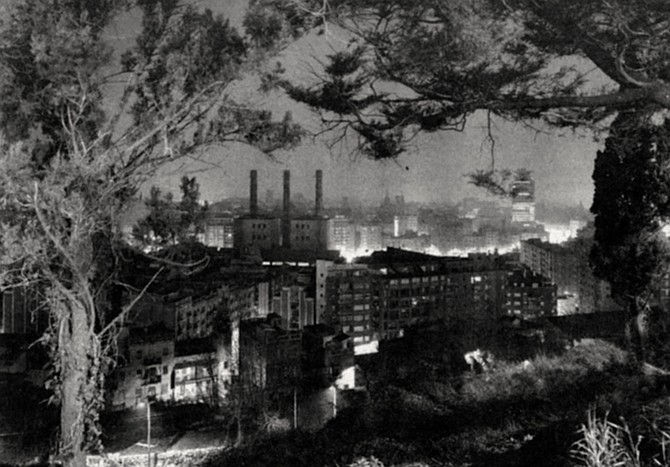
Barcelona Through the Trees, 1982. It’s night. Seen from a high vantage point, through a framing wreath of trees, the city looks as if it’s on fire.
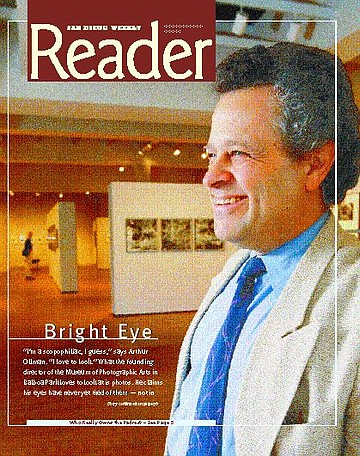
“I’m a scopophiliac, I guess,” says Arthur Ollman. “I love to look.” What the founding director of the Museum of Photographic Arts in Balboa Park loves to look at is photos. He claims his eyes have never yet tired of them — not in his nearly two decades in San Diego, nor in his earlier years as a photographer in his own right, based in San Francisco.
Many years ago, Ollman raised other people’s children. This was on a commune, where he lived after his graduation from the University of Wisconsin in 1969
There is a perfect pear in the midst of the papers and photography books on his desk. Yesterday, the apple was well-chosen. His suits are, similarly, right. Today, it’s the charcoal gray, worn with an interesting tie and deep blue shirt — just the thing for a small captain of the art industry.
He offers tea to his visitor, saying, “I’m a tea drinker.” On his desk is a catalog from a Parisian tea store. “The Greatest Tea Store on the Planet,” it proclaims.
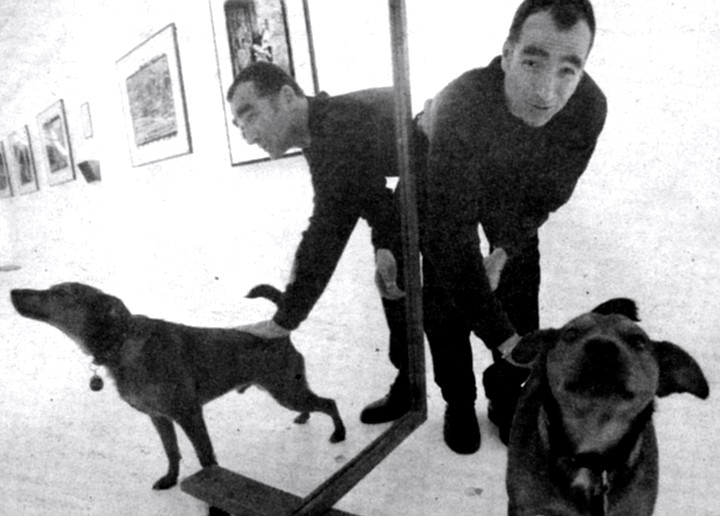
Philipp Scholz Rittermann: “I photographed exclusively at night for a long time.”
On the wall behind him is a sepia-toned photograph from the museum’s collection. It’s of Greta Garbo, made in the soft-focus, pictorialist style by one of its most famous practitioners, Arnold Genthe. Garbo is a young woman in this 1925 image, aged 20. Her eyes are pleasantly heavy-lidded, her brows curved coquettishly over them, like the tops of question marks.
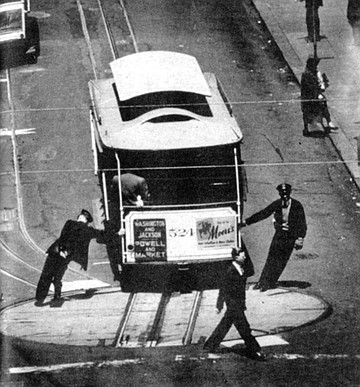
Cable Car, San Francisco. One day Yavno's friend called and said, ‘Listen, Max is in a hospital in La Jolla, bored out of his mind. He can’t get a decent hamburger in that hospital."
“See, the camera is the only medium that allows you literally to look through someone else’s eyes,” Ollman says. “What you see here is what Genthe saw in his studio. It’s not an approximation. It’s not three inches to the side. It’s exact. It’s called The Madonna and was said to have turned Garbo’s career around. Until then, she was getting bit parts as a sort of tall Scandinavian with an accent. She was a character actress. But when the studio saw this group of pictures that Genthe made — and this was the best of them — they saw the possibility of her as a lead and started giving her lead roles.”
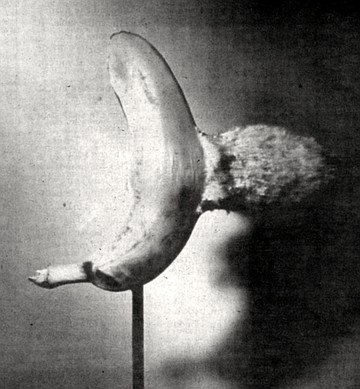
Bullet Through Banana. Edgerton’s ultra-high-speed stop-motion photography revealed to the human eye all sorts of things it had never seen before.
Like the fruit and the wardrobe, the Garbo seems a perfect choice, since the museum’s expansion has made room for a movie theater. “Film is the child of photography,” Ollman says more than once in the course of these conversations. “It’s something that the museum ought to be more identified with. There was Eadweard Muybridge, who made pictures in sequence, so if you looked at them quickly you could imagine the motion. And if you put them in a zoopraxiscope, you could actually see them moving.” He has always wanted a theater right inside the building. (Sandy Wagner, museum public relations director, calls it “Arthur’s dream fulfilled.”) “So many people who make films were influenced by photography and vice versa. And so many photographers have made films. Not only is one the progenitor of the other, but there is a huge amount of crossover.”
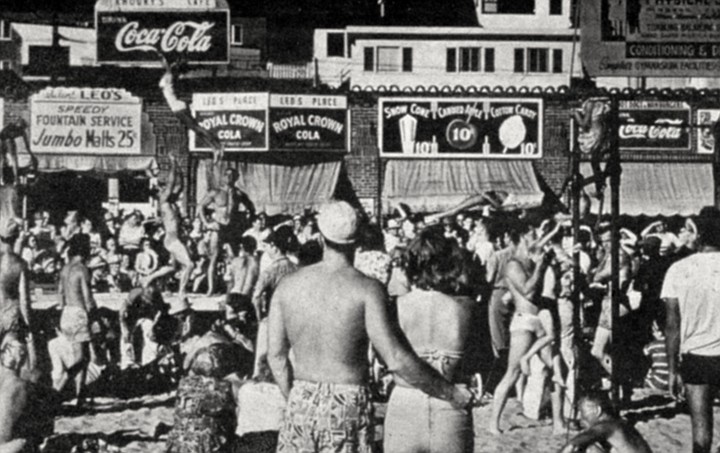
Muscle Beach. "When he died, the estate left us 25 or so Max Yavno prints and money to buy our first vault.”
Facing him, on the wall across from his desk, is another photograph from the collection — by a living photographer. Something else Ollman often says is that he’s committed to collecting and exhibiting contemporary artists. “One, because I can get more for our money; and two, because I can be involved in making the statement of who’s important. If an artist’s reputation is good but still on the verge of greatness or it’s growing, I can be a part of bringing them to the public’s attention, giving their career a little stimulation, giving them a few bucks to go on.”
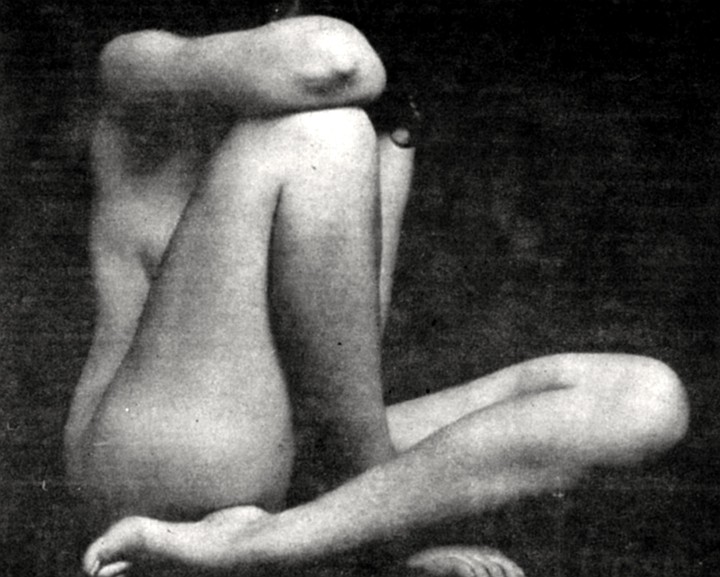
Nude. "It would take somebody all afternoon to discover where the precious Westons were."
The black-and-white portrait was made in 1987 by Sally Mann (born 1951), who is known for photographing her family in provocative, sometimes controversial, ways. This one shows Mann’s youngest daughter, at age two and a half or three, enfolded in the arms of a working man in overalls, who stands beside his pickup truck that looks to be made of dented pie tins. The place is unspecified, but Barbara Pope, the museum’s registrar (who keeps all the records of the collection), makes the logical guess that it’s near Mann’s home in Lexington, Virginia.
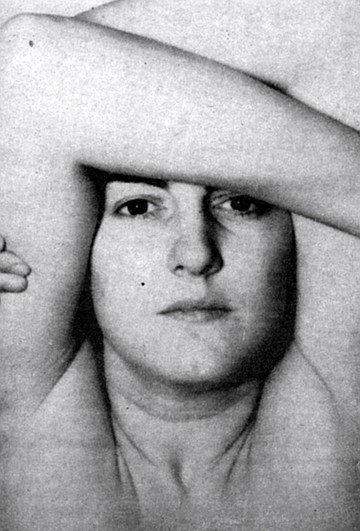
Eleanor. "The average for the vintage Callahans is in the $15,000 to $20,000 range.”
Mann titled the image Tobacco Spit, says Ollman, “because she thought it looked like tobacco spit all over the side of that truck.” He can’t remember exactly what the museum paid for it, but he’s sure it was under $1000. Today, he says, it would cost him ten times that, possibly more.
Mann’s daughter is blond and fair-skinned; the skin of the man has been stained by the sun. “He’s a grizzly old guy, who looks kind of greasy and dark,” says Ollman, “almost like a different species, while the daughter is alabaster white, almost paper white. She’s the whitest white in the whole print — angelic white. She looks like an angel, like she just dropped in from a different sphere of being.”
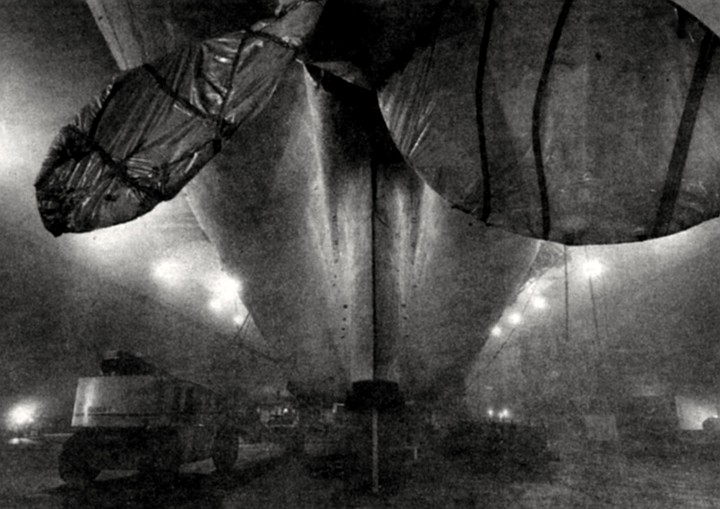
Prop Horizontal. “My relationship wasn’t great and I was looking for ways to escape it."
On a table in front of the Mann picture is another portrait. It’s one that Ollman made of his own children, Ariel, 8, and Jonah, 11. Their mother is Leah Ollman, a freelance writer and art critic for the Los Angeles Times, among other places.
Many years ago, Ollman raised other people’s children. This was on a commune, where he lived after his graduation with a degree in art history from the University of Wisconsin at Madison in 1969.
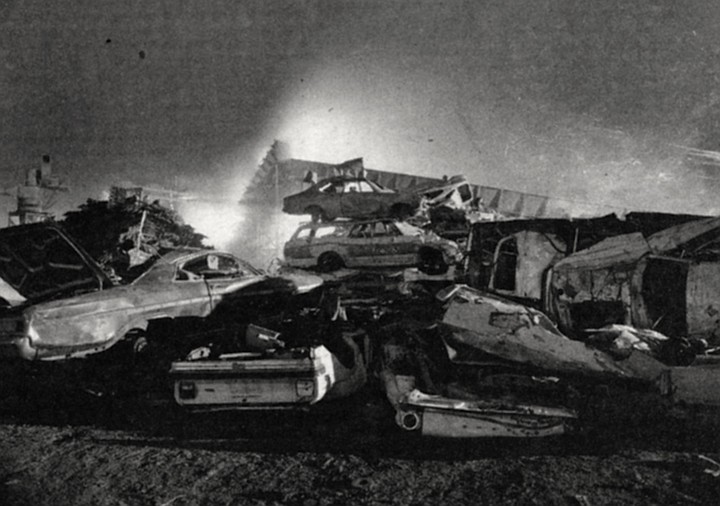
From that early San Diego period came Rittermann's shipyards and junkyards, including Car Shredding Mill, made at the 24th Avenue Terminal.
In the 1960s Madison was a turbulent, highly politicized place. “I had been involved in the antiwar movement and had gotten beaten a couple of times, and arrested a couple of times, and I was looking for, perhaps, more positive alternatives,” says Ollman of his decision to live communally. “I was trying to make a difference on the ground. And The Whole Earth Catalogue was very seductive at that point. So I heard about some friends who had bought a farm in Maine and I said, ‘That’s extraordinary! How do you do that? What does that mean? What are you going to do? Do they have any more?’ ” Born in Milwaukee, in 1947, he had not spent much time on the East Coast and had never been to Maine. “So I went there, looking. And it was beautiful, forested, clean — and I got excited about it. And I bought a farm.”
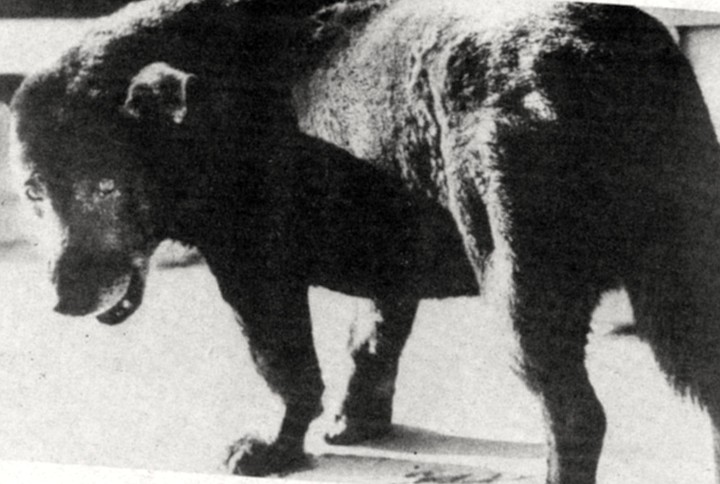
Stray Dog, Misawa, Aomori. "A lot of people [like Moriyama] looked at traditional Japanese art and they said, ‘This doesn’t relate.'"
It was about halfway up the Maine coast, in Bucksport, not far from Acadia National Park. “I bought 50 acres, 48 of which were forested and 2 of which were cleared. On the property was an 1807 house, fully furnished. It had linens, it had silverware, it had a toaster, it had a refrigerator. There was also a cabin — one room, with bunk beds, screened-in porch, wood stove. And the whole thing was $6500,” which he says he paid in four years with money he got from photographic portraiture work. “And all my neighbors in Maine thought I had paid way too much. I was a fool. It had been on the market for years for half that price and nobody had touched it.”
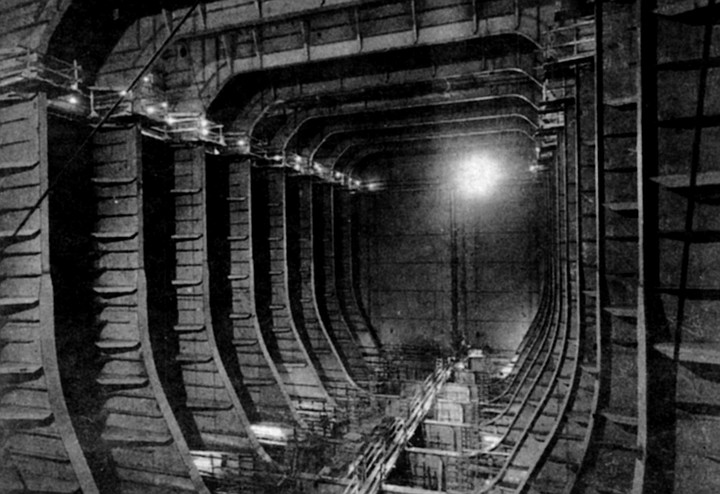
Interior of Exxon Valdez. As Rittermann describes it, and as his photograph shows, it’s “as large as a cathedral.”
The population of the commune varied. “In the summers we would swell to about 30. In the winters we would shrink back. There were 5 of us who stayed for the full four and a half years.”
He says there are still a few pictures around that show him with long hair — “down to there, or actually up to there, since it never went down.” He touches his stiff crop of tightly curled gray that’s brushed well back from his temples.
The commune did not have a name but did have an organic produce business, which was named Bright Eye Organic Gardens. “Actually, calling it a business is a little bit grandiose,” Ollman says. “We had a very old pickup truck that we would use to make the rounds to a number of organic restaurants and stores in New England. We used to draw straws to see who would do the trip to Boston, because we were all opposed to going to big cities. We were country folk. We would load up the pickup truck with whatever produce we could muster and go down and haggle already low prices and sell them to the markets directly. Then the truck’s transmission would fall out, and we’d pay twice what we had made to get it fixed and back home. The next week the front end would be wobbling so badly that the engine struts would break, and we would have to get those fixed and the wheels aligned again, and that would take up the entire profit from that trip. And we would end up sleeping in the back of the truck on the way home from Boston, on the roadside somewhere. And we’d say, ‘We’re never gonna do that again!’ ‘Business’ was not exactly the right term for it.”
A bit wistfully Ollman recalls the derivation of the name. “It was from that look that you would give someone on the street when you assumed that they were a kindred spirit, that sort of knowing glance, that you would save only for people who you thought resembled you in some way. I think if I could re-create that energy…” His voice fades away.
And yet it would seem to most of the museum’s 70,000 or more yearly visitors that he has re-created at least some of that energy here in San Diego. Many of the artists whose work he shows would agree. San Diego–based Philipp Scholz Rittermann is one. “As a curator he takes on some pretty difficult tasks,” Rittermann says by phone from his studio on Market Street one day. “In much the way that artists handle subject matter in radically different ways, curators do too. I think Arthur would probably love to do much more taking and making of images than he is able to do now, but the museum is a many-headed monster. It’s a huge job and doesn’t allow him much time for anything else. So the passion gets poured into curation, from which we all benefit.”
In the late 1970s, in San Francisco, by the time he was 30 years old, Arthur Ollman had become famous for making photographs at night, in color. The very work that he had presented in fulfillment of his master of fine arts degree at San Francisco’s Lone Mountain College was subsequently purchased by the Museum of Modern Art in New York and exhibited there, in a major show, and elsewhere. “It created a bit of a reputation for me,” Ollman says. “There were a few years of great excitement on the gallery side.”
In those years, he was also president of the board of directors of San Francisco Camerawork, the nonprofit artists’ collective that he had helped to found, whose mission is to exhibit the work of emerging photographers. And he taught photography at various places, including the San Francisco Museum of Modern Art.
Ollman left Maine and went to San Francisco in the first place, in 1974, because, “of course, to people who lived on communes, San Francisco was a sacred name. It was one of the sacred places that one should go, Boston being another.” But San Francisco, he says, was “one of the most seductive.”
Part of the thinking of those who started San Francisco Camerawork, including Ollman, was that photography was too “New York–centric” for its own good. “There was the [Museum of] Modern [Art], with a powerful, eloquent spokesperson [department of photography director John Szarkowski], who was in the judgment seat of photography, the most powerful character in the field. There was also the International Center of Photography, Cornell Capa being the director of it.” Those were the major venues and were acknowledged to be so by the whole country. “The galleries, the big ones, were also in New York, with only a couple of others scattered around. And a number of us theorized that, if the photo scene was going to be totally centered in New York, its chances of growing in interesting ways would be compromised, because it would be ruled by a handful of people whose issues were ‘New York.’ ”
Ollman often speaks in cadences that might seem more appropriate to a politician, complete with rhythmic triads; he does so, at length, on this subject — and others — that are obviously near to his heart.
“You know, in New York — the media center of the world — if someone gets brutally beaten in Central Park, it’s a national story. If somebody gets brutally beaten in Des Moines, it never shows up in the press. If somebody’s shot on the New York subway, it’s a national story. It’s not if it happens in Los Angeles. And people around the country will speak of [the New York incident] as a national story. And New Yorkers will expect you to know it as a national story.
“By the same token, if New York is in charge of the entire photographic enterprise, and its institutions run it, if something takes place in New York, the medium has to respond. So, for example, if the New York galleries’ real estate prices rise, the photographs have to rise in value. That means they have to be larger and look more painterly in order to cost enough to pay the rents of those new spaces.
“If, on the other hand, we have a vital scene that allows for major exhibitions to be produced in San Diego and St. Louis and Santa Fe and Minneapolis and Chicago and San Francisco and San Jose and Denver, then a vital scene can be encouraged. It can live. It can thrive. It can have many voices. The opportunities for all increase.
“So if curator X in New York doesn’t like your work, that’s okay, because three others — in San Jose, New Orleans, and Houston — do. And you get into their shows, their books, their catalogs. And the scene grows, the entire enterprise grows. This was very much on our minds in the mid-1970s. That was one thing we were thinking about at that time: how to decentralize this scene. And now it is decentralized, to Europe and Asia and South America. There are galleries of photography in Australia, New Zealand, and South Africa, in China, and in Taiwan. We’ve been the generation of administrators and curatorial people and artists who have done this. And as a result the field will thrive and will have many manifestations.
“It’s true that New York still plays a big role. Things come up there that don’t look a lot like things coming up in other places, and that’s fine. They can enter the discourse. But they are not the sum total of it. And that has helped a lot. We have made a much healthier environment for the field. If we do nothing else, it will thrive far better and much more interestingly and in a more diversified way.”
When Ollman was considering this museum’s directorship, he got a taste of San Francisco’s own provinciality. Many people there were nonplussed by his willingness to consider moving south. “No one said not to, but they thought it was strange. It’s not on any of their maps. They know where Biloxi, Mississippi, is — maybe. But to people in the Bay Area, coming here is like falling off the face of the earth. It’s like the Samuel Beckett play Endgame. ‘Outside of here it’s death.’ ”
Undeterred, he came for an exploratory visit. “And I was shown Balboa Park” — he who was used to small artists’ spaces, second-floor lofts, often with uncertain rental arrangements. “Then I saw this. It was a Sunday. I couldn’t believe that this was the infrastructure I would be given. This was an incredible vision. It was summer. A hundred people walked by, and three-quarters of them were carrying cameras. This is a great audience, I thought. This is a bigger audience. This is a real audience. How many people can you get to come to a show at a walk-up? Six hundred?” (Here, he has 1000 or more every week; and a recent visit to San Francisco Camerawork’s website revealed that it was being forced to move from its present location, due to rising rents.)
The story of the museum’s origins, in May 1983, is well known to many San Diegans, as is its recent growth. To wit: Ollman began with virtually nothing except the space — 7500 square feet. There was no collection. Not one piece. Since then, the space has quadrupled, and there are 6000 pictures spanning the entire history of the medium. When they aren’t being exhibited in one of the museum’s galleries, they are kept in acid-free boxes, in a state-of-the-art vault — “climate-controlled, fireproof, air-tight” — that is by no means full. “We imagine that if the sizes of what we collect stay somewhat the same, the vault, which is expandable, will be able to hold about 30,000 objects. You know, it sounds like a long way to go, if you do it one by one, but if you inherit a great collection, it could fill rapidly. And sometimes, when somebody dies, they might leave you 15,000 objects. We also have an oversized-art storage room for things that, unlike those in the vault, often stay in their frames. And that other space can hold, depending on what they are, hundreds more.”
Nor did the job come with a manual. “There wasn’t exactly a book on how to make a museum” — especially not a photography museum. They were rare birds until recently. Even the Metropolitan Museum of Art in New York had no photography department until 1992 and no permanent photography gallery until 1997. It would seem, then, that Manhattan was following others’ leads, including Ollman’s, for a change.
From the start, the Museum of Photographic Arts hosted traveling exhibitions. (Currently showing is “Inside Out: 50 Years of Collecting,” organized by the George Eastman House International Museum of Photograph and Film in Rochester, New York.) But Ollman felt strongly that “San Diego shouldn’t always be an importer; it should be an exporter of art as well.” As he says, “There are shows that go to Broadway from here, and we all are proud of them when that happens. And it’s good for the community. We have done the same thing since the 1985–86 [celebrity-portrait photographer] Arnold Newman exhibition. [In 1987–93, ‘Arnold Newman: Five Decades’ went from San Diego to Chicago, Minneapolis, West Palm Beach, New York, Fort Worth, Cincinnati, and Cambridge, Massachusetts, as well as Amsterdam, Spain, Germany, Switzerland, England, and Japan.] It helps our credibility, our institutional name, and our city’s name out there in the world. And it brings back revenues, by the way. We rent the shows, just as we pay a rental fee when one comes here.”
He considers his three-part “Points of Entry” show, which traveled in 1995–97, to be among his most successful. Cocurated by Tucson’s Center for Creative Photography and San Francisco’s Friends of Photography, it was well-timed. The heat of immigration issues was rising around the country. “In this community it was extreme,” Ollman recalls. “Every politician who was running for office had to run to the border and say, ‘I’m going to put the Marines here. Nobody’s gonna get through.’ Meanwhile, the sweatshops in L.A. needed people to make jeans. The grape harvest needed people. There was no way they were going to close down the border. They couldn’t afford to.” It was, he says, “a schizophrenic approach.”
Ollman took it personally. “Every time they were so insulting — English-only initiatives against the Hispanics and so forth — I just felt my grandfather being attacked. You know, a Jewish immigrant from the Ukraine, who couldn’t speak English. I always felt personalized.”
He saw, too, an irony in the politicians’, and the public’s, xenophobia. “I figured there are bigger countries in the world; richer countries per capita; countries with better educational achievement per capita. But, somehow, this country clearly is the most dominant, interesting, powerful nation. And how did we do it with all this detritus from other countries, all these castoffs, all these ne’er-do-wells, who couldn’t make it in Holland and Nigeria and Thailand and Cambodia?”
He realizes his patriotism might seem to contradict his formerly radical ways. “I can be as unpatriotic as the next guy. But somehow the damned thing [America] keeps working for those who are here. And you could say it doesn’t work for those who are not here. It’s a very complex set of issues. But it sure is the most interesting experiment going on in the world.”
More pertinently, he knew that numerous photographers over time had chosen immigration as a theme.
“Points of Entry” became his biggest group show, filling three catalogs with images. “And it was the show that had the most didactic panels. Every label had two and three paragraphs. People read enormously on that exhibition. I didn’t think they would, but they did.”
He heard them telling each other their own stories as they walked through the space in San Diego. “ ‘My grandfather was from Ireland and he said…’ ‘My grandfather came from Mexico and he had to…’ It’s the one thing we all share, this piece of our heritage that goes back to ‘when we came’ and ‘how hard it was’ and ‘how much we gave up.’ Well, everywhere the show went” — Rochester, New York; Washington, D.C.; Atlanta; Miami; as well as the museums of the two other curators’ — “they thought it was their show specifically. Miami people said, ‘Oh, yeah, of course this is our perfect show. You guys? San Diego? Yeah, I’ve heard they have a border issue there too, don’t they?’ At the Smithsonian, in Washington, they said, ‘Of course, we’re the gatekeepers, we’re the ones who open and close the gates. It’s our show.’ Rochester thought it was their show because of all their refugees. San Francisco, Tucson, everywhere, they thought, ‘We’re the epicenter of the issue.’ ”
Documentary-style portraits by Jacob Riis were among the show’s more conventional images — the familiar mothers in babushkas, looking bereft on Ellis Island. But the bulk were less orthodox, contemporary choices. One image, shot off the coast of Florida in 1994, shows five Cubans on a raft in open sea. As seen from a helicopter by Walter Michot, their vessel looks no sturdier than Huckleberry Finn’s, but the men wave their arms and mug for the camera: they are riding a magic carpet to America.
“Photo-related installation art” was another part of “Points of Entry.” Many of these works utilized family albums and ID photos (remnants of family members’ alien status), religious icons, newspaper clippings, postage stamps — even food. Words, too, were often part of these ingenious creations. “Leaving my country was not a simple task,” Korean-born Young Kim wrote below an eerie photo of ocean waves. “I now realize that I never really left nor really arrived.”
Last fall, visitors to the Museum of Photographic Arts would have seen a more recent photo-installation work by Kim in the lobby — that is, the David C. Copley Atrium. (Everything seems to have been named for some donor or other, and Ollman is not apologetic about it. On the contrary: “I’d like to have more names on things.”) Untitled but called informally Map (1998), it is a series of 24 large black panels sprinkled with photograms of random, irregular, ragged white shapes.
“Does anyone have a sense of what these might be?” Ollman asks a visiting high school class from North County one day. (In fiscal year 2000, 2490 students — kindergartners through college seniors — came to the museum with their teachers.)
Given the title and some time to look, the students begin to see that the shapes are actually maps of all the world’s countries. But they are disconnected to their bordering countries and exploded across the field. The pattern, if there is one, would have Ireland next to Iceland; Italy not far from India.
“Why are there separate nations?” Ollman asks the group. “There’s no nafta here. Who are we? What about cooperation, being kindred and all that?” He points out Brazil, Vietnam, the United States. He asks the students to guess others. “With photographs,” he says, “you’re allowed to carve up the world any way you like.”
Ollman’s contract requires that he continue his career as an artist. “Now that’s a curious contract,” he says of the artist-director mandate. For the truth is that he finds little time to fulfill the artist portion of it. But because he came to the job from the world of working artists, he likes to think he brings special insights to it.
“The artists I work with know they are dealing with someone who understands their point of view. And, frankly, a lot of museum people don’t really understand creative artists. They’ve never been one. They don’t know the curious existence. They don’t know the vulnerability of putting your soul on the wall for the public to look at. Museum people tend to think of things in terms of deadlines, in terms of cost. These are overlapping concerns for the artist, to be sure, but they aren’t paramount. And I’ve always felt that if we’re pleasing the artist, we’re doing it right. And that’s not always the first point of departure for a curator. Some see the [relationship with] the artist as more adversarial. I try not to. That’s not to say I love all artists and have harmonic relationships with all of them.”
Knowledge of Robert Frank’s mercurial temperament decided Ollman against inviting him to appear in San Diego when the traveling exhibition of “The Americans” was on the museum walls last summer and fall. “Because sometimes he doesn’t do what he says he will. If an institution hires him for a lecture, he may decide he’d rather go out drinking that night. He’s very ‘beat,’ and that’s a ‘beat’ thing to do. But it’s not too good if you have assembled 300 people to hear him.”
Frank, whose book The Americans (1959), from which the exhibit was derived — and which Ollman calls “the most influential photography book published in the last 50 years” — is apparently aware of his reputation for unreliability. During the exhibition, the museum screened Frank’s autobiographical 52-minute film Last Supper (1992), which tells the story of a book-signing in a vacant lot in Harlem, held in honor of a writer who never shows up.
Ollman distinguishes himself from many nonartist curators in another way. When they mount shows, he says, their central goal is the advancement of their own ideas, not the exhibited artists’. “Because I come as an artist to the curatorial practice, I tend to like an exhibition of one artist alone. I say, ‘You. I love your work. Let’s fill a gallery with it. Let’s work together to pull out stuff. Let’s see what your vision is.’ ” This, he says, is opposed to “the practice of people who were trained in art history and curatorial practice in the university who tend to say, ‘I’d like to use one of your pieces and one of yours and one of yours as building blocks for my thesis about what I think is going on today with this idea.’ ”
Ollman’s approach is “not as easy a trajectory toward fame and fortune” as other curatorial methods are. “The museum world tends to prefer those who make the grand statement, using artists as fertilizer.”
His sensitivity derives from his own experience. “I had been in many museum exhibitions and not always appreciated how I had been treated — not that I had expected to have the red carpet thrown down.”
Philipp Scholz Rittermann says, “As a younger artist, you’re always glad to be included.” (He was born in 1955.) “It’s an honor to have someone recognize your work. But sometimes you go and see the show and you say, ‘Oh! I really don’t like that I’m hanging next to this or that person.’ But that’s ego. That gets in the way all the time.”
Only once has Ollman hung his own work at the Museum of Photographic Arts. It was in 1985. The pieces were in a show of California photography 1945–80, organized by the San Francisco Museum of Modern Art before Ollman took the job in San Diego. San Francisco stipulated that nothing could be subtracted from the exhibit. So when it opened here, Ollman, the only San Diegan among the 50 photographers represented, braced himself for criticism. It didn’t come. “Nobody said boo about it, not even the local critics. But I felt very uncomfortable with being in that situation. Subsequently, I took another group show on California, in 1991. [It was ‘Picturing California: A Century of Photographic Genius,’ organized by the Oakland Museum of California.] And I was in that one too. But there was no stipulation about taking pictures out. So when it was here I dismissed myself. As the show traveled to other venues, I was a participant.”
The museum owns about 20 of Ollman’s pictures, which were donated by collectors. “And when I’m out of here, when I’m gone, they’re welcome to do what they want with them. If the curators like them, they can show them. But I don’t think it’s appropriate for me to do it. I don’t think that anybody working at this museum now even knows that the [1985] episode took place.”
Not only institutions with traveling exhibitions for him to consider but individual photographers hoping for a show send Ollman proposals constantly. The number he receives is in the order of 60 per month. “Slides, cd-roms, portfolio boxes filled with pictures — they come from all over the world.”
He rejects “all the bad stuff,” but “almost all the good stuff” too — “simply because we don’t have enough schedule to do it all.” How he goes about choosing what is shown is “not such a mysterious process when you think about it,” he says. But his explanation, about seeking a sense of balance, is vague nonetheless. He sounds like an artist trying to explain why he makes artistic decisions.
“People often say, ‘Why don’t you show more San Diego photographers?’ And I show all the really good San Diego photographers whose work I am aware of. But I don’t show it because they’re San Diego. I show it because they’re good. There are San Diego photographers who I don’t show because I don’t think their work is ready. I could be wrong. I’m only one lousy opinion. Yes, I’m informed, but I’m not necessarily the right opinion. I see a portfolio for an hour or ten minutes or whatever. I’m just a tourist in their lives. I could be missing something essential. If I don’t like the work, it doesn’t mean it’s not good.”
He shrugs at the suggestion that he’s in a tough position, because those same San Diego artists are his constituents — people he wants to support the museum, not shun it for personal-grudge-type reasons. “I can’t control that. It’s hard enough to control the chip on my own shoulder, much less theirs. I hope people will understand that the best thing I can do for the community is to show great work. And if they’re really interested in photography, they’ll come to our shows. If they’re only interested in their own view, their own material, their own work, then they’re not here to learn, and probably won’t grow as artists.”
“The least interesting thing in an artist’s portfolio is his address,” Ollman avers.
Some of those, besides Philipp Scholz Rittermann, whose addresses are “San Diego” and who have been shown at the museum include Han Nguyen, David Wing, Suda House, Pablo Mason, and Duncan McCosker.
But a king- or queen-maker Ollman simply is not. While Sally Mann’s stock, for example, may have risen dramatically in recent years, it would be a mistake to give too much of the credit to Ollman for Mann’s good fortune — as he would be the first to say: “Some artists think I have that power, when they come in here quaking, hoping I can give them a show. But the very next month after their show, their landlord is still going to want the rent check. Somebody’s in fashion, and then they’re not so in fashion,” he says, speaking as someone who experienced his own meteoric rise. “Somebody’s cutting edge, and then they’re not so cutting edge. The coal eventually extinguishes. Hopefully, we make our careers so we can stay a long time in the field.”
Before he took this job, he admits, he didn’t have to like other artists’ work. “I didn’t have to put it before my own. I didn’t have to be encyclopedic in my affections for the photographic enterprise. As a curator, I have to be open to all sorts of work. Now, ultimately, I’m not equally open; I have my favorites. But I must be willing to look at photojournalism and conceptual art and work from every era and technique, whether it’s computer-generated or daguerreotypes. I’ve got to be catholic in my tastes. That isn’t as hard as it might seem, once you start. People often say, ‘God! There’s so much junk being made today!’ Well, there has always been a lot of junk. We’ve just culled the earlier periods and pulled the work we think is more essential. And that will happen with this period too, because I’ve seen it happen with the ’60s, ’70s, ’80s, and now the ’90s. And some of that stuff, which seemed so important, was just momentarily important.”
Cambridge, Massachusetts, 1944. In a lab at the Massachusetts Institute of Technology, a bullet is shot through a banana. It’s one result of photographic experiments by Harold Edgerton, developer of the electronic flash, who is described by Ollman as “a great scientist who never thought about museums when he was making his work.” For the first time, Edgerton’s ultra-high-speed stop-motion photography revealed to the human eye all sorts of things it had never seen before, including, more famously than the exploded banana, the 1959 image of the white crown created by a single spilled drop of milk.
Tokyo, 1968. Twelve Japanese businessmen cross a shiny, rain-swept street, each of them holding a big black umbrella. They resemble black lily pads on a pond, or, more ominously, mushrooms. At least, these are a couple of the ways that one can interpret the scene as photographed by the Hungarian André Kertész, whose camera caught many spontaneous moments in the life of the world’s streets.
Barcelona, 1982. It’s night. Seen from a high vantage point, through a framing wreath of trees, the city looks as if it’s on fire — a cool, silvery fire — in this black-and-white image by Philipp Scholz Rittermann. It’s a miniature city in this rendering, an architect’s model, a tabletop diorama; or a film-noir still. We, the viewers, are at a far remove, visitors from another world. Three power-plant smokestacks are part of the landscape — not usually a symbol of contemplative thought; but that, uncannily, is the mood achieved.
All three of these works are in the museum vault, along with the 6000 others. All of them were bought with museum funds, but most of the rest — Ollman estimates 80 to 85 percent — were gifts.
True, you can’t quite “steer” a collection that’s largely given, Ollman says. “You can, however, make your hopes known, your wishes known. You can make your donors aware of certain things.” You can also say, “No, thank you.”
When the museum’s doors opened, there were a half-dozen people who were ready to donate immediately. “They had purchased portfolios of well-known artists’ work with the idea of donating; there were tax incentives for doing so. So they came forward. So, yes, we started off with some pictures pretty quickly.”
Artists themselves wanted to donate work, and still do. Here it can get complicated for Ollman. “Somebody is looking to pad their résumé. Their work is kind of inferior. And remember, just adding it to the collection is not as easy as it seems. First of all, there’s a lot of record keeping; acquisitions files; forms that have to be filled out for the government and for the artist and for our own records. There’s a treatment assessment, condition report, to see if it’s in good shape, to see whether it needs to be handled one way or another. It has to be matted, interleaved with tissue. And those records, along with the picture, have to be kept in perpetuity. Let’s say it costs the museum $20 or $30 of staff time to bring it into the collection. Then, let’s say, after that, it only costs us $2 a year to keep it. Insignificant. But we’re speaking of perpetuity, which, as far as I know, is a fairly long time. And the cost suddenly is estimable. ‘Well, what difference does my one picture make? Why should it break the back of the camel?’ But if you think of a hundred people doing it in the course of a year, then you, in fact, are incurring a bit of a financial burden.”
Some other artists’ gifts, by contrast, are more than welcome, and they may come to the museum unexpectedly, often upon an artist’s death. “I was a bit friendly with Max Yavno, a great photographer from Los Angeles, originally from New York. He was an old fellow when I met him and spent time with him, but I was not real close with him. He had cancer at one point and was here at Scripps hospital. And his dear friend, who was eventually his executor, was a big collector in Los Angeles. He’s also a dear friend of mine and on my board now. One day he called and said, ‘Listen, Max is in a hospital in La Jolla, bored out of his mind. He can’t get a decent hamburger in that hospital. Can you get him a decent hamburger?’ So I went to the hospital, and Max said, ‘Sneak me out of here.’ So I took him down the back steps and over to Hillcrest and got him a hamburger and some fries, and he was thrilled. And I took him to the park, and then I brought him back to the hospital. And when he died, the estate left us 25 or so Max Yavno prints and money to buy our first vault.”
Ollman’s fund-raising efforts buy the remainder of the photographs and balance the operating budget. It’s this activity that takes up 80 percent or more of his time, he says on a day following a “high tea” for a hundred or so donors, an event he calls “a bit of the show biz, but a nice thing.”
Hearing someone express doubt that fund-raising could be any part of “nice,” Ollman says, “Well, anyone who tells you they like all fund-raising is wrong. They’re not telling you the truth. It’s not always fun, believe me. Sometimes it’s difficult. The hardest part is that sometimes people will say no. And it can be demoralizing when you hear no a few times in a row, when you are desperate for yeses.”
Yeses have come from David Copley with frequency. The Garbo picture, for example, was a gift from him. “He has been very generous to this museum and to me,” says Ollman, although he manages twice to deflect a question about the magnitude of that generosity regarding the Garbo. (Later, the same question, about the Garbo’s cost, which was e-mailed to his staff, was the only one in a long list that went unanswered.)
Copley, doubtless, sometimes says “no.” But, explains Ollman, “no” to a fund-raiser doesn’t mean what it means to the rest of us. “It’s like the word ‘snow’ to an Eskimo. There are a lot of different no’s. And none of them means ‘no.’ They mean ‘not now.’ So you keep coming back and coming back and coming back. And you look for a new handle, a new way, a new idea. Somebody might not resonate with your institution. And maybe it’s because they assume [something erroneous] about what your institution is or does. Or maybe it’s because they don’t resonate with you personally. There are people out there who don’t much care for me. And they are not going to give a gift to me. But they should be made to know — by a board member or friend of the institution — that it’s not a gift to me. It’s a gift to the institution. It really is a gift to the community. So ‘no’ is a request for more information.
“It sounds odious. People hear about fund-raising and they recoil, because in our culture money is sacred. You must not discuss it. Most of all, you must not ask somebody for it.” It smacks of the panhandler. “Well, we tend not to press people who don’t have money. We tend to press people who do have money. And they know the business. They understand that they will be approached. They’re geared for it. They understand the process.”
Ollman understands it too. “I know when it’s premature to ask. I know when I’m not the right person to ask. There are many ways to go about it.
“And we really do believe it when we call these ‘giving opportunities.’ These people are going to make gifts to somebody. And if their whole thing is cancer research or their entire gift is always to the Catholic Church, well, then, I won’t press. But I believe if you have done well here, you definitely owe it to somebody. It doesn’t have to be to this institution. And there are very few people for whom the Museum of Photographic Arts is their only thing. I don’t know of anybody like that, particularly among our biggest funders. But the biggest funders would certainly tell you that we belong on their list and they can tell you why. If they can’t, then we haven’t done our job.
“There’s an old Zen expression that I love: ‘Learn to desire that which must be done.’ And that goes a long way towards liking your life a little more.”
To get to the museum’s vault area, you walk down a long, white, pictureless corridor. It’s hospital-like, antiseptic, just this side of sterile. Lights sensitive to human body heat illuminate your way.
The temperature inside the vault is kept at 60 degrees Fahrenheit for the black-and-white images, this visitor is told. Optimal temperature for color is 40 degrees. Humidity is a uniform 40 percent. An invitation to have a look inside is not forthcoming.
Do not imagine that the boxes are labeled with the names of the artists. That would make it too easy for a would-be thief to grab, say, the Edward Westons. Instead, the boxes are marked in code — “J-6” or “G-11” — and it would take somebody all afternoon to discover where the precious Westons were.
The necessary cipher is kept locked up in the museum. There is a second copy off-site in a bank safe-deposit box. In the same bank, but in a different safe-deposit box, is another, identical list, handwritten in indelible India ink. That same hypothetical thief would have to be awfully savvy to change all three of these records without detection.
On this particular day, just outside the vault door, there is a silver air-freight crate. It contains photos by Harry Callahan. They are of his wife, Eleanor, and their daughter, Barbara. Part of the exhibit curated by Ollman, called “The Model Wife,” the pictures in the crate came from the Center for Creative Photography, in Tucson. The museum’s preparator, Don Strandberg, says he is giving them time to adjust to their new meteorological conditions before he opens their crate and puts them into the vault with all the others.
Those who went to the exhibit when it was up at the museum last fall and winter (before it went on its way to the Art Institute of Chicago and the Cleveland Museum of Art) would have seen those prints on the museum walls. One of them shows Eleanor in 1949 in a body of water somewhere in Chicago — Lake Michigan, likely. Only her head and shoulders are visible. Her eyes are closed and her long, dark, wavy hair, parted down the middle, resembles Mona Lisa’s. Seen abstractly, she is a picture of tranquility — a veritable buoy in the sea of life. She is also, literally, an expectant mother — Barbara will be born a few months later — and if you know that fact, the image accrues more meaning. The camera must be close, but its eye belongs to her husband, so Eleanor doesn’t flinch. She’s a mermaid sleeping; a saint praying; a woman dreaming of her child. Or maybe the complicit model wife is only pretending to be any of these things.
What are some of the dollar values of these so carefully kept photos? What, for example, is the above-described Callahan worth? The museum passes the question to its owner, but the Center for Creative Photography declines to estimate. Eleanor, Chicago is only one of 60,000 items in its inventory, and it doesn’t keep track of the market or do appraisals. Its press office suggests that the Pace/MacGill Gallery, which sells Callahan’s work, would have a better idea. Reached in New York, the gallery’s controller, Frank Salinas, says, “A lot depends on availability. There are some vintage prints that we no longer have. They have been sold out totally. What that specific print would be, I don’t know. But the average for the vintage Callahans is in the $15,000 to $20,000 range.”
“Vintage” is the key word. Jackson Fine Art in Atlanta, another dealer in Callahan material, is selling what appears on their website to be the same image — for $6000. The difference, says the gallery, is that it’s a “modern” print, made and signed by Callahan years after he made the negative.
Callahan died in 1999, so there will be no more “modern” prints coming from his darkroom, the gallery regrets. (Or perhaps its regret is just slightly disingenuous, since their price before his death was $1500 less than the current price.)
Ollman gives these definitions of the various terms. “They call it ‘vintage’ if the print was made at a very similar time to the negative. If it was printed at a substantial remove but still by the artist it might be called a ‘period’ print. [The ‘modern’ print of the Atlanta gallery would fall into that category.] If it was printed after the artist’s death, it’s called a ‘posthumous’ print and has a very different price structure. You can go to the Ansel Adams galleries in Yosemite, in Mono Lake, or in Monterey and buy estate prints of Ansel Adams’s more famous negatives and they are very low priced — they are $400 or $500. But they’re not signed by Ansel of course — they were printed later. And they’re known that way. And so when they show up on the market all the dealers and all the collectors know the relative value of that material.”
Civilians may know a bit about those relative values. Ollman, in his teacherly way, explains it in detail. “Prints aren’t made on an assembly line. They’re made by hand by the artists, who sign them at about the same time, more or less, as when the negatives are made. Negatives by many of the great photographic artists are in archives where their use is restricted. They aren’t allowed to be used for printing, just as we hold some negatives in our archives and, under only the most extremely rare conditions, can we print from them. And those are all stipulated by the donors’ estates.”
Ansel Adams (who, incidentally, recommended Ollman for the San Diego job) is an exception for not having written a restrictive will. “When he left his prints and his negatives and his papers to the Center for Creative Photography at the University of Arizona in Tucson, he stipulated that students could reprint his negatives on new technologies and new papers and new materials, the same way that he felt one could play a Stravinsky score on other instruments or Bach on an electric synthesizer.”
These “connoisseurship issues,” says Ollman, affect lithographs, etchings, serigraphs, and other printmaking imagery. There is one major difference between these multiples and photographs. “If you make a woodblock print, every impression you take from it will deteriorate the original a bit, because you’re actually rubbing it up against the paper to create the impression. You can’t make an infinite number of them. The only thing that goes through a negative is light.
“The 10,000th print ought to be able theoretically to look exactly like the first — if they were all made at the same time with the same materials and the same chemistry. Nevertheless, negatives are rarely printed ‘straight,’ which is to say, you just put them in the enlarger, turn on the light, turn off the light. More often, there is what we call ‘burning’ and ‘dodging.’ ”
Speaking of the Sally Mann Tobacco Spit photo, he says, “My guess — I have no proof, because it was done very well — my guess is that the child was ‘dodged,’ which is to say that, in the darkroom, Mann let less light hit the child in that particular area of the print. Or, conversely, she might have ‘burned in’ the other areas of the print, which is the flip side of the exact same process. You cover up the areas you want to stay light and let the rest get darker. You let more light hit them.”
But the pricing of prints is “not mathematics,” says Ollman. “It’s not science. It’s business. It pertains to markets, and that’s a supply-and-demand issue. It’s also an issue of fashion and style and marketing and hype. And the longer you are familiar with it, two things happen: you become more aware of how they operate and you get more philosophic about how they operate, because you know there are certain things that are just not logical in market-making.”
He puts it kindly. Richard B. Woodward, analyzing trends for the New York Times, is less so. “The theory that vintage photographs somehow more closely reflect an artist’s intentions should be viewed more than a little skeptically,” writes Woodward, editor-at-large for DoubleTake, the literary and photographic magazine. “During the ’90s, the idea of a rarefied class of photographs seemed increasingly contrived and market-driven. The gap in price between vintage and nonvintage reached absurd proportions for standard images. In 1992, a vintage ‘Chez Mondrian’ from 1926 by André Kertész sold for $250,000, while a print from the same negative done in the ’70s might bring less than $2,500. Nonvintage photographs were scorned by dealers in favor of unknown, mundane bodies of work, provided vintage prints were available.”
In the same article, Woodward cites scandals involving counterfeit vintage prints by Man Ray and Lewis Hine. It’s apparently not such a difficult crime to commit, given the right print paper, access to the negatives, and the ability to forge a signature. This should give pause to those who would spend $250,000 — or more — on a vintage photo. (Another of Kertész’s Mondrian series went at a Christie’s auction in New York last October for $314,000. Paul Outerbridge Jr.’s Ide Collar [1922], a shirt-collar advertisement for Geo. P. Ide & Co., went for the same price at the same auction. At an auction in San Francisco at the Fraenkel Gallery last fall, Diane Arbus’s well-known Identical Twins, Roselle, New Jersey [1967] went for $270,000 — an Arbus record.)
Woodward also notes that the Walker Evans retrospective at the Metropolitan Museum of Art a few years ago was “carefully stocked with old prints when newer and, in some cases, finer ones were readily available.” Evans was never known for his wizardry in the darkroom, Woodward points out. John Szarkowski, now director emeritus of the Museum of Modern Art’s department of photography, is quoted as saying, in essence, the same thing: “[Evans] probably never owned a decent [print] washer in his life.”
The comparative values are relevant here, because they affect what ultimately goes into the collection in San Diego. “We look for interesting examples, rather than the major one,” says Ollman. “Look, if somebody gives me $150,000 to buy pictures, I could spend it on one incredible Imogen Cunningham picture. And there are certain collectors and dealers who would say that’s a great thing to do. You’ll have one of the star images.” But, he says, very few people will fly across the country to see his solitary Cunningham when they could go to the J. Paul Getty Museum and see a dozen of them. “So I would rather spend the $150,000 on, say, living Mexican photographers. That way, I could have a really nice grouping of pictures that no one else has got.”
(He has, indeed, bought work by living Mexican artists, among them Flor Garduno, born 1957, who was, in her apprenticeship, a printing assistant for Mexico’s acknowledged master, Manuel Alvarez Bravo.)
This makes the museum’s collection less canonical by default. It also reflects more clearly Ollman’s own personal aesthetics.
“I’m kind of a Japanophile,” says Ollman. “We did a show in 1986 of a photographer [Masato Sudo] who shot a lot of the tattooed irezumi culture in Japan — full-body tattoos and so forth. We included a number of Japanese woodblocks of related tattooed figures from the 1830s to 1860s, and those were hung in the show as well. And we had one of the tattooed men come to the opening and stroll around. It was wonderful.”
Likewise, when he was putting together “The Model Wife,” he included two Japanese photographers — Masahisa Fukase and Seiichi Furuya — among the nine men whose wives modeled for them over many years’ time.
Another case in point is Daido Moriyama. During the time of these conversations with Ollman, the museum’s exhibition of Moriyama’s work, scheduled for winter 2001, had not yet arrived. Organized by the San Francisco Museum of Modern Art, “Stray Dog” was still on the East Coast, at one of the Harvard University art museums. Anticipating it, Ollman says: “The students of Ansel Adams think that a photograph is made by a big negative on a tripod with a big camera that’s usually pointed at rocks.” It’s known pejoratively as rock-and-root photography. “Practitioners of rock-and-root make some absolutely exquisite, transcendent, beautiful things. Not all art is about ‘exquisite,’ or ‘transcendent,’ or ‘beautiful.’ It could be about other things.” Moriyama’s work is about some of those other things.
“When World War II ended, a whole generation of artists were growing up who could not communicate well with their parents. [Moriyama was born in 1938.] The central mythologies of the nation were destroyed. The emperor was no longer a god. And everything changed. There was a new set of powers, which was America, Europe, Abstract Expressionism, jazz, rock and roll. There was a whole new way of expressing oneself. Furthermore, the focus was no longer community or society. It was much more focused on the individual, which had never been part of the approach in Japan. A lot of people [like Moriyama] looked at traditional Japanese art with its beauty and its balance and reductive qualities and almost haiku-like simplicity, and they said, ‘This doesn’t relate. We’re a much more rapid society now. We’re much more complicated. And all that old stuff is out the window. Let’s cleave unto Western ideas.’ And they started dealing with disfunctionality and madness and wildness and ugliness. Yoko Ono’s singing, for instance, is partially like traditional Japanese, but much more about discordance. Same thing happened in photography. Same with flower arranging. These avant-garde flower arrangers made the flower-arrangement schools crazy. They would fill whole rooms with dead flowers. They would put decaying meat in their arrangements.
“Other [artists] were frightened by these new rebellious moves and went backwards, trying to reestablish the old traditions, like Yukio Mishima [author of The Sailor Who Fell from Grace with the Sea and other books], who really wanted to go back to the emperor and found eventually that he came to a dead end.”
He offers the catalog for the exhibit. On the cover is a detail from Moriyama’s Stray Dog, Misawa, Aomori (1971). Inside the book, the full image, in grainy black-and-white, shows a little bear of a canine looking back over its shoulder, with eyes that catch the light like Coke-bottle chips and a mouth that seems open in a laugh. An irreverent dog of the street, it wears an expression that says to the man who flashes the camera at it, “Yes, I know you, and you know me.”
Perhaps it’s the kind of look that Ollman, in his commune days, used to give to those he believed were kindred spirits.
Philipp Scholz Rittermann might be seen as one such kin of Ollman’s today, given his penchant for night photography, and Ollman’s. In August 2001, Rittermann’s “midcareer retrospective” opens at the museum.
“I photographed exclusively at night for a long time,” says Rittermann. “For about ten years that’s all I wanted to do.” It began in 1980, when he was living in northern Germany. “I was working as a pharmaceutical rep, wearing a three-piece suit and driving around with my satchel full of samples, doing my shtick. And on the way back, three or four o’clock on a winter’s afternoon, it would already be pitch-black. And I would photograph. There’s such an amazing quality of light at night. It becomes much more dramatic than it is during the day — very theatrical, very dramatic.”
There were other reasons to be attracted to the night. “My relationship wasn’t great and I was looking for ways to escape it. I was also trying to escape my job, because of what it entailed. I didn’t feel it was honorable. [At age 25] I was the youngest rep for Hoeschst, this huge megacorporation. And we were using salesman tactics that they don’t even use when they’re selling you detergent or cars. And the one way I could actually stop and think was to take these night photographs, because the exposures were extremely long, and I would sit there and contemplate. So it was photography as therapy, essentially. It got me to stop and look at what I was doing.”
In late 1982, Rittermann left Europe and moved to the United States. “I sold everything, brought over an old car, sold that, and had money for about six months. I was on a shoestring and a prayer. I had no visa. Now I’m a U.S. citizen.”
By chance, Rittermann met Ollman in Philadelphia, at a conference of the Society of Photographic Educators. “That would have been March 1983. And Arthur said, ‘Come to San Diego. We’re going to open a museum in a couple of months.’ I thought it was a great idea. A museum devoted to photography was still unusual. At the time there were only a handful of places in the country that were dedicated to photography.” Most other venues were merely departments of various museums of art. “And those departments would have been in the cellar. And I said, ‘Sounds good to me.’ So I was an intern, helped him open up the museum, and have been here [in San Diego] ever since.”
In the mid-1980s, after two internship years, Rittermann left the museum and established his own studio. Working full-time as a photographer, he returned to shooting pictures at night. Partly, it was because he already knew night photography. What he didn’t know was what to do with all the light in San Diego, particularly during the summer. “It was everywhere, all the time. That ubiquitous, hazy, burning, bright, glaring light. I hadn’t a clue. So I continued to work at night, because, at least, it seemed familiar.”
From that period came his shipyards and junkyards and other industrial landscapes illuminated by streetlights and moonlight. Car Shredding Mill, made at the 24th Avenue Terminal, is one. Prop Horizontal, a view of an aircraft carrier in dry dock, is another. Some of them have been seen at the museum before, in periodic shows of selections from its permanent collection. This will be Rittermann’s first solo there. And while he was grateful for the previous exposures, this invitation is a genuine graduation.
Now, in these months before the summer opening, Rittermann is preparing prints. One idea he and Ollman have had is to print one photograph huge — “12 by something feet.” It would go in the big lobby space where Young Kim’s Map was. The likely choice will be Interior of Exxon Valdez, which Rittermann made inside the steel-ribbed behemoth, when it was under construction in 1986. As Rittermann describes it, and as his photograph shows, it’s “as large as a cathedral.” He remembers being both “horrified” and “very impressed” by it.
Its place in the annals of disaster history was entirely unforeseen. Rittermann was merely photographing sights at a San Diego shipyard. Having been given a hard hat, visitor’s badge, and golf cart, he was free to roam — “which was amazing, because today I don’t think they would allow it, with all the liability issues.”
He spoke with one of the engineers. “I said, ‘So this is an oil tanker, right?’ And he said, ‘Yeah.’ So I said, ‘Where are the tanks going to go?’ And he said, ‘You’re looking at it.’ And I said, ‘I don’t get it.’ And he said, ‘This is it. The ship is the tank.’ I was dumbfounded,” because of its vulnerability.
“When Arthur sees this photograph, he says it reminds him of Jonah and the whale.”
Don’t believe you became an artist the instant you received a gift Kodak on Christmas morning. — Alfred Stieglitz
Asked if one of his missions is to get people to understand that photography is art, Ollman says, “No, that’s kind of an old mission. That’s the Stieglitz mission, although we still periodically have to fight that fight. I think in the general public there are a few holdouts that don’t understand it. But young people get it instantly.”
He says this despite all the people who take photographs of their own — people some would call nonartists, although not the people themselves, perhaps. It’s a group whose ranks would include that 75 percent of the passing crowd he once noted on a significant summer Sunday in Balboa Park.
“Look, we’ve come up in a time when, if we so designate it, this conversation is art. And if we videotape it, it’s video art. So the fact that a camera image should be questioned as art at this point should be kind of low-end discourse. It’s tired. We don’t really fight that battle unless we absolutely must. There are more interesting battles. One is the issue of veracity” — or, as he says, the “myth” of veracity.
“You know, I’ve been in this field for 30-something years, and I still look at a photograph and I believe it. It takes me another second to dredge up, ‘This is propaganda’ or ‘This is studio vision.’ ‘This is a synthetic vision.’ ‘It’s not real.’ ‘It’s an artist’s interpretation.’ ‘It’s an editorial.’ ”
That can cause a lot of unnecessary trouble, according to Ollman. He cites the legal battles sparked by Andres Serrano, who made Piss Christ (1987), the photograph of a plastic crucifix submerged in a vessel of his own urine. “Why is it that the far right was so threatened by a photograph that was clearly made in a studio, which is to say that it was fictive, it was invented?” They mistook its “fabricated ‘truth’ ” for something else, Ollman would claim.
The central myth of motion pictures is different, to his mind. “In an hour and a half, the kid has grown up, gone away to school, gotten married, and had kids of his own. And you’re completely enmeshed in his life. And it breaks your heart, what happens to this kid. In fact, however, you have been in a darkened room where still images have been flashed in front of your face. So it’s a myth of time passing more than the myth of veracity. We may very well know that it’s actors and that they’re acting, but we’re still drawn in.”
In the theater — the Joan and Irwin Jacobs Theater — there are stars on the ceiling. No, actually, they are lights that twinkle; they only look like stars — all part of the illusion. By contrast, the reality of running a museum, with an operating budget of $2 million — and $6.5 million in renovation costs — is that the seats in the theater have name plaques: Tahlia M. Essman, Barbara Freeman, Marty Block, Annika Maria Nelson… To buy a seat “in perpetuity,” it’s a $1000 donation. Out of 228 seats, there are still 83 unnamed.
Other realities, last October, were that the projection was imperfect. Technical difficulties interrupted a screening of The Boys in the Band (1970) so many times that most of the audience left. The programming, too, is under construction. “We haven’t even done it a full year yet. We don’t really know how we do it yet. We’re still feeling our way. The strategy is at first to make much more of a splash in terms of feature films. Then, when we start to have regulars, it will be easier to throw in more experimental things.”
After a lecture in that same space — on Robert Frank by a local college professor — Ollman is standing near the exit, greeting people. He will get home late and sleep a heavy sleep.
“I was a light sleeper before children. Now I sleep through it all. I’m on seismic alert, though. At the slightest tremor, real or imagined, I jump up ready to defend a 6000-square-mile area. I’m convinced it’s biological.”
Ollman has written that a man who has much to conceal lives by and for the image. It appears in one of the commentaries in the exhibition catalog, The Model Wife. Although he abruptly declines to discuss his first, failed marriage, even in the context of the show’s theme, he claims, for himself, “My life is an open book.” There are two parts to it, a work life and a home life, he says, and nothing more. “When I have any extra time, it’s with my kids. [My son is] a Little League man. He’s a budding pitcher and needs a good catcher. That’s me. He’s interested in tennis and I can occasionally return the ball. But next year I doubt if I will be able to; he’s getting good. My daughter’s a swimmer and I like to take her swimming, and those are the only things I do.”
The eyes, close-set, zircon bits, should look tired, but they don’t.
Some days later, his mood turns momentarily philosophical: “When you have done a job for 18 years, as I have, you know that some of the changes in your life and in your attitudes have come because of the work and some because you are 18 years older.”
Of the property in Maine, where his commune and his first “business” once were, he says, “I still have it, because I always pictured my kids running around on it. It only costs a couple hundred dollars a year for taxes.” The big house is no longer there. “A tenant accidentally burned it down, in 1978. I had rented it out when I came to California. So there’s no house now; there’s just the cabin. And I’m raising snowballs.”
Looking toward the future, he’s optimistic, as those whose job it is to raise funds must by nature be, despite what he calls the “financial scrapes” in which a place dependent, for the most part, upon rich people’s largesse inevitably finds itself on occasion. “The truth is, the yeses come and the funds are raised, and the institution is healthy and thriving and bigger than ever, and the audiences are bigger than ever. We’re doing all of the things that we wanted to do.”
Having said that, he moves on to what he would really rather talk about: photography. He mentions another photographer whose work is coming to the museum in 2002. He finds among the books and papers on his desk a volume of his work. It’s by Mario Giacomelli. “Italy’s best-known and greatest photographer. He’s 75 years old now and absolutely extraordinary.”
A quick look shows an arresting image: four young seminarians (pretini, or “little priests”) frolicking in a blizzard — throwing snowballs. Black on white. With their capes flying, they look a little like bats with their wings unfurled. One of the pretini has his head down, hands clasped. The camera has transformed his glasses into goggles: his eyes are obscured. So he could be either praying or merely trying to shield himself from the snow. Among other things, the photograph is a kind of Rorschach test for the viewer.
Before he came to San Diego, Ollman “was sort of on the cusp” of doing a book of his own. “I had a very hot body of work. It was being exhibited and published everywhere, and it was just around the time when such artists at that level do a book. But I came here and got too involved, and it never happened.”
He doesn’t seem sorry. It’s merely a statement of fact. The creation of the museum and the ongoing curation are themselves artistic acts, and distinctly personal ones. He gives due credit to his staff, board, and donors, and to the museum’s growing membership of 1800, mostly San Diegans. But it is, he says, using the standard phrase, his “baby.”
“And just like the photography, this work, too, will eventually be autobiographical.”
Here's something you might be interested in.
San Diego's MOPA and its indefatigable Arthur Ollman
Bright eye

San Diego's MOPA and its indefatigable Arthur Ollman
Bright eye
Barcelona Through the Trees, 1982. It’s night. Seen from a high vantage point, through a framing wreath of trees, the city looks as if it’s on fire.
“I’m a scopophiliac, I guess,” says Arthur Ollman. “I love to look.” What the founding director of the Museum of Photographic Arts in Balboa Park loves to look at is photos. He claims his eyes have never yet tired of them — not in his nearly two decades in San Diego, nor in his earlier years as a photographer in his own right, based in San Francisco.
Many years ago, Ollman raised other people’s children. This was on a commune, where he lived after his graduation from the University of Wisconsin in 1969
There is a perfect pear in the midst of the papers and photography books on his desk. Yesterday, the apple was well-chosen. His suits are, similarly, right. Today, it’s the charcoal gray, worn with an interesting tie and deep blue shirt — just the thing for a small captain of the art industry.
He offers tea to his visitor, saying, “I’m a tea drinker.” On his desk is a catalog from a Parisian tea store. “The Greatest Tea Store on the Planet,” it proclaims.
Philipp Scholz Rittermann: “I photographed exclusively at night for a long time.”
On the wall behind him is a sepia-toned photograph from the museum’s collection. It’s of Greta Garbo, made in the soft-focus, pictorialist style by one of its most famous practitioners, Arnold Genthe. Garbo is a young woman in this 1925 image, aged 20. Her eyes are pleasantly heavy-lidded, her brows curved coquettishly over them, like the tops of question marks.
Cable Car, San Francisco. One day Yavno's friend called and said, ‘Listen, Max is in a hospital in La Jolla, bored out of his mind. He can’t get a decent hamburger in that hospital."
“See, the camera is the only medium that allows you literally to look through someone else’s eyes,” Ollman says. “What you see here is what Genthe saw in his studio. It’s not an approximation. It’s not three inches to the side. It’s exact. It’s called The Madonna and was said to have turned Garbo’s career around. Until then, she was getting bit parts as a sort of tall Scandinavian with an accent. She was a character actress. But when the studio saw this group of pictures that Genthe made — and this was the best of them — they saw the possibility of her as a lead and started giving her lead roles.”
Bullet Through Banana. Edgerton’s ultra-high-speed stop-motion photography revealed to the human eye all sorts of things it had never seen before.
Like the fruit and the wardrobe, the Garbo seems a perfect choice, since the museum’s expansion has made room for a movie theater. “Film is the child of photography,” Ollman says more than once in the course of these conversations. “It’s something that the museum ought to be more identified with. There was Eadweard Muybridge, who made pictures in sequence, so if you looked at them quickly you could imagine the motion. And if you put them in a zoopraxiscope, you could actually see them moving.” He has always wanted a theater right inside the building. (Sandy Wagner, museum public relations director, calls it “Arthur’s dream fulfilled.”) “So many people who make films were influenced by photography and vice versa. And so many photographers have made films. Not only is one the progenitor of the other, but there is a huge amount of crossover.”
Muscle Beach. "When he died, the estate left us 25 or so Max Yavno prints and money to buy our first vault.”
Facing him, on the wall across from his desk, is another photograph from the collection — by a living photographer. Something else Ollman often says is that he’s committed to collecting and exhibiting contemporary artists. “One, because I can get more for our money; and two, because I can be involved in making the statement of who’s important. If an artist’s reputation is good but still on the verge of greatness or it’s growing, I can be a part of bringing them to the public’s attention, giving their career a little stimulation, giving them a few bucks to go on.”
Nude. "It would take somebody all afternoon to discover where the precious Westons were."
The black-and-white portrait was made in 1987 by Sally Mann (born 1951), who is known for photographing her family in provocative, sometimes controversial, ways. This one shows Mann’s youngest daughter, at age two and a half or three, enfolded in the arms of a working man in overalls, who stands beside his pickup truck that looks to be made of dented pie tins. The place is unspecified, but Barbara Pope, the museum’s registrar (who keeps all the records of the collection), makes the logical guess that it’s near Mann’s home in Lexington, Virginia.
Eleanor. "The average for the vintage Callahans is in the $15,000 to $20,000 range.”
Mann titled the image Tobacco Spit, says Ollman, “because she thought it looked like tobacco spit all over the side of that truck.” He can’t remember exactly what the museum paid for it, but he’s sure it was under $1000. Today, he says, it would cost him ten times that, possibly more.
Mann’s daughter is blond and fair-skinned; the skin of the man has been stained by the sun. “He’s a grizzly old guy, who looks kind of greasy and dark,” says Ollman, “almost like a different species, while the daughter is alabaster white, almost paper white. She’s the whitest white in the whole print — angelic white. She looks like an angel, like she just dropped in from a different sphere of being.”
Prop Horizontal. “My relationship wasn’t great and I was looking for ways to escape it."
On a table in front of the Mann picture is another portrait. It’s one that Ollman made of his own children, Ariel, 8, and Jonah, 11. Their mother is Leah Ollman, a freelance writer and art critic for the Los Angeles Times, among other places.
Many years ago, Ollman raised other people’s children. This was on a commune, where he lived after his graduation with a degree in art history from the University of Wisconsin at Madison in 1969.
From that early San Diego period came Rittermann's shipyards and junkyards, including Car Shredding Mill, made at the 24th Avenue Terminal.
In the 1960s Madison was a turbulent, highly politicized place. “I had been involved in the antiwar movement and had gotten beaten a couple of times, and arrested a couple of times, and I was looking for, perhaps, more positive alternatives,” says Ollman of his decision to live communally. “I was trying to make a difference on the ground. And The Whole Earth Catalogue was very seductive at that point. So I heard about some friends who had bought a farm in Maine and I said, ‘That’s extraordinary! How do you do that? What does that mean? What are you going to do? Do they have any more?’ ” Born in Milwaukee, in 1947, he had not spent much time on the East Coast and had never been to Maine. “So I went there, looking. And it was beautiful, forested, clean — and I got excited about it. And I bought a farm.”
Stray Dog, Misawa, Aomori. "A lot of people [like Moriyama] looked at traditional Japanese art and they said, ‘This doesn’t relate.'"
It was about halfway up the Maine coast, in Bucksport, not far from Acadia National Park. “I bought 50 acres, 48 of which were forested and 2 of which were cleared. On the property was an 1807 house, fully furnished. It had linens, it had silverware, it had a toaster, it had a refrigerator. There was also a cabin — one room, with bunk beds, screened-in porch, wood stove. And the whole thing was $6500,” which he says he paid in four years with money he got from photographic portraiture work. “And all my neighbors in Maine thought I had paid way too much. I was a fool. It had been on the market for years for half that price and nobody had touched it.”
Interior of Exxon Valdez. As Rittermann describes it, and as his photograph shows, it’s “as large as a cathedral.”
The population of the commune varied. “In the summers we would swell to about 30. In the winters we would shrink back. There were 5 of us who stayed for the full four and a half years.”
He says there are still a few pictures around that show him with long hair — “down to there, or actually up to there, since it never went down.” He touches his stiff crop of tightly curled gray that’s brushed well back from his temples.
The commune did not have a name but did have an organic produce business, which was named Bright Eye Organic Gardens. “Actually, calling it a business is a little bit grandiose,” Ollman says. “We had a very old pickup truck that we would use to make the rounds to a number of organic restaurants and stores in New England. We used to draw straws to see who would do the trip to Boston, because we were all opposed to going to big cities. We were country folk. We would load up the pickup truck with whatever produce we could muster and go down and haggle already low prices and sell them to the markets directly. Then the truck’s transmission would fall out, and we’d pay twice what we had made to get it fixed and back home. The next week the front end would be wobbling so badly that the engine struts would break, and we would have to get those fixed and the wheels aligned again, and that would take up the entire profit from that trip. And we would end up sleeping in the back of the truck on the way home from Boston, on the roadside somewhere. And we’d say, ‘We’re never gonna do that again!’ ‘Business’ was not exactly the right term for it.”
A bit wistfully Ollman recalls the derivation of the name. “It was from that look that you would give someone on the street when you assumed that they were a kindred spirit, that sort of knowing glance, that you would save only for people who you thought resembled you in some way. I think if I could re-create that energy…” His voice fades away.
And yet it would seem to most of the museum’s 70,000 or more yearly visitors that he has re-created at least some of that energy here in San Diego. Many of the artists whose work he shows would agree. San Diego–based Philipp Scholz Rittermann is one. “As a curator he takes on some pretty difficult tasks,” Rittermann says by phone from his studio on Market Street one day. “In much the way that artists handle subject matter in radically different ways, curators do too. I think Arthur would probably love to do much more taking and making of images than he is able to do now, but the museum is a many-headed monster. It’s a huge job and doesn’t allow him much time for anything else. So the passion gets poured into curation, from which we all benefit.”
In the late 1970s, in San Francisco, by the time he was 30 years old, Arthur Ollman had become famous for making photographs at night, in color. The very work that he had presented in fulfillment of his master of fine arts degree at San Francisco’s Lone Mountain College was subsequently purchased by the Museum of Modern Art in New York and exhibited there, in a major show, and elsewhere. “It created a bit of a reputation for me,” Ollman says. “There were a few years of great excitement on the gallery side.”
In those years, he was also president of the board of directors of San Francisco Camerawork, the nonprofit artists’ collective that he had helped to found, whose mission is to exhibit the work of emerging photographers. And he taught photography at various places, including the San Francisco Museum of Modern Art.
Ollman left Maine and went to San Francisco in the first place, in 1974, because, “of course, to people who lived on communes, San Francisco was a sacred name. It was one of the sacred places that one should go, Boston being another.” But San Francisco, he says, was “one of the most seductive.”
Part of the thinking of those who started San Francisco Camerawork, including Ollman, was that photography was too “New York–centric” for its own good. “There was the [Museum of] Modern [Art], with a powerful, eloquent spokesperson [department of photography director John Szarkowski], who was in the judgment seat of photography, the most powerful character in the field. There was also the International Center of Photography, Cornell Capa being the director of it.” Those were the major venues and were acknowledged to be so by the whole country. “The galleries, the big ones, were also in New York, with only a couple of others scattered around. And a number of us theorized that, if the photo scene was going to be totally centered in New York, its chances of growing in interesting ways would be compromised, because it would be ruled by a handful of people whose issues were ‘New York.’ ”
Ollman often speaks in cadences that might seem more appropriate to a politician, complete with rhythmic triads; he does so, at length, on this subject — and others — that are obviously near to his heart.
“You know, in New York — the media center of the world — if someone gets brutally beaten in Central Park, it’s a national story. If somebody gets brutally beaten in Des Moines, it never shows up in the press. If somebody’s shot on the New York subway, it’s a national story. It’s not if it happens in Los Angeles. And people around the country will speak of [the New York incident] as a national story. And New Yorkers will expect you to know it as a national story.
“By the same token, if New York is in charge of the entire photographic enterprise, and its institutions run it, if something takes place in New York, the medium has to respond. So, for example, if the New York galleries’ real estate prices rise, the photographs have to rise in value. That means they have to be larger and look more painterly in order to cost enough to pay the rents of those new spaces.
“If, on the other hand, we have a vital scene that allows for major exhibitions to be produced in San Diego and St. Louis and Santa Fe and Minneapolis and Chicago and San Francisco and San Jose and Denver, then a vital scene can be encouraged. It can live. It can thrive. It can have many voices. The opportunities for all increase.
“So if curator X in New York doesn’t like your work, that’s okay, because three others — in San Jose, New Orleans, and Houston — do. And you get into their shows, their books, their catalogs. And the scene grows, the entire enterprise grows. This was very much on our minds in the mid-1970s. That was one thing we were thinking about at that time: how to decentralize this scene. And now it is decentralized, to Europe and Asia and South America. There are galleries of photography in Australia, New Zealand, and South Africa, in China, and in Taiwan. We’ve been the generation of administrators and curatorial people and artists who have done this. And as a result the field will thrive and will have many manifestations.
“It’s true that New York still plays a big role. Things come up there that don’t look a lot like things coming up in other places, and that’s fine. They can enter the discourse. But they are not the sum total of it. And that has helped a lot. We have made a much healthier environment for the field. If we do nothing else, it will thrive far better and much more interestingly and in a more diversified way.”
When Ollman was considering this museum’s directorship, he got a taste of San Francisco’s own provinciality. Many people there were nonplussed by his willingness to consider moving south. “No one said not to, but they thought it was strange. It’s not on any of their maps. They know where Biloxi, Mississippi, is — maybe. But to people in the Bay Area, coming here is like falling off the face of the earth. It’s like the Samuel Beckett play Endgame. ‘Outside of here it’s death.’ ”
Undeterred, he came for an exploratory visit. “And I was shown Balboa Park” — he who was used to small artists’ spaces, second-floor lofts, often with uncertain rental arrangements. “Then I saw this. It was a Sunday. I couldn’t believe that this was the infrastructure I would be given. This was an incredible vision. It was summer. A hundred people walked by, and three-quarters of them were carrying cameras. This is a great audience, I thought. This is a bigger audience. This is a real audience. How many people can you get to come to a show at a walk-up? Six hundred?” (Here, he has 1000 or more every week; and a recent visit to San Francisco Camerawork’s website revealed that it was being forced to move from its present location, due to rising rents.)
The story of the museum’s origins, in May 1983, is well known to many San Diegans, as is its recent growth. To wit: Ollman began with virtually nothing except the space — 7500 square feet. There was no collection. Not one piece. Since then, the space has quadrupled, and there are 6000 pictures spanning the entire history of the medium. When they aren’t being exhibited in one of the museum’s galleries, they are kept in acid-free boxes, in a state-of-the-art vault — “climate-controlled, fireproof, air-tight” — that is by no means full. “We imagine that if the sizes of what we collect stay somewhat the same, the vault, which is expandable, will be able to hold about 30,000 objects. You know, it sounds like a long way to go, if you do it one by one, but if you inherit a great collection, it could fill rapidly. And sometimes, when somebody dies, they might leave you 15,000 objects. We also have an oversized-art storage room for things that, unlike those in the vault, often stay in their frames. And that other space can hold, depending on what they are, hundreds more.”
Nor did the job come with a manual. “There wasn’t exactly a book on how to make a museum” — especially not a photography museum. They were rare birds until recently. Even the Metropolitan Museum of Art in New York had no photography department until 1992 and no permanent photography gallery until 1997. It would seem, then, that Manhattan was following others’ leads, including Ollman’s, for a change.
From the start, the Museum of Photographic Arts hosted traveling exhibitions. (Currently showing is “Inside Out: 50 Years of Collecting,” organized by the George Eastman House International Museum of Photograph and Film in Rochester, New York.) But Ollman felt strongly that “San Diego shouldn’t always be an importer; it should be an exporter of art as well.” As he says, “There are shows that go to Broadway from here, and we all are proud of them when that happens. And it’s good for the community. We have done the same thing since the 1985–86 [celebrity-portrait photographer] Arnold Newman exhibition. [In 1987–93, ‘Arnold Newman: Five Decades’ went from San Diego to Chicago, Minneapolis, West Palm Beach, New York, Fort Worth, Cincinnati, and Cambridge, Massachusetts, as well as Amsterdam, Spain, Germany, Switzerland, England, and Japan.] It helps our credibility, our institutional name, and our city’s name out there in the world. And it brings back revenues, by the way. We rent the shows, just as we pay a rental fee when one comes here.”
He considers his three-part “Points of Entry” show, which traveled in 1995–97, to be among his most successful. Cocurated by Tucson’s Center for Creative Photography and San Francisco’s Friends of Photography, it was well-timed. The heat of immigration issues was rising around the country. “In this community it was extreme,” Ollman recalls. “Every politician who was running for office had to run to the border and say, ‘I’m going to put the Marines here. Nobody’s gonna get through.’ Meanwhile, the sweatshops in L.A. needed people to make jeans. The grape harvest needed people. There was no way they were going to close down the border. They couldn’t afford to.” It was, he says, “a schizophrenic approach.”
Ollman took it personally. “Every time they were so insulting — English-only initiatives against the Hispanics and so forth — I just felt my grandfather being attacked. You know, a Jewish immigrant from the Ukraine, who couldn’t speak English. I always felt personalized.”
He saw, too, an irony in the politicians’, and the public’s, xenophobia. “I figured there are bigger countries in the world; richer countries per capita; countries with better educational achievement per capita. But, somehow, this country clearly is the most dominant, interesting, powerful nation. And how did we do it with all this detritus from other countries, all these castoffs, all these ne’er-do-wells, who couldn’t make it in Holland and Nigeria and Thailand and Cambodia?”
He realizes his patriotism might seem to contradict his formerly radical ways. “I can be as unpatriotic as the next guy. But somehow the damned thing [America] keeps working for those who are here. And you could say it doesn’t work for those who are not here. It’s a very complex set of issues. But it sure is the most interesting experiment going on in the world.”
More pertinently, he knew that numerous photographers over time had chosen immigration as a theme.
“Points of Entry” became his biggest group show, filling three catalogs with images. “And it was the show that had the most didactic panels. Every label had two and three paragraphs. People read enormously on that exhibition. I didn’t think they would, but they did.”
He heard them telling each other their own stories as they walked through the space in San Diego. “ ‘My grandfather was from Ireland and he said…’ ‘My grandfather came from Mexico and he had to…’ It’s the one thing we all share, this piece of our heritage that goes back to ‘when we came’ and ‘how hard it was’ and ‘how much we gave up.’ Well, everywhere the show went” — Rochester, New York; Washington, D.C.; Atlanta; Miami; as well as the museums of the two other curators’ — “they thought it was their show specifically. Miami people said, ‘Oh, yeah, of course this is our perfect show. You guys? San Diego? Yeah, I’ve heard they have a border issue there too, don’t they?’ At the Smithsonian, in Washington, they said, ‘Of course, we’re the gatekeepers, we’re the ones who open and close the gates. It’s our show.’ Rochester thought it was their show because of all their refugees. San Francisco, Tucson, everywhere, they thought, ‘We’re the epicenter of the issue.’ ”
Documentary-style portraits by Jacob Riis were among the show’s more conventional images — the familiar mothers in babushkas, looking bereft on Ellis Island. But the bulk were less orthodox, contemporary choices. One image, shot off the coast of Florida in 1994, shows five Cubans on a raft in open sea. As seen from a helicopter by Walter Michot, their vessel looks no sturdier than Huckleberry Finn’s, but the men wave their arms and mug for the camera: they are riding a magic carpet to America.
“Photo-related installation art” was another part of “Points of Entry.” Many of these works utilized family albums and ID photos (remnants of family members’ alien status), religious icons, newspaper clippings, postage stamps — even food. Words, too, were often part of these ingenious creations. “Leaving my country was not a simple task,” Korean-born Young Kim wrote below an eerie photo of ocean waves. “I now realize that I never really left nor really arrived.”
Last fall, visitors to the Museum of Photographic Arts would have seen a more recent photo-installation work by Kim in the lobby — that is, the David C. Copley Atrium. (Everything seems to have been named for some donor or other, and Ollman is not apologetic about it. On the contrary: “I’d like to have more names on things.”) Untitled but called informally Map (1998), it is a series of 24 large black panels sprinkled with photograms of random, irregular, ragged white shapes.
“Does anyone have a sense of what these might be?” Ollman asks a visiting high school class from North County one day. (In fiscal year 2000, 2490 students — kindergartners through college seniors — came to the museum with their teachers.)
Given the title and some time to look, the students begin to see that the shapes are actually maps of all the world’s countries. But they are disconnected to their bordering countries and exploded across the field. The pattern, if there is one, would have Ireland next to Iceland; Italy not far from India.
“Why are there separate nations?” Ollman asks the group. “There’s no nafta here. Who are we? What about cooperation, being kindred and all that?” He points out Brazil, Vietnam, the United States. He asks the students to guess others. “With photographs,” he says, “you’re allowed to carve up the world any way you like.”
Ollman’s contract requires that he continue his career as an artist. “Now that’s a curious contract,” he says of the artist-director mandate. For the truth is that he finds little time to fulfill the artist portion of it. But because he came to the job from the world of working artists, he likes to think he brings special insights to it.
“The artists I work with know they are dealing with someone who understands their point of view. And, frankly, a lot of museum people don’t really understand creative artists. They’ve never been one. They don’t know the curious existence. They don’t know the vulnerability of putting your soul on the wall for the public to look at. Museum people tend to think of things in terms of deadlines, in terms of cost. These are overlapping concerns for the artist, to be sure, but they aren’t paramount. And I’ve always felt that if we’re pleasing the artist, we’re doing it right. And that’s not always the first point of departure for a curator. Some see the [relationship with] the artist as more adversarial. I try not to. That’s not to say I love all artists and have harmonic relationships with all of them.”
Knowledge of Robert Frank’s mercurial temperament decided Ollman against inviting him to appear in San Diego when the traveling exhibition of “The Americans” was on the museum walls last summer and fall. “Because sometimes he doesn’t do what he says he will. If an institution hires him for a lecture, he may decide he’d rather go out drinking that night. He’s very ‘beat,’ and that’s a ‘beat’ thing to do. But it’s not too good if you have assembled 300 people to hear him.”
Frank, whose book The Americans (1959), from which the exhibit was derived — and which Ollman calls “the most influential photography book published in the last 50 years” — is apparently aware of his reputation for unreliability. During the exhibition, the museum screened Frank’s autobiographical 52-minute film Last Supper (1992), which tells the story of a book-signing in a vacant lot in Harlem, held in honor of a writer who never shows up.
Ollman distinguishes himself from many nonartist curators in another way. When they mount shows, he says, their central goal is the advancement of their own ideas, not the exhibited artists’. “Because I come as an artist to the curatorial practice, I tend to like an exhibition of one artist alone. I say, ‘You. I love your work. Let’s fill a gallery with it. Let’s work together to pull out stuff. Let’s see what your vision is.’ ” This, he says, is opposed to “the practice of people who were trained in art history and curatorial practice in the university who tend to say, ‘I’d like to use one of your pieces and one of yours and one of yours as building blocks for my thesis about what I think is going on today with this idea.’ ”
Ollman’s approach is “not as easy a trajectory toward fame and fortune” as other curatorial methods are. “The museum world tends to prefer those who make the grand statement, using artists as fertilizer.”
His sensitivity derives from his own experience. “I had been in many museum exhibitions and not always appreciated how I had been treated — not that I had expected to have the red carpet thrown down.”
Philipp Scholz Rittermann says, “As a younger artist, you’re always glad to be included.” (He was born in 1955.) “It’s an honor to have someone recognize your work. But sometimes you go and see the show and you say, ‘Oh! I really don’t like that I’m hanging next to this or that person.’ But that’s ego. That gets in the way all the time.”
Only once has Ollman hung his own work at the Museum of Photographic Arts. It was in 1985. The pieces were in a show of California photography 1945–80, organized by the San Francisco Museum of Modern Art before Ollman took the job in San Diego. San Francisco stipulated that nothing could be subtracted from the exhibit. So when it opened here, Ollman, the only San Diegan among the 50 photographers represented, braced himself for criticism. It didn’t come. “Nobody said boo about it, not even the local critics. But I felt very uncomfortable with being in that situation. Subsequently, I took another group show on California, in 1991. [It was ‘Picturing California: A Century of Photographic Genius,’ organized by the Oakland Museum of California.] And I was in that one too. But there was no stipulation about taking pictures out. So when it was here I dismissed myself. As the show traveled to other venues, I was a participant.”
The museum owns about 20 of Ollman’s pictures, which were donated by collectors. “And when I’m out of here, when I’m gone, they’re welcome to do what they want with them. If the curators like them, they can show them. But I don’t think it’s appropriate for me to do it. I don’t think that anybody working at this museum now even knows that the [1985] episode took place.”
Not only institutions with traveling exhibitions for him to consider but individual photographers hoping for a show send Ollman proposals constantly. The number he receives is in the order of 60 per month. “Slides, cd-roms, portfolio boxes filled with pictures — they come from all over the world.”
He rejects “all the bad stuff,” but “almost all the good stuff” too — “simply because we don’t have enough schedule to do it all.” How he goes about choosing what is shown is “not such a mysterious process when you think about it,” he says. But his explanation, about seeking a sense of balance, is vague nonetheless. He sounds like an artist trying to explain why he makes artistic decisions.
“People often say, ‘Why don’t you show more San Diego photographers?’ And I show all the really good San Diego photographers whose work I am aware of. But I don’t show it because they’re San Diego. I show it because they’re good. There are San Diego photographers who I don’t show because I don’t think their work is ready. I could be wrong. I’m only one lousy opinion. Yes, I’m informed, but I’m not necessarily the right opinion. I see a portfolio for an hour or ten minutes or whatever. I’m just a tourist in their lives. I could be missing something essential. If I don’t like the work, it doesn’t mean it’s not good.”
He shrugs at the suggestion that he’s in a tough position, because those same San Diego artists are his constituents — people he wants to support the museum, not shun it for personal-grudge-type reasons. “I can’t control that. It’s hard enough to control the chip on my own shoulder, much less theirs. I hope people will understand that the best thing I can do for the community is to show great work. And if they’re really interested in photography, they’ll come to our shows. If they’re only interested in their own view, their own material, their own work, then they’re not here to learn, and probably won’t grow as artists.”
“The least interesting thing in an artist’s portfolio is his address,” Ollman avers.
Some of those, besides Philipp Scholz Rittermann, whose addresses are “San Diego” and who have been shown at the museum include Han Nguyen, David Wing, Suda House, Pablo Mason, and Duncan McCosker.
But a king- or queen-maker Ollman simply is not. While Sally Mann’s stock, for example, may have risen dramatically in recent years, it would be a mistake to give too much of the credit to Ollman for Mann’s good fortune — as he would be the first to say: “Some artists think I have that power, when they come in here quaking, hoping I can give them a show. But the very next month after their show, their landlord is still going to want the rent check. Somebody’s in fashion, and then they’re not so in fashion,” he says, speaking as someone who experienced his own meteoric rise. “Somebody’s cutting edge, and then they’re not so cutting edge. The coal eventually extinguishes. Hopefully, we make our careers so we can stay a long time in the field.”
Before he took this job, he admits, he didn’t have to like other artists’ work. “I didn’t have to put it before my own. I didn’t have to be encyclopedic in my affections for the photographic enterprise. As a curator, I have to be open to all sorts of work. Now, ultimately, I’m not equally open; I have my favorites. But I must be willing to look at photojournalism and conceptual art and work from every era and technique, whether it’s computer-generated or daguerreotypes. I’ve got to be catholic in my tastes. That isn’t as hard as it might seem, once you start. People often say, ‘God! There’s so much junk being made today!’ Well, there has always been a lot of junk. We’ve just culled the earlier periods and pulled the work we think is more essential. And that will happen with this period too, because I’ve seen it happen with the ’60s, ’70s, ’80s, and now the ’90s. And some of that stuff, which seemed so important, was just momentarily important.”
Cambridge, Massachusetts, 1944. In a lab at the Massachusetts Institute of Technology, a bullet is shot through a banana. It’s one result of photographic experiments by Harold Edgerton, developer of the electronic flash, who is described by Ollman as “a great scientist who never thought about museums when he was making his work.” For the first time, Edgerton’s ultra-high-speed stop-motion photography revealed to the human eye all sorts of things it had never seen before, including, more famously than the exploded banana, the 1959 image of the white crown created by a single spilled drop of milk.
Tokyo, 1968. Twelve Japanese businessmen cross a shiny, rain-swept street, each of them holding a big black umbrella. They resemble black lily pads on a pond, or, more ominously, mushrooms. At least, these are a couple of the ways that one can interpret the scene as photographed by the Hungarian André Kertész, whose camera caught many spontaneous moments in the life of the world’s streets.
Barcelona, 1982. It’s night. Seen from a high vantage point, through a framing wreath of trees, the city looks as if it’s on fire — a cool, silvery fire — in this black-and-white image by Philipp Scholz Rittermann. It’s a miniature city in this rendering, an architect’s model, a tabletop diorama; or a film-noir still. We, the viewers, are at a far remove, visitors from another world. Three power-plant smokestacks are part of the landscape — not usually a symbol of contemplative thought; but that, uncannily, is the mood achieved.
All three of these works are in the museum vault, along with the 6000 others. All of them were bought with museum funds, but most of the rest — Ollman estimates 80 to 85 percent — were gifts.
True, you can’t quite “steer” a collection that’s largely given, Ollman says. “You can, however, make your hopes known, your wishes known. You can make your donors aware of certain things.” You can also say, “No, thank you.”
When the museum’s doors opened, there were a half-dozen people who were ready to donate immediately. “They had purchased portfolios of well-known artists’ work with the idea of donating; there were tax incentives for doing so. So they came forward. So, yes, we started off with some pictures pretty quickly.”
Artists themselves wanted to donate work, and still do. Here it can get complicated for Ollman. “Somebody is looking to pad their résumé. Their work is kind of inferior. And remember, just adding it to the collection is not as easy as it seems. First of all, there’s a lot of record keeping; acquisitions files; forms that have to be filled out for the government and for the artist and for our own records. There’s a treatment assessment, condition report, to see if it’s in good shape, to see whether it needs to be handled one way or another. It has to be matted, interleaved with tissue. And those records, along with the picture, have to be kept in perpetuity. Let’s say it costs the museum $20 or $30 of staff time to bring it into the collection. Then, let’s say, after that, it only costs us $2 a year to keep it. Insignificant. But we’re speaking of perpetuity, which, as far as I know, is a fairly long time. And the cost suddenly is estimable. ‘Well, what difference does my one picture make? Why should it break the back of the camel?’ But if you think of a hundred people doing it in the course of a year, then you, in fact, are incurring a bit of a financial burden.”
Some other artists’ gifts, by contrast, are more than welcome, and they may come to the museum unexpectedly, often upon an artist’s death. “I was a bit friendly with Max Yavno, a great photographer from Los Angeles, originally from New York. He was an old fellow when I met him and spent time with him, but I was not real close with him. He had cancer at one point and was here at Scripps hospital. And his dear friend, who was eventually his executor, was a big collector in Los Angeles. He’s also a dear friend of mine and on my board now. One day he called and said, ‘Listen, Max is in a hospital in La Jolla, bored out of his mind. He can’t get a decent hamburger in that hospital. Can you get him a decent hamburger?’ So I went to the hospital, and Max said, ‘Sneak me out of here.’ So I took him down the back steps and over to Hillcrest and got him a hamburger and some fries, and he was thrilled. And I took him to the park, and then I brought him back to the hospital. And when he died, the estate left us 25 or so Max Yavno prints and money to buy our first vault.”
Ollman’s fund-raising efforts buy the remainder of the photographs and balance the operating budget. It’s this activity that takes up 80 percent or more of his time, he says on a day following a “high tea” for a hundred or so donors, an event he calls “a bit of the show biz, but a nice thing.”
Hearing someone express doubt that fund-raising could be any part of “nice,” Ollman says, “Well, anyone who tells you they like all fund-raising is wrong. They’re not telling you the truth. It’s not always fun, believe me. Sometimes it’s difficult. The hardest part is that sometimes people will say no. And it can be demoralizing when you hear no a few times in a row, when you are desperate for yeses.”
Yeses have come from David Copley with frequency. The Garbo picture, for example, was a gift from him. “He has been very generous to this museum and to me,” says Ollman, although he manages twice to deflect a question about the magnitude of that generosity regarding the Garbo. (Later, the same question, about the Garbo’s cost, which was e-mailed to his staff, was the only one in a long list that went unanswered.)
Copley, doubtless, sometimes says “no.” But, explains Ollman, “no” to a fund-raiser doesn’t mean what it means to the rest of us. “It’s like the word ‘snow’ to an Eskimo. There are a lot of different no’s. And none of them means ‘no.’ They mean ‘not now.’ So you keep coming back and coming back and coming back. And you look for a new handle, a new way, a new idea. Somebody might not resonate with your institution. And maybe it’s because they assume [something erroneous] about what your institution is or does. Or maybe it’s because they don’t resonate with you personally. There are people out there who don’t much care for me. And they are not going to give a gift to me. But they should be made to know — by a board member or friend of the institution — that it’s not a gift to me. It’s a gift to the institution. It really is a gift to the community. So ‘no’ is a request for more information.
“It sounds odious. People hear about fund-raising and they recoil, because in our culture money is sacred. You must not discuss it. Most of all, you must not ask somebody for it.” It smacks of the panhandler. “Well, we tend not to press people who don’t have money. We tend to press people who do have money. And they know the business. They understand that they will be approached. They’re geared for it. They understand the process.”
Ollman understands it too. “I know when it’s premature to ask. I know when I’m not the right person to ask. There are many ways to go about it.
“And we really do believe it when we call these ‘giving opportunities.’ These people are going to make gifts to somebody. And if their whole thing is cancer research or their entire gift is always to the Catholic Church, well, then, I won’t press. But I believe if you have done well here, you definitely owe it to somebody. It doesn’t have to be to this institution. And there are very few people for whom the Museum of Photographic Arts is their only thing. I don’t know of anybody like that, particularly among our biggest funders. But the biggest funders would certainly tell you that we belong on their list and they can tell you why. If they can’t, then we haven’t done our job.
“There’s an old Zen expression that I love: ‘Learn to desire that which must be done.’ And that goes a long way towards liking your life a little more.”
To get to the museum’s vault area, you walk down a long, white, pictureless corridor. It’s hospital-like, antiseptic, just this side of sterile. Lights sensitive to human body heat illuminate your way.
The temperature inside the vault is kept at 60 degrees Fahrenheit for the black-and-white images, this visitor is told. Optimal temperature for color is 40 degrees. Humidity is a uniform 40 percent. An invitation to have a look inside is not forthcoming.
Do not imagine that the boxes are labeled with the names of the artists. That would make it too easy for a would-be thief to grab, say, the Edward Westons. Instead, the boxes are marked in code — “J-6” or “G-11” — and it would take somebody all afternoon to discover where the precious Westons were.
The necessary cipher is kept locked up in the museum. There is a second copy off-site in a bank safe-deposit box. In the same bank, but in a different safe-deposit box, is another, identical list, handwritten in indelible India ink. That same hypothetical thief would have to be awfully savvy to change all three of these records without detection.
On this particular day, just outside the vault door, there is a silver air-freight crate. It contains photos by Harry Callahan. They are of his wife, Eleanor, and their daughter, Barbara. Part of the exhibit curated by Ollman, called “The Model Wife,” the pictures in the crate came from the Center for Creative Photography, in Tucson. The museum’s preparator, Don Strandberg, says he is giving them time to adjust to their new meteorological conditions before he opens their crate and puts them into the vault with all the others.
Those who went to the exhibit when it was up at the museum last fall and winter (before it went on its way to the Art Institute of Chicago and the Cleveland Museum of Art) would have seen those prints on the museum walls. One of them shows Eleanor in 1949 in a body of water somewhere in Chicago — Lake Michigan, likely. Only her head and shoulders are visible. Her eyes are closed and her long, dark, wavy hair, parted down the middle, resembles Mona Lisa’s. Seen abstractly, she is a picture of tranquility — a veritable buoy in the sea of life. She is also, literally, an expectant mother — Barbara will be born a few months later — and if you know that fact, the image accrues more meaning. The camera must be close, but its eye belongs to her husband, so Eleanor doesn’t flinch. She’s a mermaid sleeping; a saint praying; a woman dreaming of her child. Or maybe the complicit model wife is only pretending to be any of these things.
What are some of the dollar values of these so carefully kept photos? What, for example, is the above-described Callahan worth? The museum passes the question to its owner, but the Center for Creative Photography declines to estimate. Eleanor, Chicago is only one of 60,000 items in its inventory, and it doesn’t keep track of the market or do appraisals. Its press office suggests that the Pace/MacGill Gallery, which sells Callahan’s work, would have a better idea. Reached in New York, the gallery’s controller, Frank Salinas, says, “A lot depends on availability. There are some vintage prints that we no longer have. They have been sold out totally. What that specific print would be, I don’t know. But the average for the vintage Callahans is in the $15,000 to $20,000 range.”
“Vintage” is the key word. Jackson Fine Art in Atlanta, another dealer in Callahan material, is selling what appears on their website to be the same image — for $6000. The difference, says the gallery, is that it’s a “modern” print, made and signed by Callahan years after he made the negative.
Callahan died in 1999, so there will be no more “modern” prints coming from his darkroom, the gallery regrets. (Or perhaps its regret is just slightly disingenuous, since their price before his death was $1500 less than the current price.)
Ollman gives these definitions of the various terms. “They call it ‘vintage’ if the print was made at a very similar time to the negative. If it was printed at a substantial remove but still by the artist it might be called a ‘period’ print. [The ‘modern’ print of the Atlanta gallery would fall into that category.] If it was printed after the artist’s death, it’s called a ‘posthumous’ print and has a very different price structure. You can go to the Ansel Adams galleries in Yosemite, in Mono Lake, or in Monterey and buy estate prints of Ansel Adams’s more famous negatives and they are very low priced — they are $400 or $500. But they’re not signed by Ansel of course — they were printed later. And they’re known that way. And so when they show up on the market all the dealers and all the collectors know the relative value of that material.”
Civilians may know a bit about those relative values. Ollman, in his teacherly way, explains it in detail. “Prints aren’t made on an assembly line. They’re made by hand by the artists, who sign them at about the same time, more or less, as when the negatives are made. Negatives by many of the great photographic artists are in archives where their use is restricted. They aren’t allowed to be used for printing, just as we hold some negatives in our archives and, under only the most extremely rare conditions, can we print from them. And those are all stipulated by the donors’ estates.”
Ansel Adams (who, incidentally, recommended Ollman for the San Diego job) is an exception for not having written a restrictive will. “When he left his prints and his negatives and his papers to the Center for Creative Photography at the University of Arizona in Tucson, he stipulated that students could reprint his negatives on new technologies and new papers and new materials, the same way that he felt one could play a Stravinsky score on other instruments or Bach on an electric synthesizer.”
These “connoisseurship issues,” says Ollman, affect lithographs, etchings, serigraphs, and other printmaking imagery. There is one major difference between these multiples and photographs. “If you make a woodblock print, every impression you take from it will deteriorate the original a bit, because you’re actually rubbing it up against the paper to create the impression. You can’t make an infinite number of them. The only thing that goes through a negative is light.
“The 10,000th print ought to be able theoretically to look exactly like the first — if they were all made at the same time with the same materials and the same chemistry. Nevertheless, negatives are rarely printed ‘straight,’ which is to say, you just put them in the enlarger, turn on the light, turn off the light. More often, there is what we call ‘burning’ and ‘dodging.’ ”
Speaking of the Sally Mann Tobacco Spit photo, he says, “My guess — I have no proof, because it was done very well — my guess is that the child was ‘dodged,’ which is to say that, in the darkroom, Mann let less light hit the child in that particular area of the print. Or, conversely, she might have ‘burned in’ the other areas of the print, which is the flip side of the exact same process. You cover up the areas you want to stay light and let the rest get darker. You let more light hit them.”
But the pricing of prints is “not mathematics,” says Ollman. “It’s not science. It’s business. It pertains to markets, and that’s a supply-and-demand issue. It’s also an issue of fashion and style and marketing and hype. And the longer you are familiar with it, two things happen: you become more aware of how they operate and you get more philosophic about how they operate, because you know there are certain things that are just not logical in market-making.”
He puts it kindly. Richard B. Woodward, analyzing trends for the New York Times, is less so. “The theory that vintage photographs somehow more closely reflect an artist’s intentions should be viewed more than a little skeptically,” writes Woodward, editor-at-large for DoubleTake, the literary and photographic magazine. “During the ’90s, the idea of a rarefied class of photographs seemed increasingly contrived and market-driven. The gap in price between vintage and nonvintage reached absurd proportions for standard images. In 1992, a vintage ‘Chez Mondrian’ from 1926 by André Kertész sold for $250,000, while a print from the same negative done in the ’70s might bring less than $2,500. Nonvintage photographs were scorned by dealers in favor of unknown, mundane bodies of work, provided vintage prints were available.”
In the same article, Woodward cites scandals involving counterfeit vintage prints by Man Ray and Lewis Hine. It’s apparently not such a difficult crime to commit, given the right print paper, access to the negatives, and the ability to forge a signature. This should give pause to those who would spend $250,000 — or more — on a vintage photo. (Another of Kertész’s Mondrian series went at a Christie’s auction in New York last October for $314,000. Paul Outerbridge Jr.’s Ide Collar [1922], a shirt-collar advertisement for Geo. P. Ide & Co., went for the same price at the same auction. At an auction in San Francisco at the Fraenkel Gallery last fall, Diane Arbus’s well-known Identical Twins, Roselle, New Jersey [1967] went for $270,000 — an Arbus record.)
Woodward also notes that the Walker Evans retrospective at the Metropolitan Museum of Art a few years ago was “carefully stocked with old prints when newer and, in some cases, finer ones were readily available.” Evans was never known for his wizardry in the darkroom, Woodward points out. John Szarkowski, now director emeritus of the Museum of Modern Art’s department of photography, is quoted as saying, in essence, the same thing: “[Evans] probably never owned a decent [print] washer in his life.”
The comparative values are relevant here, because they affect what ultimately goes into the collection in San Diego. “We look for interesting examples, rather than the major one,” says Ollman. “Look, if somebody gives me $150,000 to buy pictures, I could spend it on one incredible Imogen Cunningham picture. And there are certain collectors and dealers who would say that’s a great thing to do. You’ll have one of the star images.” But, he says, very few people will fly across the country to see his solitary Cunningham when they could go to the J. Paul Getty Museum and see a dozen of them. “So I would rather spend the $150,000 on, say, living Mexican photographers. That way, I could have a really nice grouping of pictures that no one else has got.”
(He has, indeed, bought work by living Mexican artists, among them Flor Garduno, born 1957, who was, in her apprenticeship, a printing assistant for Mexico’s acknowledged master, Manuel Alvarez Bravo.)
This makes the museum’s collection less canonical by default. It also reflects more clearly Ollman’s own personal aesthetics.
“I’m kind of a Japanophile,” says Ollman. “We did a show in 1986 of a photographer [Masato Sudo] who shot a lot of the tattooed irezumi culture in Japan — full-body tattoos and so forth. We included a number of Japanese woodblocks of related tattooed figures from the 1830s to 1860s, and those were hung in the show as well. And we had one of the tattooed men come to the opening and stroll around. It was wonderful.”
Likewise, when he was putting together “The Model Wife,” he included two Japanese photographers — Masahisa Fukase and Seiichi Furuya — among the nine men whose wives modeled for them over many years’ time.
Another case in point is Daido Moriyama. During the time of these conversations with Ollman, the museum’s exhibition of Moriyama’s work, scheduled for winter 2001, had not yet arrived. Organized by the San Francisco Museum of Modern Art, “Stray Dog” was still on the East Coast, at one of the Harvard University art museums. Anticipating it, Ollman says: “The students of Ansel Adams think that a photograph is made by a big negative on a tripod with a big camera that’s usually pointed at rocks.” It’s known pejoratively as rock-and-root photography. “Practitioners of rock-and-root make some absolutely exquisite, transcendent, beautiful things. Not all art is about ‘exquisite,’ or ‘transcendent,’ or ‘beautiful.’ It could be about other things.” Moriyama’s work is about some of those other things.
“When World War II ended, a whole generation of artists were growing up who could not communicate well with their parents. [Moriyama was born in 1938.] The central mythologies of the nation were destroyed. The emperor was no longer a god. And everything changed. There was a new set of powers, which was America, Europe, Abstract Expressionism, jazz, rock and roll. There was a whole new way of expressing oneself. Furthermore, the focus was no longer community or society. It was much more focused on the individual, which had never been part of the approach in Japan. A lot of people [like Moriyama] looked at traditional Japanese art with its beauty and its balance and reductive qualities and almost haiku-like simplicity, and they said, ‘This doesn’t relate. We’re a much more rapid society now. We’re much more complicated. And all that old stuff is out the window. Let’s cleave unto Western ideas.’ And they started dealing with disfunctionality and madness and wildness and ugliness. Yoko Ono’s singing, for instance, is partially like traditional Japanese, but much more about discordance. Same thing happened in photography. Same with flower arranging. These avant-garde flower arrangers made the flower-arrangement schools crazy. They would fill whole rooms with dead flowers. They would put decaying meat in their arrangements.
“Other [artists] were frightened by these new rebellious moves and went backwards, trying to reestablish the old traditions, like Yukio Mishima [author of The Sailor Who Fell from Grace with the Sea and other books], who really wanted to go back to the emperor and found eventually that he came to a dead end.”
He offers the catalog for the exhibit. On the cover is a detail from Moriyama’s Stray Dog, Misawa, Aomori (1971). Inside the book, the full image, in grainy black-and-white, shows a little bear of a canine looking back over its shoulder, with eyes that catch the light like Coke-bottle chips and a mouth that seems open in a laugh. An irreverent dog of the street, it wears an expression that says to the man who flashes the camera at it, “Yes, I know you, and you know me.”
Perhaps it’s the kind of look that Ollman, in his commune days, used to give to those he believed were kindred spirits.
Philipp Scholz Rittermann might be seen as one such kin of Ollman’s today, given his penchant for night photography, and Ollman’s. In August 2001, Rittermann’s “midcareer retrospective” opens at the museum.
“I photographed exclusively at night for a long time,” says Rittermann. “For about ten years that’s all I wanted to do.” It began in 1980, when he was living in northern Germany. “I was working as a pharmaceutical rep, wearing a three-piece suit and driving around with my satchel full of samples, doing my shtick. And on the way back, three or four o’clock on a winter’s afternoon, it would already be pitch-black. And I would photograph. There’s such an amazing quality of light at night. It becomes much more dramatic than it is during the day — very theatrical, very dramatic.”
There were other reasons to be attracted to the night. “My relationship wasn’t great and I was looking for ways to escape it. I was also trying to escape my job, because of what it entailed. I didn’t feel it was honorable. [At age 25] I was the youngest rep for Hoeschst, this huge megacorporation. And we were using salesman tactics that they don’t even use when they’re selling you detergent or cars. And the one way I could actually stop and think was to take these night photographs, because the exposures were extremely long, and I would sit there and contemplate. So it was photography as therapy, essentially. It got me to stop and look at what I was doing.”
In late 1982, Rittermann left Europe and moved to the United States. “I sold everything, brought over an old car, sold that, and had money for about six months. I was on a shoestring and a prayer. I had no visa. Now I’m a U.S. citizen.”
By chance, Rittermann met Ollman in Philadelphia, at a conference of the Society of Photographic Educators. “That would have been March 1983. And Arthur said, ‘Come to San Diego. We’re going to open a museum in a couple of months.’ I thought it was a great idea. A museum devoted to photography was still unusual. At the time there were only a handful of places in the country that were dedicated to photography.” Most other venues were merely departments of various museums of art. “And those departments would have been in the cellar. And I said, ‘Sounds good to me.’ So I was an intern, helped him open up the museum, and have been here [in San Diego] ever since.”
In the mid-1980s, after two internship years, Rittermann left the museum and established his own studio. Working full-time as a photographer, he returned to shooting pictures at night. Partly, it was because he already knew night photography. What he didn’t know was what to do with all the light in San Diego, particularly during the summer. “It was everywhere, all the time. That ubiquitous, hazy, burning, bright, glaring light. I hadn’t a clue. So I continued to work at night, because, at least, it seemed familiar.”
From that period came his shipyards and junkyards and other industrial landscapes illuminated by streetlights and moonlight. Car Shredding Mill, made at the 24th Avenue Terminal, is one. Prop Horizontal, a view of an aircraft carrier in dry dock, is another. Some of them have been seen at the museum before, in periodic shows of selections from its permanent collection. This will be Rittermann’s first solo there. And while he was grateful for the previous exposures, this invitation is a genuine graduation.
Now, in these months before the summer opening, Rittermann is preparing prints. One idea he and Ollman have had is to print one photograph huge — “12 by something feet.” It would go in the big lobby space where Young Kim’s Map was. The likely choice will be Interior of Exxon Valdez, which Rittermann made inside the steel-ribbed behemoth, when it was under construction in 1986. As Rittermann describes it, and as his photograph shows, it’s “as large as a cathedral.” He remembers being both “horrified” and “very impressed” by it.
Its place in the annals of disaster history was entirely unforeseen. Rittermann was merely photographing sights at a San Diego shipyard. Having been given a hard hat, visitor’s badge, and golf cart, he was free to roam — “which was amazing, because today I don’t think they would allow it, with all the liability issues.”
He spoke with one of the engineers. “I said, ‘So this is an oil tanker, right?’ And he said, ‘Yeah.’ So I said, ‘Where are the tanks going to go?’ And he said, ‘You’re looking at it.’ And I said, ‘I don’t get it.’ And he said, ‘This is it. The ship is the tank.’ I was dumbfounded,” because of its vulnerability.
“When Arthur sees this photograph, he says it reminds him of Jonah and the whale.”
Don’t believe you became an artist the instant you received a gift Kodak on Christmas morning. — Alfred Stieglitz
Asked if one of his missions is to get people to understand that photography is art, Ollman says, “No, that’s kind of an old mission. That’s the Stieglitz mission, although we still periodically have to fight that fight. I think in the general public there are a few holdouts that don’t understand it. But young people get it instantly.”
He says this despite all the people who take photographs of their own — people some would call nonartists, although not the people themselves, perhaps. It’s a group whose ranks would include that 75 percent of the passing crowd he once noted on a significant summer Sunday in Balboa Park.
“Look, we’ve come up in a time when, if we so designate it, this conversation is art. And if we videotape it, it’s video art. So the fact that a camera image should be questioned as art at this point should be kind of low-end discourse. It’s tired. We don’t really fight that battle unless we absolutely must. There are more interesting battles. One is the issue of veracity” — or, as he says, the “myth” of veracity.
“You know, I’ve been in this field for 30-something years, and I still look at a photograph and I believe it. It takes me another second to dredge up, ‘This is propaganda’ or ‘This is studio vision.’ ‘This is a synthetic vision.’ ‘It’s not real.’ ‘It’s an artist’s interpretation.’ ‘It’s an editorial.’ ”
That can cause a lot of unnecessary trouble, according to Ollman. He cites the legal battles sparked by Andres Serrano, who made Piss Christ (1987), the photograph of a plastic crucifix submerged in a vessel of his own urine. “Why is it that the far right was so threatened by a photograph that was clearly made in a studio, which is to say that it was fictive, it was invented?” They mistook its “fabricated ‘truth’ ” for something else, Ollman would claim.
The central myth of motion pictures is different, to his mind. “In an hour and a half, the kid has grown up, gone away to school, gotten married, and had kids of his own. And you’re completely enmeshed in his life. And it breaks your heart, what happens to this kid. In fact, however, you have been in a darkened room where still images have been flashed in front of your face. So it’s a myth of time passing more than the myth of veracity. We may very well know that it’s actors and that they’re acting, but we’re still drawn in.”
In the theater — the Joan and Irwin Jacobs Theater — there are stars on the ceiling. No, actually, they are lights that twinkle; they only look like stars — all part of the illusion. By contrast, the reality of running a museum, with an operating budget of $2 million — and $6.5 million in renovation costs — is that the seats in the theater have name plaques: Tahlia M. Essman, Barbara Freeman, Marty Block, Annika Maria Nelson… To buy a seat “in perpetuity,” it’s a $1000 donation. Out of 228 seats, there are still 83 unnamed.
Other realities, last October, were that the projection was imperfect. Technical difficulties interrupted a screening of The Boys in the Band (1970) so many times that most of the audience left. The programming, too, is under construction. “We haven’t even done it a full year yet. We don’t really know how we do it yet. We’re still feeling our way. The strategy is at first to make much more of a splash in terms of feature films. Then, when we start to have regulars, it will be easier to throw in more experimental things.”
After a lecture in that same space — on Robert Frank by a local college professor — Ollman is standing near the exit, greeting people. He will get home late and sleep a heavy sleep.
“I was a light sleeper before children. Now I sleep through it all. I’m on seismic alert, though. At the slightest tremor, real or imagined, I jump up ready to defend a 6000-square-mile area. I’m convinced it’s biological.”
Ollman has written that a man who has much to conceal lives by and for the image. It appears in one of the commentaries in the exhibition catalog, The Model Wife. Although he abruptly declines to discuss his first, failed marriage, even in the context of the show’s theme, he claims, for himself, “My life is an open book.” There are two parts to it, a work life and a home life, he says, and nothing more. “When I have any extra time, it’s with my kids. [My son is] a Little League man. He’s a budding pitcher and needs a good catcher. That’s me. He’s interested in tennis and I can occasionally return the ball. But next year I doubt if I will be able to; he’s getting good. My daughter’s a swimmer and I like to take her swimming, and those are the only things I do.”
The eyes, close-set, zircon bits, should look tired, but they don’t.
Some days later, his mood turns momentarily philosophical: “When you have done a job for 18 years, as I have, you know that some of the changes in your life and in your attitudes have come because of the work and some because you are 18 years older.”
Of the property in Maine, where his commune and his first “business” once were, he says, “I still have it, because I always pictured my kids running around on it. It only costs a couple hundred dollars a year for taxes.” The big house is no longer there. “A tenant accidentally burned it down, in 1978. I had rented it out when I came to California. So there’s no house now; there’s just the cabin. And I’m raising snowballs.”
Looking toward the future, he’s optimistic, as those whose job it is to raise funds must by nature be, despite what he calls the “financial scrapes” in which a place dependent, for the most part, upon rich people’s largesse inevitably finds itself on occasion. “The truth is, the yeses come and the funds are raised, and the institution is healthy and thriving and bigger than ever, and the audiences are bigger than ever. We’re doing all of the things that we wanted to do.”
Having said that, he moves on to what he would really rather talk about: photography. He mentions another photographer whose work is coming to the museum in 2002. He finds among the books and papers on his desk a volume of his work. It’s by Mario Giacomelli. “Italy’s best-known and greatest photographer. He’s 75 years old now and absolutely extraordinary.”
A quick look shows an arresting image: four young seminarians (pretini, or “little priests”) frolicking in a blizzard — throwing snowballs. Black on white. With their capes flying, they look a little like bats with their wings unfurled. One of the pretini has his head down, hands clasped. The camera has transformed his glasses into goggles: his eyes are obscured. So he could be either praying or merely trying to shield himself from the snow. Among other things, the photograph is a kind of Rorschach test for the viewer.
Before he came to San Diego, Ollman “was sort of on the cusp” of doing a book of his own. “I had a very hot body of work. It was being exhibited and published everywhere, and it was just around the time when such artists at that level do a book. But I came here and got too involved, and it never happened.”
He doesn’t seem sorry. It’s merely a statement of fact. The creation of the museum and the ongoing curation are themselves artistic acts, and distinctly personal ones. He gives due credit to his staff, board, and donors, and to the museum’s growing membership of 1800, mostly San Diegans. But it is, he says, using the standard phrase, his “baby.”
“And just like the photography, this work, too, will eventually be autobiographical.”
Comments