

Here's something you might be interested in.
Ask a Hipster — Advice you didn't know you needed
Big Screen — Movie commentary
Blurt — Music's inside track
Booze News — San Diego spirits
Classical Music — Immortal beauty
Classifieds — Free and easy
Cover Stories — Front-page features
Drinks All Around — Bartenders' drink recipes
Excerpts — Literary and spiritual excerpts
Feast! — Food & drink reviews
Feature Stories — Local news & stories
Fishing Report — What’s getting hooked from ship and shore
From the Archives — Spotlight on the past
Golden Dreams — Talk of the town
The Gonzo Report — Making the musical scene, or at least reporting from it
Letters — Our inbox
Movies@Home — Local movie buffs share favorites
Movie Reviews — Our critics' picks and pans
Musician Interviews — Up close with local artists
Neighborhood News from Stringers — Hyperlocal news
News Ticker — News & politics
Obermeyer — San Diego politics illustrated
Outdoors — Weekly changes in flora and fauna
Overheard in San Diego — Eavesdropping illustrated
Poetry — The old and the new
Reader Travel — Travel section built by travelers
Reading — The hunt for intellectuals
Roam-O-Rama — SoCal's best hiking/biking trails
San Diego Beer — Inside San Diego suds
SD on the QT — Almost factual news
Sheep and Goats — Places of worship
Special Issues — The best of
Street Style — San Diego streets have style
Surf Diego — Real stories from those braving the waves
Theater — On stage in San Diego this week
Tin Fork — Silver spoon alternative
Under the Radar — Matt Potter's undercover work
Unforgettable — Long-ago San Diego
Unreal Estate — San Diego's priciest pads
Your Week — Daily event picks
San Diego Indians weaving baskets and making lace
They shall be dead, and we shall all be free
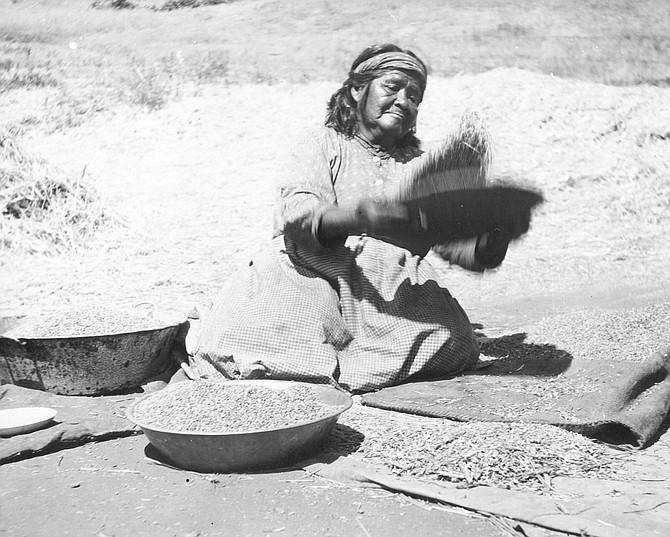
Estevan Wypooke cleaning wheat, 1908. In 1900, at Mesa Grande, Manzanita, Campo, and other Kumeyaay reservations, the old, infirm, and indigent were near starvation.
The Kumeyaay, Kamia, Luiseño, Cupeno, and Cahuilla people once formed the major population of San Diego County. The Ti'Pai and I'Pai peoples, named the Diegueno by the Spanish in 1776, and today known by the name Kumeyaay, had endured the process of missionization under the Spanish from 1776 to 1820. The Spanish believed they were sent by God to save the souls of the Indians. This was nearly equivalent to extinction.
Collectors would race to be first to the reservations and would fight to get Indian women to sell them their baskets.
The Spaniards made extensive use of forced Indian labor. Margaret Langdon published a portion of a 1961 interview with Richard Nejo, a Kumeyaay man, in News from Native California (winter 2000) in which he said:
- At that time there were a lot of Indians down here and they made them work building those churches. And they farmed all that land around the Mission there. Corn and beans, some of that is still there. Those Missions were built by the Indians and the timber was brought from Volcan [north of Julian] on their shoulders. It took about fifty men to bring one down, and those timber were about a hundred feet long; and they brought them down .... Up that canyon they built a canal. They brought the water down in the canal that was about two feet wide, I guess, and about three feet deep. And the bricks were about fourteen inches thick. They built it clear to the Mission to irrigate the crops.
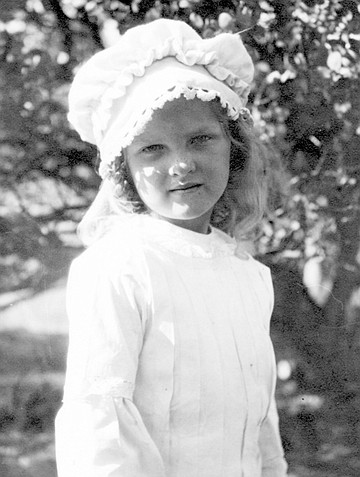
Girl in bobbin-lace-trimmed bonnet, c 1900. A Kumeyaay woman from Mesa Grande had learned the art well enough go to Campo as a lace-making teacher.
Syphilis, measles, and other contagious diseases ran rampant in the missions, leaving most Indian people who went there dead. Slowly, the Spanish found that the missions could not produce the wealth hoped for by the Crown because they could not establish a stable Indian labor population. State support of the missions was cut off around 1810, but this had little long-term significance because in 1821, subsequent to the War for Independence, California became a territory of the new Mexican republic.
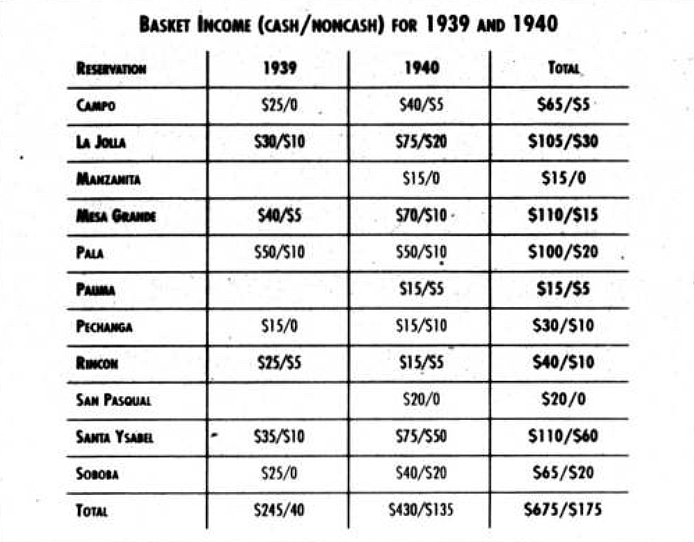
Basket Income 1939 and 1940. Even if the government wasn't invested in teaching basketry, the Indian women were.
The fledgling Mexican government conferred the rights of citizenship to Indian people. In 1829, the first Mexican governor of California, Josè Maria Echeandia,ordered Indian children removed from servitude in Mexican homes and returned to the home of their parents. It is curious that the Mexican government made Indian people citizens, because Mexican soldiers were murdering Kumeyaay people wholesale. An account of the lives of the Kumeyaay under the rule of Echeandia in the late 1820s is given in a history of San Diego by Clarence Alan McGrew.
- The old governor had some trouble with the Indians, and kept his troops busy much of the time in keeping them scared away from the port. The California soldiers brought in the ears of their victims to show what the day's work had been. On one occasion a lieutenant is said to have brought in twenty pairs of ears from Indians slain in this section.
Another example of Governor Echeandia's schizophrenic attitude came in 1829 when a smallpox epidemic hit Northern California. Svlvester Pattie, his son James Ohio Pattie, and a group of trappers were under arrest in San Diego. They had run the Colorado River escaping from some Yumas who had relieved them of their horses. Starving and penniless, the group of Americans put in at a town in Baja California where they were immediately arrested and sent to the main district jail in San Diego. There they continued to starve, languishing for months until the elder Pattie died of malnutrition and neglect. Then, according to John Walton Caughey in History of the Pacific Coast:
- [J. 0.] Pattie let it be known that he had a supply of [smallpox] vaccine, and the Governor soon contracted with him to vaccinate the Californians, officials, soldiers, settlers, padres, and Mission Indians. He toured California in his capacity as "Surgeon General to his Excellency, the Governor of California" inoculating one thousand in San Diego, four thousand at San Juan Capistrano, two thousand in Los Angeles, and lesser numbers elsewhere to make a grand total of twenty-two thousand.
It is highly unlikely that Pattie had any vaccine, much less 22,000 doses. He had straggled half-dead into Baja California and been in jail for months. Still, Echeandia would have vaccinated the Indian population; they by far outnumbered the Mexicans and were desperately needed for labor, This stands in stark contrast to the who turned a blind eye 40 years later when smallpox epidemics swept through the California Indian and Americanized Mexican populations.
The Mexican reign of terror Was to be short-lived, however; the U.S. declared war against Mexico in 1845, and an occupation force of U.S. Marines seized San Diego. The war provided a bright moment for Indian people, who hoped they might again one day be free. Constance Goddard DuBois, a popular novelist who spent summers in California, wrote:
- While the cannons were booming at the famous battle of San Pasqual old Angela sat weaving the circles in this worn basket. She sat on the mountains overlooking the valley watching the hated white man and the yet more hated Mexicans murder each other. She, said, "They will all be dead and we shall be free. " She was almost a hundred years old when she died and saw her land swallowed up by the gringo.
1848-1859
In the end, the U.S. and Mexico divided themselves Kumeyaay homelands. When Alta California was accessioned by the United States, the Treaty of Guadalupe Hidalgo stipulated, first, that the land once comprising the mission system be distributed to Indian people, and, second, that Mexican citizens could choose to become American citizens or to remain citizens of Mexico.
But when the dust settled, the American government stood mute as Americans occupied the mission lands and drove the Indian people east and south. Chairwoman of the Los Coyotes Reservation, elder Katherine Saubel, recollects what she heard about that time:
- ... the Anglos took over. They were just as bad as the Spanish. They were just there to destroy the Indians.
- That's When we really became, you might say, beggars, because we had no place to hunt, no place to gather anymore. We were just held down to the different areas. Sometimes to areas where we didn't even belong -- we were moved around by whoever was in power. It was really a trauma for my people.
- They became so, how would you say...They were always hungry now, they were always in a sad situation. I guess they had to live could get just to survive. But they were really destroyed.
In 1847, the title of military governor shifted from General Stephen Watts Kearney to a man who had risen rapidly in the ranks of the military during the Black Hawk Wars, Colonel Richard Barnes Mason. The Black Hawk Wars were a series of military actions against the Indian people of the Midwestern United States directed by President Andrew Jackson. Jackson, who led the troops and rode the battle lines on horseback, believed total removal and eventual annihilation of Indian people was the only path to what h called peace. For Indian people, the wars marked the beginning of the tradition of the Long Walk, a military-enforced march at gunpoint of masses of Indian people to some distant location, typically west of the Mississippi River, usually in the dead of winter. Every Long Walk resulted in deaths from exposure, malnutrition, and drowning of more than 50 percent of the Indian people forced to march. The survivors were forever marked by grief, trauma, and the results of prolonged malnutrition, i.e., blindness, osteoporosis; and depression.
When Mason was made the second military governor of California, he undoubtedly brought with him the' genocidal impulses that had won him many rapid promotions during the wars. It was no coincidence that,Mason would appoint Captain Jesse B. Hunter of Company B of the Mormon battalion, a man who knew the slave laws of the South, the first Indian subagent of Southern California.
Labor for the ranchos was as serious a problem for the Americans as it had been for the Spaniards and Mexicans. The population of San Diego County in the first official federal census in 1849 was 798 "people." This numbe~excludes hundreds and perhaps thousands of Indian people, who were not counted. Six hundred and fifty of the 798 lived in the city of San Diego. This left 148 nonindigenous people to master the thousands of square miles of San Diego County, which then spread north to Los Angeles and east to Arizona.
The Spanish had established the model for California Indian labor by exploitation at the missions. The Americans, in their turn, would try to force Indians to build their empire by imposing Southern slave laws, and inventing a life of their. own Indian subagent. Hunter was from a wealthy Virginia family and had every opportunity in his youth to see how the slaves were managed in the American South. He issued a series of orders that restrained Indian people from gathering together, except, of course, as laborers for the non-Indian population. He also ordered Indian people to carry passports when they traveled away from their reservations. This law was still in effect as late as 1885, when it was used arbitrarily to control Indian behavior. At age 80, Richard Nejo reminisced about the arrest of a man he knew who went to harvest his daughter and son-in-law's wheat crop without the permission of the Indian agent.
- ... every year he'd go over there and help harvest the wheat, Well, he went away this time ... he come back by the agent's house ... the agent arrested him for going out of the reservation without permission ...
The man was sentenced to chop 30 cords of wood and spend 30 days in jail.
The need for labor spawned blatant violations of Indian human rights. A mid-1800s slave market in Los Angeles did a brisk business. As much as two-thirds of the labor force in Los Angeles came from San. Diego. Indian, people were captured in raids by Mexican slavers, who supplied the ranchos with cheap labor. Local laws set additional traps for Indian people; any Indian considered idle, at best an arbitrary judgment, was fined and subjected to arrest. Any adult Indian who could not pay a fine or a citation would have his debt purchased by a citizen with capital. The citizen then owned the labor of the Indian until the 'debt was paid off.
It was even easier to control the labor of Indian children, who were routinely kidnapped and presented as orphaned. Even families of modest means could acquire an Indian servant or two, as virtually any Indian child could be removed from his or her home by a white citizen who had only to show the courts how living in a white home would benefit the child. The children worked in exchange for room and board, frequently until they reached the age of majority, and although some were well enough treated, we must presume that some were beaten and otherwise abused. All of them had their right to liberty violated and were deprived of their most valued and valuable resource, their families.
Indian agents, too, profited personally from Indian labor. Cave J. Couts, prominent San Diego citizen, used his 1851 marriage into the wealthy and powerful Bandini family and his 1853 appointment as Indian subagent of San Diego County to better his social position. As a wedding present, Abel Sterns gave his sister-in-law, Ysadora Bandini, 2000 acres of land once attached to the Mission San Luis Rey. Two Indian men, Andreas and Jose Manuel, had been deeded the land in
1845 by the Mexican government. When the Americans took over, Sterns was able to preempt the Indian claim to the land. Couts used his appointment as Indian subagent to force Indians to build Rancho Guajome for him, rounding them up as if they were part of the livestock included the land holdings. Clarence McGrew wrote:
- At that time there was a great number of Indians in and around San Luis Rey, and it was an easy matter for Colonel Couts, as he was an Indian agent, to command the services of enough laborers to do his work. It was not long before the result of the patient labor of 300 Indians took the form of an immense adobe house, built in a square, containing twenty rooms, a fine courtyard in the center, well fined with orange and lemon trees and every variety of flower; immense barns, stables, sheds, and corrals were added, after extensive quarters for the servants were built; then to finish the whole a neat chapel was built and formally dedicated to the worship of God. His military training enabled him to control and manage the Indians, as only he could.
Between 1855 and 1866 Couts was indicted for the murders of six Indians and one "Negro workman." He was acquitted on each charge because of a technicality. In the case of a man he beat to death with his whip, his conviction was overturned because a grand juror was accused of being an "alien."" In another case, Couts was acquitted because the district attorney had failed to post his bond of office. Few batted an eye at the possibility that the Indian subagent, the official of the U.S. government, had murdered his wards.
Indians all over Southern California were in constant danger of being murdered. Edward H. Davis, a storekeeper in the mountains at Mesa Grande, wrote Constance Goddard DuBois of an Indian skull he had strapped to the saddle of his horse as he rode more than 30 miles through the hills on his way home. He said that the Indian to whom the skull belonged was 60 or 70 years old when he had been shot through the head by soldiers 50 years earlier. The date suggests these would have been American soldiers, but no further information is given.
For those Indian people who avoided enslavement by finding employment, the picture was not much brighter; in 1853, according to archaeologist Richard Carrico:
- Whites hired at least 100 Indians to help divert the San Diego River from its original flood channel through Old Town. The Indians received $15.00 per month, tent housing, and some basic food stuffs. In contrast, White laborers received $60.00 per month on the same job.
B.D. Wilson, federal subagent for Indian Affairs in Southern California, wrote in his 1852 report:
- If it be true that they [Indian men] cannot do half the work a white man can, 'tis equally true that custom at best never allows them more than half the wages of the latter, and, generally, much less than half. The common pay of an Indian farm hand is from eight to ten dollars per month; and one dollar per day the highest in the towns, but few pay so much. No white man here, whether American, Sonoran, or Californian, will work for such wages, nor anything like it.
Indian people who wanted to avoid forced servitude or enslavement left the coastal and valley areas and sought refuge in the more mountainous regions of their traditional territory. The invisibility provided them by removal into the hills was a double-edged sword. It allowed the Kumeyaay, to a certain extent, to avoid contact with outsiders but perhaps made their lives tougher.
In 1850 the state legislature effectively eliminated the ability of those who fled to the mountains to hunt when it prohibited burning, traditionally used to drive small game. The legislature also outlawed the sale or transfer of guns into Indian hands. By 1859, perhaps 75 percent of Southern California Indian people were dead. A few were relocated and hungry. The remaining Indians were not so much employed as enslaved to the Americans.
1860-1875
The period between 1860 and 1875 dealt a series of terrible blows to Southern California Indian people. Drought and overgrazing ravaged the landscape, changes in federal Indian policy reduced the Indian population to wards of the government, and waves of disease and slow starvation swept through Indian communities. New epidemics, especially smallpox, raged through California, ill some cases depopulating whole villages: It is difficult for a 21st-century American to understand the terror and horror associated with this disease before the wide availability of vaccine. People were contagious before they showed serious symptoms, causing a high contagion rate and public pandemonium, High fevers and, convulsions were not uncommon; painful, weeping pustules accompanied by delirium and followed by a tortured death, seemed inevitable.
As a little girl, Dee Alvarez (c. 1925-2000) heard an elder female relative tell how she had narrowly escaped her own death. The elder had contracted the smallpox, those who could have nursed her back to health were either dead or ill themselves. Her fever rose until she became delirious. With no one to care for her, she wandered out into the desert and collapsed under it shrub. As she neared death, a stranger, a white passerby, rescued her and helped her slowly return to health. Dee told this story in an interview. After she finished; she sat pensively for a moment, then added, "I wonder how many were never found." Alvino Siva, a Cahuilla man from Los Coyotes Reservation (outside Warner's Hot Springs) seated near her, swore a letter exists that verifies that the government knew the blankets given out in Southern California to the Cahuilla by the U.S. Army were infected with smallpox. Whether the government knew or not, smallpox vaccine was withheld from the Indian people.
A second blow was dealt by a combination of drought and stock ranching. Don Pio Pico, the last Mexican governor of California, began stocking Rancho Jamul with horses and cattle as soon as he received a Mexican grant in 1829. With cattle prices low, the number of cattle on the open range grew until the market recovered in 1859. The drought of 1860-1861 (see chart) caused thousands of cattle to starve. The total animal count before 1860 is hard to estimate, but the real disaster fort the cattle industry and the native plant population was yet to come. The following year was rainy and cattle numbers recuperated. But in the winter of 1863-1864, barely three inches of rain had fallen by the end of January. The open-range animals, in search of diminishing forage, roamed farther and ate plants formerly passed over, reducing the landscape to a few shrubs stripped to the heartwood. The number of cattle in Southern California in 1863 has been estimated at between 300,000 and 400,000. The drought and the resultant barren hillsides caused the starvation of between one-half and three- fourths of the cattle.
Droughts were often followed by severe flash flooding. The land could not absorb the intense downpours, and much soil was washed away because of the enormous volume of water and because the plant cover had been removed and the roots no longer held the soil. Chief Patencio, a Cahuilla from the Palm Springs area, recalled such a downpour:
- ... such a storm was not remembered among the Indians. The floods began roaring down the canyons. My people had only time to catch up their children and rush up the mountain side to save
- their lives. When the water from the cloudburst had passed on, everything had gone with it. The homes of my people and all, they had were gone forever.
The drought broke in January 1866. The following four years allowed the herds to swell again, this time far beyond the pre-drought numbers. Rainfall was consistently two to five inches above the 20-year average, allowing some regrowth of the overgrazed landscape, but competition from naturalized European plants further limited regrowth.
A fair example of this can be seen at Monserratte Rancho, near Temecula, granted to Ysidro Maria Alvarado by Pio Pico in 1846. Alvarado started small. By the time of his death from smallpox in 1863, his personal property amounted to "180 steers, twenty cows, 100 sheep, and fifty horses." In 1869, under the direction of Ysidro's son, Tomas, the animal count at Monserratte had burgeoned to 3000 cattle, 13,000 sheep, and 300 horses.
The worst drought of all was yet to come, however. It began slowly in January 1870 and by the end of January 1873 fewer than 16 inches of rain had fallen in San Diego County, far below the annual average of about 9 inches. The starving herds decimated the native landscape of bunch grasses, annuals, and shrubs, which would never recover from this assault.
The result was an increasing Indian dependency on a cash economy at a time when cash was as scarce as food. Even if the plant communities that provided subsistence in pre-Spanish times had not been, devastated by cattle and horses, the epidemics reduced the Indian communities until not enough people remained to gather and process the diversity of seed foods needed to form a complete diet. Some, crops grew several days' walk from home. Epidemic years saw more food in the field return to the earth unharvested.
In the preceding generations, Kumeyaay families frequently went to camps to gather and store food together, whole lineages joining to share in the bounty. It may have been that when the men needed to be gone for more than a week to bring home some foodstuff, the whole family went, unless danger or infirmity prevented the travel. Some foods, particularly agave, because of the dangerous spines, the add juice, and the brute force required to harvest the plants, were harvested by the men and strongest boys alone. Then the small children remained in home camps with the women and oldest family members.
The non-Indian population swelled this era. More than 80 percent of county population of 798 in 1849 resided in the City of San Diego. In the 1870 census, of 5000 Americans residing in the county, only 2300, or fewer than 50 percent, lived in the city. In the 21 years between 1849 and 1870, the rural population jumped from 150 Americans to more than 2700. The soaring population put additional pressure on the beleaguered people and the resources of the land.
An 1875 report of the United States of Indian Affairs explains how San Diego County's Indian population of 2692 had lost the right to occupy their traditional homelands. The citation bears repeating here, as it describes most succinctly the plight of the Indian people.
- For the past eight years Southern California has been filling up by emigration; Spanish and Mexican grants have been "determined" in such a way as to cover choice tracts wherever found; large ranches have been cut up and th, desirable portions of public domain pre-empted; and thus all available agricultural lands have been seized or occupied by individual owners, who, in conformity of the law, have become possessed of the lands on which the remnants of a few" thousand Mission Indians are making their homes in San Diego and San Bernardino counties. So long as the pre-emptors and purchasers did not require the lands for use or sale, the Indians were allowed to remain undisturbed and in blissful ignorance of the fact that the place they called home had by law passed into the ownership of another. Of late, under the increasing demands for these lands, writs of ejectment are being procured by which the Indians are forcibly dispossessed and turned adrift in poverty and wretchedness.
Some Americans did not bother to use the courts but opted for a more brutal route, preferring the quick action of the gun. Such was the case in the 1875 McCain Massacre. in an unprovoked action, McCain and his fellow vigilantes murdered 15 Ti'Pai women and children living at Jacumba. The surviving Indians fled south across the border. McCain and his group took over the land for grazing their animals.
This dispossession was possible in part because the Congress of the United States vote to end any recognition of tribal independence or sovereignty. All Indian people were declared wards of the federal government. They were to remain such until they were assimilated into white society, when they would become American citizens.
1876-1908
The United States government, perhaps motivated by the McCain Massacre, finally took limited action by establishing reservations of 53,000 acres in San Diego County between December,1875, and May 1876. These reservatians included Santa Ysabel, Pala, Agua Caliente, Sycuan, Iñaja, Cosmit, Potrero, Cahuilla, and Capitan Grande.
Gathered on their reservations or pushed across the U.S.-Mexican border, the Kumeyaay were confined, and traditional resources and the large range each lineage needed to sustain its people had become off-limits, for the most part. The fear of the law and arrest often prevented men from leaving the reservation to gather foods.
Reliance on a wide diversity of species was a key element in the thousands of years of successful Kumeyaay occupation. It was a system that recognized the cyclical nature of food availability. Black oak, Quercus kelloggii, bears a reliable crop of acorns only every other year, and in any year a severe hailstorm or a late freeze might reduce acorn harvesting to salvage work. Sometimes herds of bighorn sheep would ruin a stand of agave or yuccas. Without a diversity of plants to rely on, starvation was a certainty.
European stock destroyed the diversity of species. A Kumeyaay man named Santo Lopez was in contention for some time over a piece of land near Campo occupied by a man named Bob McCain (no relationship to the McCain of the McCain Massacre has been established). Sant, as he was called, was determined to reclaim title to the land even though McCain's sheep had devastated the native plant community. Government teacher Mamie Robinson wrote Constance Goddard DuBois:
- McCain rented his land out to a sheepman and those sheep cleaned out everything before Sant got his receipt. She has has to work out side for farmers.
If the Indian men had not fired guns over the heads of the sheep, they would have destroyed the vegetable gardens that Sant's wife, Owas, and her family tended at her father's house near Manzanita, east of Camp.
Their access to traditional food and raw materials thus limited, the Kumeyaay were forced into increasing dependency on a consumer economy. There were very few stores in Kumeyaay country at the turn of the 20th Century, but they supplied sugar, beans, salt, flour, cloth, tobacco, coffee, and nearly everything else to those who had cash or anything of cash value to trade.
Cash was to be the secret to survival. Because cash was difficult to come by for most Indian people, it became essential for them to develop diverse strategies to generate cash or eliminate its need. These strategies included a combination of old and new ways. Relying on traditional foods like acorns and pine nuts, creating articles of material culture like baskets and arrows for sale selling resources like timber and heirlooms, hiring out for wages, beekeeping, and intensive vegetable gardening.
Harvesting natural foods, as well as intensive gardening, had been developed before the arrival of outsiders. Leaving home for periods of time, for the entire family or for groups of men and boys, began long before the Spanish opened the first mission in Alta California; the Spaniards only capitalized on that tradition. During the American period, the remoteness of the reservations preempted the possibility of much work near home; so many men sought work in the Colorado River drainage. More went north and west to the valley grasslands to work as vaqueros, herding livestock as their forefathers had done' for the Spaniards and Mexicans. A few.found positions as domestic servants at the ranchos and in the houses of the town folk. A very few found day jobs at nearby ranchos. The rest labored for various expansionist and empire-building enterprises, laying railroads, building roads, damming and diverting rivers, and working in the tourmaline mines of Julian. Many Southern California Indian people know of some girl or woman employed as a prostitute during these hard times. Few Indian men ever attained any status in the newcomers' eyes.
The Episcopalians and the Quakers were among the first Protestant churches to send missionaries to see to the spiritual and physical welfare of California Indian people. Across the country, individual congregations sponsored programs to promote Indian education and economic independence at a time when Indian children could not, as a rule, attend public schools and Indian individuals could not, ironically, own unallotted land. Mrs. Mary (Maria) Watkins, the government teacher at Mesa Grande. (northeast of Santa Ysabel), Was a participant in the plan the Episcopal church adopted for Indian welfare before the tum of the century. Apparently an Episcopalian, Watkins arrived at Mesa Grande Reservation sometime before 1897. She was a volunteer social worker too, reading and writing letters for the blind and illiterate, sewing yards of calico and flannel into undershirts and petticoats for the old and indigent. Her social work was supported by the Los Angeles congregation tion of Episcopal bishop Joseph H. Johnson. She wrote about her religious convictions and her attempt to follow a Christlike life, dispensing food and human compassion to those in her charge.
If I could tell you all my life here you would see almost immaculate assistance. I pray and the answer comes. It is true in the smallest as well as in more important matters. I do wish to live so near a Christ life that my faith can help my poor people. All other wants seem lost in this great want of my heart, May God, our Father, bless you as you have helped me in my work. I do love you.
On May 30,1900; Mary Watkins reported a rare event, work near home. "A new road is to be made here, and if will give several hundred dollars to the men. That will be a great help.
In 1900, at Mesa Grande, Manzanita, Campo, and other Kumeyaay reservations, the old, infirm, and indigent were near starvation. Watkins wrote to Constance Goddard DuBois in 1900 saying they were in the third year of drought. The plight of the Indian poor was generally unacknowledged by the government and the public, although their desperate condition was common knowledge to both government electees and the public at large. Watkins wrote:
- The poor little old woman in San José has gone, Help came too late. Although she was truly very old she would probably have stayed longer had not food been so scarce. Her grandson was here today and told me about it. I sent a clean gown for her burial.
Miss Mamie Robinson came to Campo Reservation to teach soon after the turn of the century. Her work was partially sponsored by Johnson's congregation in Los Angeles. The women taught school as government employees and Saw to the general welfare of the elderly and invalid as Episcopalians, Through their combined efforts many deaths from hunger and exposure were prevented, although the suffering continued all around San Diego County, as Watkins told DuBois in her letter of January 1902:
- ... six inches of snow fell today and there is a foot in Volcan Cañon. Think of the suffering of those miserable children. You remember the house away up in the crevice of the mt. under the fir trees:' The' old man died with hunger and six children were sent away to the Mission [San Diego de Alcala] to escape a like fate. I sent $3.00 of your money to the old woman at San José. She had nothing and was suffering...
Help was not forthcoming from the government:
- I forgot to tell you that the Agent went over this reserve and was astonished at the poverty, the lack of land etc. He said, "Shut your eyes to the wood cutting. Let the poor wretches have a chance."So the wagon runs loaded every hour of daylight. What would they have done without it and the wood.
Watkins wrote DuBois in March 1902:
- That morning I had given Naciso an order for $2.50 worth [of groceries] as they had eater herbs or some thing queer for three days. It was bad for my stomach,"he said earnestly, "to eat nothing."...Andres'ration money I gave to the little dried up old woman at San José. Her name is Maria Lechua. Particio, her great-grandson, is certainly a model of filial affection. I have never seen such kind eyes, nor heard a voice of such exceeding sweetness. He tends the little creature as tenderly as a mother cares fora baby ...
Indian people were not victims who went quietly away; they actively resisted the changes forced upon them. One woman from Laguna Reservation, Maria Alto, the American system in 1902 to secure her rights; she traveled to the Office of the Clerk. of San Diego County, a two-day ride on 'horseback, to file a Homestead Claim for the village, her ancestors occupied. Unlike the homes of people evicted in 1903 from Warner's Hot Springs, Alto's home was very remote and at a high altitude and had not yet been noticed by the Americans. Although the land has remained in family hands, Maria Alto's son, Tom Lucas, had moved away from the homestead by 1930 to earn a living. Interestingly, he worked for a road-paving company, building San Diego highways for 30 years.
Earning cash by using the strategies that took men far from home typically resulted in the splitting of families for extended periods. After 1900, men frequently traveled alone to find employment. Depending on the work, they might not return home for weeks and sometimes months.
In 1906, word- spread like wildfire that labor was desperately needed on the Colorado River and high wages were being paid. It seems an American entrepreneur saw an opportunity to irrigate the desert with Colorado River water. His crews, in attempting to create a canal, breached the western flank of the riverbed. Soon seasonal, flooding backed by torrential unremitting rains widened the breach until at last the entire Colorado River poured through the opening, filling the long-dry Salton Sink until it was 17 miles wide and 47 miles long. Word must have gone out quickly that the crazy capitalists had run the river out of its banks because Sant Lopez crossed the Colorado and went to work while the breach was widening. The December torrents that tore the river's bank wide open made it impossible for him to cross back over to return home until the floods subsided,
Mamie Robinson described Sant's circumstances when he went to work on the Colorado River.
- ... and he does not know when he will be able to come back. They will be thro' their work in two weeks but Sant doesn't think they will be able to cross [the river] the n. He wrote up to me telling me to tell the people not to attempt to come there for work.
"The one bright economic spot in the decade was the basket craze. This was a phenomenal time. Hungry for entertainment, crowds in the East flocked to massive exhibitions staged by museums in New York, Chicago, Philadelphia, Washington, and every other large city; P.T. Barnum's first success was the museum he opened this time. These exhibitions were object-rich attempts to recreate the sights and sounds of foreign cultures.
Individual collectors were hungry for baskets as well. Competition was fierce. Collectors would race to be first to the reservations and would fight to get Indian women to sell them their baskets. Mary Watkins wrote in a letter:
- Mr. Brackett, the merchant here, went to Agua Caliente and bought up all the baskets that I ordered made. He went into the houses and of course they took his price. He doubles his profit and it is too bad.
Basket making was an ideal industry for normal families denied access to the economic system because the process did not require any outlay of cash. Baskets were transformed from tools to gather, process, store, and serve unprocessed foods (acorn, piñon, salvia seed, chia seed) into tools that produced processed foods (sugar, flour, beans, coffee) and a variety of other consumer goods. Once used to harvest grain by sweeping the stalks int he fields, the basket of the 18002 and 19002 had the potential to harvest cash.
Indian Women were paid as much as $8 for a basket that might have sold for $4 or less before the craze. Once the $8 basket reached the city, it would be sold for double the price.
In 1902, lace making was added to the list of strategies to bring money to the Indian women. One
Episcopalian woman took her responsibility to the Indian poor seriously, although she was vain enough to name her organization after herself: the Sybil Carter Indian Lace Association. In 1902, the association started a lace-making program in Mesa Grande,La Jolla, and Santa Ysabel.
The mission of the Sybil Carter Indian Lace Association was two pronged. The first goal was to provide Indian women wjth materials and instructions in lace making. At that time, lace was all made by hand-twisting threads of linen in decorative patterns. The second goal was to serve as agents in the sale of the work to the New York City garment industry. The association would buy the lace from the workers and market it to garment manufacturers eager to buy the handmade lace. It was lightweight and could be easily and inexpensively sent by post. Any profit was pumped back into the program by hiring new teachers and providing an uninterrupted supply of materials. Several photographs in the collection of the San Diego Historical Society show lace on the bonnets of babies in Mesa Grande and Santa Ysabel.
The students in Mesa Grande worked under the direction of Miss Sophie Miller. She would teach the Indian women the art and supply them with the proper pins and thread. The first month Miller reports more than $25 worth of lace sent to New York. In the spring of 1904, a new source, of income was introduced. Bishop Johnson had secured the money to continue the salary of the lace-making teacher.
By the fall of 1904 Francis La Chappa, a Kumeyaay woman from Mesa Grande, had learned the art well enough go to Campo as a lace-making teacher and a white woman was found to accompany her and to teach the three Rs. Ed Davis, the storekeeper from Mesa Grande, wrote of the success of the venture:
- The girls are doing splendid work and a school of 14 pupils is now in operation under Francis La Chappa, maestra. Whole families are moving to Campo, so to have their children receive the benefit of school.
Seven years later, the enthusiasm Mary Watkins expressed in 1900 at the idea of lndian people with cash incomes was lost to Mamie Robinson. She Wrote to DuBois on October 23, 1907, about the effect of railroad building on basket making. "Very little basket making going on. Plenty of work for the men. More drinking than ever before. This is simply because there has been more money."
Times seemed continually hard for a majority of Kumeyaay and other Southern California Indians. One of the strategies employed to survive was bound to fail every year. Oaks bore a good crop only every two years. The European-style gardens could become a total loss at any time. At San Ignacio, a village at Los Coyotes Reservation, gardeners experienced a year of loss in 1904 as recorded by social worker Ella Collins:
- I am afraid they are almost in want, for the year has been so very dry that they will not raise a pound of hay or grain. All their gardens are dead but they are trying to dig wells and get water to irrigate their gardens; and they will plant them over but it is very late to get much garden grown now.
She adds a note about the Cupeños who were forcibly removed from Warner's Hot Spring to Pala the year before:
- The Indians who were removed from Warner's Rancho are having a hard time. Crops are a failure, and they are homesick. The white folks who have been to Warner's hot springs complain that they have not been as well treated as they used to be by the Indians.
The families with women who made baskets were more financially secure than families where the women did not. Each period of heavy basket making was accompanied by extreme weather, when garden crops and traditional food-gathering did provide enough to eat. Year after year, the letters paint the same dun-colored landscape of poverty, despite the use of multiple strategies. Sant Lopez wrote DuBois in the spring 1907, while discussing buying beehives, "I think I need the money more than hives, for I have no money for anything." Robinson wrote to DuBois in August 1907 that although the weather was hot, there was still starvation to be fended off:
Glad of the $10.00 as Mr. McArthur wrote me that he has heard nothing of the [government) appropriation for the subsistence of the aged and sick. There are 5 that we have been carrying thro' July and Aug. with your help and some money. I had here belonging to Col. Lockwood. I don't know what we should have done for they had not a soul to depend upon. One is a blind man who has a wife and four children, a new baby being born in July. She, the wife, makes baskets and gardens -- does all she can do.
A survival ration of food for one person for a month cost $3; at least that was the amount given as a monthly ration by the government teacher, Mary Watkins.
The basket craze lasted from the turn of the century until the supply was exhausted, about 1910. Constance Goddard DuBois was able to exploit the craze, buying the baskets, selling them back East, and returning the money to the basket makers. DuBois wrote in an undated essay, around 1906, of the economic impact of basket making in concrete terms:
- Basketry existing now almost entirely as a means of livelihood has become necessarily somewhat degraded from its earlier perfection, but in the Campo-Manzanita region almost no baskets were made for sale until I supplied the earliest market for the product, selling for benefit of the destitute makers a thousand dollars worth of baskets in four years.
Drawn work, a kind of handwork in which the threads of a linen fabric are removed so that the vacant spaces create a decorative pattern, had been taught to the Indian women by the Spanish more than 100 years before. Government teacher Mary Watkins and Mrs. Hall, the wife of the government teacher at La Jolla, in cooperation with DuBois and her sister, tried to develop a market for this work. They bought drawn-work linens from the Indian women and furnished them with fabric and thread to continue production. It was a tough market, and in 1900, anthropologist David I. Barrows wrote DuBois on the subject:
- The Mexican drawn work has been brought in so largely as rather to drive out that made by the Indians. The natives of certain towns of Mexico seem to make a better and cheaper article that is coming to be sold very largely, as you have doubtless noticed.
Nonetheless, the Indian women kept working. DuBois lamented, in 1906, the problems of the hand workers thus: "... they are too poor to purchase the necessary linen and they require the intelligent supervision to enable them to place 'their' products on the market."
The problem of the remoteness of the reservations manifested itself in the erection of a secondary market for the goods; that is, someone had to get the baskets, "lace, drawn work, vegetables, or honey off the remote mountainsides to, town. Ed Davis recorded a story about the exploitation inevitable when a second, distant market is important. The publisher of the Indian Philanthropist remains obscure.
- From M. Bailey, March 20, 1904, Indian Philanthropist.
A woman in govt. employ after bartering for five weeks, she succeeded in obtaining an Ind.,basket for $5.00. for which $30 was asked by the Ind. woman. While counting on the basket she had adv. a small amount from time to time to enable the woman to get food with and thereby get her in debt. Another woman had taken a fancy to the basket & intended buying it but the first woman warned her off as she had adv. money & told her to keep off. A cast off hat & some old clothes were put in as part payment. The basket was beautifully made - a large basket which took 6 months to make. She bought another basket for $2.50. She came to a good hotel on govt pay on a vacation and met some Eastern tourists who were Ind. lovers and as she was a good talker and had lived among the Inds. This interested them very much. Finally she brought out her Ind. baskets which were admired very much. She did not want to sell the baskets until at the earnest solicitation of (an) the Eastern man she sold the two baskets one for $75 & the other for $25. The large one she said had taken over 6 months to make, with great patience and care and it was represented that the poor Indians got the benefit of the money.
Mamie Robinson's letter to Dubois of September 20, 1907, relates the still-desperate plight of the sick and indigent Indian people. "No money yet for the subsistence of the old people." Baskets again fill in the gaps."I have a number of baskets, not any choice ones."
A letter from Mamie Robinson to DuBois in early October 1907 complains that the government funds for the old people have still not come and thanks DuBois for sending her monthly allotment of $10 and for sending $25 from sales of baskets.
The economic value of baskets is undeniable, especially if we look at the basket making of a woman who did not particularly care to make baskets although she could and did when circumstances compelled. Such a woman was Owas. the wife of Sant Lopez. Although no details of her background are recorded; it was said by her husband, according to Mamie Robinson that Owas did not like to sit still long enough to do that kind of work and that she did riot like basket making: She wasn't lazy. She went to work during the winter of 1907-1908 as a laundress for the workers building the railroad that was used to dump ore cars of boulders into the breech in the flank of the Colorado-River, and during the spring, summer, and early fall, she tended a garden of tomatoes, beans, greens, and corn at her father's house. In fact, she chose the laundry of the laborers over basket making when both were apparently possible.
By March 1908, the breech in the river had been sealed and wages on the railroad had been cut in half. Forced back to work she didn't care for, Owas made another basket. Sant agreed to take it and another to Mamie Robinson, who wrote DuBois, "He asked me to say he would soon send you two baskets, Owas made one and one was given to him. He wants them to go toward paying that$20 [he borrowed to purchase bees and hives]."
1909-1940
The basket craze was soon to end. The collectors wanted "old baskets." When the baskets that Indian people had used in their households had all been sold, the women were unable to produce enough new baskets to keep the craze alive. As early as 1902, C. Hart Merriam had written to Mary Watkins inquiring about old baskets only to find out they had already been, sold. Ed Davis, the storekeeper at Mesa Grande, noticed their absence too.
About the Indian things I cannot give you any encouragement as I have very few if any duplicates, as all of the Rancheros are drained of the old belongings by collectors and visitors, except some hechicero things still in use and buried away or hidden and not to be bought at any price.
The end of the basket craze among collectors and institutions meant falling basket prices. By 1910 most California baskets, and even the protected hechicero things, were in collections. (Hechicero is the name of a ceremony involving the sacred plant toloache.) In the absence of baskets, lace making became the sole income through handcraft. Mrs. Grace Lachusa of Mesa Grande was explicit about the value of lace making for her family.
- Who could be more interested in this work than me for I know what good it has done. In fact my parents couldn't of never kept us seven children together if it hadn't been for the lace work. There wasn't much work here then for my father and my mother was sick. He tried to wrestle a living out of farming these dry hills as he couldn't go away for work and leave us all alone, so we made the living for many months with our lace work.
An undated brochure from the Sybil Carter Indian Lace Association sums up the , economic impact this way:
- The practical side of what the work is today is found in improved homes, additions to houses, the purchase of farm implements and animals, and the many comforts which never could have been enjoyed from the slender incomes from the land alone: A storekeeper once remarked that he would have to go out of business if the women did not have their lace money, and not long ago several of the workers, with a good deal of pride, pointed to lace pigs," "lace cows," lace houses," etc.
In basket making, a huge amount of labor is hidden within each basket, for a woman does not just cut sticks and weave them. Every hour spent in stitching a coiled basket means another hour spent securing and preparing the materials. The Belgian linen, thread used in lace making needed no preparation. The negligible cost of the linen aside,women could produce income by making lace rather than by making baskets. Mesa Grande reservation women, under the direction of the Sybil Carter lace teacher Grace Dycke, sent $1484.85 worth of lace to New York between October 1917 and April 1918, according to the records of the Mission Indian Agency housed in the National Archives in Laguna Niguel, California. In comparison to baskets, which earned $1000 over four years, lace making was a windfall.
According to those same records, Mrs. Lachusa, an outstanding lace maker, learned the skill at the age of 8, and by age 12 she was assisting the teacher. Within a year she went to New York to work as a lace-making teacher; there she stayed for 14 years. In 1922 she returned to Mesa Grande. At the height of the Depression she worked with Superintendent John W. Dady of the Mission Indian Agency to revive lace making. In a letter to him she recalled her own experience as a lace-making teacher:
- I did all my own blueprinting and making of the patterns and the Co. furnished all the material and I measured the lace and paid the women here soon as they finished it. Mostly yard lace was made a few tried the small doilies. The yard lace was all the way from 10¢ a yard to $10.00 a yard. The main thing is to find a ready sale for the lace, so after they finish some they can get some cash.
Few girls wanted to learn basket making, but many wanted to learn lace making. Lace making was an innovation in net making, an old tradition; unlike net making, it didn't require the long trips to gather materials. Lace was stylish. The problem of a ready local market had been solved with the growth of Los Angeles. Lace making became profitable as Indian women found a direct market for their work and California filled with white people.
Lace making depended upon the import of rust-proof steel pins and Belgian linen thread; a completely uniform, small-diameter thread. There were no contemporaneous local substitutes for these materials. Cash was required to buy the imports. Traditional Indian textiles used in Southern California were cloaks made of strips of rabbit skin interwoven with milkweed or hemp cordage,
skirts of shredded bast fibers, and mats made of pierced rushes threaded together on four or five rows of cordage. Despite the fact that the twisting of thread in making lace was very similar to the knotting of cordage in making nets, lace requires the strength of steel pins holding it under tension as it is twisted; nets did not require this. Indian hemp and milkweed were unavailable in sufficient amounts for thread making because of their relative scarcity caused by overgrazing and drought. Mrs. Lachusa recalled in September 1933:
- All the thread was imported thread mostly from Belgium and France and the B. B. pins from England ... so we tried some American thread the Barbours F. D. A. thread; which I think can
- be gotten in Los Angeles, but can't say where. May be it could be found from some of these traveling sales men.
This dependence on outside supply doomed the lace-making industry in World War I, when commercial cargo ships ceased Atlantic Ocean crossings. A letter dated June 17, 1918, from Olivia M. Cutting, president of the Sybil Carter Indian Lace Association, to Cato Sells, the commissioner of Indian Affairs in Washington, D.C., predicts the failure of the association:
- With regard to the thread situation, I may say that it is serious if not critical. It is practically impossible to enlarge our present supply to any appreciable extent and what we have is far from desirable.
The choice of some Indian women to sell their lace directly, instead of through the association, assured its withdrawal from Southern California. School superintendant Harry E. Wadsworth, received a letter from Ellen Lawrence, the government lace teacher at Pala and Malki (near Banning), regarding the status of the lace-making funds. She wrote that from July 1, 1917, until June 24, 1918, she had paid out only $79.92 to women for lace. She noted that some women were selling their laces at fairs and elsewhere and were giving her no account of how much revenue had been received. The schoolgirls, she said, were making lace and keeping it.
As the supply of linen and pins dwindled, lace-making programs closed. Sells ordered the position of government lace teacher abolished, saying that between October 1916 and October 1917 only $39 worth of lace had been sold to the association and that in the subsequent year, the amount fell to $20.44. He added that he hoped the women would continue lace making on their own.
The Sybil Carter Association followed the government's lead and formally withdrew from Southern California around 1924. Lace making was forgotten.
In 1930, there was an attempt to revive it on the reservations. Both Ed Davis and Charles L. Elllis, superintendent of the Mission Indian Ageny, agree that 1930 was a terrible economic year, not only because of the crash of the stock market in distant New York the previous fall but because Southern California had not emerged from what Ellis called the worst and longest drought in recorded history. There were no acorns in 1930 and people were hungry. The National Climatic Data Center recorded 5.5 inches of rain in San Diego County in 1928 and 4. 14inches of rain in 1929. Davis wrote in 1931:
We next went to Henry Long near the school. We found him, his wife, and a child. He said his father and other child would return soon. I looked through the house and found about 1/2 pound of beans in an olla. No flour. No acorns. There are no acorns. The acorn crop failed in 1930 so no Inds. had acorn meal. We next drove about a mile and a half and turned up a hill and stopped near a good sized native hut.... Here we found a family of five, Tomas Osway & wife Anita & three children. I examined the house and found a few tortillas & few beans.
The earliest mention of a revival discovered in the records is a letter from Mrs. Grace Lachusa that reads like a response to an inquiry by Superintendent Ellis. She enclosed wrappers so Ellis would know what pins and threads were needed. Ellis wrote to Mrs. Charles Wallcott of Washington, D.C., in 1930 for help in reestablishing the lace industry. By 1931, Lachusa had written C.J. Rhoads, commissioner of Indian Affairs, who in turn wrote to Ellis directing him to try to restart the project. Ellis left office soon after, but not before he had predicted the failure of the revival attempt .
- ... [Indian women] are eager and desirous of reviving the industry, but the main difficulty to overcome is lack of market or demand for the lace. Also, the Indians are unable to find in the stores of San Diego or Los Angeles the imported thread or pins required for lace-making.
Ellis continued his efforts, requesting all of the teachers, farm agents, social workers, and others in the field service under his supervision to submit lists of crafts people.
By 1933, John W. Dady had become superintendent of the Mission Indian Agency. Initially, he pursued the revival of the lace industry with enthusiasm. He wrote to Lachusa for samples of thread and pins, He wrote to the commissioner of Indian Affairs in Washington, D.C., requesting funds to hire a lace-making teacher and a basket-making teacher. He wrote Bullock's department store in October 1933 to see if they were interested in supplying thread and buying lace. Nothing came of the inquiry, and by 1935 Dady, stymied by a lack of suitable materials, had lost all enthusiasm.
He shifted his focus to securing funds to hire a basket-making teacher and widened the search for Indian basket makers by consulting the U.S.-licensed Indian trader, R. Bruce Cregar. Basket making resurged after the hiatus of the 1920s, and lace making was nearly forgotten. Today, no one makes lace. Few elders remember seeing lace around the house, and even fewer remember anyone twisting threads into lace.
When the records pick up the basket-making element again in the early 1930s, women were still making fine baskets. The average age of the basket makers now, however, was over 50. At Temecula in 1934 the youngest "good" basket maker, Cenciona Gomez, was 53 and the oldest, Michela Quileg, was 98; more than half of the women were over 65. At Pala it was the same; the youngest, Rosinda Nolasquez, was 41 and the eldest, Rafaela Owlinguish, was 77; half the women were over 50.
Cregar, the licensed Indian trader, collected many baskets in the 1930s. These he would enter in Indian fairs, like the Indian Ceremonial in Gallup, New Mexico. Women had competed there since 1922 for the title of finest basket maker and the cash prize that accompanied the title. During the 1930s, a Cahuilla basket maker named Candelaria Saubel consistently won the grand prize at Gallup. Records indicate that even though Cregar purchased the baskets from the women and entered them in the competition, he returned the prize money to the makers. He, of course, kept any profit from the secondary sale of the basket, Gallup is many miles from San Diego County, and it is unlikely that the Kumeyaay women would have transported the baskets themselves.
By November1933, Dady had received $500 funding for a basket-making program, and he authorized social worker Esther Adamson to hire basket-making teachers at Mesa Grande, Volcan, and Los Coyotes Reservations. She spent $257 for teachers' salaries. The remaining $243 was sent to J.K. Hall in Banning to use for teachers there on Morongo Reservation.
Cash was scarce in 1934, the height of the Depression. Dady encouraged a handful of Indian women in March 1934 to loan baskets to an exhibition of domestic arts and home economics sponsored by the Washington Office of Indian Affairs. The baskets were to be offered for sale. Mr. George Norte on behalf of his mother, Mrs. Ascension (Cinciona) Norte of Banning, lent two baskets. The Nortes spent the next year fighting for the return of the baskets or the $16.50 purchase price from the Office of Indian Affairs through Dady. Mr. Norte wrote (none of the spelling or punctuation altered):
- My mother asked my about the basket I left there a few months back in your letter stated that if I wanted in back I was welcome to get it back that you could not except anything from no one, and to leve it to for a exhibit so I did and now I want it because I'm not at work, I need all what I can get. So this is the only way mother and I make our living.
The Nortes were not the only family in such a situation. Esther Adamson, social worker for the Mission Indian Agency, also wrote to Dady about the return of the unsold $7 basket of Mrs. Pedro (Carmelita) La Chappa:
- She [Mrs. La Chappa] called my attention to the fact that she and her children needed shoes and clothing and that she had hoped that this money Would provide them Mrs. La Chappa is very diligent, always working on baskets or something and is finding it very hard to find a buyer for them.
- I should like very much to feel that I have not made the situation more difficult for her by this long delayed program. I am sure that the 'letter yon write to Washington will be more tactful than this.
Basket makers Maria Tobac and Susanna Aguello from La Jolla and Mrs. Cayatas Welmas from Pala had baskets on loan to the exhibition that totaled $41 in value, but apparently these baskets were sold during the exhibition and the money was sent back to the three women. The Norte baskets were finally returned in the middle of May 1935; no disposition of the La Chappa basket is recorded.
The Indian Arts and Crafts Board was petitioned by Dady in 1938 for funds to hire Candelaria Saubel as the basket-making teacher at Morongo Reservation in Banning. He received a reply from Paul Fickinger, associate director for education at the Office of Indian Affairs, who said there were no funds available, but that Dady should contact Mary Stewart, superintendent of Indian education for the state of California, to attach funds given to the state in payment for education services for California Indians. Fickinger, to his credit went back to the Indian Arts and Crafts Board to see if they might release funding. The response was a polite no.
Mary Stewart, however, made time to see Dady late in the summer of 1938. No official record of the meeting remains, but still surviving are the official Mission Indian Agency records of the amount of money brought in by Indian basket makers on Southern California reservations in 1939 and 1940.
Overall, the reported revenue raised from basket making grew from $285 in 1939 to $565 in 1940. Presumably even if the government wasn't invested in teaching basketry, the Indian women were.
In the decades since 1940, a great deal has changed for Kumeyaay basket makers in the United States. Most have jobs and live as middle-class California Indians. Although more and more supplement their incomes by making baskets, none earns a living from it.
In Baja California, where people are poor, women make a living from basketry. Celia Silva is a typical artisan. When she was younger, she taught basket making at the school in San Jose, about 50 miles.south of San Diego, and the government paid her salary. Celia makes fine baskets of juncus, a rush. She makes clay dolls, sometimes with hats of juncus or skirts of shredded willow. She makes coiled willow storage baskets called sequin. In. San Jose, basket making continues as an economic survival strategy.
Here's something you might be interested in.
San Diego Indians weaving baskets and making lace
They shall be dead, and we shall all be free

San Diego Indians weaving baskets and making lace
They shall be dead, and we shall all be free
Estevan Wypooke cleaning wheat, 1908. In 1900, at Mesa Grande, Manzanita, Campo, and other Kumeyaay reservations, the old, infirm, and indigent were near starvation.
The Kumeyaay, Kamia, Luiseño, Cupeno, and Cahuilla people once formed the major population of San Diego County. The Ti'Pai and I'Pai peoples, named the Diegueno by the Spanish in 1776, and today known by the name Kumeyaay, had endured the process of missionization under the Spanish from 1776 to 1820. The Spanish believed they were sent by God to save the souls of the Indians. This was nearly equivalent to extinction.
Collectors would race to be first to the reservations and would fight to get Indian women to sell them their baskets.
The Spaniards made extensive use of forced Indian labor. Margaret Langdon published a portion of a 1961 interview with Richard Nejo, a Kumeyaay man, in News from Native California (winter 2000) in which he said:
- At that time there were a lot of Indians down here and they made them work building those churches. And they farmed all that land around the Mission there. Corn and beans, some of that is still there. Those Missions were built by the Indians and the timber was brought from Volcan [north of Julian] on their shoulders. It took about fifty men to bring one down, and those timber were about a hundred feet long; and they brought them down .... Up that canyon they built a canal. They brought the water down in the canal that was about two feet wide, I guess, and about three feet deep. And the bricks were about fourteen inches thick. They built it clear to the Mission to irrigate the crops.
Girl in bobbin-lace-trimmed bonnet, c 1900. A Kumeyaay woman from Mesa Grande had learned the art well enough go to Campo as a lace-making teacher.
Syphilis, measles, and other contagious diseases ran rampant in the missions, leaving most Indian people who went there dead. Slowly, the Spanish found that the missions could not produce the wealth hoped for by the Crown because they could not establish a stable Indian labor population. State support of the missions was cut off around 1810, but this had little long-term significance because in 1821, subsequent to the War for Independence, California became a territory of the new Mexican republic.
Basket Income 1939 and 1940. Even if the government wasn't invested in teaching basketry, the Indian women were.
The fledgling Mexican government conferred the rights of citizenship to Indian people. In 1829, the first Mexican governor of California, Josè Maria Echeandia,ordered Indian children removed from servitude in Mexican homes and returned to the home of their parents. It is curious that the Mexican government made Indian people citizens, because Mexican soldiers were murdering Kumeyaay people wholesale. An account of the lives of the Kumeyaay under the rule of Echeandia in the late 1820s is given in a history of San Diego by Clarence Alan McGrew.
- The old governor had some trouble with the Indians, and kept his troops busy much of the time in keeping them scared away from the port. The California soldiers brought in the ears of their victims to show what the day's work had been. On one occasion a lieutenant is said to have brought in twenty pairs of ears from Indians slain in this section.
Another example of Governor Echeandia's schizophrenic attitude came in 1829 when a smallpox epidemic hit Northern California. Svlvester Pattie, his son James Ohio Pattie, and a group of trappers were under arrest in San Diego. They had run the Colorado River escaping from some Yumas who had relieved them of their horses. Starving and penniless, the group of Americans put in at a town in Baja California where they were immediately arrested and sent to the main district jail in San Diego. There they continued to starve, languishing for months until the elder Pattie died of malnutrition and neglect. Then, according to John Walton Caughey in History of the Pacific Coast:
- [J. 0.] Pattie let it be known that he had a supply of [smallpox] vaccine, and the Governor soon contracted with him to vaccinate the Californians, officials, soldiers, settlers, padres, and Mission Indians. He toured California in his capacity as "Surgeon General to his Excellency, the Governor of California" inoculating one thousand in San Diego, four thousand at San Juan Capistrano, two thousand in Los Angeles, and lesser numbers elsewhere to make a grand total of twenty-two thousand.
It is highly unlikely that Pattie had any vaccine, much less 22,000 doses. He had straggled half-dead into Baja California and been in jail for months. Still, Echeandia would have vaccinated the Indian population; they by far outnumbered the Mexicans and were desperately needed for labor, This stands in stark contrast to the who turned a blind eye 40 years later when smallpox epidemics swept through the California Indian and Americanized Mexican populations.
The Mexican reign of terror Was to be short-lived, however; the U.S. declared war against Mexico in 1845, and an occupation force of U.S. Marines seized San Diego. The war provided a bright moment for Indian people, who hoped they might again one day be free. Constance Goddard DuBois, a popular novelist who spent summers in California, wrote:
- While the cannons were booming at the famous battle of San Pasqual old Angela sat weaving the circles in this worn basket. She sat on the mountains overlooking the valley watching the hated white man and the yet more hated Mexicans murder each other. She, said, "They will all be dead and we shall be free. " She was almost a hundred years old when she died and saw her land swallowed up by the gringo.
1848-1859
In the end, the U.S. and Mexico divided themselves Kumeyaay homelands. When Alta California was accessioned by the United States, the Treaty of Guadalupe Hidalgo stipulated, first, that the land once comprising the mission system be distributed to Indian people, and, second, that Mexican citizens could choose to become American citizens or to remain citizens of Mexico.
But when the dust settled, the American government stood mute as Americans occupied the mission lands and drove the Indian people east and south. Chairwoman of the Los Coyotes Reservation, elder Katherine Saubel, recollects what she heard about that time:
- ... the Anglos took over. They were just as bad as the Spanish. They were just there to destroy the Indians.
- That's When we really became, you might say, beggars, because we had no place to hunt, no place to gather anymore. We were just held down to the different areas. Sometimes to areas where we didn't even belong -- we were moved around by whoever was in power. It was really a trauma for my people.
- They became so, how would you say...They were always hungry now, they were always in a sad situation. I guess they had to live could get just to survive. But they were really destroyed.
In 1847, the title of military governor shifted from General Stephen Watts Kearney to a man who had risen rapidly in the ranks of the military during the Black Hawk Wars, Colonel Richard Barnes Mason. The Black Hawk Wars were a series of military actions against the Indian people of the Midwestern United States directed by President Andrew Jackson. Jackson, who led the troops and rode the battle lines on horseback, believed total removal and eventual annihilation of Indian people was the only path to what h called peace. For Indian people, the wars marked the beginning of the tradition of the Long Walk, a military-enforced march at gunpoint of masses of Indian people to some distant location, typically west of the Mississippi River, usually in the dead of winter. Every Long Walk resulted in deaths from exposure, malnutrition, and drowning of more than 50 percent of the Indian people forced to march. The survivors were forever marked by grief, trauma, and the results of prolonged malnutrition, i.e., blindness, osteoporosis; and depression.
When Mason was made the second military governor of California, he undoubtedly brought with him the' genocidal impulses that had won him many rapid promotions during the wars. It was no coincidence that,Mason would appoint Captain Jesse B. Hunter of Company B of the Mormon battalion, a man who knew the slave laws of the South, the first Indian subagent of Southern California.
Labor for the ranchos was as serious a problem for the Americans as it had been for the Spaniards and Mexicans. The population of San Diego County in the first official federal census in 1849 was 798 "people." This numbe~excludes hundreds and perhaps thousands of Indian people, who were not counted. Six hundred and fifty of the 798 lived in the city of San Diego. This left 148 nonindigenous people to master the thousands of square miles of San Diego County, which then spread north to Los Angeles and east to Arizona.
The Spanish had established the model for California Indian labor by exploitation at the missions. The Americans, in their turn, would try to force Indians to build their empire by imposing Southern slave laws, and inventing a life of their. own Indian subagent. Hunter was from a wealthy Virginia family and had every opportunity in his youth to see how the slaves were managed in the American South. He issued a series of orders that restrained Indian people from gathering together, except, of course, as laborers for the non-Indian population. He also ordered Indian people to carry passports when they traveled away from their reservations. This law was still in effect as late as 1885, when it was used arbitrarily to control Indian behavior. At age 80, Richard Nejo reminisced about the arrest of a man he knew who went to harvest his daughter and son-in-law's wheat crop without the permission of the Indian agent.
- ... every year he'd go over there and help harvest the wheat, Well, he went away this time ... he come back by the agent's house ... the agent arrested him for going out of the reservation without permission ...
The man was sentenced to chop 30 cords of wood and spend 30 days in jail.
The need for labor spawned blatant violations of Indian human rights. A mid-1800s slave market in Los Angeles did a brisk business. As much as two-thirds of the labor force in Los Angeles came from San. Diego. Indian, people were captured in raids by Mexican slavers, who supplied the ranchos with cheap labor. Local laws set additional traps for Indian people; any Indian considered idle, at best an arbitrary judgment, was fined and subjected to arrest. Any adult Indian who could not pay a fine or a citation would have his debt purchased by a citizen with capital. The citizen then owned the labor of the Indian until the 'debt was paid off.
It was even easier to control the labor of Indian children, who were routinely kidnapped and presented as orphaned. Even families of modest means could acquire an Indian servant or two, as virtually any Indian child could be removed from his or her home by a white citizen who had only to show the courts how living in a white home would benefit the child. The children worked in exchange for room and board, frequently until they reached the age of majority, and although some were well enough treated, we must presume that some were beaten and otherwise abused. All of them had their right to liberty violated and were deprived of their most valued and valuable resource, their families.
Indian agents, too, profited personally from Indian labor. Cave J. Couts, prominent San Diego citizen, used his 1851 marriage into the wealthy and powerful Bandini family and his 1853 appointment as Indian subagent of San Diego County to better his social position. As a wedding present, Abel Sterns gave his sister-in-law, Ysadora Bandini, 2000 acres of land once attached to the Mission San Luis Rey. Two Indian men, Andreas and Jose Manuel, had been deeded the land in
1845 by the Mexican government. When the Americans took over, Sterns was able to preempt the Indian claim to the land. Couts used his appointment as Indian subagent to force Indians to build Rancho Guajome for him, rounding them up as if they were part of the livestock included the land holdings. Clarence McGrew wrote:
- At that time there was a great number of Indians in and around San Luis Rey, and it was an easy matter for Colonel Couts, as he was an Indian agent, to command the services of enough laborers to do his work. It was not long before the result of the patient labor of 300 Indians took the form of an immense adobe house, built in a square, containing twenty rooms, a fine courtyard in the center, well fined with orange and lemon trees and every variety of flower; immense barns, stables, sheds, and corrals were added, after extensive quarters for the servants were built; then to finish the whole a neat chapel was built and formally dedicated to the worship of God. His military training enabled him to control and manage the Indians, as only he could.
Between 1855 and 1866 Couts was indicted for the murders of six Indians and one "Negro workman." He was acquitted on each charge because of a technicality. In the case of a man he beat to death with his whip, his conviction was overturned because a grand juror was accused of being an "alien."" In another case, Couts was acquitted because the district attorney had failed to post his bond of office. Few batted an eye at the possibility that the Indian subagent, the official of the U.S. government, had murdered his wards.
Indians all over Southern California were in constant danger of being murdered. Edward H. Davis, a storekeeper in the mountains at Mesa Grande, wrote Constance Goddard DuBois of an Indian skull he had strapped to the saddle of his horse as he rode more than 30 miles through the hills on his way home. He said that the Indian to whom the skull belonged was 60 or 70 years old when he had been shot through the head by soldiers 50 years earlier. The date suggests these would have been American soldiers, but no further information is given.
For those Indian people who avoided enslavement by finding employment, the picture was not much brighter; in 1853, according to archaeologist Richard Carrico:
- Whites hired at least 100 Indians to help divert the San Diego River from its original flood channel through Old Town. The Indians received $15.00 per month, tent housing, and some basic food stuffs. In contrast, White laborers received $60.00 per month on the same job.
B.D. Wilson, federal subagent for Indian Affairs in Southern California, wrote in his 1852 report:
- If it be true that they [Indian men] cannot do half the work a white man can, 'tis equally true that custom at best never allows them more than half the wages of the latter, and, generally, much less than half. The common pay of an Indian farm hand is from eight to ten dollars per month; and one dollar per day the highest in the towns, but few pay so much. No white man here, whether American, Sonoran, or Californian, will work for such wages, nor anything like it.
Indian people who wanted to avoid forced servitude or enslavement left the coastal and valley areas and sought refuge in the more mountainous regions of their traditional territory. The invisibility provided them by removal into the hills was a double-edged sword. It allowed the Kumeyaay, to a certain extent, to avoid contact with outsiders but perhaps made their lives tougher.
In 1850 the state legislature effectively eliminated the ability of those who fled to the mountains to hunt when it prohibited burning, traditionally used to drive small game. The legislature also outlawed the sale or transfer of guns into Indian hands. By 1859, perhaps 75 percent of Southern California Indian people were dead. A few were relocated and hungry. The remaining Indians were not so much employed as enslaved to the Americans.
1860-1875
The period between 1860 and 1875 dealt a series of terrible blows to Southern California Indian people. Drought and overgrazing ravaged the landscape, changes in federal Indian policy reduced the Indian population to wards of the government, and waves of disease and slow starvation swept through Indian communities. New epidemics, especially smallpox, raged through California, ill some cases depopulating whole villages: It is difficult for a 21st-century American to understand the terror and horror associated with this disease before the wide availability of vaccine. People were contagious before they showed serious symptoms, causing a high contagion rate and public pandemonium, High fevers and, convulsions were not uncommon; painful, weeping pustules accompanied by delirium and followed by a tortured death, seemed inevitable.
As a little girl, Dee Alvarez (c. 1925-2000) heard an elder female relative tell how she had narrowly escaped her own death. The elder had contracted the smallpox, those who could have nursed her back to health were either dead or ill themselves. Her fever rose until she became delirious. With no one to care for her, she wandered out into the desert and collapsed under it shrub. As she neared death, a stranger, a white passerby, rescued her and helped her slowly return to health. Dee told this story in an interview. After she finished; she sat pensively for a moment, then added, "I wonder how many were never found." Alvino Siva, a Cahuilla man from Los Coyotes Reservation (outside Warner's Hot Springs) seated near her, swore a letter exists that verifies that the government knew the blankets given out in Southern California to the Cahuilla by the U.S. Army were infected with smallpox. Whether the government knew or not, smallpox vaccine was withheld from the Indian people.
A second blow was dealt by a combination of drought and stock ranching. Don Pio Pico, the last Mexican governor of California, began stocking Rancho Jamul with horses and cattle as soon as he received a Mexican grant in 1829. With cattle prices low, the number of cattle on the open range grew until the market recovered in 1859. The drought of 1860-1861 (see chart) caused thousands of cattle to starve. The total animal count before 1860 is hard to estimate, but the real disaster fort the cattle industry and the native plant population was yet to come. The following year was rainy and cattle numbers recuperated. But in the winter of 1863-1864, barely three inches of rain had fallen by the end of January. The open-range animals, in search of diminishing forage, roamed farther and ate plants formerly passed over, reducing the landscape to a few shrubs stripped to the heartwood. The number of cattle in Southern California in 1863 has been estimated at between 300,000 and 400,000. The drought and the resultant barren hillsides caused the starvation of between one-half and three- fourths of the cattle.
Droughts were often followed by severe flash flooding. The land could not absorb the intense downpours, and much soil was washed away because of the enormous volume of water and because the plant cover had been removed and the roots no longer held the soil. Chief Patencio, a Cahuilla from the Palm Springs area, recalled such a downpour:
- ... such a storm was not remembered among the Indians. The floods began roaring down the canyons. My people had only time to catch up their children and rush up the mountain side to save
- their lives. When the water from the cloudburst had passed on, everything had gone with it. The homes of my people and all, they had were gone forever.
The drought broke in January 1866. The following four years allowed the herds to swell again, this time far beyond the pre-drought numbers. Rainfall was consistently two to five inches above the 20-year average, allowing some regrowth of the overgrazed landscape, but competition from naturalized European plants further limited regrowth.
A fair example of this can be seen at Monserratte Rancho, near Temecula, granted to Ysidro Maria Alvarado by Pio Pico in 1846. Alvarado started small. By the time of his death from smallpox in 1863, his personal property amounted to "180 steers, twenty cows, 100 sheep, and fifty horses." In 1869, under the direction of Ysidro's son, Tomas, the animal count at Monserratte had burgeoned to 3000 cattle, 13,000 sheep, and 300 horses.
The worst drought of all was yet to come, however. It began slowly in January 1870 and by the end of January 1873 fewer than 16 inches of rain had fallen in San Diego County, far below the annual average of about 9 inches. The starving herds decimated the native landscape of bunch grasses, annuals, and shrubs, which would never recover from this assault.
The result was an increasing Indian dependency on a cash economy at a time when cash was as scarce as food. Even if the plant communities that provided subsistence in pre-Spanish times had not been, devastated by cattle and horses, the epidemics reduced the Indian communities until not enough people remained to gather and process the diversity of seed foods needed to form a complete diet. Some, crops grew several days' walk from home. Epidemic years saw more food in the field return to the earth unharvested.
In the preceding generations, Kumeyaay families frequently went to camps to gather and store food together, whole lineages joining to share in the bounty. It may have been that when the men needed to be gone for more than a week to bring home some foodstuff, the whole family went, unless danger or infirmity prevented the travel. Some foods, particularly agave, because of the dangerous spines, the add juice, and the brute force required to harvest the plants, were harvested by the men and strongest boys alone. Then the small children remained in home camps with the women and oldest family members.
The non-Indian population swelled this era. More than 80 percent of county population of 798 in 1849 resided in the City of San Diego. In the 1870 census, of 5000 Americans residing in the county, only 2300, or fewer than 50 percent, lived in the city. In the 21 years between 1849 and 1870, the rural population jumped from 150 Americans to more than 2700. The soaring population put additional pressure on the beleaguered people and the resources of the land.
An 1875 report of the United States of Indian Affairs explains how San Diego County's Indian population of 2692 had lost the right to occupy their traditional homelands. The citation bears repeating here, as it describes most succinctly the plight of the Indian people.
- For the past eight years Southern California has been filling up by emigration; Spanish and Mexican grants have been "determined" in such a way as to cover choice tracts wherever found; large ranches have been cut up and th, desirable portions of public domain pre-empted; and thus all available agricultural lands have been seized or occupied by individual owners, who, in conformity of the law, have become possessed of the lands on which the remnants of a few" thousand Mission Indians are making their homes in San Diego and San Bernardino counties. So long as the pre-emptors and purchasers did not require the lands for use or sale, the Indians were allowed to remain undisturbed and in blissful ignorance of the fact that the place they called home had by law passed into the ownership of another. Of late, under the increasing demands for these lands, writs of ejectment are being procured by which the Indians are forcibly dispossessed and turned adrift in poverty and wretchedness.
Some Americans did not bother to use the courts but opted for a more brutal route, preferring the quick action of the gun. Such was the case in the 1875 McCain Massacre. in an unprovoked action, McCain and his fellow vigilantes murdered 15 Ti'Pai women and children living at Jacumba. The surviving Indians fled south across the border. McCain and his group took over the land for grazing their animals.
This dispossession was possible in part because the Congress of the United States vote to end any recognition of tribal independence or sovereignty. All Indian people were declared wards of the federal government. They were to remain such until they were assimilated into white society, when they would become American citizens.
1876-1908
The United States government, perhaps motivated by the McCain Massacre, finally took limited action by establishing reservations of 53,000 acres in San Diego County between December,1875, and May 1876. These reservatians included Santa Ysabel, Pala, Agua Caliente, Sycuan, Iñaja, Cosmit, Potrero, Cahuilla, and Capitan Grande.
Gathered on their reservations or pushed across the U.S.-Mexican border, the Kumeyaay were confined, and traditional resources and the large range each lineage needed to sustain its people had become off-limits, for the most part. The fear of the law and arrest often prevented men from leaving the reservation to gather foods.
Reliance on a wide diversity of species was a key element in the thousands of years of successful Kumeyaay occupation. It was a system that recognized the cyclical nature of food availability. Black oak, Quercus kelloggii, bears a reliable crop of acorns only every other year, and in any year a severe hailstorm or a late freeze might reduce acorn harvesting to salvage work. Sometimes herds of bighorn sheep would ruin a stand of agave or yuccas. Without a diversity of plants to rely on, starvation was a certainty.
European stock destroyed the diversity of species. A Kumeyaay man named Santo Lopez was in contention for some time over a piece of land near Campo occupied by a man named Bob McCain (no relationship to the McCain of the McCain Massacre has been established). Sant, as he was called, was determined to reclaim title to the land even though McCain's sheep had devastated the native plant community. Government teacher Mamie Robinson wrote Constance Goddard DuBois:
- McCain rented his land out to a sheepman and those sheep cleaned out everything before Sant got his receipt. She has has to work out side for farmers.
If the Indian men had not fired guns over the heads of the sheep, they would have destroyed the vegetable gardens that Sant's wife, Owas, and her family tended at her father's house near Manzanita, east of Camp.
Their access to traditional food and raw materials thus limited, the Kumeyaay were forced into increasing dependency on a consumer economy. There were very few stores in Kumeyaay country at the turn of the 20th Century, but they supplied sugar, beans, salt, flour, cloth, tobacco, coffee, and nearly everything else to those who had cash or anything of cash value to trade.
Cash was to be the secret to survival. Because cash was difficult to come by for most Indian people, it became essential for them to develop diverse strategies to generate cash or eliminate its need. These strategies included a combination of old and new ways. Relying on traditional foods like acorns and pine nuts, creating articles of material culture like baskets and arrows for sale selling resources like timber and heirlooms, hiring out for wages, beekeeping, and intensive vegetable gardening.
Harvesting natural foods, as well as intensive gardening, had been developed before the arrival of outsiders. Leaving home for periods of time, for the entire family or for groups of men and boys, began long before the Spanish opened the first mission in Alta California; the Spaniards only capitalized on that tradition. During the American period, the remoteness of the reservations preempted the possibility of much work near home; so many men sought work in the Colorado River drainage. More went north and west to the valley grasslands to work as vaqueros, herding livestock as their forefathers had done' for the Spaniards and Mexicans. A few.found positions as domestic servants at the ranchos and in the houses of the town folk. A very few found day jobs at nearby ranchos. The rest labored for various expansionist and empire-building enterprises, laying railroads, building roads, damming and diverting rivers, and working in the tourmaline mines of Julian. Many Southern California Indian people know of some girl or woman employed as a prostitute during these hard times. Few Indian men ever attained any status in the newcomers' eyes.
The Episcopalians and the Quakers were among the first Protestant churches to send missionaries to see to the spiritual and physical welfare of California Indian people. Across the country, individual congregations sponsored programs to promote Indian education and economic independence at a time when Indian children could not, as a rule, attend public schools and Indian individuals could not, ironically, own unallotted land. Mrs. Mary (Maria) Watkins, the government teacher at Mesa Grande. (northeast of Santa Ysabel), Was a participant in the plan the Episcopal church adopted for Indian welfare before the tum of the century. Apparently an Episcopalian, Watkins arrived at Mesa Grande Reservation sometime before 1897. She was a volunteer social worker too, reading and writing letters for the blind and illiterate, sewing yards of calico and flannel into undershirts and petticoats for the old and indigent. Her social work was supported by the Los Angeles congregation tion of Episcopal bishop Joseph H. Johnson. She wrote about her religious convictions and her attempt to follow a Christlike life, dispensing food and human compassion to those in her charge.
If I could tell you all my life here you would see almost immaculate assistance. I pray and the answer comes. It is true in the smallest as well as in more important matters. I do wish to live so near a Christ life that my faith can help my poor people. All other wants seem lost in this great want of my heart, May God, our Father, bless you as you have helped me in my work. I do love you.
On May 30,1900; Mary Watkins reported a rare event, work near home. "A new road is to be made here, and if will give several hundred dollars to the men. That will be a great help.
In 1900, at Mesa Grande, Manzanita, Campo, and other Kumeyaay reservations, the old, infirm, and indigent were near starvation. Watkins wrote to Constance Goddard DuBois in 1900 saying they were in the third year of drought. The plight of the Indian poor was generally unacknowledged by the government and the public, although their desperate condition was common knowledge to both government electees and the public at large. Watkins wrote:
- The poor little old woman in San José has gone, Help came too late. Although she was truly very old she would probably have stayed longer had not food been so scarce. Her grandson was here today and told me about it. I sent a clean gown for her burial.
Miss Mamie Robinson came to Campo Reservation to teach soon after the turn of the century. Her work was partially sponsored by Johnson's congregation in Los Angeles. The women taught school as government employees and Saw to the general welfare of the elderly and invalid as Episcopalians, Through their combined efforts many deaths from hunger and exposure were prevented, although the suffering continued all around San Diego County, as Watkins told DuBois in her letter of January 1902:
- ... six inches of snow fell today and there is a foot in Volcan Cañon. Think of the suffering of those miserable children. You remember the house away up in the crevice of the mt. under the fir trees:' The' old man died with hunger and six children were sent away to the Mission [San Diego de Alcala] to escape a like fate. I sent $3.00 of your money to the old woman at San José. She had nothing and was suffering...
Help was not forthcoming from the government:
- I forgot to tell you that the Agent went over this reserve and was astonished at the poverty, the lack of land etc. He said, "Shut your eyes to the wood cutting. Let the poor wretches have a chance."So the wagon runs loaded every hour of daylight. What would they have done without it and the wood.
Watkins wrote DuBois in March 1902:
- That morning I had given Naciso an order for $2.50 worth [of groceries] as they had eater herbs or some thing queer for three days. It was bad for my stomach,"he said earnestly, "to eat nothing."...Andres'ration money I gave to the little dried up old woman at San José. Her name is Maria Lechua. Particio, her great-grandson, is certainly a model of filial affection. I have never seen such kind eyes, nor heard a voice of such exceeding sweetness. He tends the little creature as tenderly as a mother cares fora baby ...
Indian people were not victims who went quietly away; they actively resisted the changes forced upon them. One woman from Laguna Reservation, Maria Alto, the American system in 1902 to secure her rights; she traveled to the Office of the Clerk. of San Diego County, a two-day ride on 'horseback, to file a Homestead Claim for the village, her ancestors occupied. Unlike the homes of people evicted in 1903 from Warner's Hot Springs, Alto's home was very remote and at a high altitude and had not yet been noticed by the Americans. Although the land has remained in family hands, Maria Alto's son, Tom Lucas, had moved away from the homestead by 1930 to earn a living. Interestingly, he worked for a road-paving company, building San Diego highways for 30 years.
Earning cash by using the strategies that took men far from home typically resulted in the splitting of families for extended periods. After 1900, men frequently traveled alone to find employment. Depending on the work, they might not return home for weeks and sometimes months.
In 1906, word- spread like wildfire that labor was desperately needed on the Colorado River and high wages were being paid. It seems an American entrepreneur saw an opportunity to irrigate the desert with Colorado River water. His crews, in attempting to create a canal, breached the western flank of the riverbed. Soon seasonal, flooding backed by torrential unremitting rains widened the breach until at last the entire Colorado River poured through the opening, filling the long-dry Salton Sink until it was 17 miles wide and 47 miles long. Word must have gone out quickly that the crazy capitalists had run the river out of its banks because Sant Lopez crossed the Colorado and went to work while the breach was widening. The December torrents that tore the river's bank wide open made it impossible for him to cross back over to return home until the floods subsided,
Mamie Robinson described Sant's circumstances when he went to work on the Colorado River.
- ... and he does not know when he will be able to come back. They will be thro' their work in two weeks but Sant doesn't think they will be able to cross [the river] the n. He wrote up to me telling me to tell the people not to attempt to come there for work.
"The one bright economic spot in the decade was the basket craze. This was a phenomenal time. Hungry for entertainment, crowds in the East flocked to massive exhibitions staged by museums in New York, Chicago, Philadelphia, Washington, and every other large city; P.T. Barnum's first success was the museum he opened this time. These exhibitions were object-rich attempts to recreate the sights and sounds of foreign cultures.
Individual collectors were hungry for baskets as well. Competition was fierce. Collectors would race to be first to the reservations and would fight to get Indian women to sell them their baskets. Mary Watkins wrote in a letter:
- Mr. Brackett, the merchant here, went to Agua Caliente and bought up all the baskets that I ordered made. He went into the houses and of course they took his price. He doubles his profit and it is too bad.
Basket making was an ideal industry for normal families denied access to the economic system because the process did not require any outlay of cash. Baskets were transformed from tools to gather, process, store, and serve unprocessed foods (acorn, piñon, salvia seed, chia seed) into tools that produced processed foods (sugar, flour, beans, coffee) and a variety of other consumer goods. Once used to harvest grain by sweeping the stalks int he fields, the basket of the 18002 and 19002 had the potential to harvest cash.
Indian Women were paid as much as $8 for a basket that might have sold for $4 or less before the craze. Once the $8 basket reached the city, it would be sold for double the price.
In 1902, lace making was added to the list of strategies to bring money to the Indian women. One
Episcopalian woman took her responsibility to the Indian poor seriously, although she was vain enough to name her organization after herself: the Sybil Carter Indian Lace Association. In 1902, the association started a lace-making program in Mesa Grande,La Jolla, and Santa Ysabel.
The mission of the Sybil Carter Indian Lace Association was two pronged. The first goal was to provide Indian women wjth materials and instructions in lace making. At that time, lace was all made by hand-twisting threads of linen in decorative patterns. The second goal was to serve as agents in the sale of the work to the New York City garment industry. The association would buy the lace from the workers and market it to garment manufacturers eager to buy the handmade lace. It was lightweight and could be easily and inexpensively sent by post. Any profit was pumped back into the program by hiring new teachers and providing an uninterrupted supply of materials. Several photographs in the collection of the San Diego Historical Society show lace on the bonnets of babies in Mesa Grande and Santa Ysabel.
The students in Mesa Grande worked under the direction of Miss Sophie Miller. She would teach the Indian women the art and supply them with the proper pins and thread. The first month Miller reports more than $25 worth of lace sent to New York. In the spring of 1904, a new source, of income was introduced. Bishop Johnson had secured the money to continue the salary of the lace-making teacher.
By the fall of 1904 Francis La Chappa, a Kumeyaay woman from Mesa Grande, had learned the art well enough go to Campo as a lace-making teacher and a white woman was found to accompany her and to teach the three Rs. Ed Davis, the storekeeper from Mesa Grande, wrote of the success of the venture:
- The girls are doing splendid work and a school of 14 pupils is now in operation under Francis La Chappa, maestra. Whole families are moving to Campo, so to have their children receive the benefit of school.
Seven years later, the enthusiasm Mary Watkins expressed in 1900 at the idea of lndian people with cash incomes was lost to Mamie Robinson. She Wrote to DuBois on October 23, 1907, about the effect of railroad building on basket making. "Very little basket making going on. Plenty of work for the men. More drinking than ever before. This is simply because there has been more money."
Times seemed continually hard for a majority of Kumeyaay and other Southern California Indians. One of the strategies employed to survive was bound to fail every year. Oaks bore a good crop only every two years. The European-style gardens could become a total loss at any time. At San Ignacio, a village at Los Coyotes Reservation, gardeners experienced a year of loss in 1904 as recorded by social worker Ella Collins:
- I am afraid they are almost in want, for the year has been so very dry that they will not raise a pound of hay or grain. All their gardens are dead but they are trying to dig wells and get water to irrigate their gardens; and they will plant them over but it is very late to get much garden grown now.
She adds a note about the Cupeños who were forcibly removed from Warner's Hot Spring to Pala the year before:
- The Indians who were removed from Warner's Rancho are having a hard time. Crops are a failure, and they are homesick. The white folks who have been to Warner's hot springs complain that they have not been as well treated as they used to be by the Indians.
The families with women who made baskets were more financially secure than families where the women did not. Each period of heavy basket making was accompanied by extreme weather, when garden crops and traditional food-gathering did provide enough to eat. Year after year, the letters paint the same dun-colored landscape of poverty, despite the use of multiple strategies. Sant Lopez wrote DuBois in the spring 1907, while discussing buying beehives, "I think I need the money more than hives, for I have no money for anything." Robinson wrote to DuBois in August 1907 that although the weather was hot, there was still starvation to be fended off:
Glad of the $10.00 as Mr. McArthur wrote me that he has heard nothing of the [government) appropriation for the subsistence of the aged and sick. There are 5 that we have been carrying thro' July and Aug. with your help and some money. I had here belonging to Col. Lockwood. I don't know what we should have done for they had not a soul to depend upon. One is a blind man who has a wife and four children, a new baby being born in July. She, the wife, makes baskets and gardens -- does all she can do.
A survival ration of food for one person for a month cost $3; at least that was the amount given as a monthly ration by the government teacher, Mary Watkins.
The basket craze lasted from the turn of the century until the supply was exhausted, about 1910. Constance Goddard DuBois was able to exploit the craze, buying the baskets, selling them back East, and returning the money to the basket makers. DuBois wrote in an undated essay, around 1906, of the economic impact of basket making in concrete terms:
- Basketry existing now almost entirely as a means of livelihood has become necessarily somewhat degraded from its earlier perfection, but in the Campo-Manzanita region almost no baskets were made for sale until I supplied the earliest market for the product, selling for benefit of the destitute makers a thousand dollars worth of baskets in four years.
Drawn work, a kind of handwork in which the threads of a linen fabric are removed so that the vacant spaces create a decorative pattern, had been taught to the Indian women by the Spanish more than 100 years before. Government teacher Mary Watkins and Mrs. Hall, the wife of the government teacher at La Jolla, in cooperation with DuBois and her sister, tried to develop a market for this work. They bought drawn-work linens from the Indian women and furnished them with fabric and thread to continue production. It was a tough market, and in 1900, anthropologist David I. Barrows wrote DuBois on the subject:
- The Mexican drawn work has been brought in so largely as rather to drive out that made by the Indians. The natives of certain towns of Mexico seem to make a better and cheaper article that is coming to be sold very largely, as you have doubtless noticed.
Nonetheless, the Indian women kept working. DuBois lamented, in 1906, the problems of the hand workers thus: "... they are too poor to purchase the necessary linen and they require the intelligent supervision to enable them to place 'their' products on the market."
The problem of the remoteness of the reservations manifested itself in the erection of a secondary market for the goods; that is, someone had to get the baskets, "lace, drawn work, vegetables, or honey off the remote mountainsides to, town. Ed Davis recorded a story about the exploitation inevitable when a second, distant market is important. The publisher of the Indian Philanthropist remains obscure.
- From M. Bailey, March 20, 1904, Indian Philanthropist.
A woman in govt. employ after bartering for five weeks, she succeeded in obtaining an Ind.,basket for $5.00. for which $30 was asked by the Ind. woman. While counting on the basket she had adv. a small amount from time to time to enable the woman to get food with and thereby get her in debt. Another woman had taken a fancy to the basket & intended buying it but the first woman warned her off as she had adv. money & told her to keep off. A cast off hat & some old clothes were put in as part payment. The basket was beautifully made - a large basket which took 6 months to make. She bought another basket for $2.50. She came to a good hotel on govt pay on a vacation and met some Eastern tourists who were Ind. lovers and as she was a good talker and had lived among the Inds. This interested them very much. Finally she brought out her Ind. baskets which were admired very much. She did not want to sell the baskets until at the earnest solicitation of (an) the Eastern man she sold the two baskets one for $75 & the other for $25. The large one she said had taken over 6 months to make, with great patience and care and it was represented that the poor Indians got the benefit of the money.
Mamie Robinson's letter to Dubois of September 20, 1907, relates the still-desperate plight of the sick and indigent Indian people. "No money yet for the subsistence of the old people." Baskets again fill in the gaps."I have a number of baskets, not any choice ones."
A letter from Mamie Robinson to DuBois in early October 1907 complains that the government funds for the old people have still not come and thanks DuBois for sending her monthly allotment of $10 and for sending $25 from sales of baskets.
The economic value of baskets is undeniable, especially if we look at the basket making of a woman who did not particularly care to make baskets although she could and did when circumstances compelled. Such a woman was Owas. the wife of Sant Lopez. Although no details of her background are recorded; it was said by her husband, according to Mamie Robinson that Owas did not like to sit still long enough to do that kind of work and that she did riot like basket making: She wasn't lazy. She went to work during the winter of 1907-1908 as a laundress for the workers building the railroad that was used to dump ore cars of boulders into the breech in the flank of the Colorado-River, and during the spring, summer, and early fall, she tended a garden of tomatoes, beans, greens, and corn at her father's house. In fact, she chose the laundry of the laborers over basket making when both were apparently possible.
By March 1908, the breech in the river had been sealed and wages on the railroad had been cut in half. Forced back to work she didn't care for, Owas made another basket. Sant agreed to take it and another to Mamie Robinson, who wrote DuBois, "He asked me to say he would soon send you two baskets, Owas made one and one was given to him. He wants them to go toward paying that$20 [he borrowed to purchase bees and hives]."
1909-1940
The basket craze was soon to end. The collectors wanted "old baskets." When the baskets that Indian people had used in their households had all been sold, the women were unable to produce enough new baskets to keep the craze alive. As early as 1902, C. Hart Merriam had written to Mary Watkins inquiring about old baskets only to find out they had already been, sold. Ed Davis, the storekeeper at Mesa Grande, noticed their absence too.
About the Indian things I cannot give you any encouragement as I have very few if any duplicates, as all of the Rancheros are drained of the old belongings by collectors and visitors, except some hechicero things still in use and buried away or hidden and not to be bought at any price.
The end of the basket craze among collectors and institutions meant falling basket prices. By 1910 most California baskets, and even the protected hechicero things, were in collections. (Hechicero is the name of a ceremony involving the sacred plant toloache.) In the absence of baskets, lace making became the sole income through handcraft. Mrs. Grace Lachusa of Mesa Grande was explicit about the value of lace making for her family.
- Who could be more interested in this work than me for I know what good it has done. In fact my parents couldn't of never kept us seven children together if it hadn't been for the lace work. There wasn't much work here then for my father and my mother was sick. He tried to wrestle a living out of farming these dry hills as he couldn't go away for work and leave us all alone, so we made the living for many months with our lace work.
An undated brochure from the Sybil Carter Indian Lace Association sums up the , economic impact this way:
- The practical side of what the work is today is found in improved homes, additions to houses, the purchase of farm implements and animals, and the many comforts which never could have been enjoyed from the slender incomes from the land alone: A storekeeper once remarked that he would have to go out of business if the women did not have their lace money, and not long ago several of the workers, with a good deal of pride, pointed to lace pigs," "lace cows," lace houses," etc.
In basket making, a huge amount of labor is hidden within each basket, for a woman does not just cut sticks and weave them. Every hour spent in stitching a coiled basket means another hour spent securing and preparing the materials. The Belgian linen, thread used in lace making needed no preparation. The negligible cost of the linen aside,women could produce income by making lace rather than by making baskets. Mesa Grande reservation women, under the direction of the Sybil Carter lace teacher Grace Dycke, sent $1484.85 worth of lace to New York between October 1917 and April 1918, according to the records of the Mission Indian Agency housed in the National Archives in Laguna Niguel, California. In comparison to baskets, which earned $1000 over four years, lace making was a windfall.
According to those same records, Mrs. Lachusa, an outstanding lace maker, learned the skill at the age of 8, and by age 12 she was assisting the teacher. Within a year she went to New York to work as a lace-making teacher; there she stayed for 14 years. In 1922 she returned to Mesa Grande. At the height of the Depression she worked with Superintendent John W. Dady of the Mission Indian Agency to revive lace making. In a letter to him she recalled her own experience as a lace-making teacher:
- I did all my own blueprinting and making of the patterns and the Co. furnished all the material and I measured the lace and paid the women here soon as they finished it. Mostly yard lace was made a few tried the small doilies. The yard lace was all the way from 10¢ a yard to $10.00 a yard. The main thing is to find a ready sale for the lace, so after they finish some they can get some cash.
Few girls wanted to learn basket making, but many wanted to learn lace making. Lace making was an innovation in net making, an old tradition; unlike net making, it didn't require the long trips to gather materials. Lace was stylish. The problem of a ready local market had been solved with the growth of Los Angeles. Lace making became profitable as Indian women found a direct market for their work and California filled with white people.
Lace making depended upon the import of rust-proof steel pins and Belgian linen thread; a completely uniform, small-diameter thread. There were no contemporaneous local substitutes for these materials. Cash was required to buy the imports. Traditional Indian textiles used in Southern California were cloaks made of strips of rabbit skin interwoven with milkweed or hemp cordage,
skirts of shredded bast fibers, and mats made of pierced rushes threaded together on four or five rows of cordage. Despite the fact that the twisting of thread in making lace was very similar to the knotting of cordage in making nets, lace requires the strength of steel pins holding it under tension as it is twisted; nets did not require this. Indian hemp and milkweed were unavailable in sufficient amounts for thread making because of their relative scarcity caused by overgrazing and drought. Mrs. Lachusa recalled in September 1933:
- All the thread was imported thread mostly from Belgium and France and the B. B. pins from England ... so we tried some American thread the Barbours F. D. A. thread; which I think can
- be gotten in Los Angeles, but can't say where. May be it could be found from some of these traveling sales men.
This dependence on outside supply doomed the lace-making industry in World War I, when commercial cargo ships ceased Atlantic Ocean crossings. A letter dated June 17, 1918, from Olivia M. Cutting, president of the Sybil Carter Indian Lace Association, to Cato Sells, the commissioner of Indian Affairs in Washington, D.C., predicts the failure of the association:
- With regard to the thread situation, I may say that it is serious if not critical. It is practically impossible to enlarge our present supply to any appreciable extent and what we have is far from desirable.
The choice of some Indian women to sell their lace directly, instead of through the association, assured its withdrawal from Southern California. School superintendant Harry E. Wadsworth, received a letter from Ellen Lawrence, the government lace teacher at Pala and Malki (near Banning), regarding the status of the lace-making funds. She wrote that from July 1, 1917, until June 24, 1918, she had paid out only $79.92 to women for lace. She noted that some women were selling their laces at fairs and elsewhere and were giving her no account of how much revenue had been received. The schoolgirls, she said, were making lace and keeping it.
As the supply of linen and pins dwindled, lace-making programs closed. Sells ordered the position of government lace teacher abolished, saying that between October 1916 and October 1917 only $39 worth of lace had been sold to the association and that in the subsequent year, the amount fell to $20.44. He added that he hoped the women would continue lace making on their own.
The Sybil Carter Association followed the government's lead and formally withdrew from Southern California around 1924. Lace making was forgotten.
In 1930, there was an attempt to revive it on the reservations. Both Ed Davis and Charles L. Elllis, superintendent of the Mission Indian Ageny, agree that 1930 was a terrible economic year, not only because of the crash of the stock market in distant New York the previous fall but because Southern California had not emerged from what Ellis called the worst and longest drought in recorded history. There were no acorns in 1930 and people were hungry. The National Climatic Data Center recorded 5.5 inches of rain in San Diego County in 1928 and 4. 14inches of rain in 1929. Davis wrote in 1931:
We next went to Henry Long near the school. We found him, his wife, and a child. He said his father and other child would return soon. I looked through the house and found about 1/2 pound of beans in an olla. No flour. No acorns. There are no acorns. The acorn crop failed in 1930 so no Inds. had acorn meal. We next drove about a mile and a half and turned up a hill and stopped near a good sized native hut.... Here we found a family of five, Tomas Osway & wife Anita & three children. I examined the house and found a few tortillas & few beans.
The earliest mention of a revival discovered in the records is a letter from Mrs. Grace Lachusa that reads like a response to an inquiry by Superintendent Ellis. She enclosed wrappers so Ellis would know what pins and threads were needed. Ellis wrote to Mrs. Charles Wallcott of Washington, D.C., in 1930 for help in reestablishing the lace industry. By 1931, Lachusa had written C.J. Rhoads, commissioner of Indian Affairs, who in turn wrote to Ellis directing him to try to restart the project. Ellis left office soon after, but not before he had predicted the failure of the revival attempt .
- ... [Indian women] are eager and desirous of reviving the industry, but the main difficulty to overcome is lack of market or demand for the lace. Also, the Indians are unable to find in the stores of San Diego or Los Angeles the imported thread or pins required for lace-making.
Ellis continued his efforts, requesting all of the teachers, farm agents, social workers, and others in the field service under his supervision to submit lists of crafts people.
By 1933, John W. Dady had become superintendent of the Mission Indian Agency. Initially, he pursued the revival of the lace industry with enthusiasm. He wrote to Lachusa for samples of thread and pins, He wrote to the commissioner of Indian Affairs in Washington, D.C., requesting funds to hire a lace-making teacher and a basket-making teacher. He wrote Bullock's department store in October 1933 to see if they were interested in supplying thread and buying lace. Nothing came of the inquiry, and by 1935 Dady, stymied by a lack of suitable materials, had lost all enthusiasm.
He shifted his focus to securing funds to hire a basket-making teacher and widened the search for Indian basket makers by consulting the U.S.-licensed Indian trader, R. Bruce Cregar. Basket making resurged after the hiatus of the 1920s, and lace making was nearly forgotten. Today, no one makes lace. Few elders remember seeing lace around the house, and even fewer remember anyone twisting threads into lace.
When the records pick up the basket-making element again in the early 1930s, women were still making fine baskets. The average age of the basket makers now, however, was over 50. At Temecula in 1934 the youngest "good" basket maker, Cenciona Gomez, was 53 and the oldest, Michela Quileg, was 98; more than half of the women were over 65. At Pala it was the same; the youngest, Rosinda Nolasquez, was 41 and the eldest, Rafaela Owlinguish, was 77; half the women were over 50.
Cregar, the licensed Indian trader, collected many baskets in the 1930s. These he would enter in Indian fairs, like the Indian Ceremonial in Gallup, New Mexico. Women had competed there since 1922 for the title of finest basket maker and the cash prize that accompanied the title. During the 1930s, a Cahuilla basket maker named Candelaria Saubel consistently won the grand prize at Gallup. Records indicate that even though Cregar purchased the baskets from the women and entered them in the competition, he returned the prize money to the makers. He, of course, kept any profit from the secondary sale of the basket, Gallup is many miles from San Diego County, and it is unlikely that the Kumeyaay women would have transported the baskets themselves.
By November1933, Dady had received $500 funding for a basket-making program, and he authorized social worker Esther Adamson to hire basket-making teachers at Mesa Grande, Volcan, and Los Coyotes Reservations. She spent $257 for teachers' salaries. The remaining $243 was sent to J.K. Hall in Banning to use for teachers there on Morongo Reservation.
Cash was scarce in 1934, the height of the Depression. Dady encouraged a handful of Indian women in March 1934 to loan baskets to an exhibition of domestic arts and home economics sponsored by the Washington Office of Indian Affairs. The baskets were to be offered for sale. Mr. George Norte on behalf of his mother, Mrs. Ascension (Cinciona) Norte of Banning, lent two baskets. The Nortes spent the next year fighting for the return of the baskets or the $16.50 purchase price from the Office of Indian Affairs through Dady. Mr. Norte wrote (none of the spelling or punctuation altered):
- My mother asked my about the basket I left there a few months back in your letter stated that if I wanted in back I was welcome to get it back that you could not except anything from no one, and to leve it to for a exhibit so I did and now I want it because I'm not at work, I need all what I can get. So this is the only way mother and I make our living.
The Nortes were not the only family in such a situation. Esther Adamson, social worker for the Mission Indian Agency, also wrote to Dady about the return of the unsold $7 basket of Mrs. Pedro (Carmelita) La Chappa:
- She [Mrs. La Chappa] called my attention to the fact that she and her children needed shoes and clothing and that she had hoped that this money Would provide them Mrs. La Chappa is very diligent, always working on baskets or something and is finding it very hard to find a buyer for them.
- I should like very much to feel that I have not made the situation more difficult for her by this long delayed program. I am sure that the 'letter yon write to Washington will be more tactful than this.
Basket makers Maria Tobac and Susanna Aguello from La Jolla and Mrs. Cayatas Welmas from Pala had baskets on loan to the exhibition that totaled $41 in value, but apparently these baskets were sold during the exhibition and the money was sent back to the three women. The Norte baskets were finally returned in the middle of May 1935; no disposition of the La Chappa basket is recorded.
The Indian Arts and Crafts Board was petitioned by Dady in 1938 for funds to hire Candelaria Saubel as the basket-making teacher at Morongo Reservation in Banning. He received a reply from Paul Fickinger, associate director for education at the Office of Indian Affairs, who said there were no funds available, but that Dady should contact Mary Stewart, superintendent of Indian education for the state of California, to attach funds given to the state in payment for education services for California Indians. Fickinger, to his credit went back to the Indian Arts and Crafts Board to see if they might release funding. The response was a polite no.
Mary Stewart, however, made time to see Dady late in the summer of 1938. No official record of the meeting remains, but still surviving are the official Mission Indian Agency records of the amount of money brought in by Indian basket makers on Southern California reservations in 1939 and 1940.
Overall, the reported revenue raised from basket making grew from $285 in 1939 to $565 in 1940. Presumably even if the government wasn't invested in teaching basketry, the Indian women were.
In the decades since 1940, a great deal has changed for Kumeyaay basket makers in the United States. Most have jobs and live as middle-class California Indians. Although more and more supplement their incomes by making baskets, none earns a living from it.
In Baja California, where people are poor, women make a living from basketry. Celia Silva is a typical artisan. When she was younger, she taught basket making at the school in San Jose, about 50 miles.south of San Diego, and the government paid her salary. Celia makes fine baskets of juncus, a rush. She makes clay dolls, sometimes with hats of juncus or skirts of shredded willow. She makes coiled willow storage baskets called sequin. In. San Jose, basket making continues as an economic survival strategy.
Comments