

Here's something you might be interested in.
Ask a Hipster — Advice you didn't know you needed
Big Screen — Movie commentary
Blurt — Music's inside track
Booze News — San Diego spirits
Classical Music — Immortal beauty
Classifieds — Free and easy
Close to Home — What it’s like on the street where you live
Cover Stories — Front-page features
Drinks All Around — Bartenders' drink recipes
Excerpts — Literary and spiritual excerpts
Feast! — Food & drink reviews
Feature Stories — Local news & stories
Fishing Report — What’s getting hooked from ship and shore
From the Archives — Spotlight on the past
Golden Dreams — Talk of the town
The Gonzo Report — Making the musical scene, or at least reporting from it
Letters — Our inbox
Movies@Home — Local movie buffs share favorites
Movie Reviews — Our critics' picks and pans
Musician Interviews — Up close with local artists
Neighborhood News from Stringers — Hyperlocal news
News Ticker — News & politics
Obermeyer — San Diego politics illustrated
Outdoors — Weekly changes in flora and fauna
Overheard in San Diego — Eavesdropping illustrated
Poetry — The old and the new
Reader Travel — Travel section built by travelers
Reading — The hunt for intellectuals
Roam-O-Rama — SoCal's best hiking/biking trails
San Diego Beer — Inside San Diego suds
SD on the QT — Almost factual news
Sheep and Goats — Places of worship
Special Issues — The best of
Street Style — San Diego streets have style
Surf Diego — Real stories from those braving the waves
Theater — On stage in San Diego this week
Tin Fork — Silver spoon alternative
Under the Radar — Matt Potter's undercover work
Unforgettable — Long-ago San Diego
Unreal Estate — San Diego's priciest pads
Your Week — Daily event picks
Bull Frog Ed Bowen takes command of Navy BUDS hard on the heels of1999 disaster
Faces complaints about Coronado SEAL training
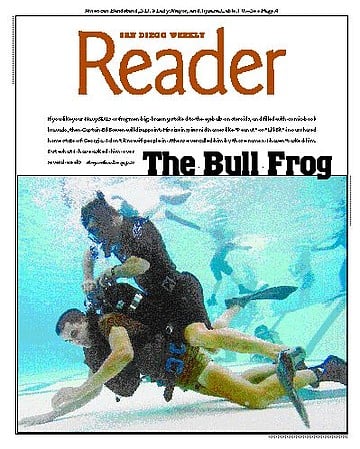
If you like your Navy SEALs or frogmen big, brawny, stoked to the eyeballs on steroids, and filled with comic-book bravado, then Captain Ed Bowen will disappoint. His size inspires nicknames like “Peanut” or “Li’l Bit” in our shared home state of Georgia. I don’t know if people in Athens ever called him by those names. I haven’t asked him. But what I have asked him over several weeks were tough questions about his new command, the Phil Bucklew Naval Special Warfare Center in Coronado, where the notorious Basic Underwater Demolition/SEAL (BUDS) course has devoured more than 5000 trainees during the past ten years and many more thousands since it started over three decades ago. As a measure of the training’s ferocity, only about 30 percent of those who enter its hellish arena survive to graduate and enter men’s houses known as “The Teams.”
But all has not been well lately at BUDS or within the special warfare (SPECWAR) community of some 2200 SEALs that depends on BUDS for new blood. Two highly critical Government Accounting Office studies in the early 1990s identified cruel and counterproductive practices that had resulted in serious injuries and unacceptable risk of death even in a Navy-sanctioned, high-risk environment. Two training deaths followed the GAO studies and — according to statistics provided by BUDS public affairs officer LTJG Tom Greer — the historical graduation rate of 30 percent plummeted to an abysmal 17 percent for the six classes that began training in 1999. Class 227, which graduated in February 2000, numbered only 10 of an original 88 men, for a grim survival rate of 11 percent.
What makes these figures particularly alarming — apart from the waste of taxpayer money — has been an unprecedented failure of former SPECWARr leaders to retain experienced SEALs during the past few years. The Teams have reached a manning crisis at the same time BUDS has experienced a meltdown of its reactor that generates new SEALs.
Enter Easy Ed Bowen, who took command of BUDS hard on the heels of the 1999 disaster and midway through the massacre of Class 227. Bowen arrived in his 34th year of active service that began when he entered the Navy as a teenager in 1965 to catch the flooding tide of the Vietnam War. Bowen graduated from what was then called UDT Replacement Training with Class 38 in 1966. He served three combat tours with SEAL Teams One and Two that brought him Presidential Unit Citations, Bronze and Silver Stars, and an officer’s commission. Bowen’s longevity in SPECWAR makes him the Bull Frog: the oldest SEAL presently on active duty. A recent holder of this title before his retirement was Rudy Boesch of Survivor fame. Although Boesch and Bowen express themselves in vastly different idioms, they share one overarching trait: what you see is what you get; neither man has a careerist or deceitful bone in his body. I come to this conclusion after having known and worked closely with both men during my own meager 16 years as a SEAL.
Captain Bowen and I meet in the center’s conference room for our second of several talks on the state of BUDS. That I’m meeting at all with the head of BUDS is noteworthy: over the years I’ve written articles critical of BUDS excesses and SPECWAR operational tragedies. The former SPECWAR leadership, therefore, had never in my ten years of reporting granted an official interview. I learned that if you didn’t have anything worshipful to say about America’s Roughest Toughest Meanest Mothers, then SPECWAR didn’t want you to say anything at all. But the new SEAL boss, Rear Admiral Eric Olson, and Captain Bowen have abandoned the old bunker mentality: they’ve given me — and consequently the public — extraordinary access to BUDS for this article.
Captain Bowen gets right to the point: “Look,” he says in a soft Southern voice tinged with an Appalachian twang, “I don’t have anything to hide. I’ve read your articles and I can’t find a single inaccuracy. There’s certainly a dark side to training and some of the things we do in the Teams. I’m trying my damnedest to do things right. I can’t explain all the sins of the past. Since I graduated with Class 38 I’d never had a tour at BUDS until I became commanding officer. Although I served in SEAL Teams One and Five not more than a couple hundred yards from here, I had no real idea of what went on in training. This place was like a black box to me that produced men for the Teams. And I was always satisfied with the product. I quite frankly was not concerned with the process. Now that I’m responsible for what goes on here I’m keenly concerned about the process. To that end, I’ve focused on the key relationship between instructor and student.”
Bowen’s use of terms such as “process” and “instructor-student relationship” reminds me that during his limited free time he is chasing a Ph.D. in educational leadership at usd. These abstract terms also remind me of a nasty, concrete example of the instructor-student relationship that took place a few months before Bowen arrived at BUDS. A retired SEAL and former instructor recounted the following incident to me. While a dwindling number of trainees (the old-fashioned word for students) were in the throes of Hell Week on a deserted beach opposite the A-8 Anchorage, an instructor ordered them into the 57-degree water of the bay for a round of what is known as “surf torture.” Although the surf was negligible, after 30 minutes or so the trainees were sufficiently “hyped” — suffering hypothermia — that they were prepared to do almost anything to end the pain. The instructor ordered them from the water and — as they stood trembling before him — said he would stop the torture provided they chose one of their number for a successful treasure hunt. The hunt, he explained, would be to find a treasure of “corn” and “peanuts” in the reeking pile the chosen would squeeze out on a piece of driftwood. Each trainee would examine the pile and sound off if he encountered a treasure. The trainees eagerly complied and to their great relief discovered enough treasure to satisfy the instructor.
I don’t have the heart to confront Bowen with this incident of which I’m certain he hasn’t a clue. I instead draw on an example from my own distant training past that speaks of this traditional fascination a very few instructors have had with bodily fluids and functions.
I recall an instructor for my class in 1966 who delighted in pissing on trainees during sneak-and-peek exercises as they crawled along the beach. I understand the practice had endured at least until two years ago. A corpsman who’d received the golden shower — photographed in living color — told me about it. I think he was in Class 210 or thereabouts. How does this manifestation of the student-instructor relationship strike you?
“Of course I don’t condone such ‘extracurricular’ activities. I don’t believe anyone in a leadership position here at BUDS would. The problem is finding out about these aberrations and stopping them. You probably know more about some things that go on here than I do. But our instructors for the most part are overwhelmingly professional, and while changes need to be made, what you describe isn’t the norm.”
Do you know about the first phase Hammer Award?
“Tell me about it.”
Students at the end of first phase select the instructor who has been the meanest sonofabitch, the one who has brought the most pain, and give him a trophy with a hammer mounted on it.
Bowen makes a notation on a pad in front of him and says, “That practice doesn’t appeal to me at all. That doesn’t fit my view of what SEALs are about or what instructors should be doing. The type instructor who exemplifies what I want to see is not the one students know as ‘The Hammer,’ but the instructor who, when the students are going on a five-mile swim, jocks up and goes with them. I want a positive instructor attitude — not an attitude that says, ‘I went through hell to become a SEAL and by God I’m going to make sure my trainees do the same.’
“My take on human nature is that no one is born good or bad but with a clean slate, a tabula rasa. It’s life experience that makes a man what he is. It’s up to us to build on what the trainee brings through the door. Some men are definitely not meant to be here, but I’m convinced the majority — not 30 percent — have the physical and mental abilities to complete the course. Our job is not to deselect until we have only those few students remaining who can eat the most shit, if you will.”
Bowen’s sudden use of profanity — so common in the Teams, even among some senior officers — is startling and all the more effective because he seldom curses.
“When I first got here,” he says, “I put out a little blurb on my philosophy and what I expected of staff. My opening lines went something like this: ‘The most important aspect of this center is the instructor-student relationship. That relationship is grounded in my fundamental belief that you lead by example.’ I’m not terribly impressed by the spectacle of an instructor standing on the beach with a bullhorn yelling at students to do things the instructor has not demonstrated a willingness and ability to do himself. I expect instructors throughout training to motivate in a positive rather than negative manner. And that includes Hell Week.”
When is Hell Week?
“Third week of first phase. Before first phase we have a low-stress, five-week workup period called Indoctrination. Here, let me give you an overview of training and the changes underway.”
We spend the next several minutes viewing a Power Point presentation on the familiar scheme for BUDS training as Bowen has amended it to reach his goal of an attrition rate of no more than 60 percent. He puts it in positive terms. “I see no reason why for every 100 students who enter the pipeline we can’t push at least 40 out the other end.”
The slides reveal that training, like Gaul, is divided into three parts. The first, or conditioning, phase lasts five weeks, during which a typical trainee day — except for Hell Week — looks like this: 0330 reveille followed by cleanup and preparation for inspection; muster at 0400 for mile run to combat-training tank and one-hour swim; 0515 to 0545, breakfast followed by run back to barracks for inspection; three hours of calisthenics and run after inspection with perhaps 45 minutes of class on such things as rubber-boat repair, first aid, or “core values” (no kidding). The remainder of the day until chow at 1730 is spent on various physical pursuits such as the obstacle course, ocean swims, log PT, and surf passage with seven-man torture chambers called ibss (inflatable boats small). Night exercises and cleanup often delay rack time for the trainees until past midnight.
Instructors swarm like killer bees around all this activity ready to light on any trainee who shows the slightest letup. The instructors do not lack targets and the sting of mass punishment follows swift and sure. Surf torture is favored.
What most strikes terror in the trainee during first phase is the prospect of Hell Week. This fabled rite of passage is an agonizing five-day gut check with virtually no sleep during which trainees must time and again, day and night, launch their ibss through freezing surf to paddle up and down the San Diego coast. When they’re not in the ibs they’re running 12-milers in their boots through soft sand, doing impossible numbers of push-ups, pull-ups, sit-ups, good morning darlings (leg openers), and just generally laboring at tasks that seem beyond mortal man. Most trainees who quit hang it up during Hell Week.
Captain Bowen has changed little of what goes on during first phase, at least through Hell Week. “This period,” he says, “is designed to select out those students who do not have the mental or physical toughness to be a SEAL. And let’s face it, not everyone who enters training is suited for the Teams. This is not to say we should think less of this person or that he should think less of himself. We’ll find that student useful employment elsewhere in the Navy. On the other hand, those who survive Hell Week should complete the course. And if a Hell Week graduate doesn’t complete the course I’m going to want to know why and will personally examine each case.”
C’mon, Ed. You know Hell Week is not the end of an instructor’s running shit down a trainee’s neck. Each phase has its own rite of passage to deep six those the instructors consider unworthy of the Teams. In second phase it’s pool harassment, and at San Clemente Island during third phase it’s the weapons practical test and obstacle loading.
“I’m aware of that and it will change. We’ve already done away with obstacle loading — who needs to learn about clearing WWII beach obstacles when what we got to worry about now are mines? And the weapons practical is no longer a reason to drop a student. The students will still have to demonstrate their ability to field strip and reassemble the Sig Sauer (pistol), M-4 (carbine), and the M-60 (machine gun), but failure — especially while on the clock — will simply be noted and remediated. This is not to say training will become a piece of cake after Hell Week: the student will still work under often exhausting conditions to learn what he needs to know in the Teams about how to shoot, move, and communicate. Training will be closely tied to operational requirements. As for pool harassment, which for obvious reasons we prefer to call pool competency, I invite you to come with me this afternoon and see for yourself what goes on. Like I said, I’ve nothing to hide.”
Bowen moves quickly through the slides covering second and third phases. Second, or dive, phase lasts seven weeks and prepares the trainee for ship attacks, harbor sabotage, and commando raids. Trainees begin diving with open-circuit, double-hose scuba, then shift to the rig the Teams use — a German rebreather manufactured by Draeger. Draeger is the same company that designed and built the plumbing for places like Belsen and Buchenwald. Or so instructors tell trainees. This little-known lore does not show up in the slide show.
Third phase is ten weeks of land warfare, with the final, nonstop five weeks at San Clemente Island, where the trainees learn patrolling, demolitions, and weaponry. The course ends with a series of field exercises. Many trainees believe the Island is tougher than Hell Week. I did.
Comparisons are odious but inevitable. I found first phase differed little from what Captain Bowen and I endured in the ’60s, except for a much greater emphasis placed on safety. (This emphasis now exists throughout BUDS, unlike in the bad old days.) Second phase is more complex today because the trainees dive a more complicated rig and must negotiate considerably more difficult underwater compass courses. Land warfare during third phase is light-years ahead of the little we learned about this crucial skill before we plunged into the cesspool of Vietnam. The reason for the improvement is simple: before Vietnam the instructors had little combat experience, with the notable exception of Korean War frogmen. But since Vietnam and the awful lessons learned there, BUDS has become about as good as it gets.
When the slide show is over, I ask the fate of what’s called the “roll-back policy,” which many SEALs, including me, believe has been indispensable for getting enough students through training to keep the Teams at least marginally manned. Captain Bowen and I had talked briefly about the policy earlier by phone. If a trainee is hurt or fails a required test he “rolls back” to the start of the phase, not to day one, week one.
When Bowen and I went through training, if you faltered either through injury or performance you went to the fleet where you were haze gray and underway for at least a year. I still recall a trainee in our class named “Deep Divin’ Diecks” who classed up with us two years after having been injured near the end of training. We marveled at the man and thought him mad. He made it the second time around, but I doubt he’s been the same since.
“We still have the roll-back program,” Bowen says, “but I’ve greatly reduced it.”
How can you do that and graduate 40 percent? Without rollbacks, Class 227 would have graduated 10 instead of 26.
I show the captain a photo of the infamous class divided into four groups: 10 from the original class, 12 from Class 226, 3 from Class 225, and 1 from Class 224.
He glances at the photo and says, “Class 227 is not a good example because the changes had not taken hold. First, we still have the program for medical rolls. That’s the same. But performance rolls are rare, because I want the emphasis to be on getting the student through the first time — especially after Hell Week. I want the student to graduate in 28 weeks, not 35, 50, or whatever. Heck, we’ve had trainees here for a year or more. BUDS is not an installment course.
“On the other hand, I’ve made it a lot harder to drop a student. Under the old roll-back program it was just too easy for instructor and student to disengage from training: the instructor would get rid of a leadership challenge or performance problem by rolling the trainee; the trainee would think, ‘Hey! I got two rolls coming! I’ll get it right next time.’ Now, everyone has to bear down. To this end, I’ve stressed that instructors are mentors, not hard-asses. Their job is to push trainees through with patience and motivation, not chase them out with screams or worse.”
Mentoring is not a word one associates with training.
“No, and attitudes developed across 30 years will not change overnight. But I’m determined to do my best. I’ve recently started a five-day course for instructors taught by an old frog, Retired Admiral Howard Roop, who teaches corporate leadership at usc. The admiral graduated with Class 7.”
Bowen tells me the course uses the case-study method to teach instructors how best to instill the key values of honesty, integrity, self-discipline, mental toughness, trust, and teamwork. I struggle not to laugh, but a smile creeps out.
“I’m dead serious,” Bowen says in a way to show he means it. “I know what you’re thinking: ‘Yeah, right. An instructor is going to teach the trainee about mental toughness by putting him face down in the sand and jumping up and down on his fucking neck.’ That’s how you and I got taught, but we have to change that attitude.”
How’s the case-study method going to drive the lesson home?
“Admiral Roop has several scenarios keyed to each value. He presents the scenario to the instructors and has them describe first how they would teach mental toughness to students having, for example, a difficult time on a beach run. An instructor might say something like ‘run the bananas in and outta the surf a few times hauling logs until they learn it pays to be a winner.’ Then the admiral guides the conversation until the instructors come up with something more progressive.”
Could I sit in on a scenario or two?
Captain Bowen looks truly troubled when he denies my request. “I’d like nothing more,” he explains, “than to have you go in there with the instructors and the admiral and just be a fly on the wall. But, well, given who you are I just don’t think that would be possible. We need the instructors to be completely honest and express their attitudes. Otherwise, we won’t have the opportunity to reason with them and show such attitudes may not be the best way to instill the values.”
Had much resistance to these sea changes?
With resignation playing across his face, Bowen replies, “Oh, sure. But I’m downright evangelical when it comes to the new program. I’ll talk to anybody anytime about the changes and why they’re necessary. I’ll talk to the board of directors — the captains and admirals in the community — the Teams, instructors, students, even old frogs and cynical SEALs like you.
“Of course a few people here at the center haven’t gotten the word, so we’ve had some ‘come to Jesus’ meetings, like when I learned about a practice called ‘hitting the slushy.’ ”
I thought I’d heard ’em all, but that’s a new one.
“For me, also. The slushy is a galvanized tub on rollers out at the Island that students fill every day with crushed ice. They wheel it to wherever training is taking place, like the rifle or demo range. If a student errs, an instructor orders him to ‘hit the slushy!’ This goes on all day…or it used to. I had the phase officer stop it. My policy is not to let punishment interfere with training. If a student makes a mistake, I want instructors to take him aside and mentor him — not stick him up to his neck in crushed ice.”
Did the instructors take that onboard okay?
“Most. I did get complaints that the slushy was traditional. I said: ‘I’m the Bull Frog and the authority on tradition. The slushy is not tradition. Get rid of it.’ ”
I thank Captain Bowen for sharing his policy and insights. We agree to meet that afternoon for pool competency.
To kill time before pool comp, I drop by the Café Madrid coffee cart in Coronado to knock back a double espresso or three. Sitting at a sidewalk table I go over notes and listen to the tape of an interview I did a few days earlier for an article on what it’s like to be young, married, and poor in the Navy. I interviewed the wife of an enlisted man who was also one of the happy few who had graduated with 227. We talked at the couple’s duplex in I.B.
Autumn Brown has shoulder-length hair, an expressive face, and a trim figure unusual for even a young mother of three. As she spoke about the challenges of making ends meet when her husband, Rodney, was a lowly E-1, she drifted into a painful recollection of his four attempts at Hell Week.
“Rodney classed up initially with 209 in July ’96,” she said, “and made it to Wednesday of Hell Week. He aspirated seawater and the doctor said it had eaten away a lot of lung tissue. They rolled him to 210, but that only gave him three weeks to heal and it wasn’t enough. When he started vomiting blood on Wednesday the doctor said the stress of training had revived the lung infection. Rodney rolled to 211 and that was the scariest experience. He made it again to Wednesday. Then he almost died.
“I didn’t find out he was at Balboa in intensive care until Thursday and then it was through dumb luck. I’d gone to the Amphib Base to see if I could catch a glimpse of him on his way to chow. One of the support people saw me and said Rodney had been hospitalized. It took another two hours of getting the runaround at Balboa before I finally located him. He had an oxygen level of, like, 60 percent with blood just saturating his lungs. He was hooked up to IVs and when he recognized me wanted to know where I’d been.
“Now, BUDS had an ombudsman who was supposed to let family know if a son or husband had been hurt. I was furious because no one had contacted me. I called BUDS to complain. They just brushed me off. Said it was the omBUDSman’s prerogative whether to notify next of kin if the situation wasn’t life or death. I’m sorry, but in my opinion if the Navy admits someone to intensive care then that’s a life-or-death situation. The people at BUDS didn’t want to hear it.”
What was Rodney doing between Classes 211 and 227?
“He left the Navy and we returned to Alaska. He stayed in the reserves and after two years decided to try training a fourth time. I was nervous, scared even, but if Rodney still wanted it then I wanted it for him. We had three children and if he finished training, the extra pay he’d get in the Teams would really help.”
This time he made it?
“Yeah, but he had some close calls that really worried us because the new CO shut down the roll-back program. When Rodney first told me about the change I saw his anxiety level on a scale of 1 to 10 shoot up like from 5 to 12.”
That may have been a failure to communicate. I’ve heard Captain Bowen hasn’t canceled the program — especially medical rolls — but has cut back on it to emphasize getting trainees through the first time.
“Well, all Rodney knew was that two classmates got dropped in third phase and had to start all over again — day one, week one. I felt really bad for him because he told me he just didn’t know if he had the mental or physical ability to struggle with Hell Week a fifth time. Fortunately, we didn’t have to find out.”
Did the ombudsman do a better job of keeping wives informed during 227?
“I never met an ombudsman. Don’t think there was one. When Rodney passed out and fell face down on that slab of concrete they call the grinder, I found out about it from another trainee. Rodney had several stitches to sew up his face and they almost dropped him.
“I’ll tell you something else that didn’t thrill me either, although Rodney will probably get mad. We spent a lot of money on plaques, presents, and booze for the instructors. It was always something: $30 for this, $40 for that, $50 to buy kegs for the instructors. Third phase alone cost us close to $600. Sure we’re making more money now that Rodney’s an E-5 petty officer, but we also have three kids. The amount of money we paid for everything was just ridiculous.”
That’s a big change from when I went through training in the ’60s. We didn’t buy the instructors anything, and I think the Navy paid for our graduation party.
Autumn laughed. “Oh the parties!” she cried. “Every time I turned around the class was having a party: a class-up party, a party to begin Hell Week, a party to end Hell Week, a phase party, a graduation party. Parties galore!”
Autumn warmed to the task as she recalled the hemorrhaging of money all this frivolity caused. “I remember parties with nothing but kegs of expensive beer. No food, no sodas, just kegs of Heineken. I’d have to walk from the beach back to the BUDS main building to find a soda machine.”
Were these phase parties?
“These were all parties. I never saw anything but booze. Like the graduation party at McP’s in Coronado. You paid $20 or so, and all it bought was beer. Some food might have been available at first, but it was gone by the time we got there.
“I complained to Rodney. I mean, when the class went to the Island for third phase, they had to buy, like, eight kegs for the instructors. I told him, ‘I’m sorry, but I don’t care if the instructors want eight kegs. I’m not sure I want you hanging around a bunch of drunks with demolitions.’ ”
Well, in fairness to the instructors, I’m certain they keep their partying separate from the demo work.
Autumn laughed. “I’m sure they do. I was just burned about paying so much money for booze. But all’s well that ends well and Rodney couldn’t be happier. Which makes me happy.”
Hoo Yah. If you could make one change at BUDS, what would it be? Fewer kegs?
“No, I guess that’s just the Navy. I would most like to see BUDS appoint a caring, responsive ombudsman who would make sure wives, girlfriends, and families know what’s going on and especially make sure they know if someone they love is injured.”
I meet Captain Bowen at the center and we drive to the combat-training tank on the bay, or dry, side of the base across Highway 75. During the ride I tell him of Autumn Brown’s complaints.
“I share her concerns and have others as well. Students must spend far too much of their own money — and not just for parties, plaques, and presents. Laundry has been a big expense, particularly for unmarried students. Too many uniform inspections were the cause. Fail an inspection and the student would have to hit the surf, which meant he’d have to break out a new set of greens for the next day. I stopped most of these inspections. Now instructors check student uniforms only on Mondays. Uniforms do not have to be starched. No one fails if his uniform is clean and pressed.
“Another unnecessary cost for students has been buying food supplements and over-the-counter medications. My medical department can provide those items free. Some students don’t think what we provide is as good as they can buy from a pharmacy — expensive ointments, for example, that students believe will prevent and heal chafing. I’ve told medical to find out what the students want and get it for them.”
The merchants will not be pleased.
“So be it. As for the parties, there’s not much I can do about that if the class decides to have them. I tried to get the Navy to pay for the cake, cookies, and punch at graduation ceremonies, but legal told me that would be against regulations. I’m not sure why, but you know how lawyers are.”
Uh-huh.
“Kegs for instructors is news to me. I’ll have to check and get back to you on that. BUDS does not have an ombudsman, but I’m presently searching for someone to fill that critical position. I personally call next of kin if a student is hospitalized. In fact, I called a father recently with the bad news his son had back and neck injuries after he fell from the slide for life on the obstacle course. I live every day with the concern and fear one of my men — instructor or student — may be hurt. I make sure family members know exactly what has happened if someone is seriously injured. I’ve also arranged to fly parents out here if necessary. When I’m not around, my executive officer, Commander Rick Bernard, does the calling. A BUDS doctor calls to explain the medical aspects. Our chaplain is available.”
We’ve arrived at the combat-training tank, which is enclosed by a high opaque fence to thwart the curious. The tank is somewhat misnamed: it’s an oversized Olympic pool that drops off from 4 feet at one end to 15 feet at the other. As we enter the enclosure I see pool comp is underway. Trainees with scuba crawl along the pool bottom. Instructors snorkeling without scuba hover above, ready to flash down like sharks to tear at fins, face masks, weight belts, and air hoses. The gao report described the looming mayhem like this:
Instructors knock off masks and fins, crimp or tie knots in air hoses. No safety observer is nearby to provide oxygen in an emergency. Students [sometimes pass out] from lack of oxygen. Diving and medical authorities view this as dangerous because it can lead to drowning or air gas embolism [air bubbles forming in the blood of a diver who ascends without exhaling the compressed air in his lungs. These bubbles lodge in arteries and block blood that carries air to the brain]. Secondary dangers include pneumonia and pulmonary edema.…
That only one trainee has died in the pool since the start of BUDS is testament to the instructors’ ability to take trainees to the edge and then yank them back. I’ve been told hardly a class goes by without trainees passing out on the pool bottom — sometimes losing control of their sphincters.
Despite the possibility of fatal or near-fatal consequences, all seems tranquil as we stand on the deck and gaze across the water. I find it strangely soothing to watch and listen as shimmering globes of air from exhalation hoses rise to roil the surface with the burbling murmur of a backyard Jacuzzi. The pleasant sound belies the tension and sometimes terror that is surely taking place below the bubbles.
Two officers approach and Captain Bowen introduces me to the head of second phase, Lieutenant John Morris, and the overall director of training, Lieutenant Commander Stephen Wisotzki. Both men are as lean and fit as the long-distance runners they probably are. I ask LT Morris about the dangers of pool comp.
“We have safety procedures all instructors follow and supervisors who constantly monitor what’s going on. Our reaction is immediate if a dangerous situation develops. We have a very good safety record — especially for high-risk training.”
What about air gas embolisms?
A slight pause, then: “I’m not going to mislead you. I’ve had seven or eight embolisms during my two years here and I don’t want to see another. We’re geared to rush the student into a recompression chamber, but you just never know what the outcome will be. We’ve been lucky and good so far.”
I ask LCDR Wisotzki about the high failure rate for pool comp: I understand Class 227 had 20 failures out of 27 trainees, although most passed on their last of three tries. And the class included D-1 college swimmers who were pretty comfortable in the water.
“As I’m sure the captain has told you, we’re putting more emphasis on teaching the student what to expect before pool comp. We now do dirt diving with wooden bottles before the students hit the water. And we give them several attempts over three days to get it right. This reduces a lot of the anxiety.”
As we talk I notice LT Morris and LCDR Wisotzki continually scan the water on the lookout for a trainee shooting to the surface or collapsing on the pool bottom. Perhaps sensing we’re distracting the officers, Bowen suggests we go to a viewing area beneath the pool.
Through pressure-proof windows we watch a kind of balletic chaos playing out in slow motion. At center stage an instructor rides the back of a trainee as he yanks the trainee’s mouthpiece loose and ties a Gordian knot in the inhalation hose. No air. The trainee begins the anoxic process of saving himself by ditching his air bottles.
Across the pool bottom another trainee completes the task of untying his knotted air hose, donning his bottles and weight belt, and giving a thumbs up to the instructor. The instructor returns the sign and the trainee slowly surfaces. Cheated death again.
Off to my left I see a trainee without his bottles kiss the bottom of the pool to show the instructor he is lucid and ready to free ascend. The instructor, dissatisfied with the kiss, grabs the trainee’s neck and shoves his face into the concrete. I see a pink blossom bloom around the trainee’s nose and then dissipate as he heads for the surface, exhaling all the way.
Bowen studies another trainee off to the right who is methodically handling all the instructor has thrown at him for the past several minutes. The trainee has ditched and donned his gear, but the instructor does not signal him to the surface. Instead the instructor again turns off the trainee’s air, tears off his mask, and releases his weight belt.
The trainee ignores the face mask and weight belt as he works his hands back along the hoses toward the manifold behind his head where the air valve is located. The trainee lifts his hand from the inhalation hose about halfway back and grabs the valve. Half-turn to the left and he has air. But the instructor shakes his head “no” and orders the trainee to surface. The trainee has failed but we don’t know why. Bowen says: “Damn! That’s a good kid. I’ve been watching him. I don’t know what he did wrong.”
Bowen abruptly leaves the viewing area and goes topside to talk with LT Morris. I trail behind but do not eavesdrop. I notice, however, that a senior instructor has called the trainee to the side of the pool and is patiently demonstrating how to work his hands all the way along the hose to the valve. Mentoring at its best. Bowen seems pleased.
On the way back to the center we discuss how pool comp has changed.
In the old days it was a lot simpler. You either panicked and failed or didn’t and passed. We dreaded pool comp but didn’t lose many trainees because of it.
“Well, we’ve been dropping or rolling students far too often in recent years — some for supertechnical reasons like you saw today without giving the student extra instruction. But with the new emphasis on preparing and mentoring the student, the success rate for pool comp is way up.”
We reach the center and Ed drops me off in the parking lot. He says as I get out: “I’m going to the Island next week to watch 228’s final field-training exercise before graduation. Want to go along?”
I eagerly accept, because the center has a policy against allowing reporters access to San Clemente, where a lot goes on. I’ve heard the policy against reporters stems from a media circus a few years ago when that aging Barbie doll Paula Zahn descended on the Island. Paula and her entourage demanded staged events for a TV extravaganza that disrupted training.
The friendly and ever-efficient BUDS public affairs officer, LTJG Tom Greer, calls and tells me the trip to the Island is on for the following week. I’m to meet Captain Bowen at the North Island air terminal for the short flight aboard Evergreen Airlines to San Clemente. Berthing and messing are on the Navy, but I pay 176 bucks for the flight.
In the meantime I contact an old friend and longtime source to hoist a few cool ones at the Plank in I.B. We’re going to talk about Easy Ed Bowen and his cosmic revamping of training. My friend, whom I’ll call Jake, has known Bowen longer than I have. Jake is retired but continues to do piecework for special warfare, as do many old frogs and SEALs. The Teams are a gift that keeps on giving. Jake was a former instructor, and his contract labor keeps him close to the pulse of BUDS. We sit at an outdoor patio off the bar area. The sound of surf drowns out the pulsing music of a Technicolor jukebox in the bar turned up too high.
So what’s the word from the mess decks about the old man’s sea changes?
Jake pulls at his long-neck Corona and replies: “The higher up the chain of command you go the stronger the support. But there’s discontent among some of the troops. Their attitude is: ‘We’ve seen reformers come and go and nothing changes for keeps. We’ll wait the old man out. He’s only got two years, and when he’s gone things will return to normal. Training ain’t never gonna get easier.’ I even heard a delegation went to him and complained, said they wanted to give him some ‘feedback.’ The captain listened, then said, ‘That’s not feedback, that’s whining.’
“What really pisses some guys off is the captain’s emphasis on leadership by example.” Jake giggles. “I mean, let me tell you about the run the captain went on with a class during Indoc. He shows up unannounced ready to join a few instructors and the trainees for an easy four-miler down to the North Island fence and back. No big deal. Lots of COs do that. What they don’t do is what Bowen did at the end of the run. He asks the instructors what’s next and they tell him it’s time for the trainees to hit the surf and cool off. Bowen says, ‘Fine. Let’s all hit the surf and cool off.’ So in everybody goes. I mean, can you imagine what a case of the ass those instructors must have had getting surf tortured with the trainees?”
Jake’s giggles turn to laughter. He laughs so hard he blows beer bubbles through his nose.
Jake wipes the beer from his face and continues. “Another time the captain shows up on deck after pool comp and notices trainees in the deep end treading water without using their hands. They’re in full gear including weight belts. He asks why this added exercise after a tough day of pool comp. Just a little competition, he’s told. The trainee who treads water for five minutes can secure.
“Now, trainees have a nasty habit of passing out during this competition and shitting themselves. The captain says he never had to tread water like this when he went through training. Says he’d like to see how many instructors can do it. One or 2 out of maybe 12 can hack it. So Bowen says no more treading water with gear on for the trainees after pool comp. Lead by example.
“Let me tell you something else: Captain Bowen is just like Charlie.”
How’s that?
“He don’t surf.”
Meaning?
“When the captain goes to the beach it’s to check on trainees and instructors, not to see how the waves are forming.
“I also heard the captain is going to crawl through the mud in the demo pit with the next class to secure Hell Week. That oughtta be something.”
Christ, the instructors fill that slime with roadkill: skunks, rabbits, snakes, cats, dogs. Hope Ed’s tetanus shots are current.
“Yeah, and consider how absolutely humble the guy is to do something like that. I mean, senior officers too often wall themselves off from the mess decks, to say nothing about trainees, who are lower than whale shit.”
Bowen is almost Zen-like with his absence of ego, which is all the more remarkable given the distorted egos you sometimes find in our so-called community. I think I’ve heard him tell maybe one very low-key war story and not one about his own training. Plus his official bio doesn’t list his Silver and Bronze Stars or Presidential Unit Citations. Doesn’t list any medals.
“How special is that in special warfare? I’ve never heard him talk about his own training either, but I’ve heard him tell a few interesting stories about when he was leading those broke-dick VN mercenaries for the cia in the U Minh Forest.”
An evil wood if ever there was one.
“You got that right, mate. The captain said he had to pay close attention to what the mercs were up to. Said he inspected them every time they left a village to make sure they didn’t expropriate anything. Once he saw a feather sticking out of an M-60 ammo can. He ordered the merc to open the can and there was a live duck stuffed inside. You know how small those ammo cans are. But somehow this VN got a whole goddamn duck in one.”
Ed told me about the time he and his SEAL Two platoon recovered bodies from a downed helo. He said of all the missions he had in-country this was one of the worst — hauling those putrefying bodies of his warrior brothers out of the mud and blood of the paddy. After that the SEALs had to blow the helo in place but didn’t have caps for the demo haversacks. Said they used fusing and caps from their hand grenades, then ran like hell after pulling those five-second delays.
“Know what I’ve noticed? Guys like the captain from the Vietnam era who saw a lot of combat almost never talk about training as if it were the be-all and end-all instead of just the beginning, just the schoolhouse. On the other hand, Vietnam-era Team guys who had little or no combat run their mouths constantly about how tough training was and tell story after story. Guys like Jim-Jesse Janos-Ventura.”
The hyphenated special warrior? The UDT-SEAL?
“The very same.”
We laugh and bang our beer bottles together. The bottles sound a satisfying clink.
I join Captain Bowen at North Island, and within the hour our flight is wheels down on San Clemente Island — home to the third and final phase of BUDS. As we roll into the chocks near the small terminal, FA-18s shoot noisy touch-and-goes on the active. No nimbys out here to threaten military readiness.
Chief Warrant Officer Jim Locklear meets us in a four-wheel-drive pickup for the short trip to Camp Al Huey at Northwest Harbor. The camp is also known as “The Rock.” Locklear runs training on the Island and is a former Marine. Although he doesn’t quite wear his hair high and tight, he has the squared-away bearing of someone who’s been in the Corps. A good example for the trainees.
The first question Bowen asks is, “What’s the water temp?”
While Locklear gives a toasty warm figure and talks about the coming field-training exercise (ftx), the ghost of Petty Officer John J. Tomlinson haunts me. Tomlinson was about to complete BUDS in 1988 when he died of hypothermia on a 5.5-mile swim off San Clemente not far from our location.
When I read the investigation report of that death, my blood ran as cold as the 57-degree water that killed Tomlinson. A senior Navy officer who was not a SEAL wrote the report. He found that trainees on the swim wore only a wet suit top and hood. He cited Navy exposure tables that required a full wet suit for even short-duration dives in less than 60-degree water. The investigator determined Tomlinson had been in the water nearly four hours when he lost consciousness toward the end of the swim at Northwest Harbor.
Instructors pulled the comatose trainee from the ocean and hurried him to a recreational sauna, where they ran the temperature up to rewarm Tomlinson. They also called for a Medevac helo. San Diego was only a 30-minute flight away, but no helo was immediately available. Tomlinson, fast slipping away, arrived at ucsd Medical Center about two hours after the first distress call. During the flight, the corpsman attending Tomlinson could not communicate with the pilots over the engine noise. The pilot could therefore not relay crucial medical information while inbound to the hospital. John J. Tomlinson died at UCSD without regaining consciousness.
The investigating officer noted this was the only death among some 2000 trainees who had completed the swim since 1966 but failed to recognize that the distance for many years had been only four miles. He did note, however, that two trainees on much shorter swims had been pulled from San Diego Bay in hypothermic coma during the three years preceding Tomlinson’s death. The most recent incident had happened three months earlier, in January 1988. Instructors had rushed both trainees to the emergency room at Coronado Hospital, where doctors revived them.
The SEAL admiral who reviewed the investigation report, Chuck LeMoyne, refused to accept the investigator’s implication that BUDS had not provided Tomlinson with enough rubber for the cold water. The Navy tables, he said, were for divers and not surface swimmers.
LeMoyne also minimized the incidents of the hypothermic trainees who almost died in the bay. He said those incidents differed substantially from “the circumstances of the case at hand.” But he added that these incidents were “relevant to demonstrate…hypothermia must always be considered in ocean swims.”
As a former trainee, LeMoyne must have learned that instructors are lay experts on the effects of hypothermia. They’ve always used hypothermia to torment and test those in their charge.
We’ve arrived at “The Rock.” The camp is a collection of squeaky-clean buff buildings arranged around an equally clean grinder — the SEAL term for what might otherwise be called a parade ground. Old Glory flaps in a constant wind that blows by the flagpole anchored in the center of the grinder. The buff buildings have color-coordinated blue metal roofs. Martha Stewart would be pleased. The compound overlooks Northwest Harbor and the Pacific less than 200 meters away. The place could well pass for a Club Med. But we know differently.
Captain Bowen tells me the camp was built in the early ’90s at a cost of about $3 million. When I suffered through my five weeks on the Island, we slept in wooden shacks with wire-mesh screens. The shacks, or “hooches,” were set on concrete slabs. All the rest was sand. Trainees shared a single, cold shower and a few outdoor shitters. But what the hell? We weren’t in camp all that often anyway.
Bowen and I stow our gear in spacious officer quarters complete with phone and TV. Then he shows me around. We start the tour at the medical building, where the treatment room is dominated by what looks like an enormous hot tub. “This,” the captain says, “is our rewarming pool. Medical can immerse a hypothermic trainee in carefully controlled 104-degree water to return his temperature to normal.”
You mean you don’t just toss the guy in a sauna, crank ’er up, and hope for the best?
Bowen laughs. “No, that’s not the way we do it.”
That’s the way it used to be done.
“I didn’t know that.”
Trust me. Any other measures to prevent and treat hyped trainees?
“We no longer have the 5.5-miler out here. Several years ago we moved the swim off the Strand between Coronado and I.B. Our doctors and corpsmen are always on hand when students are subjected to prolonged immersion in cold water. Medical staff monitor core temperature and check for other signs of hypothermia. If a student is hypothermic he’s removed and treated. We also have cold-water exposure tables to determine if students need full wet suits on swims, but I’m not satisfied with these tables. We still have too much hypothermia. I’ve asked Navy physiologists at the Point Loma lab to reexamine the tables.”
As we walk from the rewarming pool a thought intrudes: If Ed Bowen had been CO in 1988, Petty Officer Tomlinson might be alive today serving his country as a SEAL. And if someone like Ed Bowen had been in charge of the Army’s Ranger School a few years ago, maybe the four men who died there of hypothermia would still be alive. Ifs and buts…
We next inspect the comfortable trainee barracks complete with washers, dryers, and plenty of hot-water showers. We look in on the instructors at their recreation bungalow. The bungalow, which is called the “Hell Box” after the name of an old-fashioned tnt detonator, is equipped with pool table, fridge, microwave, and a big-screen TV that gets more than 300 channels. The film library is well-stocked with movies for all tastes. A trainee does not want to be summoned to the Hell Box. If he is, it will not be to watch TV.
We check out the chow hall, which serves two entrées and has milk, ice cream, and soft drink machines, a fruit-and-salad bar, and a machine that brews boiler-room coffee ’round the clock. Captain Bowen cuts the tour short to link up with Mr. Locklear for a visit to the outlying pistol, rifle, grenade, and demolition ranges. We also visit the target for tonight’s ftx. The target is about two miles from camp on a small bluff overlooking a large offshore rock that resembles a castle. The target area appears to have been a radar-tracking station of some sort. The area is spotted with make-believe scud and sam missile launchers. A few hastily built wooden hooches and disabled vehicles complete the scene. The vehicles are ventilated with hundreds of bullet holes. The ftx uses live fire — a harrowing but necessary reality I did not have to face until I’d become a SEAL. Another quantum leap for land warfare training.
We return to camp, eat, and settle in for the briefing to see if Class 228 has their poop in a group for the ftx. The room is tiered like law school classrooms. The patrol leader and his assistants use maps, a sand table, and Power Point to cover their five-paragraph order. In the old days we briefed off a picnic table and used a portable blackboard to display our plan. Christ, how did we ever survive Vietnam? Those of us who did, that is.
The concept of 228’s operation is straightforward, as all SEAL ops should be. The kiss (keep it simple, stupid) formula never goes out of style. The 20-man class will be divided into scouts, security, base, and maneuver elements. They will insert by swimming in full combat gear across the beach from boats anchored 500 meters offshore. They will patrol to an objective rally point near the target and prepare for the assault. At the target, the base element will lay down fire with their M-4 rifles. On signal, the base element will shift fire and allow the maneuver element to assault the target. Once the area is secured, the demo men will place haversacks on the missile launchers. They will pull double-primed, 15-minute delays and yell “I see smoke!” when the fuses ignite. The trainees will then withdraw through what they call “outs” marked with green kem-lites. Once they’ve cleared the target area, the trainees will form up and patrol back to camp. Instructors may ambush the patrol at any time.
So far so good, I thought. We’ll see how the practical work goes tonight, especially the live fire. Even experienced SEALs sometimes shoot and even kill each other during these exercises. The trainees will be using .223-caliber rounds in their M-4s. Although not much larger than the .22-rifle bullets boys and girls use when they learn to hunt squirrels, the .223 can have a devastating effect: the round is designed to tumble, tear, and shred when it strikes flesh.
I once saw the results of a single .223 round that had entered the buttocks of a 19-year-old pregnant woman. Within 15 minutes she and her fetus were dead after the bullet had ripped through intestines, umbilical cord, veins, arteries, ganglia, and God knows what else. We were supposed to capture the woman, who was the leader of a VC youth group. When she ran, a SEAL in my patrol chased her. He said he’d stumbled and fired accidentally. Anyway, the woman was wearing a Ho Chi Minh medal around her teenaged neck. I think one of us kept the medal as a souvenir.
As I meander down memory lane, Captain Bowen talks with the trainees and huddles with instructors. I wander toward the beach and watch the remains of the sun slip beyond the Pacific. The beach is littered with what we used to call “Jap Scullys.” The scullys are pyramid-shaped concrete blocks with iron pipes, or horns, jutting out. The Japanese placed scullys in the surf zone to impale our landing craft during the Pacific campaign. The original frogmen trained to locate and destroy these obstacles with demolitions.
Before Bowen removed scully demolition from BUDS, trainees feared this exercise more than pool comp. And for good reason. Instructors would sometimes place the scullys in much deeper water than the Japanese ever did. Trainees had to free dive and load these obstacles with 20-pound haversacks. Sometimes the trainees would pass out from lack of oxygen and float belly-up to the surface. Sometimes the trainees wouldn’t make it. Two men named McCall and McGaughen in Class 42 became tangled in a buoy line marking a scully and drowned with their faces inches from the surface. McGaughen repeatedly slashed himself and his buddy with a K-bar knife in a flailing attempt to cut the line. Instructors made their classmates recover the mutilated bodies. The next day was to be business as usual until a trainee named Bob Kerrey told the instructors the class was standing down to mourn.
Much more recently in 1996 a trainee would have suffered the same fate as McCall and McGaughen if an alert instructor named Matt Goodrich hadn’t risked his life to free the unconscious trainee from an entangling line. Goodrich received a medal for his heroism. A year later the admiral responsible for the present SEAL manning crisis was hounding Goodrich out of the Navy, despite Goodrich’s heroism and outstanding 12-year career that included combat deployments to the Gulf and Somalia. But the ordeal of Petty Officer Goodrich is another story for another time.
Last light. The trainees line up at water’s edge for a final gear inspection. Two instructors work their way down the line to make sure the trainees have the right equipment ready for use. Ed Bowen and I observe off to one side. The instructor closest to us, Petty Officer John Wiedmann, checks knives, flares, radios, and other combat gear appended to the trainees. His approach is thorough but good-natured as he corrects mistakes and makes adjustments. He wears a bush hat, as SEALs have worn in the field since Vietnam. He has camouflaged his face like the trainees with green and black grease.
The other instructor working on trainees farther down the line wears a ball cap and no camouflage. He’s yanked a trainee out of formation and has his foot on the trainee’s neck while the trainee does push-ups. Bowen frowns but remains silent.
We don’t see Class 228 again until around midnight at the target area after they’ve positioned themselves for the assault. To prep the assault, the base element decorates the darkness with red tracers from their M-4s. As the tracers dart over the ocean toward Castle Rock, I recall tracers of another color decorating the darkness of another country.
The instructors tightly control when, where, and for how long the trainees shoot their weapons. We have no mistakes and no instances of what SEALs call “blue on blue,” or casualties from friendly fire. Cheated death again.
The haversacks go high order precisely 15 minutes after the fuse pullers have shouted “I see smoke!” By then Class 228 is headed back to camp for the last time, only a week from the end of their long ordeal. The instructors ambush them with a grand finale as they enter camp. Instructors launch multicolored flares into the night sky from the deck of the Hell Box and fire long bursts of machine gun blanks. Festivity is in the air. The event has the feel of a fireworks show after a Padre game.
The next morning I’m on the grinder waiting for Captain Bowen to begin our trip home. Trainees amble about after a leisurely breakfast and engage in various chores. Many are undoubtedly looking forward to the phase party tonight with all that expensive beer Autumn Brown detests.
I talk with several trainees to get their take on instructors. I’ve done the same with members of Classes 225, 226, and 227. I’m conducting an informal poll among trainees to learn which instructors are mentors first and hard-asses second. Among the names I’ve heard most often are instructors Ekoniak, Stearns, Wiedmann, Hall, Deal, Rodriguez, Soland, Locklear, Perez, Burns, Lee, King, Peterson, Favero, Rhodes, Rector, and Nielson. The trainees can’t think of any instructor who was just a hard-ass. I attribute this to the Stockholm syndrome.
Captain Bowen shows up and Mr. Locklear takes us to the airfield for our flight. During the flight we talk above the drone of the engines. I tell Bowen he may be mistaken about his changes not taking hold during Class 227 and I certainly saw change at work during the ftx for 228. Bowen asks me what I know of 227. I tell him the story of the trainees who couldn’t shoot straight.
Class 227 had to fire qualifying scores with the Sig Sauer pistol at the Island. Four trainees couldn’t hit the broad side of the proverbial barn. Rather than throw them in the slushy, an instructor named Stearns took the trainees aside and gave them 30 minutes of patient work on such key factors as front sight focus, measured breathing, and trigger squeeze. All trainees qualified and three earned the coveted expert badge.
The same trainees said the proctor for 227, Petty Officer Ekoniak, gave individual instruction and encouragement throughout third phase. “Econ,” one trainee said, “only beat us once, but we deserved it.” A beating in trainee parlance refers to a series of seemingly interminable physical exercises often punctuated by episodes of surf torture or otherwise getting “wet ’n’ sandy.”
After I tell Bowen what I’d learned from 227, I change the subject and ask what it had been like to lead cia mercenaries on ops in the U Minh Forest. The mercenaries were for the most part Vietnamese thugs recruited from prisons and former VC. The cia organized the mercs into a force with the benign-sounding title of Provincial Reconnaissance Units, or PRUs. The CIA paid the PRUs for verifiable results on a bounty system. How results were verified depended on the tastes of those in charge. Enlisted men from SEALs and Army Special Forces trained and led these units that operated independently deep within areas controlled by VC and NVA. The movie Apocalypse Now drew upon real and imagined exploits of PRUs.
“PRUs,” Bowen says, “were a peculiar bunch. If they respected you, they would go most anywhere you led. If not, you wouldn’t last long. I saw my team chief do something once that seemed to sum up the pru mentality.
“We were walking out of a fortified hamlet in the U Minh — one of those settlements surrounded with stands of bamboo and thorn bushes — when the chief stopped the column. He’d noticed a beautiful yellow-and-blue songbird trapped among the thorns. He carefully reached in and freed the struggling bird. He held the bird lightly in his hand and stroked it. The bird stopped struggling and nestled deeper into the chief’s hand. Then the chief drop-kicked the bird in an explosion of blue and yellow feathers. The prus laughed like crazy. A very strange bunch.”
Not long after I return from the Island I stop by the training center at the Amphib Base to talk with Commander Rick Bernard, who is Bowen’s executive officer, or XO. I served with Rick during the late ’70s in Underwater Demolition Team 11. Rick was enlisted at the time and had just graduated BUDS as honor man for Class 98. We meet in his office overlooking the grinder, where instructors put trainees through daily burnout PT.
Although he’s come a long way in rank, the XO is still built like a downsized nose tackle. He is affable yet decisive. Perhaps he picked up some of his decisiveness while he was an exchange officer with the elite German commando unit, Der Kampfswimmers.
Rick recalls the first time we met at a kegger on Gator Beach after a monster mash: three hours of run-swim-runs enlivened with a tour through the obstacle course and log PT. “You asked me what an honor graduate was doing in an Underwater Demolition Team. Said I should be in SEAL One. I told you I’d always wanted to be a frogman and not a SEAL.”
What did I say?
“You laughed and welcomed me aboard. Said I’d be a SEAL sooner or later. You were right.”
Rick pulls a photograph from his desk drawer. The photo is of his UDT 11 platoon. I recognize most of the men including the platoon leader, Bill Davis, who would later lead one of the most daring and successful SEAL missions ever: the rescue of Governor General Scoon during the Grenada invasion. I also recognize Ken Butcher, who would die in a botched, needless parachute jump at sea off Grenada.
I hand the photo back and ask the XO how special warfare has reacted to Captain Bowen’s innovations.
“Admiral Eric Olson, who is in charge of all SEALs, supports the captain 100 percent. The commodores and commanding officers are onboard as well.”
I’ve heard some lower-ranking officers and senior enlisted men are less enthusiastic. They believe training is getting easier.
“We’ve had our doubters and critics, but the captain has been very good about explaining the reasons for change.” The XO pauses. “We’ve offered other employment for those who just can’t see the light.”
I thank Rick for his time and leave. Good XOs are always busy.
Just as I’m ready to wrap up, the story swerves from its comfortable progression toward a happy ending when I receive a late-night phone call from an active-duty SEAL closely associated with BUDS. He tells me he’s heard I’m writing a glowing account of Bowen’s changes because I’ve been given such wide access to training and because Bowen used to work for me. He wants to ensure the article is balanced and contains another side to the story. We agree to meet at a downtown coffee shop and I accept his condition that I not use his name. I’ll call him Joe.
Joe is the usual fit specimen who wears a muscle T-shirt that shows off the guns of a weight lifter. He’s been in the Navy for several years and seen duty in hot spots around the world. Joe doesn’t mince words: “What Captain Bowen is doing is crazy and violates all rules of leadership.”
Joe is particularly critical of what he calls the captain’s “snapshot” approach whereby Bowen shows up unannounced at a training evolution, takes a quick look at what’s happening, and steps in on a trainee’s behalf to overrule an instructor. This undermines the instructor’s authority and credibility. Joe says instructors who work with trainees daily over several weeks are in a much better position to judge performance and failings than Captain Bowen with his “snapshot.”
Joe adds that Bowen has devastated morale by “spying” on instructors. “The captain tells the instructors he’s going to leave but hangs around behind a building or something to check them out. Once an instructor saw him lurking behind parked cars to watch trainees on the obstacle course.”
I suspect I know why Bowen is concerned about the “O” course: two trainees have recently fallen from the 30-foot slide for life and been hospitalized — one with cracked ribs and another with partial paralysis from which he eventually recovered. The slide for life is near the end of a course that assaults the upper body, and especially the arms, with such torments as the cargo net climb, the high wall, the low wall, the skyscraper, the monkey bars, the belly robber, and the dirty name. Bowen suspects an instructor may exhaust the trainees with a few hundred push-ups before they even begin the gauntlet. He believes this practice may have contributed to the falls from the slide for life.
Joe also tells me the new deal at BUDS allows students who are safety risks to continue training. “I heard about two students who shit themselves during pool comp but weren’t dropped. Now what does that tell you?”
That they stayed down too long trying to untie knotted air hoses, passed out, and lost control of their sphincters?
“Nope, it shows they shit themselves because they were scared. I checked with a doctor. Don’t want people who shit themselves like that in the Teams.”
But what angers Joe and many others most, he says, is a two-page instruction Bowen has published that defines the student-instructor relationship. Joe gives me a copy and I see he’s circled two of the most offending paragraphs. The first prohibits instructors from punishing students except through the chain of command. This means no more unauthorized surf torture, lengthy calisthenics with Draegers on just before a dive, or push-ups before the obstacle course. Instructors will write chits to document performance and attitude lapses. A student with a given number of chits will appear before a review board to determine his fitness to remain in training.
I recognize this procedure from my days at Army Ranger School three decades ago. Ranger School is the Army’s nine-week, nonstop gut check at Fort Benning, in the Appalachians of north Georgia, and through the swamps of the Florida Panhandle. Unlike BUDS instructors, Ranger lane graders never mete out physical punishment: they award demerits instead. Get enough demerits and you don’t earn the Ranger shoulder tab. The distressing thing about the Ranger demerit system is that you don’t know for sure until the end of the ordeal if you’ll get the tab. Many SEALs disdain Ranger School, but it gave me all I wanted and more.
The second circled paragraph of the controversial instruction prohibits “negative reinforcement” after Hell Week and emphasizes “Instructors will utilize positive reinforcement for post–Hell Week students to enhance the learning environment.” What Bowen has done here is follow the lead of Army Special Forces and other elite units such as the Australian Special Air Service: he’s established a de facto selection process that ends after Hell Week when the operationally oriented phases kick in. I mention this to Joe.
“Some selection process,” he says. “You can’t judge for sure how mentally and physically tough a trainee is after 13 days: that’s how long it is from the start of training until the middle of Hell Week. Instructors have been told to lay off trainees after sunrise Wednesday.”
What about the five weeks of Indoc?
“Watered down to where it’s a joke.”
What would you do to solve the dilemma of falling graduation rates and piss-poor retention?
“BUDS has a historical graduation rate of around 30 percent. You need at least 900 trainees through the door to provide the 300 or so the Teams need each year. Focus on recruitment — make it every SEAL’s duty to sign up men from his hometown or college. Reward SEALs who are successful.
“Job satisfaction drives retention. I don’t know any SEAL who wouldn’t gladly deploy to places like Yemen, Bahrain, or Kosovo and stay as long as it takes. But too often we’re sent on missions like teaching 13-year-old Filipinos how to fire worn-out rifles. Before platoons deploy overseas for six months, they have an intense one-year workup period that takes them away from home most of the time. Again, nobody complains if the deployment justifies the sacrifice. But too often that’s not the case. Nobody in authority wants to say ‘no’ to any exercise, however worthless. Experienced SEALs just get burned out with all the bullshit missions and leave. What’s going on in BUDS is driving some of us out.”
You resigning?
“I’m so short we can’t get into a long conversation.”
The next day another experienced SEAL calls and voices concerns similar to Joe’s about BUDS. The SEAL tells me the controversial instruction has been bootlegged to the Teams and the negative response has been loud and clear. So much so, he adds, “that a witch-hunt is underway to find out who e-mailed the instruction.” The SEAL asks that I not use his name. I’ll call him Doc.
Doc is troubled over criticizing Captain Bowen: “I feel bad about doing this because I’ve always supported my CO, even when I disagreed with him. But the captain is just going too far, and instructor morale is terrible. I know two instructors who are resigning this week. I’ve heard retention is running better than 90 percent, but that’s hard to believe.”
Doc is also concerned about trainees who are going through under the new program, because he believes they’ll be marked men when they get to the Teams. “I’ve had some students ask if they can do push-ups or hit the surf, and I’ve had to tell them that’s not allowed.”
I ask Doc if he thinks expanding pre-training to five weeks was a good idea.
“I think so. It gives students more time to get in shape before first phase and Hell Week. But instructors don’t like Captain Bowen’s approach to getting students slowly acclimated to cold water. And they sure don’t like having to sit in the surf with the students. It’s as if the captain wants the instructors to go through training with them.
“Instructors are also demoralized because the captain doesn’t pay much attention to his chief petty officers. For example, if a student has a disciplinary problem — say he gets drunked up in Tijuana and misses quarters — the student has to appear before a board of several chiefs. Three recent boards have recommended the captain drop students and he’s refused.”
Doc ends by saying it’s all a numbers game: “Get ’em in the door and push ’em out the other end. Don’t sweat the quality.”
The only ground rule Captain Bowen laid down for our interviews was that he wouldn’t respond to anonymous complaints. I call him anyway to provide the opportunity and check on graduation numbers.
“You know,” he says in his usual even tone, “my door is always open to any SEAL, active or retired, who wants to talk about BUDS. But I’m just not going to address complaints from people who won’t identify themselves. I will tell you, however, I’ve been disappointed to discover during my walks around the area that students are doing work as servants for a few instructors.
“I’ve come across students preparing gourmet coffee for instructors, polishing their bicycles, and once I saw instructors recover a bag the size of a small whale that students had left on the hull of a ship after a dive. The bag contained cans of that gourmet coffee instructors prefer.”
Our friend Jake tells me Jack in the Bottle sometimes accompanies the coffee. Fine cigars show up too.
“I didn’t know that.”
He also said trainees sometimes leave pornographic magazines, cookies, and milk to curry favor with a few instructors during room inspections.
“I didn’t know that, either.”
What do recent graduation numbers look like?
“Class 229 was a disappointment. I’m not sure why. We started with about 70 and only 16 graduated.
“We’ve improved those numbers with Class 230, and Class 231 is on pace to graduate 42, or 37 percent of those who started.”
I’m particularly interested in 231 because this is the first class to start and finish training under Bowen’s revised program. I ask if I can attend their graduation.
“Sure. You and any other old SEALs or frogs are always welcome.”
Just a few final questions: Why put up with all the aggravation and controversy that true change brings? Why draw fire? Why not just kick back and enjoy your twilight cruise? A lot of us do.
“I’m just not built that way,” says the Bull Frog softly.
I awake to a morning sky the color of bruised fruit. I shower, shave, dress, and head for Coronado to attend the graduation of BUDS Class 231. I reach the bridge summit and see thick purple clouds piling up in the west. San Diego is about to receive an infrequent cleansing. Rain already splatters my windshield with fat drops that course upward on squiggly tails like spermatozoa seeking snug harbor.
Damn! Rain means the ceremony will be in the dark, cavernous base theater instead of outdoors on the BUDS grinder. My photographer is going to be pissed.
I pick the photographer up at Bay Books in Coronado and head down Highway 75 to the Amphib Base. Much to my surprise, the gate guard tells me graduation will in fact be on the grinder. Another first for the Bull Frog: graduation in the rain. What could be more appropriate than trainees having a wet and chilly ceremony. We’re to learn Bowen has even more novelty in store for us.
Chairs for family and friends have been set up on a covered passageway around two sides of the grinder. Trainees and instructors sit in chairs under a light drizzle. A tent shields vips, but the official party will be seated on an unprotected stage. Senior Navy officers in their white uniforms will soon be as wet and chilly as the trainees. Just how wet and chilly remains a surprise.
A giant U.S. flag decorates a wall behind the stage. I half expect to see General Patton striding forth to utter those immortal lines: “Your job is not to die for your country, but to make the other poor bastard die for his.”
I meet an old SEAL One teammate as I wait on the covered passageway for the show to begin. Roger Moscone is a barrel-chested man with the comfortable girth of someone not overly concerned about cholesterol levels.
Roger was the first true SEAL hero in Vietnam. On a patrol through the Rung Sat Special Zone, 500 square miles of primeval swamp southeast of Saigon, the point man triggered a VC ambush. Roger and other patrol members braved enemy fire to recover the mortally wounded SEAL Billy Machen. Then Roger hauled Billy’s body across his broad back through more than a thousand meters of thigh-sucking mud, through the heat and humidity of a steam bath. But Billy wasn’t heavy — he was Roger’s brother.
Roger doesn’t talk much about the op that killed Billy — the first SEAL to die in Vietnam — or any other of the many ops he survived in the Rung Sat. Instead, he likes to spin stories of his days in Da Nang, where he and other SEALs trained mercenaries for the CIA. The SEALs ferried the mercs up north in PT boats called Nastys for raids above the DMZ. Nastys precipitated the Tonkin Gulf incident when the USS Turner Joy mistook them for North Vietnamese torpedo boats about to attack.
“First thing I did when I hit Da Nang,” Roger is saying, “I built a small but comfy club in our CIA compound. Seabees actually built it in return for K-bar knives, VC and NVA battle flags. Stuff like that.
“I found the storekeeper in charge of ordering and delivering booze to the Da Nang officer and enlisted clubs. He told me he really wanted an M-2 carbine — one of those .30-caliber jobs with a selector switch to fire automatic.”
A worthless weapon.
“Yeah, but the SK didn’t know that. He wasn’t going to use it for combat anyway. So the SK gives me two pallets of truly fine booze for the carbine. I throw in 10,000 rounds of ammo for two more pallets. Then I come up with an AK-47 and he really takes care of me.
“All drinks at the club were 25 cents. Beer was free. Of course, we let others share in our good fortune for slightly higher prices. I only had one rule: no drinking until the sun had dropped below the yardarm. Oh yeah, and no screwing the cleaning girls. Do that and they’d stop working at the jobs I’d hired them for. Would have to fire them.
“I ran the club like a, you know, corporation on the stock exchange. Guy reports in I sell him shares for maybe a hundred bucks. When he leaves a few months later he sells his shares back and takes home a grand or so.”
Roger falls silent as a ship’s bell rings. The ceremony has begun and follows a familiar script: a sailor rings the ship’s bell as individual members of the official party mount the stage; uniformed guards with rifles parade the colors; a band alongside the stage plays a robust national anthem; a chaplain gives the invocation. Roger and I are disappointed he doesn’t offer up the SEAL Psalm: Yea though I walk through the Valley of the Shadow of Death I shall fear no evil, for I am the meanest motherfucker in the Valley.
The drizzle momentarily stops while Captain Bowen gives a short speech and introduces the guest speaker — retired SEAL Captain Rick Woolard. Woolard is a Vietnam vet and has a son in Class 231.
Roger and I have heard and seen all this before. We move to a far corner of the covered passageway and continue our conversation in hushed tones near a table covered with T-shirts for sale. One of the shirts displays six trainees holding a 200-pound ibs above their heads at extended arm carry. Writing on the shirt announces: “The Only Easy Day Was Yesterday!” Another shirt shows a sniper and his spotter dressed in camouflage ghillie suits hunched over a .50-caliber rifle beneath the title, “671 grains of diplomacy.” The title refers to the load for a .50-caliber round that can reach out and touch someone at 1500 meters. One shot one kill, as the saying goes.
Suddenly a flight of FA-18s thunders low overhead teasing the sound barrier. Roger and I duck as if we hear incoming. The flyby is another first for a BUDS graduation. But Bowen has saved the best for last.
After the trainees have received their graduation certificates and the chaplain has intoned the benediction, Bowen invites the official party, VIPs, and instructors to join the students in the surf zone not more than 100 meters behind the grinder. Captains, commanders, and lower-ranking officers and chief petty officers sprint toward the ocean. Only a few instructors hustle from their chairs to take part.
As the merry band streams back in soaked, see-through whites plastered to hairy bodies, I spot the XO. He waves and a wide grin creases his cheery face: “I thought this would happen,” he yells, “so I wore my skivvies!”
Real SEALs and frogmen don’t wear skivvies!
He laughs. “This one does today. I got the dignity of my office to consider.”
To paraphrase the late Admiral Elmo Zumwalt, Ed Bowen seems to have put the zest back into going to BUDS. At least for now.
Here's something you might be interested in.
Bull Frog Ed Bowen takes command of Navy BUDS hard on the heels of1999 disaster
Faces complaints about Coronado SEAL training

Bull Frog Ed Bowen takes command of Navy BUDS hard on the heels of1999 disaster
Faces complaints about Coronado SEAL training
If you like your Navy SEALs or frogmen big, brawny, stoked to the eyeballs on steroids, and filled with comic-book bravado, then Captain Ed Bowen will disappoint. His size inspires nicknames like “Peanut” or “Li’l Bit” in our shared home state of Georgia. I don’t know if people in Athens ever called him by those names. I haven’t asked him. But what I have asked him over several weeks were tough questions about his new command, the Phil Bucklew Naval Special Warfare Center in Coronado, where the notorious Basic Underwater Demolition/SEAL (BUDS) course has devoured more than 5000 trainees during the past ten years and many more thousands since it started over three decades ago. As a measure of the training’s ferocity, only about 30 percent of those who enter its hellish arena survive to graduate and enter men’s houses known as “The Teams.”
But all has not been well lately at BUDS or within the special warfare (SPECWAR) community of some 2200 SEALs that depends on BUDS for new blood. Two highly critical Government Accounting Office studies in the early 1990s identified cruel and counterproductive practices that had resulted in serious injuries and unacceptable risk of death even in a Navy-sanctioned, high-risk environment. Two training deaths followed the GAO studies and — according to statistics provided by BUDS public affairs officer LTJG Tom Greer — the historical graduation rate of 30 percent plummeted to an abysmal 17 percent for the six classes that began training in 1999. Class 227, which graduated in February 2000, numbered only 10 of an original 88 men, for a grim survival rate of 11 percent.
What makes these figures particularly alarming — apart from the waste of taxpayer money — has been an unprecedented failure of former SPECWARr leaders to retain experienced SEALs during the past few years. The Teams have reached a manning crisis at the same time BUDS has experienced a meltdown of its reactor that generates new SEALs.
Enter Easy Ed Bowen, who took command of BUDS hard on the heels of the 1999 disaster and midway through the massacre of Class 227. Bowen arrived in his 34th year of active service that began when he entered the Navy as a teenager in 1965 to catch the flooding tide of the Vietnam War. Bowen graduated from what was then called UDT Replacement Training with Class 38 in 1966. He served three combat tours with SEAL Teams One and Two that brought him Presidential Unit Citations, Bronze and Silver Stars, and an officer’s commission. Bowen’s longevity in SPECWAR makes him the Bull Frog: the oldest SEAL presently on active duty. A recent holder of this title before his retirement was Rudy Boesch of Survivor fame. Although Boesch and Bowen express themselves in vastly different idioms, they share one overarching trait: what you see is what you get; neither man has a careerist or deceitful bone in his body. I come to this conclusion after having known and worked closely with both men during my own meager 16 years as a SEAL.
Captain Bowen and I meet in the center’s conference room for our second of several talks on the state of BUDS. That I’m meeting at all with the head of BUDS is noteworthy: over the years I’ve written articles critical of BUDS excesses and SPECWAR operational tragedies. The former SPECWAR leadership, therefore, had never in my ten years of reporting granted an official interview. I learned that if you didn’t have anything worshipful to say about America’s Roughest Toughest Meanest Mothers, then SPECWAR didn’t want you to say anything at all. But the new SEAL boss, Rear Admiral Eric Olson, and Captain Bowen have abandoned the old bunker mentality: they’ve given me — and consequently the public — extraordinary access to BUDS for this article.
Captain Bowen gets right to the point: “Look,” he says in a soft Southern voice tinged with an Appalachian twang, “I don’t have anything to hide. I’ve read your articles and I can’t find a single inaccuracy. There’s certainly a dark side to training and some of the things we do in the Teams. I’m trying my damnedest to do things right. I can’t explain all the sins of the past. Since I graduated with Class 38 I’d never had a tour at BUDS until I became commanding officer. Although I served in SEAL Teams One and Five not more than a couple hundred yards from here, I had no real idea of what went on in training. This place was like a black box to me that produced men for the Teams. And I was always satisfied with the product. I quite frankly was not concerned with the process. Now that I’m responsible for what goes on here I’m keenly concerned about the process. To that end, I’ve focused on the key relationship between instructor and student.”
Bowen’s use of terms such as “process” and “instructor-student relationship” reminds me that during his limited free time he is chasing a Ph.D. in educational leadership at usd. These abstract terms also remind me of a nasty, concrete example of the instructor-student relationship that took place a few months before Bowen arrived at BUDS. A retired SEAL and former instructor recounted the following incident to me. While a dwindling number of trainees (the old-fashioned word for students) were in the throes of Hell Week on a deserted beach opposite the A-8 Anchorage, an instructor ordered them into the 57-degree water of the bay for a round of what is known as “surf torture.” Although the surf was negligible, after 30 minutes or so the trainees were sufficiently “hyped” — suffering hypothermia — that they were prepared to do almost anything to end the pain. The instructor ordered them from the water and — as they stood trembling before him — said he would stop the torture provided they chose one of their number for a successful treasure hunt. The hunt, he explained, would be to find a treasure of “corn” and “peanuts” in the reeking pile the chosen would squeeze out on a piece of driftwood. Each trainee would examine the pile and sound off if he encountered a treasure. The trainees eagerly complied and to their great relief discovered enough treasure to satisfy the instructor.
I don’t have the heart to confront Bowen with this incident of which I’m certain he hasn’t a clue. I instead draw on an example from my own distant training past that speaks of this traditional fascination a very few instructors have had with bodily fluids and functions.
I recall an instructor for my class in 1966 who delighted in pissing on trainees during sneak-and-peek exercises as they crawled along the beach. I understand the practice had endured at least until two years ago. A corpsman who’d received the golden shower — photographed in living color — told me about it. I think he was in Class 210 or thereabouts. How does this manifestation of the student-instructor relationship strike you?
“Of course I don’t condone such ‘extracurricular’ activities. I don’t believe anyone in a leadership position here at BUDS would. The problem is finding out about these aberrations and stopping them. You probably know more about some things that go on here than I do. But our instructors for the most part are overwhelmingly professional, and while changes need to be made, what you describe isn’t the norm.”
Do you know about the first phase Hammer Award?
“Tell me about it.”
Students at the end of first phase select the instructor who has been the meanest sonofabitch, the one who has brought the most pain, and give him a trophy with a hammer mounted on it.
Bowen makes a notation on a pad in front of him and says, “That practice doesn’t appeal to me at all. That doesn’t fit my view of what SEALs are about or what instructors should be doing. The type instructor who exemplifies what I want to see is not the one students know as ‘The Hammer,’ but the instructor who, when the students are going on a five-mile swim, jocks up and goes with them. I want a positive instructor attitude — not an attitude that says, ‘I went through hell to become a SEAL and by God I’m going to make sure my trainees do the same.’
“My take on human nature is that no one is born good or bad but with a clean slate, a tabula rasa. It’s life experience that makes a man what he is. It’s up to us to build on what the trainee brings through the door. Some men are definitely not meant to be here, but I’m convinced the majority — not 30 percent — have the physical and mental abilities to complete the course. Our job is not to deselect until we have only those few students remaining who can eat the most shit, if you will.”
Bowen’s sudden use of profanity — so common in the Teams, even among some senior officers — is startling and all the more effective because he seldom curses.
“When I first got here,” he says, “I put out a little blurb on my philosophy and what I expected of staff. My opening lines went something like this: ‘The most important aspect of this center is the instructor-student relationship. That relationship is grounded in my fundamental belief that you lead by example.’ I’m not terribly impressed by the spectacle of an instructor standing on the beach with a bullhorn yelling at students to do things the instructor has not demonstrated a willingness and ability to do himself. I expect instructors throughout training to motivate in a positive rather than negative manner. And that includes Hell Week.”
When is Hell Week?
“Third week of first phase. Before first phase we have a low-stress, five-week workup period called Indoctrination. Here, let me give you an overview of training and the changes underway.”
We spend the next several minutes viewing a Power Point presentation on the familiar scheme for BUDS training as Bowen has amended it to reach his goal of an attrition rate of no more than 60 percent. He puts it in positive terms. “I see no reason why for every 100 students who enter the pipeline we can’t push at least 40 out the other end.”
The slides reveal that training, like Gaul, is divided into three parts. The first, or conditioning, phase lasts five weeks, during which a typical trainee day — except for Hell Week — looks like this: 0330 reveille followed by cleanup and preparation for inspection; muster at 0400 for mile run to combat-training tank and one-hour swim; 0515 to 0545, breakfast followed by run back to barracks for inspection; three hours of calisthenics and run after inspection with perhaps 45 minutes of class on such things as rubber-boat repair, first aid, or “core values” (no kidding). The remainder of the day until chow at 1730 is spent on various physical pursuits such as the obstacle course, ocean swims, log PT, and surf passage with seven-man torture chambers called ibss (inflatable boats small). Night exercises and cleanup often delay rack time for the trainees until past midnight.
Instructors swarm like killer bees around all this activity ready to light on any trainee who shows the slightest letup. The instructors do not lack targets and the sting of mass punishment follows swift and sure. Surf torture is favored.
What most strikes terror in the trainee during first phase is the prospect of Hell Week. This fabled rite of passage is an agonizing five-day gut check with virtually no sleep during which trainees must time and again, day and night, launch their ibss through freezing surf to paddle up and down the San Diego coast. When they’re not in the ibs they’re running 12-milers in their boots through soft sand, doing impossible numbers of push-ups, pull-ups, sit-ups, good morning darlings (leg openers), and just generally laboring at tasks that seem beyond mortal man. Most trainees who quit hang it up during Hell Week.
Captain Bowen has changed little of what goes on during first phase, at least through Hell Week. “This period,” he says, “is designed to select out those students who do not have the mental or physical toughness to be a SEAL. And let’s face it, not everyone who enters training is suited for the Teams. This is not to say we should think less of this person or that he should think less of himself. We’ll find that student useful employment elsewhere in the Navy. On the other hand, those who survive Hell Week should complete the course. And if a Hell Week graduate doesn’t complete the course I’m going to want to know why and will personally examine each case.”
C’mon, Ed. You know Hell Week is not the end of an instructor’s running shit down a trainee’s neck. Each phase has its own rite of passage to deep six those the instructors consider unworthy of the Teams. In second phase it’s pool harassment, and at San Clemente Island during third phase it’s the weapons practical test and obstacle loading.
“I’m aware of that and it will change. We’ve already done away with obstacle loading — who needs to learn about clearing WWII beach obstacles when what we got to worry about now are mines? And the weapons practical is no longer a reason to drop a student. The students will still have to demonstrate their ability to field strip and reassemble the Sig Sauer (pistol), M-4 (carbine), and the M-60 (machine gun), but failure — especially while on the clock — will simply be noted and remediated. This is not to say training will become a piece of cake after Hell Week: the student will still work under often exhausting conditions to learn what he needs to know in the Teams about how to shoot, move, and communicate. Training will be closely tied to operational requirements. As for pool harassment, which for obvious reasons we prefer to call pool competency, I invite you to come with me this afternoon and see for yourself what goes on. Like I said, I’ve nothing to hide.”
Bowen moves quickly through the slides covering second and third phases. Second, or dive, phase lasts seven weeks and prepares the trainee for ship attacks, harbor sabotage, and commando raids. Trainees begin diving with open-circuit, double-hose scuba, then shift to the rig the Teams use — a German rebreather manufactured by Draeger. Draeger is the same company that designed and built the plumbing for places like Belsen and Buchenwald. Or so instructors tell trainees. This little-known lore does not show up in the slide show.
Third phase is ten weeks of land warfare, with the final, nonstop five weeks at San Clemente Island, where the trainees learn patrolling, demolitions, and weaponry. The course ends with a series of field exercises. Many trainees believe the Island is tougher than Hell Week. I did.
Comparisons are odious but inevitable. I found first phase differed little from what Captain Bowen and I endured in the ’60s, except for a much greater emphasis placed on safety. (This emphasis now exists throughout BUDS, unlike in the bad old days.) Second phase is more complex today because the trainees dive a more complicated rig and must negotiate considerably more difficult underwater compass courses. Land warfare during third phase is light-years ahead of the little we learned about this crucial skill before we plunged into the cesspool of Vietnam. The reason for the improvement is simple: before Vietnam the instructors had little combat experience, with the notable exception of Korean War frogmen. But since Vietnam and the awful lessons learned there, BUDS has become about as good as it gets.
When the slide show is over, I ask the fate of what’s called the “roll-back policy,” which many SEALs, including me, believe has been indispensable for getting enough students through training to keep the Teams at least marginally manned. Captain Bowen and I had talked briefly about the policy earlier by phone. If a trainee is hurt or fails a required test he “rolls back” to the start of the phase, not to day one, week one.
When Bowen and I went through training, if you faltered either through injury or performance you went to the fleet where you were haze gray and underway for at least a year. I still recall a trainee in our class named “Deep Divin’ Diecks” who classed up with us two years after having been injured near the end of training. We marveled at the man and thought him mad. He made it the second time around, but I doubt he’s been the same since.
“We still have the roll-back program,” Bowen says, “but I’ve greatly reduced it.”
How can you do that and graduate 40 percent? Without rollbacks, Class 227 would have graduated 10 instead of 26.
I show the captain a photo of the infamous class divided into four groups: 10 from the original class, 12 from Class 226, 3 from Class 225, and 1 from Class 224.
He glances at the photo and says, “Class 227 is not a good example because the changes had not taken hold. First, we still have the program for medical rolls. That’s the same. But performance rolls are rare, because I want the emphasis to be on getting the student through the first time — especially after Hell Week. I want the student to graduate in 28 weeks, not 35, 50, or whatever. Heck, we’ve had trainees here for a year or more. BUDS is not an installment course.
“On the other hand, I’ve made it a lot harder to drop a student. Under the old roll-back program it was just too easy for instructor and student to disengage from training: the instructor would get rid of a leadership challenge or performance problem by rolling the trainee; the trainee would think, ‘Hey! I got two rolls coming! I’ll get it right next time.’ Now, everyone has to bear down. To this end, I’ve stressed that instructors are mentors, not hard-asses. Their job is to push trainees through with patience and motivation, not chase them out with screams or worse.”
Mentoring is not a word one associates with training.
“No, and attitudes developed across 30 years will not change overnight. But I’m determined to do my best. I’ve recently started a five-day course for instructors taught by an old frog, Retired Admiral Howard Roop, who teaches corporate leadership at usc. The admiral graduated with Class 7.”
Bowen tells me the course uses the case-study method to teach instructors how best to instill the key values of honesty, integrity, self-discipline, mental toughness, trust, and teamwork. I struggle not to laugh, but a smile creeps out.
“I’m dead serious,” Bowen says in a way to show he means it. “I know what you’re thinking: ‘Yeah, right. An instructor is going to teach the trainee about mental toughness by putting him face down in the sand and jumping up and down on his fucking neck.’ That’s how you and I got taught, but we have to change that attitude.”
How’s the case-study method going to drive the lesson home?
“Admiral Roop has several scenarios keyed to each value. He presents the scenario to the instructors and has them describe first how they would teach mental toughness to students having, for example, a difficult time on a beach run. An instructor might say something like ‘run the bananas in and outta the surf a few times hauling logs until they learn it pays to be a winner.’ Then the admiral guides the conversation until the instructors come up with something more progressive.”
Could I sit in on a scenario or two?
Captain Bowen looks truly troubled when he denies my request. “I’d like nothing more,” he explains, “than to have you go in there with the instructors and the admiral and just be a fly on the wall. But, well, given who you are I just don’t think that would be possible. We need the instructors to be completely honest and express their attitudes. Otherwise, we won’t have the opportunity to reason with them and show such attitudes may not be the best way to instill the values.”
Had much resistance to these sea changes?
With resignation playing across his face, Bowen replies, “Oh, sure. But I’m downright evangelical when it comes to the new program. I’ll talk to anybody anytime about the changes and why they’re necessary. I’ll talk to the board of directors — the captains and admirals in the community — the Teams, instructors, students, even old frogs and cynical SEALs like you.
“Of course a few people here at the center haven’t gotten the word, so we’ve had some ‘come to Jesus’ meetings, like when I learned about a practice called ‘hitting the slushy.’ ”
I thought I’d heard ’em all, but that’s a new one.
“For me, also. The slushy is a galvanized tub on rollers out at the Island that students fill every day with crushed ice. They wheel it to wherever training is taking place, like the rifle or demo range. If a student errs, an instructor orders him to ‘hit the slushy!’ This goes on all day…or it used to. I had the phase officer stop it. My policy is not to let punishment interfere with training. If a student makes a mistake, I want instructors to take him aside and mentor him — not stick him up to his neck in crushed ice.”
Did the instructors take that onboard okay?
“Most. I did get complaints that the slushy was traditional. I said: ‘I’m the Bull Frog and the authority on tradition. The slushy is not tradition. Get rid of it.’ ”
I thank Captain Bowen for sharing his policy and insights. We agree to meet that afternoon for pool competency.
To kill time before pool comp, I drop by the Café Madrid coffee cart in Coronado to knock back a double espresso or three. Sitting at a sidewalk table I go over notes and listen to the tape of an interview I did a few days earlier for an article on what it’s like to be young, married, and poor in the Navy. I interviewed the wife of an enlisted man who was also one of the happy few who had graduated with 227. We talked at the couple’s duplex in I.B.
Autumn Brown has shoulder-length hair, an expressive face, and a trim figure unusual for even a young mother of three. As she spoke about the challenges of making ends meet when her husband, Rodney, was a lowly E-1, she drifted into a painful recollection of his four attempts at Hell Week.
“Rodney classed up initially with 209 in July ’96,” she said, “and made it to Wednesday of Hell Week. He aspirated seawater and the doctor said it had eaten away a lot of lung tissue. They rolled him to 210, but that only gave him three weeks to heal and it wasn’t enough. When he started vomiting blood on Wednesday the doctor said the stress of training had revived the lung infection. Rodney rolled to 211 and that was the scariest experience. He made it again to Wednesday. Then he almost died.
“I didn’t find out he was at Balboa in intensive care until Thursday and then it was through dumb luck. I’d gone to the Amphib Base to see if I could catch a glimpse of him on his way to chow. One of the support people saw me and said Rodney had been hospitalized. It took another two hours of getting the runaround at Balboa before I finally located him. He had an oxygen level of, like, 60 percent with blood just saturating his lungs. He was hooked up to IVs and when he recognized me wanted to know where I’d been.
“Now, BUDS had an ombudsman who was supposed to let family know if a son or husband had been hurt. I was furious because no one had contacted me. I called BUDS to complain. They just brushed me off. Said it was the omBUDSman’s prerogative whether to notify next of kin if the situation wasn’t life or death. I’m sorry, but in my opinion if the Navy admits someone to intensive care then that’s a life-or-death situation. The people at BUDS didn’t want to hear it.”
What was Rodney doing between Classes 211 and 227?
“He left the Navy and we returned to Alaska. He stayed in the reserves and after two years decided to try training a fourth time. I was nervous, scared even, but if Rodney still wanted it then I wanted it for him. We had three children and if he finished training, the extra pay he’d get in the Teams would really help.”
This time he made it?
“Yeah, but he had some close calls that really worried us because the new CO shut down the roll-back program. When Rodney first told me about the change I saw his anxiety level on a scale of 1 to 10 shoot up like from 5 to 12.”
That may have been a failure to communicate. I’ve heard Captain Bowen hasn’t canceled the program — especially medical rolls — but has cut back on it to emphasize getting trainees through the first time.
“Well, all Rodney knew was that two classmates got dropped in third phase and had to start all over again — day one, week one. I felt really bad for him because he told me he just didn’t know if he had the mental or physical ability to struggle with Hell Week a fifth time. Fortunately, we didn’t have to find out.”
Did the ombudsman do a better job of keeping wives informed during 227?
“I never met an ombudsman. Don’t think there was one. When Rodney passed out and fell face down on that slab of concrete they call the grinder, I found out about it from another trainee. Rodney had several stitches to sew up his face and they almost dropped him.
“I’ll tell you something else that didn’t thrill me either, although Rodney will probably get mad. We spent a lot of money on plaques, presents, and booze for the instructors. It was always something: $30 for this, $40 for that, $50 to buy kegs for the instructors. Third phase alone cost us close to $600. Sure we’re making more money now that Rodney’s an E-5 petty officer, but we also have three kids. The amount of money we paid for everything was just ridiculous.”
That’s a big change from when I went through training in the ’60s. We didn’t buy the instructors anything, and I think the Navy paid for our graduation party.
Autumn laughed. “Oh the parties!” she cried. “Every time I turned around the class was having a party: a class-up party, a party to begin Hell Week, a party to end Hell Week, a phase party, a graduation party. Parties galore!”
Autumn warmed to the task as she recalled the hemorrhaging of money all this frivolity caused. “I remember parties with nothing but kegs of expensive beer. No food, no sodas, just kegs of Heineken. I’d have to walk from the beach back to the BUDS main building to find a soda machine.”
Were these phase parties?
“These were all parties. I never saw anything but booze. Like the graduation party at McP’s in Coronado. You paid $20 or so, and all it bought was beer. Some food might have been available at first, but it was gone by the time we got there.
“I complained to Rodney. I mean, when the class went to the Island for third phase, they had to buy, like, eight kegs for the instructors. I told him, ‘I’m sorry, but I don’t care if the instructors want eight kegs. I’m not sure I want you hanging around a bunch of drunks with demolitions.’ ”
Well, in fairness to the instructors, I’m certain they keep their partying separate from the demo work.
Autumn laughed. “I’m sure they do. I was just burned about paying so much money for booze. But all’s well that ends well and Rodney couldn’t be happier. Which makes me happy.”
Hoo Yah. If you could make one change at BUDS, what would it be? Fewer kegs?
“No, I guess that’s just the Navy. I would most like to see BUDS appoint a caring, responsive ombudsman who would make sure wives, girlfriends, and families know what’s going on and especially make sure they know if someone they love is injured.”
I meet Captain Bowen at the center and we drive to the combat-training tank on the bay, or dry, side of the base across Highway 75. During the ride I tell him of Autumn Brown’s complaints.
“I share her concerns and have others as well. Students must spend far too much of their own money — and not just for parties, plaques, and presents. Laundry has been a big expense, particularly for unmarried students. Too many uniform inspections were the cause. Fail an inspection and the student would have to hit the surf, which meant he’d have to break out a new set of greens for the next day. I stopped most of these inspections. Now instructors check student uniforms only on Mondays. Uniforms do not have to be starched. No one fails if his uniform is clean and pressed.
“Another unnecessary cost for students has been buying food supplements and over-the-counter medications. My medical department can provide those items free. Some students don’t think what we provide is as good as they can buy from a pharmacy — expensive ointments, for example, that students believe will prevent and heal chafing. I’ve told medical to find out what the students want and get it for them.”
The merchants will not be pleased.
“So be it. As for the parties, there’s not much I can do about that if the class decides to have them. I tried to get the Navy to pay for the cake, cookies, and punch at graduation ceremonies, but legal told me that would be against regulations. I’m not sure why, but you know how lawyers are.”
Uh-huh.
“Kegs for instructors is news to me. I’ll have to check and get back to you on that. BUDS does not have an ombudsman, but I’m presently searching for someone to fill that critical position. I personally call next of kin if a student is hospitalized. In fact, I called a father recently with the bad news his son had back and neck injuries after he fell from the slide for life on the obstacle course. I live every day with the concern and fear one of my men — instructor or student — may be hurt. I make sure family members know exactly what has happened if someone is seriously injured. I’ve also arranged to fly parents out here if necessary. When I’m not around, my executive officer, Commander Rick Bernard, does the calling. A BUDS doctor calls to explain the medical aspects. Our chaplain is available.”
We’ve arrived at the combat-training tank, which is enclosed by a high opaque fence to thwart the curious. The tank is somewhat misnamed: it’s an oversized Olympic pool that drops off from 4 feet at one end to 15 feet at the other. As we enter the enclosure I see pool comp is underway. Trainees with scuba crawl along the pool bottom. Instructors snorkeling without scuba hover above, ready to flash down like sharks to tear at fins, face masks, weight belts, and air hoses. The gao report described the looming mayhem like this:
Instructors knock off masks and fins, crimp or tie knots in air hoses. No safety observer is nearby to provide oxygen in an emergency. Students [sometimes pass out] from lack of oxygen. Diving and medical authorities view this as dangerous because it can lead to drowning or air gas embolism [air bubbles forming in the blood of a diver who ascends without exhaling the compressed air in his lungs. These bubbles lodge in arteries and block blood that carries air to the brain]. Secondary dangers include pneumonia and pulmonary edema.…
That only one trainee has died in the pool since the start of BUDS is testament to the instructors’ ability to take trainees to the edge and then yank them back. I’ve been told hardly a class goes by without trainees passing out on the pool bottom — sometimes losing control of their sphincters.
Despite the possibility of fatal or near-fatal consequences, all seems tranquil as we stand on the deck and gaze across the water. I find it strangely soothing to watch and listen as shimmering globes of air from exhalation hoses rise to roil the surface with the burbling murmur of a backyard Jacuzzi. The pleasant sound belies the tension and sometimes terror that is surely taking place below the bubbles.
Two officers approach and Captain Bowen introduces me to the head of second phase, Lieutenant John Morris, and the overall director of training, Lieutenant Commander Stephen Wisotzki. Both men are as lean and fit as the long-distance runners they probably are. I ask LT Morris about the dangers of pool comp.
“We have safety procedures all instructors follow and supervisors who constantly monitor what’s going on. Our reaction is immediate if a dangerous situation develops. We have a very good safety record — especially for high-risk training.”
What about air gas embolisms?
A slight pause, then: “I’m not going to mislead you. I’ve had seven or eight embolisms during my two years here and I don’t want to see another. We’re geared to rush the student into a recompression chamber, but you just never know what the outcome will be. We’ve been lucky and good so far.”
I ask LCDR Wisotzki about the high failure rate for pool comp: I understand Class 227 had 20 failures out of 27 trainees, although most passed on their last of three tries. And the class included D-1 college swimmers who were pretty comfortable in the water.
“As I’m sure the captain has told you, we’re putting more emphasis on teaching the student what to expect before pool comp. We now do dirt diving with wooden bottles before the students hit the water. And we give them several attempts over three days to get it right. This reduces a lot of the anxiety.”
As we talk I notice LT Morris and LCDR Wisotzki continually scan the water on the lookout for a trainee shooting to the surface or collapsing on the pool bottom. Perhaps sensing we’re distracting the officers, Bowen suggests we go to a viewing area beneath the pool.
Through pressure-proof windows we watch a kind of balletic chaos playing out in slow motion. At center stage an instructor rides the back of a trainee as he yanks the trainee’s mouthpiece loose and ties a Gordian knot in the inhalation hose. No air. The trainee begins the anoxic process of saving himself by ditching his air bottles.
Across the pool bottom another trainee completes the task of untying his knotted air hose, donning his bottles and weight belt, and giving a thumbs up to the instructor. The instructor returns the sign and the trainee slowly surfaces. Cheated death again.
Off to my left I see a trainee without his bottles kiss the bottom of the pool to show the instructor he is lucid and ready to free ascend. The instructor, dissatisfied with the kiss, grabs the trainee’s neck and shoves his face into the concrete. I see a pink blossom bloom around the trainee’s nose and then dissipate as he heads for the surface, exhaling all the way.
Bowen studies another trainee off to the right who is methodically handling all the instructor has thrown at him for the past several minutes. The trainee has ditched and donned his gear, but the instructor does not signal him to the surface. Instead the instructor again turns off the trainee’s air, tears off his mask, and releases his weight belt.
The trainee ignores the face mask and weight belt as he works his hands back along the hoses toward the manifold behind his head where the air valve is located. The trainee lifts his hand from the inhalation hose about halfway back and grabs the valve. Half-turn to the left and he has air. But the instructor shakes his head “no” and orders the trainee to surface. The trainee has failed but we don’t know why. Bowen says: “Damn! That’s a good kid. I’ve been watching him. I don’t know what he did wrong.”
Bowen abruptly leaves the viewing area and goes topside to talk with LT Morris. I trail behind but do not eavesdrop. I notice, however, that a senior instructor has called the trainee to the side of the pool and is patiently demonstrating how to work his hands all the way along the hose to the valve. Mentoring at its best. Bowen seems pleased.
On the way back to the center we discuss how pool comp has changed.
In the old days it was a lot simpler. You either panicked and failed or didn’t and passed. We dreaded pool comp but didn’t lose many trainees because of it.
“Well, we’ve been dropping or rolling students far too often in recent years — some for supertechnical reasons like you saw today without giving the student extra instruction. But with the new emphasis on preparing and mentoring the student, the success rate for pool comp is way up.”
We reach the center and Ed drops me off in the parking lot. He says as I get out: “I’m going to the Island next week to watch 228’s final field-training exercise before graduation. Want to go along?”
I eagerly accept, because the center has a policy against allowing reporters access to San Clemente, where a lot goes on. I’ve heard the policy against reporters stems from a media circus a few years ago when that aging Barbie doll Paula Zahn descended on the Island. Paula and her entourage demanded staged events for a TV extravaganza that disrupted training.
The friendly and ever-efficient BUDS public affairs officer, LTJG Tom Greer, calls and tells me the trip to the Island is on for the following week. I’m to meet Captain Bowen at the North Island air terminal for the short flight aboard Evergreen Airlines to San Clemente. Berthing and messing are on the Navy, but I pay 176 bucks for the flight.
In the meantime I contact an old friend and longtime source to hoist a few cool ones at the Plank in I.B. We’re going to talk about Easy Ed Bowen and his cosmic revamping of training. My friend, whom I’ll call Jake, has known Bowen longer than I have. Jake is retired but continues to do piecework for special warfare, as do many old frogs and SEALs. The Teams are a gift that keeps on giving. Jake was a former instructor, and his contract labor keeps him close to the pulse of BUDS. We sit at an outdoor patio off the bar area. The sound of surf drowns out the pulsing music of a Technicolor jukebox in the bar turned up too high.
So what’s the word from the mess decks about the old man’s sea changes?
Jake pulls at his long-neck Corona and replies: “The higher up the chain of command you go the stronger the support. But there’s discontent among some of the troops. Their attitude is: ‘We’ve seen reformers come and go and nothing changes for keeps. We’ll wait the old man out. He’s only got two years, and when he’s gone things will return to normal. Training ain’t never gonna get easier.’ I even heard a delegation went to him and complained, said they wanted to give him some ‘feedback.’ The captain listened, then said, ‘That’s not feedback, that’s whining.’
“What really pisses some guys off is the captain’s emphasis on leadership by example.” Jake giggles. “I mean, let me tell you about the run the captain went on with a class during Indoc. He shows up unannounced ready to join a few instructors and the trainees for an easy four-miler down to the North Island fence and back. No big deal. Lots of COs do that. What they don’t do is what Bowen did at the end of the run. He asks the instructors what’s next and they tell him it’s time for the trainees to hit the surf and cool off. Bowen says, ‘Fine. Let’s all hit the surf and cool off.’ So in everybody goes. I mean, can you imagine what a case of the ass those instructors must have had getting surf tortured with the trainees?”
Jake’s giggles turn to laughter. He laughs so hard he blows beer bubbles through his nose.
Jake wipes the beer from his face and continues. “Another time the captain shows up on deck after pool comp and notices trainees in the deep end treading water without using their hands. They’re in full gear including weight belts. He asks why this added exercise after a tough day of pool comp. Just a little competition, he’s told. The trainee who treads water for five minutes can secure.
“Now, trainees have a nasty habit of passing out during this competition and shitting themselves. The captain says he never had to tread water like this when he went through training. Says he’d like to see how many instructors can do it. One or 2 out of maybe 12 can hack it. So Bowen says no more treading water with gear on for the trainees after pool comp. Lead by example.
“Let me tell you something else: Captain Bowen is just like Charlie.”
How’s that?
“He don’t surf.”
Meaning?
“When the captain goes to the beach it’s to check on trainees and instructors, not to see how the waves are forming.
“I also heard the captain is going to crawl through the mud in the demo pit with the next class to secure Hell Week. That oughtta be something.”
Christ, the instructors fill that slime with roadkill: skunks, rabbits, snakes, cats, dogs. Hope Ed’s tetanus shots are current.
“Yeah, and consider how absolutely humble the guy is to do something like that. I mean, senior officers too often wall themselves off from the mess decks, to say nothing about trainees, who are lower than whale shit.”
Bowen is almost Zen-like with his absence of ego, which is all the more remarkable given the distorted egos you sometimes find in our so-called community. I think I’ve heard him tell maybe one very low-key war story and not one about his own training. Plus his official bio doesn’t list his Silver and Bronze Stars or Presidential Unit Citations. Doesn’t list any medals.
“How special is that in special warfare? I’ve never heard him talk about his own training either, but I’ve heard him tell a few interesting stories about when he was leading those broke-dick VN mercenaries for the cia in the U Minh Forest.”
An evil wood if ever there was one.
“You got that right, mate. The captain said he had to pay close attention to what the mercs were up to. Said he inspected them every time they left a village to make sure they didn’t expropriate anything. Once he saw a feather sticking out of an M-60 ammo can. He ordered the merc to open the can and there was a live duck stuffed inside. You know how small those ammo cans are. But somehow this VN got a whole goddamn duck in one.”
Ed told me about the time he and his SEAL Two platoon recovered bodies from a downed helo. He said of all the missions he had in-country this was one of the worst — hauling those putrefying bodies of his warrior brothers out of the mud and blood of the paddy. After that the SEALs had to blow the helo in place but didn’t have caps for the demo haversacks. Said they used fusing and caps from their hand grenades, then ran like hell after pulling those five-second delays.
“Know what I’ve noticed? Guys like the captain from the Vietnam era who saw a lot of combat almost never talk about training as if it were the be-all and end-all instead of just the beginning, just the schoolhouse. On the other hand, Vietnam-era Team guys who had little or no combat run their mouths constantly about how tough training was and tell story after story. Guys like Jim-Jesse Janos-Ventura.”
The hyphenated special warrior? The UDT-SEAL?
“The very same.”
We laugh and bang our beer bottles together. The bottles sound a satisfying clink.
I join Captain Bowen at North Island, and within the hour our flight is wheels down on San Clemente Island — home to the third and final phase of BUDS. As we roll into the chocks near the small terminal, FA-18s shoot noisy touch-and-goes on the active. No nimbys out here to threaten military readiness.
Chief Warrant Officer Jim Locklear meets us in a four-wheel-drive pickup for the short trip to Camp Al Huey at Northwest Harbor. The camp is also known as “The Rock.” Locklear runs training on the Island and is a former Marine. Although he doesn’t quite wear his hair high and tight, he has the squared-away bearing of someone who’s been in the Corps. A good example for the trainees.
The first question Bowen asks is, “What’s the water temp?”
While Locklear gives a toasty warm figure and talks about the coming field-training exercise (ftx), the ghost of Petty Officer John J. Tomlinson haunts me. Tomlinson was about to complete BUDS in 1988 when he died of hypothermia on a 5.5-mile swim off San Clemente not far from our location.
When I read the investigation report of that death, my blood ran as cold as the 57-degree water that killed Tomlinson. A senior Navy officer who was not a SEAL wrote the report. He found that trainees on the swim wore only a wet suit top and hood. He cited Navy exposure tables that required a full wet suit for even short-duration dives in less than 60-degree water. The investigator determined Tomlinson had been in the water nearly four hours when he lost consciousness toward the end of the swim at Northwest Harbor.
Instructors pulled the comatose trainee from the ocean and hurried him to a recreational sauna, where they ran the temperature up to rewarm Tomlinson. They also called for a Medevac helo. San Diego was only a 30-minute flight away, but no helo was immediately available. Tomlinson, fast slipping away, arrived at ucsd Medical Center about two hours after the first distress call. During the flight, the corpsman attending Tomlinson could not communicate with the pilots over the engine noise. The pilot could therefore not relay crucial medical information while inbound to the hospital. John J. Tomlinson died at UCSD without regaining consciousness.
The investigating officer noted this was the only death among some 2000 trainees who had completed the swim since 1966 but failed to recognize that the distance for many years had been only four miles. He did note, however, that two trainees on much shorter swims had been pulled from San Diego Bay in hypothermic coma during the three years preceding Tomlinson’s death. The most recent incident had happened three months earlier, in January 1988. Instructors had rushed both trainees to the emergency room at Coronado Hospital, where doctors revived them.
The SEAL admiral who reviewed the investigation report, Chuck LeMoyne, refused to accept the investigator’s implication that BUDS had not provided Tomlinson with enough rubber for the cold water. The Navy tables, he said, were for divers and not surface swimmers.
LeMoyne also minimized the incidents of the hypothermic trainees who almost died in the bay. He said those incidents differed substantially from “the circumstances of the case at hand.” But he added that these incidents were “relevant to demonstrate…hypothermia must always be considered in ocean swims.”
As a former trainee, LeMoyne must have learned that instructors are lay experts on the effects of hypothermia. They’ve always used hypothermia to torment and test those in their charge.
We’ve arrived at “The Rock.” The camp is a collection of squeaky-clean buff buildings arranged around an equally clean grinder — the SEAL term for what might otherwise be called a parade ground. Old Glory flaps in a constant wind that blows by the flagpole anchored in the center of the grinder. The buff buildings have color-coordinated blue metal roofs. Martha Stewart would be pleased. The compound overlooks Northwest Harbor and the Pacific less than 200 meters away. The place could well pass for a Club Med. But we know differently.
Captain Bowen tells me the camp was built in the early ’90s at a cost of about $3 million. When I suffered through my five weeks on the Island, we slept in wooden shacks with wire-mesh screens. The shacks, or “hooches,” were set on concrete slabs. All the rest was sand. Trainees shared a single, cold shower and a few outdoor shitters. But what the hell? We weren’t in camp all that often anyway.
Bowen and I stow our gear in spacious officer quarters complete with phone and TV. Then he shows me around. We start the tour at the medical building, where the treatment room is dominated by what looks like an enormous hot tub. “This,” the captain says, “is our rewarming pool. Medical can immerse a hypothermic trainee in carefully controlled 104-degree water to return his temperature to normal.”
You mean you don’t just toss the guy in a sauna, crank ’er up, and hope for the best?
Bowen laughs. “No, that’s not the way we do it.”
That’s the way it used to be done.
“I didn’t know that.”
Trust me. Any other measures to prevent and treat hyped trainees?
“We no longer have the 5.5-miler out here. Several years ago we moved the swim off the Strand between Coronado and I.B. Our doctors and corpsmen are always on hand when students are subjected to prolonged immersion in cold water. Medical staff monitor core temperature and check for other signs of hypothermia. If a student is hypothermic he’s removed and treated. We also have cold-water exposure tables to determine if students need full wet suits on swims, but I’m not satisfied with these tables. We still have too much hypothermia. I’ve asked Navy physiologists at the Point Loma lab to reexamine the tables.”
As we walk from the rewarming pool a thought intrudes: If Ed Bowen had been CO in 1988, Petty Officer Tomlinson might be alive today serving his country as a SEAL. And if someone like Ed Bowen had been in charge of the Army’s Ranger School a few years ago, maybe the four men who died there of hypothermia would still be alive. Ifs and buts…
We next inspect the comfortable trainee barracks complete with washers, dryers, and plenty of hot-water showers. We look in on the instructors at their recreation bungalow. The bungalow, which is called the “Hell Box” after the name of an old-fashioned tnt detonator, is equipped with pool table, fridge, microwave, and a big-screen TV that gets more than 300 channels. The film library is well-stocked with movies for all tastes. A trainee does not want to be summoned to the Hell Box. If he is, it will not be to watch TV.
We check out the chow hall, which serves two entrées and has milk, ice cream, and soft drink machines, a fruit-and-salad bar, and a machine that brews boiler-room coffee ’round the clock. Captain Bowen cuts the tour short to link up with Mr. Locklear for a visit to the outlying pistol, rifle, grenade, and demolition ranges. We also visit the target for tonight’s ftx. The target is about two miles from camp on a small bluff overlooking a large offshore rock that resembles a castle. The target area appears to have been a radar-tracking station of some sort. The area is spotted with make-believe scud and sam missile launchers. A few hastily built wooden hooches and disabled vehicles complete the scene. The vehicles are ventilated with hundreds of bullet holes. The ftx uses live fire — a harrowing but necessary reality I did not have to face until I’d become a SEAL. Another quantum leap for land warfare training.
We return to camp, eat, and settle in for the briefing to see if Class 228 has their poop in a group for the ftx. The room is tiered like law school classrooms. The patrol leader and his assistants use maps, a sand table, and Power Point to cover their five-paragraph order. In the old days we briefed off a picnic table and used a portable blackboard to display our plan. Christ, how did we ever survive Vietnam? Those of us who did, that is.
The concept of 228’s operation is straightforward, as all SEAL ops should be. The kiss (keep it simple, stupid) formula never goes out of style. The 20-man class will be divided into scouts, security, base, and maneuver elements. They will insert by swimming in full combat gear across the beach from boats anchored 500 meters offshore. They will patrol to an objective rally point near the target and prepare for the assault. At the target, the base element will lay down fire with their M-4 rifles. On signal, the base element will shift fire and allow the maneuver element to assault the target. Once the area is secured, the demo men will place haversacks on the missile launchers. They will pull double-primed, 15-minute delays and yell “I see smoke!” when the fuses ignite. The trainees will then withdraw through what they call “outs” marked with green kem-lites. Once they’ve cleared the target area, the trainees will form up and patrol back to camp. Instructors may ambush the patrol at any time.
So far so good, I thought. We’ll see how the practical work goes tonight, especially the live fire. Even experienced SEALs sometimes shoot and even kill each other during these exercises. The trainees will be using .223-caliber rounds in their M-4s. Although not much larger than the .22-rifle bullets boys and girls use when they learn to hunt squirrels, the .223 can have a devastating effect: the round is designed to tumble, tear, and shred when it strikes flesh.
I once saw the results of a single .223 round that had entered the buttocks of a 19-year-old pregnant woman. Within 15 minutes she and her fetus were dead after the bullet had ripped through intestines, umbilical cord, veins, arteries, ganglia, and God knows what else. We were supposed to capture the woman, who was the leader of a VC youth group. When she ran, a SEAL in my patrol chased her. He said he’d stumbled and fired accidentally. Anyway, the woman was wearing a Ho Chi Minh medal around her teenaged neck. I think one of us kept the medal as a souvenir.
As I meander down memory lane, Captain Bowen talks with the trainees and huddles with instructors. I wander toward the beach and watch the remains of the sun slip beyond the Pacific. The beach is littered with what we used to call “Jap Scullys.” The scullys are pyramid-shaped concrete blocks with iron pipes, or horns, jutting out. The Japanese placed scullys in the surf zone to impale our landing craft during the Pacific campaign. The original frogmen trained to locate and destroy these obstacles with demolitions.
Before Bowen removed scully demolition from BUDS, trainees feared this exercise more than pool comp. And for good reason. Instructors would sometimes place the scullys in much deeper water than the Japanese ever did. Trainees had to free dive and load these obstacles with 20-pound haversacks. Sometimes the trainees would pass out from lack of oxygen and float belly-up to the surface. Sometimes the trainees wouldn’t make it. Two men named McCall and McGaughen in Class 42 became tangled in a buoy line marking a scully and drowned with their faces inches from the surface. McGaughen repeatedly slashed himself and his buddy with a K-bar knife in a flailing attempt to cut the line. Instructors made their classmates recover the mutilated bodies. The next day was to be business as usual until a trainee named Bob Kerrey told the instructors the class was standing down to mourn.
Much more recently in 1996 a trainee would have suffered the same fate as McCall and McGaughen if an alert instructor named Matt Goodrich hadn’t risked his life to free the unconscious trainee from an entangling line. Goodrich received a medal for his heroism. A year later the admiral responsible for the present SEAL manning crisis was hounding Goodrich out of the Navy, despite Goodrich’s heroism and outstanding 12-year career that included combat deployments to the Gulf and Somalia. But the ordeal of Petty Officer Goodrich is another story for another time.
Last light. The trainees line up at water’s edge for a final gear inspection. Two instructors work their way down the line to make sure the trainees have the right equipment ready for use. Ed Bowen and I observe off to one side. The instructor closest to us, Petty Officer John Wiedmann, checks knives, flares, radios, and other combat gear appended to the trainees. His approach is thorough but good-natured as he corrects mistakes and makes adjustments. He wears a bush hat, as SEALs have worn in the field since Vietnam. He has camouflaged his face like the trainees with green and black grease.
The other instructor working on trainees farther down the line wears a ball cap and no camouflage. He’s yanked a trainee out of formation and has his foot on the trainee’s neck while the trainee does push-ups. Bowen frowns but remains silent.
We don’t see Class 228 again until around midnight at the target area after they’ve positioned themselves for the assault. To prep the assault, the base element decorates the darkness with red tracers from their M-4s. As the tracers dart over the ocean toward Castle Rock, I recall tracers of another color decorating the darkness of another country.
The instructors tightly control when, where, and for how long the trainees shoot their weapons. We have no mistakes and no instances of what SEALs call “blue on blue,” or casualties from friendly fire. Cheated death again.
The haversacks go high order precisely 15 minutes after the fuse pullers have shouted “I see smoke!” By then Class 228 is headed back to camp for the last time, only a week from the end of their long ordeal. The instructors ambush them with a grand finale as they enter camp. Instructors launch multicolored flares into the night sky from the deck of the Hell Box and fire long bursts of machine gun blanks. Festivity is in the air. The event has the feel of a fireworks show after a Padre game.
The next morning I’m on the grinder waiting for Captain Bowen to begin our trip home. Trainees amble about after a leisurely breakfast and engage in various chores. Many are undoubtedly looking forward to the phase party tonight with all that expensive beer Autumn Brown detests.
I talk with several trainees to get their take on instructors. I’ve done the same with members of Classes 225, 226, and 227. I’m conducting an informal poll among trainees to learn which instructors are mentors first and hard-asses second. Among the names I’ve heard most often are instructors Ekoniak, Stearns, Wiedmann, Hall, Deal, Rodriguez, Soland, Locklear, Perez, Burns, Lee, King, Peterson, Favero, Rhodes, Rector, and Nielson. The trainees can’t think of any instructor who was just a hard-ass. I attribute this to the Stockholm syndrome.
Captain Bowen shows up and Mr. Locklear takes us to the airfield for our flight. During the flight we talk above the drone of the engines. I tell Bowen he may be mistaken about his changes not taking hold during Class 227 and I certainly saw change at work during the ftx for 228. Bowen asks me what I know of 227. I tell him the story of the trainees who couldn’t shoot straight.
Class 227 had to fire qualifying scores with the Sig Sauer pistol at the Island. Four trainees couldn’t hit the broad side of the proverbial barn. Rather than throw them in the slushy, an instructor named Stearns took the trainees aside and gave them 30 minutes of patient work on such key factors as front sight focus, measured breathing, and trigger squeeze. All trainees qualified and three earned the coveted expert badge.
The same trainees said the proctor for 227, Petty Officer Ekoniak, gave individual instruction and encouragement throughout third phase. “Econ,” one trainee said, “only beat us once, but we deserved it.” A beating in trainee parlance refers to a series of seemingly interminable physical exercises often punctuated by episodes of surf torture or otherwise getting “wet ’n’ sandy.”
After I tell Bowen what I’d learned from 227, I change the subject and ask what it had been like to lead cia mercenaries on ops in the U Minh Forest. The mercenaries were for the most part Vietnamese thugs recruited from prisons and former VC. The cia organized the mercs into a force with the benign-sounding title of Provincial Reconnaissance Units, or PRUs. The CIA paid the PRUs for verifiable results on a bounty system. How results were verified depended on the tastes of those in charge. Enlisted men from SEALs and Army Special Forces trained and led these units that operated independently deep within areas controlled by VC and NVA. The movie Apocalypse Now drew upon real and imagined exploits of PRUs.
“PRUs,” Bowen says, “were a peculiar bunch. If they respected you, they would go most anywhere you led. If not, you wouldn’t last long. I saw my team chief do something once that seemed to sum up the pru mentality.
“We were walking out of a fortified hamlet in the U Minh — one of those settlements surrounded with stands of bamboo and thorn bushes — when the chief stopped the column. He’d noticed a beautiful yellow-and-blue songbird trapped among the thorns. He carefully reached in and freed the struggling bird. He held the bird lightly in his hand and stroked it. The bird stopped struggling and nestled deeper into the chief’s hand. Then the chief drop-kicked the bird in an explosion of blue and yellow feathers. The prus laughed like crazy. A very strange bunch.”
Not long after I return from the Island I stop by the training center at the Amphib Base to talk with Commander Rick Bernard, who is Bowen’s executive officer, or XO. I served with Rick during the late ’70s in Underwater Demolition Team 11. Rick was enlisted at the time and had just graduated BUDS as honor man for Class 98. We meet in his office overlooking the grinder, where instructors put trainees through daily burnout PT.
Although he’s come a long way in rank, the XO is still built like a downsized nose tackle. He is affable yet decisive. Perhaps he picked up some of his decisiveness while he was an exchange officer with the elite German commando unit, Der Kampfswimmers.
Rick recalls the first time we met at a kegger on Gator Beach after a monster mash: three hours of run-swim-runs enlivened with a tour through the obstacle course and log PT. “You asked me what an honor graduate was doing in an Underwater Demolition Team. Said I should be in SEAL One. I told you I’d always wanted to be a frogman and not a SEAL.”
What did I say?
“You laughed and welcomed me aboard. Said I’d be a SEAL sooner or later. You were right.”
Rick pulls a photograph from his desk drawer. The photo is of his UDT 11 platoon. I recognize most of the men including the platoon leader, Bill Davis, who would later lead one of the most daring and successful SEAL missions ever: the rescue of Governor General Scoon during the Grenada invasion. I also recognize Ken Butcher, who would die in a botched, needless parachute jump at sea off Grenada.
I hand the photo back and ask the XO how special warfare has reacted to Captain Bowen’s innovations.
“Admiral Eric Olson, who is in charge of all SEALs, supports the captain 100 percent. The commodores and commanding officers are onboard as well.”
I’ve heard some lower-ranking officers and senior enlisted men are less enthusiastic. They believe training is getting easier.
“We’ve had our doubters and critics, but the captain has been very good about explaining the reasons for change.” The XO pauses. “We’ve offered other employment for those who just can’t see the light.”
I thank Rick for his time and leave. Good XOs are always busy.
Just as I’m ready to wrap up, the story swerves from its comfortable progression toward a happy ending when I receive a late-night phone call from an active-duty SEAL closely associated with BUDS. He tells me he’s heard I’m writing a glowing account of Bowen’s changes because I’ve been given such wide access to training and because Bowen used to work for me. He wants to ensure the article is balanced and contains another side to the story. We agree to meet at a downtown coffee shop and I accept his condition that I not use his name. I’ll call him Joe.
Joe is the usual fit specimen who wears a muscle T-shirt that shows off the guns of a weight lifter. He’s been in the Navy for several years and seen duty in hot spots around the world. Joe doesn’t mince words: “What Captain Bowen is doing is crazy and violates all rules of leadership.”
Joe is particularly critical of what he calls the captain’s “snapshot” approach whereby Bowen shows up unannounced at a training evolution, takes a quick look at what’s happening, and steps in on a trainee’s behalf to overrule an instructor. This undermines the instructor’s authority and credibility. Joe says instructors who work with trainees daily over several weeks are in a much better position to judge performance and failings than Captain Bowen with his “snapshot.”
Joe adds that Bowen has devastated morale by “spying” on instructors. “The captain tells the instructors he’s going to leave but hangs around behind a building or something to check them out. Once an instructor saw him lurking behind parked cars to watch trainees on the obstacle course.”
I suspect I know why Bowen is concerned about the “O” course: two trainees have recently fallen from the 30-foot slide for life and been hospitalized — one with cracked ribs and another with partial paralysis from which he eventually recovered. The slide for life is near the end of a course that assaults the upper body, and especially the arms, with such torments as the cargo net climb, the high wall, the low wall, the skyscraper, the monkey bars, the belly robber, and the dirty name. Bowen suspects an instructor may exhaust the trainees with a few hundred push-ups before they even begin the gauntlet. He believes this practice may have contributed to the falls from the slide for life.
Joe also tells me the new deal at BUDS allows students who are safety risks to continue training. “I heard about two students who shit themselves during pool comp but weren’t dropped. Now what does that tell you?”
That they stayed down too long trying to untie knotted air hoses, passed out, and lost control of their sphincters?
“Nope, it shows they shit themselves because they were scared. I checked with a doctor. Don’t want people who shit themselves like that in the Teams.”
But what angers Joe and many others most, he says, is a two-page instruction Bowen has published that defines the student-instructor relationship. Joe gives me a copy and I see he’s circled two of the most offending paragraphs. The first prohibits instructors from punishing students except through the chain of command. This means no more unauthorized surf torture, lengthy calisthenics with Draegers on just before a dive, or push-ups before the obstacle course. Instructors will write chits to document performance and attitude lapses. A student with a given number of chits will appear before a review board to determine his fitness to remain in training.
I recognize this procedure from my days at Army Ranger School three decades ago. Ranger School is the Army’s nine-week, nonstop gut check at Fort Benning, in the Appalachians of north Georgia, and through the swamps of the Florida Panhandle. Unlike BUDS instructors, Ranger lane graders never mete out physical punishment: they award demerits instead. Get enough demerits and you don’t earn the Ranger shoulder tab. The distressing thing about the Ranger demerit system is that you don’t know for sure until the end of the ordeal if you’ll get the tab. Many SEALs disdain Ranger School, but it gave me all I wanted and more.
The second circled paragraph of the controversial instruction prohibits “negative reinforcement” after Hell Week and emphasizes “Instructors will utilize positive reinforcement for post–Hell Week students to enhance the learning environment.” What Bowen has done here is follow the lead of Army Special Forces and other elite units such as the Australian Special Air Service: he’s established a de facto selection process that ends after Hell Week when the operationally oriented phases kick in. I mention this to Joe.
“Some selection process,” he says. “You can’t judge for sure how mentally and physically tough a trainee is after 13 days: that’s how long it is from the start of training until the middle of Hell Week. Instructors have been told to lay off trainees after sunrise Wednesday.”
What about the five weeks of Indoc?
“Watered down to where it’s a joke.”
What would you do to solve the dilemma of falling graduation rates and piss-poor retention?
“BUDS has a historical graduation rate of around 30 percent. You need at least 900 trainees through the door to provide the 300 or so the Teams need each year. Focus on recruitment — make it every SEAL’s duty to sign up men from his hometown or college. Reward SEALs who are successful.
“Job satisfaction drives retention. I don’t know any SEAL who wouldn’t gladly deploy to places like Yemen, Bahrain, or Kosovo and stay as long as it takes. But too often we’re sent on missions like teaching 13-year-old Filipinos how to fire worn-out rifles. Before platoons deploy overseas for six months, they have an intense one-year workup period that takes them away from home most of the time. Again, nobody complains if the deployment justifies the sacrifice. But too often that’s not the case. Nobody in authority wants to say ‘no’ to any exercise, however worthless. Experienced SEALs just get burned out with all the bullshit missions and leave. What’s going on in BUDS is driving some of us out.”
You resigning?
“I’m so short we can’t get into a long conversation.”
The next day another experienced SEAL calls and voices concerns similar to Joe’s about BUDS. The SEAL tells me the controversial instruction has been bootlegged to the Teams and the negative response has been loud and clear. So much so, he adds, “that a witch-hunt is underway to find out who e-mailed the instruction.” The SEAL asks that I not use his name. I’ll call him Doc.
Doc is troubled over criticizing Captain Bowen: “I feel bad about doing this because I’ve always supported my CO, even when I disagreed with him. But the captain is just going too far, and instructor morale is terrible. I know two instructors who are resigning this week. I’ve heard retention is running better than 90 percent, but that’s hard to believe.”
Doc is also concerned about trainees who are going through under the new program, because he believes they’ll be marked men when they get to the Teams. “I’ve had some students ask if they can do push-ups or hit the surf, and I’ve had to tell them that’s not allowed.”
I ask Doc if he thinks expanding pre-training to five weeks was a good idea.
“I think so. It gives students more time to get in shape before first phase and Hell Week. But instructors don’t like Captain Bowen’s approach to getting students slowly acclimated to cold water. And they sure don’t like having to sit in the surf with the students. It’s as if the captain wants the instructors to go through training with them.
“Instructors are also demoralized because the captain doesn’t pay much attention to his chief petty officers. For example, if a student has a disciplinary problem — say he gets drunked up in Tijuana and misses quarters — the student has to appear before a board of several chiefs. Three recent boards have recommended the captain drop students and he’s refused.”
Doc ends by saying it’s all a numbers game: “Get ’em in the door and push ’em out the other end. Don’t sweat the quality.”
The only ground rule Captain Bowen laid down for our interviews was that he wouldn’t respond to anonymous complaints. I call him anyway to provide the opportunity and check on graduation numbers.
“You know,” he says in his usual even tone, “my door is always open to any SEAL, active or retired, who wants to talk about BUDS. But I’m just not going to address complaints from people who won’t identify themselves. I will tell you, however, I’ve been disappointed to discover during my walks around the area that students are doing work as servants for a few instructors.
“I’ve come across students preparing gourmet coffee for instructors, polishing their bicycles, and once I saw instructors recover a bag the size of a small whale that students had left on the hull of a ship after a dive. The bag contained cans of that gourmet coffee instructors prefer.”
Our friend Jake tells me Jack in the Bottle sometimes accompanies the coffee. Fine cigars show up too.
“I didn’t know that.”
He also said trainees sometimes leave pornographic magazines, cookies, and milk to curry favor with a few instructors during room inspections.
“I didn’t know that, either.”
What do recent graduation numbers look like?
“Class 229 was a disappointment. I’m not sure why. We started with about 70 and only 16 graduated.
“We’ve improved those numbers with Class 230, and Class 231 is on pace to graduate 42, or 37 percent of those who started.”
I’m particularly interested in 231 because this is the first class to start and finish training under Bowen’s revised program. I ask if I can attend their graduation.
“Sure. You and any other old SEALs or frogs are always welcome.”
Just a few final questions: Why put up with all the aggravation and controversy that true change brings? Why draw fire? Why not just kick back and enjoy your twilight cruise? A lot of us do.
“I’m just not built that way,” says the Bull Frog softly.
I awake to a morning sky the color of bruised fruit. I shower, shave, dress, and head for Coronado to attend the graduation of BUDS Class 231. I reach the bridge summit and see thick purple clouds piling up in the west. San Diego is about to receive an infrequent cleansing. Rain already splatters my windshield with fat drops that course upward on squiggly tails like spermatozoa seeking snug harbor.
Damn! Rain means the ceremony will be in the dark, cavernous base theater instead of outdoors on the BUDS grinder. My photographer is going to be pissed.
I pick the photographer up at Bay Books in Coronado and head down Highway 75 to the Amphib Base. Much to my surprise, the gate guard tells me graduation will in fact be on the grinder. Another first for the Bull Frog: graduation in the rain. What could be more appropriate than trainees having a wet and chilly ceremony. We’re to learn Bowen has even more novelty in store for us.
Chairs for family and friends have been set up on a covered passageway around two sides of the grinder. Trainees and instructors sit in chairs under a light drizzle. A tent shields vips, but the official party will be seated on an unprotected stage. Senior Navy officers in their white uniforms will soon be as wet and chilly as the trainees. Just how wet and chilly remains a surprise.
A giant U.S. flag decorates a wall behind the stage. I half expect to see General Patton striding forth to utter those immortal lines: “Your job is not to die for your country, but to make the other poor bastard die for his.”
I meet an old SEAL One teammate as I wait on the covered passageway for the show to begin. Roger Moscone is a barrel-chested man with the comfortable girth of someone not overly concerned about cholesterol levels.
Roger was the first true SEAL hero in Vietnam. On a patrol through the Rung Sat Special Zone, 500 square miles of primeval swamp southeast of Saigon, the point man triggered a VC ambush. Roger and other patrol members braved enemy fire to recover the mortally wounded SEAL Billy Machen. Then Roger hauled Billy’s body across his broad back through more than a thousand meters of thigh-sucking mud, through the heat and humidity of a steam bath. But Billy wasn’t heavy — he was Roger’s brother.
Roger doesn’t talk much about the op that killed Billy — the first SEAL to die in Vietnam — or any other of the many ops he survived in the Rung Sat. Instead, he likes to spin stories of his days in Da Nang, where he and other SEALs trained mercenaries for the CIA. The SEALs ferried the mercs up north in PT boats called Nastys for raids above the DMZ. Nastys precipitated the Tonkin Gulf incident when the USS Turner Joy mistook them for North Vietnamese torpedo boats about to attack.
“First thing I did when I hit Da Nang,” Roger is saying, “I built a small but comfy club in our CIA compound. Seabees actually built it in return for K-bar knives, VC and NVA battle flags. Stuff like that.
“I found the storekeeper in charge of ordering and delivering booze to the Da Nang officer and enlisted clubs. He told me he really wanted an M-2 carbine — one of those .30-caliber jobs with a selector switch to fire automatic.”
A worthless weapon.
“Yeah, but the SK didn’t know that. He wasn’t going to use it for combat anyway. So the SK gives me two pallets of truly fine booze for the carbine. I throw in 10,000 rounds of ammo for two more pallets. Then I come up with an AK-47 and he really takes care of me.
“All drinks at the club were 25 cents. Beer was free. Of course, we let others share in our good fortune for slightly higher prices. I only had one rule: no drinking until the sun had dropped below the yardarm. Oh yeah, and no screwing the cleaning girls. Do that and they’d stop working at the jobs I’d hired them for. Would have to fire them.
“I ran the club like a, you know, corporation on the stock exchange. Guy reports in I sell him shares for maybe a hundred bucks. When he leaves a few months later he sells his shares back and takes home a grand or so.”
Roger falls silent as a ship’s bell rings. The ceremony has begun and follows a familiar script: a sailor rings the ship’s bell as individual members of the official party mount the stage; uniformed guards with rifles parade the colors; a band alongside the stage plays a robust national anthem; a chaplain gives the invocation. Roger and I are disappointed he doesn’t offer up the SEAL Psalm: Yea though I walk through the Valley of the Shadow of Death I shall fear no evil, for I am the meanest motherfucker in the Valley.
The drizzle momentarily stops while Captain Bowen gives a short speech and introduces the guest speaker — retired SEAL Captain Rick Woolard. Woolard is a Vietnam vet and has a son in Class 231.
Roger and I have heard and seen all this before. We move to a far corner of the covered passageway and continue our conversation in hushed tones near a table covered with T-shirts for sale. One of the shirts displays six trainees holding a 200-pound ibs above their heads at extended arm carry. Writing on the shirt announces: “The Only Easy Day Was Yesterday!” Another shirt shows a sniper and his spotter dressed in camouflage ghillie suits hunched over a .50-caliber rifle beneath the title, “671 grains of diplomacy.” The title refers to the load for a .50-caliber round that can reach out and touch someone at 1500 meters. One shot one kill, as the saying goes.
Suddenly a flight of FA-18s thunders low overhead teasing the sound barrier. Roger and I duck as if we hear incoming. The flyby is another first for a BUDS graduation. But Bowen has saved the best for last.
After the trainees have received their graduation certificates and the chaplain has intoned the benediction, Bowen invites the official party, VIPs, and instructors to join the students in the surf zone not more than 100 meters behind the grinder. Captains, commanders, and lower-ranking officers and chief petty officers sprint toward the ocean. Only a few instructors hustle from their chairs to take part.
As the merry band streams back in soaked, see-through whites plastered to hairy bodies, I spot the XO. He waves and a wide grin creases his cheery face: “I thought this would happen,” he yells, “so I wore my skivvies!”
Real SEALs and frogmen don’t wear skivvies!
He laughs. “This one does today. I got the dignity of my office to consider.”
To paraphrase the late Admiral Elmo Zumwalt, Ed Bowen seems to have put the zest back into going to BUDS. At least for now.
Comments