

Here's something you might be interested in.
Ask a Hipster — Advice you didn't know you needed
Big Screen — Movie commentary
Blurt — Music's inside track
Booze News — San Diego spirits
Classical Music — Immortal beauty
Classifieds — Free and easy
Close to Home — What it’s like on the street where you live
Cover Stories — Front-page features
Drinks All Around — Bartenders' drink recipes
Excerpts — Literary and spiritual excerpts
Feast! — Food & drink reviews
Feature Stories — Local news & stories
Fishing Report — What’s getting hooked from ship and shore
From the Archives — Spotlight on the past
Golden Dreams — Talk of the town
The Gonzo Report — Making the musical scene, or at least reporting from it
Letters — Our inbox
Movies@Home — Local movie buffs share favorites
Movie Reviews — Our critics' picks and pans
Musician Interviews — Up close with local artists
Neighborhood News from Stringers — Hyperlocal news
News Ticker — News & politics
Obermeyer — San Diego politics illustrated
Outdoors — Weekly changes in flora and fauna
Overheard in San Diego — Eavesdropping illustrated
Poetry — The old and the new
Reader Travel — Travel section built by travelers
Reading — The hunt for intellectuals
Roam-O-Rama — SoCal's best hiking/biking trails
San Diego Beer — Inside San Diego suds
SD on the QT — Almost factual news
Sheep and Goats — Places of worship
Special Issues — The best of
Street Style — San Diego streets have style
Surf Diego — Real stories from those braving the waves
Theater — On stage in San Diego this week
Tin Fork — Silver spoon alternative
Under the Radar — Matt Potter's undercover work
Unforgettable — Long-ago San Diego
Unreal Estate — San Diego's priciest pads
Your Week — Daily event picks
A New Bedford kid becomes man during Calif. summer vacation
Sunstruck
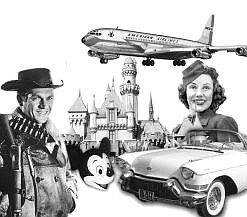
Can you imagine somewhere you’ve been? I mean, in person, actually been. That all depends — on what you call imagination, and how you want it to work for you. I was in Southern California once, for 13 days, the month after Democrats chose Jack Kennedy in Los Angeles. I’d flown nonstop from Boston with my dad. (He’d seen his California sister for the first time since V-J Day.) Do I remember California? Yes and no. Can I imagine it? You bet.
Place and time mean a lot to a kid just out of high school, on his way to college — for me New Bedford (MA) High and Boston College — because he feels so “in between.” Eighteen. What an age. I’ve still got the graduation pictures my mother snapped in front of the Olympia theater — where Milton Berle, as a kid, once performed in vaudeville. I look pretty tough in those pictures, in a silly ’50s way. But the cowlick’s all wrong, and a broken front tooth still shows through my twisted, sideways grin.
I remember the decision that we go to California being made at our kitchen table. Me, my mother, my father — considering. Except it really had all been considered long before I was involved. My mother had a boyfriend, my father’s accountant, Jim Fox, a crewcut guy, early gray, only 12 years older than I. The trip would provide a graceful way into separation. I did not realize this, then, sitting there sipping hot sugared tea. My mother’s excuse for not coming with us was her operation for ulcers the past winter. Six months was not enough time to heal, she said, to recover her strength. After all, she’d had two-thirds of her stomach removed.
I’d never really flown before, never been off the ground except as a kid on the playground swing I’d jump up above the bar, to make believe I was flying. “It’ll be a jet,” my father had said, “a 707.” That we’d fly American Airlines felt good. Patriotic, and solid and safe.
The memory of the afternoon my father and I took off from Logan Airport in Boston is mixed up now with flights my father took in the late ’40s, early ’50s, from New Bedford to New York on a 24-seat ex-U.S. Army Air Force cargo plane, the “gooney bird” DC-3. My Uncle Louie had always gone along too, and his presence lent an air of mystery. Louie — Clark Gable with glasses — a private investigator, specialized in divorce cases and carried in a shoulder holster a Smith & Wesson .45. Many’s the time I saw my father off, both of us waving, him half concealed by the window curtain, me behind a chainlink “Atomic” fence.
But the planes at Logan were no gooney birds. I knew pilots called all aircraft “birds” because I’d read it years before in my Korean War comic books. The DC-3, perched on one-tire landing gear, pitched back on its tail, did look like a bird or two I’d seen. But the planes at Logan were machines. Of course, all had four engines, with props the length of a man. From the glassed-in terminal deck, I watched a guy in dark blue coveralls out there on the tarmac, gesturing at the traffic like an animal trainer. But there was nothing animal-like about those planes. They were insects, if anything applies. Enormous silver vehicles that seemed to function without thought, or consideration. I knew, of course, that pilots had control, that beyond those black-eye windows there were men. But still I felt afraid for the guy in coveralls.
Among those planes at Logan, one stood out — not an insect, but a fish, a shark to be precise, made more for movement through water than air. From that bullet nose, over the slender fuselage, over the swept-back wings to that wonderful tail, swept-back too, everything, everything about this plane said speed. On that tail I saw “Boeing 707.” It read “California” to me.
Most of the boardering ritual that day seems off-speed now, like film from the old wind-up Kodak “Eight” we took with us that always shot too fast or too slow. My father offered, and I accepted, the window seat, just back of the starboard wing. Taxiing to the takeoff runway, the 707 lumbered over the concrete slabs. I watched that wing recoil two, three, four times to the thud of the wheels. My father and I entwined our wrists on the armrest between us and held hands.
The first minutes of the flight were filled with business: Stewardesses up and down the aisles, taking orders, then, with reassuring smiles, calming the few initiates. Behind me, after a request for a Beefeater martini, I heard, “Sorry, sir, not till cruising altitude.” And cruising altitude was well worth waiting for. I remember the impressive numbers. The pilot, on the intercom, after introducing himself — an Irish name, Hogan or Hennedy; the wing commanders in the old comic book stories were always Irish, it seemed — said we were at 35,000 feet. God, I thought, higher than Mt. Everest — “conquered,” I remembered, by an Englishman with a woman’s name a few years before. And we were traveling at 600 knots!
Halfway across the continent, the landscape changed color. Before the snaky river that I knew was the Mississippi — seeing it coming from way out over the front of the wing I was afraid even to tell my father for fear of spoiling a wonder if I was wrong — the land was all a green-shaded quilt, with clouds casting moving shadows west to east. Then came that river below us, the Mississippi the pilot announced, and soon a change from green to tan and brown. I knew from geography class that there were wheat fields down there, and corn, and cattle. Land as full of life as in the East. But different life, lived in cities clumped along river bends, to towns isolated in one corner of a checkerboard square. It must be such a different life, I thought, to look so different from far away. I remember turning back toward the Mississippi, turning my head, straining to look between the seat back and the fuselage, out the two-pane window behind me.
Our landing at LAX, engines cut back, little descents I felt on occasion in my privates, commenced somewhere over Las Vegas and ended with a smooth glide in. Five and a half hours was a long time for me to sit anywhere then. At the terminal, August in Los Angeles was August in Boston. But standing with our bags at the curb, waiting for my California aunt to arrive, taxis idling close by, I’d soon see the difference.
My father was a dealer, a used-car dealer, back in New Bedford. He’d built a place of business from the cellar of a Clarks Cove house and small yard. The cellar, just a hole in the ground after the hurricane of ’38, my father had filled, shovel by shovelful, with dirt he’d hauled from the dump. He’d blacktopped the “lot,” as we called it, and had installed, on cinder blocks, a shack he’d bought from a Cove clammer named Manny. My father had put that shack on cinder blocks so there could be an “entrance,” he said. For ten years, he’d made enough to keep my mother and me, and for this trip now to California.
I’d grown up around cars. I knew every model of every ’50s car built by Chrysler, Ford, GM. I could, for instance, distinguish between a ’49 and ’50 Chevy — the different chevron on the trunk and the hubcaps — or the ’52 and ’53 Caddy — the ’53 had a chrome plate there, with a gold company insignia.
But there was one car, one Caddy to be exact, I’d never seen. That was the Eldorado. The Cadillac Eldorado. I remember when I first heard the name, I’d looked up the word. “Eldorado: An imaginary place in South America, full of gold.” Well, that’s what I saw down from us, from my father and me, there by the curb at LAX. It was a gold 1957 Cadillac Eldorado convertible, of course top down. A man my size, crewcut and blond too, shuffled back past the trunk, touching it the way, to calm her, you’d touch the rump of a horse. A woman with luggage waited by the open passenger door. Devoted fans of Wanted: Dead or Alive, my father and I recognized Steve McQueen.
By the time my aunt picked us up, my vision of Steve McQueen had dimmed into the fuzz of fatigue that, by 8:00 p.m., we carried with our baggage. My aunt Elizabeth was full of excuses. But it was too late for excuses, and my father barely kissed her on the cheek. I remember the nighttime ride up the highway — cliffs on the right and, on the left, the sound of big waves. I sat in the back seat of that ’59 Ford Fairlaine. This aunt of mine had money, and the Ford, at least in the back seat, smelled new.
I still don’t know where Oxnard is. Seventy miles north sticks in my mind. Those were long, dark miles. I remember the choice my father had to make that night. My aunt suggested we sleep in either her trailer — she owned a big trailer park with two swimming pools — or in a room she had vacant at their “on property” motel. God, I wanted that privacy. I mean, of the motel room. But my father accommodated his sister. (She, of course, wanted the money from renting out that room.) We bedded down in her trailer — the “parlor” section — on a fold-down bed. My father smoked a Chesterfield, quickly, drawing hard. I remember his boxer shorts and his sleeveless T-shirt. Then, after the snap-out lamp, his too-soon snoring. Christ, I thought, and lay there, fingers twined behind my head, elbows up, looking into the trailer ceiling, hearing the toilet flush down toward a light.
There was a truism back East that California wasn’t as swell as advertised. No one I knew had ever been to California. But everyone knew someone who had. Invariably, that someone had been disappointed. Sure, the money’s okay, so the story would go — the someone had always left the East for a big assembly-line salary in the aircraft factories — but who wants to live in a place with no seasons, where the weather’s monotonous, sunny day after sunny day?
Well, I remember that first morning, first sunrise, me kneeling on my pillow, arms spread on the little sill beneath the trailer’s rear window. I’d never seen a sky like that in my life. I couldn’t see the horizon, and the sun had yet to clear a warehouse named Venox. But already the sky over Venox was rose, actually rose colored, and above a clear line of demarcation, still the nighttime blue. Just beyond my aunt’s Ford lay a swimming pool, shaped like a kidney, pink-bottomed with layer-cake stairs. My father rested easy, over on his side, toward the wall. This was California, right? I’d go for a swim.
In my New Bedford city-issue lifeguard trunks, black nylon, styled on boxer shorts, about the size of my heavyweight father’s underwear, I ambled out of the trailer. The Senior Lifesaving Red Cross badge my mother had sewn onto the left thigh had looked impressive when I’d packed. Now, under this strange and beautiful sky, it mattered hardly at all.
I eased myself into the chilly pool. The steps were slimy, sure, and the skimmers, either clogged or turned off, had left a smelly film. But pushing off toward the deep end, I used a side stroke I wouldn’t be caught dead doing in public — can you imagine a lifeguard not swimming the crawl? Over my summer-tan shoulder, I watched the light blue water skim by. Then I floated, arms spread, palms turned up the way you’re supposed to, and looked up and wondered.
My father was not a big man. Nor did he photograph well. And now, looking at the photos my aunt took of us that morning, I can see why. My father grew up in the ’20s, was young in the Depression, worked as a loom fixer with a wife and kid all during the war. All his life, my father wished he could laugh out with ease, embrace the shoulders of a friend, enjoy himself hugged roughly. My father tried, all his life, to delight in what he’d paid for, to relish good luck, to go nuts at bad. He had an appetite, my father. But only at home, with my mother and me at the kitchen table. There he’d eat his codfish soup, his top round stew, my Polish mother’s specialties: gaumkies (stuffed cabbages), pirogues (cheese pillows, deep fried). But in a restaurant, he ate silently. A cigarette always going, his utensils placed with care, his lips pinched chewing even pudding. Under the pressure of the camera, my father couldn’t smile. He could sneer, grimace, say cheese. But his blue eyes, so deep set that for years I thought they were brown, seemed always out of focus.
Naturally my aunt had an itinerary for my father and me. We’d be in Southern California 13 days, she knew, but we’d see “everything.” “Everything” to her meant the recently opened Disneyland, Marineland of the Pacific, and Knott’s Berry Farm. This seemed reasonable. Someone says vacation means showplace visiting, and, at 18, you go along. But I didn’t trust my aunt because, right off, I didn’t like her.
There’s a fiction in the East about dry heat: That it doesn’t feel as hot as the thermometer says. Well, our Disneyland day was hot — at 10:00 a.m., 98 degrees in the shade. The roadside dust in Anaheim, what would be dirt in New England, looked like talc. And my aunt’s Ford had no air conditioning.
My father loved to sweat. I remember summers down at his used-car lot, him Simonizing cars bare-chested, dripping, kinky red hair streaking his balding crown. Me, I hated the heat. Just before our flight to L.A., I had taken it into my head to acquire a Coppertone tan. Back then Coppertone came only in oil, a thick, rich-smelling, buttery fluid, looking as if under it you would actually be toasted brown. But after three consecutive eight-hour days out from under the lifeguard tower umbrella, lacquered with my Coppertone, I got a sudden-coming case of heatstroke. There’d been the ambulance, the St. Luke’s emergency room. All that. Even an ice-water bath rendered by a candy striper. But heatstroke, once you get it, has lasting effects — as if your body recognizes the sun for an enemy. Bright sunlight means blurred vision. Bright sunlight, plus intense heat, means dizziness. Bright sunlight, intense heat, plus being scared equals collapse.
My aunt insisted that the best way to see the Disneyland park, to get an overall view of its “basic theme” — she actually talked that way — was “to commit a morning to the funiculars.”
“What are funiculars?” I asked my father.
“I don’t know,” he said. “But Bessie does.”
To me, the funiculars looked goofy, a lot like their name. Lines from a song of the early ’50s kept running through my head. “Funiculi, funicular. Joy is everywhere. Funiculi, funicular.” We stood in line, my father and me, waiting to be ushered aboard the next pot with a parasol. I remember a woman at my elbow. She wore, in the fashion of the times, white capri pants — three-quarter-length slacks designed to show off full hips and slender calves. She was sweating, we all were, and perspiration had dampened her pants in a “V” on her behind. Without the sweat, I’d have only lusted after her, as my parish priest would have called it. But the sweat made me feel sorry she too — with her little girl grabbing incessantly at her thigh — was suffering for this ride. For some reason I thought of the contraption my father and I had ridden a few years before, one summer night on the Coney Island Ferris wheel. It was a box, as I recall, about the size of an elevator, and it swung on rails like the weighted movement of a self-winding watch. With the smell of urine and stale vomit in there, it’d been hard on that ride to keep the famous hot dogs down.
My first adventure aboard the funicular was a pass through the “Matterhorn,” a scaled-down reproduction of the famous mountain done in some form of plastic that looked, from a hundred yards away, for all the world like rock. My father, reading aloud from the fold-up information guide they’d handed out at boarding, informed me of the history and significance of the Matterhorn. I remember its reputation lay in its shape, and I tried to see why. I considered the “horn” part of the name. I pictured the horns I knew of. The trumpet I’d tried to learn in seventh grade; the trombone my mother’s favorite, Glenn Miller, had played; the tuba the skinniest kid in school had played in the high school band. I thought of a shoehorn, then Cape Horn from maps in geography, even the shape of the electric fender horn I’d unscrewed from a ’38 LaSalle and had marched around my father’s lot with, pretending to play. Then I thought of “Matter,” “mater,” “mother.” But what could a mountain be mother to? The Matterhorn, I concluded, couldn’t have been named after a horn. Or have anything to do with mothers. My father said it was on the Swiss and Italian border. ” ’Horn’ must mean something else,” I said.
For me, the Matterhorn at Disneyland had one thrill. Not a thrill, exactly, but at least a focus of interest — a gaping hole in its side that our funicular, like all those that went before it, would pass through. My father had put those information papers aside, and he too, looking over his fine Roman nose, which I inherited (except mine is twisted by a septum bent badly to the left), eyed the aperture. It’s all illusion, his face said to me. It’s only a silly kids’ ride. And yet I heard him, as we entered that plastic mountain and the heat subsided, and the sounds of splashed water — some sort of submarine-shaped cars carrying four or five people each, were crashing, regularly, into a slough about 50 feet below — say, “For God’s sake, Anna.” That was my mother’s name.
Soon enough we were out on the other side of the Matterhorn and headed, in that gentle swaying motion of the car, traveling slower than I’d walk, toward an artificial lake outlined by shrubs planted just yards back from the marsh. I remember two things on this lake. A gray plastic — I now assumed everything was plastic — submarine, and young women in two-piece bathing suits treading water, occasionally breaking into a crawl, or posing, waving, perched on huge plastic rocks. As I watched, that submarine began to move, and the mermaids — I think some actually wore bottoms with fishtails — thrashed about trying to climb aboard. Here we were, my father and me, moving past this spectacle. Young women, so far as I could tell, beautiful women, climbing aboard this “one-half scale replica of the Nautilus — the first atomic submarine,” and me waiting for that contraption to dive. But instead the Nautilus floated a circuit of the shore, the mermaids waving, arms stiff overhead, moving just their wrists, the crowd, fenced in by a waist-high railing, cheering as if they were at a parade.
Back on the ground it was hot. My father’s nylon summer shirt, which admitted light but no air, described his back. Drops of sweat ran over my ribs. My aunt came up, floating in her vague chambray dress. She wore green, Kelly green, because it matched her eyes. My aunt had red hair, not dyed, but red and full, like fur. She said there was a parade about to come down “Main Street.”
Disneyland, in those days, was designed to resemble a 19th-century Midwestern town. Or at least Walt Disney’s conception of one. There was the city hall, twin-towered like a church, except the faithful were reminded of their faith not by a bell but by the huge white face of a clock. There were movie-set shop fronts on Main Street with alliterative names — “China Closet”; “Silhouette Studio.” I made a naïve attempt at trying a door and was smirked at by a 12-year-old with a pack of Luckys rolled up, bulging in the sleeve of his jersey. In this town, trolley cars, a lot smaller than the ones I’d ridden in as a kid, traversed the streets on rail beds no wider than the length of my arm. A street cleaner my father’s age, dressed in a white suit and white fedora, pushed before him under the inevitable parasol a barrel on two wagon wheels. Before scooping the horse manure, he’d doff his hat to the thin parade crowd that lined Main Street. And they’d applaud.
My aunt’s marching band showed up, following the trolleys. All brass, I remember, maybe four abreast. Their uniforms were gold-on-red tunics, and their pants and shoes were black. They marched synchronized, not like a college band full of vigor and belief, but tired, as if they were delivery men working at the end of their day. About them cavorted “Mickey Mouse,” in full costume, with a plastic head that had to weigh ten pounds. I caught the eye of the trombone player. It was bloodshot with fatigue and what, years later, I would recognize as drink. Across the street at the “Rialto” or the “Orpheum,” I can’t remember which, the marquee read, “Lon Chaney in The Phantom of the Opera.”
I spotted the white face of a thermometer, close by a phone booth. I remember the pointer on 110 degrees. I stepped into that phone booth, dropped in my nickel, and called my mother back home. “Operator,” I said, “I’d like to place a collect call to Mrs. Milton Griffin in New Bedford, Massachusetts. Her number is Wyman 40962.” A lot of clicking, then my mother answered.
“Will you accept…?” the operator asked.
After a sigh of reluctance, “Yes.”
I don’t remember our conversation. Except that she was “sore,” as my father and I used to call it, about something. I told her how hot it was, how the heat had made me feel. She hadn’t missed a thing, I said. California makes you sick, I said, and waited for her reply. “Is your father there?” she asked.
Close by the red-striped sails of a stubby little “Pirate Ship,” upon the poop of which a small drama played, involving, I think, several rebellious “tars” and a black-wigged Captain Hook, there was a tent named “Infirmary.” Its canvas, red-striped and white, echoed of the pirate sails and made this “Infirmary” inviting to me. I expected to smell something antiseptic inside, as in old Dr. Rosenburg’s office back home. But instead it was perfume, a light, flowery scent. A woman, a nurse I assumed, took hold of my hand and called me “honey.” She led me to a green-blanketed, neatly turned-down cot. She laid a cool palm on my forehead.
At first I refused to lie down. “I’ll just sit for a minute,” I said. Then, as the tent got white inside and, for the life of me, I couldn’t blink it away, I did lie down. I remember how she held my hand, softly, with two fingers on the inside of my wrist. I knew she was taking my pulse. What the hell, I thought. And closed my eyes.
Next thing I knew a man stood over me. He held a chromed penlight in one hand and lifted my eyelids way up with fingers of the other. “He’s okay,” I heard. “Just too much sun.” Then came that perfume again. And I recognized it. White Shoulders. What my mother used on her hands every day after doing dishes and behind her knees after her Saturday night bath.
The nurse placed an ice bag, the old-fashioned kind — vulcanized rubber sack, cloth cover, with a shiny screw-on lid — on my forehead. I felt the hard, cold squareness of the cubes inside. I noticed then, for the first time, my nurse’s hands. They were tiny, not babylike, but miniature, so small her wrist made a fold with her forearm, as if creased by a rubber band. Eventually, my father came in. What had happened was explained by the nurse. “Why not let him rest a while,” she said. “Pick him up when you’re ready to go.”
Two days later my father, my aunt, and I embarked on another excursion. This time, to Marineland of the Pacific. In the meantime, my head had cleared; my aunt had made wonderful bacon, lettuce, and tomato sandwiches (luscious vegetables from the farmer’s market); and I’d been allowed to drink from elegant 11-ounce cans a number of Olympia (never heard of back East) beers.
Marineland of the Pacific lay on the coast. I don’t recall the city, but I could see the ocean from the spectator stands. Out front of Marineland was a dolphin, depicted in flowers, most of them blue. Along a chainlink fence were nautical flags used to indicate weather predictions. At Marineland the breeze, always west, coming in off the Pacific, left a light mist in the air.
Disneyland tried for the past: Marineland tried for the future. Not one building reminded me of anything back East. Out here it was all poles and layers, stacked in various forms. Everything was either platform or pavilion. I remember the huge arena, an amphitheater the floor of which was an egg-shaped pool. My aunt suggested we sit high up. The killer whale show was notorious, she said, for drenching people. But I begged my father, “Please, let’s sit near.”
Of course, we got wet. But the wonder of the show made nothing else matter. I saw this man, black-haired, slim, dressed all white, appear as an intimate of whales. It was the first time I saw how hard it is to do things. To do more, and better, than the people in the stands. I’m sure the trainer heard the applause, smelled the pool water, worried that one whale seemed to be favoring a flipper, holding it close to his body and always rotating, despite the various commands, one way. But by his devoted attention — arms describing the feats, face contorted with a yearning to communicate, as if before retarded children — he conveyed the wonder of these creatures as they tried to please him, to please themselves. “They do it for the fish,” my aunt said when, at the end of a routine, the trainer flipped each a mackerel. I knew she was dead wrong.
On the lower level, the tank became an aquarium. It was cool there, too. Air-conditioned, maybe. But what made it feel cool were those deep glass windows, allowing a view of the underwater life. Yes, it was unnatural. I knew that. All those fish in one place, swimming around each other, not hunting or scavenging or migrating. Just swimming in circles, watching, waiting to be fed. But I still loved watching the sharks, the mako especially, dark blue on top, aerodynamic, and all white underneath. I pressed my palm on the glass. With his cat-yellow eye, he brushed past like a cat rubbing his whiskers.
And then there was this “grouper,” identified by consensus of three Californians standing behind me who “knew fish.” I had never heard of a grouper. But he looked exactly like the small-mouth bass I’d caught in Buttonwood Park pond, had rejuvenated in my bathtub, and had released a month later, almost white, into the pond again. But this grouper, with just his head, filled the viewing window. I thought, “Here’s this fish looking at me like I looked at his brother fish years ago.” Then that teacup eye swam off, trailing filaments of a curious aquarium twine.
Our last hour at Marineland, my father, my aunt, and I sat eating at an outdoors table, overlooking an amorphous pool. In the middle of that pool, there was a statue of some sort, and at one end, performing seals. My aunt’s dress, the green one from Disneyland, the chambray, lay flat against her shoulders. We all spooned from waxed cardboard cups of delicious ice cream.
Of our 13 days in California, 10 were now gone. My father had a half brother up in Sanger, a small town near Fresno. “You’ve got to see him,” my aunt said to my father. The name was “Wood.” For some reason, my father drove up to Sanger in a rented car. I would follow a day later, riding with my aunt.
I guess to give me company, my aunt had invited a young woman along. She was 14 years old, short, blonde, with awfully thick hair, pudgy and knock-kneed, with the most perfect teeth I’d ever seen. Her name was Joyce Johnson, from Minneapolis, originally, but living at the trailer park with her family now for two years. “You’ve got a lot in common,” my aunt said. “She loves Disneyland, too.”
Actually, Joyce and I had met my first day in California. It seems she’d been up early, in the bathroom and, through her trailer window, she’d watched my morning swim. When I’d gone back to the pool that afternoon, this time wearing the pink “Catalina” swim trunks my aunt had bought for me, Joyce had come out in her two-piece. We’d talked easily, liking each other right off. Joyce’s portable Philco, a neat, cream-colored little radio, eased our getting acquainted with a string of ballads. The last, Elvis Presley’s beautiful “Are You Lonesome Tonight,” I knew the words to, and when he came to the part where he speaks the lyrics, I spoke along with him. “Honey, you lied when you said you loved me. And I had no cause to doubt you. But I’d rather go on hearing your lies than go on living without you.” Joyce found this “poetic.” And I did, too.
At first my aunt insisted Joyce and I, for the trip to Fresno, ride in the back seat of the Ford, as if we were being chauffeured to a prom. But at Bakersfield, at a motel along the main route where my aunt stopped for the ladies’ room and we all admired the “Olympic-sized” pool, Joyce and I got into the front seat, me, my arm around Joyce’s shoulders. Over the mountains, the landscape had seemed terrific. Brown hills like camel backs, covered with sagebrush. Just like the Sunday night TV cowboy shows: The Range Rider, The Cisco Kid, which came on after Victory at Sea.
When I met up with my father in Sanger, at his half brother’s house, he was preoccupied with a 1949 Buick convertible, fire engine red, with a white canvas top. I knew the Buick was a Fireball Eight, the first year of Dynaflow. My father sat behind the wheel; it came up to his eyes. My half uncle, an automobile mechanic, was “in love” with old cars, and, after supper, he showed this one to me too, stem to stern. When he finished, I watched him hide the keys under the driver’s side rubber mat.
The next morning, everyone — my father, my aunt, the half brother, and his wife — headed for Knott’s Berry Farm. But Joyce and I stayed behind. Joyce — because she’d told my half aunt she’d gotten her period. Me — because, after what happened at Disneyland, I said I couldn’t stand the Sanger midday heat.
As soon as we waved them all off — Joyce and I down at the intersection of the driveway and the street — we scurried back to the house and made plans. I told Joyce about the keys under the floor mat of the Buick. “Let’s take a ride,” I said. “But I don’t know anything about around here.”
“I do,” Joyce said. “My boyfriend lives in Fresno.” In my half uncle’s refrigerator, I found two cans of Olympia beer and one bottle of Burgermeister. God knows how I expected to explain their absence.
Kids in those days stiffened the suspension of their rods, and the most popular sports cars — the bug-eyed Austin Healey Sprite, the fluent MGB — rode, to use my father’s simile, like Mack trucks. But not this Buick: balloon tires on 16-inch wheels, soft-sprung with oil shocks, front seat like a sofa, full-time power steering — so you hardly feel the road. I felt, even pictured in my mind, those transmission pumps, revved by the Fireball Eight, forcing that fluid through the turbine blades of the Dynaflow. Smooth and slow as a bus on takeoff. God, what a ride.
Our white canvas top up against the sun, Joyce and I headed for a “place.” I didn’t ask any questions. I just drove. Back home, “parking” meant at night, most often at some beach. But Joyce’s place was a “monkeys’ island,” deep in the orange groves. Yellow talc collected like pollen on the windshield. Christ, I thought. It’s my first time, and she’s a veteran.
Nevertheless, if I remember right, I just took hold of this girl and turned her to me and started kissing her hard on the lips. She didn’t move her arm to hold me, except a little, almost holding and pushing off at the same time. When I smelled that nice clean smell from her cheek — you know, the baby kind young women have — and her hair against my face.
She sat up straight, looked into the mirror, and started straightening her lipstick. I tried to think of something tender to say, or something philosophical. I couldn’t. But she said something. She said, “I didn’t make it to 15.”
I kissed her pudgy cheek. “Don’t talk like that,” I said.
My father paid for our return flight tickets in cash. I watched him count out the $260, all in tens. Knott’s Berry Farm had provoked, for some reason, a fight between my father and his sister Elizabeth. On the ride back from Sanger to Oxnard, in heat so intense we actually rolled up the windows to keep it out, my father fought with his sister about years before. Lying in the back seat, a rolled-up towel full of ice cubes wrapped like a sloppy turban around my head, I heard about small crimes, misdemeanors really, that each had perpetrated against the other. In 1946, at a Polish wedding back in New Bedford, my aunt had declined, publicly, to kiss my father’s best friend on the lips. Who the hell did she think she was? My father now wanted to know. All right, my aunt said. What about her now-dead husband, Vincent? Just back from the war, both of them broke, my father sleeping in a room of his own. Why wouldn’t he share his bed with Vincent? Instead of making him sleep in the tub.
Our afternoon flight back was delayed — on two separate tries, the inboard, starboard jet spit flames — until almost dusk, and we ate supper courtesy of American Airlines. My father ordered filet mignon, then picked at it. I had some kind of clams. When we did leave, the pilot, on his turn east, arced us so sharply over Long Beach that all I remember of the takeoff is that silver wing and that dark blue sky. Flying back into the night, toward Boston, I breathed easy. I thought I was going home.
Here's something you might be interested in.
A New Bedford kid becomes man during Calif. summer vacation
Sunstruck

A New Bedford kid becomes man during Calif. summer vacation
Sunstruck
Can you imagine somewhere you’ve been? I mean, in person, actually been. That all depends — on what you call imagination, and how you want it to work for you. I was in Southern California once, for 13 days, the month after Democrats chose Jack Kennedy in Los Angeles. I’d flown nonstop from Boston with my dad. (He’d seen his California sister for the first time since V-J Day.) Do I remember California? Yes and no. Can I imagine it? You bet.
Place and time mean a lot to a kid just out of high school, on his way to college — for me New Bedford (MA) High and Boston College — because he feels so “in between.” Eighteen. What an age. I’ve still got the graduation pictures my mother snapped in front of the Olympia theater — where Milton Berle, as a kid, once performed in vaudeville. I look pretty tough in those pictures, in a silly ’50s way. But the cowlick’s all wrong, and a broken front tooth still shows through my twisted, sideways grin.
I remember the decision that we go to California being made at our kitchen table. Me, my mother, my father — considering. Except it really had all been considered long before I was involved. My mother had a boyfriend, my father’s accountant, Jim Fox, a crewcut guy, early gray, only 12 years older than I. The trip would provide a graceful way into separation. I did not realize this, then, sitting there sipping hot sugared tea. My mother’s excuse for not coming with us was her operation for ulcers the past winter. Six months was not enough time to heal, she said, to recover her strength. After all, she’d had two-thirds of her stomach removed.
I’d never really flown before, never been off the ground except as a kid on the playground swing I’d jump up above the bar, to make believe I was flying. “It’ll be a jet,” my father had said, “a 707.” That we’d fly American Airlines felt good. Patriotic, and solid and safe.
The memory of the afternoon my father and I took off from Logan Airport in Boston is mixed up now with flights my father took in the late ’40s, early ’50s, from New Bedford to New York on a 24-seat ex-U.S. Army Air Force cargo plane, the “gooney bird” DC-3. My Uncle Louie had always gone along too, and his presence lent an air of mystery. Louie — Clark Gable with glasses — a private investigator, specialized in divorce cases and carried in a shoulder holster a Smith & Wesson .45. Many’s the time I saw my father off, both of us waving, him half concealed by the window curtain, me behind a chainlink “Atomic” fence.
But the planes at Logan were no gooney birds. I knew pilots called all aircraft “birds” because I’d read it years before in my Korean War comic books. The DC-3, perched on one-tire landing gear, pitched back on its tail, did look like a bird or two I’d seen. But the planes at Logan were machines. Of course, all had four engines, with props the length of a man. From the glassed-in terminal deck, I watched a guy in dark blue coveralls out there on the tarmac, gesturing at the traffic like an animal trainer. But there was nothing animal-like about those planes. They were insects, if anything applies. Enormous silver vehicles that seemed to function without thought, or consideration. I knew, of course, that pilots had control, that beyond those black-eye windows there were men. But still I felt afraid for the guy in coveralls.
Among those planes at Logan, one stood out — not an insect, but a fish, a shark to be precise, made more for movement through water than air. From that bullet nose, over the slender fuselage, over the swept-back wings to that wonderful tail, swept-back too, everything, everything about this plane said speed. On that tail I saw “Boeing 707.” It read “California” to me.
Most of the boardering ritual that day seems off-speed now, like film from the old wind-up Kodak “Eight” we took with us that always shot too fast or too slow. My father offered, and I accepted, the window seat, just back of the starboard wing. Taxiing to the takeoff runway, the 707 lumbered over the concrete slabs. I watched that wing recoil two, three, four times to the thud of the wheels. My father and I entwined our wrists on the armrest between us and held hands.
The first minutes of the flight were filled with business: Stewardesses up and down the aisles, taking orders, then, with reassuring smiles, calming the few initiates. Behind me, after a request for a Beefeater martini, I heard, “Sorry, sir, not till cruising altitude.” And cruising altitude was well worth waiting for. I remember the impressive numbers. The pilot, on the intercom, after introducing himself — an Irish name, Hogan or Hennedy; the wing commanders in the old comic book stories were always Irish, it seemed — said we were at 35,000 feet. God, I thought, higher than Mt. Everest — “conquered,” I remembered, by an Englishman with a woman’s name a few years before. And we were traveling at 600 knots!
Halfway across the continent, the landscape changed color. Before the snaky river that I knew was the Mississippi — seeing it coming from way out over the front of the wing I was afraid even to tell my father for fear of spoiling a wonder if I was wrong — the land was all a green-shaded quilt, with clouds casting moving shadows west to east. Then came that river below us, the Mississippi the pilot announced, and soon a change from green to tan and brown. I knew from geography class that there were wheat fields down there, and corn, and cattle. Land as full of life as in the East. But different life, lived in cities clumped along river bends, to towns isolated in one corner of a checkerboard square. It must be such a different life, I thought, to look so different from far away. I remember turning back toward the Mississippi, turning my head, straining to look between the seat back and the fuselage, out the two-pane window behind me.
Our landing at LAX, engines cut back, little descents I felt on occasion in my privates, commenced somewhere over Las Vegas and ended with a smooth glide in. Five and a half hours was a long time for me to sit anywhere then. At the terminal, August in Los Angeles was August in Boston. But standing with our bags at the curb, waiting for my California aunt to arrive, taxis idling close by, I’d soon see the difference.
My father was a dealer, a used-car dealer, back in New Bedford. He’d built a place of business from the cellar of a Clarks Cove house and small yard. The cellar, just a hole in the ground after the hurricane of ’38, my father had filled, shovel by shovelful, with dirt he’d hauled from the dump. He’d blacktopped the “lot,” as we called it, and had installed, on cinder blocks, a shack he’d bought from a Cove clammer named Manny. My father had put that shack on cinder blocks so there could be an “entrance,” he said. For ten years, he’d made enough to keep my mother and me, and for this trip now to California.
I’d grown up around cars. I knew every model of every ’50s car built by Chrysler, Ford, GM. I could, for instance, distinguish between a ’49 and ’50 Chevy — the different chevron on the trunk and the hubcaps — or the ’52 and ’53 Caddy — the ’53 had a chrome plate there, with a gold company insignia.
But there was one car, one Caddy to be exact, I’d never seen. That was the Eldorado. The Cadillac Eldorado. I remember when I first heard the name, I’d looked up the word. “Eldorado: An imaginary place in South America, full of gold.” Well, that’s what I saw down from us, from my father and me, there by the curb at LAX. It was a gold 1957 Cadillac Eldorado convertible, of course top down. A man my size, crewcut and blond too, shuffled back past the trunk, touching it the way, to calm her, you’d touch the rump of a horse. A woman with luggage waited by the open passenger door. Devoted fans of Wanted: Dead or Alive, my father and I recognized Steve McQueen.
By the time my aunt picked us up, my vision of Steve McQueen had dimmed into the fuzz of fatigue that, by 8:00 p.m., we carried with our baggage. My aunt Elizabeth was full of excuses. But it was too late for excuses, and my father barely kissed her on the cheek. I remember the nighttime ride up the highway — cliffs on the right and, on the left, the sound of big waves. I sat in the back seat of that ’59 Ford Fairlaine. This aunt of mine had money, and the Ford, at least in the back seat, smelled new.
I still don’t know where Oxnard is. Seventy miles north sticks in my mind. Those were long, dark miles. I remember the choice my father had to make that night. My aunt suggested we sleep in either her trailer — she owned a big trailer park with two swimming pools — or in a room she had vacant at their “on property” motel. God, I wanted that privacy. I mean, of the motel room. But my father accommodated his sister. (She, of course, wanted the money from renting out that room.) We bedded down in her trailer — the “parlor” section — on a fold-down bed. My father smoked a Chesterfield, quickly, drawing hard. I remember his boxer shorts and his sleeveless T-shirt. Then, after the snap-out lamp, his too-soon snoring. Christ, I thought, and lay there, fingers twined behind my head, elbows up, looking into the trailer ceiling, hearing the toilet flush down toward a light.
There was a truism back East that California wasn’t as swell as advertised. No one I knew had ever been to California. But everyone knew someone who had. Invariably, that someone had been disappointed. Sure, the money’s okay, so the story would go — the someone had always left the East for a big assembly-line salary in the aircraft factories — but who wants to live in a place with no seasons, where the weather’s monotonous, sunny day after sunny day?
Well, I remember that first morning, first sunrise, me kneeling on my pillow, arms spread on the little sill beneath the trailer’s rear window. I’d never seen a sky like that in my life. I couldn’t see the horizon, and the sun had yet to clear a warehouse named Venox. But already the sky over Venox was rose, actually rose colored, and above a clear line of demarcation, still the nighttime blue. Just beyond my aunt’s Ford lay a swimming pool, shaped like a kidney, pink-bottomed with layer-cake stairs. My father rested easy, over on his side, toward the wall. This was California, right? I’d go for a swim.
In my New Bedford city-issue lifeguard trunks, black nylon, styled on boxer shorts, about the size of my heavyweight father’s underwear, I ambled out of the trailer. The Senior Lifesaving Red Cross badge my mother had sewn onto the left thigh had looked impressive when I’d packed. Now, under this strange and beautiful sky, it mattered hardly at all.
I eased myself into the chilly pool. The steps were slimy, sure, and the skimmers, either clogged or turned off, had left a smelly film. But pushing off toward the deep end, I used a side stroke I wouldn’t be caught dead doing in public — can you imagine a lifeguard not swimming the crawl? Over my summer-tan shoulder, I watched the light blue water skim by. Then I floated, arms spread, palms turned up the way you’re supposed to, and looked up and wondered.
My father was not a big man. Nor did he photograph well. And now, looking at the photos my aunt took of us that morning, I can see why. My father grew up in the ’20s, was young in the Depression, worked as a loom fixer with a wife and kid all during the war. All his life, my father wished he could laugh out with ease, embrace the shoulders of a friend, enjoy himself hugged roughly. My father tried, all his life, to delight in what he’d paid for, to relish good luck, to go nuts at bad. He had an appetite, my father. But only at home, with my mother and me at the kitchen table. There he’d eat his codfish soup, his top round stew, my Polish mother’s specialties: gaumkies (stuffed cabbages), pirogues (cheese pillows, deep fried). But in a restaurant, he ate silently. A cigarette always going, his utensils placed with care, his lips pinched chewing even pudding. Under the pressure of the camera, my father couldn’t smile. He could sneer, grimace, say cheese. But his blue eyes, so deep set that for years I thought they were brown, seemed always out of focus.
Naturally my aunt had an itinerary for my father and me. We’d be in Southern California 13 days, she knew, but we’d see “everything.” “Everything” to her meant the recently opened Disneyland, Marineland of the Pacific, and Knott’s Berry Farm. This seemed reasonable. Someone says vacation means showplace visiting, and, at 18, you go along. But I didn’t trust my aunt because, right off, I didn’t like her.
There’s a fiction in the East about dry heat: That it doesn’t feel as hot as the thermometer says. Well, our Disneyland day was hot — at 10:00 a.m., 98 degrees in the shade. The roadside dust in Anaheim, what would be dirt in New England, looked like talc. And my aunt’s Ford had no air conditioning.
My father loved to sweat. I remember summers down at his used-car lot, him Simonizing cars bare-chested, dripping, kinky red hair streaking his balding crown. Me, I hated the heat. Just before our flight to L.A., I had taken it into my head to acquire a Coppertone tan. Back then Coppertone came only in oil, a thick, rich-smelling, buttery fluid, looking as if under it you would actually be toasted brown. But after three consecutive eight-hour days out from under the lifeguard tower umbrella, lacquered with my Coppertone, I got a sudden-coming case of heatstroke. There’d been the ambulance, the St. Luke’s emergency room. All that. Even an ice-water bath rendered by a candy striper. But heatstroke, once you get it, has lasting effects — as if your body recognizes the sun for an enemy. Bright sunlight means blurred vision. Bright sunlight, plus intense heat, means dizziness. Bright sunlight, intense heat, plus being scared equals collapse.
My aunt insisted that the best way to see the Disneyland park, to get an overall view of its “basic theme” — she actually talked that way — was “to commit a morning to the funiculars.”
“What are funiculars?” I asked my father.
“I don’t know,” he said. “But Bessie does.”
To me, the funiculars looked goofy, a lot like their name. Lines from a song of the early ’50s kept running through my head. “Funiculi, funicular. Joy is everywhere. Funiculi, funicular.” We stood in line, my father and me, waiting to be ushered aboard the next pot with a parasol. I remember a woman at my elbow. She wore, in the fashion of the times, white capri pants — three-quarter-length slacks designed to show off full hips and slender calves. She was sweating, we all were, and perspiration had dampened her pants in a “V” on her behind. Without the sweat, I’d have only lusted after her, as my parish priest would have called it. But the sweat made me feel sorry she too — with her little girl grabbing incessantly at her thigh — was suffering for this ride. For some reason I thought of the contraption my father and I had ridden a few years before, one summer night on the Coney Island Ferris wheel. It was a box, as I recall, about the size of an elevator, and it swung on rails like the weighted movement of a self-winding watch. With the smell of urine and stale vomit in there, it’d been hard on that ride to keep the famous hot dogs down.
My first adventure aboard the funicular was a pass through the “Matterhorn,” a scaled-down reproduction of the famous mountain done in some form of plastic that looked, from a hundred yards away, for all the world like rock. My father, reading aloud from the fold-up information guide they’d handed out at boarding, informed me of the history and significance of the Matterhorn. I remember its reputation lay in its shape, and I tried to see why. I considered the “horn” part of the name. I pictured the horns I knew of. The trumpet I’d tried to learn in seventh grade; the trombone my mother’s favorite, Glenn Miller, had played; the tuba the skinniest kid in school had played in the high school band. I thought of a shoehorn, then Cape Horn from maps in geography, even the shape of the electric fender horn I’d unscrewed from a ’38 LaSalle and had marched around my father’s lot with, pretending to play. Then I thought of “Matter,” “mater,” “mother.” But what could a mountain be mother to? The Matterhorn, I concluded, couldn’t have been named after a horn. Or have anything to do with mothers. My father said it was on the Swiss and Italian border. ” ’Horn’ must mean something else,” I said.
For me, the Matterhorn at Disneyland had one thrill. Not a thrill, exactly, but at least a focus of interest — a gaping hole in its side that our funicular, like all those that went before it, would pass through. My father had put those information papers aside, and he too, looking over his fine Roman nose, which I inherited (except mine is twisted by a septum bent badly to the left), eyed the aperture. It’s all illusion, his face said to me. It’s only a silly kids’ ride. And yet I heard him, as we entered that plastic mountain and the heat subsided, and the sounds of splashed water — some sort of submarine-shaped cars carrying four or five people each, were crashing, regularly, into a slough about 50 feet below — say, “For God’s sake, Anna.” That was my mother’s name.
Soon enough we were out on the other side of the Matterhorn and headed, in that gentle swaying motion of the car, traveling slower than I’d walk, toward an artificial lake outlined by shrubs planted just yards back from the marsh. I remember two things on this lake. A gray plastic — I now assumed everything was plastic — submarine, and young women in two-piece bathing suits treading water, occasionally breaking into a crawl, or posing, waving, perched on huge plastic rocks. As I watched, that submarine began to move, and the mermaids — I think some actually wore bottoms with fishtails — thrashed about trying to climb aboard. Here we were, my father and me, moving past this spectacle. Young women, so far as I could tell, beautiful women, climbing aboard this “one-half scale replica of the Nautilus — the first atomic submarine,” and me waiting for that contraption to dive. But instead the Nautilus floated a circuit of the shore, the mermaids waving, arms stiff overhead, moving just their wrists, the crowd, fenced in by a waist-high railing, cheering as if they were at a parade.
Back on the ground it was hot. My father’s nylon summer shirt, which admitted light but no air, described his back. Drops of sweat ran over my ribs. My aunt came up, floating in her vague chambray dress. She wore green, Kelly green, because it matched her eyes. My aunt had red hair, not dyed, but red and full, like fur. She said there was a parade about to come down “Main Street.”
Disneyland, in those days, was designed to resemble a 19th-century Midwestern town. Or at least Walt Disney’s conception of one. There was the city hall, twin-towered like a church, except the faithful were reminded of their faith not by a bell but by the huge white face of a clock. There were movie-set shop fronts on Main Street with alliterative names — “China Closet”; “Silhouette Studio.” I made a naïve attempt at trying a door and was smirked at by a 12-year-old with a pack of Luckys rolled up, bulging in the sleeve of his jersey. In this town, trolley cars, a lot smaller than the ones I’d ridden in as a kid, traversed the streets on rail beds no wider than the length of my arm. A street cleaner my father’s age, dressed in a white suit and white fedora, pushed before him under the inevitable parasol a barrel on two wagon wheels. Before scooping the horse manure, he’d doff his hat to the thin parade crowd that lined Main Street. And they’d applaud.
My aunt’s marching band showed up, following the trolleys. All brass, I remember, maybe four abreast. Their uniforms were gold-on-red tunics, and their pants and shoes were black. They marched synchronized, not like a college band full of vigor and belief, but tired, as if they were delivery men working at the end of their day. About them cavorted “Mickey Mouse,” in full costume, with a plastic head that had to weigh ten pounds. I caught the eye of the trombone player. It was bloodshot with fatigue and what, years later, I would recognize as drink. Across the street at the “Rialto” or the “Orpheum,” I can’t remember which, the marquee read, “Lon Chaney in The Phantom of the Opera.”
I spotted the white face of a thermometer, close by a phone booth. I remember the pointer on 110 degrees. I stepped into that phone booth, dropped in my nickel, and called my mother back home. “Operator,” I said, “I’d like to place a collect call to Mrs. Milton Griffin in New Bedford, Massachusetts. Her number is Wyman 40962.” A lot of clicking, then my mother answered.
“Will you accept…?” the operator asked.
After a sigh of reluctance, “Yes.”
I don’t remember our conversation. Except that she was “sore,” as my father and I used to call it, about something. I told her how hot it was, how the heat had made me feel. She hadn’t missed a thing, I said. California makes you sick, I said, and waited for her reply. “Is your father there?” she asked.
Close by the red-striped sails of a stubby little “Pirate Ship,” upon the poop of which a small drama played, involving, I think, several rebellious “tars” and a black-wigged Captain Hook, there was a tent named “Infirmary.” Its canvas, red-striped and white, echoed of the pirate sails and made this “Infirmary” inviting to me. I expected to smell something antiseptic inside, as in old Dr. Rosenburg’s office back home. But instead it was perfume, a light, flowery scent. A woman, a nurse I assumed, took hold of my hand and called me “honey.” She led me to a green-blanketed, neatly turned-down cot. She laid a cool palm on my forehead.
At first I refused to lie down. “I’ll just sit for a minute,” I said. Then, as the tent got white inside and, for the life of me, I couldn’t blink it away, I did lie down. I remember how she held my hand, softly, with two fingers on the inside of my wrist. I knew she was taking my pulse. What the hell, I thought. And closed my eyes.
Next thing I knew a man stood over me. He held a chromed penlight in one hand and lifted my eyelids way up with fingers of the other. “He’s okay,” I heard. “Just too much sun.” Then came that perfume again. And I recognized it. White Shoulders. What my mother used on her hands every day after doing dishes and behind her knees after her Saturday night bath.
The nurse placed an ice bag, the old-fashioned kind — vulcanized rubber sack, cloth cover, with a shiny screw-on lid — on my forehead. I felt the hard, cold squareness of the cubes inside. I noticed then, for the first time, my nurse’s hands. They were tiny, not babylike, but miniature, so small her wrist made a fold with her forearm, as if creased by a rubber band. Eventually, my father came in. What had happened was explained by the nurse. “Why not let him rest a while,” she said. “Pick him up when you’re ready to go.”
Two days later my father, my aunt, and I embarked on another excursion. This time, to Marineland of the Pacific. In the meantime, my head had cleared; my aunt had made wonderful bacon, lettuce, and tomato sandwiches (luscious vegetables from the farmer’s market); and I’d been allowed to drink from elegant 11-ounce cans a number of Olympia (never heard of back East) beers.
Marineland of the Pacific lay on the coast. I don’t recall the city, but I could see the ocean from the spectator stands. Out front of Marineland was a dolphin, depicted in flowers, most of them blue. Along a chainlink fence were nautical flags used to indicate weather predictions. At Marineland the breeze, always west, coming in off the Pacific, left a light mist in the air.
Disneyland tried for the past: Marineland tried for the future. Not one building reminded me of anything back East. Out here it was all poles and layers, stacked in various forms. Everything was either platform or pavilion. I remember the huge arena, an amphitheater the floor of which was an egg-shaped pool. My aunt suggested we sit high up. The killer whale show was notorious, she said, for drenching people. But I begged my father, “Please, let’s sit near.”
Of course, we got wet. But the wonder of the show made nothing else matter. I saw this man, black-haired, slim, dressed all white, appear as an intimate of whales. It was the first time I saw how hard it is to do things. To do more, and better, than the people in the stands. I’m sure the trainer heard the applause, smelled the pool water, worried that one whale seemed to be favoring a flipper, holding it close to his body and always rotating, despite the various commands, one way. But by his devoted attention — arms describing the feats, face contorted with a yearning to communicate, as if before retarded children — he conveyed the wonder of these creatures as they tried to please him, to please themselves. “They do it for the fish,” my aunt said when, at the end of a routine, the trainer flipped each a mackerel. I knew she was dead wrong.
On the lower level, the tank became an aquarium. It was cool there, too. Air-conditioned, maybe. But what made it feel cool were those deep glass windows, allowing a view of the underwater life. Yes, it was unnatural. I knew that. All those fish in one place, swimming around each other, not hunting or scavenging or migrating. Just swimming in circles, watching, waiting to be fed. But I still loved watching the sharks, the mako especially, dark blue on top, aerodynamic, and all white underneath. I pressed my palm on the glass. With his cat-yellow eye, he brushed past like a cat rubbing his whiskers.
And then there was this “grouper,” identified by consensus of three Californians standing behind me who “knew fish.” I had never heard of a grouper. But he looked exactly like the small-mouth bass I’d caught in Buttonwood Park pond, had rejuvenated in my bathtub, and had released a month later, almost white, into the pond again. But this grouper, with just his head, filled the viewing window. I thought, “Here’s this fish looking at me like I looked at his brother fish years ago.” Then that teacup eye swam off, trailing filaments of a curious aquarium twine.
Our last hour at Marineland, my father, my aunt, and I sat eating at an outdoors table, overlooking an amorphous pool. In the middle of that pool, there was a statue of some sort, and at one end, performing seals. My aunt’s dress, the green one from Disneyland, the chambray, lay flat against her shoulders. We all spooned from waxed cardboard cups of delicious ice cream.
Of our 13 days in California, 10 were now gone. My father had a half brother up in Sanger, a small town near Fresno. “You’ve got to see him,” my aunt said to my father. The name was “Wood.” For some reason, my father drove up to Sanger in a rented car. I would follow a day later, riding with my aunt.
I guess to give me company, my aunt had invited a young woman along. She was 14 years old, short, blonde, with awfully thick hair, pudgy and knock-kneed, with the most perfect teeth I’d ever seen. Her name was Joyce Johnson, from Minneapolis, originally, but living at the trailer park with her family now for two years. “You’ve got a lot in common,” my aunt said. “She loves Disneyland, too.”
Actually, Joyce and I had met my first day in California. It seems she’d been up early, in the bathroom and, through her trailer window, she’d watched my morning swim. When I’d gone back to the pool that afternoon, this time wearing the pink “Catalina” swim trunks my aunt had bought for me, Joyce had come out in her two-piece. We’d talked easily, liking each other right off. Joyce’s portable Philco, a neat, cream-colored little radio, eased our getting acquainted with a string of ballads. The last, Elvis Presley’s beautiful “Are You Lonesome Tonight,” I knew the words to, and when he came to the part where he speaks the lyrics, I spoke along with him. “Honey, you lied when you said you loved me. And I had no cause to doubt you. But I’d rather go on hearing your lies than go on living without you.” Joyce found this “poetic.” And I did, too.
At first my aunt insisted Joyce and I, for the trip to Fresno, ride in the back seat of the Ford, as if we were being chauffeured to a prom. But at Bakersfield, at a motel along the main route where my aunt stopped for the ladies’ room and we all admired the “Olympic-sized” pool, Joyce and I got into the front seat, me, my arm around Joyce’s shoulders. Over the mountains, the landscape had seemed terrific. Brown hills like camel backs, covered with sagebrush. Just like the Sunday night TV cowboy shows: The Range Rider, The Cisco Kid, which came on after Victory at Sea.
When I met up with my father in Sanger, at his half brother’s house, he was preoccupied with a 1949 Buick convertible, fire engine red, with a white canvas top. I knew the Buick was a Fireball Eight, the first year of Dynaflow. My father sat behind the wheel; it came up to his eyes. My half uncle, an automobile mechanic, was “in love” with old cars, and, after supper, he showed this one to me too, stem to stern. When he finished, I watched him hide the keys under the driver’s side rubber mat.
The next morning, everyone — my father, my aunt, the half brother, and his wife — headed for Knott’s Berry Farm. But Joyce and I stayed behind. Joyce — because she’d told my half aunt she’d gotten her period. Me — because, after what happened at Disneyland, I said I couldn’t stand the Sanger midday heat.
As soon as we waved them all off — Joyce and I down at the intersection of the driveway and the street — we scurried back to the house and made plans. I told Joyce about the keys under the floor mat of the Buick. “Let’s take a ride,” I said. “But I don’t know anything about around here.”
“I do,” Joyce said. “My boyfriend lives in Fresno.” In my half uncle’s refrigerator, I found two cans of Olympia beer and one bottle of Burgermeister. God knows how I expected to explain their absence.
Kids in those days stiffened the suspension of their rods, and the most popular sports cars — the bug-eyed Austin Healey Sprite, the fluent MGB — rode, to use my father’s simile, like Mack trucks. But not this Buick: balloon tires on 16-inch wheels, soft-sprung with oil shocks, front seat like a sofa, full-time power steering — so you hardly feel the road. I felt, even pictured in my mind, those transmission pumps, revved by the Fireball Eight, forcing that fluid through the turbine blades of the Dynaflow. Smooth and slow as a bus on takeoff. God, what a ride.
Our white canvas top up against the sun, Joyce and I headed for a “place.” I didn’t ask any questions. I just drove. Back home, “parking” meant at night, most often at some beach. But Joyce’s place was a “monkeys’ island,” deep in the orange groves. Yellow talc collected like pollen on the windshield. Christ, I thought. It’s my first time, and she’s a veteran.
Nevertheless, if I remember right, I just took hold of this girl and turned her to me and started kissing her hard on the lips. She didn’t move her arm to hold me, except a little, almost holding and pushing off at the same time. When I smelled that nice clean smell from her cheek — you know, the baby kind young women have — and her hair against my face.
She sat up straight, looked into the mirror, and started straightening her lipstick. I tried to think of something tender to say, or something philosophical. I couldn’t. But she said something. She said, “I didn’t make it to 15.”
I kissed her pudgy cheek. “Don’t talk like that,” I said.
My father paid for our return flight tickets in cash. I watched him count out the $260, all in tens. Knott’s Berry Farm had provoked, for some reason, a fight between my father and his sister Elizabeth. On the ride back from Sanger to Oxnard, in heat so intense we actually rolled up the windows to keep it out, my father fought with his sister about years before. Lying in the back seat, a rolled-up towel full of ice cubes wrapped like a sloppy turban around my head, I heard about small crimes, misdemeanors really, that each had perpetrated against the other. In 1946, at a Polish wedding back in New Bedford, my aunt had declined, publicly, to kiss my father’s best friend on the lips. Who the hell did she think she was? My father now wanted to know. All right, my aunt said. What about her now-dead husband, Vincent? Just back from the war, both of them broke, my father sleeping in a room of his own. Why wouldn’t he share his bed with Vincent? Instead of making him sleep in the tub.
Our afternoon flight back was delayed — on two separate tries, the inboard, starboard jet spit flames — until almost dusk, and we ate supper courtesy of American Airlines. My father ordered filet mignon, then picked at it. I had some kind of clams. When we did leave, the pilot, on his turn east, arced us so sharply over Long Beach that all I remember of the takeoff is that silver wing and that dark blue sky. Flying back into the night, toward Boston, I breathed easy. I thought I was going home.
Comments