
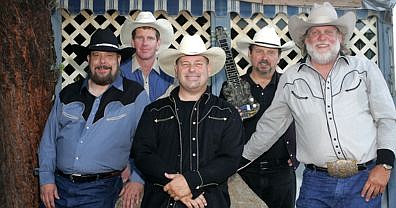

Are the majority of country-western songs built on heartache and misery? “I would say it drives a lot of the genre, for sure,” says Bob Ryan. “Just like blues. A lot of times you get the blues by having hard times. So, I think country is similarly driven by drinkin’, heartache, and being lonely.”
Ryan has been a country-western guitarist for over 30 years. His band the California Rangers play honky-tonk old-time country music, mixing in some bluegrass, Western swing, and rock and roll. Tom Boren founded the Rangers more than a decade ago. Their specialty, says Ryan, is old-school country from the ’50s and ’60s. Their instruments are standard country-band issue: stock Fender guitars and amps for that clean twang, electric bass guitar, drums, and pedal steel.
“We’re known as a shuffle band. A country-shuffle band. It’s an elusive rhythm that if not done right is pretty sucky.” In fact, he says that country can be trite when it’s not done justice. “It’s a simple form,” he says, “and if all the ingredients are not proper, it can be lame.”
But, shuffle? “A walking bass line with a little backbeat. We don’t do new country.”
Honky-tonks are bars that specialize in country music. And, with few exceptions, the honky-tonk tradition has all but withered away in San Diego. “Venue-wise, it’s never been real popular, but back in the ’80s we did have a circuit that we played quite regularly. But that went away.”
Why? In part, due to the rise of modern-country star Garth Brooks, says Ryan. “We call him the anti-Hank.” He laughs. He points out another factor.
“When the drinking laws went to .08, overnight I saw the party end. I watched it happen to country, but in general it just kicked clubs’ asses. You don’t need people drinkin’ and drivin’ home, but that really kind of hurt. The club scene kinda went away after that.”
In addition, “The DJs definitely affected the circuit,” says Ryan. “When the line-dancers started asking for songs [like the Cotton Eyed Joe or the Two Step] instead of for artists like Willie or Merle, that hurt the scene. The crowd didn’t care if it was live or recorded. They just wanted the right groove to dance to. It seems like everything has been dummied down.”