
Sponsored
Sponsored





The Death Ship Comes Alive
When the crew of the San Diego heard they were finally going home, relief erupted. “They thought they might have a few more days to live,” writes Father Antonio Ascensión, “than if they continued onward.”
Sebastián Vizcaíno’s expedition had come apart. On May 5, 1602, three ships sailed north from Acapulco to explore the upper California coast. By January, one of the worst outbreaks of scurvy ever reported had decimated the crews. The Santo Tomás headed south, and the frigate Tres Reyes disappeared near Cape Mendocino. When it eventually reached Acapulco, only five men had survived.
Vizcaíno held a council off Cape Mendocino on January 7. The San Diego must turn back, all agreed. Only two sailors were hale enough to climb the mast.
If prevailing northwest winds held true, they’d speed south to Acapulco in a month. But on January 13, a fierce southwest wind and slashing, horizontal rain blocked their progress. On the 17th, a heavy swell jolted the San Diego with such ferocity, the ailing crew tumbled from their bunks and slid across the deck. Vizcaíno slammed against wooden boxes and broke two ribs.
The expedition sailed as much by omens as navigation. Miracles — as when brackish water turned fresh — became emblems of approval. But now the signs were confusing. Once the council decided to return home, a contrary wind and powerful current shoved them north. A “trough of sea” leading northward seemed by design. Only one answer made sense: something, some unseen force, must be steering them toward the mythical Strait of Anian.
Since Columbus had proved the world was round, cartographers assumed that the globe’s upper half would resemble the lower. The southern half had the Strait of Magellan. Therefore, the northern half must have a water route — a Northwest Passage — from the Pacific Ocean to the Atlantic. The connecting link became known as the Strait of Anian.
The mysterious current drew the San Diego toward dark forests and snow-covered, volcano-like mountains. “The seas were carrying us rapidly to the entrance,” Vizcaíno declared. If he found the strait, his expedition would rival Columbus’s. The biggest miracle of all would bless Vizcaíno, and his name would live forever.
On January 19, the wind shifted. Now, to reach the entrance, the San Diego would have to battle severe northwest winds. But cold weather made the rigging stiff, and Vizcaíno didn’t have enough sailors. “If on this occasion there had been even 14 sound men,” writes his diarist, “without any doubt we should have ventured to explore and pass through the Strait of Anian, since all were of good courage to do this.”
But only six men could still walk. Instead, Vizcaíno ordered the ship to unfurl the sails and return to Acapulco. If they remained a day longer at that latitude, “the whole crew would die.”
There was no Strait of Anian. But years later, when Ascensión published his account, he advocated two myths: that California was an island; and that a healthy expedition would have sailed the strait and “gone to Spain and their King, by a route never before seen or discovered, making a turn around the world.”
As with Vizcaíno’s overpraising of Monterey as a harbor, writes Michael Mathes, Ascensión’s belief in the strait confused “the cartography of Northwest America for almost two centuries.”
On the voyage north, to avoid unseen rocks, the expedition sailed 20 to 30 miles offshore. On the return, to shorten the trip, the San Diego skirted the coast. But no one saw San Francisco Bay, coming or going. It could be that, most of the year, the narrow inlet was fogged in, or that the able few on deck needed their eyes to watch the rocky coastline, and tried to shut their ears from the agonies below.
Father Ascensión, on his bunk, unable to move, heard scurvy-riddled comrades shouting complaints or “deploring their sins.” Every bone felt broken. Ulcerated mouths and gums swollen “larger than their teeth” prevented them from chewing or swallowing whole food. Teeth loosened and fell out. Those able to move at all fed the ailing with gruel made from rotten provisions. Some died while eating. “To see so many dead,” wrote Ascensión, “to hear such cries and lamentations would move the very stones to compassion and pity.”
On January 25, the San Diego passed Monterey but couldn’t stop. If they lowered the anchors, there weren’t enough strong men to haul them back up. The ship was now in a race with death.
On the voyage north, the chief of the Chumash at Santa Barbara had promised each soldier ten women. As the San Diego sailed through the Santa Barbara Channel, the council ordered Vizcaíno not to stop. “The men were dying at a great rate,” writes Ascensión, “and if what he wished was done, they would all finish here.
“God, our Master, would be offended,” added Ascensión, “in allowing them to die.”
Vizcaíno ordered his chief pilot, Francisco de Bolaños, to bypass Catalina and San Diego Bay and sail straight for Cedros Island, off Baja California. Near the Coronados, the winds died. Since only a few sailors could steer the ship or climb the mainmast, the San Diego lost momentum. It crept past Ensenada so slowly that natives gathering onshore didn’t know what to think: the big canoe — the “whale with wings” — barely moving, muffled cries and shrieks from within, dead bodies heaved over the side. Some of those handling them howled as well.
Onboard, supplies were running out. They must stop for water or perish.
A fresh northwest wind wafted them toward Cedros. On February 6, Vizcaíno dropped a “light anchor,” the ship’s smallest, into the warm water at the island.
Back in October, against the viceroy’s demand not to harm natives, Vizcaíno’s soldiers had shot and killed several at this spot. The natives remembered. Now, when Vizcaíno went ashore with six debilitated sailors to dig a water hole, an angry band appeared with bows and arrows painted blood red. Some played a warlike tune on flutes.
The Spaniards fired their arquebuses “through the air,” writes the diarist, without saying how high they aimed. The natives fled.
On February 9, able to gather only “12 quarters” of water (the ship could hold over 200), Vizcaíno cut the cable to the light anchor and ordered all possible speed to Cabo San Lucas.
On and below-decks, the San Diego was a death ship. Because their mouths were so ulcerated they couldn’t chew the foul food, the sick were dying of starvation. At least 45 men writhed in bunks or blankets on the floor. Their shouts blurred into babble. The smells — death, excrement, decaying food, and human skin — fogged the air. As in times of plague, the dead became the most common sight. Comrades on a long, dangerous voyage blinked out. And most of their fellows were too far gone to mark the passing.
When the San Diego reached Cabo San Lucas, writes Ascensión, “not six were able-bodied.”
On February 13, Vizcaíno held his final council. The expedition had planned to go to La Paz, on the east coast of Baja, and await new orders from the viceroy. But they couldn’t. The men were “so sick and exhausted,” writes Vizcaíno’s diarist, “if the anchor were cast, the ship would not be able to leave.”
From the start, the council made all decisions (they had to, says his boatswain, Gonzalo de Francia, because Vizcaíno “could neither plan nor execute”). While some wanted to sail straight to Acapulco, the majority urged a mad dash across the “Vermillion Sea” — the Gulf of California — to the nearest point of the mainland: the islands of Mazatlán. From there, Vizcaíno would take a scouting party to a village called San Sebastián, said to be six or eight leagues inland, though no one knew for sure.
On February 17, the San Diego anchored off Mazatlán. Two days later, with the ship securely in place, Vizcaíno and the five most able men rowed to the mainland. Vizcaíno’s ribs were wound and braced, and his health, says one account, was “ruined.”
None knew where the village was, and they found no trail. After walking at least 13 leagues, over mountains and through thick jungles, they became lost.
Two days later, they came upon a small, meandering road. Exhausted, baked by radiant heat, they rested under trees, half expecting to perish in the shade. Down the way, they heard a strange tinkling.
Mule bells! A muleteer and his train were en route to a village called Culiacán. After he unloaded his goods — edibles and clothing from Castile — he promised to take Vizcaíno’s party to San Sebastián. When the mule master gave them tortillas, fruit, and wine, they dined like epicures.
A day later, the group reached San Sebastián, whose mayor, Martin Ruiz de Aguirre, was an old friend of Vizcaíno’s. Aguirre ordered a supply train with a cornucopia of blessings: chickens, veal, vegetables, bananas, oranges, lemons, papayas, generous amounts of bread and wine. Every third day, Aguirre added, he would send six more loads to the coast.
Those who remained onboard, writes Ascensión, were “more dead than alive.” All, including Ascensión, became convinced their death loomed just ahead.
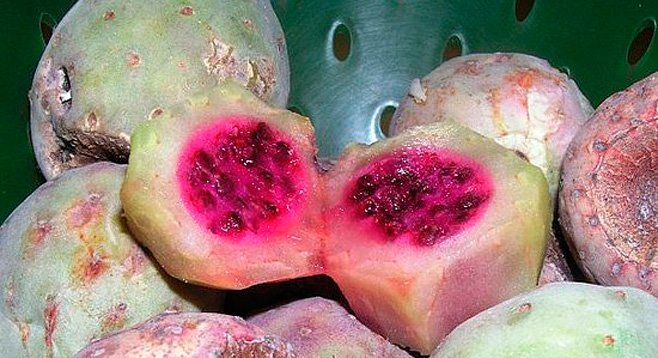
Shortly after Vizcaíno left, corporal Antonio Ruiz and one of the friars rowed the launch ashore to bury dead bodies. After the father said Mass, Ruiz noticed a longish yellow fruit, like a prickly pear. He plucked one from a stem holding at least 100. Since he suffered from scurvy, Ruiz could barely open his mouth.
He took a bite of the white pulp — the pleasing taste both sweet and acidic — and his gums started to bleed. One astringent mouthful began to lacerate the ulcers.
Another bite cleansed the infected areas. Ruiz began coughing. Then he spat out “all the bad blood collected in the swollen gums.”
“Eating it twice,” writes Ascensión, “put the mouth and teeth in such condition that one could eat any other kind of food without difficulty or pain. If this fruit had not produced this effect, the fresh food that came could not have been eaten or passed into the stomach.”
Ruiz loaded the launch to the gunwales with the fruit called xoconostle. As he and the padre rowed back to the ship, those onboard thought Ruiz had gone mad. His ravings rippled across the water. That he could speak was strange enough. And if what they could make out was true, Ruiz was blithering about a “milagro” — a miracle!
“All ate [the fruit] and found themselves much improved,” writes Ascensión. Neither “doctors nor surgeons” brought about the miracle, “nor by any human remedy understood to be a medicine given in this disease.” It came from “Our Lady, the Virgin María del Monte Carmelo.”
When Vizcaíno reached the coast with the supply train, he expected the worst: the San Diego reeking of death and corpses everywhere.
Instead, sailors “in good spirits” waved at him. He saw smiles where mouths had been bloated with ulcers. He heard something no one had in months: laughter. Many of the near-dead were up and around, climbing the mast or swabbing the deck. Vizcaíno, writes his diarist, “was much amazed.”
The crew fed, drank, and rested for 19 days. By the time they reached Acapulco, on March 21, most had recovered enough to perform chores on the ship.
When the San Diego arrived, “all the inhabitants were surprised to see how well and sound all on board her were.” Given what sailors on the Santo Tomás had told them, they’d thought “they would never see her again.”
Back in Mexico City — even though he broke almost every one of the viceroy’s demands and lost at least 48 men — Vizcaíno urged another voyage. Instead, the viceroy named Vizcaíno commander of the next galleon headed for Manila. But a new viceroy appointed shortly after, the Marquis de Montesclaros, countermanded the order. Vizcaíno was too inept for such a challenge.
Montesclaros said Vizcaíno tried to bribe him and charged the cosmographer, Geronimo Martín Palacios, of forging the king’s name to his credentials. The viceroy made Vizcaíno mayor of lowly Tehuantepec, which was “as much as he deserved.” He ordered Palacios hung.
Writing almost two decades later, Father Ascensión praised the expedition: “They accomplished with such labor and fatigue an enterprise so difficult that, of the five or six times in which it had been tried, none had accomplished…even the half of it. Those who went on this expedition can very well be proud.”
Others, including the new viceroy, saw no achievement at all. New Spain ceased official exploration of the California coastline for over 160 years. ■
QUOTATIONS
SOURCES
Chapters: 1: Galleon | 2: Assault | 3: Vermilion Sea | 4: The Crews | 5: Water | 6: San Diego | 7: The Bay | 8: Scurvy