

Here's something you might be interested in.
Ask a Hipster — Advice you didn't know you needed
Big Screen — Movie commentary
Blurt — Music's inside track
Booze News — San Diego spirits
Classical Music — Immortal beauty
Classifieds — Free and easy
Cover Stories — Front-page features
Drinks All Around — Bartenders' drink recipes
Excerpts — Literary and spiritual excerpts
Feast! — Food & drink reviews
Feature Stories — Local news & stories
Fishing Report — What’s getting hooked from ship and shore
From the Archives — Spotlight on the past
Golden Dreams — Talk of the town
The Gonzo Report — Making the musical scene, or at least reporting from it
Letters — Our inbox
Movies@Home — Local movie buffs share favorites
Movie Reviews — Our critics' picks and pans
Musician Interviews — Up close with local artists
Neighborhood News from Stringers — Hyperlocal news
News Ticker — News & politics
Obermeyer — San Diego politics illustrated
Outdoors — Weekly changes in flora and fauna
Overheard in San Diego — Eavesdropping illustrated
Poetry — The old and the new
Reader Travel — Travel section built by travelers
Reading — The hunt for intellectuals
Roam-O-Rama — SoCal's best hiking/biking trails
San Diego Beer — Inside San Diego suds
SD on the QT — Almost factual news
Sheep and Goats — Places of worship
Special Issues — The best of
Street Style — San Diego streets have style
Surf Diego — Real stories from those braving the waves
Theater — On stage in San Diego this week
Tin Fork — Silver spoon alternative
Under the Radar — Matt Potter's undercover work
Unforgettable — Long-ago San Diego
Unreal Estate — San Diego's priciest pads
Your Week — Daily event picks
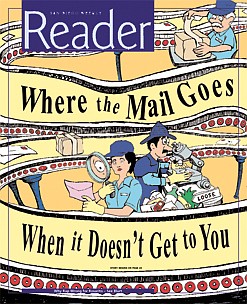
The Green Monster, Barney, and Spibs move letters at the San Diego Post Office
Where the mail goes when it doesn't get to you
"It was an envelope from the bank, with four checks in it, and I was on my way to the bank."
Maria Sandstrom gets four personal checks every week from four sets of parents for watching their children.
"But then," she says, "that day, for some reason, my brain took a twist, and I ended up at the post office. I went past one of those drive-through mailboxes. And as soon as I dropped it in, I realized that I'd made a mistake."
Sandstrom had "mailed" her blank San Diego County Credit Union deposit envelope at the Carmel Mountain post office. But it was 7:00, Friday evening, and the post office was closed.
"So I got up first thing the next morning," Sandstrom says, "and drove down, but they couldn't help me. They said the person wasn't there yet, and I didn't have time to wait either, so they gave me a phone number to call and said wait about two hours. So I called after two hours, and they told me they hadn't found anything yet. And they gave me another number to call. So I waited, and I called the other number, and it was a recording. My heart sank. I thought, 'This is it, nobody will get my message.' So I left my information on the answering machine, and I thought that was it. But then, about two hours later, a lady called, and she asked me to go over all the details with her."
That night, Sandstrom decided to take the Zen route.
"I decided there was nothing more I could do," she says. "It wasn't under my control. I went about my business. I came home. I went to bed. I woke up in the morning. I did my thing. And then they called me. They told me they'd found my envelope, and I needed to come down to the post office and describe what was inside. So I showed them my ID, and I got my checks back. The very next day, I got them back."
It's Thursday morning, and we're making our slow way around the outskirts of the mailroom floor. Lori Ferguson-Costa, San Diego's loose-in-the-mail clerk, wheels a bin from green mailbox to green mailbox, stopping to empty each one. The green mailboxes bear the words "Loose Mail."
Inside the green mailboxes, various unsendable items have come to rest over the course of the night and the previous day. By this morning, each box contains dozens of cards, tools, toys, electronic devices, keys, and letters that have fallen out of their envelopes.
"The mail carriers and the guys working in the plant gather all this loose stuff inside these green mailboxes whenever they find it," Ferguson-Costa explains. "Like this little bundle with a rubber band on it probably came from a mail carrier's route, and he just got it all together and made sure it found its way to us. And then these driver's licenses probably came loose in the machinery in this room." Ferguson-Costa says the Department of Motor Vehicles sends licenses just fine; they only come loose when people mail them in envelopes.
Trailing behind Ferguson-Costa, another fellow walks along with us, name of Robert Cleveland.
That's Ferguson-Costa and Cleveland, the postal detectives for the San Diego post office.
Cleveland is the old hand, 21 years on the job. And by now he wears glasses, and his hairline has receded to the very top of his head, which suits him. Like a kingly bird, a cardinal maybe, with a kind of mask and a high crest. He's intense, athletic, smallish, and moves well in socks and sneakers. He has on shorts, a short-sleeved shirt, a watch, eyeglasses, and the blue apron of the United States postal worker.
And Cleveland is full of information.
"Mail and trash are different," he says. He has that same tone as your favorite high school teacher. "Mail is never trash. Once something enters the mail system, it becomes the responsibility of the U.S. government. Eventually, loose bulk paper does become waste mail, but at that point it gets recycled."
Cleveland is the rewrap clerk. He's been the rewrap clerk since 2001. His work is to reunite loose mail with the ongoing "mail flow."
"Rewrap is a solitary job unless I need something or unless someone else needs something," Cleveland says. "Otherwise, I spend most of my day getting as much as I'm absolutely sure of back in its package, securing the package up, and getting it back into the proper mail flow so that it gets delivered."
Cleveland's rewrap alcove looks out on the Spibs machine (the small parcel bundle sorter) and the FG-1 sack sorter. In the morning, he comes to work, goes to rewrap, and sees what has come in overnight. Broken parcels, busted boxes, opened letters. Then he makes his tours around the floor.
"If I've got a box with two cans of Campbell's soup in it, and there's two loose cans of Campbell's soup somewhere, then that's an easy one," he says. "Or sometimes, I've got a set of jewelry, and Lori's got a ring that matches some earrings in an opened box. That's an easy one too."
Now Ferguson-Costa chimes in.
"We got a thank-you card just last week," she says, "from someone who got their insurance papers. They wrote, 'Keep up the good work.' And I thought, 'See? We are good for something.'
"But I also have a whole photo album full of really old pictures," Ferguson-Costa goes on. "And somebody's missing that. This is something that can't be replaced. And that's kind of sad. I'm just holding on to it in the office. I have no idea where it's supposed to go."
The Margaret L. Sellers Processing and Distribution Center on Rancho Carmel Drive -- San Diego's main post office -- covers 662,000 square feet (15.2 acres). And most of that incredible area, the vast majority of it, in fact, is one big room. One great room, probably the biggest room you've ever seen. Standing inside the main mailroom in San Diego, if you can see past all the machinery and packages and postal equipment, you might just about make out the curvature of the earth.
It's big enough to play eight football games at once, but instead the room houses a few mostly silent workers and hundreds of whirring machines. They process, cancel, oversee, and sort every single item of raw collection from every single mailbox and every single mail station in over 100 zip codes -- somewhere around 900,000 pieces of mail each day. That's enough post to build a cardboard and paper city way bigger than Legoland in less than a week.
Sundays and holidays are light days, to be sure, but there is no need for locks on the doors at the Margaret L. Sellers facility. The 1700 employees work 24 hours a day, 365 days a year, in three duty rotations. They use giant machines called the Green Monster, Barney, Spibs, and the Robot.
Mail comes in at the docks, gets loaded onto long conveyors and dropped into deep bins, is conveyed along its proper routes, and then gets carried out to the docks again. Yet somehow, despite this hasty circulatory activity, there is nothing but a certain easy serenity pulsing through the place.
Maybe 150 people work the mailroom this Thursday morning. But I can't see more than 2 or 3 of them at a time. And no one is sweating or yelling or rushing around frantic or anything. No one is even speaking, except for Cleveland and Ferguson-Costa. Otherwise, all you can hear is that overlying calming thrum. Down the long rows of machinery, along every sight line under the hanging lights and high ceiling, it's orderly, slow, easy, despite 900,000 pieces of mail proceeding rapidly past me.
The 11 AFC/OCRs (advanced facer canceler/optical character readers) are taking care of 13 pieces of mail per second, each. That's 46,800 pieces per hour, times 11 machines, equaling a fantastically awful lot of mail. The machines turn the letters face up, cancel them, sort them, check them for biological weapons, and then send them to automation. They can even read handwriting. Then more than 60 automation machines sort the mail by country, state, county, city, and then, if the mail is destined for San Diego, by carrier route, right down to the most efficient walk sequence.
In another corner, the FG-1 sack sorter and Spibs take care of packages using alien-looking robot arms and automated mechanical cranes dipping into bins lined up like huge cages.
The purple winding chutes of Barney and the green winding chutes of the Green Monster snake around like long angular slides in a water park.
And the mail moves along. And moves along. And moves along. And moves along.
Cleveland and Ferguson-Costa taking me to room 199A is like my grandmother taking me up to the attic, except there's way less dust.
And instead of creaky steps past family photos, we walk on concrete past forklifts, electric pallet jacks, and tow motors. We go through automation, the empty equipment area, collection mail processing (operation 010), the back dock, the postal address redirection staging area, the sack sorter area, the sack sorter dumping area, the AFC/OCR, and, finally, near the registry, we reach the "attic," the lost mail room, room 199A.
Room 199A is a small cage, say, 12 feet by 14 feet. It has a heavy door, a desk, a stool, and eight shelves of bins full of stuff. Right when you open the door, you notice it has that flea market slash garage sale kind of feel.
Food, jewelry, prescriptions, books, pens, DVDs, sports gear, cell phones, masks, a snow globe, toiletries, cassette tapes, pet accessories, games, auto equipment, luggage, batteries, posters, gift cards, IDs -- there's an almost inexhaustible mélange of human effects -- all of it intended to go somewhere else, but none of it now getting past the confines of room 199A.
Ferguson-Costa dons blue plastic gloves and a blue apron, and she starts to sort the day's loose stuff.
She opens unmarked envelopes, picks and sorts through them, and comes up with 30 to 40 personal checks, 50 to 60 driver's licenses, dozens of CDs and DVDs, money, photos, books. Over 500 loose items, by our estimates, on just an average Thursday morning in San Diego.
Percentagewise, not bad. Just 500 loose things out of 900,000 pieces of mail. But still, it's 500 loose things. In one day. That's 1000 disappointed people, give or take.
How is this possible? How can our American populace make so many mistakes? I ask Ferguson-Costa and Cleveland for their intuitions on the subject.
"Sometimes people are in a hurry," Ferguson-Costa says.
"Ignorance" is Cleveland's matter-of-fact take. "People don't know any better. How do you package something up so it will be delivered in good condition? It's amazing how people will put something in an envelope and just expect it to get there. They don't take their time and do it right."
But it isn't just human error and machine error that cause loose objects to trickle their way into the mail.
"Sometimes," Ferguson-Costa says, "it could be that when people find someone else's stuff and they don't know what else to do with it, they just drop it into the mailbox. Then it becomes our responsibility."
"I should have put it in a padded envelope," Nancy Drake tells me. "But I didn't do that. So I take the blame."
Nancy Drake had sent a Visa gift card to a family friend, a gesture of thanks from Drake and her husband for helping with some messy work on their rental house. A $200 gift card and a thank-you note, in an envelope, from Carlsbad to Oceanside. She figured it would get to the friend in about two days.
A week later, the friend still hadn't received it.
"I called the post office," Drake says, "and they told me they couldn't do anything until it had gone missing for two weeks. Fourteen days. And that's 14 workdays. I called the 1-800 number, and that's what they told me."
(Incorrect! Incorrect! The phone number for the local loose-in-the-mail unit on Rancho Carmel Drive is 858-674-0561. And if you get a recording while the office is open, that's because Ferguson-Costa is running around collecting or filing loose-in-the-mail items. She'll check for messages when she gets back in and return your call.)
"So that was a long two weeks," Drake says. "More like three weeks. But after that time, I filed a form saying what I'd lost."
Then, finally, the following Monday, Drake got a phone call.
"They told me they'd found my card," she says, "and I could come down and pick it up. They had the card -- no envelope, no note or anything, just the card itself. I was so thrilled to get it back. I didn't think I would."
But not all folks find what they've lost.
"I have a pretty good idea that I lost my keys close to our mailbox," Bob says. "So one of the first things I did was go to the post office to see if they had them."
Bob won't let me use his last name. "I would worry," he says. "Because if somebody did connect my house and my car with those keys..."
Bob goes on. "Anyhow, I've never lost my keys before," he says. "I have a specific routine whenever I come home. I pull the car in the garage, walk back out and check the front-door area to see if there's any packages, then I walk down to the mailbox and get the mail, then I bring in the garbage pails if I have to, and then I go back through the garage and go in the house."
But on the day in question, somewhere between the locked mailbox (where he needed his keys) and the time that night when his wife mentioned that her garage-door opener wasn't working, Bob's keys had gone missing.
"I went out to the garage to fix the wife's opener," he says, "and I went to get my keys, and I found out, 'Hey. They're not there.' They're usually on the table in the computer room."
Bob admits that his keys might be in the house somewhere, that they may have gotten shoved into a crack or fallen behind a cushion. "The fact is, I don't really have any idea where they are," he says.
It was about a week later when Bob went to the post office.
Turns out, the post office serves as a kind of nationwide lost and found. Because that's what Good Samaritans do when they find something they don't want to keep or sell. They bestow it upon the post office.
"That's what my mail carrier told me," Bob says. "He told me if people find stuff and they don't know what to do with it, then they put it in the mailbox. And then it goes up to the main post office, and you have to look for it up there."
Then Bob asks me, "Have you been over there to that office? And seen all those keys? Isn't that unbelievable?"
The loose photographs, glasses, keys, and empty wallets at the main post office aren't kept in room 199A. They're stored separately, up near the front door, near Ferguson-Costa's desk. That way, people can sift through the boxes and look for their lost items themselves.
"They didn't have my keys there the first time I checked," Bob says. "They told me sometimes it takes a while before things go through the system."
But Bob hasn't given up hope just yet. "I'm going to go down and look for them again in a few days. We'll see."
How do postal detectives do their detecting? What do they do with letters that have partial addresses or illegible handwriting?
"We use all resources that are available to us," Ferguson-Costa says, "such as the Thomas guide, phone book, 411, and the Internet. If we are not sure of a zip code, we use the USPS website that is available to the public. As far as illegible handwriting, we don't have a special technique to determine what the envelope says; we just use our own abilities.
"Some items such as packages that come into the office but do not have an address may have a contact phone number inside that we will use to contact the customer. There are some envelopes that may come in with a metered strip for postage, even though the envelope isn't addressed. We send those to the business entry office to determine who mailed it. There's an account number that's listed on the postage metered strip. What we do then is return it to the customer who mailed it."
If a loose payroll check contains the full address of the employee, then Ferguson-Costa will place it into an envelope with a mailing window, put a new stamp on it, and send it on its way. If a loose personal check has only the return address of the sender, then she'll return it. "We send checks and driver's licenses out the same day that we get them," Ferguson-Costa says. "Those get priority. And they're also the easiest items to deal with, usually, because they have the addresses right on them."
Other items, however, require other protocols. Keys and photos are held indefinitely. Medicine is kept for two months and then thrown away. Items under $10 in value are also held for two months and then discarded. Porn, drugs, and other contraband are sent to the postal inspectors. And the rest is stored for two months on shelves in room 199A before it's packaged up and sent to the St. Paul mail recovery center to be auctioned.
"The shelves are marked by the month when the stuff came in," Ferguson-Costa points out. "And if we can't tell where something goes, and no one comes to look for it, then all we can do is send it to be auctioned."
Ferguson-Costa spends most of her workdays in front of her computer, filing spreadsheets of items that she's found and filing reports from people who've lost things. Whenever a new report of a lost item gets onto her desk, she looks into her archives and sees whether the item is there. "Sometimes I remember an item specifically," she says, "and I'll know exactly where it is. And other times the computer helps me remember."
Used to be the job was called "inspector of dead letters." Then, 215 years into the history of the U.S. post, they changed the name to "manager of the U.S. Postal Service mail recovery program." Doesn't exactly roll off the tongue, but I guess they figured it sounded more, well, friendly.
By the same token, from 1777 to 1992, the place where the inspector of dead letters worked had been known as the dead letter office. But then the United States Postal Service adopted the gentler, more politically correct, mail recovery center.
So. Manager of mail recovery, or inspector of dead letters? Either way, the job is filled nowadays by Susan Tedrick, at her office over in Washington, DC.
Okay. Forget the cute name change. By the time it gets to Susan Tedrick, the mail is dead, isn't it?
"No," Tedrick says, "the mail isn't dead. We're looking at it with the intention of reuniting it with the person who mailed it or getting it on to its intended location. Auction is the very last resort. You have to dispose of things at some point; you can't hold on to them forever. But we do keep the more valuable stuff indefinitely, just in case someone comes looking."
Tedrick's office is in DC, but St. Paul, Minnesota, and Atlanta, Georgia, are the locations of the country's two mail recovery centers.
"We have 75,000 square feet in Atlanta and 35,000 square feet in St. Paul," Tedrick says. "We handle both letters and parcels. We have automated equipment on the letter side of the house that can identify if there's contents of value, like checks, money orders, cash, or anything that has a type of magnetic signature. They are then opened up by an employee and checked to see if it does, in fact, contain value. The only ones who can open mail are the folks in the mail recovery center and, at the local level, the clerks in the lost-in-the-mail unit."
Tedrick makes an estimation. Aside from the two recovery centers, there might be somewhere in the vicinity of 269 lost-in-the-mail units in the country, she thinks, since there are 269 mail-processing plants nationwide. That's 269 plants in 80 postal districts, from sea to sea. There are two plants in the Southern California district, covering four counties, and two loose-in-the-mail units, one in each plant.
So the 269 or so local loose-in-the-mail units try to figure out where a loose item should go. After a couple of months, they pass the buck (and the loose stuff) to one of the mail recovery centers. Then after 90 days of trying to reunite the items with their owners, the center in Atlanta holds an auction for unclaimed objects.
Tedrick tells me 200 people might show up, twice a month, to bid on things that don't get spoken for. That's 200 of the same kinds of folks who troll the beaches with metal detectors. The same individuals who sit behind fold-up tables at flea markets. Or, nowadays, the same ones who sell loads of stuff on eBay.
Tedrick says the auction lots begin at minimum dollar values, but they sell for as much as people are willing to bid. And sometimes it's many hundreds of dollars per bin. These are full hampers of stuff, Tedrick stresses, and you can see only the top items in any bin. The rest is "kind of exciting and a lot of guesswork."
Tedrick tells me that her office deals with only "one tenth of 1 percent," or .1 percent, of all mail sent and received in the United States. "That's total undeliverable mail. And items loose in the mail make up a percentage even smaller than that. It's negligible."
But then she acknowledges that it isn't quite perfect. "Our mission is to search for, recover, deliver, or return undeliverable mail nationwide to guarantee customer satisfaction."
Lori Ferguson-Costa has been the loose-in-the-mail clerk since July 2006. Before her, Janna Dujong did the job a couple of months on a fill-in basis. But before Dujong, from 1990 to 2005, it was Joanne Gardinier.
Gardinier was a postal worker for 30 years, all told, and she almost gave both of her hands to her job. "I've had a nerve in my elbow replaced, and I have trigger points in both my thumbs," Gardinier says. "All that repetitive work for all those years with my hands."
On the telephone, Gardinier knows the drill. She's eager to talk. She starts telling me about stuff she's found in the mail even before I start asking her about it.
"Handcuffs and shackles," she says. "The real thing. No packaging, no address. I called the sheriff's department, and the policeman who came to pick them up asked me, 'So where's the guy who belongs on the other end of these?' And I said, 'That's your job. I found the cuffs.' It was kind of funny."
She chuckles. Then goes on to another story.
"Here's another interesting one," Gardinier says. "DEA agents had mailed a map in this tube -- I guess they were scoping this house out for drugs -- and the tube had come open in the mail, and the map fell out. So I looked at the map, and it had 'DEA' on it and this house and the address. So I couldn't send it to the house's address because I knew that would probably blow the whole operation. So I contacted the DEA, and sure enough, they came and picked it up."
So much human error. So many people's mistakes.
But no. Gardinier paints a different picture. It isn't just people who are to blame.
"There's a lot of mail that goes through the system," Gardinier explains, "and I think people don't understand now that everything is automated. Rarely does a person now touch the mail. So packages that used to be safer a long time ago, now there's a lot of machinery that comes into play. People will send heavy things or small packages with sharp objects, and they'll send these things the cheapest rates, which isn't always a good idea because all you have to do is have one heavy parcel roll over on a little tiny one and it breaks it open. And sometimes the price difference in a small parcel like that, you're better off sending it first class."
What else might we do to lessen the chances of such mistakes?
"Valuable items should be sent registered mail," Gardinier says. "There was an urn once that was 18-karat gold and it was engraved and it was real old, and something like that should never be sent by regular mail. It should go registered, and that way it never hits automation. And there's no chance of it breaking open on a belt when it's going up. Instead, whenever anyone touches it, they have to sign for it."
And what happened to the loose urn?
"It stayed up in mail recovery for over 20 years," Gardinier says. "Unclaimed. They wouldn't auction it, of course. And we finally all got together, the folks in the post office, and we gave it a proper burial."
Did Gardinier ever get gifts or money for her detective efforts?
"We can't take anything over a $10 value, but we'd get flowers and candy, yes. And letters. I had so many letters and compliments. There was one lady, and I was crying with this one. She was sending her last pictures of her four-month-old baby to her mother. The baby had passed away from sudden infant death syndrome. So those were the last photos taken of her baby. And I still get emotional when I think about it. But the pictures were lost, and we found them. I found them, and they got to her mother. In fact, they did a story on 60 Minutes about sudden infant death syndrome, and she was on it, and she said on the show how great it was that we found her pictures, because they were the last ones taken of her baby."
A touching story. But not the only touching story she tells.
"We had a military tag from 1826," Gardinier says. "It was an antique. And someone had put it into a regular envelope. Well, automation, and it's a quarter inch thick, so the machine thinks it's a letter and it makes a 160-degree turn at a really high rate of speed. So anything hard that doesn't have the flexibility of a credit card, it jams the machine, which then pushes the hard item right out of the envelope. Well, I think somewhere back East, or wherever the military tag was going to, they got the empty envelope. Because the envelope goes on, through automation, because it still has the address. So somebody back East sent faxes out, nationwide, to lots of post offices, because it was such an antique and such a sentimental item. So we found it in San Diego. I found it. And it was engraved and just such an interesting item. And I was able to get it back to its owner."
Gardinier reflects a moment.
"Compared to the amount of mail that comes in the building, the amount that gets lost is practically nothing." Gardinier is echoing Tedrick's claim. "But it can be so important. And how do you tell someone, 'Sorry, but yours was the one thing lost in a million'?"
She goes on, "And a lot of stuff isn't something that was lost in the mail but something people inadvertently dropped in. Like bank deposits. Or one time, we got 26 $100 bills. And this woman's husband told her, 'You can kiss that money good-bye. The post office is never going to give that back.' But we found her, and we got the money back to her because she had a deposit slip in the envelope. And she was ecstatic. She said, 'You've restored our faith in the postal service.' "
Did Gardinier think of herself as a detective?
"Yes," she says. "That's pretty much what you have to be. You follow leads. You follow your instincts. You have to want to get something back to someone. You have to have good common sense, and you have to care.
Here's something you might be interested in.
The Green Monster, Barney, and Spibs move letters at the San Diego Post Office
Where the mail goes when it doesn't get to you

The Green Monster, Barney, and Spibs move letters at the San Diego Post Office
Where the mail goes when it doesn't get to you
"It was an envelope from the bank, with four checks in it, and I was on my way to the bank."
Maria Sandstrom gets four personal checks every week from four sets of parents for watching their children.
"But then," she says, "that day, for some reason, my brain took a twist, and I ended up at the post office. I went past one of those drive-through mailboxes. And as soon as I dropped it in, I realized that I'd made a mistake."
Sandstrom had "mailed" her blank San Diego County Credit Union deposit envelope at the Carmel Mountain post office. But it was 7:00, Friday evening, and the post office was closed.
"So I got up first thing the next morning," Sandstrom says, "and drove down, but they couldn't help me. They said the person wasn't there yet, and I didn't have time to wait either, so they gave me a phone number to call and said wait about two hours. So I called after two hours, and they told me they hadn't found anything yet. And they gave me another number to call. So I waited, and I called the other number, and it was a recording. My heart sank. I thought, 'This is it, nobody will get my message.' So I left my information on the answering machine, and I thought that was it. But then, about two hours later, a lady called, and she asked me to go over all the details with her."
That night, Sandstrom decided to take the Zen route.
"I decided there was nothing more I could do," she says. "It wasn't under my control. I went about my business. I came home. I went to bed. I woke up in the morning. I did my thing. And then they called me. They told me they'd found my envelope, and I needed to come down to the post office and describe what was inside. So I showed them my ID, and I got my checks back. The very next day, I got them back."
It's Thursday morning, and we're making our slow way around the outskirts of the mailroom floor. Lori Ferguson-Costa, San Diego's loose-in-the-mail clerk, wheels a bin from green mailbox to green mailbox, stopping to empty each one. The green mailboxes bear the words "Loose Mail."
Inside the green mailboxes, various unsendable items have come to rest over the course of the night and the previous day. By this morning, each box contains dozens of cards, tools, toys, electronic devices, keys, and letters that have fallen out of their envelopes.
"The mail carriers and the guys working in the plant gather all this loose stuff inside these green mailboxes whenever they find it," Ferguson-Costa explains. "Like this little bundle with a rubber band on it probably came from a mail carrier's route, and he just got it all together and made sure it found its way to us. And then these driver's licenses probably came loose in the machinery in this room." Ferguson-Costa says the Department of Motor Vehicles sends licenses just fine; they only come loose when people mail them in envelopes.
Trailing behind Ferguson-Costa, another fellow walks along with us, name of Robert Cleveland.
That's Ferguson-Costa and Cleveland, the postal detectives for the San Diego post office.
Cleveland is the old hand, 21 years on the job. And by now he wears glasses, and his hairline has receded to the very top of his head, which suits him. Like a kingly bird, a cardinal maybe, with a kind of mask and a high crest. He's intense, athletic, smallish, and moves well in socks and sneakers. He has on shorts, a short-sleeved shirt, a watch, eyeglasses, and the blue apron of the United States postal worker.
And Cleveland is full of information.
"Mail and trash are different," he says. He has that same tone as your favorite high school teacher. "Mail is never trash. Once something enters the mail system, it becomes the responsibility of the U.S. government. Eventually, loose bulk paper does become waste mail, but at that point it gets recycled."
Cleveland is the rewrap clerk. He's been the rewrap clerk since 2001. His work is to reunite loose mail with the ongoing "mail flow."
"Rewrap is a solitary job unless I need something or unless someone else needs something," Cleveland says. "Otherwise, I spend most of my day getting as much as I'm absolutely sure of back in its package, securing the package up, and getting it back into the proper mail flow so that it gets delivered."
Cleveland's rewrap alcove looks out on the Spibs machine (the small parcel bundle sorter) and the FG-1 sack sorter. In the morning, he comes to work, goes to rewrap, and sees what has come in overnight. Broken parcels, busted boxes, opened letters. Then he makes his tours around the floor.
"If I've got a box with two cans of Campbell's soup in it, and there's two loose cans of Campbell's soup somewhere, then that's an easy one," he says. "Or sometimes, I've got a set of jewelry, and Lori's got a ring that matches some earrings in an opened box. That's an easy one too."
Now Ferguson-Costa chimes in.
"We got a thank-you card just last week," she says, "from someone who got their insurance papers. They wrote, 'Keep up the good work.' And I thought, 'See? We are good for something.'
"But I also have a whole photo album full of really old pictures," Ferguson-Costa goes on. "And somebody's missing that. This is something that can't be replaced. And that's kind of sad. I'm just holding on to it in the office. I have no idea where it's supposed to go."
The Margaret L. Sellers Processing and Distribution Center on Rancho Carmel Drive -- San Diego's main post office -- covers 662,000 square feet (15.2 acres). And most of that incredible area, the vast majority of it, in fact, is one big room. One great room, probably the biggest room you've ever seen. Standing inside the main mailroom in San Diego, if you can see past all the machinery and packages and postal equipment, you might just about make out the curvature of the earth.
It's big enough to play eight football games at once, but instead the room houses a few mostly silent workers and hundreds of whirring machines. They process, cancel, oversee, and sort every single item of raw collection from every single mailbox and every single mail station in over 100 zip codes -- somewhere around 900,000 pieces of mail each day. That's enough post to build a cardboard and paper city way bigger than Legoland in less than a week.
Sundays and holidays are light days, to be sure, but there is no need for locks on the doors at the Margaret L. Sellers facility. The 1700 employees work 24 hours a day, 365 days a year, in three duty rotations. They use giant machines called the Green Monster, Barney, Spibs, and the Robot.
Mail comes in at the docks, gets loaded onto long conveyors and dropped into deep bins, is conveyed along its proper routes, and then gets carried out to the docks again. Yet somehow, despite this hasty circulatory activity, there is nothing but a certain easy serenity pulsing through the place.
Maybe 150 people work the mailroom this Thursday morning. But I can't see more than 2 or 3 of them at a time. And no one is sweating or yelling or rushing around frantic or anything. No one is even speaking, except for Cleveland and Ferguson-Costa. Otherwise, all you can hear is that overlying calming thrum. Down the long rows of machinery, along every sight line under the hanging lights and high ceiling, it's orderly, slow, easy, despite 900,000 pieces of mail proceeding rapidly past me.
The 11 AFC/OCRs (advanced facer canceler/optical character readers) are taking care of 13 pieces of mail per second, each. That's 46,800 pieces per hour, times 11 machines, equaling a fantastically awful lot of mail. The machines turn the letters face up, cancel them, sort them, check them for biological weapons, and then send them to automation. They can even read handwriting. Then more than 60 automation machines sort the mail by country, state, county, city, and then, if the mail is destined for San Diego, by carrier route, right down to the most efficient walk sequence.
In another corner, the FG-1 sack sorter and Spibs take care of packages using alien-looking robot arms and automated mechanical cranes dipping into bins lined up like huge cages.
The purple winding chutes of Barney and the green winding chutes of the Green Monster snake around like long angular slides in a water park.
And the mail moves along. And moves along. And moves along. And moves along.
Cleveland and Ferguson-Costa taking me to room 199A is like my grandmother taking me up to the attic, except there's way less dust.
And instead of creaky steps past family photos, we walk on concrete past forklifts, electric pallet jacks, and tow motors. We go through automation, the empty equipment area, collection mail processing (operation 010), the back dock, the postal address redirection staging area, the sack sorter area, the sack sorter dumping area, the AFC/OCR, and, finally, near the registry, we reach the "attic," the lost mail room, room 199A.
Room 199A is a small cage, say, 12 feet by 14 feet. It has a heavy door, a desk, a stool, and eight shelves of bins full of stuff. Right when you open the door, you notice it has that flea market slash garage sale kind of feel.
Food, jewelry, prescriptions, books, pens, DVDs, sports gear, cell phones, masks, a snow globe, toiletries, cassette tapes, pet accessories, games, auto equipment, luggage, batteries, posters, gift cards, IDs -- there's an almost inexhaustible mélange of human effects -- all of it intended to go somewhere else, but none of it now getting past the confines of room 199A.
Ferguson-Costa dons blue plastic gloves and a blue apron, and she starts to sort the day's loose stuff.
She opens unmarked envelopes, picks and sorts through them, and comes up with 30 to 40 personal checks, 50 to 60 driver's licenses, dozens of CDs and DVDs, money, photos, books. Over 500 loose items, by our estimates, on just an average Thursday morning in San Diego.
Percentagewise, not bad. Just 500 loose things out of 900,000 pieces of mail. But still, it's 500 loose things. In one day. That's 1000 disappointed people, give or take.
How is this possible? How can our American populace make so many mistakes? I ask Ferguson-Costa and Cleveland for their intuitions on the subject.
"Sometimes people are in a hurry," Ferguson-Costa says.
"Ignorance" is Cleveland's matter-of-fact take. "People don't know any better. How do you package something up so it will be delivered in good condition? It's amazing how people will put something in an envelope and just expect it to get there. They don't take their time and do it right."
But it isn't just human error and machine error that cause loose objects to trickle their way into the mail.
"Sometimes," Ferguson-Costa says, "it could be that when people find someone else's stuff and they don't know what else to do with it, they just drop it into the mailbox. Then it becomes our responsibility."
"I should have put it in a padded envelope," Nancy Drake tells me. "But I didn't do that. So I take the blame."
Nancy Drake had sent a Visa gift card to a family friend, a gesture of thanks from Drake and her husband for helping with some messy work on their rental house. A $200 gift card and a thank-you note, in an envelope, from Carlsbad to Oceanside. She figured it would get to the friend in about two days.
A week later, the friend still hadn't received it.
"I called the post office," Drake says, "and they told me they couldn't do anything until it had gone missing for two weeks. Fourteen days. And that's 14 workdays. I called the 1-800 number, and that's what they told me."
(Incorrect! Incorrect! The phone number for the local loose-in-the-mail unit on Rancho Carmel Drive is 858-674-0561. And if you get a recording while the office is open, that's because Ferguson-Costa is running around collecting or filing loose-in-the-mail items. She'll check for messages when she gets back in and return your call.)
"So that was a long two weeks," Drake says. "More like three weeks. But after that time, I filed a form saying what I'd lost."
Then, finally, the following Monday, Drake got a phone call.
"They told me they'd found my card," she says, "and I could come down and pick it up. They had the card -- no envelope, no note or anything, just the card itself. I was so thrilled to get it back. I didn't think I would."
But not all folks find what they've lost.
"I have a pretty good idea that I lost my keys close to our mailbox," Bob says. "So one of the first things I did was go to the post office to see if they had them."
Bob won't let me use his last name. "I would worry," he says. "Because if somebody did connect my house and my car with those keys..."
Bob goes on. "Anyhow, I've never lost my keys before," he says. "I have a specific routine whenever I come home. I pull the car in the garage, walk back out and check the front-door area to see if there's any packages, then I walk down to the mailbox and get the mail, then I bring in the garbage pails if I have to, and then I go back through the garage and go in the house."
But on the day in question, somewhere between the locked mailbox (where he needed his keys) and the time that night when his wife mentioned that her garage-door opener wasn't working, Bob's keys had gone missing.
"I went out to the garage to fix the wife's opener," he says, "and I went to get my keys, and I found out, 'Hey. They're not there.' They're usually on the table in the computer room."
Bob admits that his keys might be in the house somewhere, that they may have gotten shoved into a crack or fallen behind a cushion. "The fact is, I don't really have any idea where they are," he says.
It was about a week later when Bob went to the post office.
Turns out, the post office serves as a kind of nationwide lost and found. Because that's what Good Samaritans do when they find something they don't want to keep or sell. They bestow it upon the post office.
"That's what my mail carrier told me," Bob says. "He told me if people find stuff and they don't know what to do with it, then they put it in the mailbox. And then it goes up to the main post office, and you have to look for it up there."
Then Bob asks me, "Have you been over there to that office? And seen all those keys? Isn't that unbelievable?"
The loose photographs, glasses, keys, and empty wallets at the main post office aren't kept in room 199A. They're stored separately, up near the front door, near Ferguson-Costa's desk. That way, people can sift through the boxes and look for their lost items themselves.
"They didn't have my keys there the first time I checked," Bob says. "They told me sometimes it takes a while before things go through the system."
But Bob hasn't given up hope just yet. "I'm going to go down and look for them again in a few days. We'll see."
How do postal detectives do their detecting? What do they do with letters that have partial addresses or illegible handwriting?
"We use all resources that are available to us," Ferguson-Costa says, "such as the Thomas guide, phone book, 411, and the Internet. If we are not sure of a zip code, we use the USPS website that is available to the public. As far as illegible handwriting, we don't have a special technique to determine what the envelope says; we just use our own abilities.
"Some items such as packages that come into the office but do not have an address may have a contact phone number inside that we will use to contact the customer. There are some envelopes that may come in with a metered strip for postage, even though the envelope isn't addressed. We send those to the business entry office to determine who mailed it. There's an account number that's listed on the postage metered strip. What we do then is return it to the customer who mailed it."
If a loose payroll check contains the full address of the employee, then Ferguson-Costa will place it into an envelope with a mailing window, put a new stamp on it, and send it on its way. If a loose personal check has only the return address of the sender, then she'll return it. "We send checks and driver's licenses out the same day that we get them," Ferguson-Costa says. "Those get priority. And they're also the easiest items to deal with, usually, because they have the addresses right on them."
Other items, however, require other protocols. Keys and photos are held indefinitely. Medicine is kept for two months and then thrown away. Items under $10 in value are also held for two months and then discarded. Porn, drugs, and other contraband are sent to the postal inspectors. And the rest is stored for two months on shelves in room 199A before it's packaged up and sent to the St. Paul mail recovery center to be auctioned.
"The shelves are marked by the month when the stuff came in," Ferguson-Costa points out. "And if we can't tell where something goes, and no one comes to look for it, then all we can do is send it to be auctioned."
Ferguson-Costa spends most of her workdays in front of her computer, filing spreadsheets of items that she's found and filing reports from people who've lost things. Whenever a new report of a lost item gets onto her desk, she looks into her archives and sees whether the item is there. "Sometimes I remember an item specifically," she says, "and I'll know exactly where it is. And other times the computer helps me remember."
Used to be the job was called "inspector of dead letters." Then, 215 years into the history of the U.S. post, they changed the name to "manager of the U.S. Postal Service mail recovery program." Doesn't exactly roll off the tongue, but I guess they figured it sounded more, well, friendly.
By the same token, from 1777 to 1992, the place where the inspector of dead letters worked had been known as the dead letter office. But then the United States Postal Service adopted the gentler, more politically correct, mail recovery center.
So. Manager of mail recovery, or inspector of dead letters? Either way, the job is filled nowadays by Susan Tedrick, at her office over in Washington, DC.
Okay. Forget the cute name change. By the time it gets to Susan Tedrick, the mail is dead, isn't it?
"No," Tedrick says, "the mail isn't dead. We're looking at it with the intention of reuniting it with the person who mailed it or getting it on to its intended location. Auction is the very last resort. You have to dispose of things at some point; you can't hold on to them forever. But we do keep the more valuable stuff indefinitely, just in case someone comes looking."
Tedrick's office is in DC, but St. Paul, Minnesota, and Atlanta, Georgia, are the locations of the country's two mail recovery centers.
"We have 75,000 square feet in Atlanta and 35,000 square feet in St. Paul," Tedrick says. "We handle both letters and parcels. We have automated equipment on the letter side of the house that can identify if there's contents of value, like checks, money orders, cash, or anything that has a type of magnetic signature. They are then opened up by an employee and checked to see if it does, in fact, contain value. The only ones who can open mail are the folks in the mail recovery center and, at the local level, the clerks in the lost-in-the-mail unit."
Tedrick makes an estimation. Aside from the two recovery centers, there might be somewhere in the vicinity of 269 lost-in-the-mail units in the country, she thinks, since there are 269 mail-processing plants nationwide. That's 269 plants in 80 postal districts, from sea to sea. There are two plants in the Southern California district, covering four counties, and two loose-in-the-mail units, one in each plant.
So the 269 or so local loose-in-the-mail units try to figure out where a loose item should go. After a couple of months, they pass the buck (and the loose stuff) to one of the mail recovery centers. Then after 90 days of trying to reunite the items with their owners, the center in Atlanta holds an auction for unclaimed objects.
Tedrick tells me 200 people might show up, twice a month, to bid on things that don't get spoken for. That's 200 of the same kinds of folks who troll the beaches with metal detectors. The same individuals who sit behind fold-up tables at flea markets. Or, nowadays, the same ones who sell loads of stuff on eBay.
Tedrick says the auction lots begin at minimum dollar values, but they sell for as much as people are willing to bid. And sometimes it's many hundreds of dollars per bin. These are full hampers of stuff, Tedrick stresses, and you can see only the top items in any bin. The rest is "kind of exciting and a lot of guesswork."
Tedrick tells me that her office deals with only "one tenth of 1 percent," or .1 percent, of all mail sent and received in the United States. "That's total undeliverable mail. And items loose in the mail make up a percentage even smaller than that. It's negligible."
But then she acknowledges that it isn't quite perfect. "Our mission is to search for, recover, deliver, or return undeliverable mail nationwide to guarantee customer satisfaction."
Lori Ferguson-Costa has been the loose-in-the-mail clerk since July 2006. Before her, Janna Dujong did the job a couple of months on a fill-in basis. But before Dujong, from 1990 to 2005, it was Joanne Gardinier.
Gardinier was a postal worker for 30 years, all told, and she almost gave both of her hands to her job. "I've had a nerve in my elbow replaced, and I have trigger points in both my thumbs," Gardinier says. "All that repetitive work for all those years with my hands."
On the telephone, Gardinier knows the drill. She's eager to talk. She starts telling me about stuff she's found in the mail even before I start asking her about it.
"Handcuffs and shackles," she says. "The real thing. No packaging, no address. I called the sheriff's department, and the policeman who came to pick them up asked me, 'So where's the guy who belongs on the other end of these?' And I said, 'That's your job. I found the cuffs.' It was kind of funny."
She chuckles. Then goes on to another story.
"Here's another interesting one," Gardinier says. "DEA agents had mailed a map in this tube -- I guess they were scoping this house out for drugs -- and the tube had come open in the mail, and the map fell out. So I looked at the map, and it had 'DEA' on it and this house and the address. So I couldn't send it to the house's address because I knew that would probably blow the whole operation. So I contacted the DEA, and sure enough, they came and picked it up."
So much human error. So many people's mistakes.
But no. Gardinier paints a different picture. It isn't just people who are to blame.
"There's a lot of mail that goes through the system," Gardinier explains, "and I think people don't understand now that everything is automated. Rarely does a person now touch the mail. So packages that used to be safer a long time ago, now there's a lot of machinery that comes into play. People will send heavy things or small packages with sharp objects, and they'll send these things the cheapest rates, which isn't always a good idea because all you have to do is have one heavy parcel roll over on a little tiny one and it breaks it open. And sometimes the price difference in a small parcel like that, you're better off sending it first class."
What else might we do to lessen the chances of such mistakes?
"Valuable items should be sent registered mail," Gardinier says. "There was an urn once that was 18-karat gold and it was engraved and it was real old, and something like that should never be sent by regular mail. It should go registered, and that way it never hits automation. And there's no chance of it breaking open on a belt when it's going up. Instead, whenever anyone touches it, they have to sign for it."
And what happened to the loose urn?
"It stayed up in mail recovery for over 20 years," Gardinier says. "Unclaimed. They wouldn't auction it, of course. And we finally all got together, the folks in the post office, and we gave it a proper burial."
Did Gardinier ever get gifts or money for her detective efforts?
"We can't take anything over a $10 value, but we'd get flowers and candy, yes. And letters. I had so many letters and compliments. There was one lady, and I was crying with this one. She was sending her last pictures of her four-month-old baby to her mother. The baby had passed away from sudden infant death syndrome. So those were the last photos taken of her baby. And I still get emotional when I think about it. But the pictures were lost, and we found them. I found them, and they got to her mother. In fact, they did a story on 60 Minutes about sudden infant death syndrome, and she was on it, and she said on the show how great it was that we found her pictures, because they were the last ones taken of her baby."
A touching story. But not the only touching story she tells.
"We had a military tag from 1826," Gardinier says. "It was an antique. And someone had put it into a regular envelope. Well, automation, and it's a quarter inch thick, so the machine thinks it's a letter and it makes a 160-degree turn at a really high rate of speed. So anything hard that doesn't have the flexibility of a credit card, it jams the machine, which then pushes the hard item right out of the envelope. Well, I think somewhere back East, or wherever the military tag was going to, they got the empty envelope. Because the envelope goes on, through automation, because it still has the address. So somebody back East sent faxes out, nationwide, to lots of post offices, because it was such an antique and such a sentimental item. So we found it in San Diego. I found it. And it was engraved and just such an interesting item. And I was able to get it back to its owner."
Gardinier reflects a moment.
"Compared to the amount of mail that comes in the building, the amount that gets lost is practically nothing." Gardinier is echoing Tedrick's claim. "But it can be so important. And how do you tell someone, 'Sorry, but yours was the one thing lost in a million'?"
She goes on, "And a lot of stuff isn't something that was lost in the mail but something people inadvertently dropped in. Like bank deposits. Or one time, we got 26 $100 bills. And this woman's husband told her, 'You can kiss that money good-bye. The post office is never going to give that back.' But we found her, and we got the money back to her because she had a deposit slip in the envelope. And she was ecstatic. She said, 'You've restored our faith in the postal service.' "
Did Gardinier think of herself as a detective?
"Yes," she says. "That's pretty much what you have to be. You follow leads. You follow your instincts. You have to want to get something back to someone. You have to have good common sense, and you have to care.
Commentskinggold
This comment was removed by the site staff for violation of the usage agreement.
Dec. 2, 2018
kinggold
This comment was removed by the site staff for violation of the usage agreement.
Dec. 12, 2018
starklue
This comment was removed by the site staff for violation of the usage agreement.
Jan. 11, 2019
diskeyson
This comment was removed by the site staff for violation of the usage agreement.
Jan. 11, 2019
mastonleo
This comment was removed by the site staff for violation of the usage agreement.
Jan. 17, 2019
cedrickik
This comment was removed by the site staff for violation of the usage agreement.
Jan. 18, 2019
[email protected]
This comment was removed by the site staff for violation of the usage agreement.
Aug. 5, 2019
sandra654
This comment was removed by the site staff for violation of the usage agreement.
Oct. 12, 2019
walkerhut
This comment was removed by the site staff for violation of the usage agreement.
Oct. 22, 2019
michlaw
This comment was removed by the site staff for violation of the usage agreement.
Jan. 27, 2020