

Here's something you might be interested in.
Ask a Hipster — Advice you didn't know you needed
Big Screen — Movie commentary
Blurt — Music's inside track
Booze News — San Diego spirits
Classical Music — Immortal beauty
Classifieds — Free and easy
Cover Stories — Front-page features
Drinks All Around — Bartenders' drink recipes
Excerpts — Literary and spiritual excerpts
Feast! — Food & drink reviews
Feature Stories — Local news & stories
Fishing Report — What’s getting hooked from ship and shore
From the Archives — Spotlight on the past
Golden Dreams — Talk of the town
The Gonzo Report — Making the musical scene, or at least reporting from it
Letters — Our inbox
Movies@Home — Local movie buffs share favorites
Movie Reviews — Our critics' picks and pans
Musician Interviews — Up close with local artists
Neighborhood News from Stringers — Hyperlocal news
News Ticker — News & politics
Obermeyer — San Diego politics illustrated
Outdoors — Weekly changes in flora and fauna
Overheard in San Diego — Eavesdropping illustrated
Poetry — The old and the new
Reader Travel — Travel section built by travelers
Reading — The hunt for intellectuals
Roam-O-Rama — SoCal's best hiking/biking trails
San Diego Beer — Inside San Diego suds
SD on the QT — Almost factual news
Sheep and Goats — Places of worship
Special Issues — The best of
Street Style — San Diego streets have style
Surf Diego — Real stories from those braving the waves
Theater — On stage in San Diego this week
Tin Fork — Silver spoon alternative
Under the Radar — Matt Potter's undercover work
Unforgettable — Long-ago San Diego
Unreal Estate — San Diego's priciest pads
Your Week — Daily event picks
The Bookseller Who Came in From the Cold
The inimitable D.G. Wills of La Jolla
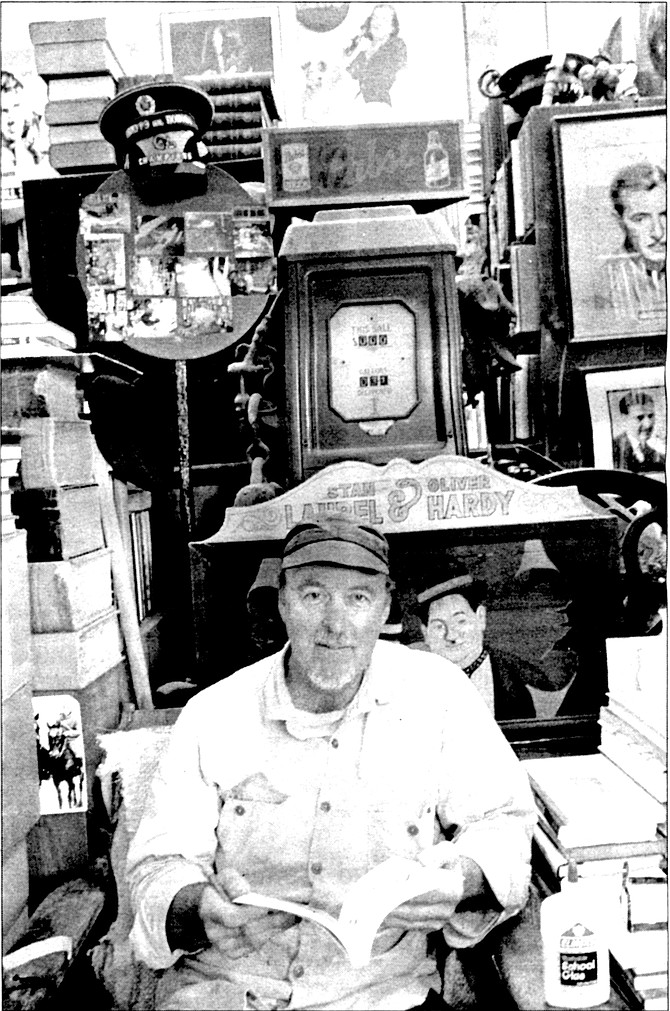
Dennis Wills: "I really identified with Larry Darrell, that character in W. Somerset Maugham’s novel The Razor’s Edge. I was rather inspired by Darrell’s remarkable curiosity — someone who went through World War I, whose best friend was killed, and he’s still alive. The arbitrariness of this puzzles him."
I asked Dennis Wills, proprietor of D.G. Wills Books in La Jolla, how he came to be a bookseller. “That’s a very long story,” he said. “It involves espionage, intrigue, years working for the National Security Agency and for Zbigniew Brzezinski — right before he became Jimmy Carter’s national security adviser — encounters in Europe with great bookstores like Blackwell’s in London, and, especially, two books that made a deep impression on me, Somerset Maugham’s Razor’s Edge and James Hilton’s Lost Horizon. It also involves my father’s illness that brought me back to Southern California after all those years away. Where should I start?”
"The USS Pueblo was seized when I was in intelligence school. And when that ship was seized, all of our code words were changed."
“How about at the beginning,” I said.
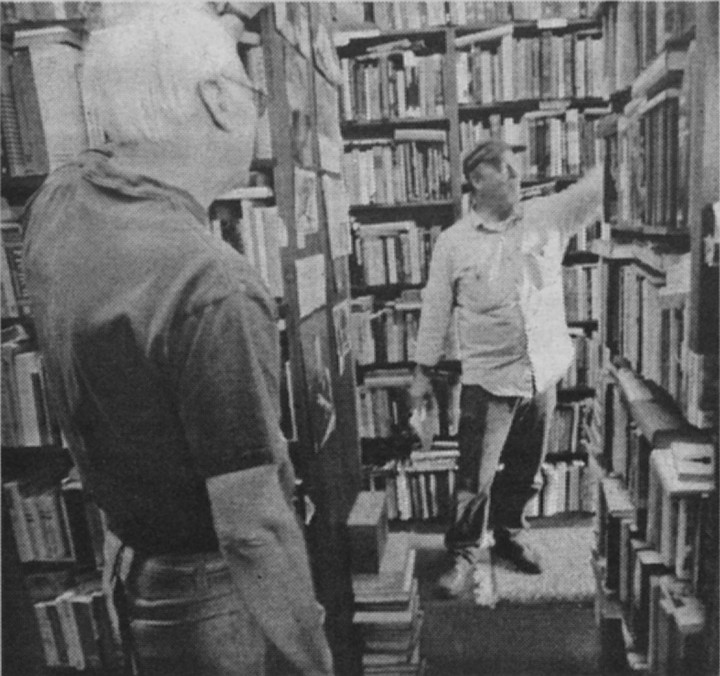
Dennis has been selling books in La Jolla for 20 years, first in a tiny, narrow converted office space on La Jolla Boulevard, and later in his present location on Girard Avenue. He collects photos of authors with books in their hands, statues and figurines of people reading books, book presses, and all sorts of other paraphernalia associated with books. There are several paintings and photographs in the store based on a famous painting called The Bookworm by the 19th-century German genre painter Carl Spitzweg, which shows an elderly man, apparently a scholar, on a ladder in front of a row of bookshelves with a book under each arm, one tucked between his knees, and yet another open in his hands. This is a man who can’t get enough of book knowledge, and he seems emblematic of Dennis himself.
When I suggested to Dennis that he consider developing a website or at least catalog his rare and valuable books for one of the many used-book sites on the Internet, he looked at me as if I had gone loony. “You know,” he said, “someone walked in once and asked if we had our inventory online. ‘No,’ I told him, ‘our books are on the shelves. We walk over to the shelf and look.’ Imagine that!”
One of Dennis’s colleagues, Chuck Valverde of Wahrenbrock’s Book House, at 726 Broadway, San Diego’s oldest bookstore, recently underscored the feeling many independent booksellers have today. He likened book dealers to dirigible pilots or carriage makers. Some dirigible pilots learned to fly airplanes, and some buggy makers started manufacturing automobile chassis; others went out of business. Dennis shows no sign of adapting to the new technological realities of bookselling, but his bookstore remains a gathering place for the literati and a must destination for serious book lovers throughout Southern California. As I looked around the splendidly disarrayed yet orderly chaos of his one-of-a-kind La Jolla institution, I felt like I was in the middle of an archeological dig.
Nearly every square foot of space in the store is used. Yet Dennis still manages to host regular literary readings — aisles crammed with folding chairs, usually spilling out into the street — where speakers carry the word to faithful attendees. There is bric-a-brac everywhere: small Chinese sculptures, hand-carved busts, tribal ceremonial masks, a Laurel and Hardy poster, baseball caps, and, tacked all over, photos and letters and yellowed, curled newspaper clippings. Next to the arm of a worn-out easy chair, a pile of six or seven thick dictionaries proclaims the prominence of words in this place. Over the archway that connects one part of the store with another hangs a huge two-man crosscut saw, symbolic, I think, of the trees sacrificed to produce the books Dennis has sold. As if to emphasize this symbol, next to the counter is a circular, five-foot-long shellacked hardwood slab that has served as a podium for authors at his Friday- and Saturday-night readings. Among the writers who have stood at that podium are Allen Ginsberg, Gary Snyder, Norman Mailer, Gore Vidal, Yevgeny Yevtushenko (three times), and Nobel Laureates Francis Crick and Derek Walcott.
Dennis talks about writers with reverence, and he obviously feels honored to have had these literary figures read and sign books in his store. I asked him why he held them in such esteem. “Because it’s knowledge,” he said. “We’re surrounded here by knowledge. To whatever extent members of our species are capable of understanding our failures or our potential is through knowledge. Our brains are capable of creating the symphonies of Beethoven or Brahms, or works of art that will excite us like those of Picasso or Michelangelo or Da Vinci, or words, stirring words that stimulate our thoughts and carry forth ideas about justice or freedom or individuality, as in the works of Thoreau, or Emerson, or Plato. And then there are characters in novels, plays, and short stories that give these ideas flesh and bones. While Hegel or Kant write very difficult books that only a handful of philosophers are going to fully understand, a character in a Tolstoy short story contemplating good and evil can speak to many more people who do not have serious, rigorous philosophical training.” As I listened to Dennis talk about books, philosophy, art, music, and religion, surrounded by his tens of thousands of books, I nearly became convinced that hordes of people are rummaging through The Death of Ivan Illych, hungry for ideas, instead of staring at Who Wants to Be a Millionaire on TV. For him, books have a transformative power, and they certainly have transformed his life.
“I wasn’t always interested in books,” he told me. “Especially as a young man. I was born in Los Angeles in 1946. My parents came out from Nebraska during the Depression to Los Angeles, and I was their only child. My dad went to medical school in the Los Angeles area, and my mother worked at Newberry’s department store. My parents, I guess, were Presbyterian. We didn’t go to church that much because my dad was mainly at the hospital on Sunday mornings, and he was interested in sports medicine and sports in general. He ran track and was a pole-vaulter back in Nebraska, and so on Sunday we were never churchgoers in a formal sense.
“I went to California Military Academy for seven years and had a pretty good education there, I guess. Small classes. I lived at home. I did not board. And I went to Lutheran High School, which was then in Inglewood. I played football, in great part because my dad had played football, so I became very interested in sports. I loved football and particularly the Rams.” At the mention of the Rams, Dennis became more animated and lively. His face brightened. “After all these years, they finally won the Super Bowl even though they are in St. Louis. There are a lot of us from Los Angeles who fantasize and have the delusion that the Rams are still in L.A., and naturally we were excited about this year’s Super Bowl.
“After I got out of high school, my parents divorced, like many parents after 25 or 26 years of marriage. My father moved to Redondo Beach. My mother and I had stayed in the house we had lived in as a family after the divorce. But when the house was sold, she moved to West Covina and became a schoolteacher again. She had taught in Nebraska early in the ’30s, I think. So I moved in with my dad and his second wife. I went to L.A. Valley College for a semester and to El Camino Junior College for a few semesters. Then I quit El Camino and started working. I can’t remember quite the circumstances. Maybe I wasn’t quite ready to transfer — I was still working on my first hot rod. I had motorcycles, a few motorcycles, and somehow I got interested in Model A Fords. And so I had one hot rod while I was in high school, when we lived in Baldwin Hills. I was building a new Model A Ford, and maybe I — I think I dropped out, had to work on the hot rod and go to work for a while. Hot rods and sports, that’s what I was most interested in.”
Dennis looks more like an auto mechanic than a bookseller. The flattened, oily, nondescript baseball cap he nearly always wears seems to match his frayed khaki shirts, his stained and unkempt jeans, his heavily worn brown walking shoes with tears between the sole and tops. These details combine to produce the image of a man who is, let’s say, casual about his appearance. His friends and employees kid him about being so “fashion” conscious. His graying goatee and dark-rimmed Clark Kent glasses are the only professorial touches about him, and even they blend into his artfully careless sartorial ensemble.
Lots of things in the bookstore reflect his early interests. One of the first things you notice when you walk in is several huge pulleys and hooks suspended across wooden beams near the ceiling. “I think the pulleys are a reflection of those hot rod days,” he said, “and I think even though we have a bookstore, I still think it’s a garage where I’m working on the Model A Ford, and, I don’t know, I just picked them up. I acquired them here and there. I like to have heavy iron things around because it probably reminds me of that garage or something, and we’re working on the hot rod. I’ve got pictures hanging up over the front door of the hot rod — the Model A Ford. I still have it, of course. It’s parked in the ‘Bat Cave,’ a few blocks from here. My friend John Hughes came up with the Bat Cave name because the Model A Ford lives there and there’s an automatic garage door. The Model A is black and it looks sort of like the Batmobile. I also have most of my private library over there, mainly some works of philosophy that I used in Oxford and some works in Soviet studies from my Columbia days. Some works inscribed to me from Brzezinski and other professors of mine. Some books inscribed to me from people who have read here — Mailer, Ginsberg, Gore Vidal, Françoise Gilot, Oliver Stone, etc. I keep them together on a shelf. I don’t look at them that much, but from time to time if there’s something I want to review I’ll pull it down. Books in my own library consist of books that I’ve been wanting to read that I haven’t gotten around to yet and people whose style I respect, like Sir Isaiah Berlin.
“As it turns out, perhaps I’m a failed blacksmith or caretaker of a 19th-century hardware store from a John Ford movie. I sort of like the notion of the cracker barrel–potbelly stove–hardware store phenomenon. It has a lot of historical roots in America. So I’ve tried to make the bookstore like a bar, or combination bar–hardware store. And I think any bookstore can function in that way. It’s a place to hang out, browse around, and talk. And so that’s why the store looks the way it does.” It’s also a little bit of a gas station and barbershop (there are two barber chairs and a gasoline pump in the store), two other traditional hangouts where male members of a community gather to trade observations about sports, politics, religion, as well as “life, the universe, and everything.”
“How come you have two barber chairs?” I asked.
“Well, I’m down to two; at one time I had four and a half barber chairs. There was a half a barber chair that I picked up that I was going to finish in wood, but I eventually gave it away and I had another that I also sold, but now I’m down to two barber chairs — the original one, which is over there, and then the newer one. A barber chair because, well, again, a barbershop is a place where a lot of oral history occurs, and barber chairs are sturdy. Children can’t break them. Lots of kids come in and like to run around and touch everything, of course, as we would at that age. For them it’s sort of like Tom Sawyer’s Island here because there are a lot of artifacts and it’s a perfect place to run around and hide. So I like the barber chairs because they remind me of, oh, I don’t know, that cracker-barrel, community-store, barbershop phenomenon in which oral history occurs.
“As to what I read? People in the book business tend to be an inch deep and a mile wide. Just in the course of shelving books on every conceivable subject we might learn a little bit about something. For example, since we’ve been talking about the Bat Cave, this morning when I was ordering books, I ordered a book called Bat Bomb from the U of Texas Press for a number of reasons. We actually have a chiroptera section in the store, only because Texas Tech University Press had a sale once and they specialize in books on bats, scholarly monographs on bats, because there are caverns where the university is located. It’s not that we sell bat books very often, but once we started that section, every time we came across a bat book like The Short-Tailed Fruit Bats of Egypt, or something that we would never sell in a hundred years, we’d buy it anyway, just to add to the chiroptera section. Just because we thought it was fun. This morning we came across Bat Bomb and discovered there was some way that bats were used during World War II. I don’t know what that is yet, but I’ll find out because the book will be here tomorrow afternoon. And we’ll put it in the window because it’s a book that no one else is likely to have. That’s what we would call a ‘bookseller’s book’ — a book on an uncommon topic. And even though we’ll never be authorities on bats, a book dealer likes to look at odd books for a few minutes and learn something on an obscure topic and then shelve it and forget about it. But then maybe a year later somebody will walk in and say, ‘Do you have anything on bats?’ and I’ll beam and say, ‘Right over here.’ Sometimes that happens. There are books on everything — hot air balloons, baby carriages, packing-crate art during the golden age of the canneries in Monterey. There’s a whole book on packing-crate art. There’s hardly anything you can think about that somebody hasn’t written a book on. They often come out of dissertation topics: books on The Diseases of Mites or The Mammalian Ear, from Cornell University Press, which we have. There’s also a book called The Social History of the Potato. It’s over 400 pages. From Cambridge University Press. We have that book. We like that kind of a book. Someone was probably looking for a dissertation topic and spent a few years researching the potato famine in Ireland and it went from there. We learn something new every day in the book business. It’s the uncommon books that we like to discover and grab.”
I reminded Dennis that I still wasn’t clear about how he got into bookselling. “How come you didn’t open a hardware store or bar?” I asked.
“Well, I think the beginnings of that are my experience in the Air Force. I would have been drafted into the Army, but I enlisted into the Air Force. I was attracted to the Air Force because I heard about a language program that they offered. I went down, took some preliminary tests, and passed them. And so I was able to go into the Air Force. And in California Military Academy I had three years of Latin and then one year of Latin at Lutheran High School. So I must have had a linguistic facility to some extent. I enlisted in the Air Force in September of ’67 and went to Lackland Air Force Base in San Antonio, Texas, when I was 20. I got through my language school at the end of ’68 and then went to intelligence school at a little place called Goodfellow Air Force Base in San Angelo, Texas. It’s a little hole in the wall in the middle of nowhere, so intelligence training can take place and it’s hard for people to approach it without being seen.
“The funny thing is that in San Angelo, like many of my classmates, I wasn’t sure what I was being trained for. At first when we were in language school we thought that we might be using the Russian language in some diplomatic capacity to help in some aspect of Soviet-American relations. But eventually we realized we were being trained to listen to Soviet pilots, and some of us weren’t sure how comfortable we would feel continuing in this. We did have the option of getting out before we began the intelligence training. And some did decide to drop out at that point. But a number of us continued, even having some moral qualms about what we might be doing. A few of us actually contemplated turning in our top-secret cryptographic security clearance because we were troubled, even though we were also fascinated by the intrigue of working with such sophisticated technology and knowing what the Russians were doing every day in this particular region. Of course, we also felt like we were participating in brinkmanship — and preparing for World War III. But I guess ultimately, as we did not expect our species to change overnight and to surmount problems that had taken thousands of years to create — all sorts of religious and cultural differences and hatreds that had evolved in different forms of government — we weren’t going to change this and so we kept doing our job, but we did it with some moral hesitation. Some people would swig Maalox like booze, direct from the bottle, because their stomachs couldn’t take it. True, they weren’t getting their arms blown off like our peers in Vietnam, but it was a tense set of circumstances.
“When we were in the middle of intelligence school at Goodfellow, the USS Pueblo was seized by the North Koreans. That was the famous incident involving Commander Lloyd Bucher. And, ironically, he spoke at the old store years ago. I wrote him a letter or called him on the phone and told him that we both worked for the same people — the Army, the Air Force, and the Navy — to collect cryptographic intelligence information, as it’s called. All branches of the services did work for the National Security Agency.” In his book The Puzzle Palace, James Banford refers to the National Security Agency as “America’s most secret agency,” so secret that it makes the Central Intelligence Agency seem wide open by comparison. “There are a couple of phrases that are referred to when NSA is discussed. NSA could either mean ‘no such agency.’ It also could mean ‘never say anything.’ It is generally assumed that the CIA is the primary agency that collects and analyzes intelligence information. It does a lot of things, but most of the defense intelligence is collected by the National Security Agency. When I say ‘collect,’ I mean listen to and tape record what other governments are doing.”
“Do you mean you were a spy?” I interjected. Dennis seemed a little defensive.
“Until our species somehow invents a replacement for the nation-state or the individual cultures and individual religious traditions, nation-states will continue with different forms of governments. Those nation-states will have their military organizations to defend their interests, their presuppositions about God, or about how government will function. Whether it’s a representative democracy or dictatorship, these forms of government will have military, and, where they are capable, they will have intelligence-collection capabilities. And the countries that are best able to do that were and are the Soviet Union, the United States, and Israel is pretty good at it, as well as the People’s Republic of China. But some countries are obviously better at it than others. Naturally if a country is just more open, like the United States, it’s easier for Soviet or Chinese agents to engage in what was then referred to as ‘human intelligence.’ It’s easier for human beings to interact with other human beings, to walk around undisturbed, in an open society, and take photographs, have affairs — sexual affairs — romantic involvements, or get a job somewhere that will allow someone to collect information and give it back to his or her own government. But in a closed society, where it’s more difficult for Americans to mingle unnoticed (for example, in the former Soviet Union or in China), then more technical means of collection are necessary, and that’s where the NSA comes in because they have satellites or they have people on the periphery with listening devices, so that the U.S. government can learn something about the intentions of the other government.
“Of course, during the Cold War — and I was in the service during the Cold War — we were very much concerned with strategic iICBMs, intercontinental ballistic missiles. We were concerned with destruction on a massive scale and how to prevent it. And there’s a big difference between the world of human intelligence — where you can get certain ideas about what somebody might do if you’re sleeping with another agent or you’ve gotten somebody with some secret information intoxicated and talking about what might happen in the future — but it’s never completely reliable because governments, like human beings, change their minds. With technical collection, as opposed to human-intelligence collection, you find out what’s going on right now and what’s going to happen at 0800 hours. Someone of another government is talking to a colleague and saying, ‘We’re going to go from A to B at 0800 hours and we’re going to do X, Y, and Z.’ And so that gives you really an accurate idea of what the target government is going to do.
“At the time I had a choice of studying Chinese or Russian. The Air Force was actually looking for people: the highest priority then was Mandarin Chinese. There were more people who had studied Russian, but the Air Force needed people studying Chinese because we were concerned that the Chinese were developing the capability of delivering a warhead over a certain distance. And capable of reaching one of our allies and, potentially, the United States at some point. So naturally the U.S. government wanted people who could listen to Chinese so they could learn more about their intentions. But, again, I didn’t want to go to an Army base; instead I went to Syracuse so I could study Russian and go to Europe. I was lucky and that’s where I ended up.
“As I said, the USS Pueblo was seized when I was in intelligence school. And when that ship was seized, all of our code words were changed. Our secret encryptograph and top-secret code words were changed because some of those code words were compromised when they were not able to destroy everything on the Pueblo. At that time they didn’t have magnesium destruction devices that are put on top of equipment and can melt it immediately. All they had were axes, and they tried to destroy things — they tried to burn some things, but they didn’t have time. They were under fire. That was another change that was made after the Pueblo incident. People in intelligence said we needed magnesium devices so we could melt our equipment. And they eventually would go through a lot of drills of this sort and be timed. Like at 3:00 in the morning.
“I got through intelligence school and I went to Germany and worked at a ‘collection platform.’ A collection platform can be a submarine, it can be a naval surface ship, it can be a satellite traveling around taking pictures or listening to communications, or can be somebody in an Army van. A collection platform could be somebody in the CIA or NSA in a Ford Econoline van filled with equipment sitting on a street listening to an embassy across the street or something. Or it can be an Air Force plane. It can be some Air Force guys on the ground who are listening. These are all possibilities. So I was in Germany for about a year and a half, and we were able to listen to Soviet cosmonauts whenever they flew over; we would listen to the conversations between the cosmonauts and their ground controllers. But we mainly listened to certain Soviet military operations in the area.
“And even though this has been 30 years ago, it still makes me a little nervous talking about it. I remember when I told my mother what I was doing. I picked her up in a car, drove way out to some abandoned space, and told her walking outdoors. I was still nervous, because I know the eavesdropping capabilities of our government. Actually the kind of collection I’m talking about is covered in David Kahn’s book The Codebreakers, which is the definitive history of cryptography, and he discusses somewhere in that book the notion of a ferret mission. A ferret mission is one in which one country penetrates the border of another country to test how long it takes for the other country to scramble its jet aircraft and try to shoot you down. And while the ferret plane is across the border, it’s listening and collecting lots of electronic information to get an idea of how the other side will respond in case of war. Naturally these are very dangerous missions, and a number of planes on ferret missions were actually shot down. In fact, I did lose two classmates who wanted the extra pay and the glory of being on flight status. They were in one of these ferret missions and were shot down.”
I told Dennis that while I recalled the Pueblo incident and a few other episodes when Russians detected our spying (the Gary Powers U-2 incident, for example), I didn’t recall reading about a significant number of American planes being shot down behind the Iron Curtain. Could it be that they weren’t reported? If this is true, then we were on the brink of World War III more times than we know.
“That’s right. There was a case in ’69 or ’70 when President Nixon discussed a plane that went down, I think it was an EC-121. It was a plane shot down in the North Korea area, and President Nixon accidentally referred to a capability of the Russians. The intelligence community was very upset that this capability was inadvertently referred to by the president because it suggested that U.S. intelligence was capable of seeing what a MiG pilot could see on certain electronic boxes inside his aircraft. We in the West were able to see the same data that was being transmitted to him and that he was transmitting back to his Soviet controller on the ground.
“People at higher echelons need to make decisions based upon the information provided by Army, Navy, and Air Force intelligence personnel at these collection platforms, and so the product of our work went back to the NSA, to the CIA, and was analyzed at higher levels as needed. Now occasionally at 3:00 and 3:30 in the morning we’ll be sitting there — it seemed that things happened or tended to go wrong at 3:00 or 4:00 in the morning — we might be watching a monitor that tells us if there’s any Soviet activity going on at a particular base across the border. We were less than a kilometer from the border, the East German–Czech border at this particular platform. And with our electronic equipment we could see — monitor — if anybody was talking. There are means other than voice by which intelligence information is transmitted — strange sounds that I will remember as long as I live, that represent a sound that the MiG pilot hears when the location of a possible target is transmitted to him by a Soviet ground controller. His machine transforms that sound into numbers and those numbers mean how to get to the target, where the target is. They mean certain things to the MiG pilot’s weapons system. When the Korean Flight 007 airliner was shot down by a Russian pilot some years ago, a portion of a conversation between the Soviet pilot and his ground controller included the phrase ‘I am in lock-on.’ I never thought I would see that phrase on the front page of the New York Times, because it was part of our top-secret knowledge. That phrase refers to the Soviet pilot’s weapon system and says he is ready to fire. We were able to intercept those transmissions and convert the sound into numbers as well. There are several sounds like this that I will always remember. That’s why there’s sort of a Manchurian Candidate aspect to this. I can still hear those sounds, and I could imitate them for you, if I’d been drinking. I’ve imitated those sounds for a couple of my colleagues.
“So people at the platform select information and it’s sent back. You hear one sound and we know that there’s a certain instrument inside the MiG aircraft that’s being used and it means something. It means one thing. If we hear another sound, we know that another piece of equipment is being used to help that MiG pilot get to our ferret aircraft to shoot us down. We’ll be listening to a ballgame on our Force network, but then if we see some little blips go off, that means something is going on. So we turn the football game off and we turn the sound on and then the guys in another room of the intelligence site are watching their radar. All of a sudden 20 or 25 Bison bombers — that’s a nato designation for a particular Soviet bomber — 25 bombers are headed west out of Poland or out of East Germany, they’re headed for West Germany and we’re capable of contacting the Pentagon and the White House within a minute with a certain message we can send so that people are put on alert. And of course these bombers are monitored, and just as they get to the border, they turn around and go back. Now that’s an exercise that the Soviets would engage in to test us. I’m sure the Soviets were tape-recording us — tape-recording us tape-recording them. They were listening to us as we listened to them.”
I said it sounded like a combination of Catch-22 and Dr. Strangelove.
“Yes. That was part of the Cold War that seemed mad and tragic and led me to want to study philosophy and not pre-med. When I did get out of the service eventually, in ’71, I wanted to go back and study philosophy of religion because I would sit in this intelligence site with a good friend of mine, who is now in Philadelphia, and we would contemplate what madness we were engaged in. We understood again that nation-states were going to spy on each other to protect their respective presuppositions and their God — and they always find a way to justify it morally. But it’s always ironic. In a particular war movie, I think The Longest Day, you’ll see some footage of soldiers in one army saying, ‘Well, God is on our side.’ And then the director shifts over to the German soldiers and they’re saying, ‘Gott mit uns.’ Everybody thinks that God is on their side in war and war is just. Whether it’s Arab-Israeli or Protestant-Catholic in Northern Ireland, and now Islamic extremists, people are going to feel justified in blowing up whoever they disagree with. Or Timothy McVeigh and others internally in the United States feeling that somehow the government is exerting too much control. They say, ‘Well, let’s blow up a bunch…’ and they don’t realize maybe they’re blowing up a bunch of innocent children. That’s tragic.
“So I got out of the service with an honorable discharge.”
When Dennis returned from his stint as an intelligence collector for the National Security Agency, he studied philosophy and classical Greek at Cal State Dominguez Hills and at UCLA. After graduating from Cal State, he had the opportunity to do graduate work at Oxford, where he studied philosophy and the philosophy of religion. Working in the intelligence community brought home to him what nuclear capabilities the superpowers had. He gravitated toward the idea of working in the arms-control community. And books had a lot to do with that decision.
“I guess at this time in my life I really identified with Larry Darrell, that character in W. Somerset Maugham’s novel The Razor’s Edge. I had seen the film before I went into the service, and it made a deep impression on me. Tyrone Power and Gene Tierney were in it. I was rather inspired by Darrell’s remarkable curiosity — someone who went through World War I, whose best friend was killed and he’s still alive. The arbitrariness of this puzzles him. And, as a result of that experience, he pursues studies in philosophy and religion to try to better understand the universe in which he finds himself. I think I saw him as something of a model for my life. I read and reread that book during my years in the military, and also James Hilton’s Lost Horizon, which was Hilton’s response to World War I and tells about Shangri-La, where there was a high lama who built a repository of knowledge that was full of books and classical music.
“The year at Oxford led to another year at the University of Fribourg in Switzerland and then to Columbia University. I got to Columbia thinking that I would pursue a Ph.D. in the history department in some aspect of Soviet history of science, which would lead me to arms control. But when I got there, I felt that my time would be better spent pursuing arms control more directly, so I began studying at the Russian Institute and working on a master’s degree in international relations at the School of International Affairs. I studied with Marshall D. Shulman, who was the director of the Russian Institute, and with the late John Hazard, a wise man who had studied at the Moscow Juridical Institute during the Stalin show trials in the ’30s. And then, while at Columbia, I met a woman on the roof of the building of the dormitory in which I was living, and she became Zbigniew Brzezinski’s research assistant. There was another opening at the institute for which I applied and I was hired, to work with Brzezinski. I worked on a publication that we founded called Global Political Assessment. I was taking course work on Soviet political structure and Soviet military matters and spending a lot of time learning about the Soviet Backfire bomber, about our cruise missiles, about problems of Soviet-American arms control. This course of study led to an interest in the Strategic Arms Limitation Treaty talks — the salt talks. In fact, I published a bibliography — I wrote a paper, several papers; I was immersed in the arms-control community.
“Brzezinski had been an advisor to Carter before he was elected president. Now he was the director of his own international relations institute at Columbia. I was at the institute one night shortly after Carter won the election. I was alone working on Global Political Assessment when a call came in from Plains, Georgia, asking for ‘Zbig.’ And I knew that Zbig was at a party because he left the number at the institute with me knowing that I’d be there. And so I forwarded the caller from Plains, Georgia, to this party, and then the next morning Brzezinski and Andrew Young appeared with Jimmy Carter because Carter announced that Andrew Young was the new ambassador to the United Nations and Brzezinski was the national security advisor. Brzezinski went to Washington. I stayed at Columbia to finish my master’s degree, and then I went to Washington to try and pursue a career in the arms-control community. Having worked for Brzezinski, I thought I had a pretty good connection there.
“But that wasn’t to be. I packed all my books — by that time I had accumulated quite a few books — and was working part-time while going through the interview process and the security-clearance process in Washington, D.C. It took a while to re-initiate the top-secret clearance. But a few months went by and I was called back to California because there was another crisis and I had to take care of my dad. I thought I would stay in Washington, D.C., for 30 years in the arms-control community, which meant perhaps getting back into the intelligence community but working on the Strategic Arms Limitation Treaty talks in some fashion. I thought I would spend the rest of my life there, or the rest of my professional life. I didn’t think I’d do a bookstore. During the years at Oxford and Switzerland and then at Columbia, I thought I’d be working in arms control, but from this vantage point, that’s clearly the road not taken.
“But the idea of a bookstore had been in my mind all along. Probably since I read The Razor’s Edge and Lost Horizon and visited those great bookstores in England, Blackwell’s and Thornton’s. I always knew I wanted to study religion and philosophy and maybe work in arms control and maybe, maybe, like in Lost Horizon, have a collection of books and knowledge where not only I but also other people could contemplate problems of knowledge. They could learn, try to learn, something about this puzzling existence in which we find ourselves. On this dinky little planet, you know, we’re just a speck, but we’ve got a brain. So the potential of the bookstore goes back to being in the Air Force in Germany. Books changed my life, and I knew they could change the lives of others as well. And who knows, maybe someday they’ll really make the world a better place.”
The phone rang. It was someone wanting an obscure book on ancient Buddhist philosophy. Dennis told the caller he didn’t have it but referred him immediately to the Bodhi Tree in Los Angeles, which he said “is probably the best place in the U.S. for books on Eastern religions.” All through my contacts with Dennis, I’ve been impressed how often he refers people to other bookstores, a commonplace, he says, in the independent book trade. I’m impressed by the generosity and cooperative spirit of the gesture, so alien to the competitive, self-interested spirit of most capitalist ventures. (Imagine amazon.com sending you a message: “We don’t have the book you want, but you might try BarnesandNoble.com.”) It’s another reminder of how this unique independent bookstore is a survivor from more hospitable and personal times than ours, and I’m happy that we’ll never likely see a dgwills.com. And I’m happy, too, that after a life on the cutting edge of the American intelligence community and after dipping into global politics, Dennis Wills came home to build his own Shangri-La right here in La Jolla.
Here's something you might be interested in.
The Bookseller Who Came in From the Cold
The inimitable D.G. Wills of La Jolla

The Bookseller Who Came in From the Cold
The inimitable D.G. Wills of La Jolla
Dennis Wills: "I really identified with Larry Darrell, that character in W. Somerset Maugham’s novel The Razor’s Edge. I was rather inspired by Darrell’s remarkable curiosity — someone who went through World War I, whose best friend was killed, and he’s still alive. The arbitrariness of this puzzles him."
I asked Dennis Wills, proprietor of D.G. Wills Books in La Jolla, how he came to be a bookseller. “That’s a very long story,” he said. “It involves espionage, intrigue, years working for the National Security Agency and for Zbigniew Brzezinski — right before he became Jimmy Carter’s national security adviser — encounters in Europe with great bookstores like Blackwell’s in London, and, especially, two books that made a deep impression on me, Somerset Maugham’s Razor’s Edge and James Hilton’s Lost Horizon. It also involves my father’s illness that brought me back to Southern California after all those years away. Where should I start?”
"The USS Pueblo was seized when I was in intelligence school. And when that ship was seized, all of our code words were changed."
“How about at the beginning,” I said.
Dennis has been selling books in La Jolla for 20 years, first in a tiny, narrow converted office space on La Jolla Boulevard, and later in his present location on Girard Avenue. He collects photos of authors with books in their hands, statues and figurines of people reading books, book presses, and all sorts of other paraphernalia associated with books. There are several paintings and photographs in the store based on a famous painting called The Bookworm by the 19th-century German genre painter Carl Spitzweg, which shows an elderly man, apparently a scholar, on a ladder in front of a row of bookshelves with a book under each arm, one tucked between his knees, and yet another open in his hands. This is a man who can’t get enough of book knowledge, and he seems emblematic of Dennis himself.
When I suggested to Dennis that he consider developing a website or at least catalog his rare and valuable books for one of the many used-book sites on the Internet, he looked at me as if I had gone loony. “You know,” he said, “someone walked in once and asked if we had our inventory online. ‘No,’ I told him, ‘our books are on the shelves. We walk over to the shelf and look.’ Imagine that!”
One of Dennis’s colleagues, Chuck Valverde of Wahrenbrock’s Book House, at 726 Broadway, San Diego’s oldest bookstore, recently underscored the feeling many independent booksellers have today. He likened book dealers to dirigible pilots or carriage makers. Some dirigible pilots learned to fly airplanes, and some buggy makers started manufacturing automobile chassis; others went out of business. Dennis shows no sign of adapting to the new technological realities of bookselling, but his bookstore remains a gathering place for the literati and a must destination for serious book lovers throughout Southern California. As I looked around the splendidly disarrayed yet orderly chaos of his one-of-a-kind La Jolla institution, I felt like I was in the middle of an archeological dig.
Nearly every square foot of space in the store is used. Yet Dennis still manages to host regular literary readings — aisles crammed with folding chairs, usually spilling out into the street — where speakers carry the word to faithful attendees. There is bric-a-brac everywhere: small Chinese sculptures, hand-carved busts, tribal ceremonial masks, a Laurel and Hardy poster, baseball caps, and, tacked all over, photos and letters and yellowed, curled newspaper clippings. Next to the arm of a worn-out easy chair, a pile of six or seven thick dictionaries proclaims the prominence of words in this place. Over the archway that connects one part of the store with another hangs a huge two-man crosscut saw, symbolic, I think, of the trees sacrificed to produce the books Dennis has sold. As if to emphasize this symbol, next to the counter is a circular, five-foot-long shellacked hardwood slab that has served as a podium for authors at his Friday- and Saturday-night readings. Among the writers who have stood at that podium are Allen Ginsberg, Gary Snyder, Norman Mailer, Gore Vidal, Yevgeny Yevtushenko (three times), and Nobel Laureates Francis Crick and Derek Walcott.
Dennis talks about writers with reverence, and he obviously feels honored to have had these literary figures read and sign books in his store. I asked him why he held them in such esteem. “Because it’s knowledge,” he said. “We’re surrounded here by knowledge. To whatever extent members of our species are capable of understanding our failures or our potential is through knowledge. Our brains are capable of creating the symphonies of Beethoven or Brahms, or works of art that will excite us like those of Picasso or Michelangelo or Da Vinci, or words, stirring words that stimulate our thoughts and carry forth ideas about justice or freedom or individuality, as in the works of Thoreau, or Emerson, or Plato. And then there are characters in novels, plays, and short stories that give these ideas flesh and bones. While Hegel or Kant write very difficult books that only a handful of philosophers are going to fully understand, a character in a Tolstoy short story contemplating good and evil can speak to many more people who do not have serious, rigorous philosophical training.” As I listened to Dennis talk about books, philosophy, art, music, and religion, surrounded by his tens of thousands of books, I nearly became convinced that hordes of people are rummaging through The Death of Ivan Illych, hungry for ideas, instead of staring at Who Wants to Be a Millionaire on TV. For him, books have a transformative power, and they certainly have transformed his life.
“I wasn’t always interested in books,” he told me. “Especially as a young man. I was born in Los Angeles in 1946. My parents came out from Nebraska during the Depression to Los Angeles, and I was their only child. My dad went to medical school in the Los Angeles area, and my mother worked at Newberry’s department store. My parents, I guess, were Presbyterian. We didn’t go to church that much because my dad was mainly at the hospital on Sunday mornings, and he was interested in sports medicine and sports in general. He ran track and was a pole-vaulter back in Nebraska, and so on Sunday we were never churchgoers in a formal sense.
“I went to California Military Academy for seven years and had a pretty good education there, I guess. Small classes. I lived at home. I did not board. And I went to Lutheran High School, which was then in Inglewood. I played football, in great part because my dad had played football, so I became very interested in sports. I loved football and particularly the Rams.” At the mention of the Rams, Dennis became more animated and lively. His face brightened. “After all these years, they finally won the Super Bowl even though they are in St. Louis. There are a lot of us from Los Angeles who fantasize and have the delusion that the Rams are still in L.A., and naturally we were excited about this year’s Super Bowl.
“After I got out of high school, my parents divorced, like many parents after 25 or 26 years of marriage. My father moved to Redondo Beach. My mother and I had stayed in the house we had lived in as a family after the divorce. But when the house was sold, she moved to West Covina and became a schoolteacher again. She had taught in Nebraska early in the ’30s, I think. So I moved in with my dad and his second wife. I went to L.A. Valley College for a semester and to El Camino Junior College for a few semesters. Then I quit El Camino and started working. I can’t remember quite the circumstances. Maybe I wasn’t quite ready to transfer — I was still working on my first hot rod. I had motorcycles, a few motorcycles, and somehow I got interested in Model A Fords. And so I had one hot rod while I was in high school, when we lived in Baldwin Hills. I was building a new Model A Ford, and maybe I — I think I dropped out, had to work on the hot rod and go to work for a while. Hot rods and sports, that’s what I was most interested in.”
Dennis looks more like an auto mechanic than a bookseller. The flattened, oily, nondescript baseball cap he nearly always wears seems to match his frayed khaki shirts, his stained and unkempt jeans, his heavily worn brown walking shoes with tears between the sole and tops. These details combine to produce the image of a man who is, let’s say, casual about his appearance. His friends and employees kid him about being so “fashion” conscious. His graying goatee and dark-rimmed Clark Kent glasses are the only professorial touches about him, and even they blend into his artfully careless sartorial ensemble.
Lots of things in the bookstore reflect his early interests. One of the first things you notice when you walk in is several huge pulleys and hooks suspended across wooden beams near the ceiling. “I think the pulleys are a reflection of those hot rod days,” he said, “and I think even though we have a bookstore, I still think it’s a garage where I’m working on the Model A Ford, and, I don’t know, I just picked them up. I acquired them here and there. I like to have heavy iron things around because it probably reminds me of that garage or something, and we’re working on the hot rod. I’ve got pictures hanging up over the front door of the hot rod — the Model A Ford. I still have it, of course. It’s parked in the ‘Bat Cave,’ a few blocks from here. My friend John Hughes came up with the Bat Cave name because the Model A Ford lives there and there’s an automatic garage door. The Model A is black and it looks sort of like the Batmobile. I also have most of my private library over there, mainly some works of philosophy that I used in Oxford and some works in Soviet studies from my Columbia days. Some works inscribed to me from Brzezinski and other professors of mine. Some books inscribed to me from people who have read here — Mailer, Ginsberg, Gore Vidal, Françoise Gilot, Oliver Stone, etc. I keep them together on a shelf. I don’t look at them that much, but from time to time if there’s something I want to review I’ll pull it down. Books in my own library consist of books that I’ve been wanting to read that I haven’t gotten around to yet and people whose style I respect, like Sir Isaiah Berlin.
“As it turns out, perhaps I’m a failed blacksmith or caretaker of a 19th-century hardware store from a John Ford movie. I sort of like the notion of the cracker barrel–potbelly stove–hardware store phenomenon. It has a lot of historical roots in America. So I’ve tried to make the bookstore like a bar, or combination bar–hardware store. And I think any bookstore can function in that way. It’s a place to hang out, browse around, and talk. And so that’s why the store looks the way it does.” It’s also a little bit of a gas station and barbershop (there are two barber chairs and a gasoline pump in the store), two other traditional hangouts where male members of a community gather to trade observations about sports, politics, religion, as well as “life, the universe, and everything.”
“How come you have two barber chairs?” I asked.
“Well, I’m down to two; at one time I had four and a half barber chairs. There was a half a barber chair that I picked up that I was going to finish in wood, but I eventually gave it away and I had another that I also sold, but now I’m down to two barber chairs — the original one, which is over there, and then the newer one. A barber chair because, well, again, a barbershop is a place where a lot of oral history occurs, and barber chairs are sturdy. Children can’t break them. Lots of kids come in and like to run around and touch everything, of course, as we would at that age. For them it’s sort of like Tom Sawyer’s Island here because there are a lot of artifacts and it’s a perfect place to run around and hide. So I like the barber chairs because they remind me of, oh, I don’t know, that cracker-barrel, community-store, barbershop phenomenon in which oral history occurs.
“As to what I read? People in the book business tend to be an inch deep and a mile wide. Just in the course of shelving books on every conceivable subject we might learn a little bit about something. For example, since we’ve been talking about the Bat Cave, this morning when I was ordering books, I ordered a book called Bat Bomb from the U of Texas Press for a number of reasons. We actually have a chiroptera section in the store, only because Texas Tech University Press had a sale once and they specialize in books on bats, scholarly monographs on bats, because there are caverns where the university is located. It’s not that we sell bat books very often, but once we started that section, every time we came across a bat book like The Short-Tailed Fruit Bats of Egypt, or something that we would never sell in a hundred years, we’d buy it anyway, just to add to the chiroptera section. Just because we thought it was fun. This morning we came across Bat Bomb and discovered there was some way that bats were used during World War II. I don’t know what that is yet, but I’ll find out because the book will be here tomorrow afternoon. And we’ll put it in the window because it’s a book that no one else is likely to have. That’s what we would call a ‘bookseller’s book’ — a book on an uncommon topic. And even though we’ll never be authorities on bats, a book dealer likes to look at odd books for a few minutes and learn something on an obscure topic and then shelve it and forget about it. But then maybe a year later somebody will walk in and say, ‘Do you have anything on bats?’ and I’ll beam and say, ‘Right over here.’ Sometimes that happens. There are books on everything — hot air balloons, baby carriages, packing-crate art during the golden age of the canneries in Monterey. There’s a whole book on packing-crate art. There’s hardly anything you can think about that somebody hasn’t written a book on. They often come out of dissertation topics: books on The Diseases of Mites or The Mammalian Ear, from Cornell University Press, which we have. There’s also a book called The Social History of the Potato. It’s over 400 pages. From Cambridge University Press. We have that book. We like that kind of a book. Someone was probably looking for a dissertation topic and spent a few years researching the potato famine in Ireland and it went from there. We learn something new every day in the book business. It’s the uncommon books that we like to discover and grab.”
I reminded Dennis that I still wasn’t clear about how he got into bookselling. “How come you didn’t open a hardware store or bar?” I asked.
“Well, I think the beginnings of that are my experience in the Air Force. I would have been drafted into the Army, but I enlisted into the Air Force. I was attracted to the Air Force because I heard about a language program that they offered. I went down, took some preliminary tests, and passed them. And so I was able to go into the Air Force. And in California Military Academy I had three years of Latin and then one year of Latin at Lutheran High School. So I must have had a linguistic facility to some extent. I enlisted in the Air Force in September of ’67 and went to Lackland Air Force Base in San Antonio, Texas, when I was 20. I got through my language school at the end of ’68 and then went to intelligence school at a little place called Goodfellow Air Force Base in San Angelo, Texas. It’s a little hole in the wall in the middle of nowhere, so intelligence training can take place and it’s hard for people to approach it without being seen.
“The funny thing is that in San Angelo, like many of my classmates, I wasn’t sure what I was being trained for. At first when we were in language school we thought that we might be using the Russian language in some diplomatic capacity to help in some aspect of Soviet-American relations. But eventually we realized we were being trained to listen to Soviet pilots, and some of us weren’t sure how comfortable we would feel continuing in this. We did have the option of getting out before we began the intelligence training. And some did decide to drop out at that point. But a number of us continued, even having some moral qualms about what we might be doing. A few of us actually contemplated turning in our top-secret cryptographic security clearance because we were troubled, even though we were also fascinated by the intrigue of working with such sophisticated technology and knowing what the Russians were doing every day in this particular region. Of course, we also felt like we were participating in brinkmanship — and preparing for World War III. But I guess ultimately, as we did not expect our species to change overnight and to surmount problems that had taken thousands of years to create — all sorts of religious and cultural differences and hatreds that had evolved in different forms of government — we weren’t going to change this and so we kept doing our job, but we did it with some moral hesitation. Some people would swig Maalox like booze, direct from the bottle, because their stomachs couldn’t take it. True, they weren’t getting their arms blown off like our peers in Vietnam, but it was a tense set of circumstances.
“When we were in the middle of intelligence school at Goodfellow, the USS Pueblo was seized by the North Koreans. That was the famous incident involving Commander Lloyd Bucher. And, ironically, he spoke at the old store years ago. I wrote him a letter or called him on the phone and told him that we both worked for the same people — the Army, the Air Force, and the Navy — to collect cryptographic intelligence information, as it’s called. All branches of the services did work for the National Security Agency.” In his book The Puzzle Palace, James Banford refers to the National Security Agency as “America’s most secret agency,” so secret that it makes the Central Intelligence Agency seem wide open by comparison. “There are a couple of phrases that are referred to when NSA is discussed. NSA could either mean ‘no such agency.’ It also could mean ‘never say anything.’ It is generally assumed that the CIA is the primary agency that collects and analyzes intelligence information. It does a lot of things, but most of the defense intelligence is collected by the National Security Agency. When I say ‘collect,’ I mean listen to and tape record what other governments are doing.”
“Do you mean you were a spy?” I interjected. Dennis seemed a little defensive.
“Until our species somehow invents a replacement for the nation-state or the individual cultures and individual religious traditions, nation-states will continue with different forms of governments. Those nation-states will have their military organizations to defend their interests, their presuppositions about God, or about how government will function. Whether it’s a representative democracy or dictatorship, these forms of government will have military, and, where they are capable, they will have intelligence-collection capabilities. And the countries that are best able to do that were and are the Soviet Union, the United States, and Israel is pretty good at it, as well as the People’s Republic of China. But some countries are obviously better at it than others. Naturally if a country is just more open, like the United States, it’s easier for Soviet or Chinese agents to engage in what was then referred to as ‘human intelligence.’ It’s easier for human beings to interact with other human beings, to walk around undisturbed, in an open society, and take photographs, have affairs — sexual affairs — romantic involvements, or get a job somewhere that will allow someone to collect information and give it back to his or her own government. But in a closed society, where it’s more difficult for Americans to mingle unnoticed (for example, in the former Soviet Union or in China), then more technical means of collection are necessary, and that’s where the NSA comes in because they have satellites or they have people on the periphery with listening devices, so that the U.S. government can learn something about the intentions of the other government.
“Of course, during the Cold War — and I was in the service during the Cold War — we were very much concerned with strategic iICBMs, intercontinental ballistic missiles. We were concerned with destruction on a massive scale and how to prevent it. And there’s a big difference between the world of human intelligence — where you can get certain ideas about what somebody might do if you’re sleeping with another agent or you’ve gotten somebody with some secret information intoxicated and talking about what might happen in the future — but it’s never completely reliable because governments, like human beings, change their minds. With technical collection, as opposed to human-intelligence collection, you find out what’s going on right now and what’s going to happen at 0800 hours. Someone of another government is talking to a colleague and saying, ‘We’re going to go from A to B at 0800 hours and we’re going to do X, Y, and Z.’ And so that gives you really an accurate idea of what the target government is going to do.
“At the time I had a choice of studying Chinese or Russian. The Air Force was actually looking for people: the highest priority then was Mandarin Chinese. There were more people who had studied Russian, but the Air Force needed people studying Chinese because we were concerned that the Chinese were developing the capability of delivering a warhead over a certain distance. And capable of reaching one of our allies and, potentially, the United States at some point. So naturally the U.S. government wanted people who could listen to Chinese so they could learn more about their intentions. But, again, I didn’t want to go to an Army base; instead I went to Syracuse so I could study Russian and go to Europe. I was lucky and that’s where I ended up.
“As I said, the USS Pueblo was seized when I was in intelligence school. And when that ship was seized, all of our code words were changed. Our secret encryptograph and top-secret code words were changed because some of those code words were compromised when they were not able to destroy everything on the Pueblo. At that time they didn’t have magnesium destruction devices that are put on top of equipment and can melt it immediately. All they had were axes, and they tried to destroy things — they tried to burn some things, but they didn’t have time. They were under fire. That was another change that was made after the Pueblo incident. People in intelligence said we needed magnesium devices so we could melt our equipment. And they eventually would go through a lot of drills of this sort and be timed. Like at 3:00 in the morning.
“I got through intelligence school and I went to Germany and worked at a ‘collection platform.’ A collection platform can be a submarine, it can be a naval surface ship, it can be a satellite traveling around taking pictures or listening to communications, or can be somebody in an Army van. A collection platform could be somebody in the CIA or NSA in a Ford Econoline van filled with equipment sitting on a street listening to an embassy across the street or something. Or it can be an Air Force plane. It can be some Air Force guys on the ground who are listening. These are all possibilities. So I was in Germany for about a year and a half, and we were able to listen to Soviet cosmonauts whenever they flew over; we would listen to the conversations between the cosmonauts and their ground controllers. But we mainly listened to certain Soviet military operations in the area.
“And even though this has been 30 years ago, it still makes me a little nervous talking about it. I remember when I told my mother what I was doing. I picked her up in a car, drove way out to some abandoned space, and told her walking outdoors. I was still nervous, because I know the eavesdropping capabilities of our government. Actually the kind of collection I’m talking about is covered in David Kahn’s book The Codebreakers, which is the definitive history of cryptography, and he discusses somewhere in that book the notion of a ferret mission. A ferret mission is one in which one country penetrates the border of another country to test how long it takes for the other country to scramble its jet aircraft and try to shoot you down. And while the ferret plane is across the border, it’s listening and collecting lots of electronic information to get an idea of how the other side will respond in case of war. Naturally these are very dangerous missions, and a number of planes on ferret missions were actually shot down. In fact, I did lose two classmates who wanted the extra pay and the glory of being on flight status. They were in one of these ferret missions and were shot down.”
I told Dennis that while I recalled the Pueblo incident and a few other episodes when Russians detected our spying (the Gary Powers U-2 incident, for example), I didn’t recall reading about a significant number of American planes being shot down behind the Iron Curtain. Could it be that they weren’t reported? If this is true, then we were on the brink of World War III more times than we know.
“That’s right. There was a case in ’69 or ’70 when President Nixon discussed a plane that went down, I think it was an EC-121. It was a plane shot down in the North Korea area, and President Nixon accidentally referred to a capability of the Russians. The intelligence community was very upset that this capability was inadvertently referred to by the president because it suggested that U.S. intelligence was capable of seeing what a MiG pilot could see on certain electronic boxes inside his aircraft. We in the West were able to see the same data that was being transmitted to him and that he was transmitting back to his Soviet controller on the ground.
“People at higher echelons need to make decisions based upon the information provided by Army, Navy, and Air Force intelligence personnel at these collection platforms, and so the product of our work went back to the NSA, to the CIA, and was analyzed at higher levels as needed. Now occasionally at 3:00 and 3:30 in the morning we’ll be sitting there — it seemed that things happened or tended to go wrong at 3:00 or 4:00 in the morning — we might be watching a monitor that tells us if there’s any Soviet activity going on at a particular base across the border. We were less than a kilometer from the border, the East German–Czech border at this particular platform. And with our electronic equipment we could see — monitor — if anybody was talking. There are means other than voice by which intelligence information is transmitted — strange sounds that I will remember as long as I live, that represent a sound that the MiG pilot hears when the location of a possible target is transmitted to him by a Soviet ground controller. His machine transforms that sound into numbers and those numbers mean how to get to the target, where the target is. They mean certain things to the MiG pilot’s weapons system. When the Korean Flight 007 airliner was shot down by a Russian pilot some years ago, a portion of a conversation between the Soviet pilot and his ground controller included the phrase ‘I am in lock-on.’ I never thought I would see that phrase on the front page of the New York Times, because it was part of our top-secret knowledge. That phrase refers to the Soviet pilot’s weapon system and says he is ready to fire. We were able to intercept those transmissions and convert the sound into numbers as well. There are several sounds like this that I will always remember. That’s why there’s sort of a Manchurian Candidate aspect to this. I can still hear those sounds, and I could imitate them for you, if I’d been drinking. I’ve imitated those sounds for a couple of my colleagues.
“So people at the platform select information and it’s sent back. You hear one sound and we know that there’s a certain instrument inside the MiG aircraft that’s being used and it means something. It means one thing. If we hear another sound, we know that another piece of equipment is being used to help that MiG pilot get to our ferret aircraft to shoot us down. We’ll be listening to a ballgame on our Force network, but then if we see some little blips go off, that means something is going on. So we turn the football game off and we turn the sound on and then the guys in another room of the intelligence site are watching their radar. All of a sudden 20 or 25 Bison bombers — that’s a nato designation for a particular Soviet bomber — 25 bombers are headed west out of Poland or out of East Germany, they’re headed for West Germany and we’re capable of contacting the Pentagon and the White House within a minute with a certain message we can send so that people are put on alert. And of course these bombers are monitored, and just as they get to the border, they turn around and go back. Now that’s an exercise that the Soviets would engage in to test us. I’m sure the Soviets were tape-recording us — tape-recording us tape-recording them. They were listening to us as we listened to them.”
I said it sounded like a combination of Catch-22 and Dr. Strangelove.
“Yes. That was part of the Cold War that seemed mad and tragic and led me to want to study philosophy and not pre-med. When I did get out of the service eventually, in ’71, I wanted to go back and study philosophy of religion because I would sit in this intelligence site with a good friend of mine, who is now in Philadelphia, and we would contemplate what madness we were engaged in. We understood again that nation-states were going to spy on each other to protect their respective presuppositions and their God — and they always find a way to justify it morally. But it’s always ironic. In a particular war movie, I think The Longest Day, you’ll see some footage of soldiers in one army saying, ‘Well, God is on our side.’ And then the director shifts over to the German soldiers and they’re saying, ‘Gott mit uns.’ Everybody thinks that God is on their side in war and war is just. Whether it’s Arab-Israeli or Protestant-Catholic in Northern Ireland, and now Islamic extremists, people are going to feel justified in blowing up whoever they disagree with. Or Timothy McVeigh and others internally in the United States feeling that somehow the government is exerting too much control. They say, ‘Well, let’s blow up a bunch…’ and they don’t realize maybe they’re blowing up a bunch of innocent children. That’s tragic.
“So I got out of the service with an honorable discharge.”
When Dennis returned from his stint as an intelligence collector for the National Security Agency, he studied philosophy and classical Greek at Cal State Dominguez Hills and at UCLA. After graduating from Cal State, he had the opportunity to do graduate work at Oxford, where he studied philosophy and the philosophy of religion. Working in the intelligence community brought home to him what nuclear capabilities the superpowers had. He gravitated toward the idea of working in the arms-control community. And books had a lot to do with that decision.
“I guess at this time in my life I really identified with Larry Darrell, that character in W. Somerset Maugham’s novel The Razor’s Edge. I had seen the film before I went into the service, and it made a deep impression on me. Tyrone Power and Gene Tierney were in it. I was rather inspired by Darrell’s remarkable curiosity — someone who went through World War I, whose best friend was killed and he’s still alive. The arbitrariness of this puzzles him. And, as a result of that experience, he pursues studies in philosophy and religion to try to better understand the universe in which he finds himself. I think I saw him as something of a model for my life. I read and reread that book during my years in the military, and also James Hilton’s Lost Horizon, which was Hilton’s response to World War I and tells about Shangri-La, where there was a high lama who built a repository of knowledge that was full of books and classical music.
“The year at Oxford led to another year at the University of Fribourg in Switzerland and then to Columbia University. I got to Columbia thinking that I would pursue a Ph.D. in the history department in some aspect of Soviet history of science, which would lead me to arms control. But when I got there, I felt that my time would be better spent pursuing arms control more directly, so I began studying at the Russian Institute and working on a master’s degree in international relations at the School of International Affairs. I studied with Marshall D. Shulman, who was the director of the Russian Institute, and with the late John Hazard, a wise man who had studied at the Moscow Juridical Institute during the Stalin show trials in the ’30s. And then, while at Columbia, I met a woman on the roof of the building of the dormitory in which I was living, and she became Zbigniew Brzezinski’s research assistant. There was another opening at the institute for which I applied and I was hired, to work with Brzezinski. I worked on a publication that we founded called Global Political Assessment. I was taking course work on Soviet political structure and Soviet military matters and spending a lot of time learning about the Soviet Backfire bomber, about our cruise missiles, about problems of Soviet-American arms control. This course of study led to an interest in the Strategic Arms Limitation Treaty talks — the salt talks. In fact, I published a bibliography — I wrote a paper, several papers; I was immersed in the arms-control community.
“Brzezinski had been an advisor to Carter before he was elected president. Now he was the director of his own international relations institute at Columbia. I was at the institute one night shortly after Carter won the election. I was alone working on Global Political Assessment when a call came in from Plains, Georgia, asking for ‘Zbig.’ And I knew that Zbig was at a party because he left the number at the institute with me knowing that I’d be there. And so I forwarded the caller from Plains, Georgia, to this party, and then the next morning Brzezinski and Andrew Young appeared with Jimmy Carter because Carter announced that Andrew Young was the new ambassador to the United Nations and Brzezinski was the national security advisor. Brzezinski went to Washington. I stayed at Columbia to finish my master’s degree, and then I went to Washington to try and pursue a career in the arms-control community. Having worked for Brzezinski, I thought I had a pretty good connection there.
“But that wasn’t to be. I packed all my books — by that time I had accumulated quite a few books — and was working part-time while going through the interview process and the security-clearance process in Washington, D.C. It took a while to re-initiate the top-secret clearance. But a few months went by and I was called back to California because there was another crisis and I had to take care of my dad. I thought I would stay in Washington, D.C., for 30 years in the arms-control community, which meant perhaps getting back into the intelligence community but working on the Strategic Arms Limitation Treaty talks in some fashion. I thought I would spend the rest of my life there, or the rest of my professional life. I didn’t think I’d do a bookstore. During the years at Oxford and Switzerland and then at Columbia, I thought I’d be working in arms control, but from this vantage point, that’s clearly the road not taken.
“But the idea of a bookstore had been in my mind all along. Probably since I read The Razor’s Edge and Lost Horizon and visited those great bookstores in England, Blackwell’s and Thornton’s. I always knew I wanted to study religion and philosophy and maybe work in arms control and maybe, maybe, like in Lost Horizon, have a collection of books and knowledge where not only I but also other people could contemplate problems of knowledge. They could learn, try to learn, something about this puzzling existence in which we find ourselves. On this dinky little planet, you know, we’re just a speck, but we’ve got a brain. So the potential of the bookstore goes back to being in the Air Force in Germany. Books changed my life, and I knew they could change the lives of others as well. And who knows, maybe someday they’ll really make the world a better place.”
The phone rang. It was someone wanting an obscure book on ancient Buddhist philosophy. Dennis told the caller he didn’t have it but referred him immediately to the Bodhi Tree in Los Angeles, which he said “is probably the best place in the U.S. for books on Eastern religions.” All through my contacts with Dennis, I’ve been impressed how often he refers people to other bookstores, a commonplace, he says, in the independent book trade. I’m impressed by the generosity and cooperative spirit of the gesture, so alien to the competitive, self-interested spirit of most capitalist ventures. (Imagine amazon.com sending you a message: “We don’t have the book you want, but you might try BarnesandNoble.com.”) It’s another reminder of how this unique independent bookstore is a survivor from more hospitable and personal times than ours, and I’m happy that we’ll never likely see a dgwills.com. And I’m happy, too, that after a life on the cutting edge of the American intelligence community and after dipping into global politics, Dennis Wills came home to build his own Shangri-La right here in La Jolla.
Comments