

Here's something you might be interested in.
Ask a Hipster — Advice you didn't know you needed
Big Screen — Movie commentary
Blurt — Music's inside track
Booze News — San Diego spirits
Classical Music — Immortal beauty
Classifieds — Free and easy
Cover Stories — Front-page features
Drinks All Around — Bartenders' drink recipes
Excerpts — Literary and spiritual excerpts
Feast! — Food & drink reviews
Feature Stories — Local news & stories
Fishing Report — What’s getting hooked from ship and shore
From the Archives — Spotlight on the past
Golden Dreams — Talk of the town
The Gonzo Report — Making the musical scene, or at least reporting from it
Letters — Our inbox
Movies@Home — Local movie buffs share favorites
Movie Reviews — Our critics' picks and pans
Musician Interviews — Up close with local artists
Neighborhood News from Stringers — Hyperlocal news
News Ticker — News & politics
Obermeyer — San Diego politics illustrated
Outdoors — Weekly changes in flora and fauna
Overheard in San Diego — Eavesdropping illustrated
Poetry — The old and the new
Reader Travel — Travel section built by travelers
Reading — The hunt for intellectuals
Roam-O-Rama — SoCal's best hiking/biking trails
San Diego Beer — Inside San Diego suds
SD on the QT — Almost factual news
Sheep and Goats — Places of worship
Special Issues — The best of
Street Style — San Diego streets have style
Surf Diego — Real stories from those braving the waves
Theater — On stage in San Diego this week
Tin Fork — Silver spoon alternative
Under the Radar — Matt Potter's undercover work
Unforgettable — Long-ago San Diego
Unreal Estate — San Diego's priciest pads
Your Week — Daily event picks
A walk on Coronado bridge's big blue catwalk
Drive to the sky
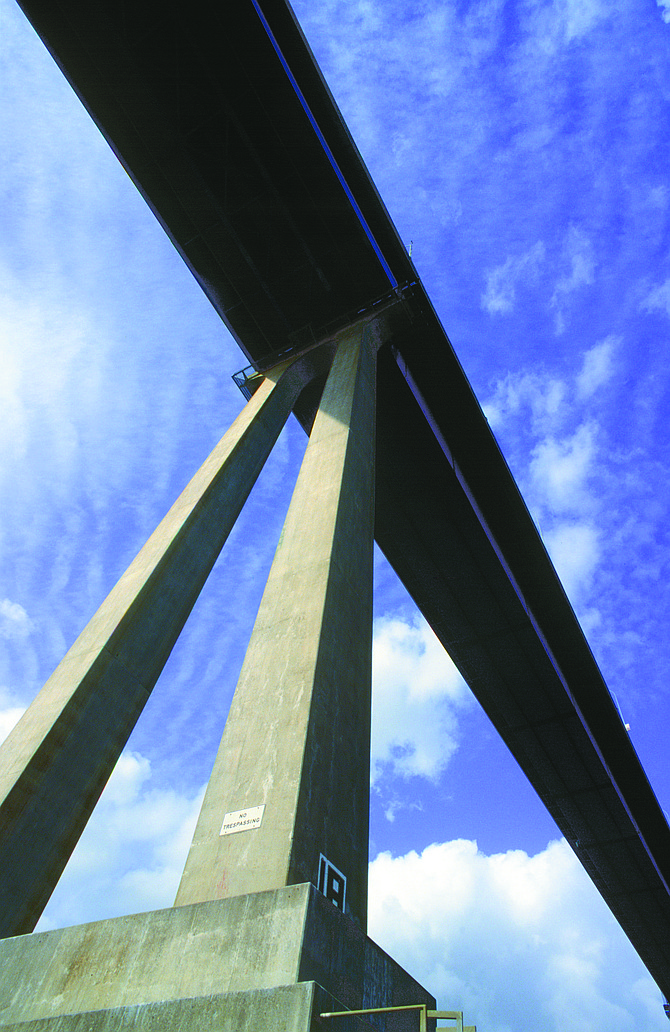
It’s a slash of light blue against the bay’s darker blue.
“How could mere toil align thy choiring strings!” Hart Crane, the great and doomed American poet wrote in astonishment about the Brooklyn Bridge, which he loved not only for its architectural beauty but also because it stood for him as a symbol for a synthesis of America. The choiring strings refer literally to the hundreds of miles of crosshatched cables (it’s a suspension bridge) that help hold it up. By calling them “choiring” he’s making them holy, but the line is grounded in the literal as well as leaping wildly into the metaphorical: the wind through the cables, when strong enough, makes a kind of music.
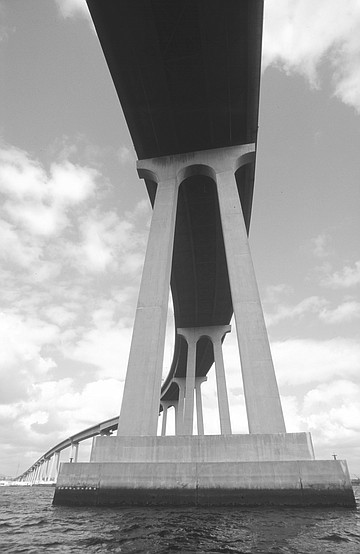
A 4.67 percent grade is the hill you climb driving from Coronado to San Diego.
The San Diego–Coronado Bay Bridge has no choiring strings. In fact, it has no strings, no cables, at all. Instead it is: a long blue banner — from some angles — held out and up almost straight by a strong wind and sometimes showing a slacker wind in its curves. It is a one-bar — blue — rainbow arching over the bay in fog at dawn. It’s a blue piece of ribbon candy hurled from a child’s hand and caught as a faint blur in the frame of a badly focused snapshot one lost Christmas morning. It’s a blue streak on the backs of 30 daddy long legs with their knees straightened (and their other legs lost) under the deadweight of steel and concrete. It’s a ramp upwards (particularly from Coronado to San Diego) to the sky, to vapors, to — some might say — heaven.
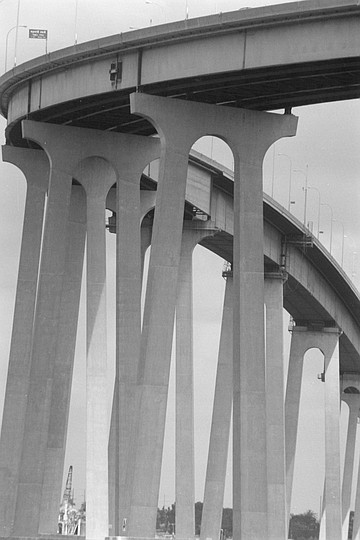
It’s a blue streak on the backs of 30 daddy long legs with their knees straightened.
It’s a slash of light blue against the bay’s darker blue and partly absorbed, partly contrasted to, the blue of the sky. And below the blue of the bridge and above the blue of the bay: the long skinny legs, pale as a banker’s calves when his trousers ride up above his dark blue socks. It’s to the eye what a word with a soothing vowel is to the ear. From the bay’s south side it’s almost straight, a bolt, connecting city to town, island — pure, lean, and practical: I will get you there, it says, on my blue back fast. From Coronado it’s a huge blue hook, its curve almost as tight as either end of a paperclip. From San Diego, approaching the bridge, for a few seconds: that paperclip straightened out. A comet’s tail. A low blue flame hurled across a chasm. The bridge’s color is the color of the great ether dome of your dreams. It’s hardly there at all, a wisp, at dawn or in mist, or at night its lights and the lights of its cars look like two strings of white beads beneath which there’s nothing but darkness. Steel and stone. The bridge.
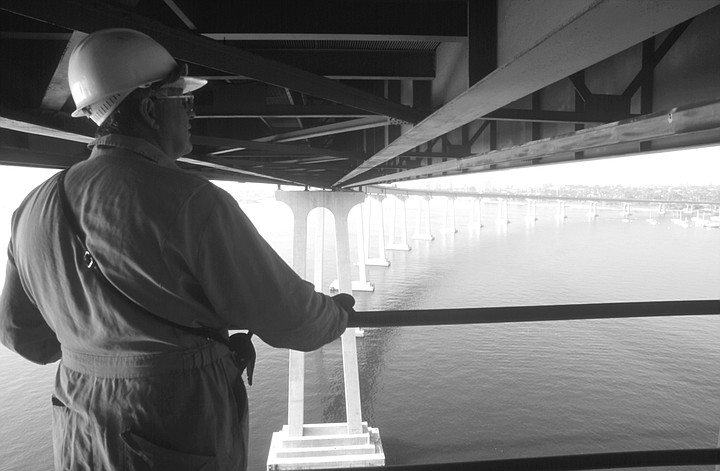
A construction worker surveying the bridge. When painters work on the outsides of the bridge, they stand on scaffolding that moves on a rail alongside it.
It’s 2.12 miles (11,179 feet) long and cost nearly $50 million. Last summer it was 30 years old. Retrofitting — earthquake-proofing (does it offend nature that we presume such a thing possible?) — going on now will cost between $70 and $150 million by the time it’s finished. Which end of these estimates do you think will be more accurate? It has 20,000 tons of steel in it — 13,000 tons of that in structural steel and the other 7000 in reinforcing steel. That equals the weight of about 15,384 and one half 1995 Honda Accords. Multiply that 15,000-plus by four and that’s the approximate number of Honda Accords (or other cars smaller than Accords and trucks bigger) that cross the bridge every day. It contains 94,000 cubic yards of concrete, 40,000 linear feet of concrete pilings. Add to that 900,000 cubic yards of dredged fill. Some of the caissons for the towers were drilled and blasted 100 feet into the bay’s bed. A lot of weight, a lot of space. A lot of space filled, a lot of space emptied.
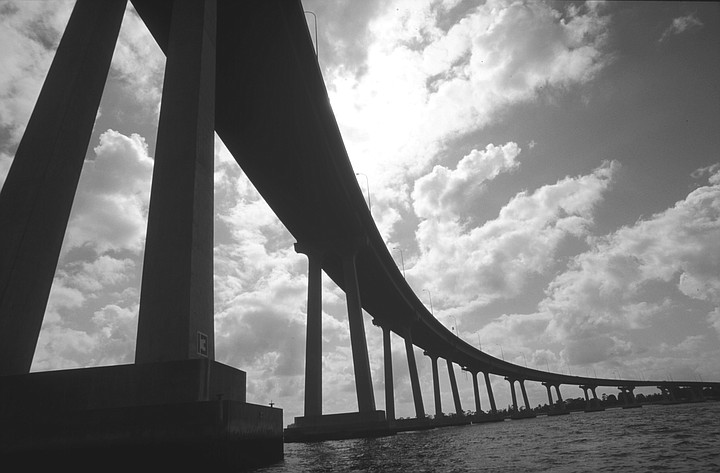
At one time it was proposed an enclosed 16-foot tube for bicyclists and pedestrians be built onto the bridge. That plan didn’t fly.
It’s what’s known as an orthotropic structure, a word that reminded me of “orthopedic” and made me think of aching shoulder joints and hip replacements. What it means is: it has unequal flexibility in two perpendicular directions. Which means, metaphorically, what it’s really about is great strength, apparent spareness, and a kind of architectural cunning. It’s a design originally used by German naval engineers building battle ships. The center part of the bridge is called “the box” and spans three piers (numbers 18 to 21), the ones over the main shipping channels. It’s the third largest orthogonal box in the country. This design is a steel-saver and contributes a slender superstructure and a smooth exterior: the braces and stiffeners are inside the box and beneath the roadway in all other parts of the bridge.
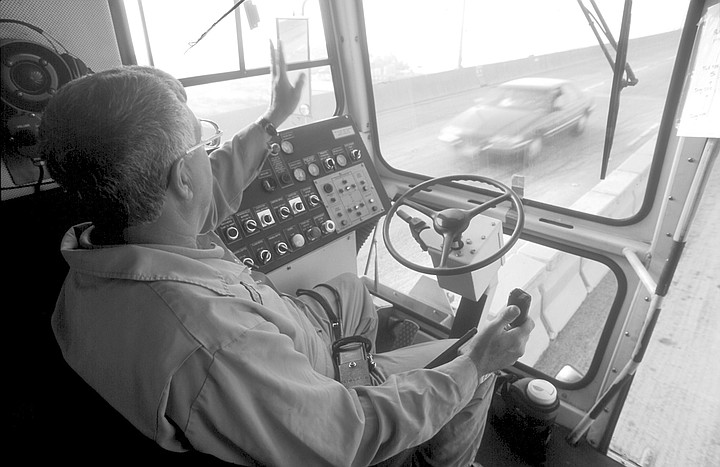
Jerry driving the Zipper. Before the Zipper, the job was done by hand in an operation the crew called “pull ’em and plug ’em.”
That’s what I mean by cunning: instead of showing off its muscles like a suspension bridge, it keeps them all hidden inside, beneath. It doesn’t have huge shoulders that brag about its strength like the Golden Gate or Brooklyn Bridge. It was originally set to be painted red like the former (red is easier and cheaper to maintain), but the planners decided on blue: it’s more harmonious with the surroundings. Its 2850 feet of curved steel contain the longest segments of such steel in the country. The bridge’s principal architect, Robert Mosher, as I suspect of many architects and engineers, had a sculptor’s eye. In 1970 it was given the Most Beautiful Bridge Award — by the American Institute of Steel Construction. I suppose one could call that a possible conflict of interest, but as far as I know no one was inclined to disagree and put forth another Most Beautiful Bridge in 1970. It took about three and one half years to build and opened officially on August 3, 1969, the summer after the summer after the Summer of Love and during the year of San Diego’s bicentennial.
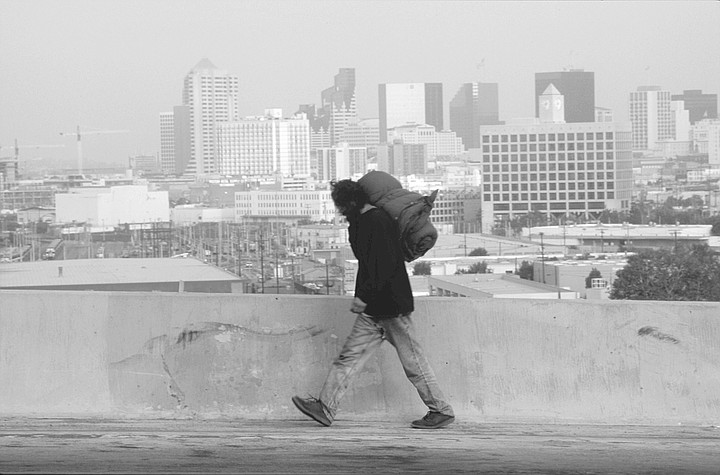
A bridge walker. It’s very dangerous to break down or run out of gas on the bridge.
A 4.67 percent grade is the hill you climb driving from Coronado to San Diego: this is the ramp to the sky. The side railings are concrete blocks only 34 inches high — to present an unobstructed view. If you hit them they’re designed to let your car ride up a few inches and then let it slide down to the road again. Cars have gone over twice. One with three drunk sailors somehow jumped onto the railing, slid along it like a skateboarding trick, and then over into the water. Was there a moment, a second or two, when the car teetered on the railing while gravity decided which way it would fall — back to the roadway or into the bay?
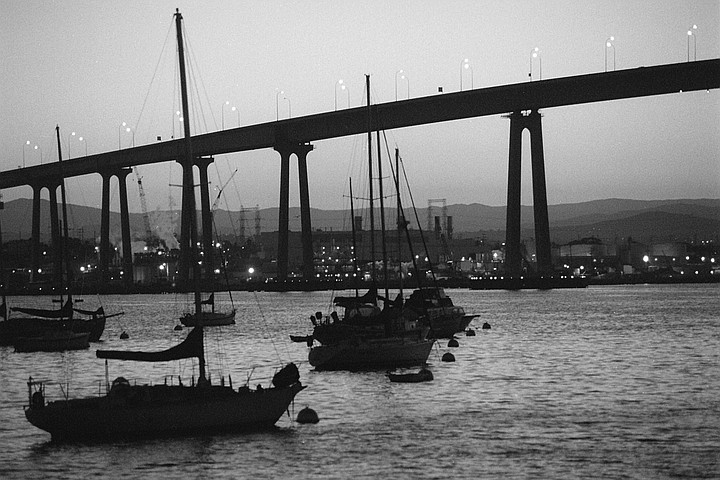
All sorts of things fall out of cars or off trucks. Bob Morbeu told me he saw a huge sheet of plywood fly off a truck and over the railing.
So: you’re driving up to the sky and to your right or left is the sky,which begins just below your window. It needs its grade and the 90-degree angle to rise high enough to create clearance for an empty aircraft carrier to pass underneath it — about 200 feet. It takes ten years to paint the bridge. It’s not painted from one end to another. It’s painted where it most needs painting, when it needs painting. Over 50 people — men and women — work every day to maintain it and take its tolls. The bridge is always there. Always open, 24 hours a day, 365 days a year.
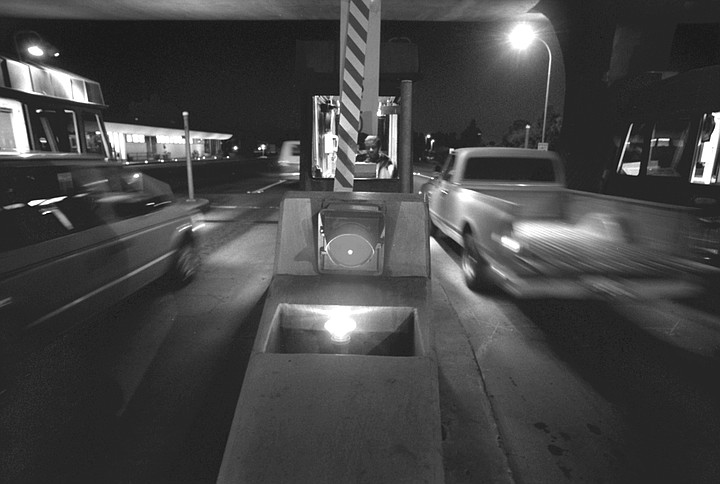
The bridge toll booth. Some people worry that if the tollbooths are gone, people will hit the island at about 80 mph.
I think the first thing Michael Martin, the bridge’s toll captain, said to me was “So do I.” I had just said to him, “I think the bridge is beautiful.” Captain Martin, and his second in command, Lieutenant Patricia Young, have the rank of captain and lieutenant (there are also sergeants) because at one time all highway and toll-bridge workers were peace officers and carried sidearms. They no longer do but have kept the ranking system. I heard one story, probably apocryphal, as to why they are no longer armed: A drunk sheriff or policeman stops at the tollbooth one night and refuses to pay. After some argument the toll-taker pulls his gun. So does the sheriff. Standoff. No shots fired. No one seems to know who backed down. Did the sheriff hand over his buck? Did the toll-taker wave him through with the barrel of his pistol? Captain Martin, a trim man in his late 40s, looking both a little preppy and a little military at the same time, has a splendid view of the bridge from his corner office at the Glorietta Toll Plaza: over the tops of some trees the great blue stream of it rushes toward San Diego as if shot off the tight curve into a straightaway home. He told me his predecessor, knowing he was dying, asked him to hold a memorial service in Tidelands Park, just across from the toll plaza and with a perfect view of the bridge. He did.
Captain Martin arranged for me to meet, the next day, Robert Morbeu, the bridge’s maintenance supervisor. Bob’s been with Caltrans for nearly 30 years, the past decade on the bridge. His crew’s headquarters is located directly below Pier 36 on the San Diego side of the bridge. The massive columns rise up from the parking lot. You can get an idea of how immense they are when you stand next to one. It makes you feel smaller than those men standing in front of the giant redwoods. Parked in the yard was a Caltrans truck with a 6´x6´ orange box attached to its rear end. It’s called an attenuator and it’s a crash absorber — getting rear-ended is always a danger for a vehicle stopped on the bridge.
Some months ago Bob and his crew heard a thud on the roof of the shop. It was a dog that either jumped in panic after wandering onto the bridge or was tossed out of a car over the railing. Depending on how you feel about the potential cruelty of humans, you can choose to believe the former or the latter. The dog was pretty smashed up but didn’t die.
Bob’s 5´8˝ or 5´9˝, sandy-haired, and has about him an easygoing air and a sense of calm control that one sees in men who are utterly competent in their work. You never mistake this calm for a lack of alertness or indifference. It is men and women like him without whom a good portion of America — particularly its infrastructure — would simply crumble. He knew every bolt on the bridge and exactly what to do to keep each one in the best condition, coordinating a crew of 11 men and women to do so every day. I learned later that he was a pretty serious tournament poker player. No surprise. Bob set me up to ride on the barrier transfer machine (colloquially known as the Zipper or even the Zamboni), to ride with one of the bridge’s tow-truck drivers, and to walk the two-mile maintenance catwalk that runs below the bridge’s surface.
A tunnel inside of a bridge: that’s how I thought of the catwalk when I first heard about it. At one time it was proposed an enclosed 16-foot tube for bicyclists and pedestrians be built onto the bridge. That plan didn’t fly. Now the bridge is open to pedestrians a few times a year for walks or runs. The catwalk is never open to the public. You enter it about a quarter of a mile onto the bridge from the San Diego side — a set of stairs lead down to a door — looking like the entrance to a basement apartment. Through another locked door, down a ladder, and you’re on it. (Note to nincompoops: these are serious doors, serious locks, and monitored 24 hours a day.) The catwalk is open-meshed steel, with handrails about bottom-rib high. Other than some crossing beams: air and distance to the ground and then more air and more distance to the water.
Don Elms, one of the crew, who loved it up here, took me. For some reason I walked ahead of him. Maybe I didn’t want to seem spooked. Maybe I just wanted to get across as fast as I could. Don handed me a hardhat and I soon found out why: bong! my head hit a pipe. I was glad it had some practical use — I knew (like a seatbelt in a plane crash) that it sure as hell wouldn’t help me if I fell. In fact, I was having a mild case of acrophobia. I gripped the handrail hard for the first hundred yards or so. Later, I heard a joke about a certain bridgeworker “who does a good job keeping the handrail clean” — meaning he doesn’t like to let go of it on the catwalk.
For a while it’s earth below, then docks, then the water. It’s a different feeling over water, scarier to me, and a few of the crew said it was for them too. You’d think just the opposite. It’s windy up here. Sometimes very windy. If it’s too windy — a call made by Bob Morbeu — nobody works up here. The bridge is built to give a little in the wind. I asked Don if he’d ever been up there when he could feel it move. “Many times,” he said. I asked him if it was likely the wind would pick up enough to move it today. He said he didn’t know.
Here and there’s a porthole with blue sky in it or the white of a cloud. A ladder was lashed with rope to the railing of the catwalk. Everything up here — every tool, bucket, etc. — has to be tied down when not in use. I spotted someone walking toward us. I asked Don if we’d have to fight with big sticks as in Robin Hood to see who would get to pass first. Actually, there’s enough room, just, for two-way traffic. All was airy, water and wind, until we hit the box, which you enter through what looks like a bulkhead door on a ship. It’s dark in the box — there’s a string of lights along the catwalk and a porthole here and there, but it’s so large — like being in a huge empty boxcar in a land of giants. The light was so dim that before my eyes adjusted I thought a bank of electrical panels was a locker room for the men who work up here.
Don led the way now, and he said there was one particular place he wanted me to see: a large porthole, reached by a ladder, outside of which was a small balcony. Don climbed the ladder and went out onto the balcony eagerly. Another ladder led down to the top of one of the pier caps. I was hoping he wouldn’t suggest that we descend that one. He didn’t. He leaned back with his arms draped over the balcony’s railing, smiling like the Lord Admiral of the Ocean Seas at the helm of his flagship making record time around the Horn: he loved this spot, one of the best views in San Diego (it looks south toward the Strand, Imperial Beach, and Mexico), and it belongs to practically no one else but him. He invited me onto the platform, but I settled for standing on the ladder and leaning out. I don’t think Don was ready to leave, but we did, continuing our trek.
After the box, the descent and the turn begin, although neither, particularly the turn, seemed very noticeable to me. Back out over the open water again, perhaps I welcomed the downslope because it quickened my journey. The catwalk ends at Pier 2, and you descend a series of stairs and ladders to the ground just feet from where the bay’s water laps the Coronado shore.
We saw some painters working when we were on the catwalk. They were so swathed in protective gear that I didn’t recognize them back at the shop. Their names were Bob and Julian, and they were partners — painters work in crews of at least two so they can watch each others’ backs, check each other’s safety equipment. Bob’s shoes were blue. Julian’s thumbs were blue. Julian was voluble, Bob knew how to get his words in edgewise. Painters are tested regularly for drug or alcohol abuse. Their blood is checked yearly for lead and their lungs are monitored — a lot of times they’re painting tucked up underneath in a corner of the bridge. When they work on the outsides of the bridge, they stand on scaffolding that moves on a rail alongside it. Even though it’s more dangerous, they prefer it outside. I asked Don if he ever had a fear of heights. He said no, but now he has a great respect for heights. Everything gets four coats: red primer, pink, light blue, and dark blue finish. Their thumbs and their shoes, therefore, wear different colors sometimes. They take regular training-and-development courses — in rigging, safety issues, etc. — even though they’re veteran painters.
The Zipper is not exactly a Disneyland ride, probably because the Zipper (the barrier transfer machine, or BTM) only goes five miles per hour, is essentially on a rail, and makes a deafening noise while at the same time creating a vibration that made my whole body feel like a struck funnybone. The Zipper’s been on the bridge since 1993. It moves the concrete barriers to create an extra lane coming or going — in the morning rush hour, three lanes leaving San Diego; in the evening rush hour, three lanes back to San Diego. Before the Zipper, the job was done by hand in an operation the crew called “pull ’em and plug ’em.” The barriers were orange-rubber stanchions that were pulled or plugged by a worker on the back of a moving vehicle. There were hundreds of these stanchions. It was a matter of pride, when plugging, to not miss any holes. Not easy. No one ever plugged a perfect game: no misses. The closest I heard anyone ever came was two or three missed “plug ’ems.”
The best part about my ride on the Zipper was Jerry Browning, one of its regular drivers. Jerry’s another happy man on what felt like a crew of unusual harmony. When I noticed that Beverly Sanders, a crew leader and one of the two women working on bridge maintenance (the other is Laura, a paint-crew leadworker), was limping around in a walking cast, I said to her, “They made you come to work today?” She said, “They let me come to work today.” Beverly has long brown hair, almost to her waist. In her ID picture pinned to her shirt she wears it in pigtails.
Jerry drives the front BTM (there are two cabs) because he’s a friendly guy and likes to wave to people. Several people waved and smiled as they drove past us. Jerry said many of them were regulars, people he sees and waves to often. Jerry sat in the driver’s seat with the same kind of body language that Don Elms displayed when on the high balcony — he smiled serenely while looking over his kingdom of sky and land and sea. The barriers have also virtually eliminated head-on collisions on the bridge. The two vehicles (each lifts and moves the 1400-pound barrier segments 6 feet to create a 12-foot lane) move forward guided by a wire in the pavement. The lifting is done by hydraulics, and there are only three or four other machines like this in the country.
On the day I rode with Jerry, we carried several cans of paint. We stopped at a manhole, and while Jerry and a few others lowered the large containers on a rope to the painters below, I sat in the driver’s seat. Previously I rode shotgun on a small jump seat. Jerry told me not to touch anything. There were several rows of buttons and dials to the left. Citizens of San Diego, know that as of March 31, 1999, your Zipper had 2879.4 engine hours on its odometer. (Note to taggers: don’t try the Zipper — it’s got eyeballs on it at all times that will get you.) People like the Zipper: it makes more room for their cars. They also like Jerry, and Jerry — no kidding — likes them.
When we went back to the shop for lunch I got a chance to meet other members of the crew and to listen as they talked and kidded and ate. These kinds of rooms exist in the thousands all over America — where working people eat, or grab a cup of coffee, get their assignments for the day, catch a few minutes of goldbricking time now and then. You hear lockers slamming and the thunk of a hardhat on the table. And even though Bob is clearly the boss he gets his share of ribbing too. I can freely admit (I have tenure) that I would rather eat, hang around to listen, and talk in a room like this, with people like these, than eat in a faculty dining room at a college, and I sure as hell would rather hear these people discuss business than sit through a meeting of English-department professors yammering about abstractions.
I met another man at lunch. He’s about 5´10˝, shaves his skull clean (even though he has a full head of hair) once a week, has a goatee to make a Viking marauder proud, is heavily tattooed (all of which he got long before tattoos were fashionable and seems somewhat chagrined now that they are), drives a big black motorcycle, has never drunk a drop of alcohol in his life, is a former Merchant Marine, barroom bouncer, and truck driver. You will be very happy to see this man — if you run out of gas or break down on the bridge. He’s one of the tow-truck drivers who constantly loop the bridge for about 16 hours a day. They’re usually on the scene a few minutes after a breakdown is reported at a tollbooth or, more frequently, seen on one of the monitors from five cameras on the bridge. His name is Gene Harrell. He’s lived on Coronado (where he looks neither like the typical townie nor the typical tourist) for 15 years, and driving a tow truck for the bridge is his dream job.
It’s very dangerous to break down or run out of gas on the bridge. Both, particularly the latter, happens a lot, and most often on the uphill climb around the curve of the bridge. Other than the grade itself, nobody had any idea why. Everyone, Gene said, no matter what kind of car they’re driving, says their gas gauge is broken, i.e., it’s a mechanical problem and not boneheadedness. Gene said this part of the bridge is a little spooky, even for him, and was so even before he worked on it. Although Robert Frost was dead several years before the bridge was built, he could have been thinking of it, and this part of it, when he wrote the lines: “The road at the top of the rise /Seems to come to an end /And take off into the skies.”
The tow-truck driver’s job is to get a disabled car off the bridge as fast as possible. Traffic can get snarled quickly, and a rear-end collision could hurt or kill someone. A story I heard a few times: in June of 1995, a newlywed couple, on their way from the reception to their honeymoon destination, blow a tire on the bridge. They’re struck from the rear, both are killed.
The tow truck pushes you off the bridge. If you’re out of gas they give you a gallon (note to idiots: don’t fake running out of gas on bridge in order to get a free gallon), and if you’re broken down otherwise, they’ll call a private tow truck. Gene says sometimes people expect him to fix their car or change a flat for them. A car with a flat is pushed off the bridge: “Possible rim damage is not as bad as possible death,” said Gene. One of the other tow-truck drivers never gets out of the cab: he pulls up behind them, tells them what he’s going to do over the loudspeaker, and pushes them off.
The tow-truck drivers are also often the first on the scene if someone is threatening to jump. They get a little training in how to talk to people in this situation to try to keep them from leaping before police or other emergency workers can arrive.
That the bridge with some frequency draws suicides and potential suicides to it is well known. I’m not sure if the statistics would differ from those of the Golden Gate Bridge or the Brooklyn Bridge. In the same poem of Hart Crane’s I quoted earlier, he writes: “Out of some subway scuttle, cell or loft /A bedlamite speeds to thy parapets /Tilting there momently, shrill shirt ballooning…” About eight to ten people per year jump from the bridge. Maybe twice that many threaten to and are talked down.
One thing was clear to me: These statistics, these facts, disturb the men and women who work the bridge. Not once did I hear the kind of joking, in order to lessen death’s frequent and violent presence, that one might hear among police, say, or emergency medical personnel. I know a compassionate and thoughtful doctor who routinely uses the phrase “fly signs” to indicate that someone is near death. Beverly, whom I mentioned earlier, used the term “floaters.” She said they preferred “floaters,” and I thought she was using the term flippantly until I asked her why. She said, “So the families have something to bury.” Most people are grabbed by the current and swept out to sea. And occasionally (three times is the figure I heard most often) someone jumps and survives. One such woman broke most of the bones in her body, recovered after several months in the hospital, went back to the bridge upon release, and jumped again. She must have desired exit badly. Hitting water after a 200-foot fall is very much like hitting cement.
I heard this story a few times, from different people: An empty car is pulled over, mid-bridge, and on the railing next to it a pair of cowboy boots. They were aligned neatly, toes pointing out, as if their occupant had been lifted from them into another world. Another story concerned the so-called Dapper Bandit, a bank robber known for his natty attire, who in September 1998 was cornered on the bridge and held many cops at bay for a few hours before finally jumping. Did he hesitate so long because he was considering the damage it would do to his suit? (Note to would-be suicides: Please don’t but if you absolutely must, please do it somewhere else. Note to people who might yell “Jump, you asshole!” to someone threatening to jump: Don’t. You could and should — someone recently was — be arrested, which will delay you much longer than a traffic tie-up and will make it clear to those who know you, if they did not already suspect, that you are a cruel and insensitive moron.)
Gene picked me up at 4:30 a.m. so I could ride with him on his Saturday rounds. When I stepped out onto the sidewalk, it was so dark I didn’t see him, sitting on his bike, wearing a black helmet and jacket, only about 20 feet from me. I jumped on the back of his big bike and we hit the bridge. It was freezing, and when I lifted my head and looked over Gene’s shoulder, my mouth (open, I guess, in awe or semi-terror) and cheeks flapped in the wind. I’d never been on the back (or front) of a motorcycle, in pitch dark, racing over a bridge. When we hit the upgrade I remembered Gene’s earlier comment about it — that it was a kind of Bermuda Triangle of the bridge — and I felt exhilarated. When we got to the maintenance headquarters and Gene realized he’d forgotten his keys (I’m not so sure he didn’t forget them on purpose so we’d have to repeat the trip), I was delighted. We rode back to Coronado, picked up the keys, and again over the bridge. By now I saw a few streaks of pink in the sky sneaking through cracks in the clouds. I felt like a little god. This time over I even let go of Gene’s jacket (with one of my hands) and tapped my helmet tighter on my head.
His Saturday shift, which he starts earlier than usual, is Gene’s favorite time on the bridge: at dawn, and with much less traffic than a regular workday. He said it feels peaceful. We looped the bridge several times in a kind of figure eight, waiting for calls over the radio or to spot something ourselves. Mid-bridge, we stopped to pick up some trash. What gets picked up when is a judgment call: is it something a driver would swerve to avoid and maybe cause an accident or will stopping to remove it be more dangerous for the driver of the truck or someone in a car? All sorts of things fall out of cars or off trucks. Bob Morbeu told me he saw a huge sheet of plywood fly off a truck and over the railing. A toll-taker, who looked remarkably like Jack Nicholson, gave me a list off the top of his head: ceiling fans, surfboards, a box full of wine glasses. He said that once the Navy dropped some sensitive instruments on the bridge and then didn’t want to admit it because they were embarrassed they’d lost them.
As Gene gathered the trash, I looked over the rail. Enormous, and sliding silently, a freighter passed beneath my feet.
Gene, too, loves his job, loves the bridge. He’s planning, in fact, to get married on the bridge, pending approval. His bride will walk from one direction on the catwalk, and he will walk from the other. Then the wedding party will descend a ladder to the top of a pier cap, where the ceremony will be held. I hope I’m invited. I hope he and his fiancée screen the guest list for acrophobics.
The next day Gene drove the boat. I wanted to see the bridge from beneath. I wanted to look up to where I had been recently looking down. We set out from the marina, and when we turned the corner by the Coronado Golf Course and I first saw the bridge from this angle, the south, I was again stunned by the great blue banner of it, so spare and spindly legged, seeming so effortlessly to stretch and surge across the bay. It emanates, from here, a sense of forward movement and immovability at the same time, and nothing, really, seems to be holding it up. The Brooklyn Bridge is the Sing Sing Prison of bridges: massive, medieval, so many cables crossing, holding it up from above and then gigantic legs holding it up from below. Nothing (but the sky) holds up the San Diego–Coronado Bay Bridge from above. And what holds it from beneath is so slender, slim of thigh, smooth as though electrolysis could happen to stone. Gene piloted the boat (“O my Captain…”) all around and beneath the bridge, slaloming between the piers, going out further to the north, right up to the lower pier caps. These need to be maintained, too: they haul a big hose out on a boat to wash the birdlime away. People on the crew take turns with this assignment. It doesn’t seem to be a favorite job, but as one said, “Hey, if it’s a nice day, you’re out in the boat…”
Gene drove the boat, and the photographer sat up front near him taking photographs. They both made fun of me when I lay down in the bow so I could look straight up when we were beneath the bridge. The catwalk looks a long way up and thin as a pencil. The crossing beams and stiffeners beneath the bridge offer a kind of strict geometry to balance the fluid wildness of the bridge seen from a distance. I could barely make out the sign mid-bridge with the suicide prevention hotline number. I spotted the little crow’s nest where Don Elms stood happily the day before, surveying his kingdom. It looked so high and fragile from here that I stopped regretting not going out on the platform with him. There is a reason people have a fear of heights: if you fall from one great enough, you will die. The lightpoles on the bridge looked the same shape and as thin as that curved pick the dentist uses but with a bulb shaped like a teardrop. As in the box, where they were much louder, when we were under the expansion joints, there were bangs each time a car or a truck drove over them. We went further north to look from a greater distance. Different again, from every angle different and new. From here the curve is more evident and looks as if it might draw you into its huge arms; it looks as if it’s saying, “Come to me, my little boat. Come to me.” Again, we went under the bridge. We considered tying up to one of the pier caps — the center columns have docking facilities — but the tide was low and the water choppy. We also didn’t want to annoy the harbor patrol: they wouldn’t know from wherever they saw us that Gene was authorized to be here. It was getting cold, so we headed back to harbor. As we rounded the golf course point again going back, I watched the bridge slide from view. The water was calmer now, and I stood in the boat until we docked, trying to imagine myself an explorer returning home after charting new oceans, new lands, and proud of myself that I didn’t get seasick and bequeath my lunch to the sea in the midst of my rhapsodies. I’m not nuts about boats either, particularly on the ocean, which we sort of were on and sort of weren’t. Samuel Johnson said that being on a boat was like being in jail but with a chance of drowning.
One longtime Coronadan said to me, “I can’t tell you what we called the bridge when it was first built,” and, as so often when someone says that, she immediately said, “Brown’s last erection.” Meaning then-governor Pat Brown, who, as legend has it, got frustrated one day waiting for the ferry to take him to the island and exclaimed, “I don’t care if they don’t want this bridge, we’re going to build it!” A lot of longtime Coronadans still don’t like that the bridge is there. It changed Coronado drastically by making it more accessible. It does not, however, seem likely that it will be dismantled and removed. Most people want the tolls eliminated. Some people worry (legitimately, I think) that if the tollbooths are gone, people will hit the island coming off the downgrade at about 80 mph. If this happens, some of the houses at the end of the bridge should put up crash barriers. Coronado cabbies hate to take a fare to San Diego and pay a buck to get back. “San Diego cabbies taking a fare to Coronado don’t have to pay a buck to get back,” one said to me. There’s no toll if there’s more than one person in the car. Let’s let former-governor Brown have the last word on the politics. He was invited to the opening ceremonies on August 3, 1969, but declined to come, sending a letter with these words: “The San Diego–Coronado Bay Bridge is one I will be proud of until the day I die, and I do hope that I will be able to quietly travel that bridge some early morning because I feel it is my baby.” Not many people get such a beautiful baby from their last erection.
I have traveled the bridge quietly (as quiet as it can be on a motorcycle, tow truck, and the Zipper), and I didn’t feel like it was my baby. I felt like it was my mother, my big architectural mother. I know what Hart Crane meant when he said of the Brooklyn Bridge at night, “And I have seen night lifted in thine arms.”
The next time you drive from San Diego to Coronado, give a little salute to Captain Martin in his office. He and his people and Bob Morbeu and his people are taking care of their big blue baby, which just bore you on its slender shoulders high over the bay, safe and swift, to an island (almost) you could (almost) only get to by boat not so long ago.
Here's something you might be interested in.
A walk on Coronado bridge's big blue catwalk
Drive to the sky

A walk on Coronado bridge's big blue catwalk
Drive to the sky
It’s a slash of light blue against the bay’s darker blue.
“How could mere toil align thy choiring strings!” Hart Crane, the great and doomed American poet wrote in astonishment about the Brooklyn Bridge, which he loved not only for its architectural beauty but also because it stood for him as a symbol for a synthesis of America. The choiring strings refer literally to the hundreds of miles of crosshatched cables (it’s a suspension bridge) that help hold it up. By calling them “choiring” he’s making them holy, but the line is grounded in the literal as well as leaping wildly into the metaphorical: the wind through the cables, when strong enough, makes a kind of music.
A 4.67 percent grade is the hill you climb driving from Coronado to San Diego.
The San Diego–Coronado Bay Bridge has no choiring strings. In fact, it has no strings, no cables, at all. Instead it is: a long blue banner — from some angles — held out and up almost straight by a strong wind and sometimes showing a slacker wind in its curves. It is a one-bar — blue — rainbow arching over the bay in fog at dawn. It’s a blue piece of ribbon candy hurled from a child’s hand and caught as a faint blur in the frame of a badly focused snapshot one lost Christmas morning. It’s a blue streak on the backs of 30 daddy long legs with their knees straightened (and their other legs lost) under the deadweight of steel and concrete. It’s a ramp upwards (particularly from Coronado to San Diego) to the sky, to vapors, to — some might say — heaven.
It’s a blue streak on the backs of 30 daddy long legs with their knees straightened.
It’s a slash of light blue against the bay’s darker blue and partly absorbed, partly contrasted to, the blue of the sky. And below the blue of the bridge and above the blue of the bay: the long skinny legs, pale as a banker’s calves when his trousers ride up above his dark blue socks. It’s to the eye what a word with a soothing vowel is to the ear. From the bay’s south side it’s almost straight, a bolt, connecting city to town, island — pure, lean, and practical: I will get you there, it says, on my blue back fast. From Coronado it’s a huge blue hook, its curve almost as tight as either end of a paperclip. From San Diego, approaching the bridge, for a few seconds: that paperclip straightened out. A comet’s tail. A low blue flame hurled across a chasm. The bridge’s color is the color of the great ether dome of your dreams. It’s hardly there at all, a wisp, at dawn or in mist, or at night its lights and the lights of its cars look like two strings of white beads beneath which there’s nothing but darkness. Steel and stone. The bridge.
A construction worker surveying the bridge. When painters work on the outsides of the bridge, they stand on scaffolding that moves on a rail alongside it.
It’s 2.12 miles (11,179 feet) long and cost nearly $50 million. Last summer it was 30 years old. Retrofitting — earthquake-proofing (does it offend nature that we presume such a thing possible?) — going on now will cost between $70 and $150 million by the time it’s finished. Which end of these estimates do you think will be more accurate? It has 20,000 tons of steel in it — 13,000 tons of that in structural steel and the other 7000 in reinforcing steel. That equals the weight of about 15,384 and one half 1995 Honda Accords. Multiply that 15,000-plus by four and that’s the approximate number of Honda Accords (or other cars smaller than Accords and trucks bigger) that cross the bridge every day. It contains 94,000 cubic yards of concrete, 40,000 linear feet of concrete pilings. Add to that 900,000 cubic yards of dredged fill. Some of the caissons for the towers were drilled and blasted 100 feet into the bay’s bed. A lot of weight, a lot of space. A lot of space filled, a lot of space emptied.
At one time it was proposed an enclosed 16-foot tube for bicyclists and pedestrians be built onto the bridge. That plan didn’t fly.
It’s what’s known as an orthotropic structure, a word that reminded me of “orthopedic” and made me think of aching shoulder joints and hip replacements. What it means is: it has unequal flexibility in two perpendicular directions. Which means, metaphorically, what it’s really about is great strength, apparent spareness, and a kind of architectural cunning. It’s a design originally used by German naval engineers building battle ships. The center part of the bridge is called “the box” and spans three piers (numbers 18 to 21), the ones over the main shipping channels. It’s the third largest orthogonal box in the country. This design is a steel-saver and contributes a slender superstructure and a smooth exterior: the braces and stiffeners are inside the box and beneath the roadway in all other parts of the bridge.
Jerry driving the Zipper. Before the Zipper, the job was done by hand in an operation the crew called “pull ’em and plug ’em.”
That’s what I mean by cunning: instead of showing off its muscles like a suspension bridge, it keeps them all hidden inside, beneath. It doesn’t have huge shoulders that brag about its strength like the Golden Gate or Brooklyn Bridge. It was originally set to be painted red like the former (red is easier and cheaper to maintain), but the planners decided on blue: it’s more harmonious with the surroundings. Its 2850 feet of curved steel contain the longest segments of such steel in the country. The bridge’s principal architect, Robert Mosher, as I suspect of many architects and engineers, had a sculptor’s eye. In 1970 it was given the Most Beautiful Bridge Award — by the American Institute of Steel Construction. I suppose one could call that a possible conflict of interest, but as far as I know no one was inclined to disagree and put forth another Most Beautiful Bridge in 1970. It took about three and one half years to build and opened officially on August 3, 1969, the summer after the summer after the Summer of Love and during the year of San Diego’s bicentennial.
A bridge walker. It’s very dangerous to break down or run out of gas on the bridge.
A 4.67 percent grade is the hill you climb driving from Coronado to San Diego: this is the ramp to the sky. The side railings are concrete blocks only 34 inches high — to present an unobstructed view. If you hit them they’re designed to let your car ride up a few inches and then let it slide down to the road again. Cars have gone over twice. One with three drunk sailors somehow jumped onto the railing, slid along it like a skateboarding trick, and then over into the water. Was there a moment, a second or two, when the car teetered on the railing while gravity decided which way it would fall — back to the roadway or into the bay?
All sorts of things fall out of cars or off trucks. Bob Morbeu told me he saw a huge sheet of plywood fly off a truck and over the railing.
So: you’re driving up to the sky and to your right or left is the sky,which begins just below your window. It needs its grade and the 90-degree angle to rise high enough to create clearance for an empty aircraft carrier to pass underneath it — about 200 feet. It takes ten years to paint the bridge. It’s not painted from one end to another. It’s painted where it most needs painting, when it needs painting. Over 50 people — men and women — work every day to maintain it and take its tolls. The bridge is always there. Always open, 24 hours a day, 365 days a year.
The bridge toll booth. Some people worry that if the tollbooths are gone, people will hit the island at about 80 mph.
I think the first thing Michael Martin, the bridge’s toll captain, said to me was “So do I.” I had just said to him, “I think the bridge is beautiful.” Captain Martin, and his second in command, Lieutenant Patricia Young, have the rank of captain and lieutenant (there are also sergeants) because at one time all highway and toll-bridge workers were peace officers and carried sidearms. They no longer do but have kept the ranking system. I heard one story, probably apocryphal, as to why they are no longer armed: A drunk sheriff or policeman stops at the tollbooth one night and refuses to pay. After some argument the toll-taker pulls his gun. So does the sheriff. Standoff. No shots fired. No one seems to know who backed down. Did the sheriff hand over his buck? Did the toll-taker wave him through with the barrel of his pistol? Captain Martin, a trim man in his late 40s, looking both a little preppy and a little military at the same time, has a splendid view of the bridge from his corner office at the Glorietta Toll Plaza: over the tops of some trees the great blue stream of it rushes toward San Diego as if shot off the tight curve into a straightaway home. He told me his predecessor, knowing he was dying, asked him to hold a memorial service in Tidelands Park, just across from the toll plaza and with a perfect view of the bridge. He did.
Captain Martin arranged for me to meet, the next day, Robert Morbeu, the bridge’s maintenance supervisor. Bob’s been with Caltrans for nearly 30 years, the past decade on the bridge. His crew’s headquarters is located directly below Pier 36 on the San Diego side of the bridge. The massive columns rise up from the parking lot. You can get an idea of how immense they are when you stand next to one. It makes you feel smaller than those men standing in front of the giant redwoods. Parked in the yard was a Caltrans truck with a 6´x6´ orange box attached to its rear end. It’s called an attenuator and it’s a crash absorber — getting rear-ended is always a danger for a vehicle stopped on the bridge.
Some months ago Bob and his crew heard a thud on the roof of the shop. It was a dog that either jumped in panic after wandering onto the bridge or was tossed out of a car over the railing. Depending on how you feel about the potential cruelty of humans, you can choose to believe the former or the latter. The dog was pretty smashed up but didn’t die.
Bob’s 5´8˝ or 5´9˝, sandy-haired, and has about him an easygoing air and a sense of calm control that one sees in men who are utterly competent in their work. You never mistake this calm for a lack of alertness or indifference. It is men and women like him without whom a good portion of America — particularly its infrastructure — would simply crumble. He knew every bolt on the bridge and exactly what to do to keep each one in the best condition, coordinating a crew of 11 men and women to do so every day. I learned later that he was a pretty serious tournament poker player. No surprise. Bob set me up to ride on the barrier transfer machine (colloquially known as the Zipper or even the Zamboni), to ride with one of the bridge’s tow-truck drivers, and to walk the two-mile maintenance catwalk that runs below the bridge’s surface.
A tunnel inside of a bridge: that’s how I thought of the catwalk when I first heard about it. At one time it was proposed an enclosed 16-foot tube for bicyclists and pedestrians be built onto the bridge. That plan didn’t fly. Now the bridge is open to pedestrians a few times a year for walks or runs. The catwalk is never open to the public. You enter it about a quarter of a mile onto the bridge from the San Diego side — a set of stairs lead down to a door — looking like the entrance to a basement apartment. Through another locked door, down a ladder, and you’re on it. (Note to nincompoops: these are serious doors, serious locks, and monitored 24 hours a day.) The catwalk is open-meshed steel, with handrails about bottom-rib high. Other than some crossing beams: air and distance to the ground and then more air and more distance to the water.
Don Elms, one of the crew, who loved it up here, took me. For some reason I walked ahead of him. Maybe I didn’t want to seem spooked. Maybe I just wanted to get across as fast as I could. Don handed me a hardhat and I soon found out why: bong! my head hit a pipe. I was glad it had some practical use — I knew (like a seatbelt in a plane crash) that it sure as hell wouldn’t help me if I fell. In fact, I was having a mild case of acrophobia. I gripped the handrail hard for the first hundred yards or so. Later, I heard a joke about a certain bridgeworker “who does a good job keeping the handrail clean” — meaning he doesn’t like to let go of it on the catwalk.
For a while it’s earth below, then docks, then the water. It’s a different feeling over water, scarier to me, and a few of the crew said it was for them too. You’d think just the opposite. It’s windy up here. Sometimes very windy. If it’s too windy — a call made by Bob Morbeu — nobody works up here. The bridge is built to give a little in the wind. I asked Don if he’d ever been up there when he could feel it move. “Many times,” he said. I asked him if it was likely the wind would pick up enough to move it today. He said he didn’t know.
Here and there’s a porthole with blue sky in it or the white of a cloud. A ladder was lashed with rope to the railing of the catwalk. Everything up here — every tool, bucket, etc. — has to be tied down when not in use. I spotted someone walking toward us. I asked Don if we’d have to fight with big sticks as in Robin Hood to see who would get to pass first. Actually, there’s enough room, just, for two-way traffic. All was airy, water and wind, until we hit the box, which you enter through what looks like a bulkhead door on a ship. It’s dark in the box — there’s a string of lights along the catwalk and a porthole here and there, but it’s so large — like being in a huge empty boxcar in a land of giants. The light was so dim that before my eyes adjusted I thought a bank of electrical panels was a locker room for the men who work up here.
Don led the way now, and he said there was one particular place he wanted me to see: a large porthole, reached by a ladder, outside of which was a small balcony. Don climbed the ladder and went out onto the balcony eagerly. Another ladder led down to the top of one of the pier caps. I was hoping he wouldn’t suggest that we descend that one. He didn’t. He leaned back with his arms draped over the balcony’s railing, smiling like the Lord Admiral of the Ocean Seas at the helm of his flagship making record time around the Horn: he loved this spot, one of the best views in San Diego (it looks south toward the Strand, Imperial Beach, and Mexico), and it belongs to practically no one else but him. He invited me onto the platform, but I settled for standing on the ladder and leaning out. I don’t think Don was ready to leave, but we did, continuing our trek.
After the box, the descent and the turn begin, although neither, particularly the turn, seemed very noticeable to me. Back out over the open water again, perhaps I welcomed the downslope because it quickened my journey. The catwalk ends at Pier 2, and you descend a series of stairs and ladders to the ground just feet from where the bay’s water laps the Coronado shore.
We saw some painters working when we were on the catwalk. They were so swathed in protective gear that I didn’t recognize them back at the shop. Their names were Bob and Julian, and they were partners — painters work in crews of at least two so they can watch each others’ backs, check each other’s safety equipment. Bob’s shoes were blue. Julian’s thumbs were blue. Julian was voluble, Bob knew how to get his words in edgewise. Painters are tested regularly for drug or alcohol abuse. Their blood is checked yearly for lead and their lungs are monitored — a lot of times they’re painting tucked up underneath in a corner of the bridge. When they work on the outsides of the bridge, they stand on scaffolding that moves on a rail alongside it. Even though it’s more dangerous, they prefer it outside. I asked Don if he ever had a fear of heights. He said no, but now he has a great respect for heights. Everything gets four coats: red primer, pink, light blue, and dark blue finish. Their thumbs and their shoes, therefore, wear different colors sometimes. They take regular training-and-development courses — in rigging, safety issues, etc. — even though they’re veteran painters.
The Zipper is not exactly a Disneyland ride, probably because the Zipper (the barrier transfer machine, or BTM) only goes five miles per hour, is essentially on a rail, and makes a deafening noise while at the same time creating a vibration that made my whole body feel like a struck funnybone. The Zipper’s been on the bridge since 1993. It moves the concrete barriers to create an extra lane coming or going — in the morning rush hour, three lanes leaving San Diego; in the evening rush hour, three lanes back to San Diego. Before the Zipper, the job was done by hand in an operation the crew called “pull ’em and plug ’em.” The barriers were orange-rubber stanchions that were pulled or plugged by a worker on the back of a moving vehicle. There were hundreds of these stanchions. It was a matter of pride, when plugging, to not miss any holes. Not easy. No one ever plugged a perfect game: no misses. The closest I heard anyone ever came was two or three missed “plug ’ems.”
The best part about my ride on the Zipper was Jerry Browning, one of its regular drivers. Jerry’s another happy man on what felt like a crew of unusual harmony. When I noticed that Beverly Sanders, a crew leader and one of the two women working on bridge maintenance (the other is Laura, a paint-crew leadworker), was limping around in a walking cast, I said to her, “They made you come to work today?” She said, “They let me come to work today.” Beverly has long brown hair, almost to her waist. In her ID picture pinned to her shirt she wears it in pigtails.
Jerry drives the front BTM (there are two cabs) because he’s a friendly guy and likes to wave to people. Several people waved and smiled as they drove past us. Jerry said many of them were regulars, people he sees and waves to often. Jerry sat in the driver’s seat with the same kind of body language that Don Elms displayed when on the high balcony — he smiled serenely while looking over his kingdom of sky and land and sea. The barriers have also virtually eliminated head-on collisions on the bridge. The two vehicles (each lifts and moves the 1400-pound barrier segments 6 feet to create a 12-foot lane) move forward guided by a wire in the pavement. The lifting is done by hydraulics, and there are only three or four other machines like this in the country.
On the day I rode with Jerry, we carried several cans of paint. We stopped at a manhole, and while Jerry and a few others lowered the large containers on a rope to the painters below, I sat in the driver’s seat. Previously I rode shotgun on a small jump seat. Jerry told me not to touch anything. There were several rows of buttons and dials to the left. Citizens of San Diego, know that as of March 31, 1999, your Zipper had 2879.4 engine hours on its odometer. (Note to taggers: don’t try the Zipper — it’s got eyeballs on it at all times that will get you.) People like the Zipper: it makes more room for their cars. They also like Jerry, and Jerry — no kidding — likes them.
When we went back to the shop for lunch I got a chance to meet other members of the crew and to listen as they talked and kidded and ate. These kinds of rooms exist in the thousands all over America — where working people eat, or grab a cup of coffee, get their assignments for the day, catch a few minutes of goldbricking time now and then. You hear lockers slamming and the thunk of a hardhat on the table. And even though Bob is clearly the boss he gets his share of ribbing too. I can freely admit (I have tenure) that I would rather eat, hang around to listen, and talk in a room like this, with people like these, than eat in a faculty dining room at a college, and I sure as hell would rather hear these people discuss business than sit through a meeting of English-department professors yammering about abstractions.
I met another man at lunch. He’s about 5´10˝, shaves his skull clean (even though he has a full head of hair) once a week, has a goatee to make a Viking marauder proud, is heavily tattooed (all of which he got long before tattoos were fashionable and seems somewhat chagrined now that they are), drives a big black motorcycle, has never drunk a drop of alcohol in his life, is a former Merchant Marine, barroom bouncer, and truck driver. You will be very happy to see this man — if you run out of gas or break down on the bridge. He’s one of the tow-truck drivers who constantly loop the bridge for about 16 hours a day. They’re usually on the scene a few minutes after a breakdown is reported at a tollbooth or, more frequently, seen on one of the monitors from five cameras on the bridge. His name is Gene Harrell. He’s lived on Coronado (where he looks neither like the typical townie nor the typical tourist) for 15 years, and driving a tow truck for the bridge is his dream job.
It’s very dangerous to break down or run out of gas on the bridge. Both, particularly the latter, happens a lot, and most often on the uphill climb around the curve of the bridge. Other than the grade itself, nobody had any idea why. Everyone, Gene said, no matter what kind of car they’re driving, says their gas gauge is broken, i.e., it’s a mechanical problem and not boneheadedness. Gene said this part of the bridge is a little spooky, even for him, and was so even before he worked on it. Although Robert Frost was dead several years before the bridge was built, he could have been thinking of it, and this part of it, when he wrote the lines: “The road at the top of the rise /Seems to come to an end /And take off into the skies.”
The tow-truck driver’s job is to get a disabled car off the bridge as fast as possible. Traffic can get snarled quickly, and a rear-end collision could hurt or kill someone. A story I heard a few times: in June of 1995, a newlywed couple, on their way from the reception to their honeymoon destination, blow a tire on the bridge. They’re struck from the rear, both are killed.
The tow truck pushes you off the bridge. If you’re out of gas they give you a gallon (note to idiots: don’t fake running out of gas on bridge in order to get a free gallon), and if you’re broken down otherwise, they’ll call a private tow truck. Gene says sometimes people expect him to fix their car or change a flat for them. A car with a flat is pushed off the bridge: “Possible rim damage is not as bad as possible death,” said Gene. One of the other tow-truck drivers never gets out of the cab: he pulls up behind them, tells them what he’s going to do over the loudspeaker, and pushes them off.
The tow-truck drivers are also often the first on the scene if someone is threatening to jump. They get a little training in how to talk to people in this situation to try to keep them from leaping before police or other emergency workers can arrive.
That the bridge with some frequency draws suicides and potential suicides to it is well known. I’m not sure if the statistics would differ from those of the Golden Gate Bridge or the Brooklyn Bridge. In the same poem of Hart Crane’s I quoted earlier, he writes: “Out of some subway scuttle, cell or loft /A bedlamite speeds to thy parapets /Tilting there momently, shrill shirt ballooning…” About eight to ten people per year jump from the bridge. Maybe twice that many threaten to and are talked down.
One thing was clear to me: These statistics, these facts, disturb the men and women who work the bridge. Not once did I hear the kind of joking, in order to lessen death’s frequent and violent presence, that one might hear among police, say, or emergency medical personnel. I know a compassionate and thoughtful doctor who routinely uses the phrase “fly signs” to indicate that someone is near death. Beverly, whom I mentioned earlier, used the term “floaters.” She said they preferred “floaters,” and I thought she was using the term flippantly until I asked her why. She said, “So the families have something to bury.” Most people are grabbed by the current and swept out to sea. And occasionally (three times is the figure I heard most often) someone jumps and survives. One such woman broke most of the bones in her body, recovered after several months in the hospital, went back to the bridge upon release, and jumped again. She must have desired exit badly. Hitting water after a 200-foot fall is very much like hitting cement.
I heard this story a few times, from different people: An empty car is pulled over, mid-bridge, and on the railing next to it a pair of cowboy boots. They were aligned neatly, toes pointing out, as if their occupant had been lifted from them into another world. Another story concerned the so-called Dapper Bandit, a bank robber known for his natty attire, who in September 1998 was cornered on the bridge and held many cops at bay for a few hours before finally jumping. Did he hesitate so long because he was considering the damage it would do to his suit? (Note to would-be suicides: Please don’t but if you absolutely must, please do it somewhere else. Note to people who might yell “Jump, you asshole!” to someone threatening to jump: Don’t. You could and should — someone recently was — be arrested, which will delay you much longer than a traffic tie-up and will make it clear to those who know you, if they did not already suspect, that you are a cruel and insensitive moron.)
Gene picked me up at 4:30 a.m. so I could ride with him on his Saturday rounds. When I stepped out onto the sidewalk, it was so dark I didn’t see him, sitting on his bike, wearing a black helmet and jacket, only about 20 feet from me. I jumped on the back of his big bike and we hit the bridge. It was freezing, and when I lifted my head and looked over Gene’s shoulder, my mouth (open, I guess, in awe or semi-terror) and cheeks flapped in the wind. I’d never been on the back (or front) of a motorcycle, in pitch dark, racing over a bridge. When we hit the upgrade I remembered Gene’s earlier comment about it — that it was a kind of Bermuda Triangle of the bridge — and I felt exhilarated. When we got to the maintenance headquarters and Gene realized he’d forgotten his keys (I’m not so sure he didn’t forget them on purpose so we’d have to repeat the trip), I was delighted. We rode back to Coronado, picked up the keys, and again over the bridge. By now I saw a few streaks of pink in the sky sneaking through cracks in the clouds. I felt like a little god. This time over I even let go of Gene’s jacket (with one of my hands) and tapped my helmet tighter on my head.
His Saturday shift, which he starts earlier than usual, is Gene’s favorite time on the bridge: at dawn, and with much less traffic than a regular workday. He said it feels peaceful. We looped the bridge several times in a kind of figure eight, waiting for calls over the radio or to spot something ourselves. Mid-bridge, we stopped to pick up some trash. What gets picked up when is a judgment call: is it something a driver would swerve to avoid and maybe cause an accident or will stopping to remove it be more dangerous for the driver of the truck or someone in a car? All sorts of things fall out of cars or off trucks. Bob Morbeu told me he saw a huge sheet of plywood fly off a truck and over the railing. A toll-taker, who looked remarkably like Jack Nicholson, gave me a list off the top of his head: ceiling fans, surfboards, a box full of wine glasses. He said that once the Navy dropped some sensitive instruments on the bridge and then didn’t want to admit it because they were embarrassed they’d lost them.
As Gene gathered the trash, I looked over the rail. Enormous, and sliding silently, a freighter passed beneath my feet.
Gene, too, loves his job, loves the bridge. He’s planning, in fact, to get married on the bridge, pending approval. His bride will walk from one direction on the catwalk, and he will walk from the other. Then the wedding party will descend a ladder to the top of a pier cap, where the ceremony will be held. I hope I’m invited. I hope he and his fiancée screen the guest list for acrophobics.
The next day Gene drove the boat. I wanted to see the bridge from beneath. I wanted to look up to where I had been recently looking down. We set out from the marina, and when we turned the corner by the Coronado Golf Course and I first saw the bridge from this angle, the south, I was again stunned by the great blue banner of it, so spare and spindly legged, seeming so effortlessly to stretch and surge across the bay. It emanates, from here, a sense of forward movement and immovability at the same time, and nothing, really, seems to be holding it up. The Brooklyn Bridge is the Sing Sing Prison of bridges: massive, medieval, so many cables crossing, holding it up from above and then gigantic legs holding it up from below. Nothing (but the sky) holds up the San Diego–Coronado Bay Bridge from above. And what holds it from beneath is so slender, slim of thigh, smooth as though electrolysis could happen to stone. Gene piloted the boat (“O my Captain…”) all around and beneath the bridge, slaloming between the piers, going out further to the north, right up to the lower pier caps. These need to be maintained, too: they haul a big hose out on a boat to wash the birdlime away. People on the crew take turns with this assignment. It doesn’t seem to be a favorite job, but as one said, “Hey, if it’s a nice day, you’re out in the boat…”
Gene drove the boat, and the photographer sat up front near him taking photographs. They both made fun of me when I lay down in the bow so I could look straight up when we were beneath the bridge. The catwalk looks a long way up and thin as a pencil. The crossing beams and stiffeners beneath the bridge offer a kind of strict geometry to balance the fluid wildness of the bridge seen from a distance. I could barely make out the sign mid-bridge with the suicide prevention hotline number. I spotted the little crow’s nest where Don Elms stood happily the day before, surveying his kingdom. It looked so high and fragile from here that I stopped regretting not going out on the platform with him. There is a reason people have a fear of heights: if you fall from one great enough, you will die. The lightpoles on the bridge looked the same shape and as thin as that curved pick the dentist uses but with a bulb shaped like a teardrop. As in the box, where they were much louder, when we were under the expansion joints, there were bangs each time a car or a truck drove over them. We went further north to look from a greater distance. Different again, from every angle different and new. From here the curve is more evident and looks as if it might draw you into its huge arms; it looks as if it’s saying, “Come to me, my little boat. Come to me.” Again, we went under the bridge. We considered tying up to one of the pier caps — the center columns have docking facilities — but the tide was low and the water choppy. We also didn’t want to annoy the harbor patrol: they wouldn’t know from wherever they saw us that Gene was authorized to be here. It was getting cold, so we headed back to harbor. As we rounded the golf course point again going back, I watched the bridge slide from view. The water was calmer now, and I stood in the boat until we docked, trying to imagine myself an explorer returning home after charting new oceans, new lands, and proud of myself that I didn’t get seasick and bequeath my lunch to the sea in the midst of my rhapsodies. I’m not nuts about boats either, particularly on the ocean, which we sort of were on and sort of weren’t. Samuel Johnson said that being on a boat was like being in jail but with a chance of drowning.
One longtime Coronadan said to me, “I can’t tell you what we called the bridge when it was first built,” and, as so often when someone says that, she immediately said, “Brown’s last erection.” Meaning then-governor Pat Brown, who, as legend has it, got frustrated one day waiting for the ferry to take him to the island and exclaimed, “I don’t care if they don’t want this bridge, we’re going to build it!” A lot of longtime Coronadans still don’t like that the bridge is there. It changed Coronado drastically by making it more accessible. It does not, however, seem likely that it will be dismantled and removed. Most people want the tolls eliminated. Some people worry (legitimately, I think) that if the tollbooths are gone, people will hit the island coming off the downgrade at about 80 mph. If this happens, some of the houses at the end of the bridge should put up crash barriers. Coronado cabbies hate to take a fare to San Diego and pay a buck to get back. “San Diego cabbies taking a fare to Coronado don’t have to pay a buck to get back,” one said to me. There’s no toll if there’s more than one person in the car. Let’s let former-governor Brown have the last word on the politics. He was invited to the opening ceremonies on August 3, 1969, but declined to come, sending a letter with these words: “The San Diego–Coronado Bay Bridge is one I will be proud of until the day I die, and I do hope that I will be able to quietly travel that bridge some early morning because I feel it is my baby.” Not many people get such a beautiful baby from their last erection.
I have traveled the bridge quietly (as quiet as it can be on a motorcycle, tow truck, and the Zipper), and I didn’t feel like it was my baby. I felt like it was my mother, my big architectural mother. I know what Hart Crane meant when he said of the Brooklyn Bridge at night, “And I have seen night lifted in thine arms.”
The next time you drive from San Diego to Coronado, give a little salute to Captain Martin in his office. He and his people and Bob Morbeu and his people are taking care of their big blue baby, which just bore you on its slender shoulders high over the bay, safe and swift, to an island (almost) you could (almost) only get to by boat not so long ago.
Comments