
Here's something you might be interested in.
Ask a Hipster — Advice you didn't know you needed
Big Screen — Movie commentary
Blurt — Music's inside track
Booze News — San Diego spirits
Classical Music — Immortal beauty
Classifieds — Free and easy
Cover Stories — Front-page features
Drinks All Around — Bartenders' drink recipes
Excerpts — Literary and spiritual excerpts
Feast! — Food & drink reviews
Feature Stories — Local news & stories
Fishing Report — What’s getting hooked from ship and shore
From the Archives — Spotlight on the past
Golden Dreams — Talk of the town
The Gonzo Report — Making the musical scene, or at least reporting from it
Letters — Our inbox
Movies@Home — Local movie buffs share favorites
Movie Reviews — Our critics' picks and pans
Musician Interviews — Up close with local artists
Neighborhood News from Stringers — Hyperlocal news
News Ticker — News & politics
Obermeyer — San Diego politics illustrated
Outdoors — Weekly changes in flora and fauna
Overheard in San Diego — Eavesdropping illustrated
Poetry — The old and the new
Reader Travel — Travel section built by travelers
Reading — The hunt for intellectuals
Roam-O-Rama — SoCal's best hiking/biking trails
San Diego Beer — Inside San Diego suds
SD on the QT — Almost factual news
Sheep and Goats — Places of worship
Special Issues — The best of
Street Style — San Diego streets have style
Surf Diego — Real stories from those braving the waves
Theater — On stage in San Diego this week
Tin Fork — Silver spoon alternative
Under the Radar — Matt Potter's undercover work
Unforgettable — Long-ago San Diego
Unreal Estate — San Diego's priciest pads
Your Week — Daily event picks
Old Skin
Baby puke decorates clothes.
When I drove for the Red Cross it was my job to pick people up at their homes and drive them to their doctors’ appointments or to restaurants or grocery stores. Convalescent groups were more difficult than individuals because you had to load and buckle down so many wheelchairs. The process was time-consuming, and the voice on the two-way radio kept insisting you hurry. I lived in fear of a wheelchair breaking loose and careening across the van, but nothing like that ever happened. The drama happened on a September day when I was sent to a convalescent home to pick up a client and drive him to his specialist. As I walked down the long main hall to look for him, I noticed that patients were parked in wheelchairs outside their rooms.I speculated it was an attempt to keep them social, though most of them did not look so inclined; more likely the practice of parking the patients outside their rooms facilitated the cleaning of rooms. In the air there was the inevitable smell of dander and urine overlaid with cleanser. I was anxious to locate my client and get us both out of there when I saw a woman whose image burned through my retina and tattooed itself on my memory’s eye. She was dressed like so many others in a faded flowered housecoat. Her silver hair was askew, all wild and separate filigrees. Her mouth was open, and sounds that approximated singing rasped from her throat. She was moving front to back, as if the wheelchair were a rocking chair, caressing a life-sized, pink-fleshed, naked plastic babydoll — its arms stretched up toward her face, its legs about to kick free. It would be easy to say she was senile. It would be harder to know the many ways she was stripped — the way bleach strips color from clothing — of friends, of family members, of mementos, of home. Sometimes you see or hear something significant, but it takes years to interpret its significance; this image offered me its meaning instantly.
Children are not for everyone. I know people who are sorry they spent time in childhood and are loathe to revisit it, even in the form of another person. I have friends who prefer the rich and complex world of adults, who pause briefly from the heights of big peopleness to pat the heads of the small creatures milling about at their kneecaps. And I know people who experience baby fever like spring fever, an annual sickness that passes in three days. Whom we love or whom we choose to love is part of what shapes us, organizes our lives in terms of priorities. I recognized, the instant I saw that aged woman rocking that doll, there was a world I could be cast out of that was essential and vital for me, and there was another world I could be condemned to that was truly a ghetto.
What have we done with our lives that makes them fly by so fast? Fly by like hedges and houses, stop signs and streetlights, Kmarts and Wal-Marts? We are like delicate, short-lived hummingbirds who beat their wings so swiftly they are invisible — but to what nectar? Eastern philosophers, therapists, and country-western singers exhort us to slow down, to catch the scent, savor the food, fondle the rose. And we try. But we are future-living creatures with miles to go before we sleep. A child insists we slow down, see the world. What’s that? Why? A child makes us move at his or her own short-legged pace.
“Oh, that’s very nice,” you say. Tell that to the woman who is loading her crying newborn into the car seat, wondering if he’s wet or hungry or both, while the two-year-old, already ensconced in his chair, pursues a trapped fly with his pacifier, meaning to smash it. The woman is weary to the bone, milk is beginning to leak from her breasts, her frozen chicken pies are beginning to thaw, and she still has to stop at the vegetable stand and the cleaners. In her head she is counting the money she just spent, subtracting it from the sum she does not have. I have been that woman. The one who had no time to bounce the chubby baby, the one who worried constantly about money, the one who counted the days till kindergarten. Sometimes, what the left hand takes away, the right hand offers: I have been offered another chance, another incarnation.
Which brings me to my embarrassing faux pas in the middle of the conversation, the hackneyed emotion solidified in amber, the reason behind this discursive opening. I want to talk about the deep pleasure of being a grandparent.
Kenko, a Japanese author from the 11th Century, says, “We cannot live forever in this world; why should we wait for ugliness to overtake us? The longer man lives, the more shame he endures. To die, at the latest, before one reaches 40, is the least unattractive. Once a man passes that age, he desires (with no sense of shame over his appearance) to mingle in the company of others. In his sunset years he dotes on his grandchildren and prays for long life so that he may see them prosper…a lamentable state of affairs.” And so it is. To be a grandparent is to be besotted. To lurk around the fringes of conversation trying to find a pretext to insert grandchild stories, to finally update yourself technologically only to augment the photo opportunities. Perhaps Kenko is right, not about the dying early, but about the doting. The shame of it all. Perhaps telling stories about your grandchild is like recounting a long, enigmatic dream. Or as my old poetry professor used to say when he read a particularly self-indulgent poem: “I read this poem and say, who cares?” Yet I persist. I swear to you, time spent with a child is philosophical, meditative, slows time to the speed of honey in its languid descent from the silver spoon to the steaming cup.
It’s a hot, smoggy day, the 35th in an unvarying chain of hot and smoggy days. The students are surly because you’ve just given them a surprise quiz on a short story they presumably read. One of the usual three is willing to talk, but she prefaces her comment by saying, “I didn’t like the story; it was kind of boring…” A little ping happens in the vicinity of your heart. You love this story, and you want to force them all to love it too. But how can they if they’re to be tested on it, if soon they will be obliged to produce a paper on it, and if it is only one story in a chain of 35 other stories they must read before they can leap through the hoop of literature into their own domain? You want to look outside for a leaf, a bough, a trinket from the natural world, but there are no windows, so you look at the clock. In ten minutes you can call it a day and hope that tomorrow the alchemical mixture of story, weather, students, and self turns to gold instead of dross.
It’s time to redeem the day. This one day a week you are given a short day. A gift. You grab your bags and rush to your car. You have only ten minutes if you’re to rescue your grandson from the dreaded communal daycare nap. It is dark and cool inside the building. All of the children are on mats spread around the floor. Lullaby music is playing in the background, and some children are crying for their mothers. They are beginning to learn that crying is an act unto itself; it can’t remedy anything. The attendants are patting the children’s backs, trying to comfort them. But there he is. Aidan. Seated at the table with a book, waiting for you. Your day comes into focus. The meaning behind the motion.
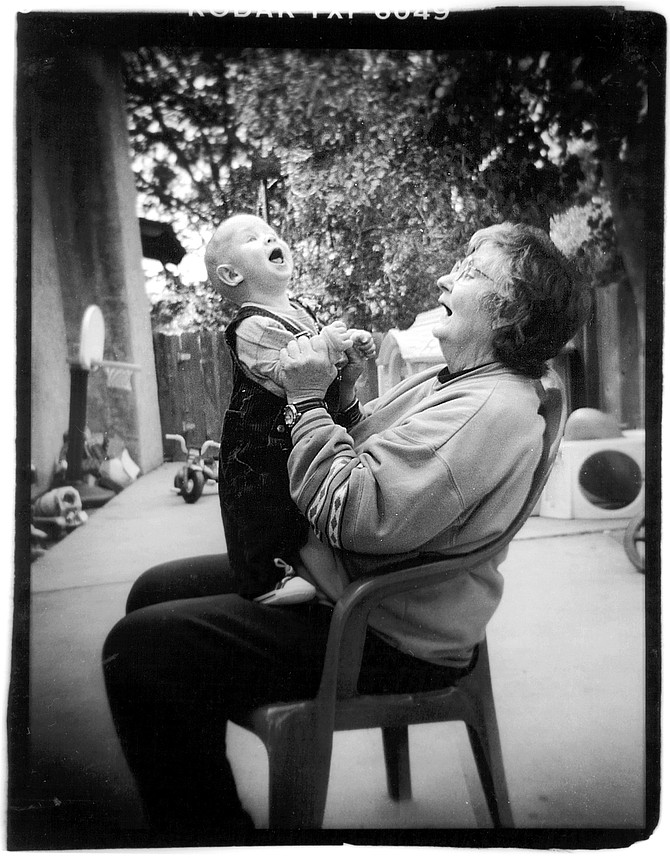
You get to hold his hand all the way to the car. As you seatbelt him in, you want to brush your hand through his red-blond hair, but you are in love over your head, and you know you need to hold yourself in check. He asks you if you have any gum in your purse, and you promise to look. Then he turns his never-miss-anything eyes on your hands and asks, “Why do you have such old skin, Nonna?” And you aren’t stung, you aren’t inclined to rush to the salon and have your hands dipped in waxy moisturizer and squeezed into warmed gloves. You are suffused with pleasure. You want to tell him what he already intuits. The two of you are in a long chain, linked by a thousand things and a number of chromosomes in particular; you have old skin so he can be here now, with his soft, flawless skin. But you’re realistic and open your purse and look for the gum. As you drive home, the same unlovely landscape you passed on the way to work transforms itself, is worth discussing. “Is that where the big swimming pool is? Where is that muddy park, Nonna?”
As you pull into the driveway he asks, “Did you set anything up, Nonna?” Each time he comes you try to create a diorama of sorts — today it’s dinosaurs, leaves, rocks, and a little plastic pool of water. As you settle down to play one of the multitudinous variations on The Land Before Time, the adult world recedes — gone the relentless pace, the weight of the saddle, the frothy bit of necessity. The dinosaurs — and therefore the two of you — are no longer bound by linearity. Just as in A Hundred Years of Solitude, the cutting edge of technology coexists with the primeval and the rudimentary: a dump truck appears out of nowhere to carry the dinosaurs on their way. Suddenly Sir Knight makes his entrance and seems to want to challenge us. His sword is drawn and his demeanor is hostile. But we are not bound by logic either. Our dinosaurs can speak English to one another, call out encouraging things. “Sara, Sara, bury Sir Knight in leaves.” Our powers are unlimited. We have more choices than virtual reality, more power than cartoon characters, more avenues than the average adult. We can fly when we need to, we can climb 110 times our height in less than a minute. Finally, because the game is interminable, like some Scrabble games I have known, we must throw in the towel, move on to the next event.
Aidan is watering the garden with the power nozzle; now that he is a fireman, we speak of cosmic things: why bees sting, why we can’t fly, where boogers come from, and where the snails hide their eyes. He has to turn his hose on the tomatoes because they are on fire; the eggplant is smoldering, but nothing is in danger, because death does not exist. Once when I was babysitting him, he stepped on a spider with the casual cruelty of a child. Then he asked me to make it move again. I wasn’t ready to use the “D” word: I didn’t know how my daughter and son-in-law intended to package the idea. So I said the spider was broken, that I didn’t know how to fix it. With the sun warming a square on my back, the metallic-green hummingbird descending into the droplets, the dampened lavender giving up its scent, and Aidan by my side, I could be seduced into believing that the “D” word was a vicious rumor, that everything is subject to fixing.
My nutrition book tells me that tuna and yogurt are soporifics. And it is time to slather on the soporifics. I learned the word “soporific” when I read Peter Rabbit books to my children. I think it was Peter who had eaten a great deal of something, maybe cabbage, and was so tired he had to go to sleep. Naturally he narrowly escaped from the evil Farmer MacGregor. Though we have delayed it as long as we can, the turn toward nap must happen. Kids are forced to nap all the time. I remember how I hated to nap and the many creative things I did with my body instead of sleeping. But now, tell me I must lie down for two hours in the middle of the afternoon, and to you I say “Amen” and “Hallelujah.” But first the story. Maybe we will read, for the hundredth time, Everyone Poops. And we will tell the same jokes about it. They say routine is important to children, but how soothing is it for adults so spun by this dervish world? Out of which end does the snake poop? Is whale poop bigger than the love we have for one another? Or we will read a Little Bear vignette. They are such nonstories — no foreshadowing, a tiny crisis, and a comforting denouement. Sunshine and domesticity — soothing as hot soup or just-right oatmeal. Whatever we select, I can count on it to not be boring.
But in the end, it’s all a sham. We are not living in the moment — neither he nor I. I am all the while trying to worm my way into his memory, hollow out a place in which Nonna can continue to live and love Aidan. A few summers ago I read Dalva by Jim Harrison. In the story a grandfather left a letter for his granddaughter to be read after his death. I recorded a piece of the letter in my journal because it made me feel in company, and because so often language seems too small a container to hold emotion. It seemed to me that he had got it just right, and I wanted to remember it and even use it.
“Along with my sons, perhaps more so, you were the grace note of my life. Now I am so far down the ghost road I can’t see you, but I still send you back a kiss and an embrace. We loved one another so.”
The “so” at the end of the sentence seems not to terminate it, rather to allow the sentence, and the love expressed in it, to flow endlessly.
I am in a position to know the way that grandparents etch themselves into their grandchildren’s lives and memories. Whether I assign memoirs or poems or simply narratives, grandparents and even great-grandparents appear more than half the time in students’ writing. This is what David Martinez remembers in a memoir entitled “Jaws.”
“When the man, known to my cousins and I as Grandpa, would allow his teeth to come out and play, the fun of children began…
He would pounce around, swaying along the deck, swooping and galloping toward each of us, making us feel as if we were his only pleasure.”
Jeanette Gann writes in her memoir called “Chita”:
“When I was growing up, I distinctly remember the strong smell of guavas… it’s a sort of annoyingly sweet smell. My great-grandmother, who I called Chita, practically lived off of guavas. One morning she wasn’t up at her usual time; little did I know she wouldn’t be up at all. The night of November 13, 1996, she passed on to a world where she would no longer suffer. I went into her room and opened the nightstand drawer, that smell, the smell of rotting guavas, filled the room as the tears flooded my eyes and leaked out, crawling down my cheeks and stopping at the edge of my shirt. I wasn’t crying because she died; I was crying out of my own selfishness not ever to be able to touch her again or hear her voice.”
Students’ poems are filled with tender images of their grandparents. David Ramirez wrote a poem about his grandfather’s hands called “Manos de la Tierra.” In the poem he describes the poignant way his grandfather used his hands:
- The smooth hands of his childhood days
- Now wear the stone texture of ancient Mayan statues.
- He tells stories to his nietecitos
- Shaking them and pointing in every direction to explain the story
- His grandchildren don’t speak Spanish, so his hands do the talking.
In a similar vein, Danielle Arroyo records her memories of her grandfather in a poem called “I Wished You Luck With a Kiss.”
- I remember how you would pull
- the long yellow weeds in the blazing sun.
- When you finished
- your hands would be scratched and bleeding
- I would watch you
- put the stinging alcohol on your wounds… astonished
- because you took all that pain
- just to make the rose garden pretty for Grandma…
- when I would go to your room at night
- I would find you on the mustard-colored floor
- rocking back and forth
- clutching your knees
- Asking God to heal you.
The poem concludes:
- You are in heaven
- A place where you can use your hands again
- You are carrying me
- In the right direction.
Love, as the student writers demonstrate, deepens our experience of the world and also makes us terribly vulnerable. I remember when I first had my children, people said, “Oh, your life will never be the same. You’ll never get a good night’s rest; you’ll have to carry bags and bags of stuff with you everywhere you go; baby puke will decorate your clothes,” and so on. What they didn’t tell me was that I would love two beings more than myself for the rest of my life. That their very existence in the world would make me vulnerable. If they were sick, I would be sick; if they were sad, I would be sad; if they were in danger, then my desire to live would be in danger. Now that I have two grandchildren, because Lio was born singing last June, the ways that the world can nourish and wound me have quadrupled.
And Aidan: Aidan is not naive. Though he may not possess the “D” word, though beings rise and fall in his world with the resilience of Disney inventions, he has a liminal understanding of what we’re about. Just before we go to sleep he says, “Nonna, one day all this old skin’s gonna break offa you and you’re gonna get new skin.”
Here's something you might be interested in.
Old Skin
Baby puke decorates clothes.

Old Skin
Baby puke decorates clothes.
When I drove for the Red Cross it was my job to pick people up at their homes and drive them to their doctors’ appointments or to restaurants or grocery stores. Convalescent groups were more difficult than individuals because you had to load and buckle down so many wheelchairs. The process was time-consuming, and the voice on the two-way radio kept insisting you hurry. I lived in fear of a wheelchair breaking loose and careening across the van, but nothing like that ever happened. The drama happened on a September day when I was sent to a convalescent home to pick up a client and drive him to his specialist. As I walked down the long main hall to look for him, I noticed that patients were parked in wheelchairs outside their rooms.I speculated it was an attempt to keep them social, though most of them did not look so inclined; more likely the practice of parking the patients outside their rooms facilitated the cleaning of rooms. In the air there was the inevitable smell of dander and urine overlaid with cleanser. I was anxious to locate my client and get us both out of there when I saw a woman whose image burned through my retina and tattooed itself on my memory’s eye. She was dressed like so many others in a faded flowered housecoat. Her silver hair was askew, all wild and separate filigrees. Her mouth was open, and sounds that approximated singing rasped from her throat. She was moving front to back, as if the wheelchair were a rocking chair, caressing a life-sized, pink-fleshed, naked plastic babydoll — its arms stretched up toward her face, its legs about to kick free. It would be easy to say she was senile. It would be harder to know the many ways she was stripped — the way bleach strips color from clothing — of friends, of family members, of mementos, of home. Sometimes you see or hear something significant, but it takes years to interpret its significance; this image offered me its meaning instantly.
Children are not for everyone. I know people who are sorry they spent time in childhood and are loathe to revisit it, even in the form of another person. I have friends who prefer the rich and complex world of adults, who pause briefly from the heights of big peopleness to pat the heads of the small creatures milling about at their kneecaps. And I know people who experience baby fever like spring fever, an annual sickness that passes in three days. Whom we love or whom we choose to love is part of what shapes us, organizes our lives in terms of priorities. I recognized, the instant I saw that aged woman rocking that doll, there was a world I could be cast out of that was essential and vital for me, and there was another world I could be condemned to that was truly a ghetto.
What have we done with our lives that makes them fly by so fast? Fly by like hedges and houses, stop signs and streetlights, Kmarts and Wal-Marts? We are like delicate, short-lived hummingbirds who beat their wings so swiftly they are invisible — but to what nectar? Eastern philosophers, therapists, and country-western singers exhort us to slow down, to catch the scent, savor the food, fondle the rose. And we try. But we are future-living creatures with miles to go before we sleep. A child insists we slow down, see the world. What’s that? Why? A child makes us move at his or her own short-legged pace.
“Oh, that’s very nice,” you say. Tell that to the woman who is loading her crying newborn into the car seat, wondering if he’s wet or hungry or both, while the two-year-old, already ensconced in his chair, pursues a trapped fly with his pacifier, meaning to smash it. The woman is weary to the bone, milk is beginning to leak from her breasts, her frozen chicken pies are beginning to thaw, and she still has to stop at the vegetable stand and the cleaners. In her head she is counting the money she just spent, subtracting it from the sum she does not have. I have been that woman. The one who had no time to bounce the chubby baby, the one who worried constantly about money, the one who counted the days till kindergarten. Sometimes, what the left hand takes away, the right hand offers: I have been offered another chance, another incarnation.
Which brings me to my embarrassing faux pas in the middle of the conversation, the hackneyed emotion solidified in amber, the reason behind this discursive opening. I want to talk about the deep pleasure of being a grandparent.
Kenko, a Japanese author from the 11th Century, says, “We cannot live forever in this world; why should we wait for ugliness to overtake us? The longer man lives, the more shame he endures. To die, at the latest, before one reaches 40, is the least unattractive. Once a man passes that age, he desires (with no sense of shame over his appearance) to mingle in the company of others. In his sunset years he dotes on his grandchildren and prays for long life so that he may see them prosper…a lamentable state of affairs.” And so it is. To be a grandparent is to be besotted. To lurk around the fringes of conversation trying to find a pretext to insert grandchild stories, to finally update yourself technologically only to augment the photo opportunities. Perhaps Kenko is right, not about the dying early, but about the doting. The shame of it all. Perhaps telling stories about your grandchild is like recounting a long, enigmatic dream. Or as my old poetry professor used to say when he read a particularly self-indulgent poem: “I read this poem and say, who cares?” Yet I persist. I swear to you, time spent with a child is philosophical, meditative, slows time to the speed of honey in its languid descent from the silver spoon to the steaming cup.
It’s a hot, smoggy day, the 35th in an unvarying chain of hot and smoggy days. The students are surly because you’ve just given them a surprise quiz on a short story they presumably read. One of the usual three is willing to talk, but she prefaces her comment by saying, “I didn’t like the story; it was kind of boring…” A little ping happens in the vicinity of your heart. You love this story, and you want to force them all to love it too. But how can they if they’re to be tested on it, if soon they will be obliged to produce a paper on it, and if it is only one story in a chain of 35 other stories they must read before they can leap through the hoop of literature into their own domain? You want to look outside for a leaf, a bough, a trinket from the natural world, but there are no windows, so you look at the clock. In ten minutes you can call it a day and hope that tomorrow the alchemical mixture of story, weather, students, and self turns to gold instead of dross.
It’s time to redeem the day. This one day a week you are given a short day. A gift. You grab your bags and rush to your car. You have only ten minutes if you’re to rescue your grandson from the dreaded communal daycare nap. It is dark and cool inside the building. All of the children are on mats spread around the floor. Lullaby music is playing in the background, and some children are crying for their mothers. They are beginning to learn that crying is an act unto itself; it can’t remedy anything. The attendants are patting the children’s backs, trying to comfort them. But there he is. Aidan. Seated at the table with a book, waiting for you. Your day comes into focus. The meaning behind the motion.
You get to hold his hand all the way to the car. As you seatbelt him in, you want to brush your hand through his red-blond hair, but you are in love over your head, and you know you need to hold yourself in check. He asks you if you have any gum in your purse, and you promise to look. Then he turns his never-miss-anything eyes on your hands and asks, “Why do you have such old skin, Nonna?” And you aren’t stung, you aren’t inclined to rush to the salon and have your hands dipped in waxy moisturizer and squeezed into warmed gloves. You are suffused with pleasure. You want to tell him what he already intuits. The two of you are in a long chain, linked by a thousand things and a number of chromosomes in particular; you have old skin so he can be here now, with his soft, flawless skin. But you’re realistic and open your purse and look for the gum. As you drive home, the same unlovely landscape you passed on the way to work transforms itself, is worth discussing. “Is that where the big swimming pool is? Where is that muddy park, Nonna?”
As you pull into the driveway he asks, “Did you set anything up, Nonna?” Each time he comes you try to create a diorama of sorts — today it’s dinosaurs, leaves, rocks, and a little plastic pool of water. As you settle down to play one of the multitudinous variations on The Land Before Time, the adult world recedes — gone the relentless pace, the weight of the saddle, the frothy bit of necessity. The dinosaurs — and therefore the two of you — are no longer bound by linearity. Just as in A Hundred Years of Solitude, the cutting edge of technology coexists with the primeval and the rudimentary: a dump truck appears out of nowhere to carry the dinosaurs on their way. Suddenly Sir Knight makes his entrance and seems to want to challenge us. His sword is drawn and his demeanor is hostile. But we are not bound by logic either. Our dinosaurs can speak English to one another, call out encouraging things. “Sara, Sara, bury Sir Knight in leaves.” Our powers are unlimited. We have more choices than virtual reality, more power than cartoon characters, more avenues than the average adult. We can fly when we need to, we can climb 110 times our height in less than a minute. Finally, because the game is interminable, like some Scrabble games I have known, we must throw in the towel, move on to the next event.
Aidan is watering the garden with the power nozzle; now that he is a fireman, we speak of cosmic things: why bees sting, why we can’t fly, where boogers come from, and where the snails hide their eyes. He has to turn his hose on the tomatoes because they are on fire; the eggplant is smoldering, but nothing is in danger, because death does not exist. Once when I was babysitting him, he stepped on a spider with the casual cruelty of a child. Then he asked me to make it move again. I wasn’t ready to use the “D” word: I didn’t know how my daughter and son-in-law intended to package the idea. So I said the spider was broken, that I didn’t know how to fix it. With the sun warming a square on my back, the metallic-green hummingbird descending into the droplets, the dampened lavender giving up its scent, and Aidan by my side, I could be seduced into believing that the “D” word was a vicious rumor, that everything is subject to fixing.
My nutrition book tells me that tuna and yogurt are soporifics. And it is time to slather on the soporifics. I learned the word “soporific” when I read Peter Rabbit books to my children. I think it was Peter who had eaten a great deal of something, maybe cabbage, and was so tired he had to go to sleep. Naturally he narrowly escaped from the evil Farmer MacGregor. Though we have delayed it as long as we can, the turn toward nap must happen. Kids are forced to nap all the time. I remember how I hated to nap and the many creative things I did with my body instead of sleeping. But now, tell me I must lie down for two hours in the middle of the afternoon, and to you I say “Amen” and “Hallelujah.” But first the story. Maybe we will read, for the hundredth time, Everyone Poops. And we will tell the same jokes about it. They say routine is important to children, but how soothing is it for adults so spun by this dervish world? Out of which end does the snake poop? Is whale poop bigger than the love we have for one another? Or we will read a Little Bear vignette. They are such nonstories — no foreshadowing, a tiny crisis, and a comforting denouement. Sunshine and domesticity — soothing as hot soup or just-right oatmeal. Whatever we select, I can count on it to not be boring.
But in the end, it’s all a sham. We are not living in the moment — neither he nor I. I am all the while trying to worm my way into his memory, hollow out a place in which Nonna can continue to live and love Aidan. A few summers ago I read Dalva by Jim Harrison. In the story a grandfather left a letter for his granddaughter to be read after his death. I recorded a piece of the letter in my journal because it made me feel in company, and because so often language seems too small a container to hold emotion. It seemed to me that he had got it just right, and I wanted to remember it and even use it.
“Along with my sons, perhaps more so, you were the grace note of my life. Now I am so far down the ghost road I can’t see you, but I still send you back a kiss and an embrace. We loved one another so.”
The “so” at the end of the sentence seems not to terminate it, rather to allow the sentence, and the love expressed in it, to flow endlessly.
I am in a position to know the way that grandparents etch themselves into their grandchildren’s lives and memories. Whether I assign memoirs or poems or simply narratives, grandparents and even great-grandparents appear more than half the time in students’ writing. This is what David Martinez remembers in a memoir entitled “Jaws.”
“When the man, known to my cousins and I as Grandpa, would allow his teeth to come out and play, the fun of children began…
He would pounce around, swaying along the deck, swooping and galloping toward each of us, making us feel as if we were his only pleasure.”
Jeanette Gann writes in her memoir called “Chita”:
“When I was growing up, I distinctly remember the strong smell of guavas… it’s a sort of annoyingly sweet smell. My great-grandmother, who I called Chita, practically lived off of guavas. One morning she wasn’t up at her usual time; little did I know she wouldn’t be up at all. The night of November 13, 1996, she passed on to a world where she would no longer suffer. I went into her room and opened the nightstand drawer, that smell, the smell of rotting guavas, filled the room as the tears flooded my eyes and leaked out, crawling down my cheeks and stopping at the edge of my shirt. I wasn’t crying because she died; I was crying out of my own selfishness not ever to be able to touch her again or hear her voice.”
Students’ poems are filled with tender images of their grandparents. David Ramirez wrote a poem about his grandfather’s hands called “Manos de la Tierra.” In the poem he describes the poignant way his grandfather used his hands:
- The smooth hands of his childhood days
- Now wear the stone texture of ancient Mayan statues.
- He tells stories to his nietecitos
- Shaking them and pointing in every direction to explain the story
- His grandchildren don’t speak Spanish, so his hands do the talking.
In a similar vein, Danielle Arroyo records her memories of her grandfather in a poem called “I Wished You Luck With a Kiss.”
- I remember how you would pull
- the long yellow weeds in the blazing sun.
- When you finished
- your hands would be scratched and bleeding
- I would watch you
- put the stinging alcohol on your wounds… astonished
- because you took all that pain
- just to make the rose garden pretty for Grandma…
- when I would go to your room at night
- I would find you on the mustard-colored floor
- rocking back and forth
- clutching your knees
- Asking God to heal you.
The poem concludes:
- You are in heaven
- A place where you can use your hands again
- You are carrying me
- In the right direction.
Love, as the student writers demonstrate, deepens our experience of the world and also makes us terribly vulnerable. I remember when I first had my children, people said, “Oh, your life will never be the same. You’ll never get a good night’s rest; you’ll have to carry bags and bags of stuff with you everywhere you go; baby puke will decorate your clothes,” and so on. What they didn’t tell me was that I would love two beings more than myself for the rest of my life. That their very existence in the world would make me vulnerable. If they were sick, I would be sick; if they were sad, I would be sad; if they were in danger, then my desire to live would be in danger. Now that I have two grandchildren, because Lio was born singing last June, the ways that the world can nourish and wound me have quadrupled.
And Aidan: Aidan is not naive. Though he may not possess the “D” word, though beings rise and fall in his world with the resilience of Disney inventions, he has a liminal understanding of what we’re about. Just before we go to sleep he says, “Nonna, one day all this old skin’s gonna break offa you and you’re gonna get new skin.”
Comments